1. Introduction
Edible insects and caterpillars constitute one of the cheapest sources of animal protein in most African countries (Chavunduka, Reference Chavunduka1975; Defoliart, Reference Defoliart1995; Banjo et al., Reference Banjo, Lawal and Songonuga2006). Most of them contain more protein, fat, and carbohydrates than equal amounts of beef and fish, and a higher energy value than soybeans, maize, beef, fish, lentils, and other beans (Illgner and Nel, Reference Illgner and Nel2000; Banjo et al., Reference Banjo, Lawal and Songonuga2006). In some African countries, children are fed flour made from dried caterpillars to curb malnutrition, while pregnant and nursing women as well as people who are anaemic are encouraged to eat caterpillars because of their high protein, calcium, and iron content (Moruakgomo, 1996, cited in Illgner and Nel, Reference Illgner and Nel2000). Owing to the nutritional properties of caterpillars, South African entomologist Rob Toms (Toms et al., Reference Toms, Thagwana and Lithole2003) recommended that HIV-positive people eat caterpillars to boost their nutritional levels.
One of the most nutritious, commonly eaten and economically important caterpillars in southern Africa is the edible larvae or caterpillar of the Saturnid moth Imbrasia belina Westwood, colloquially referred to as the ‘mopane worm’. It grazes primarily on the leaves of Colophospermum mopane or the mopane tree (Chavunduka, Reference Chavunduka1975; Mlambo et al., Reference Mlambo, Nyathi and Mapaure2005), a dominant tree species in mopane woodlands, which are mainly confined to several parts of southern Africa including Angola, Botswana, Malawi, Mozambique, Namibia, South Africa, Zambia, and Zimbabwe (Mapaure, Reference Mapaure1994). Besides hosting mopane worms, mopane woodlands provide fuelwood, construction materials, fibre, medicines, resin, tannins as well as browsing for livestock and wildlife (Mlambo et al., Reference Mlambo, Nyathi and Mapaure2005). It has been argued that the mopane tree is used for these purposes not because it is the dominant tree species but rather because it is simply highly preferred for many of its uses (Musvoto et al., Reference Musvoto, Mapaure, Gondo, Ndeinoma and Mujawo2007). For example, mopane trees have been cited as one of the most preferred species not only for fuelwood but also for construction poles, putting it at risk of being cut down for these purposes. Research has shown that collection of branches and trunks for fuelwood and construction purposes has led to extensive harvesting of mopane trees (Illgner and Nel, Reference Illgner and Nel2000). Moreover, although mopane trees grow on land that has relatively low natural potential for agriculture, high population growth on limited land coupled with hard economic conditions accentuated by adverse climatic conditions such as drought might increase incentives to rural communities not only to accelerate harvesting of mopane worms but in some cases to clear mopane woodlands for agricultural expansion (Chipika and Kowero, Reference Chipika and Kowero2000). It has been noted that smallholder farmers continue to grow crops such as sorghum, millet, and maize on these marginal rainfall areas (Stack et al., Reference Stack, Dorward, Gondo, Frost, Taylor and Kurebgaseka2003). However, since farmers do not generally consider the mopane land as the preferred option for cropping, our analysis is based on the potential threat to the mopane forest stock from other alternative uses such as fuelwood.
Estimates show that the processed mopane worm (dried and ready for consumption) contains 60.70 per cent crude protein, 16.70 per cent crude fat, and 10.72 per cent minerals on a dry matter basis (Headings and Rahnema, Reference Headings and Rahnema2002). It also contains high levels of lysine, tryptopan, and methionine (Dreyer, 1968, cited in Illgner and Nel, Reference Illgner and Nel2000) and three times the protein content of beef per unit weight, and has the advantage that it can be stored for many months (Menzel and D'Aluisio, 1998, cited in Illgner and Nel, Reference Illgner and Nel2000). Consequently, it is listed in the ‘Big Twelve African Insects’ by entomologists (Toms et al., Reference Toms, Thagwana and Lithole2003), highlighting its importance in the region.
With minimal barriers to entry into both the collection and trade of the worm, coupled with an increasing incidence of poverty in southern African countries where the worms are found, overexploitation is currently increasing while selective harvesting is decreasing (Hobane, Reference Hobane1995). This, together with the threat to mopane trees due to deforestation of the mopane woodlands for fuelwood, construction poles, or in some extreme cases agricultural expansion, has led to the disappearance of the worms from parts of Botswana and South Africa (Illgner and Nel, Reference Illgner and Nel2000). Moreover, the institutional capacities to govern forest resources, which to a large extent are communally ownedFootnote 1 in most African countries, are very weak owing to the social, economic, and ecological challenges associated with implementing and improving institutions to manage common property resources, and woodland resources in particular, in Africa (Campbell et al., Reference Campbell, Mandondo, Nemarundwe, Sithole, Jong, Luckert and Matose2001; Campbell et al., Reference Campbell, Shackleton, Wollenberg, Kowero, Campbell and Sumaila2003). These challenges have led to a drive towards a policy of devolution of responsibility of and control over natural resources from government agencies to resource users, i.e. Community Based Natural Resource Management (CBNRM) (Ostrom, Reference Ostrom1990). With the poor heavily dependent on the collection and marketing of the worm, policies towards its sustainable management will contribute to the alleviation of poverty and increase food security, especially among the rural poor.
The only existing policy instrument, which is informally employed by some traditional leaders, is embargos on harvesting the worm during certain periods (Toms and Thagwana, Reference Toms and Thagwana2005). This, on its own, has proved insufficient as overexploitation continues to be of major concern, prompting the need to look into alternative policies. An example of communities that have implemented the restrictive harvest period policy is the Uukwaluudhi Conservancy in Namibia (FAO, 2007). In this conservancy, traditional leaders insist on villagers harvesting mature worms during a pre-specified harvest period only (FAO, 2007), with each harvester paying a fee to the community leaders in order to harvest the worms.
In this paper, we present a two-stage bioeconomic model to explore the effectiveness of the aforementioned policy instrument (i.e. restrictions on harvesting the worms during certain periods). First we present a benchmark case where the social planner's mopane forest stock management problem is modelled (where some optimal quantity/biomass of the mopane forest stock can be harvested periodically for, for example, fuelwood, construction poles, and mine props, and the standing forest serves as a host plant for the mopane worm). Second, given the optimal stock obtained from the first stage, an expression for a possible Pigouvian tax that guarantees sustainable harvesting under a restrictive harvest period policy is derived. Furthermore, we explore the comparative static analyses of an increased social discount rate and an increased number of exploiters on the tax. The result, which is unambiguous, shows that some optimal tax must accompany the restrictive harvest period policy if the number of resource exploiters is very large. The tax rate is negatively related to the benefit discount rate but positively related to the number of harvesters. To the best of our knowledge, no bioeconomic model has been developed to help us understand the implications of this existing management regime (i.e. the restricted harvest period policy) on the sustainability of harvesting of the worm.
In the next section we present a brief description of the life cycle and the method of harvesting and processing of the worm. Section 3 introduces the social planner's problem from which the optimal forest stock allocation decision is derived. Section 4 models the restrictive harvest period management regime, taking the optimal mopane forest stock allocation derived in section 3 as given. Section 5 derives the expression for the optimal tax and explores the conditions under which this tax could be zero. In addition, we undertake comparative static analyses for some policy-relevant variables. Discussions and conclusions are presented in section 6.
2. The life cycle, harvesting and marketing of the worm
The mopane worm is actually the caterpillar of the Saturnid moth Imbrasia belina Westwood. The adult moths lay single clusters of 50 to 200 eggs over a two-month period and the larval stage lasts for approximately six weeks during which the caterpillars undergo a 4,000-fold increase in body mass (Gullan and Cranston, Reference Gullan and Cranston1994). The worm completes five larval stages in its life cycle before pupation. During the first three stages, the caterpillars strictly aggregate in numbers of between 20 and 200 and forage together. Then they immediately disperse to become solitary (Toms et al., Reference Toms, Thagwana and Lithole2003). Although mature larvae are preferred to younger ones, harvesting is indiscriminate of age and size. Thus, the population of worms that are not harvested in one period determines the intensity of the outbreak in the next period. At the end of the larval stage, the fifth instar caterpillars that survive harvesting burrow underground where they undergo a period of diapause. After some six to seven months they reach the adult stage, which is crucial as this is the stage at which they mate and lay eggs marking the beginning of an outbreak of the worms. In general, the species is bivoltine with the first generation emerging from pupation in November to January and the second in March to May; it is univoltine only in more arid areas (Toms et al., Reference Toms, Thagwana and Lithole2003).Footnote 2
Traditionally, mopane worms are collected, prepared, and consumed by rural communities within the range of the mopane woodlands. The bulk of the harvesting and processing of the worms is done by women and children. A survey in Botswana indicated that 95 per cent of harvesters are poor rural women, of which 73 per cent live within 50 kilometers of the harvesting areas (Illgner and Nel, Reference Illgner and Nel2000). Approximately 40 per cent of the estimated £57m annual harvest of the mopane worms in South Africa goes to producers who are primarily poor rural women (Styles, 1994, cited in Stack et al., Reference Stack, Dorward, Gondo, Frost, Taylor and Kurebgaseka2003). The most common and basic method of collection is to manually pick the worms from the ground and trees. After the larvae are collected, the undigested material in the gut is removed by either squeezing them between the thumb and fingers or by using a bottle as a roller to squeeze out the contents. While younger larvae have relatively large amounts of gut content, fully grown larvae have less; instead their bodies are filled with a yellow nutritive material that is liked by consumers. After removing the gut content, the larvae are charcoal roasted or boiled and then dried to preserve them (Kozanayi and Frost, Reference Kozanayi and Frost2002).
On the demand side, owing partly to the economic misfortunes faced by rural communities, the mopane worms have become a vital trading commodity in southern Africa. Unemployed men close to urban areas are becoming increasingly involved in the collection of the worms and are in most cases contracted by local traders (Kozanayi and Frost, Reference Kozanayi and Frost2002). The women are generally engaged in the sale (including barter) of the commodity in small volumes, while men tend to be engaged mainly in the more lucrative long-distance and large-volume trade which is sometimes of cross-border nature (Kozanayi and Frost, Reference Kozanayi and Frost2002).
Also on the demand side, the on-going urbanization has made people migrate from rural areas taking their eating habits with them to urban areas. In addition, increasing poverty in urban areas has created a demand for low-cost protein such as the mopane worm (Stack et al., Reference Stack, Dorward, Gondo, Frost, Taylor and Kurebgaseka2003). Supermarkets have over the years become the main retail outlets for pre-packed and labelled mopane worms supplied by wholesale food packaging companies such as Quality Foods and Jasbro in Zimbabwe (Kozanayi and Frost, Reference Kozanayi and Frost2002). Research indicates that about 16,000 tonnes of mopane worms were traded on the South African commercial market in 1982, some of which were traded as animal feed (Dreyer and Wehmeyer, 1982, cited in Illgner and Nel, Reference Illgner and Nel2000). A sizeable amount of trade occurs at bus terminals, roadside markets, and beer halls, where the worms are sold as snacks.
3. The mopane worm model: the social planner's problem
This section presents the social planner's mopane forest stock management problem. Suppose that a single rational decision maker manages the mopane forest or woodland and has to decide on the biomass of the forest stock to be harvested in each period (for e.g. fuelwood or construction poles) and, conversely, on the standing stock to be conserved for hosting the mopane worms. Thus, the social planner will choose an allocation that maximizes overall benefits from these two activities. This is tantamount to the domestication of the worm, a possible policy that some researchers have advocated and for which there have been some projects to test its feasibility (Ghazoul, Reference Ghazoul2006). Suppose that the stock evolution equation for worm biomass is

which can be written as

where  ; x is the stock/biomass of the mopane worm; h is the total harvest (biomass in kilograms) of the worm, and the intrinsic growth rate of the worm is given by γ. Note that since in reality all sizes of the worm are harvested, the biomass model is preferred to an age-structured model. As indicated in the preceding section, the worm goes through different stages as part of its life cycle, eventually transforming into a moth that can migrate, meaning that different behavioural equations could be specified for each stage. However, due to the biological and mathematical complexities involved in characterizing the problem, the logistic function is assumed for simplicity. Similarly, since there is no existing information on the migratory pattern of the worm, it is assumed for simplicity that there is no cross-community migration of the worms. Thus, our model could be considered restrictive in these ways. Nevertheless, this simple specification provides a benchmark upon which some extensions can be made. The woodland's carrying capacity is captured by k, which is the stock of the mopane trees that are set aside to host the mopane worms. Following Ben-Shahar (Reference Ben-Shahar1996), suppose that the mopane forest stock grows over time so that the equation of motion defining this process is
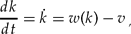
where v is the harvest or biomass cleared for, for example, fuelwood, and the change in the forest stock is assumed to be a function of the existing forest stock, i.e. w(k). Consequently, while the carrying capacity could grow, say, logistically, harvesting dampens the growth rate.
As mentioned, the objective of the social planner is to maximize the net benefits from both mopane worm production and the harvest of mopane trees for, for example, fuelwood and construction poles, while considering the effects of harvesting the worms on worm stock dynamics as well as the effects of clearing the forests on mopane forest stock dynamics. Assuming that the net benefits from fuelwood or construction pole production can be collapsed into a net benefit function B(v), the social planner's problem can be set out as follows
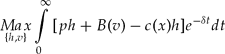
subject to equations (1′) and (2), with x ≥ 0, h ≥ 0, Bv > 0, Bvv ≤ 0, and x(0) = x 0.
Here p is the competitive market price per kilogram of the worm and  is the cost per unit harvest of the worm (c is cost per unit effort and σ is the catchability coefficient of the worm, which is normalized to one). The current value Hamiltonian associated with this problem is

The Pontryagin maximum principle is given by


where x** and h* are the optimum stock and harvest of the worm respectively. From equation (5), the maximum principle indicates that in an intertemporal equilibrium, the marginal profit from harvesting the mopane worm, (p − c(x)), should reflect or equate the scarcity value of the stock of mopane, λ. Note that if p − c(x) < λ, then the level of stock is less than what is optimally desired (i.e. x < x**), and it is hence more valuable to preserve the worm and harvest will therefore be at its minimum (i.e. h = h min). On the other hand, if p − c(x) > λ, then the worm is less valuable to preserve and harvest will be at its possible maximum. Equation (6) states that the marginal benefit from using a unit of the mopane forest biomass for an alternative use (e.g. for fuelwood), Bv, should equate or reflect the scarcity value of using the mopane forest for this alternative use, ϵ. Here Bv denotes the first derivative of B with respect to v.Footnote 3 The costate equations associated with the two stocks are as follows


Thus, in a dynamic equilibrium, the returns from harvesting the resource today on the margin, δλ, should be offset by the capital gains from postponing that additional harvest,  , plus the stock effect, (λgx − cxh). Similarly, the returns from using the mopane trees today for fuelwood, δϵ, must compensate for the capital gains from postponing using it,
 , plus the stock effect, (λgk + ϵwk). Since we are interested in sustainable harvesting of the worm, which is a renewable resource, we explore the steady state conditions. In the steady state, the following conditions hold:
 . From the costate and the stock dynamics equations, the optimum shadow values of the stock of mopane worms and the forest stock are

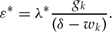
Equation (9) stipulates that in the steady state, the marginal value from an additional stock of the worm (λ*) is some adjusted discounted value of the stock effect of the worm ((cxh/(gx − δ))). From equation (10), the marginal value of an additional unit of the forest stock (ϵ*) is the product of the marginal benefit from additional stock of the worm and some adjusted discounted value of the forest stock effect ( ). Note that the relative shadow prices will depend on
 and if the marginal gain from increasing the size of the forest stock is high, say
 , then the shadow price of the forest stock will exceed that of the worm.
The optimal values of k (and x, h, v, λ, ϵ) can be obtained by solving equations (5) to (10), and using h* = g(x**, k*) and v* = w(k*) we can solve for k* = k(p, c, δ, γ).Footnote 4 At this stage the social planner decides on the optimal harvest of the mopane forest stock to be allowed in each period. Consequently, the social planner also decides on the optimal mopane worm harvest. However, if the worms are harvested under open access, the worms will have no capitalized value (i.e. λ = 0) and will therefore not be harvested sustainably. Hence, open access creates incentives for accelerated rates of exploitation. Thus, the current rate of open access exploitation of the mopane worms in many southern African communities poses a serious threat to the worm stock. Sustainability of the mopane worm requires policies that restrain the rate of exploitation.
4. The restrictive harvest period policy model
This section analyses the stock and harvest dynamics under the restrictive harvest period regime, in accordance with the prevailing management policy. A restrictive harvest period management regime is defined as a regime in which the harvest of the worm is limited to an instantaneous harvest period (i.e. harvest reduces escapement but does not affect the growth of the biomass), a situation that mimics the practice of some traditional leaders who allow harvesting during certain periods only (Toms and Thagwana, Reference Toms and Thagwana2005). As in the previous case, we assume that harvesters are price takers, thereby assuming a competitive restrictive harvest period management regime. Thus, it is assumed that the social planner or community leader allocates an optimal stock of the mopane woodland to mopane worm production (as per the preceding section). Given this allocation, he/she imposes a restrictive harvest period policy.
Drawing from the escapement model of Reed (Reference Reed1979) and Clark (Reference Clark1990), we specify the stock dynamics of the restrictive or instantaneous harvest as

which can be presented as

where z = x − h is escapement (i.e. the biomass of worm that escapes capture at each point in time),  is the total harvest of the worm, and n is the total number of harvesters.Footnote 5 Note that since the social planner predetermines the optimum forest stock k*, each harvester i will have the following optimization programme
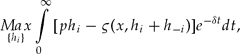
where  . Equation (12) is maximized subject to equation (11). The current value Hamiltonian associated with this problem for the ith harvester is

Assuming symmetric harvests of the worm so that h = nhi, the maximum principle equation and the costate equation are defined by equations (14) and (15), respectively


The interpretation of the maximum principle remains the same; in an intertemporal equilibrium, the marginal profit obtained from harvesting the worm, (p − nςh), must reflect the scarcity value of the stock of the worm, μin(1 + Λz). Clearly, the terms for the marginal profit and the shadow value under the restrictive harvest policy are different from those in equation (5). Furthermore, from the costate equation (i.e. equation (15)), the returns on investment from harvesting an additional unit of the worm, δμi, should be equal to capital gains,  , plus some stock effect given by (ςx − μiΛz). It is also clear that this dynamic equilibrium condition is different from that in equation (7), implying that harvest levels under the restrictive harvest period policy may not be optimal, making it imperative to consider complementary policies. In the next section we propose a hybrid instrument that combines the restrictive harvest period policy with a Pigouvian tax.
5. The economic policy instrument (tax)
In this section we derive an expression for an optimal ad valorem tax and then explore the conditions under which the tax may not be necessary (i.e. conditions under which the tax is zero). We then derive comparative static analyses for some policy relevant variables. Consequently, some relevant propositions are derived. As mentioned earlier, the increased commercialization of the worm implies that it has a market value, which makes it relatively easy to impose an ad valorem tax on harvest. Notably, communities such as the Uukwaluudhi Conservancy in Namibia provide a good example of the feasibility of some form of tax on mopane worms. In this community each harvester must pay a fee to get written permission from the Uukwaluudhi Traditional Authority or from other relevant authorities and people are allowed to harvest only within a restricted period (FAO, 2007). This lends support to the kind of hybrid policy instrument we are proposing, i.e. the restrictive harvest period policy accompanied by a Pigouvian tax on harvest.
Proposition 1:The optimal tax is defined by the expression

Proof. By subtracting c(x) + λ from both sides of equation (14) and rearranging the terms, the maximum principle can be written as

where ω = nμi. Comparing equations (5) and (16) and following Akpalu and Parks (Reference Akpalu and Parks2007), we derive the expression in equation (17) for the tax rate

In steady state,  , implying that
 . Also, from equation (7) we know that
 . Substituting these values into the tax expression gives

This tax corrects for undervaluation of the scarcity value of the mopane stock under the restrictive harvest period policy, differences in harvest costs, and some stock externality. While there could be legitimate concerns regarding the feasibility of implementing a tax in relatively non-monetized economies such as those in rural Africa, it can be argued that since the resource has become very much commercialized, imposing a tax is not unrealistic. Moreover, the quantity equivalent of the ad valorem tax that could apply to individuals who harvest for subsistence consumption is simply  .Footnote 6 Nevertheless, other challenges including the risk of misuse of the funds by corrupt community leaders as well as costs associated with monitoring harvesters might still have to be overcome.
The existence of zero optimal tax
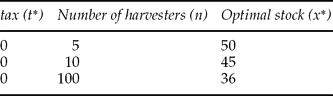
It may not be necessary to impose any tax on harvest (i.e. t* = 0) if the stock level in the absence of the tax coincides with what is optimally desired (i.e. if a restrictive harvest period policy leads to optimal resource stocks and harvest levels), yet this is indeed a rare condition. From the tax expression it is straightforward to see that there exist replicate dynamics between the level of stock and number of harvesters, all other things being equal. In this section we tabulate such equilibrium relationships for different numbers of resource users, assuming the aforementioned specific functional forms. Note that no tax implies

Using the parameter values γ = 0.1, δ = 0.03, c = 1000, h = 100 and k* = k(·) = 100 (assumed for convenience), table 1 presents simple simulated results of the relationship between harvest, the number of harvesters, and the optimum level of stock.
The equilibrium relationships between harvest and stock for different numbers of harvesters
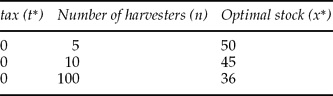
The table shows that, in general, an increase in the number of harvesters might lead to overexploitation of the worms in the absence of any tax on harvest. Consequently, the tax should be imposed if, all other things being equal, the number of harvesters is sufficiently large.
Characterizing the optimal tax
Proposition 2:The optimal tax must increase if the number of worm harvesters increases, all other things being equal.
Proof. The proof of this proposition requires taking comparative statics of the optimal tax with respect to the number of harvesters and characterizing the results to show that the derivative is positive. From equation (17), we have

Note that −ςxΛzn > 0, −cx > 0, nςhn > 0 and  . Therefore,
 if it can be shown that ςx (Λz + 1) > −ςh (Λz −δ). Since δ > 0, we will have if ςx > −ςh. But we know from the specific functional forms that
 and
 . It follows that
 , which is as given. Thus, as the number of worm exploiters increases, the tax rate must increase to ensure sustainable harvesting of the worm.
Proposition 3:The optimal tax t* must decrease if the benefit discount rate increases, all other things being equal.
Proof. The proof of this proposition requires taking the first derivative of the optimal tax with respect to the discount rate and characterizing the results to show that the derivative is negative. Thus, from equation (17) we have

From equation (19), since (gx − δ)2 < (Λz −δ)2 ∀xi > 0, it follows that  if nςx(Λz + 1)>cxh. Using the specific functional forms of the cost functions (i.e.
 and
 , and h = nhi), we have if x − nhi < n 2x, which is true since n ≥ 1.
Increasing discount rates imply increased returns on investment of proceeds from the worm. Consequently, as the discount rate increases, more worms must be harvested to earn higher returns on the investment of the proceeds; therefore, the tax rate will have to decrease.
6. Discussions and conclusions
Inadequate forest resource management policies in southern Africa, like in other regions of Africa, contribute to unsustainable exploitation of mopane worms. It has already been noted that overexploitation has led to the disappearance of the worms from parts of Botswana and South Africa (Illgner and Nel, Reference Illgner and Nel2000). Clearly, in view of the important role of the worms in poverty alleviation and food security in the region, adequate and timely policy interventions are needed to address the problem. It is therefore not surprising that some community leaders have placed restrictions on harvesting during certain time periods in an effort to ensure sustainable harvesting of the worm.
Using a simple bioeconomic modelling approach, this paper has investigated whether, for some predetermined mopane forest allocation, restricting the harvesting season to an instant or predetermined harvest period as currently advocated will result in sustainable harvesting of the worms. Our results show that some optimal tax that corrects for (1) undervaluation of the scarcity value of the mopane stock under the restrictive harvest period policy, (2) differences in harvest costs, and (3) some stock externality must accompany the restrictive harvest period policy. The optimal tax is negatively related to the benefit discount rate but positively related to the number of harvesters.
While the fact that some communities have managed to restrict harvesting to certain time periods and at the same time impose a fee on harvesters (FAO, 2007) gives us faith that the hybrid policy instrument we propose is feasible in the analysed setting, we also acknowledge the challenges that might come with its implementation. In particular, an implementation of the policy might for example require a Community-Based Natural Resource Management setting or some institutions to support common property resource (CPR) management. The rules that come with such settings might be far removed from the current institutional systems in Africa (Campbell et al., Reference Campbell, Mandondo, Nemarundwe, Sithole, Jong, Luckert and Matose2001). For example, national policies are not conducive to CPR management in some cases, economic hardships might undermine CPR institutions, local institutions might lack legitimacy, and, in the case of woodland resources, returns to their management might be too low to encourage the establishment of CPR institutions (Campbell et al., Reference Campbell, Mandondo, Nemarundwe, Sithole, Jong, Luckert and Matose2001). As noted by Campbell et al. (Reference Campbell, Mandondo, Nemarundwe, Sithole, Jong, Luckert and Matose2001), these complexities need not lead to institutional vacuums since a set of customs and norms might still be in place to influence resource use. However, there are successful cases of Community-Based Forest Management (CBFM), for example in Tanzania's Duru-Haitemba Forest Reserve, where devolution has induced local communities to conserve forests (Kajembe et al., Reference Kajembe, Monela, Mvena, Kowero, Campbell and Sumaila2003), although its success is derived mainly from a unique local situation in that the village is permitted by the government to own property in its own right as a corporate entity (Campbell et al., Reference Campbell, Shackleton, Wollenberg, Kowero, Campbell and Sumaila2003). As the case of the Uukwaluudhi Conservancy in Namibia shows, the increasing commercial value of the worm is expected to create incentives for introducing mechanisms to support sustainable harvesting policies. Moreover, the case also shows that the hybrid instrument we propose might be feasible in southern Africa.
 . This implies that the biomass in the next period is the escapement plus the growth of the escaped biomass. By letting
 , in continuous time, this equation is rewritten as equation (