Our work seeks to better understand the relation between clientelist intermediaries and politicians—particularly in relation to brokers’ decisions to remain loyal or cheat on their patrons. Territorial brokers (or intermediaries—we use these terms interchangeably) are important players in clientelist relations in several nations around the world (Gingerich Reference Gingerich2014; Mares and Young Reference Mares and Young2016), and there is growing interest in political science about their preferences and decisions (Gottlieb Reference Gottlieb2017; Holland and Palmer-Rubin Reference Holland and Palmer-Rubin2015; Larreguy, Marshall, and Querubin Reference Larreguy, Marshall and Querubin2016; Novaes Reference Novaes2018; Stokes et al. Reference Stokes, Dunning, Nazareno and Brusco2013; Zarazaga Reference Zarazaga2014). We define territorial brokers as people who live in the poorer neighborhoods they serve and solve day-to-day problems that their neighbors suffer regularly. Much of their activity involves helping poor residents deal with the bureaucratic demands of municipal offices to gain access to government social programs and the selective goods that politicians provide. In exchange for these goods, brokers use these networks of neighbors to support the party and its politicians both during elections and in everyday demonstrations of party strength.Footnote 1 Thus, we focus on territorial party brokers rather than other alternatives, such as those found in social organizations (Holland and Palmer-Rubin Reference Holland and Palmer-Rubin2015; Larreguy Marshall, and Querubin Reference Larreguy, Marshall and Querubin2016; Zaremberg Reference Zaremberg2011) or hybrid intermediaries (Oliveros Reference Oliveros2016). We do not assume, however, that party brokers are tied to one party (Holland and Palmer-Rubin Reference Holland and Palmer-Rubin2015); we find that they are able to switch between options, given the specific conditions discussed later.
Several important studies on territorial brokers around the world have assumed that they are inherently disloyal to their political bosses (Aspinall Reference Aspinall2014; Bowles, Larreguy, and Liu Reference Bowles, Larreguy and Liu2020; Camp Reference Camp2015; Novaes Reference Novaes2018). Many authors note that—in much the same way that voters and their politicians are ensconced in a principal-agent relationship—brokers are contracted by the principal (the politician) to take actions to further the latter’s goals (Larreguy, Marshall, and Querubin Reference Larreguy, Marshall and Querubin2016; Novaes Reference Novaes2018; Stokes et al. Reference Stokes, Dunning, Nazareno and Brusco2013). Because of an asymmetry of information and differing interests, the principal must work diligently to minimize the opportunities to cheat or shirk on the part of her agent, mostly through enhanced monitoring activities. We define broker disloyaltyFootnote 2 as those actions that do not further the politicians’ goals but rather, help the intermediaries’ material interests. The following examples illustrate various types of broker disloyalty: working on a campaign with one politician and her rival as well; misrepresenting the number of votes that the broker controls; changing parties during the campaign; siphoning off a large portion of the goods that the broker should be distributing to her voters to sell or distribute to family members; and finally, charging neighbors for their services, which are meant to be done for free.Footnote 3
Our research, however, finds something quite different: that brokers and politicians have strong incentives to build long, stable relationships. Most clientelist intermediaries do not engage in one-shot exchanges with politicians; rather, politicians invest time, energy, and resources in building and maintaining networks of brokers and voters in scores of neighborhoods to maintain a stable base of votes. Over time, politicians learn which broker can and cannot deliver votes reliably (Gingerich Reference Gingerich2020). Brokers often wish to stay with “their” politician or party because they can rely on regular access to government goods and the programs that they need to keep their voters from switching to other brokers, without the costs of searching out new patrons (Auyero Reference Auyero2000; González-Ocantos and Oliveros Reference Gonzalez-Ocantos, Oliveros, Vanden and Prevost2019). If they cheat on their patron, however, they will lose this access if that party remains in office because they are no longer deemed trustworthy. Most participants seem to believe that profitable relations will extend into the foreseeable future, making loyalty a better option.
Because many of the activities carried out by brokers take place in small meetings or at a resident’s home, it can be difficult for the politician to see what the intermediary has or has not done, and so, politicians often cannot know whether territorial brokers have cheated on them until after the election, at which point, it is too late (Stokes Reference Stokes2005; Kitschelt and Wilkinson Reference Kitschelt and Wilkinson2007; Larreguy, Marshall, and Querubin Reference Larreguy, Marshall and Querubin2016). We found, however, that the fine-grained information that makes territorial brokers so important to politicians can also be used by one territorial broker against another, which promotes the flow of knowledge of broker behavior up to the municipal politician. People see, people talk, and neighbors tell municipal politicians about the actions of other neighborhood intermediaries (Szwarcberg Reference Szwarcberg2014). This information flow lowers the probability of serious cheating on the part of the agent, while not stemming it completely.
If both brokers and their bosses prefer a stable, dependent relation that benefits both sides, and information about the behavior of brokers circulates upward to the politicians, then why would brokers commit acts of disloyalty? This study argues that disloyalty is a decision made by the broker that depends less on the ability of the politician to monitor her (Novaes Reference Novaes2018; Stokes et al. Reference Stokes, Dunning, Nazareno and Brusco2013) than on a calculation made by the broker that is driven by the value of her reputation for good work and of the votes she controls, which vary across different contexts. Our research argues that two factors that raise or lower the relative worth to brokers of their reputations and their votes: the level of electoral competition the incumbent party faces and the level of dependence that exists between broker and politician.
In terms of electoral competition, as the incumbent party becomes less popular with voters, the broker’s potential benefits from cooperating with its politicians from that party fall as well. Electoral volatility increases the likelihood of non-cooperative behavior as brokers enjoy more options besides working with their party, because other parties vie for their votes. But if there is little probability that her party will lose, then she has little reason to risk cheating on the incumbent—if the likelihood of their incumbent continuing to office is high, then the marginal value of broker votes is low (because of wider margins between their incumbent party and rivals), which reduces the likelihood of non-cooperative behavior.
The second condition is the resource autonomy or dependence of the broker on her politician or party. Consistent with the work done by Koter (Reference Koter2013), we identify some intermediaries who are dependent on their politicians for access to resources and, therefore, hold different incentives to remain loyal or defect than those brokers who are more autonomous. Autonomous brokers are those, for example, who run civil associations that help reclaim empty plots for housing, that support street vendors, or that protect non-licensed taxis.Footnote 4 They have access to resources that do not depend on municipal government thanks to the quotas and fees they charge their residents. This does not mean, however, that they are completely independent from the need to acquire money, goods, and access from municipal government. Rather, independent brokers can commit acts of disloyalty with fewer consequences than those who are more resource dependent because they can survive for longer periods outside the municipal-led clientelism arrangement, which allows them to switch from one candidate to another with greater ease. We theorize that the interaction between these two factors—more than the ability of politicians to monitor their agents—helps determine outcomes on cheating or loyalty.
Brokers calculate whether the value of their reputation for hard work and honesty is enough to make up for the rising value of their votes due to greater electoral competition. If competition can upend their incumbent politician, brokers may cheat because future gains are not enough to offset the immediate winnings from not cooperating. This calculation is altered by their exogenous status as dependent or independent brokers: if they can survive for longer because of their self-generated resources, they may defect more often than those who are dependent on municipal government; that is, those who have municipal jobs, receive goods only from local government, or hold leadership roles in a neighborhood committee.
We employ an interview-based, comparative case study with careful case selection to better understand how these two factors interact. Instead of employing disaggregated electoral data, survey data, or experiments, we held in-depth conversations with brokers and politicians and in doing so, we were able to capture the long-term nature of politician-broker interactions (for political science works based largely on interviews, see Levitsky Reference Levitsky2001; Szwarcburg Reference Szwarcberg2014; Zarazaga Reference Zarazaga2014). There is no doubt that other types of empirical data-gathering are crucial to understanding political phenomena, but without speaking to brokers and politicians, assumptions of broker interests can be incomplete or erroneous because scholars may not understand the goals that intermediaries are attempting to maximize and why.
We concentrate on clientelism in Mexico City because the city’s various boroughs – now called municipalitiesFootnote 5 – offer variation on both of our causal variables of interest, competition, and types of relations between politician and broker, as well as variation in outcomes. We use interviews in three different boroughs—Álvaro Obregón, Benito Juárez, and Magdalena Contreras—to take advantage of variation both within and across cases, allowing us to develop a theory of clientelist brokers and how they interact with politicians.
The findings of this paper highlight the importance of studying brokers in young democracies. Even in a party system that has been characterized as institutionalized (Mainwaring Reference Mainwaring2018) having strong parties and strong party labels, much of the work of campaigning in clientelist neighborhoods increasingly depends on brokers rather than party activists, which has helped weaken party-citizen links in Mexico. Party activists often show up in poor areas only during campaign season, leaving to brokers the everyday tasks of helping residents with food and access to government goods. This in turn has placed the selective exchange relation in the forefront of political mobilization for millions of Mexicans that does not spill over into organizational party strength. Given that brokers with weak party ties are increasingly common in Mexican municipalities, and voters receive goods from them, party labels are likely to continue to dilute in Mexico.
Theories of Broker Behavior towards Politicians
Clientelism constitutes the system in which politicians and party networks offer goods, services, or jobs to individual or selected groups of voters with the expectation that they will return the favor with political support or lose these goods (Stokes et al. Reference Stokes, Dunning, Nazareno and Brusco2013; Gans-Morse, Mazzuca, and Nichter Reference Gans-Morse, Mazzuca and Nichter2014). The relations between brokers and their parties and politicians are a topic less studied than relations between voters and their patrons (Brusco, Nazareno, and Stokes Reference Brusco, Marcelo and Stokes2004; Calvo and Murillo Reference Calvo and Murillo2004; Weitz-Shapiro Reference Weitz-Shapiro2012). However, most literature on brokers follows the general guidelines that govern clientelist voter behavior (Larreguy, Marshall, and Querubin Reference Larreguy, Marshall and Querubin2016). In political science research, brokers are seen as essential actors who bring together resource-rich politicians with resource-poor residents who hold valuable votes. According to Stokes et al. (Reference Stokes, Dunning, Nazareno and Brusco2013), brokers are “free agents,” who are not tied to any politician, and so the incumbent party chooses those who are closest to their neighbors—that is, the party faces a selection problem in which brokers have incentives to misrepresent their ties to voters. On the other hand, Larreguy, Marshall, and Querubin (Reference Larreguy, Marshall and Querubin2016) see territorial brokers as “hired contractors rather than actors with incentives closely tied to political parties,” and so, the patron is faced with an issue of moral hazard as well, which requires close monitoring on the part of the principal.
In this type of work, which can be termed “monitoring theories,” brokers have more information about their actions, interests, and work than the politicians who contract them, and so they are able to either shirk on their mobilizing duties, steal goods that are destined for voters, or work for rival politicians (Kitschelt and Wilkinson Reference Kitschelt and Wilkinson2007; Novaes Reference Novaes2018; Stokes et al. Reference Stokes, Dunning, Nazareno and Brusco2013). Because brokers hold private information about voters that they do not share with their politicians, party organizations become dependent on brokers. To protect their interests, politicians must engage in different types of monitoring activities to assure that brokers do not cheat (Aspinall Reference Aspinall2014; Larreguy, Marshall, and Querubin Reference Larreguy, Marshall and Querubin2016; Stokes et al. Reference Stokes, Dunning, Nazareno and Brusco2013; Szwarcberg Reference Szwarcberg2014). These monitoring strategies include examining disaggregated election results (Larreguy, Marshall, and Querubin Reference Larreguy, Marshall and Querubin2016; Rueda Reference Rueda2016) or attendance at local rallies and elections (Szwarcberg Reference Szwarcberg2014).
In sociological and anthropological works on clientelism, one finds far fewer mentions of this behavior on the part of brokers. Instead, intermediaries are described as important members of poorer communities who solve problems of food and health insecurity (Auyero Reference Auyero2000; Bagchi Reference Bagchi2019; Cobilt Cruz Reference Cruz and Cristina2008; Hagene Reference Hagene2015; Tosoni Reference Tosoni2007). This strain of research concentrates on how intermediaries work with politicians to keep their neighborhood network afloat, which involves constant work by territorial brokers to deliver goods to their neighborhoods—not on the frequent attempts by brokers to cheat on their politicians (Ansell Reference Ansell2018; Aguilar and Alis Reference Aguilar and Alis2018; Hagene and González-Fuente Reference Hagene and Fuente2016). We believe that this problem-solving perspective on broker behavior offers an important counterpoint to the monitoring theories and stems, at least in part, from whether researchers communicated with a significant number of actors involved in clientelist exchanges.
Other work on clientelism that is not based on principal-agent relationships, also offers important information to understand politician-broker arrangements and their stability. For example, when brokers are strong supporters who share the partisan leaning of the patron, they seem to have fewer incentives to be disloyal. This is the case of the Mexican Teachers’ Union, as studied by Larreguy, Montiel Olea, and Querubin (Reference Larreguy, Olea and Querubin2017), whose members are effective brokers when mobilizing voters in favor of their preferred party. Political parties can also offer private rewards, such as career advancement or resources (Camp Reference Camp2015) and create incentives to deliver the votes (Szwarcberg Reference Szwarcberg2014). Clientelistic politician-broker ties can also be stable when brokers are public employees and their jobs are tied to the electoral success of the patron (Oliveros Reference Oliveros2021; Robinson and Verdier Reference Robinson and Verdier2013).
As we will discuss later, territorial brokers with long-term relationships with their patrons are likely to have partisan affinity. While this affinity makes these relationships more stable, brokers still face changing environments—e.g., increasing levels of competition—and if their party is expected to lose in the next election, they may choose to bring their voters to another party with a different ideological standpoint. Several brokers with whom we spoke accepted that changing their patron during certain periods was an act of disloyalty and that it was not their preferred scenario, but if they wanted to continue to have access to resources, many of them were willing to cross party lines. Similarly, many brokers who have built a long-term relationship with politicians have public employment in municipal government—some of them with a plaza (a low-level job). Therefore, as we discuss in the next sections, when facing increasing levels of competition and strong incentives to defect, many brokers who depend on municipal government decide to remain with their parties in the hope they will keep their semi-permanent municipal job.
A Different Theory of Broker Behavior: Varying Values of Reputation and Votes
Clientelist brokers have strong incentives to form long-term relations with their politicians because most require access to government resources. If brokers are unable to procure goods, their voters will search elsewhere for an intermediary who can (Cornelius Reference Cornelius1975). This means that cheating is not always the best strategy because if intermediaries are “fired” by their politician or party, they are blocked from receiving government goods distributed by the municipality. As a result, we found many brokers who had long-lived careers and often worked with the same politician or party for years, even decades, which challenges the assumption that short-term disloyalty is always a broker’s first choice. Unlike some studies of Argentine brokers (Auyero Reference Auyero2000; Levitsky Reference Levitsky2003), we find that Mexican intermediaries depend on the resources delivered by politicians in municipal governments. Politicians may depend on brokers in the short term but are very willing to build and develop relations with new intermediaries if necessary, lessening their dependence on brokers’ knowledge of their residents.
One could argue that municipal politicians are not the only source for access to government largess, because politicians who are active in other levels of government can provide these goods. In one example from the middle-class borough of Mexico City, Benito Juárez (governed by the center-right National Action Party or PAN), a poorer area was supported for over ten years by the state government that was in the hands of the center-left Party of the Democratic Revolution or PRD, until the incumbent party in Benito Juárez decided it needed these votes and simply offered the brokers access to their municipal goods and services, with the result that of the territorial brokers in that area switched their activities to the PAN. Why was it so easy to switch ideologically opposed brokers to the incumbent municipal government? Because the PAN held the borough government, which is the closest point of access to government goods and services, even if many of these services are in fact, paid for by higher levels of government, such as support for single mothers and old-age pensions. As such, the most common type of politician-broker arrangement is between the municipal politician and the territorial broker.
Instead of concentrating on how politicians mitigate problems of agency loss through monitoring, our work focuses on the decisions of the brokers to cheat or remain loyal, which are based on the fluctuating values of their reputation for honesty and the votes they control. Zarazaga (Reference Zarazaga2014) argues that brokers carry out multiple activities to gain the information and reputation for delivering resources crucial for maintaining voters’ loyalty, creating incentives for voters to maintain these links with brokers. In much the same way that voters prefer to support those brokers with a reputation of delivering, politicians also prefer brokers who provide votes and support in rallies and marches.Footnote 6 Politicians and parties require a reliable base of voters who will arrive at the polling stations on election day and mark their ballots correctly. Over time, parties discover which brokers deliver their voters and which do not, and this is the base of a broker’s reputation (Interview #18, 1, consistent with Gingerich Reference Gingerich2020). (In online appendix 3 we report the complete list of interviewees, with their gender, party, mentions of cheating, type of actor, and the day and place of the interview. When we insert a number followed by a comma and another number within a set of parentheses, this denotes the number of a broker or politician and the page number in our notes on which the information can be found. The interview notes (without names) are available upon request. In online appendix 2 we include the interview questionnaire that we used in interviews.) They do this using two methods; first, by maintaining copies of all the lists maintained by the territorial brokers of those who have accepted their help; second, by comparing how well their brokers perform in each election at the precinct level.
Brokers in long-term relationships with their voters can produce votes for their party, in large part because they are able to monitor and sanction voters if they defect,Footnote 7 and it is this ability that makes them valuable to party leaders. Intermediaries draw up lists of those neighbors who receive goods, which include their names, cell phone numbers, and copies of addresses and voting cards (Interview #1, 3; Interview #2, 1). If a neighbor who accepted goods from the broker in question did not come to a meeting, join a march, attend a rally, then she no longer receives goods from the broker (Interview # 6, 2; Interview #7, 3). In their small patch of territory, brokers muster their supporters on election day by calling them, driving them to the voting stations, and asking them whether they had voted. Many install themselves or an assistant outside of the various stations to verify whether “their people” voted. If they did not see them, then the calls or messages to their cell phones began (Interview #1, 4; Interview #5, 5).
We argue that the assumed asymmetrical information in clientelist relationships is not as severe as many authors have posited, at least between brokers and politicians (Keefer and Vlaicu Reference Keefer and Vlaicu2008; Stokes et al. Reference Stokes, Dunning, Nazareno and Brusco2013). Szwarcberg’s work on rallies demonstrates that politicians use various methods to monitor their brokers’ performance with voters before the elections (Reference Szwarcberg2014). In addition, we find that information also flows freely throughout the network, with little explicit effort on the part of politicians, because brokers report on the behaviors of their counterparts. If brokers are central actors in neighborhoods who know which of their neighbors is ill, which is a single mother, and which has a drug-addicted son, they also know which nearby broker is skimming off the top and which has sold her votes to more than a single candidate. Socializing this information is part of the everyday experience of the brokers, neighbors, municipal functionaries, and politicians (Interview #15, 2; Interview #2, 1-2, and Interview #12, 3). This information flow and the benefits of continued cooperation tamp down the most egregious acts of disloyalty when competition is not rising.Footnote 8
However, the cost-benefit calculations of brokers can change. We propose that variations in two factors can lead to changes in the values of brokers’ reputations and the votes they control, which then lead to differences in whether they are willing to cheat on their politicians.
Under What Conditions Do Brokers Become Disloyal?
The first condition that causes variation on the value of a broker’s benefit-cost analysis is the level of electoral competition. As competition rises, each vote weighs more at the margin, driving up its value to politicians and parties. As such, the increased value of the votes can outweigh the gains of dependent relations, particularly as uncertainty rises over which party will hold local government. Thus, uncertainty and the value of the vote rise together in the context of higher electoral competition. Brokers’ activities are only one element of electoral outcomes: electoral competition can rise quickly because of national vote swings, economic changes, or the popularity of the candidate at the top of the ballot—thus, even if brokers are doing their job well, their parties can still be thrown out of office.
The second condition that causes variation is the autonomy or dependence in the relation that the broker holds with her political boss. Consistent with other work about the types of brokers that engage in clientelist relations (Holland and Palmer-Rubin Reference Holland and Palmer-Rubin2015; Koter Reference Koter2013), we argue that there is exogenous variation among the different kinds of relations that territorial intermediaries establish with political patrons. Brokers can be more or less independent (or dependent) on their patrons for access to the resources they need to maintain their group of voters. More independent brokers control some resources because they hold privileged access to money, land, or licenses from other sources (Holland and Rubin-Palmer Reference Holland and Palmer-Rubin2015; Koter Reference Koter2013; Zaremberg Reference Zaremberg2011). Examples of more autonomous brokers are rural caciques (who still exist in rural areas of Mexico City) who control access to light and water in their communities (Interview #39, 1); leaders of groups engaged in illicit activities, such as non-registered taxis, street vendors, and garbage pickers (Interview #4, 5); and community leaders who can disburse land or licenses (Interview #39, 5; Interview #37, 3).Footnote 9
If a broker is not completely dependent on continued access to municipal goods, then her reputation for loyalty to local politicians matters less, and she may be more willing to cheat, so that when a candidate relies on independent brokers, she must make greater efforts to monitor the behavior of brokers for fear of non-cooperative behavior (Interview #15, 2; Interview #2, 1-2, and Interview #12, 3; Interview #19, 2; Interview #39). While some degree of broker credibility is desirable to establish a relationship with a party, the more independent brokers do not always have strong incentives to build a long-term relationship with a party. As electoral fluctuation grows, more brokers move from a long-term relationship with the incumbent party to short-term connections with the candidate or party that can offer the most money for a single campaign. Because the relationships are not expected to last past the current election, the brokers’ reputations for honesty hold less value, and we see more non-cooperative actions.
Furthermore, while only a minority of brokers have more autonomous resources, many of them control significantly more votes than dependent territorial brokers,Footnote 10 making them valuable for parties and politicians. The borough of Álvaro Obregón in Mexico City provides us with a typical example of an independent broker. Starting in the 1970s, according to her account, an enterprising woman named Rosa María fought to win land and municipal services for “her people” and controlled the votes of those who lived in her area. In the late 1990s, she took over a piece of private land, and was able to win a legal claim to a part of it when the Mexico City government expropriated it to build a superhighway. In exchange for “allowing” the city’s government to take over part of the plot, its leaders gave her legal title to it.Footnote 11 She controls who can rent or buy in this parcel - both before and after the title change—which constitutes the source of her independent resources. She claims to control 10,000 votes—although most politicians put that number closer to 4,000. In 2006, the PRD recruited her away from another party and she worked successfully for them for years, selling her people’s votes in exchange for needed government goods and services. After approximately 2018, this broker became politically independent by formally renouncing her membership in the PRD. Since then, for a certain price from politicians, she will direct her voters to support one party for local deputy and another party for mayor (Interview #39) in return for money and access.Footnote 12
It is important to note that not all the activities carried out by independent brokers are semi-illegal. Several groups engage in navigating the bureaucracy, winning permits, and gaining access to credit for their followers. But, as Reyes (Reference Reyes2018) finds in her study of Mexico City housing associations, of the 17,500 mortgage credit applications made to Mexico City’s Housing Institute, roughly 16,000 went to organizations and less than a thousand were won by private applicants because the government’s housing authority delegated this allocation to the associations (Reyes Reference Reyes2018, 330), allowing the housing associations to control their people and their votes with promises of credit.
The second type of broker are those who depend fully on their relations with politicians for access to government services and are rewarded when they bring their people to vote, to march, and to participate in a rally. These dependent brokers are seen as the distribution points for many of the municipality’s goods, such as shoes, toys, water tanks, and wheelchairs. Some of the dependent intermediaries are paid with semi-permanent, low-level jobs in the municipal government (plazas in Spanish) (Interview #25, 2; Interview #26, 3; Interview #37, 1).Footnote 13 They are among the most loyal because they would lose their post if another party took over the municipality; however, these plazas are difficult to come by, so most brokers must count on unofficial “salaries,” or payments from their politicians (Interview #18, 2-3; Interview #29, 5; Interview #15, 1).
One of the most important bases in Mexico City for these dependent brokers are the Neighborhood Committees (Comités Vecinales), which were created in 1999 as non-partisan organizations that eventually grew to control community budgeting. The presidents of these committees must win an election to gain the post; however, in practice, party and municipal leaders are able to place their favorites in poorer colonias because of low neighborhood participation. By giving their favored brokers official leadership roles in the neighborhoods, politicians helped establish a more dependent and long-lived relationship with territorial brokers. Until 2020, leaders of the Neighborhood Committees had formal access to the borough offices and functionaries; they were allowed one meeting with the borough mayor during the official’s three-year tenure; and they made the decisions over the yearly participatory budget that every colonia enjoyed. They also had informal influence over the distribution of goods, information, and access. As a party leader remarked, “the municipality controls 100% of the Committees” (Interview #27, 2). A party leader in a different borough estimates that about 20% of the Committee leaders were non-partisan, while 80% belonged to the incumbent party (Interview #4, 3; See Table 2, below).
In table 1, we visualize how the two factors interact to create different outcomes of cheating or loyalty. One can see from outcomes (3) and (4) that the variable “electoral competition” has a stronger effect on the probability of cheating than does the “autonomy or dependence” of brokers, because under low competition both types of brokers behave similarly (below average likelihood of disloyalty). It is under high competition that each type of broker significantly differs in its calculations. We expect that brokers who depend on their party calculate that they have more to lose if the party loses power; high competition implies that their partisan option can still win (or so they believe) and if it does, they will continue to benefit from their association with it. If, however, an independent broker sees that her association with the incumbent party is of declining value because of declining electoral popularity, she has a higher probability of cheating. The incumbent party would find it difficult to maintain brokers because of the probability they will lose office in the next election, which then presents the best opportunity to cheat with few negative consequences.
Expectations: Probability of broker disloyalty

Interview set in Mexico City

Source: Authors’ interview database
Although independent brokers are better able to withstand backing a losing party because of their auto-generated resources, they do not have interests in backing a losing option over the mid to long range. The distribution of money and material to residents continues between elections; this is one of the strongest selling points that allows brokers to avoid voter defection on election day, and independents do not wish to spend their own resources to maintain links with voters, especially when there is only a small probability of an incumbent defeat, outcome (2).
Under low levels of competition—outcomes (1) and (2), and therefore greater certainty about the results of the elections, we expect that intermediaries will have little reason to weaken their reputation with their bosses, and at the same time, their chief product—votes—are not as valuable because of the low probability of flipping the party in power. The high probability of getting caught and then excluded from the future distribution of municipal goods generate losses that are greater than the benefits of cheating in the short term. Without resources to share, the dependent broker would most likely lose the support of her voters (Interview #40, 7; Interview #9, 2) and even the more independent broker would come under pressure if the municipal government attempted to oust its leaders or reduce its prerogatives. Under these conditions, intermediaries are not likely to cheat. Incumbent politicians find it difficult to avoid broker disloyalty because they cannot guarantee they will continue to control the municipality in the face of higher electoral competition.
In the next sections we employ a case-study analysis of the interaction of these conditions in three Mexico City boroughs: Álvaro Obregón, Benito Juárez, and Magdalena Contreras.
Empirical Strategy: Semi-Structured Interviews in Mexico City
Recent studies in political science have emphasized the role of parties and party systems in clientelist relations in fluid party systems, such as Indonesia (Aspinall Reference Aspinall2014); Peru, (Muñoz Reference Muñoz2014); Brazil (Novaes Reference Novaes2018), Nigeria (Bowles, Larreguy, and Liu Reference Bowles, Larreguy and Liu2020); or in systems with uneven institutionalization in which only one party enjoys high organizational capacity, such as Argentina (Levitsky Reference Levitsky2003; Stokes et al. Reference Stokes, Dunning, Nazareno and Brusco2013). Fewer studies have explicitly examined how clientelism works in a stronger party system. Mexico is an institutionalized party system with strong parties (Mainwaring Reference Mainwaring2018) and strong partisanship compared to the average of the region (Castro Cornejo Reference Castro Cornejo2019), allowing us to theorize about which type of brokers have a greater or lower likelihood of loyalty in a context of stable electoral organizations.
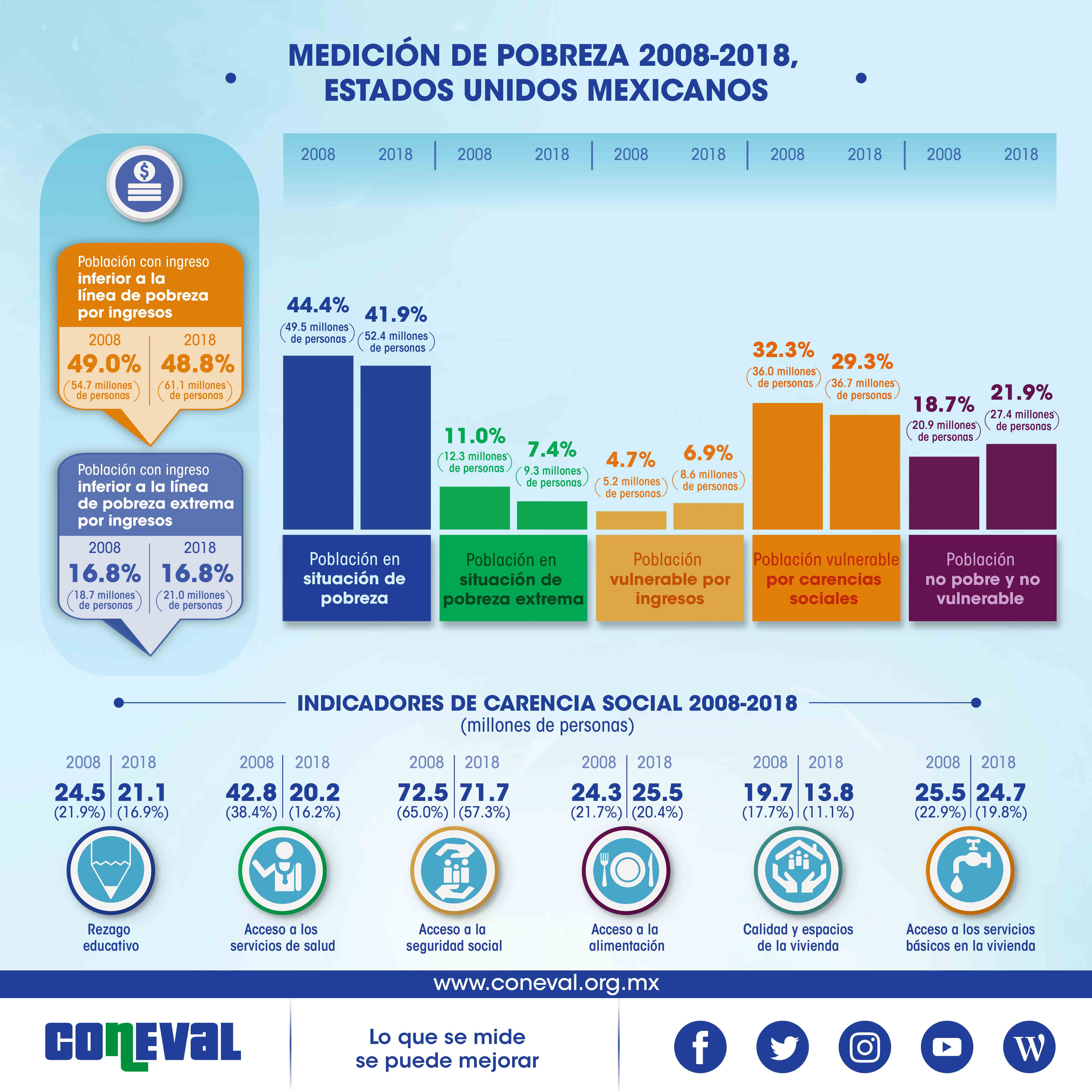
Mexico’s transition to democracy led to a profound transformation of the electoral system, but clientelistic practices did not disappear. Despite the expectation that programmatic linkages between parties and voters would be strengthened after the democratizing election of 2000 when the Party of the Institutional Revolution (PRI) lost the presidency, clientelism has persisted as a connection between poorer voters and parties (Greene and Simpser Reference Greene and Simpser2020; Castro Cornejo and Beltrán 2021). Over 40% of Mexico’s population lives in a situation of poverty,Footnote 14 and many less-favored families tend to congregate in poor neighborhoods, such that more than 50 million Mexicans are potentially part of territorial clientelist networks, even if many choose not to join them.Footnote 15
While not all economically challenged voters are part of a clientelist network, recent evidence shows that voters in Mexico, as in many other developing nations, do participate in these networks, as demonstrated by several surveys, such as Mexico’s National Election Study (Beltrán and Castro Cornejo Reference Beltrán and Cornejo2019). Table A1 in online appendix 1 reports that between 27% and 51% of respondents in the 2012 and 2015 polls, respectively, stated that they have received presents from parties. Table A2 in online appendix 1 also reports the type of gifts that are commonly distributed by parties in Mexico. While many voters report receiving campaign merchandise, about 15% of the electorate receive gifts that are likely to be part of a clientelist exchange.Footnote 16
To understand the relation between brokers and their patrons, as well as the conditions under which the intermediaries decide to be loyal or to cheat, we interviewed just over fifty brokers and politicians from August of 2019 through early March of 2020 in three boroughs of Mexico City. Mexico City has been governed by the Mexican left since 1997 when, for the first time, elections were held to choose the Head of Government, roughly, the city’s governor. One might argue that our interviewees cannot faithfully represent events that occurred over the course of the last ten years; however, as by and large the brokers did not change, and normally, the politicians involved also related similar aspects of clientelist relations, we have confidence that their information hews closely to reality. We do not employ information from our interviews, however, if it comes from more than ten years ago.
The PRD governed the city between 1997 and 2018 but began to experience an important decline beginning in 2015, when a major faction of the PRD, led by Andrés Manuel López Obrador, resigned from the party and founded Morena. The PAN has an important electoral presence in Mexico City, particularly governing the middle-class areas such as the borough of Benito Juárez. The PRI tends to have more success in more rural areas with lower income.
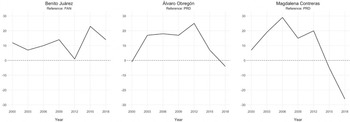
We chose three boroughs—Alvaro Obregón, Benito Juárez, and Magdalena Contreras—within the borders of the capital city because of their variation on factors of potential interest, such as the party in power; the control of local government over time by a single party; and whether the incumbent had been defeated. One of the alcaldías has been held by a single party for over two decades (Benito Juárez), while the incumbent in another borough recently suffered a defeat after almost twenty years in power (Álvaro Obregón), and the third has seen three different parties win local executive office in the last three elections (Magdalena Contreras). Two have been controlled by the PRD, while the PAN governs Benito Juárez (figure 1 reports the margin of victory in each borough; refer to figure A1 in the online appendix 1 for election results).
Margin of victory between first and second place

In Benito Juárez, one sees the PAN significantly above the second-place party, normally the PRD, except for 2012, which is an inflection point for the PAN and its willingness to construct clientelist networks (figure 1, and figure 1A in online appendix 1). In Álvaro Obregón, we see the tremendous fall of the PRD from winning almost 50% of the votes in 2012 to 25% in 2015, which is mentioned in the interviews as a wake-up call for PRD leaders that their brand and its candidates were losing support. Finally, in Magdalena Contreras, the PRD began to have problems with its votes for municipal executive as early as 2009. Its candidate for the borough came back strongly in 2012, but in 2015, the party lost the election. The PRD was too weak to even nominate its own candidate in the 2018 race, and so its leaders formed an electoral coalition with the PAN and the much smaller Citizens’ Movement (MC) but were defeated by Morena.
Even in a political system without consecutive reelection (which only became legal for borough executives—roughly the equivalent of mayor—as of 2021), in many parts of Mexico City, diverse political groups have been able to dominate borough governments over time.Footnote 17 Strong politicians place their close political allies as candidates for office to control elected posts (Interview #40, 1; Interview #5, 3). Because of this hegemony over municipal politics, politicians constructed and maintained networks of brokers within the borough that often lasted for years.
In our interviews, we found that three to six brokers were active in each colonia—most of whom were working for the party in power, with at least one using the resources of a different party to maintain some presence in the area. In Álvaro Obregón, we spoke to political actors in six different neighborhoods that are characterized by high levels of poverty.Footnote 18 The people whom we interviewed were introduced to us by residents, who know local brokers with a radius of approximately ten blocks from their homes, which permitted us to speak to intermediaries from several neighborhoods. In many areas, we spoke to more than one broker. We also interviewed a broker-coordinator who was the leader of several other brokers. We then searched out politicians from the borough and spoke to several of them.
Our second borough government within Mexico City is Benito Juárez, a middle-class area in the city, with pockets of poverty to the east. As was our strategy in Álvaro Obregón, we interviewed local political actors and intermediaries in the poorest neighborhoods, and the intermediaries would then refer us to others, which allowed us to expand our universe of brokers in a convenience sample, which included every active broker in the small neighborhood, San Simón Ticumac. After speaking to this neighborhood’s intermediaries, we realized that their information was similar to what other brokers in poorer areas of Benito Juárez had related, giving us extra assurance in the validity of their experiences within the borough. Finally, we carried out interviews in Magdalena Contreras, a city borough to the west that includes neighborhoods that are among the wealthiest in the city, as well as some in the mountains that are still controlled by caciques. We began with politicians once again, who referred us to brokers and we found more through a “snowball” effect.
We define high and low competition as the possibility of losing or winning municipal elections in Mexico City. While state and presidential elections are, of course, important, the brokers’ immediate futures depend on the fate of their politicians and party in local government. Low competition simply refers to those elections in which no actors in any party see the possibility of a surprise victory by a non-incumbent. On the other hand, high competition means that most see either difficulties in holding the municipal government or impending defeat.
Our cases present variation on both factors of interest: electoral competition and broker relations with their patrons, allowing us to make comparisons both within the municipalities and across them. We employ matched comparisons across boroughs to determine whether the presence of one or both factors lead to different outcomes on the propensity of brokers to cheat (Bennett Reference Bennett, Sprinz and Wolinsky-Nahmias2004). We rely on three cases to pinpoint the interaction between the type of broker and the competitive environment to understand how the structural causes connect to the brokers’ decisions to cheat or cooperate. As several methodologists have pointed out, a case study can allow one to examine how causal factors interact and in doing so, contribute to theory development (Bennett Reference Bennett, Sprinz and Wolinsky-Nahmias2004; Gerring Reference Gerring and Goodin2011).
Because of the nature of the activities that we discussed in our interviews, one can reasonably question whether the brokers and politicians told us the truth—given that much of this behavior is affected by social desirability bias—or simply accused their fellow brokers of undertaking illegal actions. We mitigate this problem by employing at least two citations of interviews for every claim made by the brokers about cheating.
Cases
Outcome 1. Low Electoral Competition with Brokers in Dependent Relations ⇒ Very Low Probability of Disloyalty
In this section, we examine the behavior of brokers who are in resource-dependent relations with a politician or party in a context of low electoral competition, with the expectation that they should be the most loyal because the value of the votes they provide is lower than it would be in a competitive environment and their reputation for loyalty is valuable because they work in a network with their politician over time. Our cross-case comparison here employs the boroughs of Álvaro Obregón and Benito Juárez, where we anticipate finding that when parties construct alliances with local dependent brokers under conditions of low competition, the brokers will by and large not choose disloyal behavior.Footnote 19
For years, a powerful politician from the PRD in Álvaro Obregón worked diligently to create a strong network of territorial brokers in the area, mostly by recruiting natural leaders and placing them as members of the Neighborhood Committees in the poor colonias (Interview #1, 1; Interview #7, 2). These dependent brokers were the backbone of the political leader’s power in the borough. In areas close to and including the Pueblo de Santa Fe, there are profound socio-economic problems, such as schools where drugs are prevalent, few formal jobs, organized drug gangs, crime, and poverty. Dependent brokers oversaw the distribution of municipal goods to neighbors who were then pressed into service as “assistants” to the broker: these persons were expected to march, attend a rally, and of course, vote correctly (Interview #6, 4; Interview #15, 1). Many neighbors found it easier to work with brokers rather than distant municipal functionaries (Interview #1, 3; Interview #7, 4).Footnote 20
The ability of these dependent intermediaries to deliver goods to voters depended on their continued relationship with a politician who had access to resources (Interview #7; Interview #10, 3). Those who accepted gifts were then organized to attend rallies and mobilized to vote on election day by the territorial brokers (Interview #35, 4; Interview #18, 4; Interview #15, 1-2), and if a recipient refused to attend a rally or vote, then she no longer received goods from the broker—a classic quid pro quo arrangement. Few brokers in Álvaro Obregón went rogue (although they skimmed a percentage of government goods for personal use), as they did not have incentives to break or weaken their relationship with their patrons. And when they did, the municipal PRD leader actively sought out the disloyal broker for an explanation (Interview #7, 4). Several brokers worked for the PRD in Álvaro Obregón for more than ten years and did not commit major acts of disloyalty.
The borough of Benito Juárez is a wealthier middle-class municipality in Mexico City, and only a section to the east can be called working class. This area is known as the Corbata (or the Tie, because of its shape on a map) and for many years, its residents voted predominantly for the left. After a near defeat in the 2012 municipal elections, PAN leaders of Benito Juárez decided they could not afford to lose the entirety of the Corbata voters and moved in to convince territorial intermediaries to transfer their loyalty from the PRD to the PAN in the borough. As a result, many dependent brokers severed their long-term relations with the PRD. Now that the PAN has locked in its relations with these dependent intermediaries, they have become an important base of votes and they are loyal to their new patrons. Much as before, the Corbata area continues to be known for its clientelism (“Over there, everything is done with packages of food,” or in Spanish “por ahí, todo es con dispensas,” (Interview #32, 2) but now they are organized by the PAN’s local government instead of the PRD in state office (Interview #26, 3; Interview #27, 3). The reputation of the dependent brokers helps politicians maintain these relations; as one broker tells us, the PAN leaders test their brokers by tempting them to cheat; if they do not, that is a signal to keep working with them (Interview #33, 5). A PAN politician who ran for office relates that if he uses the same brokers, over time they discover who delivers the votes and who does not (Interview #37). The local PAN leadership knows that the intermediaries are always measuring the response of the Benito Juárez government to their requests, and if the politicians respond to their needs, they will remain loyal (Interview #19, 4).
The offer from the PAN was clear—work for us and we will support you with the resources of the municipality (Interview #25, 2). The PAN in Benito Juárez used the same strategy as PRD party leaders in Álvaro Obregón, placing their brokers in leadership posts in the Neighborhood Committees (Interview #7; Interview #19, 4), so much so that most neighborhood committee leaders are now members of the PAN. The incumbent PAN has made commitments to retain the services of the territorial brokers into the future: they work diligently to maintain their brokers working for them, by delivering goods and access to services.
Of course, not all PRD brokers shifted to the PAN; a traditional leader of the PRD in the Colonia San Simón Ticumac continued working for the PRD after 2012, and when she realized that the PRD’s power was ebbing at all levels of government, she switched to leftist Morena taking several of her brokers and their voters with her—and in this way, continued her political career (Interview #25, 2 & 3). One of the older intermediaries recognizes that it does not look good to change parties so often (she has been with the PRI, the PRD, and occasionally works for PAN candidates), but she defends herself stating, “my people follow me wherever I go” (Interview #18, 1).
When there was no real possibility of an incumbent defeat in Álvaro Obregón or Benito Juárez in the short term, the brokers’ votes were not as valuable, and they could rely on their connections in the municipal government to supply them with resources to keep their voters in order. Here, the brokers’ reputation for honesty and mobilization skills held value. Even with dependent associations between brokers and their party, the PAN in Benito Juárez continues to take steps to minimize the possibility of important infractions on the part of their intermediaries. They obligate the beneficiaries to come to a central location where borough functionaries tick off who receives goods (Interview #24, 3) and they are in constant contact with brokers and pressure them by counting how many neighbors appear at meetings with the politicians and candidates (Interview #18, 3). Thus, in Benito Juárez, there is a greater effort to monitor broker behavior than in Álvaro Obregón before 2018, but the outcome of interest remained the same—a lack of cheating.
Outcome 3: High Competition with Dependent Brokers ⇒ Medium Probability of Cheating
In the previous section, dependent brokers were embedded in a long-term relationship with a party in a context of low electoral competition and were not disloyal to their patrons. In Outcome 3, we continue to focus on dependent brokers, but in a context of high electoral competition, which according to our theory, brokers are likely to update their cost-benefit analysis making them more likely to be disloyal than they were under low competition.
To illustrate this combination, we use a within-case comparison of Álvaro Obregón beginning in 2015, as electoral competition rose against the incumbent PRD, through its ouster from the municipal government in 2018. We will demonstrate that some but not all resource-dependent brokers—many of whom were members of the Neighborhood Committees or who held low-level jobs in the municipality—remained loyal to their patron even after the 2018 debacle in which the PRD lost the borough election, which speaks to outcomes in this intermediate category. This is an important contrast to the brokers in Outcome 4, which follows, where almost all brokers went rogue after the breakup of the PRD in Magdalena Contreras because electoral volatility made it less viable to remain with a single party, given that in the next election, it might lose.
Politicians and municipal officials in Álvaro Obregón knew of low-grade cheating of their dependent brokers who had been working with them for years and tolerated it if the votes were delivered. But once electoral competition began to rise, the problems of disloyalty on the part of dependent brokers grew. Smaller parties were able to buy off disgruntled brokers who were now willing to work for a non-PRD option (Interview #10, 3; Interview #2, 1). A former PRD broker (Interview #9, 4) states that other brokers cheated on the PRD during the 2018 elections, which led to its defeat, as they sold information about PRD strategies to Morena operatives. Others stated that some brokers split their votes between two candidates because of payoffs from Morena, the emerging political party in Mexico City and nationwide (Interview #1, 5). During competitive campaigns, party resources are plentiful, and the moment is propitious for disloyalty, because votes become highly valued goods. Furthermore, because of the possibility of the incumbent losing the municipal election, brokers calculate that they will not be excluded from the future distribution of municipal goods even if they switch.
But for the dependent brokers in Álvaro Obregón, especially those with jobs in municipal government, it was difficult to break from the PRD and its municipal leader. A broker coordinator, who worked for PRD politicians of Álvaro Obregón for eighteen years, did not leave the party in 2018, even though he knew a disastrous defeat was imminent (Interview #6). He stated that he simply asked his voters to split their ticket—vote for Morena/López Obrador for President, but down-ticket, remain with the PRD. Because the PRD did not have its own presidential candidate (the PRD nominated the PAN candidate as part of an electoral coalition), and people would vote for López Obrador regardless, ticket splitting in this case was not considered a terrible act of disloyalty. Two other dependent brokers (Interview #2, 5) and (Interview #7, 4) report much the same thing—Morena asked them to change parties and work for them during the campaign, but they declined the invitation. One broker stated that Morena had invited her to work for them, but she refused, because “the people do not know how to vote” (Interview #7, 4). She also claimed that a deputy from Morena had offered her a candidacy; but she declined, arguing that she was loyal, “I am not a chacotera (roughly, a person who is not sincere or not serious).”
The fact that these brokers remained outside the networks of the now dominant Morena has caused difficulty for them after the defeat of 2018 largely because they can no longer distribute goods or specialized information for their group of voters. Why did they refuse to either jump ship during the campaigns or otherwise cheat on their party if their party was expected to lose the election? At least two of them had jobs in the municipal government of Álvaro Obregón, and so they hoped they would keep them. Some who held municipal plazas simply could not believe the PRD would be defeated, regardless of the popularity of its presidential candidate (Interview #1, 4). Finally, some were not invited by Morena, so they continued to mobilize their voters in their precincts as they had done for years (Interview #3, 3). Thus, calculations of these dependent brokers as competition rose led to different outcomes based on their autonomy of resources, and particularly, their closeness to the municipal government.
Outcome 2. Low Electoral Competition with Brokers in Autonomous Relations ⇒ Low Probability of Disloyalty
Now we analyze the behavior of more independent intermediaries in Cell 2 under low competition. As we explained earlier, more independent brokers do not depend on the party organization for all their needs, because they hold some resources of their own. Because more autonomous brokers exist in all boroughs, for this outcome, we examine those who work under low competition, regardless of the municipality. Since extra votes are not worth pursuing under less competitive circumstances, opposition parties will not usually invest much in autonomous brokers to move in on a dominant party and as a result, one should see less disloyalty than one does when independent brokers work in a context of high competition (Outcome 4, which follows).
Even though competition is low, sometimes during periods of campaigning, smaller parties will often search out more independent brokers and use their services if possible, to raise their vote totals. If new or smaller parties wish to test the electoral waters, they promise better payoffs to the autonomous brokers and voters than they currently enjoy. A non-incumbent party will “turn” a dependent broker who works for another party during a campaign and in others, a party uses the services of a broker who is already independent. In the first case, the money promised by the new patron must be more than what the broker would have earned had she stayed in the more stable relationship.
Still, as demonstrated by the more independent brokers in Álvaro Obregón and Magdalena Contreras, some brokers remained enmeshed in networks with their incumbent party for decades. Leaders of housing developments, caciques in the mountains, and leaders of residential areas tended to vote for the leftist PRD, and all remained with their PRD politicians up through the period of electoral volatility and decline for the left option.
Outcome 4. More Independent Broker-Politician, High Competition ⇒ Most Likely to Cheat
As discussed earlier, while more independent brokers do hold more resources than their dependent counterparts, they still require access to government goods and services. In this section, we show that when competition was low in the borough of Magdalena Contreras, the more independent intermediaries tended to stay loyal to the incumbent party. However, when competition rose sharply, brokers saw that the incumbent was under threat and did not fear future exclusion from municipal services, because they believed they could work for the eventual winner, either by brokering for both parties during campaigns or by switching parties during the campaign—both non-cooperative strategies. Because these more autonomous brokers do not depend on municipal jobs or posts on the Neighborhood Committees, they can more easily change allegiance to parties and politicians. Thus, it is the interaction between these two variables that drives the outcome of the highest probability of cheating.
Our comparison for this outcome is a within-case study of the borough of Magdalena Contreras; in each electoral contest in 2012, 2015, and 2018, a different party won the contest for mayor, indicating high levels of competition at the ballot box. Party factionalism within the incumbent PRD led to the weakening of ties between broker and party, turning many once-dependent brokers into independent agents, while electoral competition allowed opportunities to cheat.
In Magdalena Contreras, both independent and dependent brokers worked for the municipality and the incumbent PRD government for many years, including autonomous brokers in the rural areas of the municipality who were so powerful that, as one PAN candidate related, she refused to send her campaign teams or even voting station representatives to that area for fear of violence against them (Interview #38, 5). The same federal deputy noted that her local leaders included those who owned common lands; the woman who sold flowers on the street and “knew everybody;” the leaders of the markets; those who sold goods on the streets; and leaders of the neighborhood committees – a mix of dependent and independent brokers (Interview #38, 3-4) under lower competition.
However, the PRD began to lose control over the municipality largely because of factional infighting, with some leaders leaving the party and others attempting to sabotage those from other groups. This breakdown allowed brokers to detach from the PRD with relative ease. One candidate for local deputy for the PAN (a non-dominant party that competes in the borough) told us that once the PRD began to weaken, important brokers began to switch parties or sell their services to more than one buyer (Interview #39, 2). For example, a powerful family, which had worked for years with the PRD, switched to the PRI in 2015 and then to Morena in 2018, selling their block of votes to the party that had the best possibilities of winning and offered a good price for their votes. Because competition was high, independents searched for more promising alternatives with relative ease because a new party had the possibility of gaining office and the incumbent party was unable to retain them by offering better terms (Interview #39, 4; Interview #20, 3; Interview #22,1-2). A political operator in the municipality noted that because so many brokers had gone independent, politicians had to create new brokers in the colonias to be able to depend on them (Interview #27, 2).
This point allows us to grasp how important dependent brokers can be for politicians who want an assured voter base in a specific geographic area. Because by 2018 the brokers no longer relied on their reputations, the candidates had to work diligently to monitor their actions to reduce pilfering, and one candidate found that many were in fact cheating on him by not distributing goods meant for voters and by not making their phone calls (Interview #39). As a result, some candidates with more autonomous brokers actively monitor their behavior by searching out information on whether they have received the goods provided by the candidate (Interview #39, 3). Here, one sees that increased monitoring comes after the breakdown of the longer-term relations between politician and broker, but it did not affect the willingness of the brokers to cheat in the first place.
In this context, opposition parties and candidates are especially active during periods of campaigning because they have resources to tempt a broker away from her original party. In these circumstances, parties go to the broker marketplace to “rent” the services of willing intermediaries who either do not have long term relations with a politician or who are willing to break them. However, these autonomous relations can end badly. One broker (Interview #22, 1) relates that in competitive areas, brokers have strong incentives to exaggerate the number of people they control. Because these are short-term relationships, it is difficult to attest to the actual number of voters that a broker can assure on election day. As a Morena politician told us (Interview #36, 2), electoral competition gives those brokers without dependent relations the best opportunity to shake down politicians because they can sell “their” 200 votes for up to MX$100,000, roughly US$6,000. And while many brokers may wish to extend their work with the politician or party into the future, if their candidate loses, or if the politician goes back on his word about procuring a job in municipal government (which is mentioned quite frequently in our interviews), then the intermediary is left with only the money paid in the campaign and no possibility of creating a dependent relationship with the politician.
From this case we can see that independent intermediaries who face high competition are more likely to cheat than their counterparts in low competition, and more likely than dependent brokers laboring in volatile electoral contexts as well.
Conclusion
We have argued that many brokers and politicians find it in their interests to construct long-term relationships that are based on cooperation over time. Disloyalty is a decision made by the broker that depends less on the ability of the politician to monitor her than on a calculation of the value of her reputation for good work and of the votes she controls. Parties and politicians can increase monitoring efforts, but when levels of competition increase—particularly among independent brokers—brokers will still defect because they discount the future with that party. In contrast, reputations hold more value when brokers are in a dependent relation with their politician that lasts over time. Politicians prefer to work with the same brokers who are recognized as vote-getters because they know that their distribution of goods and services will provide them with a known quantity of votes.
This is an important finding for more normative discussions of clientelism and democratization: some believed clientelism should disappear as elections and programmatic links would strengthen. Unfortunately, this is not the case particularly in poorer neighborhoods—even in a party system with parties that are stronger than the average in the region. This research shows that ideological preferences are not such strong links as previously thought, which once again, weakens the link between elections and programmatic promises. While clientelism can potentially help party building, if voters are receiving goods and services from disloyal brokers, voter-party linkages are not likely to strengthen since brokers appear as free agents instead of distributing goods on behalf of parties and politicians.
Our cases presented variation on both factors of interest, and we conducted matched comparisons across boroughs in Mexico City to examine whether the presence of one or both factors led to different probabilities of brokers to cheat. In this sense, our case study allows us to develop our theory more fully. The results of this paper are likely to travel to other contexts in Latin America and elsewhere, since broker reputation and the value of the votes they control exist in all clientelist situations. The most fruitful cross-national comparisons will be between nations with stronger party systems and those with weakly institutionalized party systems such as Peru or Indonesia, where parties are weak electoral vehicles and voters have little partisan identification. Future research can determine how the value of reputation and votes varies under weaker and stronger parties and party systems.
Supplementary Materials
To view supplementary material for this article, please visit http://doi.org/10.1017/S1537592721004084.
Appendix 1. Public Opinion Data
Table A1. Clientelism in Mexico (2012 and 2015)
Table A2. Type of Gifts Distributed by Mexican Parties (2015)
Appendix 2. Interview Questions
Appendix 3. List of Those Interviewed for Article
Acknowledgements
The authors wish to thank the brokers and politicians who took time to speak with us about their activities. Furthermore, the members of the Seminario de Política y Gobierno at CIDE and members of the Centro de Estudios Internacionales del Colegio de México improved the paper with their suggestions and criticisms, as did Matthew Cleary. All errors remain those of the authors.