Introduction
Rising prevalence rates for neurodegenerative diseases and corresponding efforts to find early indicators of cognitive decline lead to the development of the concept of mild cognitive impairment (MCI), whose classification requires objective cognitive deficits as well as subjective cognitive complaints (Petersen, Reference Petersen2004). Thus, intact awareness, which can be defined as a person's ability to accurately assess his/her performance in a given domain (Roberts et al., Reference Roberts, Clare and Woods2009), is implied among MCI patients. However, the criterion of subjective cognitive complaint – especially subjective memory complaint (SMC) – for MCI diagnosis has been strongly criticized, as prior research suggests that MCI patients often do not report cognitive problems (Purser et al., Reference Purser, Fillenbaum and Wallace2006) or underestimate their extent (Lin et al., Reference Lin2010). This phenomenon of being unable to (fully) recognize deficits caused by a neurodegenerative illness has been referred to as anosognosia, unawareness or impaired insight (Ecklund-Johnson and Torres, Reference Ecklund-Johnson and Torres2005). In this study, which will specifically focus on awareness of memory deficits, these terms will be used synonymously.
Research on awareness among patients suffering from Alzheimer's disease (AD) has shown that anosognosia is a common clinical symptom even in the earliest stages of the disease and that the frequency of the symptom increases with disease progression (Ecklund-Johnson and Torres, Reference Ecklund-Johnson and Torres2005; Aalten et al., Reference Aalten, van Valen, de Vugt, Lousberg, Jolles and Verhey2006). In the past few years, researchers also began to focus on awareness in possible prodromal stages of AD, like MCI, and there is now accumulating evidence suggesting that impaired insight is also frequently present in MCI (Vogel et al., Reference Vogel, Stokholm, Gade, Bo Andersen, Hejl and Waldemar2004; Hanyu et al., Reference Hanyu, Sakurai and Iwamoto2007; Galeone et al., Reference Galeone, Pappalardo, Chieffi, Iavarone and Carlomagno2011; Maki et al., Reference Maki, Amari, Yamaguchi, Nakaaki and Yamaguchi2012), even though considerable variability in the degree of insight has been observed (Roberts et al., Reference Roberts, Clare and Woods2009; Nobili et al., Reference Nobili2010).
Under the assumption of a continuum of the unawareness phenomenon in MCI and AD, the level of awareness, defined as the degree of correspondence between subjective and actual memory performance, may provide a useful tool to identify those individuals with MCI who are most likely to convert to dementia (Roberts et al., Reference Roberts, Clare and Woods2009). This hypothesis is supported by studies revealing associations between low awareness and AD-related biomarkers (Nobili et al., Reference Nobili2010) or risk for future progression to dementia (Tabert et al., Reference Tabert2002) in aMCI. Moreover, deficits in episodic memory, which count among the most sensitive cognitive markers for early AD-identification (Bäckman et al., Reference Bäckman, Jones, Berger, Laukka and Small2004), have been linked to diminished awareness (Orfei et al., Reference Orfei2010; Clare et al., Reference Clare2013). Yet, there is a need for further studies assessing awareness in MCI and MCI subtypes and surprisingly little research has addressed awareness in Parkinson's disease (PD), even though cognitive decline is a common aspect of the disease (Meireles and Massano, Reference Meireles and Massano2012).
Moreover, it needs to be noted that, albeit some evidence is pointing towards a possible diagnostic utility of awareness measures, even among AD patients considerable variability in unawareness is reported with frequency estimates varying widely from about 20 to 80% (Mograbi et al., Reference Mograbi2012). Such variability is, at least in part, based on different methods employed to assess anosognosia. Additionally, awareness is considered a biopsychosocial construct (Clare et al., Reference Clare2012) with a number of non-cognitive influencing factors (most importantly anxiety and depression, e.g. Aalten et al., Reference Aalten, van Valen, de Vugt, Lousberg, Jolles and Verhey2006) and, hence, findings about awareness will differ depending on whether these factors are considered and controlled in the respective studies. Clare et al. (Reference Clare2012, Reference Clare2013) provide useful overviews concerning influencing factors and assessment methods. In contemporary research, the two dominant approaches to measure awareness are comparison of patient and caregiver ratings on parallel questionnaires (evaluative judgments) and comparison of task-specific self-ratings and objective performance (performance monitoring) (cf. Levels of Awareness framework, Clare et al., Reference Clare2013).
With regard to evaluative judgments, motivational and affective variables are likely to bias caregivers’ ratings (Clare, Reference Clare2004). Concerning performance monitoring, unawareness might reflect a person's inability to accurately assess the nature of the neuropsychological test (Trosset and Kaszniak, Reference Trosset and Kaszniak1996). In the present study we therefore compared evaluative self-ratings on the frequency of memory related problems in familiar everyday life situations with objective test performance (delayed recall).
The purpose of this study was to compare awareness of memory deficits among healthy controls and patients with varying degrees of memory impairment. The seven patient groups under analysis were cognitively asymptomatic individuals with SMC (subjective cognitive decline, SCD), non-amnestic and amnestic MCI (naMCI/aMCI), AD, cognitively healthy PD patients (PD-CH) and PD patients with naMCI or aMCI. Furthermore, we aimed to explore correlates of awareness and to compare frequencies of over- and underestimation among the investigated groups using a percentile-based approach (Clare et al., Reference Clare, Whitaker and Nelis2010). It was hypothesized that the ability to accurately self-report memory function would decline concurrently with cognitive abilities (controls→SCD→naMCI→aMCI→AD).
Methods
Participants and measures
Patient groups
756 consecutive, community-dwelling patients of a memory and movement disorder clinic were assessed as part of two larger research projects, the Vienna Conversion to Dementia Study and the Vienna Mild Cognitive Impairment and Cognitive Decline in Parkinson's Disease Study. Patients were either referred by general practitioners, neurologists or psychiatrists or were self-referrals. The study was conducted in accordance with the Helsinki Declaration and was approved by the Ethical Committee of the Medical University of Vienna.
All patients received a complete neurological examination, standard laboratory blood tests, and psychometric testing. In most cases, a computer tomography scan or magnetic resonance imaging scan of the brain was obtained.
The Neuropsychological Test Battery Vienna (NTBV), which encompasses measures of the domains attention, language, executive functioning and episodic memory, was administered to assess cognitive function (for a list of the NTBV subtests see table S1 published as supplementary material online attached to the electronic version of this paper at http://journals.cambridge.org/ipg). Adequate normative data using cognitively normal participants were available, and a detailed description of the standardization procedures, norms, and validation is published elsewhere (Lehrner et al., Reference Lehrner, Maly, Gleiß, Auff and Dal-Bianco2007; Pusswald et al., Reference Pusswald2013). Further neuropsychological measures included the Mini Mental State Examination (MMSE) and the Wortschatztest (WST; Schmidt and Metzler, Reference Schmidt and Metzler1992), a standardized vocabulary test providing an estimate of premorbid IQ.
The diagnosis was determined by the decision of a consensus committee including neuropsychologists, neurologists and other study personnel involved in the evaluation of the patients’ cognitive status.
Diagnosis of MCI was based on Petersen criteria (Petersen, Reference Petersen2004) and required a z-score of -1.5 SD below the age and education-corrected norms for elderly controls using MIN-mode MCI classification (Pusswald et al., Reference Pusswald2013). Inclusion also required absence of severe head injuries, strokes and medical conditions that lead to severe cognitive deterioration like renal, respiratory, cardiac, or hepatic diseases. Furthermore, patients with a current psychiatric diagnosis according to ICD-10 criteria other than (sub) depressive disorders were excluded.
SCD classification required (a) the presence of subjective memory deterioration as manifested by the seeking of medical help for memory problems and (b) the concurrent absence of any objectively measurable cognitive deficits (mean z-score of each domain greater than −1.5 SD) (Jessen et al., Reference Jessen2014).
AD was diagnosed according to the NINCDS-ADRDA (McKhann et al., Reference McKhann, Drachman, Folstein, Katzman, Price and Stadlan1984) and DSM-IV criteria. Movement disorders specialists established the clinical diagnosis of PD according to the UK Parkinson's Disease Society Brain Bank criteria (Gibb and Lees, Reference Gibb and Lees1988) for probable PD (median Hoehn and Yahr stage 2.5, quartile 2–3; median age at onset 59.5, quartile 52–66; median disease duration 84 months, quartile 50–144; all PD patients were taking anti-Parkinson medication).
Control subjects
Cognitively healthy control subjects were recruited via advertisements. They underwent a rigorous screening evaluation and were assessed as being in good health. The criteria for healthy function included: (a) an MMSE score ≥27 and a Montreal Cognitive Assessment score ≥26, adjusted for education (b) no active neurological or psychiatric disease (c) no psychotropic medication and (d) no medical disorder or treatment that negatively affects cognitive functioning. Controls underwent the same neuropsychological assessment as patients.
Assessment of subjective memory complaints
The Forgetfulness Assessment Inventory (FAI) scale was used to assess SMC. The FAI is a 16-item self-report questionnaire for measuring frequencies of memory-related problems in everyday life within the past four weeks. Addressed are, for instance, problems in remembering names, telephone numbers, faces, birthdays or shopping lists. Answers can be given on a 5-point Likert scale ranging from 1 (never) to 5 (very often). The test score (sum score divided by the number of items answered) ranges from 0 to 5, with higher scores indicating greater perceived memory difficulties. Internal consistency is satisfactory with an evaluated Cronbach alpha of 0.85 (Lehrner et al., Reference Lehrner2014). The patients’ ratings on the FAI (and hence awareness measures) were used for research purposes only. All other measures were used as part of the diagnostic process.
Assessment of objective memory performance
The Verbal Selective Reminding Test (VSRT; Lehrner et al., Reference Lehrner, Gleiß, Maly, Auff and Dal-Bianco2006), a paper pencil modification of the Grocery List Selective Reminding Test of the Memory Assessment Clinics (MAC) test-battery (Crook et al., Reference Crook, Salama, Gobert, Bes, Cohn, Hoyer, Marc-Vergenes and Wisniewski1986) with the subtests of immediate recall, total recall, delayed recall and recognition, was used to assess episodic memory. Due to the specifically high sensitivity for age-related memory changes of delayed recall tasks (Bäckman et al., Reference Bäckman, Jones, Berger, Laukka and Small2004), the results of the VSRT-subtest Delayed Recall were used as a measure of objective memory for the calculation of awareness scores. The score was the sum of correctly retrieved items after a retention interval of 20 minutes and ranged from 0 to 15 (maximum memory performance). The test has adequate psychometric properties (Lehrner et al., Reference Lehrner, Gleiß, Maly, Auff and Dal-Bianco2006).
Assessment of awareness
Awareness measures were obtained by subtracting VSRT Delayed Recall scores from FAI scores. To allow for the computation of discrepancy scores, raw scores were converted into z-scores based on the mean and SD of the total sample. Furthermore, FAI scores were inverted so that higher scores represent better subjective memory. Accordingly, high VSRT scores correspond to high objective performance. Thus, positive awareness scores express an overestimation and negative scores an underestimation of memory performance.
Assessment of depression and functional impairment
Depressive symptomatology was measured via the Beck Depression Inventory (BDI-II; test score: 0–63; Hautzinger et al., Reference Hautzinger, Keller and Kühner2006). The self-rating version of the Bayer Activities of Daily Living Scale (B-ADL; Hindmarch et al., Reference Hindmarch, Lehfeld, de Jongh and Erzigkeit1998) was administered to cover perceived impairment in everyday activities (test score: 1–10). Higher scores indicate a higher severity of depression and functional impairment, respectively.
Statistical methods
Between-group differences in awareness were investigated using univariate analysis of covariance (ANCOVA). Spearman correlations were calculated to explore correlates of awareness. A percentile-based approach was employed to establish frequencies of overestimation and underestimation per group. Statistical analyses were performed using SPSS (version 20). The level of significance was set at p < .05. All statistical tests are two-tailed.
Results
Descriptive data
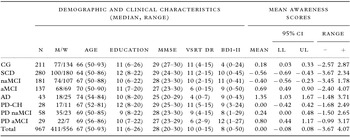
A total of 211 controls, 280 SCD, 318 MCI, 115 PD and 43 AD patients were included in the analysis. Detailed sample sizes, demographic characteristics, MMSE, VSRT Delayed Recall and BDI scores of the subgroups are shown in Table 1. They are described by median and range owing to the skewed distribution of the variables.
Demographic and clinical characteristics and mean awareness scores per subgroup

Note. Median (Range); M – men, W – women; MMSE – Mini-Mental State Examination; VSRT DR – Verbal Selective Reminding.
Test Delayed Recall; BDI-II – Beck Depression Inventory II; CI – confidence interval; LL – lower limit, UL – upper limit.
The groups differed significantly in mean age, F(7,959) = 6.41, p < .001, mean years of education, F(7,959) = 2.57, p = .013, and mean BDI-scores, F(7,952) = 14.70, p < .001. Post hoc analyses (Games Howell) showed that AD patients were older than controls, SCD and naMCI patients (ps < .03) and SCD patients younger than aMCI and PD naMCI patients (ps < .01). Furthermore, SCD patients had a higher level of education than naMCI patients (p = .021), and controls showed less depressive symptoms than all other groups (ps < .04).
Differences in awareness among groups
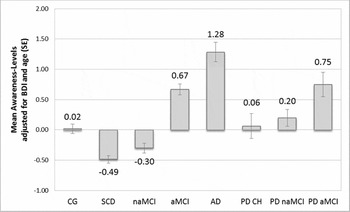
The groups were first examined for overall differences in awareness scores. Mean values, confidence intervals (CIs) and ranges are presented in Table 1. ANCOVA with Group as a between-subject factor and BDI scores and age as covariates indicated a main Group effect, F(7,950) = 28.43, p < .001, η2 p = .17, as well as main effects of the covariates depression, F(1,950) = 64.07, p < .001, η2 p = .06, and age, F(1,950) = 31.82, p < .001, η2 p = .03. Figure 1 shows the mean awareness scores adjusted for depression scores (BDI-II) and age, with higher scores indicating an overestimation of actual memory performance.
Mean awareness scores adjusted for depression scores and age. (Covariates were evaluated at a BDI score of 10.03 and age of 66.78) SE – Standard Error; BDI – Beck Depression Inventory. Awareness = inverted z-score FAI – z-score VSRT delayed recall; Higher scores indicate an overestimation of memory function. Values close to zero indicate close similarity between subjective and objective scores.

Post hoc analyses (Bonferroni) revealed significant differences between controls and the groups aMCI, AD (ps < .001) and PD aMCI (p = .019). Amnestic MCI patients (with and without PD) had significantly higher scores than naMCI patients (ps < .001), and AD patients reached higher scores than all other groups (ps < .026) except PD aMCI. Furthermore, scores of SCD patients were significantly lower than those of all other groups (ps < .001) except PD-CH and naMCI.
As depression is a major confound for subjective and objective memory performance, we repeated our calculations under exclusion of all participants with BDI scores > 13, indicating clinical depression. Again, ANCOVA indicated a main Group effect, F(7,710) = 20.16, p < .001, η2 p = .17, as well as a main effect of the covariate age, F(1,710) = 14,13, p < .001, η2 p = .02. However, post-hoc analyses yielded three differences compared to the initial analyses: (a) a statistically relevant difference between controls and naMCI patients (p = .004), (b) no significant difference between AD and aMCI patients and (c) no significant difference between controls and PD aMCI patients.
Correlates of awareness
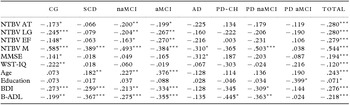
The results of the correlational analyses are shown in Table 2 (for correlations between awareness measures and the single NTBV subtests see supplemental online material, Table S1).
Spearman Correlations (rs ) between awareness scores, objective performance measures and non-cognitive factors

Note. NTBV – Neuropsychological Test Battery Vienna: Domains Attention (AT), Language (LG), Executive Functioning (EF), Memory (M); MMSE – Mini Mental State Examination; WST – Wortschatztest; BDI – Beck Depression Inventory; B-ADL – Bayer Activities of Daily Living Scale.
* p < .05. ** p < .01. *** p < .001. (uncorrected p).
We observed considerable variations in the magnitudes of correlation coefficients depending on diagnostic group. The strongest associations were found between awareness and the domain memory (significant in all groups except PD-CH and PD aMCI; medium to large effects). Unawareness was further associated with decreased cognitive performance in attention, language, executive function (controls/naMCI/aMCI), MMSE (controls/AD) and WST/premorbid IQ (controls). Non-cognitive correlates of unawareness were decreased levels of depression (controls/SCD/naMCI/aMCI/PD naMCI) and functional impairment (all groups except AD and PD aMCI), higher age (SCD/naMCI/aMCI) and lower educational level (PD aMCI).
Additional correlational analyses, in which participants with BDI scores > 13 were excluded, yielded similar results.
Frequencies of memory over- and underestimation per diagnostic group
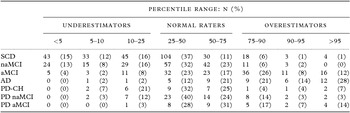
To establish frequencies of (un)awareness, we identified the percentile ranks of controls’ awareness scores and classified the scores of patient groups accordingly. The results are shown in Table 3. Awareness scores above the 75th and below the 25th percentile were defined as memory overestimation and underestimation, respectively. It can be clearly seen that the percentage of overestimation was highest among AD patients (63% scoring above the 75th percentile) followed by the groups aMCI and PD aMCI (46% and 38%). In contrast, SCD and naMCI showed low rates of overestimation (8%) but the highest rates of underestimation of memory performance (43% and 37%). For a comparison of subgroups with different levels of awareness (i.e. underestimators, normal raters, overestimators) on various cognitive and non-cognitive measures see supplementary online table S2 published at http://journals.cambridge.org/ipg.
Absolute and relative frequencies of awareness scores by percentile range using control group percentile scores

Note. Percentile ranks based on the control data: 95th percentile = 1.991; 90th = 1.609; 75th = 0.996; 50th = 0.309; 25th = −0.743; 10th = −1.339; 5th = −1.735.
Over- and underestimation are represented at the extremes of the percentile rankings.
Discussion
The major objective of this study was to determine differences in awareness of memory deficits among healthy controls and patients with SCD, MCI, AD or PD.
As has been hypothesized, we found significant between-group differences along the SCD→naMCI→aMCI→AD continuum even after controlling for depression and age. Contrary to our expectations, naMCI patients tended to underestimate memory function, yet, did not differ significantly from controls. Consistent with previous research (Seltzer et al., Reference Seltzer, Vasterling, Mathias and Brennan2001; Sitek et al., Reference Sitek, Soltan, Wieczorek, Robowski and Slawek2011), we observed relatively accurate self-appraisals in PD-CH and PD naMCI, while the group PD aMCI showed significant overestimation of memory functioning compared to controls. Yet, differences between the PD groups were not significant, which, however, might be due to the small sample sizes and the associated lack in statistical power. However, we observed some variations in these results after excluding all participants who may suffer from clinical depression (BDI > 13). This further demonstrates the importance of examining non-cognitive influencing factors and, moreover, underlines a drawback of the present study, namely the lack of anxiety measures, which would be particularly important given the current view of awareness as having biological, psychological and social components. (Clare et al., Reference Clare2012).
The finding that impaired awareness for memory deficits is not only an important symptom of AD, but also of aMCI, is consistent with the majority of prior studies (Vogel et al., Reference Vogel, Stokholm, Gade, Bo Andersen, Hejl and Waldemar2004; Onor et al., Reference Onor, Trevisiol, Negro and Aguglia2006; Hanyu et al., Reference Hanyu, Sakurai and Iwamoto2007; Galeone et al., Reference Galeone, Pappalardo, Chieffi, Iavarone and Carlomagno2011; Maki et al., Reference Maki, Amari, Yamaguchi, Nakaaki and Yamaguchi2012). Yet, not all of them reported that aMCI patients still have a higher level of insight than AD patients (Vogel et al., Reference Vogel, Stokholm, Gade, Bo Andersen, Hejl and Waldemar2004; Galeone et al., Reference Galeone, Pappalardo, Chieffi, Iavarone and Carlomagno2011). Overall, these findings raise further concern about the mandatory prerequisite of SMCs for aMCI diagnosis, as decreased awareness may cause underestimation of impairment.
However, there are also contradictory results indicating that people with MCI overestimate dysfunctions (Kalbe et al., Reference Kalbe2005). Furthermore, a prior study by our group, which included controls, SCD, naMCI and aMCI patients, revealed that aMCI patients exhibited the highest level of memory complaint, with about half of aMCI and one third of subjective memory impairment patients and naMCI patients reporting considerable SMC (Lehrner et al., Reference Lehrner2014). This suggests that SMCs may reflect preserved awareness in aMCI to some extent.
A possible reason for contradictory findings in this field may rest in the considerable inter-individual variability in awareness (cf. Roberts et al., Reference Roberts, Clare and Woods2009), which gives rise to the question whether differences in awareness in MCI are predictive of future conversion to dementia – a longitudinal study by our group is underway to investigate this hypothesis.
Concerning correlates of awareness, prior research has generally yielded little consistent information (Ecklund-Johnson and Torres, Reference Ecklund-Johnson and Torres2005; Clare, Reference Clare2004). In the present study, the strongest associations were observed between awareness and the domain memory, which, however, is at least partly due to the operationalization of awareness scores, which included a subtest of the domain memory. Nevertheless, this finding is in line with prior research indicating that awareness of memory is specifically linked to memory functioning (Gilleen et al., Reference Gilleen, Greenwood and Davis2014). Yet, further small but significant correlations were also observed for the domains attention, language and executive function (controls/SCD/naMCI/aMCI), which suggests that memory is not the only cognitive domain influencing memory awareness. Especially the association with executive functioning, which has been of particular interest in past research given the possible prefrontal involvement in awareness, is consistent with prior evidence (Ecklund-Johnson and Torres, Reference Ecklund-Johnson and Torres2005; but see Clare, Reference Clare2004; Vogel et al., Reference Vogel2005). A significant association with overall cognitive ability (MMSE) was only found in AD (rs = −.31), yet not among the other patient groups. Overall, our findings demonstrate that deterioration of awareness appears to correspond with cognitive decline, especially memory decline. However, the magnitudes of coefficients also indicate that cognitive measures explain only a part of the variance concerning awareness.
Accordingly, awareness was also significantly associated with several basic non-cognitive factors, including depression, functional impairment, age and education. The observed association with depression corresponds to previous findings (Vogel et al., Reference Vogel2005). Regarding functional ability, we found that unawareness was related to less functional impairment, which contradicts prior results (Vogel et al., Reference Vogel2005). However, as we assessed functional ability via self-reports, it seems likely that patients with poor insight pertaining to memory deficits might be unaware of functional impairment, too. This notion is backed by evidence indicating that impaired insight may affect several aspects or domains (Maki et al., Reference Maki, Amari, Yamaguchi, Nakaaki and Yamaguchi2012).
Importantly, however, the reported correlations were only observed in some, yet not in all investigated groups. Thus, as posited in prior research (O’Connell et al., Reference O’Connell, Dal Bello-Haas, Crossley and Morgan2014), our findings further demonstrate that clinical correlates of memory awareness depend on diagnostic group, which implies restrictions in cross-domain generalizations.
Based on considerable variability in awareness measures, we further aimed to determine frequencies of memory over- and underestimation within each group. In this respect it needs to be noted that inaccurate self-assessments can also be observed in controls, with studies reporting up to 26.1% of overestimation in controls (Lin et al., Reference Lin2010). Such inaccuracies in self-ratings among healthy elderly people should be taken into consideration when interpreting findings from patients (Clare et al., Reference Clare, Whitaker and Nelis2010). We achieved this aim by employing a percentile-based approach similar to a previous study by Clare et al. (Reference Clare, Whitaker and Nelis2010), in which the 5th and 95th percentiles were used to define over- and underestimation. The authors reported 61% of overestimation and 13% of underestimation relative to objective test performance among AD patients. Using the same cut-off ranks, we observed rates of 28% and 0%, respectively. These divergent results can partly be explained by methodological differences. In the study by Clare et al., items of the memory self-rating questionnaire were task-specific while we compared a questionnaire referring to everyday situations with a more abstract word list recall task. We acknowledge that these two measures might lack comparability (Clare, Reference Clare2004). Yet, as both measures count among the standard repertoire of diagnosis in MCI and other dementia-related diseases, we were nevertheless specifically interested in whether their comparison would reveal awareness differences similar to prior research. In fact, we observed characteristic between-group differences in the distribution of scores, even though our methodological approach might be of less sensitivity.
In the present study, we defined memory overestimation and underestimation by awareness scores outside the percentile range of 25–75. In the AD sample, 63% showed overestimation and 5% underestimation. Using these cut-off ranks, Clare et al. (Reference Clare, Whitaker and Nelis2010) reported similar results (67% and 17% respectively). Furthermore, we found that the percentage of overestimation decreased across the groups AD (63%), aMCI (46%), PD aMCI (38%), PD naMCI (21%), PD-CH (14%), SCD (9%) and naMCI (8%). In contrast, underestimation was highest in SCD (43%) and lowest in PD aMCI (3%). Frequency estimates for overestimation in aMCI in prior studies, which employed patient-carer discrepancies to measure awareness, yielded similar rates (56%, 41%) (Hanyu et al., Reference Hanyu, Sakurai and Iwamoto2007; Galeone et al., Reference Galeone, Pappalardo, Chieffi, Iavarone and Carlomagno2011). Hence, these results suggest that our approach of measuring awareness yields rates of memory overestimation comparable to those of studies using different methods.
With regard to the interpretation of the results, some limitations to this study should be noted. First, sample sizes were unbalanced and the groups AD and PD were relatively small, which affected statistical power. Second, generalizability of the results may be limited because SMCs were present in most patients of this clinical sample and the variations in the patients’ motives for attending the memory clinic (i.e. self-referral vs. referral by physician) were not controlled. Furthermore, the recruitment of healthy controls via advertisements might entail a selection bias. Finally, not all variables known to mediate/moderate SMCs and, hence, awareness measures – most importantly, anxiety and neuroticism (Vogel et al., Reference Vogel2005) – were included in the study design.
The strengths of our study are the extensive clinical examination of all participants, the first direct comparison of levels of awareness across various groups at risk for dementia, including PD patients, and the use of a percentile-based approach providing normative data of controls (Clare et al., Reference Clare, Whitaker and Nelis2010), and we believe that our findings have several implications.
First, they add to the growing body of evidence that self-awareness of memory impairment gradually deteriorates as objective deficits increase. Second, the findings show that associations between awareness and other clinical variables are only partially generalizable across different etiologies, even though certain tendencies were evident in all groups. Third, our results indicate that there is no straightforward association between awareness and particular aspects of cognitive function and, thus, reinforce the view that research needs to take into account non-cognitive factors to allow for a full explanation of variations in awareness. Furthermore, we observed a considerable between-group overlap in levels of awareness, which limits their diagnostic utility in cross-sectional settings. However, awareness measures seem to reflect objective memory deterioration to some extent and longitudinal studies are required to assess their predictive validity.
Conflict of interest
None.
Disclosures
None.
Description of author's roles
Prof. Lehrner: Study concept and design, study supervision, acquisition of data, critical revision of the manuscript for important intellectual content
Mag. Kogler: Analysis and interpretation, drafting the manuscript
Prof. Lamm: Critical revision of the manuscript for important intellectual content
Dr. Moser: Acquisition of data
Mag. Klug: Acquisition of data
Dr. Pusswald: Critical revision of the manuscript for important intellectual content
Prof. Dal-Bianco: Critical revision of the manuscript for important intellectual content
Prof. Pirker: Critical revision of the manuscript for important intellectual content
Prof. Auff: Critical revision of the manuscript for important intellectual content
Supplementary material
To view supplementary material for this article, please visit http://dx.doi.org/10.1017/S1041610214002245