China’s modernization endeavors from the nineteenth to the early twentieth century were handicapped by the rapid deterioration of local governance (Moore Reference Moore1993; Esherick Reference Esherick1981; Huang Reference Huang1995). One important cause was the emergence of “bad gentry”—local elites who dominated rural communities, imposed excessive surcharges, embezzled public funds, and preyed upon poor farmers (Duara Reference Duara1991). Such misbehavior triggered commoners’ protests and revolts in the last decade of the Qing dynasty (1900–1911) and laid the foundation for China’s communist revolution in the republican era (1912–1949) (Skocpol Reference Skocpol1979; Fairbank Reference Fairbank1987; Perry Reference Perry1980, Reference Perry2012). However, the labeling of local elites as “bad gentry” contrasts starkly with the benevolent image of local elites presented in late imperial China (Fei Reference Fei1946; Kuhn Reference Kuhn2002; Rowe Reference Rowe2010). They traditionally served as local community leaders, intermediaries between governments and local communities, and providers or managers of local public goods, such as schools, charities, granaries, and water infrastructure (Chang Reference Chang1955, Reference Chang1962; Ch’u Reference Ch’u1962). An interesting question thus arises: How did traditionally benevolent local elites become the target of protests and revolts?
We argue that the abolition of the imperial civil service exam (Keju) in 1905 was an important contributing factor to the decay of local elites in rural areas. Before the abolition, most local elites were “lower gentry” who had passed the county exams and held the title of Shengyuan. They were not eligible to hold official positions but anticipated the prospect of upward mobility (henceforth POUM) if they could pass the provincial exam and obtain the title of Juren or even pass the national exam to be awarded the higher title of Jinshi. As “upper gentries,” Juren and Jinshi were eligible to hold official positions and obtain much greater wealth and prestige (Chang Reference Chang1962). Before moving to higher levels, local elites were subject to the supervision and evaluation of local governments in their jurisdictions; they could be stripped of their titles for misconduct or corruption (Hsiao 1967). The Qing state appointed non-local bureaucrats as county magistrates due to the “law of avoidance” (Brandt, Ma, and Rawski Reference Brandt, Ma and Rawski2014). They were incentivized to enforce such supervision because they were held accountable for social stability in rural areas.
The end of the exam system disrupted local elites’ traditional career paths and incentive structures. Educated individuals could not obtain higher status unless they pursued modern education in urban areas (Bai Reference Bai2019; Yuchtman Reference Yuchtman2017). However, for those still engaged in local affairs in rural areas, local officials no longer enforced a performance evaluation (Wang Reference Wang2008). The breakdown of this oversight system arguably encouraged local elites to engage in corruption, and the impact was greater in areas that previously experienced a higher POUM. The exam abolition also had a selection effect: those who had lower private returns from local public service and greater returns on investing in modern human capital would leave their rural homes to obtain modern education in urban areas (Esherick Reference Esherick1976). As they moved out, the local elites who were left behind tended to be those with low career prospects and a high inclination to make money from local service provision. The worsening of their incentives and adverse selection led to more excessive surcharges and corruption, which ultimately triggered commoners’ protests against them.
We use a unique prefecture-level dataset from 1902 to 1911 to empirically test the linkage between the abolition of the civil service exam and the deterioration of local governance in rural areas and explore the potential mechanisms underlying this relationship. We measure the deterioration of local governance in rural areas by the incidence of anti-elite protests. Our empirical strategy exploits the feature that, although lower gentry from different prefectures faced an ex ante equal chance of becoming upper gentry at the province level, the ex post odds of success had a significant variation at the prefectural level and were highly stable over time.Footnote 1 We define a passers-candidates ratio for each prefecture to measure the POUM for local elites in this prefecture. The passers-candidates ratio is calculated as the number of Juren, the successful passers of the provincial exam from 1875 to 1905, divided by the number of candidates (the lower gentry) during the same period. To the extent that the commonly perceived probability of passing the provincial exam is closely related to the previous success rate of the candidates in the same prefecture, the ex post odds of success, that is, the passer-candidates ratio, before the abolition of the civil exam, would be a good proxy for the POUM for local elites.Footnote 2
This paper applies the difference-in-differences (DID) method to identify the impact of exam abolition on anti-elite protests. We find that a greater POUM for local elites is associated with a greater increase in the frequency of anti-elite protests following the abolition of the Keju exam in 1905. A one-standard-deviation increase in the POUM is associated with 0.114 more incidents of anti-elite protests, which is nearly one-half of the sample mean of the dependent variable. Our main results are robust to alternative specifications and robustness checks. Event-study estimation shows that anti-elite protests in prefectures with different POUM evolved in similar trends prior to the exam abolition, satisfying the parallel-trend assumption required by the DID identification strategy. In a placebo test, we find no effects of the exam abolition on other types of violent activities unrelated to local elites, suggesting that our main findings are not simply capturing the widespread social unrest during this chaotic period, unrelated to the misbehaviors of local elites.
Then, we use a simple game-theoretical model between lower gentry and commoners to explore the mechanisms through which the abolition of exams increased anti-elite protests. The upward mobility gained from the civil service exam is shown to provide a deterrent mechanism for corruption: a more corrupt gentry is more likely to fail the performance evaluation by the state due to commoners’ protests and lose the opportunity to obtain a higher status. As a result, the abolition had a greater impact on local elites’ incentives in areas where they anticipated a greater POUM before the abolition.
We offer a series of evidence consistent with the model’s predictions about the mechanisms of worsening incentives and adverse selection after the exam abolition. First, areas with a higher POUM before the abolition experienced a significant increase in protests, particularly those induced by surcharges and those targeting local public services explicitly financed by surcharges (e.g., modern primary schools) after the abolition. Second, POUM had a greater impact in prefectures subject to stricter government monitoring, as measured by proximity to Beijing and access to a telegraph network, and in regions with a stronger presence of clan organizations and more temples, which facilitated collective action by commoners. Regarding the selection mechanism, we find that, for prefectures with a greater POUM, there was a larger outflow of rural talent into modern institutions in urban areas, as reflected in the increase in enrollment in modern military colleges and secondary schools. We also find that lower gentries who engaged in rural public service in 1909 were more likely to come from below-average kinships relative to those who did not, implying a lower-quality pool of local elites in rural areas. Finally, as detailed later, we discuss several alternative interpretations that could threaten our proposed argument.
This paper contributes to three strands of research. First, it adds to a large literature on the economic, social, and institutional causes of the deterioration of local governance in the late Qing era, which paved the way for the Chinese revolution in the republican era. Moore (Reference Moore1993) and Skocpol (Reference Skocpol1979) highlighted the role of state extraction, which laid an excessive burden on tenants and small landowners and triggered a “class struggle” between commoners and local elites. Esherick (Reference Esherick1981), Fairbank (Reference Fairbank1987), and Huang (Reference Huang1995) linked the deterioration of local governance in rural areas with the opening of the treaty ports, which encouraged local elites to move to the cities and left rural public services to the rent seekers. Several other studies, such as Fei (Reference Fei1946), Duara (Reference Duara1991), and Wang (Reference Wang2008), explored how the exam abolition removed the cultural authority and political connections of local elites and created a governance crisis. Our paper complements these studies by showing that the collapse of the exam system disrupted local elites’ traditional career paths and triggered the problems of moral hazard and adverse selection in local governance.
Second, our paper contributes to the recent literature on the political economy of the Chinese imperial civil exam (Keju). Some scholars view Keju as a “ladder of upward mobility” for commoners from humble backgrounds, which was crucial to maintaining social stability (Ho Reference Ho1962; Elman Reference Elman1991; Chen, Kung, and Ma Reference Chen, James Kai-sing and Ma2020). For example, Bai and Jia (Reference Bai and Jia2016) find that right after the abolition of the exam in 1905, commoners at the bottom of the ladder participated in the revolution against the Qing state partly because they lacked an alternative path of mobility. Our paper focuses on the effect of the exam abolition on local elites who were located at the middle of the ladder and demonstrates how the loss of their career prospects of advancing to the upper gentry reshaped their incentives and selection in local public goods provision.
Lastly, our findings are related to the literature on the role of incentives and selection of political agents in governance (Besley Reference Besley2005; Dal Bó, Finan, and Rossi Reference Dal Bó, Finan and Rossi2013; Gagliarducci and Nannicini Reference Gagliarducci and Nannicini2013; Khan, Khwaja, and Olken Reference Khan, Khwaja and Olken2016; Deserranno Reference Deserranno2019).Footnote 3 The central government in late Imperial China exerted bureaucratic control over local government officials through rule-based appointments and performance-based promotions (Ch’u Reference Ch’u1962). Such practices helped to alleviate the principal-agent problem between the central ruler and local governments arising from a large territory and high information costs (Sng Reference Sng2014). Our study instead focuses on the non-government local elites and provides evidence that a loss of career prospects (and hence future payoffs) negatively affects their incentives and leads to a deterioration in local governance.Footnote 4 We also speak to a growing literature that studies the role of traditional leaders in local development (Acemoglu, Reed, and Robinson Reference Acemoglu, Reed and Robinson2014; Michalopoulos and Papaioannou Reference Michalopoulos and Papaioannou2015; Casey et al. Reference Casey, Glennerster, Miguel and Voors2018; de Kadt and Larreguy Reference de Kadt and Larreguy2018; Henn Reference Henn2020). Our paper suggests that the state’s control (monopoly) over social status was important in exerting political control over these elites. Hence, it helps to understand how a small bureaucracy could govern a large and populous empire through cooperation with local elites.
HISTORICAL BACKGROUND
The Composition and Role of the Chinese Gentry
In late imperial China, the majority of formal taxes were submitted to the central government to finance national defense, government salaries, imperial roads, and major river works (Wang Reference Wang1973). Thus, the county magistrates had to cede the provision of local public goods to the hands of non-government local elites (Brandt, Ma, and Rawski Reference Brandt, Ma and Rawski2014). These public goods included roads, water infrastructure, local granaries, small-scale famine relief, charities, private academies, community schools, and hosting rituals or sacrifices (Ch’u Reference Ch’u1962). During the devastating Taiping Rebellion (1851–1865), local elites stepped up and took the responsibility of organizing local self-defense against domestic rebels (Kuhn Reference Kuhn1970). These activities were financed by private donations and quasi-taxes collected by the local elites from commoners, yet the local elites retained a portion of these funds as personal income (Rankin Reference Rankin1986).
Among the local elites in the rural area, the lower gentries played a major role in managing local affairs. As is shown in Table 1, Panel A, lower gentry (Shenyuan) consisted of 3 percent of the male population, while only fewer than 5 percent of Shenyuan could pass the very competitive provincial exam and be promoted to upper gentries (Juren) within their lifetime. Hence most of the lower gentries resided in a rural area, living by providing public services (accounting for 42 percent of their income, as shown in Table 1, Panel B) and teaching as private tutors (26 percent). In contrast, most upper gentries resided in an urban area, obtaining lucrative returns from holding official positions (28 percent), taking shares in the business (23 percent), and receiving rents as absentee landlords (42 percent).Footnote 5 Most rural communities could not have a single upper gentry living there and had to leave the void for lower gentry to dominate the community affairs as local elites.Footnote 6
THE COMPOSITION AND ROLE OF CHINESE GENTRY

Notes: The sum of proportion of gentry members involving in different types of services could add up to more than 100 percent because some gentry members participated in more than one type of services.
Sources: Panel A and B are calculated and summarized from Table 26 and Appendix 9 of Chang (Reference Chang1962). Panel C is summarized from Table 33 of Chang (Reference Chang1955).
As presented in Table 1, Panel C, the lower gentry participated in various types of rural public services, including organizing self-defense, financing and managing charity, relief and public projects, holding rituals and ceremonies, etc. The proportion of lower gentries who did not participate in any type of rural public service was only 18 percent, while the proportion of non-active upper gentries was 43 percent.
Career Prospects of and Constraints on Local Elites under the Exam System
The prospect of upward mobility, or POUM, for local elites (the lower gentry, or Shengyuan) to become upper gentry (Juren and Jinshi) is critical for constraining behavior in rural areas. First, there was a large increase in social and economic status for Shengyuan to be promoted to Juren. As is shown in Table 1 (Panel A), it is estimated that the average income of Juren was 30 times that of Shengyuan, and that the average income of Shengyuan was 6 times that of a commoner (Chang Reference Chang1962). Besides, Juren were eligible to hold official positions and speak about public affairs directly to county magistrates or even provincial governors (Ho Reference Ho1962).Footnote 7
Second, Shengyuan’s behavior in local public service was crucial to maintaining their candidacy for higher degrees. Shengyuan had to pass a performance evaluation by county magistrates (Zhouxianguan) and education supervisors (Jiaoyu) to keep their current status and candidacy to take higher exams. If Shengyuan failed this evaluation through an accusation of corruption, the supervisors could strip them of their titles so that they would lose all of their privileges and candidacy for higher exams (Hsiao 1967).Footnote 8 Moreover, it is also widely recognized that a substantial share of the lower gentry prepared for the exam while participating in public services. Participation in public services could not conflict with preparing for provincial exams.
Finally, the central and provincial governments imposed bureaucratic control to ensure that state agents at the county level were not “captured” by local elites. On the one hand, frequent rotation of county magistrates and the rule of avoidance ensured that these state bureaucrats could not build up long-term cooperation and collusion with local gentries (Brandt, Ma, and Rawski Reference Brandt, Ma and Rawski2014). On the other hand, the state imposed local stability as a key performance indicator for magistrates (Ma and Rubin Reference Ma and Rubin2019). If the lower gentry engaged in overcollection of quasi-tax, dissatisfied commoners might organize a protest that incurred real costs, not only to the Shengyuan, who were responsible for them, but also to the county magistrate, who needed to exert efforts to dampen the protests to avoid punishment from the upper government (Ch’u Reference Ch’u1962). More importantly, local magistrates were given the actual power to supervise the lower gentry and strip their titles for misbehavior.Footnote 9
The Abolition of Exams and Worsening of Local Governance in Rural Areas
After China’s defeat by the West in the Boxer Rebellion, the Qing state was determined to reform the elite recruiting system. Along with the abolition in 1905, the dynasty attempted to switch to a Western-style education system and recruit government officials holding modern degrees. Although the abolition directed talent toward modern knowledge and skills and facilitated the spread of modern industry (Bai Reference Bai2019), it shackled social mobility in many other aspects. For most commoners from humble backgrounds, modern education is much more expensive than under the traditional system. Hence, their upward mobility was largely blocked.Footnote 10
The effect of abolition on existing elites was more complicated. As is shown in Table 2, the upper gentry continued to hold government positions or were elected as provincial congress members until the demise of the Qing dynasty in 1911. Jinshi and Juren, who obtained college degrees, particularly from overseas colleges, were exceptionally popular as new governmental recruits (Wang Reference Wang1960). In contrast, most lower gentries did not have financial resources or social networks to obtain modern tertiary education. Throughout the 1910s, fewer than 20,000 individuals graduated from domestic and overseas colleges. Instead, modern secondary schools were a major outlet for those attempting to move up the social ladder. More than 300,000 people graduated from such schools from 1900 to 1910. Such a degree was much less expensive to obtain than a college degree and equipped a graduate with the necessary skills to work in banking, law, social media, and other modern industries. Military schools that trained military officers acted as another alternative in an era when China was building its modern army and demanding military talent.
SOCIAL BACKGROUNDS OF ASSEMBLY MEMBERS (1907–1911)

Sources: a, bChang (1969); c Su (Reference Su1981).
Nonetheless, the lower gentry remained dominant in local affairs in the last years of the Qing dynasty, when local bodies of self-governance took root in different layers of administration. As shown in Table 2, at the county level, almost 90 percent of assembly members had exam degrees, and the lower gentry accounted for three-quarters of the total assembly. Only 10 percent of assembly members were clerks (who were mostly state tax agents), and very few were modern degree holders and merchants. Hence, the lower gentry could still engage in local public service and make lucrative returns.
When the exam was abolished, the local elites would choose between two career paths: they could pursue modern education in the cities to improve their career prospects, or they could stay in their hometowns and continue to provide public services.Footnote 11 The benefits and costs of the two paths varied among individuals who had heterogeneous returns on modern education vis-à-vis the private ability to extract rents from rural public services. For the latter path, the exam abolition removed the previously imposed constraint on local elites, rendering the link between upward mobility and performance in public goods provision inactive. Therefore, those who remained to engage in rural public services were more likely to levy surtaxes to extract rents. In addition, rural public services generally attracted those who had better chances of rent extraction.Footnote 12
Based on the earlier historical observations, we propose our major hypothesis about the effects of the exam abolition as follows. The disruption of a traditional career path worsened the incentives of local elites, who remained in the countryside to serve their communities. An empirical implication of this hypothesis is that, in the areas more greatly affected by the exam abolition, as measured by the POUM, we should observe a larger increase in the frequency of anti-elite protests after 1905.
DATA
Anti-Elite Protests
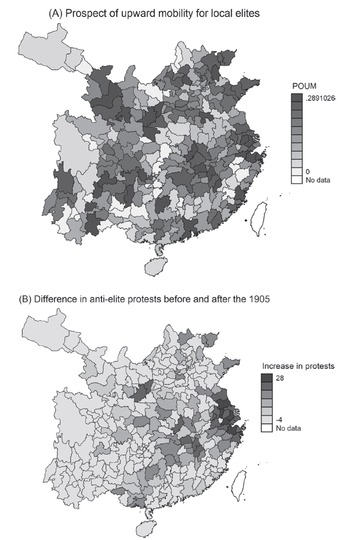
Our main data source on civil protests is Qingmo minbian nianbiao (The Chronology of Civil Protests in the Late Qing Dynasty), compiled by Zhang and Ding (Reference Zhang and Ding1982). The original data is drawn from several major nationwide newspapers and supplemented with data from the government archives, which record 1,511 incidents of grassroots protests in the last ten years of the Qing empire (1902–1911), including information on the time, location, causes, and participants of each protest. Anti-elite protests are defined as incidents that are either triggered by misbehaviors of local elites (such as over-extraction of surcharges and encroachment on local public assets by local elites) or targeted at establishments managed by local elites (such as local granaries, modern primary schools, etc.).Footnote 13 For placebo tests, we coded 91 incidents of anti-Christian protests and 131 incidents of anti-government protests. In addition, we use data on activities organized by secret societies from Liu (Reference Liu1992). Figure 1 maps the increase in anti-elite protests before and after the exam abolition and the distribution of POUM for local elites at the prefecture level.
SPATIAL DISTRIBUTION OF POUM AND DIFFERENCE IN ANTI-ELITE PROTESTS BEFORE AND AFTER THE ABOLITION
Source: See the Data section for details.

During China’s first decade of the twentieth century, vandalizing modern schools was a special action to express dissatisfaction against the local gentry, who frequently taxed the commoners to finance the construction of these schools. We draw the data on vandalizing modern schools from Tian and Chen (Reference Tian and Chen2009) as alternative outcome variables. The data on the occurrence of school destruction covers the period from 1904–1911.
The Prospect of Upward Mobility (POUM) for Local Elites
In China’s imperial civil exam system, the numbers of eligible candidates and successful passers at each exam level were controlled by a quota system. When the quota of the lower gentry (upper gentry or Juren) was binding at the prefecture (provincial) level, candidates from different prefectures faced an ex ante equal chance of success at the province level, but the ex post odds of success had a significant spatial variation and were stable over time. We exploit this feature to construct an ex post measure of the POUM for local elites. Specifically, using the number of Juren, the successful passers of the provincial exam from 1875 to 1905, divided by the total number of candidates (the lower gentry) during the same period, we calculate the passers-candidates ratio for each prefecture.Footnote 14
As shown in Online Appendix Figure D1, the prefecture’s success in provincial exam exhibits large spatial differences even within the province. Taking Fujian province as an example, the ex post success rate of the most successful prefecture, Fuzhou, is 0.289, while that of its nearby prefecture, Jianning, is only 0.014. The spatial variation in relative exam success turned out to be fairly stable over time. In Online Appendix Figure D2, we examine the persistence of the relative exam success in achieving the Juren degree. Panel A shows a quite strong correlation between a prefecture’s exam passers (Juren) as the proportion of total exam passers in a province in 1851–1905 and that in 1801–1850 (with a correlation of 0.9447). We also find a similar correlation using the prefecture’s rank within the province in exam passers in Panel B.Footnote 15
The results noted previously on regional variations of POUM and their stability over time provide important support for the validity of our measure of POUM. Take the example of Fuzhou versus Jianning again. Observing such a large and stable gap in the previous exam success rate, on average, the lower gentry in Fuzhou would expect a much higher probability of passing the exam than their competitors in Jianning. To the extent that the lower gentry’s perceived probability of passing the provincial exam and obtaining the upper gentry title is closely related to the previous success rate of their fellow candidates in the same prefecture, the ex post success rate (the passer-candidates ratio) before the abolition of the civil exam would be a good proxy for the prospect of upward mobility (POUM) for local elites.Footnote 16 In addition, using the information on the upper gentry who succeeded in the highest-level exams (i.e., Jingshi), we construct analogous measures of POUM for the upper gentry, that is, Jinshi/Juren and government officials/Jinshi. Footnote 17
Prefecture Characteristics
From a variety of sources, we collected a rich dataset on regional characteristics for robustness checks and heterogeneity analysis. In our baseline estimation, we include four sets of control variables (see Online Appendix Table D1 for the data sources and summary statistics). First, we compiled a weather shock dummy that is set to 1 if the rainfall is ranked as exceptionally high or low, based on historical meteorological data (State Meteorological Society 1981). Second, we include two dummy variables for whether a prefecture is situated on the coast or covers one or more major rivers to control for the potential influence of geographical features. Third, since the incidence of protests might also be correlated with economic conditions, we control for the urbanization rate at the prefecture level, using Rozman’s (Reference Rozman2015) three-type classification of Chinese cities. Fourth, we use the agricultural suitability for rice and sweet potatoes from the Food and Agriculture Organization (FAO 2012).
We also collect other information to address several alternative explanations. As proxies for human capital endowment, we collected data on Confucian academies (Shuyuan) from Ji (Reference Ji1996), the key educational infrastructure in imperial China, and the number of notable book authors from Jiang (Reference Jiang2005). The prefectural level number of students studying in Japan before 1905 and the density of newspapers capture the extent of political enlightenment.Footnote 18 To measure exposure to trade openness, we use the distance to treaty ports obtained from China Historical GIS (2016). In order to capture the political connections of local elites with incumbent officials, we use the data on the hometown of officials from the China Government Employee Database-Qing, constructed by Campbell et al. (Reference Campbell, Chen, Ren and Lee2019). We create two proxy variables for the extent of state extraction, including province-level fiscal income and expenditure data in 1908 (Zhou Reference Zhou2000) and the number of commercial tax (lijin) bureaus and commercial tax stations (Luo Reference Luo1936).
Data on Career Choices after the Exam Abolition
After the exam abolition, there were a variety of modern career paths, typically for those local elites with strong motivation for public service, including modern secondary schools and military colleges. We collected data on these career choices from a variety of data sources, including the list of Baoding Military College students from Chen (Reference Chen2006). We also drew the data on modern secondary school enrollment in the period 1907–1909 from the first, second, and third reports on modern education by the Ministry of Education of the Republic of China.
Descriptive Correlation between Upward Prospect and Anti-Gentry Protests
There is evidence linking the prospect of upward mobility (POUM) for local elites with anti-elite protests before and after 1905. In Figure 1, we map the increase in anti-elite protests before and after the exam abolition and the distribution of POUM for local elites. The prefectures with a higher frequency of anti-elite protests in the post-abolition period coincide with those that offered better career prospects for local elites before 1905. Figure 2 presents the plot of aggregate trends in incidences of anti-elite protests over time, dividing the full sample into a high-prospect group (prefectures with POUM above the median) and a low-prospect group (prefectures with POUM below the median). There was no obvious gap between the two groups before the exam abolition, but after the abolition, a significant divergence emerged. Despite a temporary decrease in 1908, the number of anti-elite protests in the high-prospect group started to climb remarkably after 1905, the year of the exam abolition. Moreover, there was a parallel trend between the two groups of prefectures before the abolition of the exam.Footnote 19
TRENDS OF ANTI-ELITE PROTESTS PER PREFECTURE PER YEAR
Notes: This figure shows how the average frequency of anti-elite protests in two groups of prefectures changed during the entire sample period (1902–1911). The two groups of prefectures are divided by the prefectural median of the POUM. The high (low) prospect group is composed of prefectures above (below) the median (0.031). The red vertical line marks the year of the exam abolition.
Source: See the Data section for details.

EMPIRICAL STRATEGY AND BASELINE RESULTS
Empirical Strategy
Our baseline differences-in-differences (DID) specification is the following:
 $${y_{it}} = \beta InPOU{M_i} \times Pos{t_t} + \gamma {X_{it}} + {\delta _i} + {\theta _t} + {\lambda _{prov}} \times {\theta _t} + {\varepsilon _{it}},$$
where y it is the number of anti-elite protests in prefecture i in year t. Post t is a dummy variable indicating the year after the exam abolition, which equals one after 1905, and InPOUM i is the logged POUM as a proxy for the career incentive of local elites. δi are prefecture fixed effects, controlling for all time-invariant differences between prefectures. θt are year fixed effects capturing the common shocks in a particular year that affect all prefectures. In addition, we control for flexible province-specific time fixed effects by using the interactions of province dummies and year dummies (λprov × θt), which helps us address potential time-varying confounding factors at the provincial level. X it includes the series of prefecture-level control variables including weather shock, the interactions between post and geographical features, urbanization indicators, and agricultural suitability. β is the coefficient of interest, capturing the effect of a disruption in career paths on anti-elite protests. To address the potential serial correlation of the error term, we cluster the standard errors at the prefecture level for all regressions.
Baseline Results
The baseline results are presented in Table 3. Column (1) reports the simple DID estimation including year and prefecture fixed effects. Column (2) adds the weather shock. The results show that those prefectures with a higher POUM for local elites did experience a higher increase in anti-elite protests after the exam abolition. We find that negative weather shocks have little effect on anti-elite protests. In Columns (3) and (4), we include the province-specific time trend and province-year fixed effects, respectively. Column (5) presents our preferred specification, which includes a full set of control variables and provincial-year fixed effects. The estimated β is 0.126 and statistically significant. In terms of magnitude, this estimate suggests that an increase of one standard deviation in logged POUM (0.838) is associated with 0.106 more incidents of anti-elite protests. This effect accounts for nearly half (45 percent) of the yearly anti-elite protests during the period 1902–1911.Footnote 20
THE EFFECT OF POUM ON ANTI-ELITE PROTESTS

* = Significant at the 10 percent level.
** = Significant at the 5 percent level.
*** = Significant at the 1 percent level.
Notes: This table reports the estimation results of Equation (1). Robust standard errors in parentheses are clustered at the prefecture-level. Other controls include dummy variables for proximity to coast and main river, urbanization classifications, and rice and sweet potato suitability.
Source: See the Data section for details.
To ensure that our results are not driven by some confounding factors, we further expand our analysis in Online Appendix Table D4 to include a series of additional control variables. Our results are robust to the inclusion of the total number of revolutionary party members, which is also a consequence of the abolition (Bai and Jia Reference Bai and Jia2016), the linguistic diversity and polarization, the dummies of political importance, and the grain price as a proxy for the agricultural production shock.
To formally test the parallel trend assumption of the DID approach, we examine whether there are any different trends in prefectures with different POUMs prior to 1905. We separately estimate the effects of POUM for each year using the following event-study specifications:
 $$\matrix{
{{y_{it}}} \hfill & = \hfill & {\sum\limits_{\tau = 1903}^{1912} {\beta InPOU{M_i} \times Yea{r_\tau }} } \hfill \cr
{} \hfill & + \hfill & {\sum\limits_{\tau = 1903}^{1912} {{\gamma _\tau }{X_i} \times Yea{r_\tau } + {\delta _i} + {\theta _t} + {\lambda _{prov}} \times {\theta _t} + {\varepsilon _{it}},} } \hfill \cr } $$
where the year 1902 is omitted as the reference year. The coefficient βτ identifies the effect of the POUM in year τ, compared with t. We also include interaction terms between the controls and a set of time dummies, Yearτ.
The results on βτ are displayed in Figure 3. It is clear that prior to 1905, all estimated coefficients fluctuated around zero and were statistically insignificant, suggesting that there were no heterogeneous trends in protests with regard to the POUM for local elites prior to the abolition. Furthermore, right after the abolition, the coefficients become significantly positive and show a slightly increasing trend in magnitude.
DYNAMIC EFFECTS OF THE POUM ON ANTI-ELITE PROTESTS BEFORE AND AFTER THE ABOLITION OF THE EXAM
Notes: This figure shows the estimated coefficient by year from Equation (2). Standard errors are clustered at the prefecture level. The points connected by the solid line indicate the estimated coefficients of the POUM interacted with Year τ . Year 1902 is omitted as the reference year. The gray lines with caps indicate the 95 percent confidence intervals. The red vertical dashed line marks the timing of the exam abolition.
Source: See the Data section for details.

Placebo Tests
There are also concerns that the effects of anti-elite protests might simply reflect the general environment of political instability rather than the outcome of local elites’ bad behavior. To mitigate this concern, we employ different types of social unrest to conduct a set of placebo tests, using other types of protests and riots, such as anti-Christianity protests, anti-government protests, or rebellion organized by secret societies. Table 4 reports the results. We find that none of these activities are correlated with the POUM for local elites. The effects of POUM on these placebo outcomes are not only statistically insignificant but also very small in magnitude (Columns (1) to (3)). We also add up the total incidents of the three placebo outcomes (anti-Christian protests, anti-government protests, and rebellion organized by secret societies) and conduct an additional placebo test.Footnote 21 This exercise results in a total of 371 incidents. As displayed in Column (4), we again find no effect on non-anti-gentry social unrest.
PLACEBO TESTS

* = Significant at the 10 percent level.
** = Significant at the 5 percent level.
*** = Significant at the 1 percent level.
Notes: This table reports the results of placebo tests. Robust standard errors in parentheses are clustered at the prefecture-level. Placebo social unrest is the sum of outcomes in Columns (1), (2), and (3). Other controls include dummy variables for proximity to coast and main river, urbanization classifications, and rice and sweet potato suitability.
Source: See the Data section for details.
Lastly, we explore whether the link between the abolition of the imperial civil exam and anti-elite protests was affected by other segments of the exam hierarchy whose upward prospects were also affected by the exam abolition.Footnote
22
Similar to the POUM of the lower gentry, we can measure the POUM for commoners by
 ${{Shengyuan\,Quota} \over {Pop}}$
and that for the upper gentry by
 ${{Jinshi} \over {Juren}}$
and
 ${{Official} \over {Jinshi}}$
Online Appendix Table D5 shows that neither the upward prospect for commoners nor that for the upper gentry has a significant impact on protests, suggesting that the effects are specific to the POUM for local elites.
THEORETICAL MODEL
In this section, we outline a simple game-theoretic model to incorporate our baseline empirical findings and guide our further empirical investigation of the mechanisms. Consider two players: a lower gentry (she) and a representative commoner (he). An allocation a ∈ {0,1} must be made. The utility of the commoner u depends on the state of the world, ω ∈ {0,1}, and the allocation. a The prior is that both states occur with equal probability ½. We assume that the commoner always wants the allocation to match the state, that is, u = 1 if a = ω and u = 0 otherwise. The utility of the gentry, v, is the same as u except v = x > 0 when a = 1 and ω=0.
The previously mentioned model setup can be interpreted as follows. The allocation a involves the provision of local public goods through a surcharge, where a =1 implies the surcharge is imposed and a = 0 the opposite. The commoner is willing to pay the surcharge if and only if the public goods are really needed. We use ω = 1 to represent the state in which the public goods are needed, and ω = 0 to represent the opposite state. The commoner’s ideal allocation is a = ω as reflected by the specification of u. However, the gentry can obtain an additional utility, x > 0 from the surcharge even if the public goods are not needed (ω =0). We assume that x is privately observed by the gentry, and the commoner believes that x is uniformly distributed on the interval [0,1].
Time proceeds as follows. The gentry first privately observes x and messages m ∈ {0,1} about the state ω. We assume that Pr(m = ω| ω) = π > ½, so the message m is an informative but imperfect signal about the state ω. Based on x and m, the gentry recommends an allocation â to the commoner. The commoner observes â and another message s about the state ω. We assume that conditional on the state ω, the message s is normally distributed with mean ω and standard deviation σ. Based on â and s, the commoner decides whether to protest or not. Making a protest is costly for the commoner: it is assumed he has to pay cost c > 0, and the probability of success is θ > c. If the protest is successful, allocation 1− â is taken and the gentry suffers a disutility y. Otherwise, allocation â is taken. Finally, under the civil exam system, the gentry also has probability β to obtain the upper gentry title via taking provincial exams, which brings value Z – 0 to her. But if the protest succeeds, the gentry will lose this opportunity as a punishment.Footnote 23 Obviously, β measures POUM in our model.
The details of the model are presented in Online Appendix A. To summarize, under the exam system, there exists a perfect Bayesian equilibrium for the above game where the gentry recommends â =1 when observing message m = 1, or message m = 0, but the additional utility x exceeds a threshold
 $\bar x$
. Given
 $\bar x$
, the commoner’s protest decisions are shaped by thresholds on his message. s These thresholds jointly determine the expected loss for the gentry in corrupting (i.e., in collecting surtax when it was not needed), which is a product of the likelihood of protest, the likelihood of protest being successful, the prospect of upward mobility, and the future rents from being an upper gentry. Four things follow.
Corollary 1:The exam abolition made the gentry more likely to over-collect surcharges when they were not needed (higher
 $\bar x$
) and, hence, the commoners were more likely to make a protest against surcharges. A gentry was stripped of the future rents from being an upper gentry by a successful protest, and this “deterrence” mechanism was deactivated after abolition. Since the opportunity cost of over-collecting surcharges was greater with a higher POUM before the exam, the abolition led to a greater increase in such behaviors and a greater increase in protests with a greater POUM.
Corollary 2: The marginal effect of POUM on the expected loss was increasing in the likelihood of the protest being successful. If the state monitory capacity is stronger, the state is more likely to conceive and punish the gentry’s corruption once a protest occurs, which means a protest is more likely to be successful. Therefore, the impact of POUM on anti-elite protests post-1905 should be larger with stronger state monitory capacity.
Corollary 3: The marginal effect of POUM on the expected loss was increasing the likelihood of protests. With lower costs of collective action, commoners were more likely to protest, all else equal. Therefore, the impact of POUM on anti-elite protests post-1905 should be greater when the costs of collective action are lower.
Corollary 4: With the gentry’s participation constraint, a greater POUM led to a higher exit of gentries, which made the impact of protest against surcharges even stronger.
A straightforward extension of our model is to include an outside option yielding utility
 $\overline V $
, which could be interpreted as utility gained from taking professions other than being a gentry. A gentry will participate in local public goods provision only when the resulting expected utility is higher than
 $\overline V $
, or equivalently, when the additional utility x exceeds another threshold
 $\underline x $
. This participation constraint implies another selection effect of POUM, as stated in Corollary 4.
MECHANISMS
In this section, we examine the empirical predictions of the model and pin down the mechanisms of worsening incentives and adverse selection that drove the linkage between the exam abolition and anti-elite protests.
Evidence on Surcharges
According to Corollary 1, in areas with a larger POUM, the abolition led to a greater increase in the collection of surcharges by local elites and a higher frequency of anti-elite protests. To test this corollary, we use the number of various surcharge-related protests or conflicts as the dependent variables. In Column (1) of Table 5, we identify those protests that are explicitly documented as “excess collection of surcharges” as the direct trigger of the protests. In Column (2), we use incidents of vandalizing surcharge agencies as the dependent variable. In Column (3), we use an alternative dependent variable, which is the incidences of vandalizing modern schools that were financed by the surcharges on commoners. In all of these specifications, we find positive and sizable effects of POUM after the abolition, suggesting that the abolition triggered the moral hazard of local elites regarding surcharge collection, which in turn led to protests against them.
EVIDENCE ON SURCHARGE

* = Significant at the 10 percent level.
** = Significant at the 5 percent level.
*** = Significant at the 1 percent level.
Notes: Robust standard errors in parentheses are clustered at the prefecture-level. Other controls include dummy variables for proximity to coast and main river, urbanization classifications, and rice and sweet potato suitability.
Source: See the Data section for details.
The Role of State’s Monitoring
As shown in Corollary 2, the impact of POUM on local elites on the anti-elite protest was greater where the state had a stronger capacity to monitor a gentry’s misbehavior. We use two proxies for state monitory capacity. First, we use the distance from a prefecture (km) to Beijing. The costs of travel, transportation, and information transmission were large, especially in the premodern world (Sng Reference Sng2014). Hence, it was difficult for the central ruler to monitor a far-away county official who might collude with local elites in collecting excessive taxes. Second, we use a dummy variable indicating a prefecture’s access to the telegraph network. In 1876, telegraphs were introduced to China, and by 1906, 60 percent of all prefectures had been connected to telegraph networks (Hao, Li, and Nye Reference Hao, Li and Nye2022).Footnote 24 The telegraph network was widely used to transmit information on grain prices, domestic conflicts, and military actions. As a result, the cost of information transmission was greatly reduced. We argue that it becomes easier for the central ruler to monitor a prefecture after accessing telegraph networks.
Table 6 presents the empirical results of testing Corollary 2. In Column (1), we add a triple-interaction term: distance from Beijing × POUM × Post, which captures the heterogeneous effect of state monitoring capacity on our treatment effect. The estimate of this triple-interaction term is negative and significant, which is consistent with our prediction. In Column (2), the estimated coefficient on the triple interaction, telegraph × POUM × Post, is positive and significant, which is similarly consistent with our prediction. With the inclusion of a triple-interaction term, the own effect of POUM on anti-elite protests remains significant in both specifications. These results lend support to Corollary 2, which highlights the role of state monitoring capacity.
THE ROLE OF STATE’S MONITORING AND COMMONERS’ COLLECTIVE ACTION

* = Significant at the 10 percent level.
** = Significant at the 5 percent level.
*** = Significant at the 1 percent level.
Notes: Robust standard errors in parentheses are clustered at prefecture level. In Column (1), we use the linear distance in thousand kilometers of a prefecture to Beijing. In Column (2), telegraph indicates whether a prefecture was connected to the telegraph network before 1900. The strength of clan is proxied by the number of genealogies in Column (3). The strength of religion is measured by the number of Buddhism temples in Column (4). To keep the double-interaction terms having a standard interpretation, the distance to Beijing, clan, and religion in the triple-interaction term use the deviation from the sample mean. Other controls include dummy variables for proximity to coast and main river, urbanization classifications, and rice and sweet potato suitability.
Source: See the Data section for details.
The Role of Commoners’ Collective Action
Corollary 3 of our theoretical model predicts that the impact of POUM for local elites on the anti-elite protest was greater where commoners had lower costs of collective action. We use two proxies to measure the costs of collective action. First, we propose that the strength of clans in an area, measured by the number of clan genealogies during the Qing dynasty, should be negatively associated with the costs of collective action. In premodern China, clans were the basic units of cooperation and trust in pursuing collective action (Greif and Tabellini Reference Greif and Tabellini2017; Rosenthal and Wong 2011). The presence of strong clans implies a lower cost of coordinating protests among commoners with kinship ties. Second, religion could also play an important role in coordination and mobilization of collection action (Iyer Reference Iyer2016). Affiliation to the same religious identity promotes mutual trust (Chuah et al. Reference Chuah and Gächter2016), helps screen out free riders, and stabilizes within-group cooperation (Akerlof and Kranton Reference Akerlof and Kranton2010; Carvalho Reference Carvalho2013). These effects work to reduce the costs of collective action.
We use the number of Buddhist temples as a proxy for religious influence, obtained from the Imperial Encyclopedia of the Qing Empire (Daqing Yitong Zhi). A greater number of temples within a prefecture indicates a greater proportion of villagers sharing the same religious attitude, which fosters greater mutual trust and more cooperation for collection actions. In Table 6, we add the interaction term with the number of genealogies and temples in Columns (3) and (4), respectively. We find that both estimates of these two triple interactions are positive and significant, indicating that the impact of POUM is stronger in areas with the presence of clans or shared Buddhist religion. These results provide supportive evidence for Corollary 3.
Evidence on Selection
As previously described, the local elites’ career profiles diverged greatly after the exam abolition. Some moved to cities and attended modern schools to move up the social ladder. A small group of the lower and upper gentries obtained college degrees from domestic and overseas universities. Modern secondary schools and military schools were major outlets for local elites who desired better career prospects. The process of moving out of rural areas for upward mobility triggered by the abolition of exams might have created an adverse selection problem: the lower gentry remaining in rural areas to serve local public services tended to be those with lower career prospects or those who desired private gains from local public services.
In what follows, we aim to provide some evidence for the selection process triggered by the exam abolition. First, we explore how exam abolition affected military school enrollment in urban areas. We collect information (prefecture hometowns and year of enrollment) on newly enrolled students of Baoding Military College, the largest national military college in the late Qing period, from 1903 to 1907. In Table 7, we apply a similar DID setting as Equation (1) and use the number of military college students as the dependent variable. A one-standard-deviation increase in the logged POUM (0.838) is associated with 0.5 more military school enrollments per million citizens from a prefecture after 1905. The estimate is statistically significant at the 1 percent level. This effect accounts for 54 percent of the sample mean of military school enrollment. Figure 4 presents the dynamic effects on military school enrollment. There is no significant difference in military school enrollment among prefectures with different POUM before the abolition but a dramatic increase after the exam abolition for those prefectures with higher POUM.
EVIDENCE ON SELECTION I: MODERN MILITARY COLLEGE

* = Significant at the 10 percent level.
** = Significant at the 5 percent level.
*** = Significant at the 1 percent level.
Notes: Robust standard errors in parentheses are clustered at the prefecture level. Dependent variable is the military college enrollment per capita from a prefecture. The sample period is 1903–1907.
Source: See the Data section for details.
DYNAMIC EFFECTS OF THE POUM ON MILITARY COLLEGE ENROLLMENT
Notes: This figure shows the dynamic effects extended from Table 7. Standard errors are clustered at the prefecture-level. The points connected by the solid line indicate the estimated coefficients of the POUM interacted with Year τ . Year 1903 is omitted as the reference year. The dashed lines with caps indicate the 95 percent confidence intervals. The red vertical line marks the timing of the abolition of the exam.
Source: See the Data section for details.

Second, we examine the effect of exam abolition on modern school enrollment and merchant group membership. Since we do not have data prior to 1905, we can only use a cross-sectional dataset for empirical analysis. In Table 8, we find that there were more modern secondary students per capita in 1907–1909 in areas with higher POUM. While these results must be interpreted with caution due to data limitations, the cross-sectional regression result implies that, after the abolition, those prefectures with a higher POUM were associated with higher modern school enrollment. This evidence suggests an outflow of talented youth from rural areas after the abolition.
EVIDENCE ON SELECTION II: MODERN SECONDARY SCHOOL

* = Significant at the 10 percent level.
** = Significant at the 5 percent level.
*** = Significant at the 1 percent level.
Notes: Robust standard errors in parentheses. Dependent variables are normalized by the prefecture population (in million). The dependent variable in Columns (1)–(3) is the total number of secondary school students per million citizens from 1907 to 1909. Other controls include dummy variables for proximity to coast and main river, urbanization classifications, and rice and sweet potato suitability.
Source: See the Data section for details.
Third, to examine the quality of the lower gentry after the abolition, we exploit a hand-collected dataset of electors (who were eligible to vote for local assembly) in rural areas around Suzhou in 1909 to examine their family background. Online Appendix B describes how we construct the key independent variables and reports the regression results in Table B1. A cross-sectional analysis shows that those lower gentries who remained in rural areas were more likely to come from below-average families and more likely endowed with a relatively low level of human capital.
ALTERNATIVE EXPLANATIONS
In this section, we discuss a number of alternative explanations. While we cannot claim the POUM-based hypothesis is the only explanation, we show strong evidence that our key results are unlikely to be overturned by these alternative interpretations.
The Rise of Non-Scholar Landed Elites
One could argue that the scholar gentry’s power might decline, and other local elites could rise with the exam abolition. In addition to the lower gentry, who held the civil exam title, there could be some other local elites, such as the landed gentry, who could not pass the civil service exam but were very wealthy. Under the exam system, the lower gentry had the likelihood of holding political power in the future and hence could constrain the power of the landed gentry, which was like a system of checks and balances between the scholar gentry and the landed gentry. However, after the abolition, the gentry that was economically powerful started to dominate rural affairs and behaved unresponsively, which caused a deterioration in local governance.
To evaluate the validity of this potential explanation, we first discuss the extent to which there was a polarization between the scholar gentry and the landed gentry before the abolition. First, most of the lower gentry came from wealthy families.Footnote 25 Since landholding was the most important form of wealth holding, it is safe to argue that these members primarily came from landlord families. Second, since exam titles were the only source of social privilege, once a family became wealthy, they would invest heavily in education to produce an exam passer (Chen, Kung, and Ma 2020). Third, in places where local communities were dominated by large kinships, kinships produced an increasing number of exam passers who dominated local communities (and held more land), and exam passers typically served as kinship leaders (Ho Reference Ho1962). Considered together, these stylized facts suggest that landed elites and scholar gentries largely overlapped with each other and that there was no salient polarization between these two elite groups in rural China.
It is still possible that, in some regions, there was a distinctive separation between the scholar gentry and the landed gentry. To examine whether this separation drove our main results, we introduced a proxy for the power of the landed gentry, which is land inequality. We hypothesize that the power of the landed gentry is stronger in places with greater land inequality. If land inequality measures the power of the landed gentry, the alternative hypothesis about the checks and balances between landed and scholar gentry would predict that the abolition of the exam should have a stronger effect on anti-gentry protests in places with greater land inequality, and such an effect should be even stronger in places with greater POUM (indicating a greater loss of checks and balances on the landed gentry).
There are no systematic data available on land inequality at the prefecture level from the late Qing period or Republic era, and we instead measure land inequality using the prefecture-level land Gini coefficient using data on land distribution from approximately 1950, before the land reforms were launched by the Chinese Communist Party.Footnote 26 This measure is arguably justifiable because the structure of rural land ownership in China changed little between the early twentieth century and the land reforms in approximately 1950.Footnote 27
Table 9 presents the results of testing this hypothesis. As shown in Column (1), we do not find a significant effect of land inequality after the exam abolition, and the effect of POUM remains unchanged. Column (2) shows that the estimate of the triple interaction is also insignificant, suggesting the absence of heterogeneous effects between POUM and land inequality. We find similar results in Columns (3) and (4) using the tenant farmer rate from the provincial-level survey in 1912.
ALTERNATION EXPLANATION: THE ROLE OF LANDED GENTRY

* = Significant at the 10 percent level.
** = Significant at the 5 percent level.
*** = Significant at the 1 percent level.
Notes: This table reports the results examining the potential effect of landed gentry. Robust standard errors in parentheses are clustered at prefecture level. The land Gini coefficient is calculated at the prefecture level, using data on land distribution around 1950 before the communist land revolution. The tenant farmer rate is the proportion of tenant framers at the provincial level in 1912. To keep the double-interaction terms having a standard interpretation, the land Gini coefficient and the tenant farmer rate in the triple-interaction term use the deviation from the sample mean. Other controls include dummy variables for proximity to coast and main river, urbanization classifications, and rice and sweet potato suitability.
Source: See the Data section for details.
Human Capital
One potential concern is that human capital endowment might correlate with the passer-candidate ratio and have a greater effect on protest occurrences after the exam abolition, which could confound the effect of POUM.Footnote 28 To ensure that our results do not capture this potential influence, we use two proxies to control for the local human capital stock. We collected data on Confucian academies (Shuyuan), the key educational infrastructure in imperial China (Ho Reference Ho1962), from Ji (Reference Ji1996). We control for this confounding effect by adding to our baseline specification the interaction between Confucian academies per capita and the post-abolition dummy. Alternatively, we also use the number of book authors as another proxy for human capital. Columns (1) and (2) of Table 10 report the results after controlling for the potential effect of human capital stock. The estimated effect of POUM remains highly significant, although its magnitude becomes somewhat smaller, suggesting that our results are unlikely to be explained by the effect of human capital endowment.
ALTERNATION EXPLANATIONS: HUMAN CAPITAL AND POLITICAL ENLIGHTENMENT

* = Significant at the 10 percent level.
** = Significant at the 5 percent level.
*** = Significant at the 1 percent level.
Notes: This table reports the results after controlling for the potential influence of human capital and political enlightenment. Robust standard errors in parentheses are clustered at the prefecture-level. Other controls include dummy variables for proximity to coast and main river, urbanization classifications, and rice and sweet potato suitability.
Source: See the Data section for details.
Political Enlightenment
Another alternative interpretation of our results is that commoners in prefectures with higher POUM were more politically enlightened, and they might have viewed the abolition of the civil exam as a signal of an empire’s collapse, increasing anti-establishment sentiment and leading to anti-elite protests. We employ two relevant proxies for local political enlightenment: the number of students studying in Japan before 1905 and the density of newspapers. Columns (3) and (4) of Table 10 show the results, including the interactions between these proxies and the post-abolition dummy. The effect of political enlightenment did not change before and after the abolition, and the impacts of POUM remained similar to our baseline estimate.
Finally, we discuss additional alternative explanations, including greater state extraction, the loss of the lower gentry’s authority, and greater trade openness. The results are reported in Online Appendix C. We show strong evidence that our key results are unlikely to be overturned by these alternative interpretations.
CONCLUSION
The Keju system was so deeply embedded in China’s traditional political system that its sudden abolition generated career disruption and social instability via many channels. This paper focuses on one important aspect—local governance in rural areas. The abolition of the exam system disrupted the traditional career paths of local elites, which had previously provided a modern career path for them. As a result, it triggered both a moral hazard and an adverse selection problem on the part of local elites. We apply a DID approach to empirically test the linkage between the abolition of civil exams and anti-elite protests. Using a prefecture-level dataset from 1902–1911, we find that those prefectures with a higher POUM before the abolition witnessed a higher incidence of anti-elite protests after the abolition. The evidence provided is consistent with the predictions of the model, highlighting the role of POUM in shaping the selection effects and moral hazard of lower gentry as public agents.
Our study sheds new light on the roots of the Chinese communist revolution since the rise of the “bad gentry” in rural areas set the stage for the Chinese Communist Party to fuel a social revolution. Rural local elites either switched to modern education in the cities or stayed in rural areas and decayed into “bad gentry.” The “grabbing hand” of local elites stirred up widespread complaints and protests, which enabled the Chinese Communist Party to mobilize furious peasants from village to village to fight against local elites and finally overthrow the old regime ruled by the Chinese Nationalist Party (Perry Reference Perry1980, Reference Perry2012). By presenting empirical evidence, our study helps to lend support to the notion that the decay of the gentry, triggered by the abolition of the exam, planted the seeds of a radical revolution in modern China.