Introduction
The past decade has seen phenomenal growth in public support for the production, processing and marketing of local foods. This increased support is driven by a number of factors, including a renewed interest in food grown closer to home, supporting local farmers, reducing the distance food travels, sustaining the environment, and food safety and quality. Canadian industry and government have responded in a number of ways, including an increase in direct to consumer sales (often through farmers' markets) and provincial/regional branding campaigns. In Canada, farmers' markets are a popular and increasing method of direct to consumer sales, with the number of Canadian farmers' markets doubling since the late 1980s 1 . Such growth is seen across Canada. In Ontario, the number of farmers' markets increased from 60 in 1991 to 163 in 2010 2 , and British Columbia added 40 new farmers' markets between 2000 and 2006 1 . Much of the growth in farmers' markets has occurred in urban centers. For instance, Toronto added six new markets in 2007 1 , and in Vancouver, British Columbia, sales via farmers' markets almost tripled from C$1.2 million in 2005 to approximately C$3 million in 2008 1 .
There has also been increased support for local food initiatives through provincial and regional branding campaigns. For example, the government of Ontario has established the Pick Ontario Freshness campaign in addition to other initiatives including FoodLand Ontario and Savour Ontario. Pick Ontario Freshness is a 4-year, C$12 million provincial initiative to promote Ontario-produced foods and encourage Ontarians to buy locally in restaurants, grocery stores and farmers' markets 2 . Similar initiatives are taking place in other provinces. Select Nova Scotia is a campaign to increase awareness and consumption of Nova Scotia produced and processed agri-food products by citizens and visitors of that province 3 .
Research has examined consumer perceptions across a variety of issues pertaining to local food. These studies suggest that local foods have a number of characteristics related to the actual product itself as well as production and distribution methods that make buying local appealing to consumers. However, there is a paucity of research examining the link between consumers' perceptions of local food and actual purchase behavior. To our knowledge, the research reported herein is the first large-scale study that links attitudes and values toward buying local to actual (self-reported) behavior. Specifically, Ontario consumers were asked about their purchase of 19 fresh produce categories and 3 meat categories available in Ontario during the summer months of August and September, 2010. Logistic regression was used to explain differences in purchasing behavior of Ontario produce based on perceptions of local products, barriers to buying local, and perceived responsibility for buying local.
Literature Review
In Canada over the past decade, there has been an increase in marketing products as ‘locally grown’ and ‘regionally grown’ as reflected in a range of government and direct to consumer marketing initiatives, particularly farmers' markets. A growing literature, the disciplinary focus of which spans geography, sociology and agricultural economics, has enhanced our understanding of the drivers behind the increasing public interest in and support of these buy local initiatives. In particular, the geography and rural sociology literature has grappled with the nuanced changes in and the interface between food, social values and the environment. A major focus has been defining local and regional food systems and how the shortening of supply chains impacts wider agricultural policies and practices such as agri-environmental management and sustainabilityReference Smithers, Lamarche and Joseph 4 . A related stream of research has examined changing consumer demands for food and the various ways in which these changing demands are challenging existing food production and distribution systems. The focus of this research has been on how consumers view community values and their concerns about food security, resource preservation and the need to sustain local farming communities. The literature explores a range of topics such as the trajectory of the key elements of this localized/alternative food system, which include farmers' marketsReference Smithers, Lamarche and Joseph 4 – Reference Feagan, Morris and Krug 6 , community-supported/shared agriculture programs (CSAs)Reference Feagan and Henderson 5 , community food programs, ‘pick-your-own’ and ‘on farm produce stands’Reference Smithers, Lamarche and Joseph 4 , Reference Cox, Holloway, Venn, Dowler, Hein, Kneafsey and Tuomainen 7 . A report by Donald focuses on various food innovations in Ontario that are bringing about a new culture of food that is healthier and sustainableReference Donald 8 . A recent literature review of local food initiatives highlights their influence across different sectors of the food system as well as their effects at the personal, interpersonal and institutional levelReference Baker 9 .
The agricultural and environmental economics literature has explored the ‘local food’ issue from several perspectives, mainly in the USA. Although local foods are defined in many ways (including region, state, country and distance), the different terms capture the notions of what consumers demand from the food systemReference Larson 10 – Reference Clancy and Ruhf 14 . Some of the literature focuses on consumers' perceptions of local and motivations for purchasing local food productsReference Hand and Martinez 13 , Reference Onozaka, Nurse and McFadden 15 , Reference Thilmany, Bond and Bond 16 and some on policy issues affecting the development of local food systemsReference Onken and Bernard 17 , Reference Hardesty 18 . This line of literature suggests that consumer preferences are driven by inherent product characteristics (such as freshness and taste), safety and quality, food miles and health benefits and that consumers are willing to pay a premium for country, county, in-state and regionally produced productsReference Schneider and Francis 11 , Reference Loureiro and Hine 19 – Reference Toler, Briggeman, Lusk and Adams 24 . In addition, some consumers exhibit altruistic motivations related to the public goods they want to support, particularly the plight of local farmers, support for jobs, maintaining local farm land and the environmentReference Onozaka, Nurse and McFadden 15 , Reference Lusk, Foster and Nilsson 25 , Reference Umberger, Thilmany McFadden and Smith 26 . In other studies, consumers are willing to support local if they believe that the distribution of benefits in the supply chain is ‘fair’ and those benefits accrue to local farmersReference Carpio and Isengildina-Massa 21 , Reference Toler, Briggeman, Lusk and Adams 24 , Reference Lusk and Briggeman 27 , Reference Chang and Lusk 28 . The literature also highlights the importance of understanding the various definitions of ‘local’ in order to understand the expectations and aspirations people have for food system performanceReference Durham, Roheim and King 12 , Reference Hand and Martinez 13 . The literature on policy support suggests that state agricultural marketing programs have been significant to the growth in demand for and availability of local food productsReference Onken and Bernard 17 , Reference Hardesty 18 .
Several studies have utilized survey or qualitative research to examine people's beliefs, attitudes and motivations toward buying local, although none of these studies linked perceptions to actual purchasing behavior. These studies indicate that people believe buying local food is good for the local economy, particularly through supporting local farmers, and beneficial to the rural areaReference Roininen, Arvola and Lähteenmäki 29 – Reference Chambers, Harvey, Traill, Lobb and Butler 32 . Nonetheless, in some of these studies, despite having positive beliefs and attitudes toward buying local, respondents typically rated whether or not food was local as having a relatively small influence in their food purchase decisionsReference Schneider and Francis 11 , Reference Selfa and Qazi 30 . Two more recent Canadian surveys, one conducted in Guelph, Ontario and the other in Nova Scotia, confirmed the findings of the aforementioned studies suggesting that concern for local farmers and the local economy were seen as benefits and drivers to buying localReference Dukeshire, Garbes, Kennedy, Boudreau and Osborne 33 , Reference Cranfield, Henson and Blandon 34 . However, unlike the other studies, respondents in both studies also indicated concern for the environment as an important factor for buying local, potentially reflecting elevated concerns about food miles and global warming.
Collectively, the studies reveal that consumers exhibit heterogeneous preferences for novelty, local and regional products. However, most of these studies use stated preference data and are limited to the USA. We are not aware of any study that considers consumer purchase decisions of regional foods in Ontario, Canada. The only three closely related studies in the published literature in Canada are by Smithers and his colleagues, who focused on the nuanced role of farmers' markets and the interaction between farmers/vendors and consumers from 15 farmers' markets in OntarioReference Smithers, Lamarche and Joseph 4 and the two previously mentioned surveys that were conducted in Ontario and Nova ScotiaReference Dukeshire, Garbes, Kennedy, Boudreau and Osborne 33 , Reference Cranfield, Henson and Blandon 34 . None of these three studies, however, assessed the relationship of motivations to buy local with actual purchase behavior. To build upon the extant research, the current study presents the first empirical analysis focusing on actual consumption of Ontario grown produce using a comprehensive coverage of produce types. In particular, three potential motivating factors for buying local, that is perceptions about local food, barriers to buying local and responsibility for buying local, are related to self-reported behavior, including the actual purchase behavior for 22 Ontario products.
Sample
The method of data collection was through an Ontario-wide, web-based survey. This survey was part of a longitudinal panel that sent online surveys regarding food issues. A third-party market research firm, Academica Group, recruited the original sample in 2008 through random digital dialing using landlines only. Effort was made to ensure the distribution of the panel reflected that of the province within ±2% based on the 2006 Census of Canada. However, certain groups were harder to recruit in the required numbers, for a number of reasons. Thus, the final sample was overrepresented by individuals with a university degree, over 50 years of age, and women. Selected individuals were contacted and the nature and purpose of the longitudinal study was explained to them before being asked to participate. The total sample size for the panel was 4679 with respondents ranging from 20 to 69 years of age. The survey reported in this study was the sixth one presented to the panel and was administered in August and September, 2010. The survey yielded a total of 1879 responses, representing a response rate of 40.2% of the panel.
Survey
The survey consisted of nine different topics related to the purchase of local food, including beliefs and attitudes toward buying local, conditions under which people would buy local over non-local food, geographic origins of food items purchased in the past 2 weeks, barriers to buying local food, whether or not respondents had engaged in different types of buy local behavior in the past year, purchase behavior concerning strawberries, specific requirements for food to be considered local, availability and quality of food from different venues, and personal/societal responsibility for purchasing local food. Below, we detail the elements of the survey used for the analysis of people's motivations to engage in behaviors related to buying local, including the self-reported buying behavior for 22 different food products.
The survey contained three different measures that were used to assess the respondents' overall beliefs, attitudes and values toward local food. The purchase of local foods was measured by asking respondents to indicate the origin of any of 22 different produce and meat items that they had purchased 2 weeks prior to the survey. One produce item (strawberries) was selected for additional in-depth questions related to the propensity to buy local. The following subsections provide details on each of the measures and the questions contained therein.
Factors associated with buying local food
Three factors were examined for their association with consumer behaviors that supported buying local food. The three factors were assessed by three measures: perceptions about local food, barriers to buying local food and personal/societal responsibility for buying local.
Perceptions about local food index
The perceptions about local food index (Perceptions) assessed consumers' views toward eight attributes often associated with local food. Respondents indicated their responses using a seven-point semantic differential scale, with the negatively valenced descriptor on the left side and the positively valenced descriptor on the right side. The eight items rated were: hurts/helps local farmers, bad/good for the environment, unhealthy/healthy, not fresh/fresh, expensive/inexpensive, limited variety/wide variety, poor taste/excellent taste and poor quality/excellent quality. The items in this section were summed to form the perceptions about local food index (Perceptions) (mean=46.7 out of 56; SD=5.94; Cronbach alpha=0.80).
Barriers to buying local index
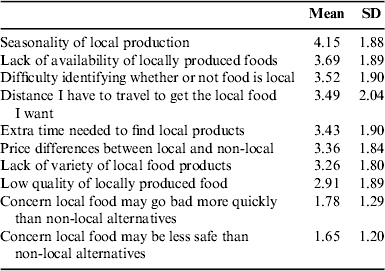
The barriers to buying local index (Barriers) assessed factors that individuals perceived as barriers to purchasing local food. Respondents were asked to indicate on a seven-point scale, ranging from 1 ‘No Barrier’ to 7 ‘Large Barrier’, the extent to which ten different potential barriers affected their ability to purchase local food. The potential barriers were: ‘the distance needed to travel to buy local food’, ‘extra time needed to find local food’, ‘price differences between local and non-local foods’, ‘quality of locally produced food’, ‘lack of variety of local food products’, ‘lack of availability of locally produced food’, ‘seasonality of local food’, ‘concern local food may be less safe than non-local alternatives’ and ‘difficulty identifying whether or not food is local’. The ten items were aggregated to form the barriers to buying local index (Barriers) (mean=31.1 out of 70; SD=11.0; Cronbach alpha=0.82).
Personal/societal responsibility for buying local index
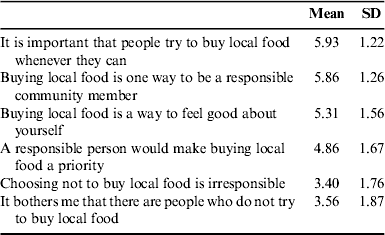
The personal/societal responsibility for buying local index (Responsibility) assessed respondents' level of agreement using seven-point scales ranging from 1 ‘Strongly Disagree’ to 7 ‘Strongly Agree’ with six statements concerning a sense of moral responsibility for buying local food. The items included: ‘it is important that people try to buy local food whenever they can’, ‘buying local food is one way to be a responsible community member’, ‘buying local food is a way to feel good about yourself’, ‘a responsible person would make buying local food a priority’, ‘choosing not to buy local food is irresponsible’ and ‘it bothers me that there are people who do not try to buy local food’. These six items were combined to form the personal/societal responsibility for buying local food index (Responsibility) (mean=28.9 out of 42; SD=7.42; Cronbach alpha=0.88).
Actions taken in the past year to support buying local
Respondents were asked to indicate from a list of activities associated with buying/supporting local food which activities they had engaged in during the past year. The list included asking if they had intentionally purchased local food, talked to their grocer about supplying local foods, paid more to purchase a local product, purchased a product over a similar product because it was local, did not purchase a product because there was no local choice and only bought some types of food in season.
Origin status of recently purchased products
Respondents were asked to indicate, for each of 22 different fresh produce and meat items, whether they had purchased the item in the past 2 weeks. If they had purchased the item in the past 2 weeks, they were asked to indicate the status of the product's origin from five different options: grown in my province, grown elsewhere in Canada, grown outside Canada, checked but could not find out where grown and did not check where grown. The results for each item were dichotomized as grown in Ontario versus not grown in Ontario (any of the other four options).
Purchase behavior for fresh strawberries
Respondents were asked to indicate whether they had purchased strawberries in the past year. Those who indicated they had were asked to indicate whether or not they had bought strawberries all year long regardless of where they were grown, if they had only bought local strawberries, if they had only bought strawberries in season and if they had bought strawberries in the winter. Strawberries were the product selected for the additional items because it was expected that most respondents would have purchased strawberries, there is a narrowly defined growing season for local strawberries in Ontario, and with very few exceptions, only non-local alternatives are available outside the relatively short Ontario growing season for strawberries.
Statistical analysis
The Statistical Package for the Social Sciences (SPSS), version 19 was used for all statistical analysis. Descriptive analyses of either frequencies or means were provided for individual items as well as the three indices. Simple logistic regression equations were run to determine the effect of each of the three indices on respondents' actions taken to either support or purchase local foods. Thus, for each index (Perceptions, Barriers, Responsibility), simple logistic regression analyses were run with each of the six items assessing buy local actions/behavior, the 22 fresh food items (not buy Ontario/buy Ontario) and the five strawberry items acting as the dependent variable. The same logistic regression analyses were also run adjusting for sex, education (five levels ranging from less than high school to university) and age (five levels in 10 year ranges, starting from 20 to 29 years). Because in all cases the unadjusted and adjusted odds ratios were extremely similar, only the adjusted odds ratios are reported.
Results
Perceptions, barriers and responsibility to buy local
In general, most respondents had favorable perceptions of local food, indicating that they believed local food helps local farmers, is good for the environment, is healthy, is fresh, has excellent taste and is of excellent quality. However, perceptions of cost and variety were mixed, with some individuals perceiving there to be a wide variety of local food, whereas others found variety to be limited. Similarly, some respondents perceived local food to be inexpensive, whereas others viewed local foods as expensive (see Table 1). The strongest barriers centered around being able to obtain local foods including the seasonality of local production, lack of availability of locally produced foods as well as the distance and extra time required to get local food. Difficulty identifying whether food is local or not, price differences between local and non-local foods and lack of variety of local food products were also reported as barriers (see Table 2). However, it should be noted that all of these barriers were perceived as moderate, with most scores around the midpoint of the seven-point scale. For items assessing personal and societal responsibility for buying local, there were relatively high scores given for the ideas that it is important for people to buy local food and buying local food is a way to be a responsible community member (see Table 3). However, respondents were less likely to identify people as irresponsible if they did not buy local food or feel bothered that others did not try to buy local. A few respondents in the comments section of the survey indicated that they felt it was inappropriate to label individuals who did not buy local food as ‘irresponsible’ because there may be other reasons (primarily cost) out of their control for not buying local.
Perceptions about local food.

Items answered on seven-point semantic differential scales.
Barriers to buying local food.

Items answered on scales ranging from 1 ‘No Barrier’ to 7 ‘Large Barrier’.
Personal/societal responsibility for buying local.

Items answered on scales from 1 ‘Strongly Disagree’ to 7 ‘Strongly Agree’.
Factors associated with purchase behavior
Actions taken in the past year to support buying local
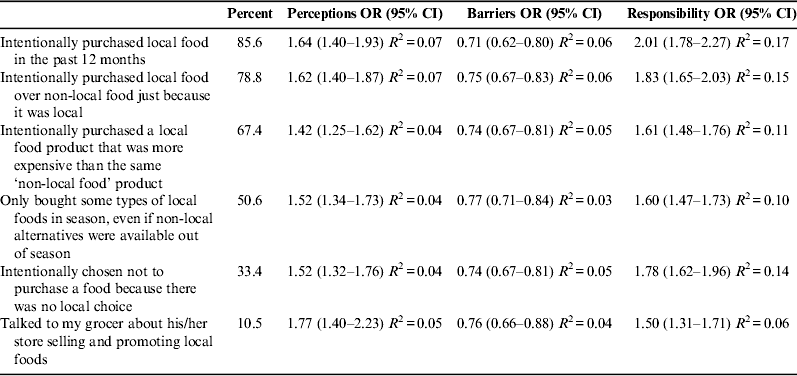
Table 4 presents the percentage of respondents who indicated that they had engaged in each of six activities related to purchasing or supporting local food during the past year. The results suggest that a majority of respondents had intentionally bought local food in the past year (85.6%), purchased a product just because it was local (78.8%) and paid more for a local product (67.4%). Respondents were less likely to indicate that they had foregone a product because they only bought that product in season (50.6%) and intentionally chose not to buy a product because there was no local choice (33.4%). To determine the association between perceptions, barriers and responsibility with each of the six behaviors/actions, separate binary logistic regressions were run. As shown in Table 4, Perceptions, Barriers and Responsibility were significant predictors (P<0.05) of all six behaviors. Therefore, higher positive perceptions and stronger feelings of responsibility for buying local were positively associated with all behaviors associated with buying or supporting local, and higher perceived barriers was negatively associated with the same behaviors. A local Behavior index (mean=3.28; SD=1.69) was formed by adding together the number of behaviors each respondent reported having engaged in, resulting in an index ranging from 0 (performed no behaviors) to 6 (performed all behaviors). Results of three multiple regressions, adjusted for age, sex and education revealed a significant positive relationship between the Behavior index and Perceptions (b=0.21, P<0.001; adjR 2=0.06) as well as Responsibility (b=0.39, P<0.001; adjR 2=0.17) and a negative relationship between the Behavior index and Barriers (b=−0.20, P<0.001; adjR 2=0.06).
Adjusted odds ratios (OR) representing the effect of perceptions, barriers and responsibility on actions taken related to buying or supporting local food.

Odds ratios and (95% CI) adjusted for age, sex and education level.
R 2=Nagelkerke R-square.
Purchase behavior for fresh products in past 2 weeks
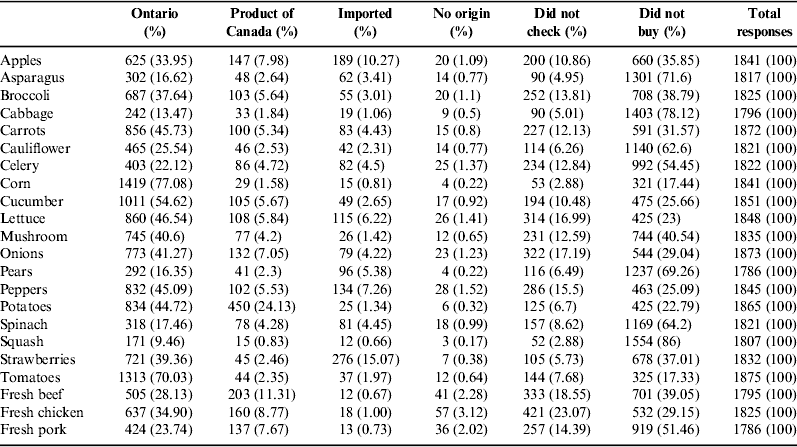
Table 5 indicates whether or not consumers had purchased each of 22 fresh products in the past 2 weeks, and if they had, what the status of origin was for the most recent purchase. As expected, there was a wide range of frequency of products purchased in the past 2 weeks. The most commonly purchased in the 2-week period were tomatoes (83.7%), corn (83.6%), potatoes (77.2%) and lettuce (77.0%). The least commonly purchased in the same time period were cabbage (21.9%) and asparagus (28.4%). From respondents who reported buying a product in the past 2 weeks, the products most frequently produced in Ontario include corn (93.4%) and tomatoes (84.7%). Five products were produced in Ontario less than half the time, including celery (48.6%), spinach (48.8%) and the three meats (beef 46.2%, pork 48.9% and chicken 49.3%).
Origin of 22 products purchased in past 2 weeks.

To determine the association between perceptions, barriers and responsibility on whether or not respondents purchased each product item locally (in Ontario), separate binary logistic regressions were run. Table 6 indicates the results adjusted for age, sex and education. For all 22 items, positive perceptions toward local foods were associated with higher odds of buying an Ontario product, with odds ratios ranging from a low of 1.34 (asparagus) to a high of 1.67 (apples). All odds ratios were significant (P<0.05) with the exception of squash which just fell short of being statistically significant. For all 22 items, perceived Barriers were significantly (P<0.05) associated with lower odds of buying an Ontario product, with odds ratios ranging from 0.58 (fresh pork) to 0.75 (fresh chicken). Similar to Perceptions, for all 22 items with the exception of squash, higher levels of perceived Responsibility for buying local foods were significantly (P<0.05) associated with higher odds of buying an Ontario product, with odds ratios ranging from a low of 1.12 (squash) to a high of 1.65 (tomatoes).
Adjusted odds ratios (OR) representing the effect of perceptions, barriers and responsibility on whether most recent product purchase was local.

Odds ratios and (95% CI) adjusted for age, sex and education level.
R 2=Nagelkerke R-square.
Factors associated with purchasing strawberries
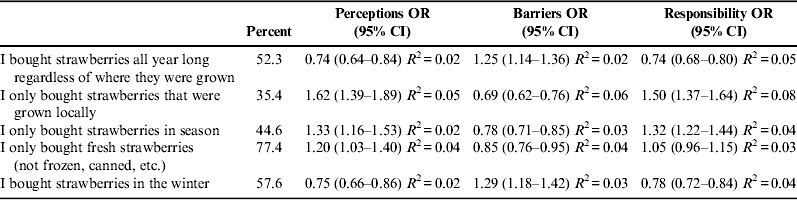
Respondents (1778, 94.6%) who indicated that they had purchased strawberries in the past year were asked five questions pertaining to behaviors that were thought to be associated with buying only local strawberries. As seen in Table 7, over three-quarters of respondents reported buying only fresh strawberries, about half bought strawberries only when in season and just over a third indicated they purchased only local strawberries. Just over one-half indicated they bought strawberries all year long regardless of where they were grown, and a similar percentage indicated that they bought strawberries in the winter.
Adjusted odds ratios (OR) representing the effect of perceptions, barriers and responsibility on actions taken related to buying strawberries.

Based on 1778 (94.6%) respondents who indicated they had purchased strawberries in the past year.
Odds ratios and (95% CI) adjusted for age, sex and education level.
R 2=Nagelkerke R-square.
To determine the association between perceptions, barriers and responsibility on each of the five behaviors related to buying only local strawberries, separate binary logistic regressions were run. Table 7 indicates the results adjusted for age, sex and education. The results show that all three predictors were significant (P<0.05) and had the expected direction for strawberry purchasing behavior, with the sole exception of the relationship between Responsibility and buying strawberries only if fresh.
Discussion
As outlined in the Introduction, there has been a huge growth in financial and policy-related support for the production, processing and marketing of local foods, presumably in response to, but also in turn fuelling, the interest of the public in this area. Previous research confirms this interest by revealing, for example, a willingness to pay more for local food, a desire to support local farmers, a belief that it is important to reduce the distance food travels in order to sustain the environment and perceived higher quality and taste of local food. To date, though, there has been little research that explores the significance of specific factors as drivers of purchase behaviors. This lack of research results in an important gap that establishes a link between people's beliefs, attitudes and values toward local food and actual purchase and consumption. This research aimed to close that gap by examining the association of perceptions, barriers and values toward buying local food with actual behavior.
The Perceptions index indicated relatively strong positive perceptions of local food, including perceiving buying local as helping local farmers and the environment, and local food being fresh, healthy and of good quality and taste. On the downside, respondents felt that local foods tended to be somewhat expensive and somewhat limited in terms of availability. Respondent perceptions from the present study coincide with results from extant studies suggesting that consumers value physical and social attributes of their food mostReference Schneider and Francis 11 , Reference La Trobe 35 – Reference O'Hara and Stagl 37 .
Respondents also indicated a number of barriers that reportedly interfered with their ability to buy local food. The barriers seemed primarily related to availability, including seasonality, distance traveled and extra time required to buy local products, and lack of variety. Furthermore, price and the ability to differentiate local from non-local food were also identified as barriers. These findings were consistent with other studies that assessed barriers to buying local foodReference Stephenson and Lev 31 , Reference Chambers, Harvey, Traill, Lobb and Butler 32 .
In addition to examining perceptions of and barriers toward buying local that is typical in other studies, we extended the present study to try to ascertain people's values toward buying local food. In particular, an index was developed to assess consumers' perceived personal and societal responsibility for buying local food. Results from the Responsibility index indicated that participants felt a fairly high degree of personal and social responsibility to buy local. In particular, they gave fairly strong endorsement to the ideas that it is important for people to buy local when they can and that a responsible community member would buy local. They also indicated that buying local is a way to feel good about oneself. Although we are not aware of studies that assess values to buying local, studies in Europe on organics suggest that consumers sometimes relate feelings of good conscience and feelings of responsibility for the well-being of one's family with organic food purchase decisionsReference Baker, Thompson and Engelken 38 – Reference Magnusson, Arvola, Hursti, Aberg and Sjoden 40 .
Overall, our results are consistent with studies suggesting that while consumers generally have positive perceptions of local food and feel a responsibility to support local foods, they also experience a number of barriers when trying to buy local. However, the present study builds upon the findings of other studies by examining the association of these three factors (Perceptions, Barriers and Responsibility) with behaviors related to supporting local food, including the actual purchase behavior for 22 different products. The results of logistic regression analyses point to a consistent relationship between these three factors and behaviors related to buying local. That is, buying local and related behaviors were positively associated with positive perceptions of local food and greater feelings of responsibility toward buying local, and negatively associated with barriers to buying local. In particular, the three factors were consistently predictive of local buying behavior for all 22 different products. It is noteworthy that the three factors were associated with purchase behavior across a wide range of items that differed in the type of product, frequency of being purchased and proportion of the sales being local. This outcome suggests that people have an overall orientation or schema to buying local in general, rather than a highly specific schema directed to one or a few particular products. As such, campaigns and interventions may be more successful if they are designed to increase consumers' perceptions of local products in general, rather than focusing on a single product or category of product. However, it is also noted that the overall explanatory power of these three variables for predicting who would buy local versus non-local goods was somewhat low. This finding is not largely unexpected given that whether or not a product is local is only one of many factors that will influence any given food purchase decisionReference Schneider and Francis 11 , Reference Selfa and Qazi 30 . Certainly, other influences such as price, product quality and availability, to name just a few, impact buying behavior.
The idea that individuals have an overall belief and value system toward buying local is further confirmed by the findings relating the Perceptions, Barriers and Responsibility indices to behaviors related to supporting local foods. Stronger orientations to buying local were associated with higher odds of having purchased local food in the past year, talking to one's grocer about buying local, paying more to buy a local product, purchasing a product just because it was local, not buying a product because no local alternative was available and only buying some types of food in season. The last one in the list, while not specifically a ‘buy local’ behavior, provides evidence that other purchase and consumption decisions may also be impacted by factors that influence actual local food purchasing behavior. Further evidence that a buying local orientation can impact other purchase and consumption decisions is seen in the specific questions concerning buying strawberries. Strawberries have recently been available all year round in Ontario, but local strawberries are only available during a fairly narrow time frame in mid to late summer. Therefore, consumers committed to only buying local would likely only buy Ontario strawberries in season. Our findings confirmed this idea. Respondents who had more positive perceptions of buying local and felt a greater moral responsibility to buy local were less likely to report buying strawberries year round and in winter, and more likely to report only buying fresh strawberries and buying strawberries only in season. These findings support the idea that a buy local orientation extends beyond just impacting the actual specific behavior of buying local, but also potentially influences other aspects of the food purchase decision.
Keeping in mind all the caveats about interpreting correlational research as causal, our results carry potential policy and intervention implications. First, any policy or intervention that increases people's perceptions and/or perceived responsibility of buying local is likely to be associated with an increase in actual purchase behavior. Therefore, promotional campaigns that positively impact perceptions of local food are likely to result in individuals feeling an increased propensity toward buying local. However, most people seem to already have positive perceptions of local food, except that they tend to see local food as somewhat expensive and lacking in variety/availability. What this suggests is that people may need education to increase their awareness of (supposed) reasons as to why local food may cost more. Of course, likely even more effective would be to generate prices that were more in keeping with the prices of conventional food and drawing attention to occasions when local foods are less costly than non-local.
Perhaps more importantly, though, are policies and campaigns that serve to reduce barriers to buying local, such as the Pick Ontario Freshness campaign that was designed to increase awareness of Ontario produce and make Ontario produce more identifiable through a labeling campaign. In a similar vein, making local food more accessible is also important, given survey responses that distance traveled and time required to purchase local food were perceived as barriers to buying local. Making local food more available in central locations (e.g., supermarkets) and more identifiable, may be an effective means of increasing the purchase and consumption of local food. However, such policies should be considered and implemented with caution. In the same survey, we asked respondents to indicate whether they would consider food to be local if it were sold in a large grocery chain or boxstore. Almost a quarter (23.3%) agreed (5 or higher on a seven-point scale) that they would not consider food sold in a boxstore to be local and 11.6% agreed that they would not consider food sold in a large grocery chain to be local. This finding indicates that the dynamics involved in defining what local food is may be more complex and multifaceted in the eyes of some consumers than just the distance food traveled. Further research is needed to determine if perceptions of whether or not food is considered ‘local’ varies among retail venues and the impact this may have on the marketing of local food.
There are a number of limitations associated with this study. Survey respondents were overrepresented by age (older), sex (female) and education (higher) as compared to the general adult population in Ontario. There are also the usual caveats associated with correlational research. Although a relationship existed between actual purchase behavior of local products and Perceptions, Barriers and Responsibility, there is little research to confirm the expected direction of this association or causality. In fact, this study may be the first that demonstrates a relationship between Perceptions, Barriers, Responsibility and actual purchase behavior for local foods. Furthermore, it should be noted that the behavior was retrospectively self-reported, with the potential for all the biases and inaccurate misconceptions inherent in research relying on recall. Nonetheless, self-reported behavior may be the best type of data for this type of research given that observing actual behavior or examining archival data (e.g., cash register tapes) does not provide the ability to discern the intentionality of the behavior. For example, scanner data cannot tell us whether local products were purchased because they were local or due to other attributes. Self-report data at least can provide information about whether respondents themselves perceived their purchase behavior as being partly motivated by the geographic origin (local or non-local) of the product. Finally, it should be reiterated that this research was conducted during a provincial campaign intended to increase awareness of, as well as the probability of consumers buying, local food. The research was also geographically bounded in a large province (Ontario) and conducted during a time when there was likely the greatest availability of local, fresh produce (i.e. late summer). The impact of these factors on generalizability needs to be considered, although the consistency of the results of this study with other studies assessing consumer perceptions toward and willingness to buy local does suggest the findings are likely applicable to differing locations and time periods.
Acknowledgements
The authors gratefully acknowledge support for the study from the Dairy Farmers of Canada and the National Centres of Excellence Advanced Food and Materials Network. The authors would also like to acknowledge the reviewers for comments that immensely improved the paper.