INTRODUCTION
Palliative care (PC) is defined by the World Health Organization (WHO) as “an approach that improves the quality of life of patients and their families facing the problems associated with life-threatening illness, through the prevention and relief of suffering by means of early identification and impeccable assessment and treatment of pain and other problems, physical, psychological and spiritual” (WHO, 2006).
In Lebanon, PC is new to the health care field. It was first introduced by the WHO National Cancer Control Workshop in 1995 and later by the Middle East Oncology Congress in 1999 (Abu-Saad & Daher, Reference Abu-Saad and Daher2005). Despite the interest in this field, little is known about the knowledge, attitudes, and practices (KAP) of nurses and physicians working in different specialties in Lebanon.
Several studies were conducted to evaluate KAP of physicians and nurses working in different specialties in PC. Miccinesi et al. (Reference Miccinesi, Fischer and Paci2005) conducted a study in six European countries and Australia on physicians' attitudes toward end-of-life decisions. Physicians from 10 different specialties were involved in this study. In all countries, oncologists and geriatricians had the lowest score for use of “lethal drugs” and the highest score for preserving life; anesthesiologists had the lowest score for preserving life.
Hanratty et al. (Reference Hanratty, Hibbert and Mair2006) reported that cardiologists in England believed that dealing with the death of their patients meant dealing with their failure. In Australia, Wotton et al. (Reference Wotton, Borbasi and Redden2005) found the level of nurses' knowledge in patients with end stage heart failure to be influenced by specialty; PC nurses believed cardiac pharmacology should be decreased in end stage heart failure, whereas acute care nurses considered it better to have both PC and cardiac therapy.
In Lebanon, in a study by Yazigi et al. (Reference Yazigi, Riachi and Dabbar2005) on withholding and withdrawal of life-sustaining treatment in an ICU, the nursing staff was not involved in the decisions to limit care in 26% of terminally ill patients and families in 21% of the cases. In addition, decisions regarding withholding and withdrawal of life-sustaining treatments were not recorded in the medical chart of the patient in 23% of the cases, most likely secondary to lack of legal guidelines. Similar results were reported in other studies regarding ICU physicians and nurses (Thibault-Prevost et al., Reference Thibault-Prevost, Jensen and Hodgins2000; Mosenthal et al., Reference Mosenthal, Lee and Huffman2002; Ferrand et al., Reference Ferrand, Lemaire and Regnier2003; Boyle et al., Reference Boyle, Miller and Forbes-Thompson2005; Yazigi et al., Reference Yazigi, Riachi and Dabbar2005; Levy & McBride, Reference Levy and McBride2006; Mosenthal & Murphy, Reference Mosenthal and Murphy2006).
A number of studies in oncology (Hilden et al., Reference Hilden, Emanuel and Fairclough2001; White et al., Reference White, Coyne and Patel2001; Cherny & Catane, Reference Cherny and Catane2003; Wang et al., Reference Wang, Di and Reyes-Gibby2004; Steginga et al., Reference Steginga, Dunn and Dewar2005; Morita et al., Reference Morita, Fujimoto and Imura2006) addressed the self-assessment level of competence in dealing with dying patients; some nurses and physicians felt competent dealing with physical symptoms and less competent with psychological symptoms. Discrepancies were found between physicians and nurses regarding informing patients and their families about diagnosis and prognosis and involving them in the decision-making process. Pediatric nurses working with dying children reported being most competent with pain management and least competent in talking with children and their families (Feudtner et al., Reference Feudtner, Santucci and Feinstein2007).
Pediatric residents showed a strong interest in PC education mainly in pain control, discussing prognosis, delivering bad news, and including children in discussions about end-of-life care (Kolarik et al., Reference Kolarik, Walker and Arnold2006).
Pan et al. (Reference Pan, Carmody and Leipzig2005) found 70% of geriatric fellows to have had PC courses and rotations during their fellowship. Almost all fellows considered it the physician's responsibility to assist patients in facing the end of life and preparing them for death. Nurses working in long-term-care facilities were found to lack knowledge in PC; they needed information on pain and symptom management in addition to information on the philosophy and principles of PC (Raudonis et al., Reference Raudonis, Kyba and Kinsey2002).
In Lebanon, no PC studies have been conducted to assess KAP of nurses and physicians. The purpose of this study is to determine PC knowledge, attitudes, and practices among physicians and nurses from different specialties.
The following research questions were addressed:
1. How do physicians and nurses from different specialties differ in their knowledge of PC?
2. What are the attitudes of physicians and nurses from different specialties toward PC?
3. Do physicians and nurses provide PC for terminally ill patients, and how does provision of PC differ by specialty?
METHODS
Design, Sample, and Setting
A cross-sectional descriptive survey was taken that used a self-administered questionnaire.
The target population was nurses and physicians currently working in hospitals in Lebanon. Participants were chosen from 15 hospitals geographically spread in Lebanon, 4 of which are academic hospitals located in Beirut, the capital. A contact person was designated per hospital to distribute and collect questionnaires. This was done in close collaboration with the syndicate of private hospitals in Lebanon.
Institutional Review Board approval was granted by all hospitals.
Data Collection Procedures
The sample size determination was based on a power of 80%, alpha of 5%, and a precision (effect size) of 3%, with a baseline proportion of .5 (used when the proportion is not known). The calculated sample size was 1,056, but to account for nonresponse rates, all nurses and physicians in the selected hospitals were included in the study. A total of 3,757 (1,873 nurses and 1,884 physicians) questionnaires were sent between November 2005 and January 2006 with a cover letter written by the first author describing the goals of the study, name of the contact person, and a time frame of 2 weeks for returning the questionnaire. A reminder was sent after 2 weeks and deadline extended to 2 months due to the low response rate.
Questionnaire
The questionnaire, designed especially for this study, was developed based on a review of the literature and information gained from a qualitative study conducted by the principal investigator. Content validity and appropriateness for use in Lebanon was established by a team of experts. It was pilot tested for feasibility and clarity.
Because the educational background of nurses and physicians in Lebanon is either English or French, the questionnaire was developed in both languages. It includes six sections: general information on specialty area; perceptions and knowledge; attitudes, practice, and needs assessment for PC services, and two open-ended questions on the best model for delivering PC and general comments.
Statistical Analysis
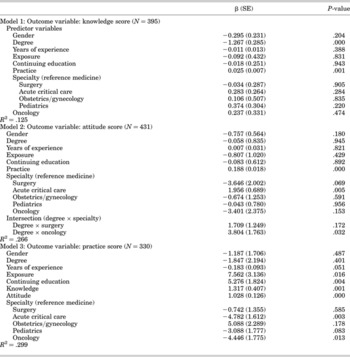
General characteristics were reported using means and standard deviations for numerical variables such as age and years of experience. Categorical variables, such as specialty and gender, were reported using frequencies and percentages. Physicians and nurses were compared by specialties using analyses of variance (ANOVA), chi-square, and the Fisher exact test when appropriate. Knowledge score (KS; 16 items), attitude score (AS; 19 items), and practice score (PS; 41 items) were created by summing the items within each domain; possible scores ranged from 0 to 16 on the KS (actual scores ranged from 6 to 16), from 19 to 95 on the AS (actual scores ranged from 59 to 90), and from 41 to 205 on the PS (actual scores ranged from 113 to 201). A two-way ANOVA was used to test differences in the computed scores among specialty, degree, and their interaction. The scores were used in three separate regression models. The following variables were considered as possible confounders, and thus were kept in the model regardless of significance: gender, degree, years of experience, exposure to terminally ill patients, and receiving continuing education (CE) in PC. Specialty was entered in the model as five dummy variables with medical specialty as the reference. Interactions between specialty and degree were tested, and, if they were not significant, they were removed. The model fit was assessed using the R 2. The data were analyzed using SPSS 15, and all tests were carried out at the .05 significance level.
RESULTS
The total number of completed and returned questionnaires was 1,205, resulting in a 32% response rate (51% for nurses and 12.7% for physicians); however, the number of questionnaires considered eligible for analysis in this study was 868, giving a 23% response rate; 74.31% nurses (645) and 25.69% physicians (223). Eligible participants for this study were nurses and physicians specialized in the six clinical specialties included in this study: medical, surgical, pediatrics, acute critical care, oncology, and obstetric/gynecology.
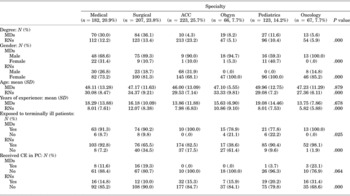
Table 1 displays the general characteristics of respondents by specialty. Specialty was found to be significantly associated with all the background variables measured with the exception of age and years of experience. These two variables were not different among doctors of different specialties (p = .879 and .678, respectively) but were for nurses (p = .000 for both). The majority of nurses (23.2%) reported working in acute critical care and the majority of physicians (36.1%) in surgery. More than 80% of nurses and physicians had been exposed to terminally ill patients, except for obstetric/gynecology nurses (38.6%). Significant differences were found among specialties in term of receiving continuing education in PC.
Characteristics of physicians and nurses by specialty (N = 868)

ACC: acute critical care; Obgyn: obstetrics/gynecology; CE: continuing education.
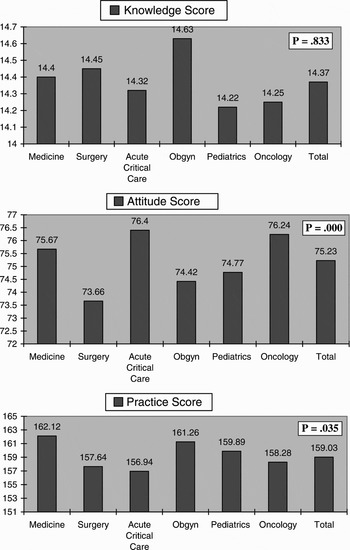
Statistically significant differences were found in attitudes and practice levels among the different specialties in general (Figure 1). The majority of specialties answered the knowledge questions correctly across specialties. Likewise, the majority of respondents answered the attitude and practice items along with the standards of PC across specialties and degree.
Comparison of mean knowledge score, attitude score, and practice score between specialties.

About 20.0% to 25.0% of physicians reported that they tell their terminally ill patients about their diagnosis across specialties with the exception of oncology, where this practice was only reported by 8.3% of physicians.
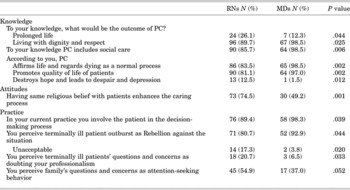
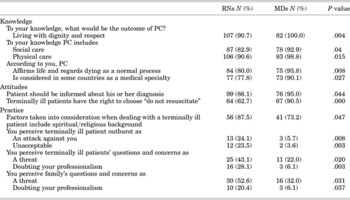
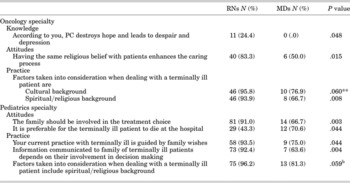
There were a number of items where physicians and nurses of the same specialty differed significantly in their response profile. These are summarized and presented in Tables 2–5. In general, more nurses than physicians in the medical and surgical specialties perceived the patient's and family's outbursts and questions negatively. Furthermore, physicians of these specialties were more likely than nurses to report “DNR as a right” (Tables 2 and 3).
Knowledge, attitudes, and practices of physicians and nurses, medical specialtya

a Only significant results are reported.
Knowledge, attitudes, and practices of physicians and nurses, surgical specialtya

a Only significant results are reported.
Knowledge, attitudes, and practices of physicians and nurses, oncology and pediatric specialtiesa

a Only significant results are reported.
bFisher's exact test.
Regression models

Same religious belief was reported to enhance the caring process among medical, surgical, and oncology nurses more so than their physician counterparts (Tables 2 and 3). More nurses than physicians in the medical and oncology specialties considered PC as a practice that destroys hope and leads to despair and depression (Tables 2 and 4). Obstetric/gynecology and pediatric nurses and physicians were found to have a different preference for the place of death. Oncology and pediatric nurses were more likely than doctors of the same specialty to report taking the patients' spiritual/religious background into consideration when delivering the care (Table 4).
At the multivariate level (Table 5), the KS was found to be statistically associated with the PS and degree (physicians vs. nurses). For every unit increase in the PS, the KS was found to increase by 0.03. Physicians were found to have, on average, a 1.02-point higher KS in PC than nurses. There were no statistically significant differences among the specialties. This model explained only 12.5% of the variability in KS. The AS model explained about 26.6% of the variability in AS, depicting a better fit. Higher scores on practice were associated with higher scores on AS (0.176 increase for every unit increment). Respondents in the acute critical care specialty had, on average, a 1.9-point higher attitude score than other specialties regardless of degree (physicians or nurses). Oncology physicians scored, on average, 3.8 points lower than all other physicians. There were no statistical differences between oncology nurses and other nurses. The PS was found to be positively associated with KS, AS, receiving continuing education, and having been exposed to terminally ill patients, where, for every unit increase in KS, the PS would increase, on average, 1.44 points. Similarly, the PS would increase, on average, 1.0 point with the AS. Those reporting having received continuing education in PC scored, on average, 5.3 points higher than those not reporting. Similarly, those exposed to terminally ill patients had, on average, a PS of 7.6 points higher than those never exposed. Acute critical care and oncology specialties were found to have about 5 points lower on the PS than other specialties (−5.54 and −5.4, respectively). There was no statistical difference between physicians and nurses. This model was able to explain 29.9% of the variability in PS.
DISCUSSION
Although only a small percentage of nurses and physicians across specialties were found to have received continuing education in PC, the majority were able to identify correctly the goals, components, and assumptions of PC; however, physicians were found to have, on average, a 1.02-point higher KS than nurses. These results are in line with other studies (Hilden et al., Reference Hilden, Emanuel and Fairclough2001; White et al., Reference White, Coyne and Patel2001; Hanratty et al., Reference Hanratty, Hibbert and Mair2006) that reported a lack of formal training and education in PC among nurses and physicians who were able to define PC outcomes and who reported that PC was part of their current practice. In this study, 24.4% of oncology nurses believe that PC destroys hope and leads to despair and depression. This finding has not been reported in other studies; it emphasizes the need for PC education in Lebanon, especially in oncology, where nurses are more likely to deal with terminally ill patients.
More medical and surgical nurses than physicians viewed the patient's and family's outbursts, questions, and concerns in a negative manner. These results can be attributed to lack of knowledge and communication skills and to the nurses' inability to deal with emotional outbursts in difficult stressful situations. Although similar results have not been reported elsewhere, in the study by Boyle et al. (Reference Boyle, Miller and Forbes-Thompson2005), intensive care unit nurses and physicians believed good communication among physicians, nurses, patients, and family to be the most important factor in end-of-life care in the intensive care units but found it to be the least accomplished. Similarly, the study by Feudtner et al. (Reference Feudtner, Santucci and Feinstein2007) found pediatric nurses to be least competent in talking to patients and family about death, dying, and end-of-life care and the study by Hanratty et al. (Reference Hanratty, Hibbert and Mair2006) also reported negative attitudes of cardiologists when dealing with dying patients. In our study, the majority of acute critical care and pediatric physicians and nurses, however, viewed the patient's and family's outbursts, questions, and concerns as acceptable given the patient's condition. These results affirm the importance of PC knowledge and communication techniques in the educational preparation of nurses and physicians.
We found that a small percentage of physicians actually informed their patients about their diagnosis, especially in oncology, although the majority believed that the patient should be informed. This finding is similar to the results of other studies (Hilden et al., Reference Hilden, Emanuel and Fairclough2001; White et al., Reference White, Coyne and Patel2001; Cherny & Catane, Reference Cherny and Catane2003; Wang et al., Reference Wang, Di and Reyes-Gibby2004; Steginga et al., Reference Steginga, Dunn and Dewar2005; Morita et al., Reference Morita, Fujimoto and Imura2006), where discrepancies were found between beliefs and attitudes of physicians and nurses regarding informing patient and family about diagnosis and prognosis and what they actually do in practice. In general, social attitudes and the societal prevailing norms regarding communication and truth telling are known to be affected by cultural beliefs and norms. In Lebanon, the patient's family is usually informed first about the diagnosis and prognosis of cancer before communicating with the patient. Family members may keep the diagnosis and prognosis a secret in order to protect the patient from emotional trauma. The attitude of many health care professionals and their approach to communication and truth telling mirrors that of family members (Abu-Saad Huijer & Dimassi, Reference Abu-Saad Huijer and Dimassi2007). These results are in direct contrast with the wishes and needs of Lebanese cancer patients (Doumit et al., Reference Doumit, Abu-Saad Huijer and Kelley2007) and others (Proot et al., Reference Proot, Huijer Abu-Saad and ter Meulen2004) who preferred to communicate directly with their physicians, emphasizing their right to be told the truth.
A significant number of surgical and obstetric/gynecology nurses, compared to physicians in same specialties, believed that terminally ill patients do not have the right to a do not resuscitate order. This finding is most likely secondary to lack of legal guidelines in Lebanon regarding end-of-life decisions and advance directives and the fact that the majority of Lebanese are very religious and, as such, value the sanctity of life. In addition, surgical and obstetric/gynecology nurses are not as commonly exposed to terminally ill patients compared to other specialties such as oncology and acute critical care. This finding is in line with the results of the study done in Lebanon on withholding and withdrawing life-sustaining treatment in the intensive care units (Yazigi et al., Reference Yazigi, Riachi and Dabbar2005).
Sharing the same religious belief was found to enhance the caring process among medical, surgical, and oncology specialties, but significantly more among nurses than physicians. This finding highlights the importance of understanding others' religious beliefs when discussing end-of-life care. A total of 17 religious sects are recognized in Lebanon, and, thus, religion plays an important part in the daily lives of most Lebanese. Moreover, our study showed that the majority of nurses and physicians took into consideration the cultural, socioeconomic, and spiritual/religious background of the patient; oncology and pediatric nurses were more likely than physicians of the same specialties to include spiritual/religious background in their care planning process. This is in contrast to results reported in the United States, where primary care physicians considered themselves weak in addressing these aspects in PC (Farber et al., Reference Farber, Urban and Collier2004).
At the multivariate level, our results show that better knowledge and attitudes in PC, receiving continuing education in PC, and being exposed to terminally ill patients were positively associated with better practice in PC. Surprisingly, acute critical care and oncology scored lower on the practice score when compared to other specialties, although these two specialties deal extensively with terminally ill patients. This finding supports the need for formal education and training in PC.
CONCLUSION
The low response rate among physicians is a limitation of this study.
The results of this study underscore the need to develop the field of PC in Lebanon. The education and training of health care professionals becomes, as a result, a must. For quality PC services to be provided, PC should become an integral part of all nursing and medical school curricula and continuing nursing and medical education offerings. Finally, informing the public and empowering patients and families to demand these services will have an impact on policy decisions in this field and on putting PC on the national health agenda in Lebanon.
ACKNOWLEDGMENTS
The authors acknowledge the collaboration of the Syndicate of Private Hospitals in Lebanon and the cooperation of all 15 hospitals in supporting and facilitating the conduction of the study. This study was funded by Medical Practice Plan (MPP) and University Research Board (URB) grants, American University of Beirut, Lebanon.