





“When artists fail to play their role, an entire society despairs. It is an entire generation that loses its footing and is violently subjected to political influences from everywhere. The failure of artists is one of the most serious things that can happen to a civilisation” Yeanzi, 2024Footnote 1
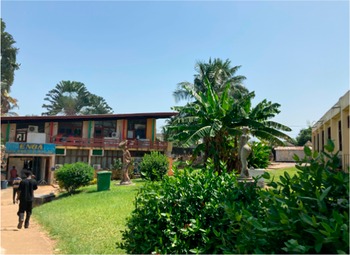
The Institut National Supérieur d’Art et d’Action Culturelle (INSAAC), which trains artists and actors of Côte d’Ivoire’s cultural sector, is part of Abidjan’s texture and a well-known landmark for Abidjan inhabitants. Thanks to its students wearing uniforms within the city, the INSAAC is present outside its walls in Abidjan streets and public transport. During our interview, the iconic Ivorian sculptor Jems Koko Bi told me that he would never had the idea to study art and become an artist if he had not seen the School’s students in their uniform with their scale models and canvas riding the same bus as him every morning when he was doing a degree in Spanish at the neighboring and interdisciplinary university, Université Félix Houphouët-Boigny.Footnote 2 Located on the Plateau de Cocody, the INSAAC is surrounded by walls lined with sculptures and was painted by students in 2019 on their own initiative (Figure 1).Footnote 3 The INSAAC is accessible, and one can enter its buildings and discover its Dance, Theatre, Music, and Fine Arts Schools. The buildings of the various Schools surround a lush park built in a hollow semi-circle that serves as an informal auditorium where the students learn their lines, rehearse their dance moves or musical scores, draw, or chat with each other. In this place, where the sound of cars on the busy road in central Abidjan is replaced by musical harmonies, one can feel that creativity of all forms flourishes in all heads (Figure 2).
Front of the School. Source: Judith Lignières, 2024.

Front of the School and park. Source: Judith Lignières, 2024.

However, despite the INSAAC being an important part of Abidjan and all the people I interviewed for this research having an impressive knowledge of its history and stories, the availability of published articles about its foundation and its history is surprisingly sparse. Only one academic article explicitly bears the Abidjan School of Fine Arts name. Written by the avant-garde French curator Pierre Gaudibert in 1991, the article is published in the second issue of Revue Noire .Footnote 4 The author describes the School being seen as a model for the continent before its decline in the 1980s – a period that this article, on the contrary, posits as a revolutionary and creatively vibrant time for the institution. Moreover, the literature available on this School focuses on individual artists or specific movements rather than the Abidjan School of Fine Arts as a whole.Footnote 5 , Footnote 6 This scant literature on such an iconic artistic institution is rather understandable as the Côte d’Ivoire art world seems more market than research-driven. Indeed, the Côte d’Ivoire art market is successful and has historically been supported by the state. Unlike Léopold Sédar Senghor, who grounded his politics in culture and the Négritude movement, Côte d’Ivoire’s first president, Félix Houphouët-Boigny (1905–1993), emphasised economic development, contributing to what is known as the economic “Ivorian miracle.” During his 33-year tenure, Houphouët-Boigny also fostered a vibrant art market by purchasing artworks from Ivorian artists at high prices, inspiring his powerful peers to do so.Footnote 7 Since 2021, the presence of Galerie Cécile Fakhoury (one of Côte d’Ivoire’s largest commercial gallery) on Avenue Matignon, one of the most prestigious art-market streets in Paris, together with Ivorian artist Aboudia (b. 1983) becoming the world’s best-selling artist in 2022, illustrates the success of this market-driven approach within Côte d’Ivoire’s cultural sphere.Footnote 8
Moreover, the new director of one of the INSAAC schools, the School of Fine Arts – nowadays called the Superior School of Art, Architecture and DesignFootnote 9 – Richard N’Dri Kouamé has the project to write the very first institutional history of the School.Footnote 10 During my brief stay in Abidjan, I was unable to consult the School’s archives and, as the aim of this article is to examine the School’s foundational years through the lens of the canon – understood here as the most recognised narratives in art history – I prioritised interviews and accessible published materials in my research. Nonetheless, producing a comprehensive institutional history of the School would be a valuable and pioneering step toward compiling a broader history of modern Ivorian art – one that contextualises its major canons, movements, and figures. To my knowledge, such a history does not yet have a dedicated anthology. Encouragingly, a history of modern art in Côte d’Ivoire is currently being written by Henri N’Koumo, an art historian working at the Ivorian Ministry of Culture, who generously shared a draft chapter of his forthcoming book with me for the purposes of this article.Footnote 11 Without a doubt, art history requires far more nation-specific research within African contexts, as the art historian’s text remains a crucial tool for institutionalising artists, inscribing them within artistic continuities, and establishing their status.
I am profoundly grateful to the people who, with great generosity, entrusted me with their stories and shared their knowledge, making this article possible; I extend to them my heartfelt thanks. The scholar Gayatri Chakravorty Spivak criticised intellectuals, in particular those specialists in postcolonial studies, for their tendency to speak for the subaltern rather than enabling them to speak for themselves. She highlighted the problems with this form of representation by arguing that it often reinforces the power dynamics it seeks to dismantle.Footnote 12 As a French art historian and trying to avoid falling into that trend, listening to and interviewing those who embody, develop, and are influenced by the canons we will be discussing – from artists and professors to art historians and gallery managers – has been incredibly helpful. This research showed me the importance of interviews and fieldwork, which seems to remain too marginal in academic art history. By treating the artwork as the primary source, the discipline tends to ignore the artist’s social experience, reinforcing ideas of artistic genius. Writing a modern art history of Côte d’Ivoire from the starting point of the School of Fine Arts highlights how training is essential to understanding the artist and their art.
This article surveys the institutional history of the Abidjan School of Fine Arts from its foundation in 1962 to the creation of the Vohou Vohou movement in the 1970s onward. Starting by comparing the trajectories of two icons of modern and contemporary Ivorian art, the first section reflects on the choice to focus on the theme of the canon when studying this School of Fine Arts. Emerging after independence, the founding of art schools across Africa, including in Abidjan, was initially driven by the desire to reclaim and reconstruct African identity. Despite this, these institutions heavily imitated European models. The Abidjan School of Fine Arts was no exception, reflecting a belief that adopting Western artistic traditions would confer prestige and legitimacy on the newly independent nation. The second section of this article deepens this ambivalent policy. The third section pays tribute to Albert Botbol, a UNESCO (United Nations Educational, Scientific and Cultural Organisation) adviser who played a key role in the early 1970s in reversing the trend of schools being overly influenced by and dependent on French arts education. The fourth and final section focuses on the first modern Ivorian art movement, Vohou Vohou. I will show how, through both its subversion of academic canons and its resistance to imitative pedagogy, the Vohou Vohou movement forged a distinctly Ivorian canon that progressively came to shape and define the visual language of the School of Fine Arts.
The School of Fine Arts and the National Canon
Talking with the successful painter Yeanzi, I understood that he was critical of the School’s pedagogy based on the imitation of the canon and accused the School of being not only conformist but also of reducing the role of the artist in society. For Yeanzi, there are three categories of artist. In the first category are the aesthetes who have learned to develop illustration skills. These are what the Abidjan School produces, according to the painter. The second are the savants who want to introduce the concept of reflection and ideas into their practice. The last are the geniuses who make history. They are those who have succeeded and had an impact on the world. For him, “Leonardo da Vinci and Picasso are such geniuses. In Côte d’Ivoire, they are Lattier and KoKo Bi.”Footnote 13 Incidentally, the school’s 2023–2024 academic theme was titled “From Lattier to Koko Bi,” affirming these two alumni’s enduring impact on Ivorian art and ultimate place in the national artistic canon. However, their careers, artistic approaches, and interactions with the school reveal a narrative of disappointment and revolt. They are to me excellent examples to how the Abidjan School influenced so much the Ivorian national canon.
Christian Lattier studied in France for 23 years, attending the Saint-Étienne School of Fine Arts (1945) and the Paris School of Fine Arts (1947), where he gained a reputation in modern art circles. He won the Cathédrales de France prize in 1953, enabling him to restore Romanesque and Gothic churches,Footnote 14 and the Prix Chevanard in 1954 for his sculpture Panthère , earning acclaim both in France and Abidjan. Invited to lead the Abidjan School of Fine Arts in 1962 by the Ivorian Minister of Education Joachim Bony, he found the position already filled but became a respected professor of sculpture.Footnote 15 Despite honors such as the Ordre du Mérite de l’Éducation Nationale (1966) and Ordre du Mérite de la Culture (1986), Lattier felt undervalued in Côte d’Ivoire, particularly after his Panthère sculpture was rejected by major museums.Footnote 16 Soon after his death in 1980, the historian Frédéric Grah Melh and the painter Jame Hourapublished an article drawing attention to the neglect of Lattier’sworks, arguing that a valuable opportunity had been missed to recognize him as an indispensable cultural figure during the independence period.Footnote 17 Nonetheless, Christian Lattier is nowadays celebrated as the most iconic Ivorian sculptor of the modern era.Footnote 18 Renowned for his innovative figurative sculptures made from rope and iron, Lattier’s works conceal iron frames beneath intricate rope designs, challenging formal conventions of sculpture.
A member of the Guro tribe, Jems Koko Bi, was expelled from his village at eight for carving ritual masks before initiation.Footnote 19 He began his studies at the Abidjan School of Fine Arts in 1988, where restrictions on woodcarving initially limited his practice, as sculpture classes relied on clay and plaster and techniques like rope and wood were discouraged.Footnote 20 Exposure to German sculptor Klaus Simon, who was invited to the Abidjan School and explored identity through wood, inspired Koko Bi to pursue wood sculpture and individual expression.Footnote 21 Using knives, chainsaws, and fire, Koko Bi creates figurative and abstract works that have been exhibited internationally – including the Dakar and Havana Biennales, Documenta, the Venice Biennale, the Smithsonian National Museum of African Art, and the Musée du Quai Branly.
If the School’s 2023–2024 academic theme affirmed these two alumni’s ultimate place in the national artistic canon, these two sculptors share a fraught and contentious relationship with the School. Lattier, trained in elite French institutions and lauded in European art circles, returned to post-independence Côte d’Ivoire to find rigid administrative structures and a lack of institutional support.Footnote 22 Similarly, Koko Bi’s artistic trajectory was marked by early rejection and marginalisation within his own Guro community. Later, he was dismayed at the School’s dismissal of woodcarving – a medium intrinsic to Guro tradition – as archaic and incompatible with modernity.Footnote 23 Yet both artists channeled their disappointments into radical aesthetic innovation: Lattier’s experimental use of rope, and Koko Bi’s bold, often monumental wood sculptures carved with chainsaws and fire. Their work challenges conventional hierarchies of form and medium, reasserting Indigenous materialities within contemporary discourse. Christian Lattier perfectly illustrated this thirst for radical change by explaining the use of rope in his sculpture: “If I had worked with wood, people would have accused me of copying my ancestors; if I had worked with stone, people would have said I was copying the whites. In short, I had to find something new.”Footnote 24 That the School now venerates them as canonical figures is a testament not only to their technical mastery but also to their capacity to redefine the very terms of artistic legitimacy in Côte d’Ivoire – transforming personal rupture and institutional critique into enduring cultural influence.
Inspired by these two icons’ trajectories and relationship with the School, I chose to focus on the theme of the national canon when researching the history of the Abidjan School of Fine Arts. Because the School is a national and state-backed institution, it is a place where national artistic norms and values are established, taught, and transmitted over the generations. Through the making of the curriculum, the institution makes a choice of what is seen as the most important to be taught and defines aesthetic standards, thus establishing a national canon. Within an art school, this process is particularly significant because it is where aspiring artists are first introduced to established artistic standards and are encouraged to learn from them. Through this structured education, they come to understand not only the concept of artistic excellence but also the cultural and aesthetic values that define what it means to be an artist in Côte d’Ivoire. In doing so, the School acts as the gatekeeper of national cultural identity. However – and this is why art training is so ambivalent – while an art school teaches students to reproduce and engage with established artistic traditions, artists are ultimately evaluated not just for their technical mastery but also for their ability to innovate. Artists trained in these institutions often challenge state-imposed canons, leading to avant-garde movements that have the possibility to redefine national consciousness. It is only by challenging the canon that art can become iconic. Therefore, the canon serves a dual function: it provides the foundation upon which artistic knowledge is built, but it also represents a structure that artists must challenge in order to create something new.
Exploring the evolution of a national artistic canon reveals how notions of nationality are constructed and expressed. In this article, the term “national canon” can be used interchangeably with “cultural identity,” or more specifically, “national visual identity”. By analysing how the artistic canon has developed over time, we can trace the ways in which a nation chooses to construct, negotiate, and reinterpret its identity. Moreover, researching the evolution of the canon is a way to understand how a society defines “beauty” and “art,” and therefore what it chooses to preserve and elevate by calling it “beautiful” or “art”. A national school of fine arts, such as the Abidjan one, provides a powerful lens through which to observe these changes. Art, in this sense, becomes more than just aesthetic expression; it functions as an historical document, one that grants access to intangible elements of the past – moments, emotions, and perspectives that cannot be fully captured through quantitative data. As such, art presses against the limits of empirical knowledge and offers insight into the symbolic and affective dimensions of nationhood.
Foundations of the Abidjan School: Colonial Legacies and post-independence Aspirations
Frantz Fanon famously argued that national culture is essential for building national consciousness, which in turn legitimises a nation’s sovereignty.Footnote 25 Thus, during the historic wave of independence that swept across Africa in 1960, cultural mobilisations emerged and were prioritized. They were characterized by a sense of optimism and the belief that disentangling, reclaiming, and reconstructing African cultural identity was an essential aspect to achieving national liberation and sovereignty. Amid this momentum, there was a concerted effort from newly independent African governments, intellectuals, and artists, but also international organisations such as UNESCO, to reframe Africa’s position on the global stage, demonstrating that its cultures were not only of equal value to those of the West but were deserving of recognition and celebration in their own right. This push for cultural self-determination manifested in various ways, all aimed at cultivating a distinct African identity that could transcend colonial legacies. Moreover, after independence, contemporary African art developed outside museums, which were largely prisoners of the colonial legacy of studying African art as an ethnographic rather than an artistic object. Modern African art has thus been popularised by ephemeral events such as biennials and festivals functioning as art history factories in which it was defined in all its pan-African dimensions.Footnote 26 A prime example of this cultural push was the World Festival of Black Arts, held in Dakar, Senegal, in 1966. Funded by UNESCO, this festival was a monumental event and celebration that brought together African and diasporic artists, intellectuals, and politicians to celebrate and promote the idea of a unified, modern, and culturally and intellectually successful African identity on the global stage.
This drive for cultural reawakening during the period of independence was also reflected in the founding of art schools across the continent. Institutions like the School of Fine Arts in Dakar (founded in 1956) and in Libreville (1982) emerged as part of this broader cultural mobilisation, aiming to cultivate artists who could represent the spirit and identity of newly independent nations. While these post-independence schools were designed to foster a distinctly modern national art, many earlier institutions – such as the Casablanca School (1919) and the Bamako School of Fine Arts (1933) – had initially served colonial interests by training assistants and technicians rather than autonomous artists.Footnote 27 A similar philosophy shaped the art school founded in 1937 by French sculptor Charles Alphonse Combes. This school in Bingerville, on the outskirts of Abidjan, is recognised as Côte d’Ivoire’s first formal art institution. Combes transformed his own sculpture studio into a School of Applied Arts. His goal was for young artists to be “equipped with modern tools, with a European technique and an inspiration that can only be African.”Footnote 28 In 1962, his workshop evolved into the Technical Centre of Applied Arts, affiliated with the Abidjan School of Fine Arts.
It was only after independence that these schools began to be led by African artists, who were committed to shaping a new generation of creative voices capable of expressing a vision of national modernity. Yet, despite this shift in leadership and purpose, many of the teaching methods still mirrored Western academic models, replicating the structures of European art education. However, this act of mimicryFootnote 29 – the deliberate imitation of European systems – was not simply a matter of copying. Between the two world wars, a wave of independent art schools emerged across the African continent. Heavily influenced by the European avant-garde, these art schools created by Europeans rejected academicism in art and called for fresh approaches to both art-making and education. Perceiving Western academic training as a threat to what they saw as “authentic Indigenous arts,” these institutions were often aimed at reviving intuitive, sensorial practices among African artists and operated under the belief that encouraging “untaught free play” would nurture genuine African expression. Therefore, many of the early studio schools established by Europeans sought to restrict African artists to precolonial visual languages, often discouraging engagement with modern or external influences.Footnote 30 This approach, therefore, required very little training and reflected the broader racist idea that African artists were not seen as capable of engaging with or contributing to the contemporary, innovative movements of modernism, further entrenching colonial hierarchies in the cultural sphere.Footnote 31 After the independence, the deliberate imitation of European systems was a strategic gesture, a means of challenging the colonial narrative that had long depicted Indigenous cultures as uncivilised. By mastering and reinterpreting Western artistic traditions, African artists demonstrated their ability to engage with global cultural standards.
In Côte d’Ivoire, the Abidjan School of Fine Arts epitomised the post-independence approach of mimicry to art education in Africa. Even 30 years after its creation, Jems Koko Bi, who graduated from the School in 1995, reflected that “the ambition of the School’s founders was to reproduce exactly the teaching of Western art schools, imagining that this would confer particular prestige on the country.”Footnote 32 This ambition was deeply rooted in the broader political context of the time, in which the colonial mindset was embedded in the public discourse. Côte d’Ivoire was unified under French colonial rule in 1904, became an autonomous republic in 1958, and gained independence in 1960.Footnote 33 Under President Houphouët-Boigny, Côte d’Ivoire maintained close ties with France through “ Françafrique ,” a policy marked by continued French influence in political, economic, and cultural spheres, with France positioning itself as a stabilising force. Houphouët-Boigny himself argued in 1958 that Ivorian unity could best be achieved within the framework of a French-created nation.Footnote 34 However, this narrative of unity and progress was soon challenged, notably in Ahmadou Kourouma’s Reference Kourouma1968 iconic novel The Suns of Independence, which portrays the disillusionment of Ivorians as the life of a Dioula disrupted by newly imposed national borders and the fragmentation of French West Africa. Just as Françafrique perpetuated a dependency on French influence, the act of mimicry in art education failed to fully emancipate the country from colonial legacies.
The founding of the School was both a neocolonial initiative and a family endeavor. In 1959, a year before Côte d’Ivoire’s independence, Félix Houphouët-Boigny and André Malraux, then French minister of culture, agreed to establish two cultural institutions as part of their bilateral cooperation: the Theatre School, founded that same year, and the School of Fine Arts, which opened in 1962 on the site now occupied by the car park of the Abidjan District Council.Footnote 35 The French sculptor Marcel Homs (1910–1985), trained in the classical tradition under Jean Boucher at the Paris School of Fine Arts and awarded the prestigious Prix de Rome in 1939,Footnote 36 was appointed as the School’s first director. Homs brought with him extensive experience, having founded an art academy in Perpignan with his wife, Olga, a painter, and having decorated numerous schools in their home region of Languedoc.Footnote 37 Both Marcel and Olga Homs contributed to teaching at the School, alongside their son Serge, who taught anatomy and drawing.Footnote 38 In 1967, after the Homs family left Côte d’Ivoire, Claude Roucard (1937), a French figurative painter trained at the Bordeaux School of Fine Arts, took over as director. It was not until 1969 that an Ivorian artist, the ceramist Yao Célestin Dogo (1938–2005),Footnote 39 was appointed as director, likely due in part to his artistic education in France at Tours School of Fine Arts.
Moreover, the curriculum of the Abidjan School closely mirrored that of French institutions. The pedagogy left little room for exploring African art history or techniques, prioritising rigorous training in perspective, drawing, and imitative practice rooted in Western frameworks.Footnote 40 According to Jems Koko Bi, students “learned portrait, landscape, and environmental techniques inspired by classicism, baroque, and realism and executed on easels.”Footnote 41 Lessons in both drawing and sculpture emphasised classical Western methods, including the study of human anatomy based on plaster casts of Western models. Koko Bi also recalled how the curriculum focused on Western artists such as Rodin and Michelangelo, with students tasked with replicating features like Richelieu’s nose or Julius Caesar’s bust.Footnote 42 The Abidjan School also maintained a strong partnership with French art schools. Not only were examination papers sent to France for grading, but students’ work was also returned there for evaluation. Additionally, the school offered students the opportunity to continue their studies in France. After completing five years of study and earning the Certificate of Artistic Training Higher Qualification, students specialising in fine arts could advance to the Paris School of Fine Arts, while those focusing on interior design (“déco-volume”) went on to the Paris School of Decorative Arts.Footnote 43
Finally, the majority of the teachers were trained in France. At the time of its founding, the Abidjan School had only seven teachers: Serge Hélénon, Louis Laouchez (whom I will discuss later), and the Homs siblings – Olga, Marcel, and Serge. In addition, there were two Ivorian teachers: the sculptor Christian Lattier and the ceramist Yao Célestin Dogo, the latter of whom did not even have a dedicated studio.Footnote 44 Recognising the need to train local educators, the Ivorian government enlisted artists educated in Paris to help establish a national cultural identity.Footnote 45 Graduates were often expected to transition directly into teaching roles. From 1970 onward, the curriculum became more professional, with students required to complete a three-month internship at cultural institutions or companies as part of their studies.Footnote 46 Furthermore, since November 1963, Ivorian students in France were obligated to join the National Union of Ivorian Students, which enabled them to apply for grants and secure positions in Côte d’Ivoire’s public sector upon completing their studies. In 1965, Houphouët-Boigny explicitly reinforced the government’s expectation that students return to contribute to national development: “Either you will be with us in our party, and you will work for national construction, or you will be against us, and we will fight you.”Footnote 47
Despite its French foundation, the Abidjan School was designed to cultivate a distinctly Ivorian artistic identity. As more Ivorian teachers joined, the goal shifted to training local artists and educators who could support the nation’s cultural and economic development. Step by step, France ceased to be a necessary detour for Ivorian artists, and the school absorbed local sensibilities, reclaiming agency and reshaping inherited practices to forge a modern artistic identity – both globally conversant and uniquely Ivorian. As Bhabha writes, mimicry was never mere imitation, but rather a practice of resemblance that at the same time claimed a space for difference. This represents the agency, or resistance, of the colonised, who refuse to capitulate entirely to the conditions of their colonisation: “mimicry is both resemblance and threat.”Footnote 48
Albert Botbol: An international Aid to anchor the School in its Territory
While researching in the archives of the French National Library, I encountered a crucial figure in the early history of the School whom none of my interviewees mentioned: Albert Botbol (1928–1993). A UNESCO adviser, he played a pivotal role in grounding Côte d’Ivoire’s post-independence artistic training in its local cultural heritage. Botbol was a Moroccan-Jewish playwright whose multifaceted identity endowed him with what he referred to as “a deep cultural intuition,” enabling him to mediate between African cultural expressions and Western institutional frameworks. Born under the name Abraham, he signed his Arabic-language works as Ibrahim, while using the name Albert in his professional life in France. Botbol was one of the most influential figures in establishing Côte d’Ivoire as a theatrical powerhouse – alongside the most famous Ivorian playwright, Bernard Dadié, whose Monsieur Thogo-Gnigni denounced neocolonialism at the 1969 Algiers Panafrican Festival.Footnote 49 Notably, having founded the University of the Theatre of Nations from 1960 to 1965 – an experimental space devoted to revealing “the extraordinary diversity and profound unity of the world’s cultures” to the French public – Botbol directed Danses from Côte d’Ivoire in 1960, which won the award for best show in the category of popular tradition.Footnote 50 His legacy endures in the founding of the Market for African Performing Arts in 1993, a biennial festival celebrating dance, theater, and music, which continues to be held in Abidjan to this day. As Botbol noted in a UNESCO mission report, these festivals “made it possible, in parallel with its political rise, to ensure Africa’s artistic ascent on the international scene.”Footnote 51 Yet in later years, his tone grew more cynical. Reflecting on the post-independence decline in cultural investment, Botbol lamented: “Achievements there generally take on that ephemeral character which sometimes renders derisory, if not sterile, the most meritorious effort… Lack of choice, lack of resources, lack of people – solicited elsewhere or unprepared.”Footnote 52
In 1965, Botbol was sent by UNESCO as project coordinator and technical adviser to the cabinet of the Ivorian minister of national education, Lambert Amon Tanoh. He assisted the Ivorian (and also the Cameroonian) authorities in drawing up plans for national institutes of culture and the arts, including the Abidjan School of Fine Arts. Botbol worked not only on the infrastructure, staff, budgets, and administration of cultural training institutions but also on curricula and methods.Footnote 53 In the same cynical mindset as his writings on the drop of cultural initiatives of Côte d’Ivoire, Botbol wrote about the School, five years after its creation: “This establishment has existed for several years, in dilapidated premises. Up to now, it has provided an education about which there is no question of passing judgment. In any case, the total transformation of this school is planned for the coming months […] This project has aroused great interest among the many personalities to whom I have had the opportunity, in Abidjan and Paris, to outline it, insofar as its realisation will undoubtedly constitute the first experiment of this type attempted in Africa.”Footnote 54
This transformation was started by the initiative led by Botbol to incorporate the Abidjan School of Fine Arts into a larger institution that would unite all of the city’s art schools, encouraging greater fluidity and exchange between artistic disciplines. Conceived as a dynamic cultural center, the future National Arts Institute was to include a book and film library, a discotheque, and spaces for conferences, exhibitions, and international cultural events. A major step toward this vision was taken in 1967, when, under the leadership of its first Ivorian director, Yao Célestin Dogo, the School of Fine Arts relocated to its current site in Plateau de Cocody, alongside the already established Schools of Theatre and Music. This relocation laid the groundwork for the integration of the arts within a shared institutional framework. The project continued to develop over the following decades, eventually culminating in the creation of the INSAAC in 1991. Today, INSAAC comprises four specialist schools: the Higher School of Dance and Music; the Higher School of Art, Architecture and Design; the Higher School of Theatre, Cinema and Media; and the Higher School of Tourism, Craft and Cultural Action.
In 1971, a new building was constructed to house the Abidjan School of Fine Arts, thoughtfully designed to integrate with the park’s sloping topography through a large roof that follows the natural incline of the site. Extending well beyond the main structure, the roof provides effective protection for the galleries and workshops beneath, shielding them from sun and rain. This architectural openness further reinforced Albert Botbol’s vision of permeability between artistic disciplines, as the design blurs the boundaries between indoor and outdoor spaces, encouraging interaction among students of music, drama, painting, and sculpture. The School’s tropical modernist architecture – adapted to the climatic context – mirrored Botbol’s educational philosophy, which championed a curriculum that was both modern and locally rooted. Deeply invested in the institution’s potential, Botbol envisioned the school as a key player in shaping an Ivorian cultural identity, aspiring to foster “the cultural and artistic development of communities and to make this national heritage, a true source of inspiration, available to contemporary artists and creators.”Footnote 55
The Vohou Vohou: From Rejection to Canonisation
The intervention of Albert Botbol had set the scene for the emergence of the first Ivorian modern art movement: Vohou Vohou. In the 1970s and 1980s, Vohou Vohou represents a pivotal shift towards modernist expressions deeply rooted in Ivorian cultural identity in formation. While the School initially adhered to Western academic traditions that often sidelined Indigenous perspectives, it paradoxically became, 10 years after its creation, a fertile ground where alternatives to this normative approach took root. Rejecting European paradigms and early pedagogical approaches that echoed Western academic ideals – centered on imitation and technical mastery – the Vohou Vohou artists championed a form of spontaneous expression grounded in Ivorian cultural heritage.Footnote 56 By not only subverting the academic canon but also by being against imitative pedagogy, the Vohou Vohou established itself as a national canon until it imposed a style to the School of Fine Art. Therefore, contrary to what the French curator, Pierre Gaudibert, describes as a school being in decline in the 1980s,Footnote 57 this period was vibrant and revolutionary for the School.
Although the Négritude movement was not officially embedded in Côte d’Ivoire’s state cultural policy – unlike neighboring Senegal – it subtly informed Ivorian artistic practice, especially through diasporic figures like Serge Hélénon (1934) and Louis Laouchez (1934–2016). Trained in Martinique and France, both artists were inspired by Négritude ideals and moved to Abidjan to support national cultural emancipation, becoming founding professors at the Abidjan School in 1962. There, they created the Négro-Caraïbe School, a movement challenging French academic norms by encouraging students to draw on ancestral African forms, natural pigments, and found materials. Serge Hélénon described himself not as a teacher but as a facilitator of creativity, fostering experimentation over reproduction. Far from Koko Bi’s description of the curriculum focused on Western artists such as Rodin and Michelangelo, Négro-Caraïbe’s anti-academic ethos encouraged students to break from canonical art history and engage with unconventional materials and techniques. One of Hélénon’s students, Sékou Dosso, recalled his studio as “a dumping ground for objects and waste,” where students turned scavenged materials into tools of cultural expression.Footnote 58
This pedagogical shift laid the groundwork for the Vohou Vohou movement, initiated by students like Mathilde Moreau, Youssouf Bath, Théodore Koudougnon, Kra N’Guessan, and Yacouba Touré in the late 1970s. The movement’s palette – dominated by ochres, blacks, and reds – reflected a return to natural, spiritual, and ritual sources. Moreover, the term “Vohou Vohou,” from the Gouro language, implies both disorder and healing, capturing the movement’s ethos of reassembling fragments to restore cultural wholeness. As Kra N’Guessan explained, working with materials was a ritualistic act that “takes [him] back to the origins of mankind.”Footnote 59 Artists drew upon the symbolic language of Ivorian traditions, referencing Senufo and Baoulé sculptures, Dan and We masks, and local architectural forms – not for aesthetics alone, but to reactivate cultural memory and resist colonial erasure.Footnote 60 By turning the canvas into a site of invocation rather than representation, Vohou Vohou forged a distinctly Ivorian mode of contemporary art-making: rooted in regional epistemologies yet resonant with global decolonial currents. It was, fundamentally, a movement of rupture, reinvention, and cultural sovereignty.
European avant-garde movements such as Impressionism, Surrealism, Cubism, Futurism, and Dada emerged in the late nineteenth and early twentieth centuries as reactions against the conservative norms upheld by institutions like the Paris School of Fine Arts. Vohou Vohou’s emphasis on rejecting academicism and embracing spontaneity places it in alignment with these movements. Just as African art schools appropriated the classical European canon to inscribe themselves within global artistic hierarchies, Vohou Vohou practitioners instrumentalised the languages of global modernity to articulate – and thereby legitimise – the sovereignty of Côte d’Ivoire’s cultural identity. In doing so, they conformed to what Valentin Mudimbe refers to as “the projected modernity of colonialism.”Footnote 61 As a modern movement, Vohou Vohou reflected its era and played a pivotal role in ensuring Ivorians were heard, found a place, and gained respect in the international art world. At this period in particular, the pressure to demonstrate the nation’s modernity was crucial for entering the global artistic community, and as the country’s primary institution for artistic training, the Abidjan School naturally became the incubator for this transformation.
Conclusion
The Vohou Vohou movement has become deeply ingrained in the identity of the Abidjan School of Fine Arts. It has been institutionalised to the point that journalist Diégou Bailly has suggested renaming the School after Vohou Vohou, similar to how regional movements like the Poto-Poto School in Brazzaville (Congo) are recognised.Footnote 62 Many successful contemporary Ivorian artists, such as Yeanzi, Armand Boua, and Aboudia, are inspired by Vohou Vohou experimentation on material and continue to push boundaries by tasting materials like plastic, cardboard, and street debris. The act of mimicry in this context has evolved beyond the colonial mimicry of academic then modern Western art by Ivorians; instead, Ivorian artists now engage in a process of imitating Ivorian traditions and forms. This shift signifies the ultimate success of the Abidjan School of Fine Arts in achieving its original goal: to create a national canon that reinforces the country’s sovereignty, independence, and global respect. From Christian Lattier with his innovative use of rope to the Vohou Vohou artists with their salvaged objects and Jems Koko Bi with his distinctive work in wood, the negotiation of Ivorian canons is unique. Here, the canon is not merely theoretical but materialises in the choice of media and materials used by artists. By fostering an environment where the Ivorian canon can be reinterpreted and reimagined on its own terms, the School has helped establish a cultural foundation that affirms Côte d’Ivoire’s cultural place on the international stage. Accordingly, all the alumni of the Abidjan School of Fine Arts I interviewed expressed pride in having attended the institution. Since its founding, the School has attracted some of the continent’s most talented artists, including pioneering professors such as sculptor Christian Lattier (1925–1978) and ceramist Yao Célestin Dogo (1938–2005). Over the decades, it has gained a reputation as a model institution in West Africa, nurturing generations of Côte d’Ivoire’s leading artists – many of whom have achieved international acclaim. Among them are Ouattara Watts (1957), Jems Koko Bi (1966), and Barthélémy Toguo (1967).
Although the Vohou Vohou’s legacy is undeniable, some critics argue that its once-radical spirit has faded over time. For example, Ernest Dükü, a current professor at the School, worries that the weight of Vohou Vohou’s legacy is now a burden on younger artists, limiting their creative freedom.Footnote 63 Moreover, some gallery managers, like Suzanne Vogel-Tolstoï, caution that focusing solely on the novelty of materials could result in art that lacks conceptual depth and artistic identity. She worries she has seen examples of this from the recent graduate students from the School (not to also mention the long-term conservation challenges posed by using such unconventional materials).Footnote 64 Moreover, commercial pressures may be overshadowing the movement’s original emphasis on innovation.Footnote 65 Therefore, the Abidjan School now faces a critical challenge: How can it respect the spirit of Vohou Vohou while moving beyond its limitations? This issue is part of a larger debate in art education that can be summarised by this question: How to teach the canon without making it a burden? While Western academic art traditions traditionally value artistic mastery through the imitation of established works, imitation holds a different and culturally significant role in many African societies. In African apprenticeship systems, repetition is a crucial part of learning, particularly in the creation of ritual objects, where adherence to traditional forms is vital. In this context, imitation is seen not as passive copying but as a form of cultural transmission. Ultimately, the Abidjan School’s hybrid approach – blending Western academic traditions with African cultural practices – calls for a revaluation of imitation. Rather than seeing it as a constraint, imitation can be understood as a space for negotiation, where tradition and innovation can coexist.
This article has explored a dual ambivalence at the core of the Abidjan School of Fine Arts: first, the tension between adherence to artistic canons and the pursuit of creative freedom within formal art education; and second, the challenge of establishing national canons within a postcolonial cultural landscape that is inherently hybrid, fluid, and evolving.Footnote 66 A key question emerges regarding whether official art institutions can become open, generative spaces that foster artistic experimentation while still engaging critically with national traditions. The foundational contributions of Christian Lattier, Vohou Vohou, and Jems Koko Bi remain vital, yet their canonical status should not constrain younger generations. Instead, the canon must be seen as a dynamic, evolving dialogue – reshaped by each new cohort of artists. As David Carrier suggests, a canon’s role is to serve as a basis for dialogue, not dogma.Footnote 67 By honoring its most iconic figures while embracing innovation, the School can continue to shape art both nationally and globally, cultivating a canon that reflects local values, histories, and experiences. In embracing this dual ambivalence – between local and global, tradition and innovation – the School affirms its relevance as a progressive force within the art world, continually redefining what it means to belong to the Ivorian artistic canon.
AI use
ChatGPT was used solely to check spelling and grammar in this article. No content was generated, modified, or added beyond linguistic correction. The tool was accessed via the publicly available interface. Its use did not influence the analysis, interpretation, or conclusions of the article, and no competing interests or potential sources of bias arise from its use.


 Open access

