





Impact statement
This study demonstrates that participation in the transdiagnostic trauma-informed mental health service for young people in Georgia was associated with improvements in anxiety, depression, quality-of-life outcomes and high satisfaction with the service. This was achieved primarily through the digital delivery of trauma-sensitive, transdiagnostic modules addressing emotion dysregulation and interpersonal difficulties. The relative ease of implementation and brief treatment duration suggest that this approach may offer a promising, adaptable and multipliable model for supporting young people’s mental well-being in resource-constrained settings.
Introduction
The mental health (MH) treatment gap in low- and middle-income countries (LMICs) is as high as 85% (WHO, 2025). The gap between unmet needs and access to care for mental ill-health is wider for adolescents and young people (YP) aged up to 25 years than any other age group worldwide (Herrman et al., Reference Herrman, Purcell, Goldstone and McGorry2012). The MH treatment gap among this age group appears particularly pronounced in LMICs, where limited service availability and barriers to access contribute to high levels of unmet MH need (Duarte et al., Reference Duarte, Lovero, Sourander, Ribeiro and Bordin2022; UNICEF, 2022; Yu et al., Reference Yu, Perera, Sharma, Ipince, Bakrania, Shokraneh, Sepulveda and Anthony2023).
To address the MH gap, WHO calls for modern treatment approaches (WHO, 2013) and contemporary, evidence-based models of both services and interventions. YP face many challenges and stressors across life domains, such as home, schools/universities, jobs, communities and relationships. The convergent approach to MH indicates that the effect of negative factors is greatest during the developmentally sensitive phases of early life and adolescence (Tausendfreund et al., Reference Tausendfreund, Knot-Dickscheit, Schulze, Knorth and Grietens2016), causing a wide range of problems and a high prevalence of common mental symptoms, including interpersonal difficulties, addictions, toxic stress and even socioeconomic drawbacks (Patel et al., Reference Patel, Saxena, Lund, Thornicroft, Baingana, Bolton, Chisholm, Collins, Cooper, Eaton, Herrman, Herzallah, Huang, Jordans, Kleinman, Medina-Mora, Morgan, Niaz, Omigbodun, Prince, Rahman, Saraceno, Sarkar, de Silva, Singh, Stein, Sunkel and UnÜtzer2018).
High prevalence rates of common mental symptoms were found in YP across the world during the COVID-19 pandemic; studies reported longitudinal deterioration in the mental health of YP, with increased depression, anxiety and psychological distress (Samji et al., Reference Samji, Wu, Ladak, Vossen, Stewart, Dove, Long and Snell2022; Kauhanen et al., Reference Kauhanen, Wan Mohd Yunus, Lempinen, Peltonen, Gyllenberg, Mishina, Gilbert, Bastola, Brown and Sourander2023; Casella et al., Reference Casella, Kessler, Mneimneh, Merikangas, Polanczyk and Salum2026), indicating the need to support YP at risk (Panchal et al., Reference Panchal, Salazar, Franco, Moreno, Parellada, Arango and Fusar-Poli2023).
The recent Lancet Commission paper on youth MH (McGorry et al., Reference McGorry, Mei, Dalal, Alvarez-Jimenez, Blakemore, Browne, Dooley, Hickie, Jones, McDaid, Mihalopoulos, Wood, El Azzouzi, Fazio, Gow, Hanjabam, Hayes, Morris and Pang2024) warns that global megatrends (major, long-lasting societal changes such as environmental, social, economic, political or technological changes) and changes in many societies around the world in the past two decades have harmed the MH of YP (McGorry et al., Reference McGorry, Mei, Dalal, Alvarez-Jimenez, Blakemore, Browne, Dooley, Hickie, Jones, McDaid, Mihalopoulos, Wood, El Azzouzi, Fazio, Gow, Hanjabam, Hayes, Morris and Pang2024).
Unfortunately, there are no epidemiological data on YP mental health morbidity in the Republic of Georgia. A study of university students in Georgia revealed a heavy burden of college-related and COVID-19 stressors and high prevalence rates of common MH conditions, such as depression and anxiety, alongside a preference for informal over formal help (Bachem et al., Reference Bachem, Makhashvili, Maercker, Javakhishvili, Aeschlimann, Pilauri, Latibashvili, Levin and Shengelia2023).
UNICEF Georgia study (2023) of university students found that one in every four university students in Georgia experienced moderate to severe symptoms of anxiety, and one in three suffered symptoms of depression. A third of the surveyed students reported that they had contemplated suicide at least once in their lives (UNICEF, 2023).
Globally, MH systems remain insufficiently adapted for YP with MH problems or at risk of developing them. Accessibility, engagement and continuity of care remain challenging, particularly when YP transition to adult services (Muñoz-Solomando et al., Reference Muñoz-Solomando, Townley and Williams2010; Ly et al., Reference Ly, Tremblay and Beauchamp2019). In the last decade, there has been an increased focus on organising integrated care to overcome the lack and fragmentation of services for YP (WHO, 2016). Unmet needs drive the field towards modern, youth-focused, multidisciplinary and transdiagnostic services capable of modifying potential psychopathological trajectories as early as possible (Colizzi et al., Reference Colizzi, Lasalvia and Ruggeri2020).
Child and Adolescent MH (CAMH) care in Georgia remains underdeveloped, with notable gaps in prevention programmes and in early detection and intervention services (Winkler et al., Reference Winkler, Guerrero, Kågström, Petrášová, Pashoja, Qirjako, Hristakeva, Germanov, Kuzman, Kuharić, Havlíková, Eek, Maron, Őri, Wernigg, Fanaj, Krasniqi, Sile, Brinkmane, Levickaitė, Grigaitė, Manusheva, Kalpak, Ivanovic, Chihai, Mihaela, Gondek, Todzia-Kornaś, Mihai, Molnar, Letovancová, Kopcová, Suvalo, Khudoba, Ismayilova, Muradova, Makhashvili, Dumbadze, Panteleeva, Popkov, al Tayara, van Voren and Thornicroft2025). According to the WHO 2020 Atlas, the number of CAMH psychiatrists in Georgia is 0.3 per 100.000 population (World Health Organization, 2021); there are 30 beds for this age group, amounting to 0.08 beds per 100.000 population (compared with a total of 36.72 beds per 100.000). The MH share of health expenditure is less than 2%, and the share of CAMH care in the 2025 MH State budget is only 0.302%. These data indicate insufficient funding and scarcity of services for children and adolescents.
Nevertheless, the government’s recent adoption of the Georgian MH Strategy 2022–2030 signals an intent to prioritise the development of CAMH services (Government of Georgia, 2022).
This article focuses on the contemporary, trauma-informed MH service, the Club Synergy (referred to later in the text as “Synergy”), which aims to address the “treatment gap” and offers prevention, early intervention, management and follow-up care to YP in Georgia.
Synergy operates as a low-threshold model, emphasising accessibility and reducing barriers to engagement. YP could access support without a formal diagnosis, including through self-referral, and services were provided free of charge.
It employs a multidisciplinary team of trained psychologists, social workers, addictologists, psychiatrists, a medical doctor/psycho-somatologist and clinical supervisors. The trained MH professionals delivered assessments and interventions, including both transdiagnostic (TD) and advanced modules. A paper detailing the service and preliminary effectiveness findings was published earlier as part of the Prevention of Addiction and Mental Health in Adolescents in Georgia (PAMAd) project (Makhashvili et al., Reference Makhashvili, Javakhishvili, Chikovani, Bevan-Jones, Uchaneishvili, Pilauri, Shengelia, Marjanishvili, Sulaberidze, Sikharulidze, Roberts and Bisson2022). This article describes the full results of the PAMAd study. It follows SQUIRE 2.0 reporting guidelines (Ogrinc et al., Reference Ogrinc, Davies, Goodman, Batalden, Davidoff and Stevens2016).
Aim of the study
The aim of the PAMAd study was to examine the characteristics of YP presenting to Synergy, describe changes in clinical outcomes over the course of care and explore factors associated with treatment outcomes.
Methods
Study design
The PAMAd study employed a mixed-methods approach, combining quantitative and qualitative methods. Over the 21-month intervention period, we collected quantitative data on clinical outcomes, treatment characteristics and treatment duration at baseline, at the end of treatment and at the 3-month follow-up. The qualitative study design and its findings will be presented separately.
Participants
The participants were clients aged 14–25 years who were seen by Synergy during the 21-month recruitment period (1 November 2019 to 31 July 2021) and gave consent to participate. Parent/guardian/carer consent was also required for participants under 18 years of age. A formal a priori power analysis to assess a required sample size was not performed. The sample size was determined by the total number of eligible participants enrolled during the data collection period.
Intervention/service
A detailed description of Synergy is provided elsewhere (Makhashvili et al., Reference Makhashvili, Javakhishvili, Chikovani, Bevan-Jones, Uchaneishvili, Pilauri, Shengelia, Marjanishvili, Sulaberidze, Sikharulidze, Roberts and Bisson2022). The service was launched in March 2019 in two cities in Georgia: the capital, Tbilisi, and the coastal city of Batumi. To avoid stigma, “mental health” is not mentioned in the service’s name, and the physical environment was designed to create a client-friendly, homely atmosphere. YP aged 14–25 can access support by telephone, e-mail or Facebook. The clients fall into two main groups: (a) YP who are at high risk of developing MH problems, such as persons in conflict with the law (e.g., on probation or diversion), those under state care (e.g., fostering, small family-like houses) and YP from war-affected communities – internally displaced persons (IDPs); and (b) YP from the general population with a wide range of MH issues. YP in conflict with the law and under state care are referred by specialised institutions, while most clients, including IDPs, self-refer to Synergy.
Synergy offers seven basic TD modules and six advanced or condition-specific modules. The seven basic modules employ a TD approach to address common problems through skill-building, resource activation and effective coping. Most are pre-existing evidence-based modules adapted for use in Georgia, while some were explicitly designed for Synergy in collaboration with the international experts and YP themselves. The six advanced/condition-focused modules are primarily based on cognitive–behavioural therapy (CBT) approaches and include interventions for PTSD, anxiety, addiction and gambling (see Box 1 in the Supplementary Material).
The service is “trauma-informed,” referring to the recognition of trauma exposure as clinically relevant and the incorporation of this understanding into assessment and the delivery of ongoing support in both TD and advanced programmes.
The modules have benefited from a co-production process with YP and are personalised for 14–17-year-olds and 18–25-year-olds. YP were involved in developing the Synergy group TD programmes during the early service development phase. Seven YP/peer contributors reviewed the draft transdiagnostic modules after the clinical and research team initially developed them. Through structured feedback discussions, they provided input on the relevance, clarity, acceptability, language and format of the basic modules’ content and activities. This feedback was used to refine the intervention materials, including the wording of psychoeducational content, examples and exercises, to improve their relevance to youth and accessibility prior to implementation.
Following an initial assessment, a case manager obtained informed consent from the client (and parent – in case of juveniles), including consent for both treatment and research participation, and then assigned them to one or more basic TD modules – depending on the revealed needs and, if indicated, to an advanced module.
Each module comprises multiple sessions, delivered individually over 45–60 minutes and/or in groups over 90 minutes, according to client preference, unless the module is delivered only in an individual or group format, such as addiction and art therapy. The sessions are primarily led by psychologists and addictologists trained in counselling and psychotherapy.
In response to the high prevalence of adverse childhood experiences (ACEs) in the preliminary sample (Makhashvili et al., Reference Makhashvili, Javakhishvili, Chikovani, Bevan-Jones, Uchaneishvili, Pilauri, Shengelia, Marjanishvili, Sulaberidze, Sikharulidze, Roberts and Bisson2022), Synergy implemented a comprehensive trauma-informed framework that included structured evaluation of potential trauma exposure, standardised screening for PTSD/CPTSD symptomatology and extended therapeutic sessions devoted to trauma-focused psychoeducation, practice of emotion-regulation skills and the remediation of interpersonal difficulties within the TD modules.
Experienced therapists provide regular once-a-week team and individual clinical supervision sessions, as well as ad hoc individual supervision requested by the therapist. The service operated solely face-to-face until the COVID-19 pandemic in March 2020, when it transitioned to offering clients remote input via video platforms such as Zoom and Skype, with an increased reliance on mobile phones, texts and emails to offer support and deliver services.
One vital element of Synergy is the sense of participation, “co-designing and co-authorship” with YP, who have been involved in developing and evaluating the main programmes of the service and often serve as peer educators and supporters.
Measures
All study participants completed core measures: the PHQ-9 (a measure of screening for depression symptoms) (Kroenke et al., Reference Kroenke, Spitzer and Williams2001), GAD-7 (for screening anxiety symptoms) (Spitzer et al., Reference Spitzer, Kroenke, Williams and Löwe2006) and EQ-5D (a measure of health-related quality of life) (Rabin and Charro, Reference Rabin and Charro2001). In addition, all participants were offered the opportunity to complete the ACE-IQ, a measure of ACEs (WHO, 2018a). The latter questionnaire was developed by the World Health Organisation (WHO) to measure ACEs in adults worldwide. It covers 13 categories of adversity, including abuse, neglect and family dysfunction, but also bullying, community violence and collective violence. The binary scoring counts the number of different types of ACEs a person has had. The frequency scoring considers how often each type of ACE occurred to distinguish between more and less severe experiences. In both methods, the final score is the sum of the different categories; in both cases, the score ranges from 0 to 13 (WHO, 2018b).
We examined exposure to ≥4 ACEs as a categorical threshold because previous evidence has identified this level of cumulative adversity as a clinically meaningful marker of elevated risk; therefore, using a ≥4 ACE cutoff enabled us to assess the association between high cumulative childhood adversity and the severity of mental health outcomes in our sample.
Optional measures completed at the discretion of counsellors were ITQ (a measure for PTSD/CPTSD) (Cloitre et al., Reference Cloitre, Shevlin, Brewin, Bisson, Roberts, Maercker, Karatzias and Hyland2018), ASSIST (screening for addictive behaviours) (Humeniuk et al., Reference Humeniuk, Henry-Edwards, Ali, Poznyak and Monteiro2010) and Lie/Bet Questionnaire (a validated measure of gambling) (Johnson et al., Reference Johnson, Hamer and Nora1998).
Alongside symptom severity scores, the functional impairment items from the PHQ-9 and GAD-7 were analysed descriptively to examine the extent to which depressive and anxiety symptoms affected YP’s daily functioning. Reviewing this item separately allowed for description of functional difficulties at presentation and changes in perceived symptom-related impairment over the course of service delivery.
Most of these measures have been adapted for the Georgian adult population and have been used in broader studies over the years (PHQ-9, GAD-7, ASSIST, ITQ). Lie/Bet Q and ACE-IQ have been used in clinical settings for years. We have translated, back-translated and applied cognitive debriefing to EQ-5D. While these instruments were originally developed for adult populations, their use in adolescents aged 14–18 is supported to varying degrees (Richardson et al., Reference Richardson, McCauley, Grossman, McCarty, Richards, Russo, Rockhill and Katon2010; Mossman et al., Reference Mossman, Luft, Schroeder, Varney, Fleck, Barzman, Gilman, DelBello and Strawn2017; Ford et al., Reference Ford, Spinazzola, Van Der Kolk and Grasso2018; Kazlauskas et al., Reference Kazlauskas, Zelviene, Daniunaite, Hyland, Kvedaraite, Shevlin and Cloitre2020).
All measures were completed during the assessment (pre-test), after the intervention (post-test) and at the 3-month follow-up, except for the WHO ACE-IQ, which was administered at the third or fourth session to minimise the risk of re-victimisation, re-traumatisation and stigma (Racine et al., Reference Racine, Killam and Madigan2020). Assessments were administered by the therapist during either face-to-face or online sessions depending on the service delivery format, with responses completed collaboratively with participants during the session.
After the intervention was completed, an online anonymous client satisfaction survey was conducted, asking clients to rate their experience across 4 key domains and 22 sub-items using a 5-point Likert scale (from 1 – strongly disagree to 5 – strongly agree).
Analysis
Statistical analysis was conducted using SPSS version 26 (IBM Corp., 2019). The study sample’s sociodemographic characteristics, seeking care, client characteristics, intervention characteristics, ACEs and satisfaction information were analysed using descriptive statistics. The Shapiro–Wilk test was applied to assess sample distribution using age data. The sample was normally distributed; therefore, a paired t-test was used to examine changes in mental health outcomes over time between the pre-test and post-test and between the post-test and follow-up. Group differences for categorical variables were measured using Chi-square statistics; differences for continuous variables were assessed using ANOVA. A repeated-measures ANOVA test was used to identify statistically significant differences between the groups (pre-test, post-test and follow-up). Pearson correlations were computed for the variables used in the regression models. The statistical significance for the analysis was set at p < 0.05. Simple and multiple linear regression models were applied to assess the relationship with mental health outcomes (anxiety, depression and health-related quality of life) and binary and multinomial logistic regression for the non-completion of treatment. Candidate predictors were first examined in univariable regression analyses, and variables associated with the outcome at p < 0.05 were entered into the multivariable regression models. The final model specification also considered theoretical relevance and potential confounding.
Missing outcome data at post-test and 3-month follow-up were primarily due to non-completion of questionnaires at discharge or follow-up. Baseline characteristics were compared between participants with complete post-test data and those with missing post-test data. No significant differences were observed in baseline anxiety, depression or quality-of-life scores, suggesting that missingness was unlikely to be strongly associated with initial status. Analyses were conducted using available case (complete-case) data, where participants with missing values were excluded from the scoring analysis.
Results
Three hundred seventy-one YP were enrolled in counselling and therapy at Synergy during the study period; of them, 105 (28.3%) dropped out and 266 (71.2%) completed treatment. Of the 266 treatment completers, 183 (69%) were Synergy-Tbilisi and 83 (31%) Synergy–Batumi clients; 66.9% were female, the mean (SD) age was 19.95 (3.13) and 22.6% were aged 14–17. The majority of the clients were studying (64.0%), while less than half (45.6%) were working. Supplementary Table 1 in the Supplementary Material provides the full sociodemographic characteristics of the sample.
More than one-third (36.8%) of the participants reported previous engagement with MH services and receipt of medication, counselling/psychotherapy, or both. This was mainly through primary health care, and 72.4% reported non-completion of previous treatment due to “no improvement” (35.7%), “feeling better” (30%), “did not trust/like the service” (24.2%) and “cannot afford treatment” (12.9%). Few clients (1.9%) received other psychosocial services alongside the Synergy service.
The participants reported a wide range of complaints. The most common were as follows: emotional instability (77.1%), anxiety/restlessness (63.5%), problems in interpersonal relationships (53%), low mood (48.5%), internalised difficulties (e.g., shyness, self-blaming) (44%), self-esteem problems (38%), sleep problems (38%), externalised difficulties (e.g., aggression, impulsivity) (30.5%), obsessive-compulsive thoughts and behaviours (27.4%), psychosomatic complaints (21.4%) and 11.7% reported addictions (to gambling, gaming or substances) (Supplementary Table 2).
Table 1 summarises the referral characteristics and interventions provided to the participants. Self-referring YP from the general population were the largest group, while 14.3% were YP in conflict with the law and thus referred by probation services (almost half reporting service receipt as mandatory); other high-risk groups were less represented (YP under the state care – 4.1% and IDPs – 1.5%).
Client characteristics and intervention types (N = 266)

Table 1. Long description
Regarding willingness, 159 (59.8%) receive care voluntarily, 19 (7.1%) as mandatory, 13 (4.9%) unknown, and 75 (28.2%) no response. Individual counselling only is reported for 190 (71.4%), group only for 11 (4.1%), both for 23 (8.6%), and 42 (15.8%) no response. Basic individual intervention only is reported for 180 (67.7%), advanced for 20 (7.5%), both for 13 (4.9%), none for 11 (4.1%), and 42 (15.8%) no response. Sessions are offline for 78 (29.3%) and online for 188 (70.7%).
Most participants are from the general population (194; 72.9%), followed by individuals in conflict with the law (38; 14.3%), state care (11; 4.1%), and internally displaced persons (4; 1.5%); 19 (7.1%) did not respond. For admission type, 163 (61.3%) are self-referred, 72 (27.1%) referred, and 31 (11.7%) no response. Family involvement is reported as yes for 45 (16.9%), no for 122 (45.9%), and no response for 99 (37.2%).
Summarises characteristics of 266 participants, reported as counts (n) and percentages (%).
Most participants (71.4%) engaged in individual counselling, 4.1% received a group intervention, and 8.6% received a combination. The majority (67.7%) received only basic transdiagnostic (TD) modules (among which the Emotional Regulation Module was the most used [74.1%]), and 7.5% received the advanced, condition-specific treatment (with 6.7% of this group receiving CBT for anxiety and 4.5% trauma-focused CBT). The most used group intervention concerned interpersonal relationships (9.8% of participants). Due to COVID-19, only 29.3% received face-to-face support, with the remainder receiving online support. The mean number of counselling sessions was 7.18 over approximately 2 months (see Supplementary Table 3). About one-sixth of the sample (15.8%) did not report what interventions they received.
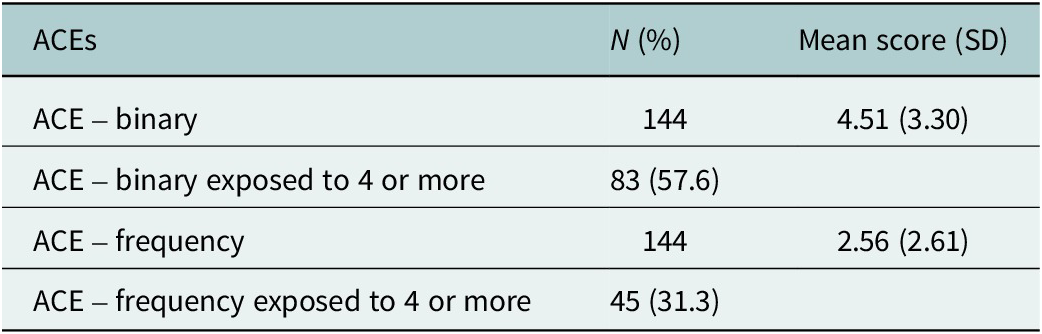
Even though the ACEs instrument was carefully administered after rapport was established, only 144 YP (54.1%) completed the questionnaire. Table 2 presents the binary (yes/no) and frequency scores for ACEs. More than half of the participants who completed the ACEs (57.6%) reported exposure to four or more different ACEs; almost one-third (31.3%) reported that the frequency of these ACEs was four or more. It should be noted that 23.6% had a frequency of 5–9 (not presented in Table 2).
Adverse childhood experiences (ACEs) scores (N = 144)

Table 2. Long description
Counts represent the number of participants with available data for each measure. Percentages are calculated based on the total sample size (N=144).
For the ACE frequency measure, all 144 participants also have available data, with a mean score of 2.56 (SD 2.61). Within this measure, 45 participants (31.3%) are exposed to four or more ACEs.
For the ACE binary measure, all 144 participants have available data, with a mean score of 4.51 (SD 3.30). Among them, 83 participants (57.6%) are exposed to four or more ACEs.
Summarises Adverse Childhood Experiences (ACE) scores for 144 participants, reported as counts (n), percentages (%), and mean scores with standard deviations (SD).
Tables 3 and 4 show the changes in clinical outcomes over time. Between 132 (49.6%) and 153 (57.5%), participants completed both pre- and post-measures for different outcomes (Table 3), and between 53 (19.9% and 66 (24.8%) participants completed questionnaires at all three time-points (pre-test, post-test and the 3-month follow-up) (Table 4).
Clinical outcomes at pre-post intervention screening (N = 266)

Table 3. Long description
PHQ-9 functionality difficulties reported for 139 participants (52.3%), with mean scores 1.39 (SD 0.98) at pre-test and 0.55 (SD 0.71) at post-test, (p<0.01).
For depression (PHQ-9), 153 participants (57.5%) had mean scores of 11.18 (SD 6.1) at pre-test and 5.18 (SD 4.35) at post-test (p<0.01).
For health-related quality of life (EQ-5D-5L), 132 participants (49.6%) have data, with mean scores of 68.58 (SD 20.9) at pre-test and 82.43 (SD 15.53) at post-test, (p<0.01).
GAD-7 functionality difficulties are reported for 137 participants (51.5%), with mean scores of 1.53 (SD 1.04) at pre-test and 0.59 (SD 0.76) at post-test, (p<0.01).
For anxiety (GAD-7), 152 participants (57.1%) have data, with mean scores of 10.07 (SD 5.24) at pre-test and 4.68 (SD 3.65) at post-test, (p<0.01).
Shows clinical outcomes at pre- and post-intervention screening for a total sample of 266 participants. Data are reported as counts (n), percentages (%), mean scores with standard deviations (SD), and p values.
Note: Bold p-values indicate statistically significant differences between pre-test and post-test scores (p < 0.05).
Clinical outcomes at all three time points

Table 4. Long description
For depression (PHQ-9), 66 participants (24.8%), with mean scores of 11.12 (SD 5.57), 4.15 (SD 3.45), and 4.62 (SD 4.81) (p<0.01). PHQ-9 functionality difficulties are reported for 53 participants (19.9%), with mean scores of 1.51 (SD 0.85), 0.51 (SD 0.58), and 0.51 (SD 0.67) (p<0.01).
For health-related quality of life (EQ-5D-5L), 56 participants (21.1%) have data, with mean scores of 67.7 (SD 20.69), 83.36 (SD 14.26), and 83.04 (SD 17.83), (p=0.14).
GAD-7 functionality difficulties are reported for 53 participants (19.9%), with mean scores of 1.74 (SD 0.98), 0.51 (SD 0.72), and 0.49 (SD 0.75), (p=0.01).
For anxiety (GAD-7), 66 participants (24.8%) have data, with mean scores of 10.53 (SD 4.97) at pre-test, 3.88 (SD 2.98) at post-test, and 3.71 (SD 3.20) at follow-up, (p<0.01).
Presents clinical outcomes measured at pre-test, post-test, and follow-up for a subset of participants, with data reported as counts (n), percentages (%), mean scores with standard deviations (SD)and p values.
Note: Bold p-values indicate statistically significant differences across the three time points (p < 0.05).
Those who screened pre- and post-treatment showed statistically significant improvements in the YP conditions according to all parameters – anxiety and depression symptoms are significantly decreased, and functional difficulties are reported less. At the same time, the health-related quality of life is remarkably improved.
The analyses of data collected at all three-time points show large and statistically significant decreases in clinical symptoms of anxiety and depression and a steady improvement in daily functioning from pre- to post-test, with improvements being maintained over time. The improvement in health-related quality of life score was statistically significant from pre- to post-intervention (p-value < 0.01), but not in the group with follow-up data (p-value = 0.14), despite an observable improvement in mean scores.
Details of the regression analyses that explored the associations between client characteristics and symptoms of anxiety and depression are presented in Supplementary Tables 4 and 5 (see Supplementary Material). Age, gender, living location, occupation, intervention type and intervention format were not significantly associated with anxiety outcomes at post-test (p-value > 0.05); baseline anxiety pre-test scores were also not significantly associated with post-treatment outcomes (p-value = 0.09). Participants who reported fewer than four ACEs and those who self-referred were more likely to have lower post-test scores for anxiety, whereas higher baseline depression scores predicted higher post-treatment anxiety (all p-value < 0.05). Multiple regression model for depression post-treatment did not show any significant association with pre-test scores or other client characteristics (p-value > 0.05), except that depression post-test scores were negatively associated (p-value < 0.01) with lower ACE exposure (less than 4 ACEs), while baseline depression scores were marginally associated with higher post-treatment depression (p-value = 0.05).
The health-related quality of life post-test score was significantly higher for clients with better baseline quality of life and lower (fewer than 4) exposure to ACE experiences (p-value < 0.01) and a greater number of basic and advanced individual sessions (p-value = 0.01). Other characteristics were not significantly associated with health-related quality of life outcomes (Supplementary Table 6).
Intercorrelation analysis revealed significant positive correlations between anxiety and depression symptoms, and gender and age correlated positively with mental health symptoms (Supplementary Tables 7–9). Negative correlations were found between the ACE binary score and the type of referral for depression and anxiety. Furthermore, health-related quality of life was negatively correlated with mental health symptoms and the number of basic individual sessions but not with advanced individual sessions (Supplementary Table 9).
Fifty-eight clients (21.8%) returned client satisfaction questionnaires. The results, shown in Table 5, reveal high overall satisfaction with the service (94.83%) and improvements in condition, including achieving treatment goals (89.66%) and reducing negative emotions and disturbing thoughts (87.93%). Several facilitating factors were endorsed, including the ability to share problems during counselling sessions and discuss them openly (96.55%), as well as feeling understood by the counsellor (96.55%). Almost all who completed the questionnaire (94.83%) felt “better oriented in life” and empowered, while 91.23% reported a positive feeling of being a productive participant (“co-author”) in the process. The lowest-rated area was “session duration/having enough time” (36.21%).
Client satisfaction (N = 58)

Table 5. Long description
For overall satisfaction, mean scores range from 4.14 to 4.71, with agreement from 82.76% to 98.28%, including highest for relationship quality (4.71; 98.28%) followed by willingness to recommend the service (4.26; 94.83%) and lowest in this section but still high score Will recommend a friend/peer to address the Club Synergy (4,26; 94.83%).
For factors encouraging change, highest score was for quality of contact (4.57; 93.10%), followed by session duration (2.86; 36.21%).
For helpful factors, highest score was for empathy (4.60; 93.10%), followed by understanding by the counsellor (4.53; 96.55%).
For overall condition change, highest was for achieving goals (4.19; 89.66%), followed by reduced negative emotions (4.17; 87.93%).
Presents client satisfaction outcomes for 58 participants, reported as mean scores and percentages of clients who agreed or strongly agreed.
Supplementary Tables 10 and 11 report the characteristics of those who dropped out of Synergy before treatment completion. In total, 105 individuals (28.3% of those who enrolled in the service) dropped out. The gender ratio (61.9% female), mean age (19.5), education levels and marital status did not differ statistically from those of completers. There was a difference in occupational status: 30% of completers and 21% of dropouts were officially employed (p-value = 0.004).
No differences were found in target group composition, referral pathways or willingness to engage in the service. However, the groups differed according to intervention type, with fewer dropouts receiving individual sessions only (58.1% vs. 74.1%) and more receiving group sessions only (12.4% vs. 4.5%) (p-value = 0.01). More dropouts were enrolled in face-to-face offline sessions than completers (51.4% vs. 29.3%; p-value < 0.001). This may suggest that online delivery supported treatment retention for some YP. Remote intervention can reduce logistical barriers to attendance, including travel requirements, time constraints and difficulties accessing services in person, thereby facilitating continued engagement. However, this finding should be interpreted with caution, as dropout is likely influenced by multiple interacting clinical and contextual factors beyond treatment modality alone.
There was no statistically significant difference in pre-test scores or ACE scores.
Multiple regression identified that living in Batumi was associated with a 4.5 times higher dropout rate than living in Tbilisi (p-value = 0.03, 95% CI [1.18, 16.82]), which may reflect several interacting factors. At the service level, the regional programme was staffed by fewer clinicians with relatively less clinical experience, which may have affected capacity, continuity of care and the development of a therapeutic alliance. At the contextual level, greater stigma around mental health and lower mental health literacy may also have contributed to dropout.
Discussion
Summary
The results of this study show promise that a trauma-informed, transdiagnostic, multi-disciplinary, primarily digital approach to supporting YP aged 14–25 with mental health problems is effective and acceptable. Mean symptom reductions were over 60% in those who completed the treatment they were offered and were maintained at 3-month follow-up. Overall satisfaction ratings were over 90%. Dropout rates were, however, high (28.8%), and many YP who completed treatment would have welcomed more sessions than they received.
The results are consistent with previous preliminary positive findings (Makhashvili et al., Reference Makhashvili, Javakhishvili, Chikovani, Bevan-Jones, Uchaneishvili, Pilauri, Shengelia, Marjanishvili, Sulaberidze, Sikharulidze, Roberts and Bisson2022) and suggest that Synergy’s service may provide appropriate mental health support for YP presenting with a wide range of MH manifestations.
Interpretation
It is essential to recognise that the participants presented with complex needs. More than half of those with ACEs binary data (57.6%) had been exposed to four or more ACEs, which have been consistently linked to an increased risk of numerous negative health and psychological outcomes in adulthood, including mental health disorders, substance abuse and chronic diseases (Hughes et al., Reference Hughes, Bellis, Hardcastle, Sethi, Butchart, Mikton, Jones and Dunne2017; Sanderson et al., Reference Sanderson, Mouton, Cook, Liu, Blot and Hargreaves2021; Broekhof et al., Reference Broekhof, Nordahl, Tanum and Selvik2023). While studies (e.g., Hughes et al., Reference Hughes, Bellis, Hardcastle, Sethi, Butchart, Mikton, Jones and Dunne2017) demonstrate strong associations between ≥4 ACEs and adult mental ill health, subsequent adolescent research indicates that this relationship emerges earlier in the life course, with higher ACE exposure in adolescence similarly associated with elevated depression, anxiety and other psychosocial difficulties (Bomysoad and Francis, Reference Bomysoad and Francis2020; Kim et al., Reference Kim, Kim, Chartier, Wike and McDonald2021; Lam et al., Reference Lam, Fairweather, Lewer, Prescott, Undugoda, Dickerson, Gilbody and Wadman2024).
Nearly one-third of the participants experienced multiple ACEs frequently, indicating not just exposure but repeated (and potentially ongoing) trauma. Despite a lack of published research in this area, it seems reasonable to suggest that the frequency of ACEs could intensify the impact of these experiences, leading to more severe and widespread effects on mental and physical health and a greater risk of adverse outcomes.
The high prevalence of ACE exposure among participants highlights the importance of considering the potential impacts of such experiences in services for YP and the need for trauma-informed care and strategies to foster resilience and adaptive coping. Early intervention and ongoing support can help mitigate some of these effects and enhance clients’ overall outcomes (Webster, Reference Webster2022). The interventions provided by Synergy addressed this requirement.
The low completion rate of the ACE questionnaire (ACE data from only 54.1% of the sample invited to complete it) may indicate challenges in implementing trauma-related screening in clinical settings. At the client level, disclosure of childhood adversity can be emotionally demanding and may evoke shame, avoidance or concerns about confidentiality. At the clinician level, previous literature indicates that barriers to trauma inquiry may include discomfort discussing trauma, limited training, concerns about causing distress and uncertainty regarding appropriate follow-up after disclosure (Substance Abuse and Mental Health Services Administration, 2014; Stevens et al., Reference Stevens, Ziadni, Lillis, Gerhart, Baker and Hobfoll2019).
The satisfaction with the service may arise from the client-focused, friendly, non-judgemental and warm atmosphere of the service, which aligns with existing evidence (Hartnell et al., Reference Hartnell, Ou and Kinicki2011; Glisson and Williams, Reference Glisson and Williams2015). Considering the high level of exposure to ACEs, the organisational culture and friendly climate of Synergy seem likely to have provided a healing atmosphere to YP, counteracting earlier ACEs and modelling healthy problem-solving-oriented patterns of behaviour to reduce symptoms and achieve high levels of satisfaction with the service.
Most participants received relatively short online interventions, supporting existing evidence that brief internet-based prevention and treatment programmes for anxiety and depression are effective (Das et al., Reference Das, Salam, Lassi, Khan, Mahmood, Patel and Bhutta2016). In addition to sustained reductions in anxiety and depression symptoms, there were significant improvements in functioning from pre-test to post-test. The continued slight improvement in a follow-up suggests that these gains were maintained and even slightly enhanced over time.
The pre- and post-treatment scores demonstrated a statistically significant improvement in health-related quality of life, although the increased mean scores were not statistically significant for participants with pre-, post- and follow-up data. This is most likely due to insufficient power, given the notably smaller sample size. Overall, these results suggest that the service was effective in enhancing participants’ health and well-being, and importantly, this improvement was maintained after discharge.
Higher baseline levels of anxiety were associated with higher levels of depression and vice versa. This is consistent with existing literature that shows substantial comorbidity between anxiety and depression (Frank et al., Reference Frank, Titone, Kagan, Alloy and Kendall2021; Konac et al., Reference Konac, Young, Lau and Barker2021) and supports a transdiagnostic approach to YP presenting with common mental health problems. The negative correlation between health-related quality of life (HRQoL) and symptoms of depression and anxiety was not surprising (Hohls et al., Reference Hohls, König, Quirke and Hajek2021; Wilzer et al., Reference Wilzer, Zeisel, Roessner and Ring2024) and suggests that interventions with a focus on improving HRQoL could reduce anxiety and depression.
There was a significant difference in the levels of anxiety and depression between genders, as shown in the recent systematic review and other studies (Campbell et al., Reference Campbell, Bann and Patalay2021; Farhane-Medina et al., Reference Farhane-Medina, Luque, Tabernero and Castillo-Mayén2022). Females tended to report higher levels of anxiety and depression than males. These findings should be interpreted cautiously, as some authors emphasise underreporting in males (Shi et al., Reference Shi, Yang, Zhao, Chen, Ren and Dai2021). Older individuals were more likely to experience higher levels of anxiety and depression compared to younger people. International literature reports contrasting findings on this. During COVID-19, younger age was linked to increased vulnerability to common mental disorders (Varma et al., Reference Varma, Junge, Meaklim and Jackson2021). Still, the WHO reported that anxiety disorders were more common among older than younger adolescents (WHO, 2024). A recent report based on a nationally representative survey found that young adults in the United States experience anxiety and depression twice as often as teenagers (Weissbourd et al., Reference Weissbourd, Batanova, McIntyre, Torres, Irving, Eskander and Bhai2023). The influence of gender and age on mental health is an important consideration. It should inform the development of tailored interventions that may lead to more effective treatments and management plans.
Existing literature supports our TD approach for common MH problems. TD programmes for emotional regulation (Cludius et al., Reference Cludius, Mennin and Ehring2020; Espinosa et al., Reference Espinosa, Valiente, García-Escalera, Chorot, Arnáez, Schmitt and Sandín2024) and interpersonal difficulties have demonstrated efficacy internationally. Furthermore, TD approaches delivered by non-specialist providers are effective at treating symptoms of common mental disorders and non-specific distress in LMICs (Ó hAnrachtaigh et al., Reference Ó hAnrachtaigh, Brown, Beck, Conway, Jones and Angelakis2024). Evidence from LMICs also indicates promising outcomes for interventions targeting depression, anxiety and PTSD among YP (Alozkan‐Sever et al., Reference Alozkan‐Sever, Uppendahl, Cuijpers, De Vries, Rahman, Mittendorfer‐Rutz, Akhtar, Zheng and Sijbrandij2023), with emerging evidence suggesting that TD may be effective in the treatment of PTSD and Complex PTSD (Karatzias et al., Reference Karatzias, Mc Glanaghy and Cloitre2023).
A TD youth mental health is gaining momentum globally (McGorry et al., Reference McGorry, Mei, Dalal, Alvarez-Jimenez, Blakemore, Browne, Dooley, Hickie, Jones, McDaid, Mihalopoulos, Wood, El Azzouzi, Fazio, Gow, Hanjabam, Hayes, Morris and Pang2024; Wang et al., Reference Wang, Wang and Qiu2024; Bontilao-Lagare et al., Reference Bontilao-Lagare, Mordeno, Nalipay and Ma2025), especially for traumatised children and adolescents (Gruen et al., Reference Gruen, Lindenbach, Arnold, Ehrenreich-May, Dimitropoulos and Shenk2023). A recent umbrella review systematically examined psychological trauma as a transdiagnostic risk factor across psychiatric conditions, highlighting the importance of preventing early traumatic events and providing trauma-informed care in early intervention and mental health services (Hogg et al., Reference Hogg, Gardoki-Souto, Valiente-Gómez, Rosa, Fortea, Radua, Amann and Moreno-Alcázar2023).
Early TD interventions might be especially important given that many YP do not respond adequately to existing treatments. For instance, a systematic review and meta-analysis (Cuijpers et al., Reference Cuijpers, Pineda, Ng, Weisz, Muñoz, Gentili, Quero and Karyotaki2021) revealed that more than 60% of youth receiving therapy for depression using CBT treatment did not achieve a treatment response (Cuijpers et al., Reference Cuijpers, Karyotaki, Ciharova, Miguel, Noma, Stikkelbroek, Weisz and Furukawa2023). The authors concluded that more effective treatment strategies were needed. Although these findings derive from samples restricted to children and adolescents, and our sample included both participants below and above 18 years of age, they remain relevant in highlighting ongoing challenges in achieving optimal treatment outcomes among YP.
Findings indicated that dropout was higher in the regional Batumi service than in the Tbilisi service. This may reflect several interacting factors. At the service level, the regional programme was staffed by fewer clinicians with less clinical experience, which may have affected capacity, continuity of care and the development of a therapeutic alliance. At the contextual level, greater stigma around mental health and lower mental health literacy may also have contributed.
It is worth noting that Synergy, which bridges adolescent and adult services and supports mixed-age groups, reflects real-world practice, even though our findings are harder to compare with age-restricted trials. The service was intentionally developed as a low-threshold model of care to reduce common barriers to accessing MH support. Unlike existing services in the country and broader region, access does not require a formal diagnosis; YP could self-refer, and care is provided free of charge. Within the service mandate, all YP presenting for support, either face-to-face or online, are eligible for assessment and care. The service collected data from a large number of people systematically using validated outcome measures.
The results suggest that online delivery supported treatment retention for some YP. Remote intervention can reduce logistical barriers to attendance, including travel requirements, time constraints and difficulties accessing services in person, thereby facilitating continued engagement. However, this finding should be interpreted with caution, as dropout is likely influenced by multiple interacting clinical and contextual factors beyond treatment modality alone.
While the multivariable models were developed using predefined statistical criteria and theoretical considerations, the study employed a non-randomised, single-group design and modest samples limited the robustness of these analyses. Replication in larger, controlled studies is warranted to confirm the observed associations.
Our results suggest potential value in the wider application and further evaluation of a trauma-informed transdiagnostic, both digital and face-to-face service model for YP in other LMIC settings. The core elements of the service model, including low-threshold access and transdiagnostic intervention delivery, may be relevant to other areas and countries. However, transferability and scalability would depend on adaptation to local context, available resources and existing service structures.
Limitations
A key limitation of the study concerns the incompleteness of the data. Some participants dropped out of the service. Although this reduced the overall sample size, data from more than 160 participants were retained, and no significant differences were found between completers and dropouts in their characteristics. In addition, some service completers did not complete all assessment measures, especially at the follow-up point, where the sample size was substantially smaller. The non-completers were not contacted to discuss potential causes for discontinuation of the service. Analyses were conducted using available case (complete case) data, and missing values were excluded from outcome analysis. Although no significant baseline differences were observed between participants with complete and missing post-test data, the exclusion of missing outcome data may have introduced bias related to attrition and should be considered when interpreting the findings.
The sample included several distinct participant subgroups with potentially differing psychosocial needs and lived experiences. As subgroup analyses were not conducted, it was not possible to determine whether intervention effects differed across groups. In addition, limited sample sizes across several participant categories limited meaningful statistical comparisons. Therefore, the overall findings may mask variation in outcomes between subgroups. A further concern is that the study may have been underpowered to fully assess all outcomes across the chosen time points.
Given the relatively modest sample size in relation to the number of predictors included, the multivariable models may have had limited statistical power and may be vulnerable to overfitting. Although predictor selection was guided by univariable screening (p < 0.05) and theoretical relevance, these findings should be interpreted cautiously and confirmed in larger studies.
Missing ACE data may not be random and should therefore be interpreted with caution. Non-completion may be associated with both client-related factors (e.g., discomfort disclosing adversity) and clinician-related factors (e.g., reluctance to initiate trauma-focused questioning), potentially introducing selection bias into the sample.
Another limitation is the absence of a control group or any comparative data to validate the study results. Future controlled studies in different settings are necessary to confirm the potential effectiveness of the Synergy approach.
Additionally, the study did not include a structured baseline assessment of YP, such as a comprehensive interview. This was not possible due to the nature of the service, and therefore, we have only an overview of presentations, focusing on symptoms of depression and anxiety. Future research would benefit from including a more comprehensive assessment to accurately evaluate the full range and interactions of the problems YP present.
Conclusions
This study shows that Club Synergy’s trauma-informed, transdiagnostic interventions, delivered both digitally and face-to-face, lead to meaningful and lasting improvements in reducing anxiety, depression and daily functioning over at least 3 months, indicating the approach is worth applying more widely and exploring through further research.
Open peer review
To view the open peer review materials for this article, please visit http://doi.org/10.1017/gmh.2026.10303.
Supplementary material
The supplementary material for this article can be found at http://doi.org/10.1017/gmh.2026.10303.
Author contributions
NM, IC, JJ, MU and JB were involved in the conception and design of the study; NSh analysed the data; all were involved in the interpretation of findings; NM drafted the initial article, and JB, BR, JJ, RB and IC revised it critically. All authors agree to be accountable for all aspects of the work.
Competing interests
The authors report that there are no competing interests to declare.
Data availability statement
The data supporting the findings of this study are openly available in Zenodo at https://zenodo.org/records/17802325
Ethics and approvals
Ethical approval for this study was granted by the Ilia State University Bioethics Committee (Approval No. #IBECMA-2019-10/07). Ethical approval for this study was obtained from the Institutional Review Boards (IRB) of the National Centre for Disease Control and Public Health in Georgia (ref. IRB # 2019-054 and IRB # 2021-057) and Cardiff University School of Medicine (SMREC Reference Number: 19/103).
Funding statement
This work was supported by the Medical Research Council (MRC), Department for International Development (DFID) and National Institute for Health Research (NIHR) Joint Adolescent Health 2018 National Prevention Research Initiative [Grant Reference: MR/S025278/1] through the PAMAd project.



 Open access

