Patterns of leaf production and leaf fall directly influence leaf area index and forest productivity. However, to date, most studies of vegetative phenology in tropical forests have focused on the classification of plant phenology (i.e. continuous or rhythmic growth) rather than analyses of the periodicity of leaf production. In the tropics, plant species with continuous phenology are less abundant than those with rhythmic phenology, and it is assumed, but rarely tested, that continuous phenology is the most common behaviour of pioneer species (Osada et al. Reference OSADA, TOKUCHI and TAKEDA2012, Reich et al. Reference REICH, UHL, WALTERS, PRUGH and ELLSWORTH2004). Continuous leaf production is common in everwet environments, but appears to be less common in seasonal environments. Here, we explore intra-annual variation in leaf production, the number of live leaves per sapling, and internode elongation in a pioneer plant at different localities characterized by contrasting rainfall seasonality.
Previous studies of Cecropia obtusa and Cecropia sciadophylla have shown high annual periodicity in reproductive and branching processes, and seasonal alternation between long and short nodes (Heuret et al. Reference HEURET, BARTHÉLÉMY, GUÉDON, COULMIER and TANCRE2002, Zalamea et al. Reference ZALAMEA, STEVENSON, MADRIÑÁN, AUBERT and HEURET2008). Working in habitats with seasonal rainfall regimes, Davis (Reference DAVIS1970), Santos (Reference SANTOS2000) and Zalamea et al. (Reference ZALAMEA, STEVENSON, MADRIÑÁN, AUBERT and HEURET2008) suggested that rainfall seasonality could be one of the drivers behind the alternation of long and short nodes on Cecropia. Thus, if the rate of leaf production is constant throughout the year and across habitats with contrasting seasonality in climate, then variation in internode length in Cecropia individuals can be confidently attributed to seasonal changes in climatic data. This hypothesis, however, has not yet been tested.
The Neotropical genus Cecropia (Urticaceae) occupies a wide range of climates, with 61 species distributed from southern Mexico to northern Argentina (Berg & Franco Reference BERG and FRANCO2005). It is among the most abundant genera of Neotropical pioneer trees with fast growth and a propensity to colonize large gaps and early successional habitats (Berg & Franco Reference BERG and FRANCO2005). Using adult C. sciadophylla trees, Zalamea et al. (Reference ZALAMEA, STEVENSON, MADRIÑÁN, AUBERT and HEURET2008) predicted that adult trees produce 23 new leaves y−1 on individuals growing in seasonal environments. However, little is known about how the rate of leaf production varies among habitats with contrasting patterns in rainfall seasonality, or to what extent the rate of leaf production shows intra-annual fluctuation in this species. This is useful information because, in the absence of climate effects on leaf production rates, the number of leaf scars could be used as an accurate estimator of plant age.
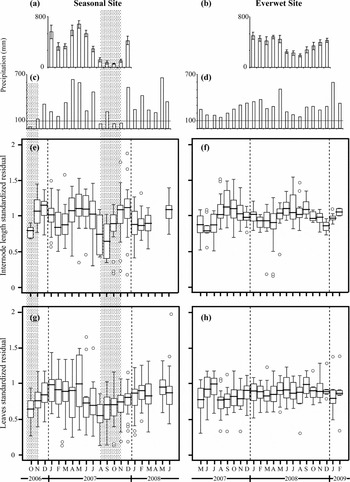
Here, we focused on C. sciadophylla, which is one of the most widely distributed species of the genus (i.e. the Amazon basin, the Guiana shield and the Llanos region of Colombia and Venezuela). We chose our localities of study at the extremes of the gradient in seasonality in rainfall at which C. sciadophylla naturally occurs, and we compared the intra-annual variation in leaf production as well as the intra-annual fluctuation in internode length on Cecropia saplings at these two localities (one in French Guiana and the other in Colombia). The French Guiana population was located at a seasonal site near the locality of Sinnamary-Counamama (hereafter seasonal site; 5°21’N, 53°12’W). For this locality there is on average a 4-mo dry period between August and November (during the study, there were 3 mo with less than 100 mm mo−1 of rainfall) and a short, less regular dry period in March (Figure 1a, c). The mean annual rainfall for this locality is ~3000 mm. The Colombian population was located at an everwet site near Leticia, in the CercaViva Nature Reserve on the northern margin of the Amazon River (hereafter everwet site; 4°12’S, 69°55’W). During the study, there was not a single month with less than 100 mm of rainfall and the mean annual rainfall for this locality is ~3300 mm (Figure 1b, d). In French Guiana, monthly precipitation data were collected at the Pointe Combi station (~25 km from the site). For the everwet site, monthly precipitation data were collected at Leticia station (~7 km from the site).
Mean monthly precipitation ± SE patterns are shown for the seasonal site in French Guiana (a) and everwet site in Colombia (b). Actual precipitation patterns for the seasonal (c) and everwet (d) sites during the growth monitoring. Box-plot representation of monthly standardized residuals of internode lengths for Cecropia sciadophylla saplings at the seasonal (e) and everwet (f) sites. Box-plot representation of monthly standardized residuals of the number of live leaves per tree for the seasonal (g) and everwet (h) populations. For each box-plot the boxes represent the lower and upper quartiles (i.e. 25% and 75% of the observations). The bold line represents the median and the whiskers represent the minimum and maximum values, excluding the outliers. Outliers are represented as circles. Black dashed lines represent annual limits and the dotted areas correspond to the dry season.

For 69 saplings ranging in size from 1 to 2 m we monitored growth, intra-annual variation of leaf production, the number of live leaves per sapling and variation in internode length. Saplings at the everwet and seasonal sites were monitored monthly. At the first census (September 2006 for the seasonal site and April 2007 for the everwet site), 20 and 25 unbranched saplings were marked, respectively. All individuals were marked on the fifth leaf below the apex. The number of new leaves produced and the number of leaves per sapling were recorded monthly for each population. We gathered data for 22 mo (May 2007–February 2009) in the everwet site and 19 mo (October 2006–June 2008) in the seasonal site. During the 2007 rainy season, mortality was high at the seasonal site (~60% of marked saplings died). Thus in September 2007, 24 new saplings in this population were marked and monitored. After the growth monitoring, we felled 10 individuals on March 2009 at the everwet site and 23 individuals on July 2008 at the seasonal site to determine seasonal variation in internode length. For all these individuals the internode length was measured node by node from the base to the apex. Then, for the internode length analysis, we used all the nodes produced during the monitoring period, as we know the exact dates on which these nodes were produced.
The number of live leaves per tree varies among individuals. To standardize the observed fluctuation in the number of live leaves per tree and to estimate if there was seasonal variation in number of live leaves on the trunk, the standardized residuals of the number of live leaves for each individual were calculated as follows:
 \begin{equation*}
{\textit{residual}} = \frac{(x_{i} - y_{i})}{\bar{x}},\end{equation*}
where xi is the total number of leaves present in the month i (including old as well as new leaves), yi is the number of new leaves produced in the month i and x is the mean number of leaves observed monthly for a given individual throughout the full study period.
To analyse the fluctuation in internode length, a time-series analysis relying on a decomposition principle was used (Guédon et al. Reference GUÉDON, CARAGLIO, HEURET, LEBARBIER and MEREDIEU2007). A symmetric smoothing filter corresponding to the probability mass function of binomial distributions with parameters n = 100 and P = 0.5 was used to remove the trend in internodal length (Zalamea et al. Reference ZALAMEA, STEVENSON, MADRIÑÁN, AUBERT and HEURET2008). After removing the trend, standardized residuals were calculated to examine the local fluctuation in internode length.
To compare site differences in seasonal variation in internode length, the rate of leaf production and number of live leaves per sapling, a linear mixed-effect analysis of variance was used. To determine the month effect on internode elongation, the standardized residuals of internode length were used as the response variable, with month and year as fixed effects, and individuals as a random effect. A Poisson distribution was used to fit a linear mixed-effect model to leaf production and live leaves per tree, since these variables represent counts over time. To determine seasonal variation in leaf production, month and year were assigned as fixed effects and individuals as a random effect. Finally, for the number of live leaves per sapling, month, year and initial number of leaves were coded as fixed effects and individuals as a random effect. Pearson correlation analyses were used to assess whether periodic variation in rate of leaf production and in number of live leaves per sapling was related to monthly precipitation recorded during the study. We used a Bonferroni correction when we analysed the data using different month-lags. All analyses were made in Python (http://www.python.org/) and R software using the nlme, lme4 and gdata packages.
Mean ± SE rate of leaf production was 1.9 ± 0.3 leaves mo−1 for the seasonal population and 1.9 ± 0.4 leaves mo−1 for the everwet population. There was no significant intra-annual fluctuation in the rate of leaf production for the saplings at the seasonal site (χ2 = 7.66, df = 11, P = 0.74) or the everwet site (χ2 = 16.8, df = 11, P = 0.11). We found no significant difference in the rate of leaf production between the two localities (Mann–Whitney–Wilcoxon test, P = 0.27). Mean ± SD rate of leaf production was 23.6 ± 2.7 leaves y−1 at the seasonal site and 22.5 ± 2.5 leaves y−1 at the everwet site.
Internode length varied among months at both sites (seasonal: F = 8.86, df = 11, P < 0.001; Figure 1e; everwet: F = 3.61, df = 11, P < 0.001; Figure 1f). In addition, internode length at the seasonal site was correlated with monthly precipitation (seasonal: N = 19, rp = 0.48, P = 0.018, no time lag), but was not correlated at the everwet site after a Bonferroni correction (N = 22, rp = 0.37, P = 0.123, 3-mo lag). When variation in internode length was represented as standardized residuals, two annual cycles were determined at the seasonal population, while only one cycle was found for the everwet (Figure 1e, f).
The number of live leaves per sapling varied significantly during the year at the seasonal population (χ2 = 38.3, df = 11, P < 0.001; Figure 1g) but not at the everwet site (χ2 = 6.10, df = 11, P = 0.866; Figure 1h). Between July and October, the individuals of the seasonal site bore fewer leaves per sapling than during the rest of the year (Figure 1g). On average, August 2007 was the month with fewest leaves per sapling (8 ± 1.5 leaves) and January 2007 was the month with the maximum number of leaves per sapling (10.8 ± 0.9 leaves) at the seasonal site. Precipitation was not significantly correlated with the standardized residuals of the number of live leaves on the trunk at the seasonal site after a Bonferroni correction (N = 19, rp = −0.48, P = 0.052; 3-mo lag).
Many studies in tropical regions have shown that climatic factors, particularly rainfall, affect growth periodicity in plants (Wagner et al. Reference WAGNER, ROSSI, STAHL, BONAL and HÉRAULT2012, Zalamea & González Reference ZALAMEA and GONZÁLEZ2008, Zalamea et al. Reference ZALAMEA, MUNOZ, STEVENSON, PAINE, SARMIENTO, SABATIER and HEURET2011). In this study we found that individuals growing in the everwet and seasonal sites were subject to contrasting patterns of rainfall seasonality, but we found no significant difference in the rate of leaf production on C. sciadophylla saplings. In two sites with highly seasonal rainfall regimes, Zalamea et al. (Reference ZALAMEA, STEVENSON, MADRIÑÁN, AUBERT and HEURET2008) showed that trees of C. sciadophylla present annual successive cycles involving long and short internodes separated by an interval of about 23 leaves. Here we found that C. sciadophylla saplings also produced about 23 leaves y−1. Thus, the similar rate of leaf production between adult trees and saplings suggests that leaf production is a constant trait throughout ontogeny and among populations in areas of contrasting rainfall seasonality and wide geographical range. Our results suggest that the rate of leaf production may be an endogenously controlled trait little affected by climate and geographical distance.
Our results are consistent with previous studies of internode length variation in seasonal climates. In Costa Rica, Davis (Reference DAVIS1970) found that C. peltata and C. obtusifolia, elongated shorter internodes in the dry season than in the rainy season. Similarly, Zalamea et al. (Reference ZALAMEA, STEVENSON, MADRIÑÁN, AUBERT and HEURET2008) reported a bimodal annual pattern of internode elongation for adult C. sciadophylla at the seasonal site of Saint-Elie in French Guiana. In the latter case, short internodes were produced during two different dry periods that occur 6 mo apart in the same year, providing compelling evidence that internode length in Cecropia is controlled by moisture availability.
Censuses of the number of live leaves in this study showed that leaf number varies among months at the seasonal site but not in the everwet site. Because the rate of leaf production is constant at both localities, the difference in number of live leaves per sapling at the seasonal site must reflect seasonal variation in leaf life span. Poorter (Reference POORTER2001) found that leaf longevity increased with shade in Cecropia ficifolia seedlings in Bolivia. At low irradiance, carbon gain is limited, thus leaf construction cost can be recovered only if leaves live longer (Poorter Reference POORTER2001). Our results extend this result for C. sciadophylla and show that at the seasonal site, leaf lifetime is shorter during the dry than during the rainy season. Our results also show that C. sciadophylla could be a good model to study leaf life span and carbon balance, because C. sciadophylla cannot adjust its rate of leaf production but can adjust leaf life span in relation to environmental conditions.
The constant rate of leaf production in C. sciadophylla allows one to determine the age of a tree and reconstruct its past growth simply by dividing the total number of nodes on the trunk by 23. Zalamea et al. (Reference ZALAMEA, HEURET, SARMIENTO, RODRÍGUEZ, BERTHOULY, GUITET, NICOLINI, DELNATTE, BARTHÉLÉMY and STEVENSON2012) showed how this result could be applied to date the age of a disturbance, since C. sciadophylla establishes soon after the perturbation and this species is incapable of establishing after canopy closure (Mesquita et al. Reference MESQUITA, ICKES, GANADE and WILLIAMSON2001). One of the most remarkable findings of the present study is constancy in rate of leaf production among C. sciadophylla populations, irrespective of rainfall seasonality, geographical distance and tree ontogeny. This result reinforces the idea of using Cecropia individuals as a promising tool to date the age of disturbances (Zalamea et al. Reference ZALAMEA, HEURET, SARMIENTO, RODRÍGUEZ, BERTHOULY, GUITET, NICOLINI, DELNATTE, BARTHÉLÉMY and STEVENSON2012), even at intra-annual scales. Our contribution also shows how a field-measurable trait such as internode length could act as a good indicator for rainfall seasonality. Finally, it is assumed that many species exhibit strong seasonality of leaf production in tropical areas. However, this study provides a clear example where this statement is not true; in C. sciadophylla, leaf production occurs independently of climatic seasonal cues. An open question is whether leaf production in other pioneer species is also independent of climatic seasonal cues. This could allow us to link growth and climate of secondary forest species and better understand how past and future climate can affect plant growth trajectories.
ACKNOWLEDGEMENTS
The authors are most grateful to A. Rodríguez and B. Leudet de la Vallée for their assistance in the field. We thank F. Munoz and A. Berthouly for enlightening discussions during data analyses. We also thank J. Dalling, E. V. J. Tanner, E. Leigh Jr., N. Rowe, D. Roche, B. Wolfe and one anonymous reviewer for helpful comments on earlier versions of this manuscript. This research was partially supported by an Ecos-Nord, Colciencias, and Paris 13 University grant (C08A01), an IRD (Institut de Recherche pour le Développement, France) doctoral grant to P-C Z.