INTRODUCTION
Payments for ecosystem services (PES) have been praised as a promising means to provide land users with the incentive to conserve that which benefits wider society by creating an exchange value for conservation services (Wunder Reference Wunder2007; TEEB [The Economics of Ecosystems and Biodiversity] 2010). Despite a lively debate from practical and deontological viewpoints about the implications of the so-called commoditization of nature through PES (see for example Redford & Adams Reference Redford and Adams2009; Kosoy & Corbera Reference Kosoy and Corbera2010; Norgaard Reference Norgaard2010; McAfee & Shapiro Reference McAfee and Shapiro2010), the political thrust towards the use of PES continues (Wunder et al. Reference Wunder, Engel and Pagiola2008).
Although PES is widely understood as a voluntary transaction through which service beneficiaries pay service providers for the generation of conservation services (see Wunder Reference Wunder2007), many PES are in fact government-financed (Engel et al. Reference Engel, Pagiola and Wunder2008). Direct payments are generally seen as an effective conservation instrument (Ferraro Reference Ferraro2001; Ferraro & Kiss Reference Ferraro and Kiss2002). In order to maximize their cost-effectiveness, namely the conservation services generated with limited conservation funds, those land users that can provide conservation services at least-cost should be targeted, and only compensated for their actual conservation costs (Babcock et al. Reference Babcock, Lakshminarayan, Wu and Zilberman1996; Windle & Rolfe Reference Windle and Rolfe2008; Chen et al. Reference Chen, Lupi, Viña, He and Liu2010), following a ‘value for money’ approach.
In agricultural landscapes for instance, conservation costs are location and even farm-specific and therefore fully known only by the farmer. Conservation auctions involving a competitive bidding process, through which farmers indicate a land area to manage under certain conditions and the compensation payment they would require, are a means through which those farmers who can provide conservation services at least-cost can be identified (Latacz-Lohmann & van der Hamsvoort Reference Latacz-Lohmann and Van der Hamsvoort1997; Stoneham et al. Reference Stoneham, Chaudhri, Ha and Strappazzon2003; Ferraro Reference Ferraro2008). Conservation auctions can thus inform the targeting of conservation payments, but have not yet been widely applied in the context of PES implementation (Jack et al. Reference Jack, Leimona and Ferraro2009).
The growing debate about the cost-effectiveness of PES stems from two concerns that have gained increasing attention in the literature: (1) the uncertainty about the environmental additionality of PES (services that would not have been provided had the payment scheme not been in place) (for example Sierra & Russmann Reference Sierra and Russman2006; Sanchez-Azofeifa et al. Reference Sanchez-Azofeifa, Pfaff, Robalino and Boomhower2007; Honey-Róses et al. Reference Honey-Róses, Lopéz-García, Rendon-Salinas, Peralta-Higuerra and Galindo-Leali2009; Pattanayak et al. Reference Pattanayak, Wunder and Ferraro2010); and (2) tradeoffs with social equity aspects, which could undermine the legitimacy with which such schemes are viewed and thus result in a so-called ‘PES curse’ (Corbera et al. Reference Corbera, Brown and Adger2007; Kosoy et al. Reference Kosoy, Martinez-Tuna, Muradian and Martinez-Alier2007; Pascual et al. Reference Pascual, Muradian, Rodríguez and Duraiappah2010).
The literature on PES is dominated by its focus on forest conservation, with hardly any attention being paid to agrobiodiversity conservation, here understood as sustaining the on-farm use of crop genetic resources (Narloch et al. Reference Narloch, Drucker and Pascual2011). Genetic diversity is irreversibly lost from many agricultural landscapes around the world due to farming systems becoming specialized in fewer financially profitable crop species and varieties (Jackson et al. Reference Jackson, Pascual and Hodking2007; FAO [Food and Agriculture Organization of the United Nations] 2009). This is mainly due to a public goods problem, where social benefits from many agrobiodiversity conservation services are not captured in market values (Smale et al. Reference Smale, Bellon, Jarvis and Sthapit2004; Narloch et al. Reference Narloch, Drucker and Pascual2011). The on-farm use of a diverse portfolio of crop varieties is expected to be closely linked to regulating services, such as pest and disease management (Hajjar et al. Reference Hajjar, Jarvis and Gemmill-Herren2008), and the maintenance of evolutionary processes in the field (Brush Reference Brush1989). Additionally, from a sociocultural perspective, the on-farm conservation of landraces contributes to the maintenance of seed exchange networks, associated agricultural knowledge and cultural traditions (Coomes Reference Coomes2010; Stromberg et al. Reference Stromberg, Pascual and Bellon2010). High option values may also be associated with genetic resource diversity, particularly in the context of climate change and biotechnology developments, as well as changing consumer preferences (Bellon Reference Bellon, Kontoleon, Pasqual and Smale2009).
Based on the PES concept, this paper draws on two pilot schemes of payments for agrobiodiversity conservation services (PACS) recently launched by an international agricultural research centre in collaboration with local non-governmental organizations (NGOs) on the Andean Altiplano (high plains). These schemes offer farmers compensation payments for using traditional and currently neglected crop varieties (landraces) of quinoa (Chenopodium quinoa). Such incentives are necessary as, due to its growing export market potential, quinoa farming is increasingly becoming market-orientated, leading to specialization in a few highly financially profitable varieties with commercial traits and the erosion of wider quinoa diversity (Hellin & Higman Reference Hellin and Higman2005; Rojas et al. Reference Rojas, Valdivia, Padulosi, Pinto, Soto, Alcocer, Guzmán, Estrada, Apapza and Bravo2009).
Data were obtained through a conservation auction, in which community-based groups (CBGs) applied for conservation contracts by identifying the land area and the number of farmers in the community willing to take part in the conservation of a given set of priority quinoa landraces, as well as the payment (compensation) required for such effort. The existence of numerous varieties within the same crop species means that there is a need to prioritize the most threatened and unique landraces, so as to be able to maximize the level of genetic diversity conserved with limited conservation funds (as per Weitzman Reference Weitzman1998). Dealing with farming groups instead of individual farmers can reduce the scheme's transaction costs (for example for bidding, contracting and verification) while at the same time strengthening the self-organization skills of participating groups. Although there is some limited empirical consideration of applying conservation auctions in the developing world (see for example Jack et al. Reference Jack, Leimona and Ferraro2009), to the best of our knowledge this is the first time that a group-level auction to conserve threatened crop varieties has been implemented.
The targeting of conservation payments is generally based on conservation goals expressed in terms of a simplified and relatively easily verifiable service delivery proxy (such as land area under a certain land use), since conservation services are generally difficult to measure (Muñoz-Piña et al. Reference Muñoz-Piña, Guevara, Torres and Braña2008; Muradian et al. Reference Muradian, Corbera, Pascual, Kosoy and May2010). At the same time, there might be multiple conservation services being sought that require the attainment of different conservation goals, which may not be compatible with each other (Babcock et al. Reference Babcock, Lakshminarayan, Wu and Zilberman1996; Ferraro Reference Ferraro2003; Naidoo & Rickets Reference Naidoo and Ricketts2006; Chen et al. Reference Chen, Lupi, Viña, He and Liu2010) Under PACS, conservation area is clearly an important conservation goal, as it is closely linked with the ability to produce enough seeds to safeguard genetic material and to facilitate evolutionary processes in the field. The maintenance of cultural traditions and agricultural knowledge may be closely linked to the number of conserving farmers (Brush Reference Brush1989; Stromberg et al. Reference Stromberg, Pascual and Bellon2010). An additional goal may be the involvement of a large number of communities, since this increases the likelihood that seed exchange networks can be maintained (Coomes Reference Coomes2010).
The distribution of conservation funds among the service providers varies depending on the conservation goals upon which the scheme is based. It may be desirable to reach an equitable distribution of conservation funds, so as to avoid situations in which, in the name of cost-effectiveness, a minority of powerful landholders obtain an excessive share of the payments (see Alix-Garcia et al. Reference Alix-Garcia, De Janvry and Sadoulet2008; Börner et al. Reference Börner, Wunder, Wertz-Kanounnikoff, Rügnitz Tito, Pereira and Nascimento2010; Sommerville et al. Reference Sommerville, Jones, Rahajaharison and Milner-Gulland2010). This would be perceived as highly unfair by farmers in the Andes, where local perceptions of fairness largely concur with an egalitarian tradition of sharing duties and rights, such as access over resources and benefits originating from these resources (Trawick Reference Trawick2001).
Consequently, two key issues deserve special attention with regard to the cost-effective targeting of conservation payments: (1) are there trade-offs between alternative agrobiodiversity conservation goals?; and (2) to what extent do these goals affect the distribution of conservation payments among communities? By providing empirical insight into these questions in a context of agrobiodiversity conservation, this paper seeks to evaluate if, when paying for conservation services, multiple conservation goals can be optimized without compromising social equity.
METHODS
Study sites
The pilot PACS scheme was implemented in farming communities around the Salar (salt flats) of Uyuni (Bolivia, Southern Altiplano) and around Puno (Peru, Northern Altiplano). Quinoa, also known as ‘Inca corn’, is an indigenous cereal crop with diverse landraces well adapted to a range of environments, permitting it to be grown even under extreme climate conditions (Tapia & Fries Reference Tapia and Fries2007).
The farming communities in the two study sites share similar sociocultural and historical backgrounds, although there are some key differences regarding the agroecological and market conditions they faced. In the Bolivian site, quinoa is one of the very few crops that is cultivable due to the harsh climate conditions. Accordingly, the production system is characterized by the monocropping of quinoa cultivated on alternating large plots, with fields left in fallow for 3–5 years and used for pasture (VSF [Veterinaires Sans Frontieres] 2009). By contrast, in the Peruvian site, land use is restricted to much smaller plots and farmers normally follow a multi-crop rotational system, switching between potatoes, quinoa, other cereals, beans and fallow (Canahua et al. Reference Canahua, Tapia, Ichuta, Cutipa, Pugal Vidal, Zegarra and Urrutia2002).
In the absence of adequate status data, those quinoa landraces most under threat with replacement by more commercially favoured ones were identified in a participatory process with local farmers. In community workshops and interviews, farmers were asked about those landraces that had used to play a role in their livelihoods, but that were rarely still found in their farming systems. Based on a list of named landraces, complemented by local varieties catalogued in earlier surveys, an expert group of local scientists and agricultural extension agents prepared a ranking of the most threatened landraces through consideration of qualitative information on: (1) the area under cultivation for each landrace, (2) the number of farmers cultivating a specific landrace, (3) the level of traditional knowledge associated with the use of that landrace in farming, food preparation and for sociocultural purposes, and (4) the amount of farmer stored seeds available for each landrace.
In order to help focus on the most unique landraces, the expert group also undertook a dissimilarity analysis. As information on genetic traits was not available, they classified the landraces on the basis of their agromorphological characteristics, such as colour and size of panicle, size and form of leaves, size of plant and resistance to specific weather conditions (such as frost or drought). The most important characteristics in distinguishing between landraces were, however, grain size and colour.
Based on this information, from the landraces ranked as being most under threat the most dissimilar ones were identified. As a result of this process, the expert group selected five priority quinoa landraces in Bolivia (Chillpi Blanco, Huallata, Hilo, Kanchis and Noveton) and four in Peru (Misa Quinua, Chullpi Anaranjado, Janko Witulla and Cuchi Willa) for inclusion in a conservation auction.
The conservation auction
Between January and March 2010, representatives from 18 CBGs in Bolivia and 20 CBGs in Peru with a long tradition in quinoa cultivation were invited to take part in a reverse auction for conservation contracts during the 2010–2011 planting season related to the cultivation of the previously identified priority landraces. Local NGOs assisted the CBGs to prepare their bid offers. The CBGs were free to determine for each of the priority landraces: (1) the total land area in the community that would be allocated to their cultivation, (2) the number of farmers within the CBG who would take part in the conservation activity, and (3) the community-level (in-kind) payment level required. Invited CBGs were informed that their bid offers would be evaluated independently for each of the priority landraces, and that the winners of the conservation auction would be selected on the basis of area to be conserved, the number of farmers involved and the proposed payment level required.
Targeting approaches could seek to maximize any of the following three conservation goals or a combination thereof, namely (A) cultivated area under a specific priority landrace (proxy for the maintenance of genetic diversity in the field), (F) the number of farmers conserving such landraces (proxy for the maintenance of local agricultural knowledge and cultural traditions) and (G) the number of participating CBGs (proxy for the maintenance of informal seed exchange networks and, hence, geneflow across communities) or (C) a combination of all the three aforementioned conservation goals (A, F and G).
Subject to limited funding of US$ 4000 for conservation payments in each of the two sites, an iterative process was followed, whereby the highest ranked bids per landrace were selected, while seeking to evenly distribute the conservation budget among the landraces in each site, until no further bids could be selected without exceeding the budget.
RESULTS
Conservation costs
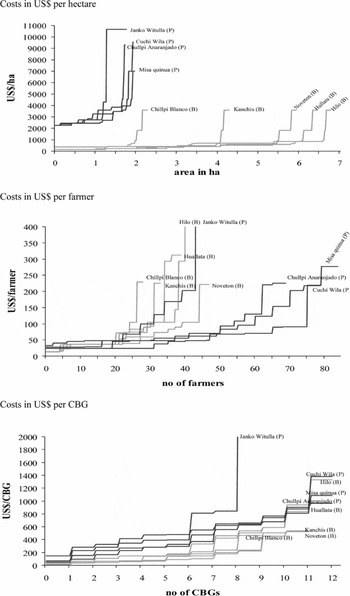
Out of all those invited, 12 Bolivian and 13 Peruvian CBGs participated in the conservation auction. The costs of conservation for each prioritized landrace in each of the case study (Fig. 1) show significant differences between the Bolivian and Peruvian bid offers, in particular with regard to the supply of land area for conservation purposes.
Supply cost curves for the conservation of priority quinoa landraces. Curves represent conservation costs (in US$) per conservation hectare, participating farmer and participating community based group (CBG) as revealed from the bid offers in the conservation auction in Bolivia (light grey) and Peru (dark grey).

In Bolivia, only a few CBGs revealed costs higher than US$ 2000 ha−1 for conserving any of the priority landraces, while conservation costs per hectare in Peru were significantly higher. This implied that Bolivian CBGs offered significantly larger conservation areas (mean 0.5 ha per bid) than their Peruvian counterparts (0.2 ha per bid). With regard to the number of farmers offering to conserve the prioritized landraces, the conservation costs per farmer were lower in Peru. With respect to total payments required per CBG, most of the Bolivian community offers did not surpass US$ 200 for any of the prioritized landraces, in contrast to average offers of about US$ 600 in Peru.
From these data we calculated total conservation costs (Fig. 1); for instance, in order to allocate one hectare to a given priority landrace through a PACS scheme, the minimum payment required would range from US$ 143 in Bolivia to US$ 2400 in Peru.
Cost-effectiveness targeting
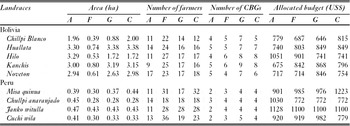
Each of the four targeting approaches produced a different cost-effectiveness ranking for the actual CBGs’ bid offers. Several conservation-goal specific targeting outcomes could be reached within a total budget of US$ 4000 (Table 1); for instance, A would target 3.29 ha of landrace Hilo, conserved by 11 farmers in four CBGs with a total expenditure of US$ 1051, under F the number of targeted farmers would be 27, but only 0.53 ha and six CBGs would be targeted, while under G eight CBGs, but only 1.72 ha and 17 farmers would be targeted for conservation of Hilo.
Targeted conservation area (in ha), number of farmers, number of community based groups (CBGs) and budget (in US$) for each landrace under targeting approaches A (maximizing conservation area), F (maximizing number of farmers), G (maximizing community-based groups) and C (combined approach).

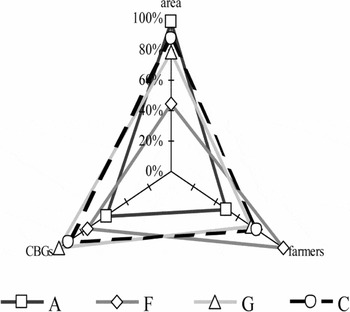
Each individual selection criterion (A, F and G) optimized cost-effectiveness related to its specific conservation goal (Fig. 2). Non-complementary relationships can be identified between the three conservation goals. For example, the most competitive offers in terms of cost per hectare of land did not correspond to the most competitive offers in terms of costs per farmer. Targeting approaches A or F could not simultaneously maximize the number of participating CBGs. In other words, the choice would be between maximizing cost-effectiveness based on any of the three conservation goals individually and a compromise (weighted) approach that took into account all three conservation goals.
Cost-effectiveness trade-offs between agrobiodiversity conservation goals (on the axes) under targeting approaches A, F, G, and C. The four targeting approaches aim at maximizing (A) conservation area (proxy for the maintenance of genetic diversity in the field), (F) number of conserving farmers (proxy for the maintenance of local agricultural knowledge and cultural traditions), (G) number of CBGs (proxy for the maintenance of informal seed exchange networks and, hence, geneflow across communities) or (C) a combination of these goals. Axes indicate the average of the nine priority landrace goal-specific targeting outcomes as a percentage of the maximum that could be reached under any of the four targeting approaches subject to the conservation funds available.

A combined approach (C) with an arbitrary weighting of 40% (A) – 40% (F) –20% (G) best balanced the three conservation goals. This would result in an average across the nine landraces of 87% of the maximum potential conservation area, 77% of the conserving farmers and 92% of the participating CBGs relative to the targeting approach that would maximize these landrace-specific conservation goal within the budget. The actual weights that might be assigned to each conservation goal would of course be expected to directly influence the degree of additionality achievable. In this context, the lack of a scientific framework for assigning weights is a serious significant constraint. This limitation is further compounded by the fact that different weights could also result in another type of tradeoff, that between cost-effectiveness and equity.
Equity targeting
An egalitarian distribution of conservation funds independent of the CBG's contribution to the programme may be considered to be a relevant equity criterion, as revealed in the community workshop discussions. Other equity concerns, for example that CBGs may receive a different level of payment for the same conservation effort due to the differentiated payments approach adopted (as per Muñoz-Piña et al. Reference Muñoz-Piña, Guevara, Torres and Braña2008) only seem to be a secondary concern in the current context, provided funds are split relatively equally between the participating CBGs. Based on the egalitarian fairness principle, equity in the distribution of conservation funds can be measured with a Gini indicator (as in Alix-Garcia et al. Reference Alix-Garcia, De Janvry and Sadoulet2008). The Gini coefficient takes a value of zero if every CBG receives the same payment (egalitarian distribution of payments) and a value of one if only a single CBG receives all the funds. The closer the Gini coefficient is to zero, the more egalitarian is the distribution of payments.
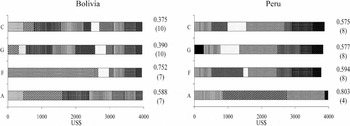
According to the competitiveness of their bid offers, CBGs could find that either all, part, or none of their landrace bid offers were selected based on a value-for-money approach. In the last case, CBGs would be excluded from the conservation programme, which they might view as unfair. The largest number of CBGs facing such exclusion would occur under targeting approach A, whereby five CGBs in Bolivia and nine in Peru would be excluded from the programme. The most unequal distribution would be associated with targeting approach F in Bolivia, with just one CBG appropriating more than 60% of the total budget (Fig. 3). In Peru, targeting approach A would have also created a highly unequal distribution of the conservation budget, since up to two-thirds of the Peruvian budget would be allocated to just two CBGs (Fig. 3). In both countries, a more equal distribution would be achieved under targeting approaches G and C, although the Gini-coefficient still remained relatively high in Peru (Fig. 3).
Distribution of conservation funds (in US$) among (anonymized) CBGs under targeting approaches A, F, G and C. Each CBG is represented by specific shading. To the right the Gini-indicators measuring the inequality of payments (0 = egalitarian distribution, 1 = most unequal) and the number of CBGs that would be selected out of those 12 Bolivian and 13 Peruvian CBGs that participated in the conservation auction are displayed.

The distribution of rewards between the participating CBGs is highly sensitive to the targeting approach being favoured and the implicit weighting of their underlying conservation goals. Targeting payments based on conservation goals, such as conservation area or the number of conserving farmers, would have resulted in highly unequal distributions of the conservation budget, strongly favouring those groups that offered the most competitive bids in terms of these specific goals. This indicates that the targeting of conservation payments coupled with multiple conservation goals is likely to be confronted with a tough choice between economic efficiency (namely maximizing cost-effectiveness) and social equity.
DISCUSSION
Cost differentials
The significant differences in costs per hectare may be because agroecological conditions mean Peruvian quinoa yields can be more than double those in Bolivia and because of differences in land tenure within the countries. In Bolivia, although land is formally owned by the community, members have access to significantly larger land areas and thus are able to expand quinoa production into non-cultivated areas. In the Peruvian communities, land is scarcer due to inheritance-related land divisions, and quinoa competes with other crops. Although the Bolivian CBGs offered larger land areas for conservation, their overall bid prices were lower due to much lower costs per hectare, implying that it would be cheaper to involve an additional CBG in Bolivia than in Peru.
The lower conservation costs per farmer in the Peruvian site were driven by a higher number of farmers willing to participate in the conservation programme, with the exception of the landrace Janko witulla. This may be because, in Peru, the scheme was able to use existing community-based farming organizations with a link to quinoa production and processing. Leaders of these organizations were probably in a better position to mobilize their group members, whereas invited community representatives in Bolivia had to organize dispersed farmers without being able to take advantage of similar organizational networks. Furthermore, the increasing commercialization of farming systems in Bolivia has been argued to be responsible for undermining social cohesion in these communities, with adverse effects on collective decision-making and resource management (VSF 2009).
Environmental additionality
The lack of a robust scientific basis on which to establish weightings for different conservation goals emerges as a potential constraint for conservation-based PES schemes, as is illustrated in the present PACS schemes. Surprisingly, multi-criteria targeting approaches that seek to maximize multiple conservation goals (see for example Hajkowicz et al. Reference Hajkowicz, Higgins, Miller and Marinoni2008) have only found limited recognition in PES schemes (for example Pagiola et al. Reference Pagiola, Ramirez, Gobbi, de Haan, Ibrahim, Murgueitio and Ruiz2007). Also, it is unclear in how far the conservation goals are expressed in adequate service delivery proxies. In general, PES face a high level of uncertainty surrounding the directness of the link between their conservation goal and the actual provision of conservation services (Kosoy & Corbera Reference Kosoy and Corbera2010; Norgaard Reference Norgaard2010). For instance, linking the extent of cultivation of certain landraces by a number of farmers located in a number of spatially distributed communities to the actual level of genetic diversity conserved on-farm is not straightforward (Brush Reference Brush1989; van de Wouw et al. Reference van de Wouw, Kik, van Hintum, van Treuren and Visser2009). As such, PACS share many of the same challenges as numerous agrienvironmental programmes in the European Union for the promotion of certain biodiversity-friendly land-use practices (Kleijn & Sunderland Reference Kleijn and Sutherland2003) and many forest-based PES schemes focusing on non-agricultural land uses (Wunder et al. Reference Wunder, Engel and Pagiola2008; Kosoy & Corbera Reference Kosoy and Corbera2010).
In addition, there is insufficient scientific insight into how much agrobiodiversity needs to be conserved. If the primary interest is the maintenance of genetic diversity per se, a minimum population that does not threaten the long-term in situ survival of the priority landraces would need to be reached. This idea corresponds with a safe minimum standard (SMS) approach (Berrens Reference Berrens2001; Drucker Reference Drucker2006). However, a SMS remains to be defined for the in situ conservation of crop genetic resources, although it would, nonetheless, play a crucial role in the evaluation of environmental additionality. If, for instance, the SMS was associated with an area-based SMS of one hectare per prioritized landrace, the pilot PACS schemes would not have been able to properly safeguard any of the targeted landraces in Peru under the existing budget (Table 1) and thus would fail to provide any additionality.
Moreover, given the differences in the area-based conservation costs, the case studies presented here also raise the question of where to conserve when cost-effectiveness is a major objective in payment targeting. If yield potential differentials exist across agroecological regions, as is the case between the Peruvian and Bolivian case studies, this may justify the use of a location-specific SMS. More importantly, the above question would only be relevant if the priority landraces in both countries were sufficiently similar that, from a genetic diversity perspective, Bolivian landraces could be traded-off with Peruvian ones. However, even under these circumstances, it might be desirable to conserve similar genetic resources in different sites, so as to support evolutionary processes under different agroecological and socioeconomic conditions, hence also acknowledging the cultural dimension of landrace conservation, namely maintaining seed exchange networks, agricultural knowledge and local customs in different sites. This calls for a global strategy for conserving agrobiodiversity, with special attention being paid to prioritizing valuable and threatened crop genetic resources based on sound baseline data. Furthermore, there is a need for the establishment of scientific methods to link easily verifiable and measurable service delivery proxies with conservation services and to define a SMS capable of ensuring the long-term in situ survival of priority landraces.
Social equity implications
Allocating funds, not only to the most competitive bidders, but also in a manner that ensures an equitable distribution of payments, may to some extent undermine the main motivation behind using (competitive) conservation auctions. Nevertheless, careful assessment of any trade-offs between economic efficiency and social equity is necessary in order to minimize any risks of discord that may undermine the political legitimacy of PACS schemes (as per Corbera et al. Reference Corbera, Brown and Adger2007).
Aiming at targeting approaches that take equity considerations on-board may make the programme seemingly less economically efficient in the short term, but possibly fairer and hence more robust in the longer term due to its higher social legitimacy. Given the potential occurrence of irreversible loss of genetic resources, should the scheme break down, the long-term sustainability of the intervention is clearly an important consideration. In the context of repeated conservation auctions over time, any targeting approach that clashes with local perceptions of fairness might result in reduced participation rates in the future, thus leading to limited competitiveness and hence reducing the efficiency gains of conservation auctions (as per Ferraro Reference Ferraro2008).
Another issue to take into account in auction-based PACS schemes is the exclusion of potential, but poorly competitive, providers of conservation services for the sake of cost-effectiveness. In cases where communities or farmers have first been invited to take part in the conservation auction, thereby incurring time and coordination effort to prepare their bids, it might be expected that, given their aspirations of earning some income through the payments, any targeting that rejects their participation due to offering uncompetitive bids could be perceived as unfair by the communities in some social contexts. This is especially likely to be so where social norms are shaped by egalitarian traditions and where concepts such as competitiveness and commoditization of biodiversity-related resources are poorly understood and even rejected. Introducing competition among communities may undermine existing pro-social norms underlying collective action (see Castillo et al. Reference Castillo, Bousquet, Janssen, Worrapimphong and Cardenas2011). If efficiency gains were to be undermined in repeated auctions due to strategic behaviour (for example Schilizzi & Latacz-Lohmann Reference Schilizzi and Latacz-Lohmann2007), then the application of conservation auctions would need to be treated with caution.
Additionally, as pointed out by Redford and Adams (Reference Redford and Adams2009), PES schemes may induce competition for gaining control over resources that underlie the provision of conservation services if the latter become increasingly valuable, at least in terms of exchange value. Such a situation could possibly arise in the Bolivian sites, where agricultural land is formally under communal tenure arrangements. Following the price surge in some quinoa varieties, it has been observed that powerful farmers have extended their agricultural land by making use of open-access community lands (VSF 2009), thereby excluding other farmers from using these areas. Consequently, PES interventions may increase existing power imbalances and thereby exacerbate existing inequalities in the access to key livelihood assets, such as land (Corbera et al. Reference Corbera, Brown and Adger2007). When payments are made at the group or community level, as in these pilot PACS cases, the intra-group distribution of costs and benefits also becomes relevant. It may well be the case that powerful farmers are able to obtain the highest share of the payments due to a more privileged social position, even if their contribution to the conservation activity was marginal. This clearly needs to be further investigated in the given case study context.
Last, but not least, it has been argued that PES may undermine intrinsic motivations for conservation, hence crowding-out existing local conservation practices (Pattanayak et al. Reference Pattanayak, Wunder and Ferraro2010). Recent empirical research based on economic field experiments indicates that in the Peruvian sites, where social norms appear to be stronger than in the Bolivian ones, group-level payments do have a detrimental impact on pro-social behaviour (U. Narloch, U. Pascual & A.G. Drucker, unpublished observations Reference Narloch, Drucker and Pascual2011).
Given these concerns with regard to the wider social equity implications of PES and given existing uncertainties related to environmental additionality, under certain circumstances it is possible that PES could result in outcomes with a loss to all parties if these considerations are not carefully taken into account in the targeting of payments.
CONCLUSIONS
This paper has illustrated the importance of multi-criteria targeting approaches which aim to address trade-offs between different conservation goals, without overly compromising an equitable distribution of conservation funds. Robust frameworks for such approaches need to be established and scientifically informed about the underlying link between alternative conservation goals and conservation service provision. This is specifically important in the case of agrobiodiversity conservation, where PES has not yet been implemented on any significant spatial scale.
Although sophisticated multi-criteria targeting approaches may provide compromise solutions, local policy makers and conservation service providers may have difficulty understanding on what grounds payments would be distributed, thereby jeopardizing the legitimacy of a potential PES schemes, especially where a number of conservation goals or equity criteria are relevant. These considerations, here illustrated in the specific context of agrobiodiversity, echo the significant challenges that PES face in achieving the desired environmental additionality while securing an acceptable level of social justice, so that cost-effective and equitable solutions may be much more difficult to attain than often recognized in the literature.
ACKNOWLEDGEMENTS
This paper is part of Bioversity International's Economics and Policy of Agrobiodiversity Conservation and Use programme of work. The Payment for Agrobiodiversity Conservation Services (PACS) component of this work is supported by the Syngenta Foundation for Sustainable Agriculture and the CGIAR's Systemwide Program on Collective Action and Property Rights (CAPRi). We are highly indebted to the Fundación Promoción e Investigación de Productos Andinos (PROINPA) in La Paz, Bolivia, and the Centro de Investigación de Recurcos Naturales y Medio Ambiente (CIRNMA) in Puno, Peru, for implementing the pilot PACS schemes. We also thank Uwe Lactacz-Lohmann (University of Kiel) for his suggestions regarding the design of the conservation auction. Moreover, we are grateful for useful comments to earlier drafts of this paper by Nicholas Polunin and three anonymous reviewers.