Introduction
Photoperiodic diapause is a crucial ecological adaptation that allows many insects to cope with recurring seasonal environmental variation by using daylength (photoperiod) as a token cue to initiate physiological changes that prepare the insect for persistence under adverse conditions. Many of the most serious agricultural pest insects have very broad geographical distributions and show photoperiodic control of diapause (Danilevskii, Reference Danilevskii1965, Beck, Reference Beck1980, Tauber et al., Reference Tauber, Tauber and Masaki1986). Therefore, genetic differences must exist within these species as a result of adaptation to local conditions within broader geographical areas. Generally, mid-latitude populations (i.e., those with short growing seasons) tend to have long critical daylengths (the daylength that elicits 50% diapause response) for the induction of diapause and an associated high percentage of univoltinism; low latitude populations (i.e., those with long growing seasons) show shorter critical daylengths and an associated tendency toward multivoltine or non-diapause life cycles. Populations from intermediate geographic regions have critical daylengths that are intermediate in length to those from more extreme regions (Denlinger, Reference Denlinger1986, Tauber et al., Reference Tauber, Tauber and Masaki1986, Saunders, Reference Saunders2002). These widely distributed insects are excellent animals for studying the inheritance of diapause by crossing strains from different geographical areas. Their small size, short generation time, ease of rearing and particularly their abundance, makes it easy to address evolutionary questions. Furthermore, understanding the genetics of diapause can be important for effective pest management of insect populations.
Cross-mating of strains from different geographical areas has shown that there is a great deal of genetic polymorphism for the diapause trait within populations. The inheritance of diapause in many insects is under polygenic control, and the incidence of diapause, the critical photoperiod and the duration of diapause of F1 hybrids are intermediate between those of their parents (Danilevskii, Reference Danilevskii1965, Tauber et al., Reference Tauber, Tauber and Masaki1986). In the European corn borer Ostrinia nubilalis diapause-related genes are sex-linked (Ikten et al., Reference Ikten, Skoda, Hunt, Molina-Ochoa and Foster2011). Diapause is controlled polygenically, with epistasis and sex linkage through the male parent, in the pyralid butterfly Pionea forficalis (King, Reference King1974). Diapause incidence is mainly determined maternally in the blow fly, Calliphora vicina (McWatters & Saunders, Reference McWatters and Saunders1996, 1997). The incidence of diapause of F1 progeny in the cabbage beetle, Colaphellus bowringi was intermediate between their parents under short daylengths of 12 and 13 h, with the female parent exerting a greater effect on diapause incidence than the male parent (Chen et al., Reference Chen, Xiao, He, Xu and Xue2014). Diapause is dominant over non-diapause in the fruit fly Drosophila littoralis (Lumme et al., Reference Lumme, Lakovaara, Oikarinen and Lokki1975). The non-diapause phenotype is inherited in a completely dominant manner in the two-spotted spider mite Tetranychus urticae (Kawakami et al., Reference Kawakami, Numata, Ito and Goto2010). A simple Mendelian inheritance of diapause has been found in some insects, such as the linden bug, Pyrrhocoris apterus (Dolezel et al., Reference Dolezel, Vanecková, Sauman and Hodkova2005), the spider mite, Tetranychus pueraricola (Suwa & Gotoh, Reference Suwa and Gotoh2006) and the flesh fly, Sarcophaga bullata (Han & Denlinger, Reference Han and Denlinger2009), in which the segregation rate of diapause in hybrids was close to 3:1. It is not surprising that components of diapause have a different genetic basis in various insects since diapause may have arisen independently many times during natural selection (Hoy, Reference Hoy, Dingle and Hegman1978).
The Asian corn borer, Ostrinia furnacalis (Guenée) (Lepidoptera Crambidae), is a widely distributed and serious economic pest of corn production in China. Estimated average annual losses in China due to this insect range from 6 to 9 million tons per year and can be much greater in an outbreak year (Zhou & He, Reference Zhou and He1995). This moth is a typical long daylength species, undergoing a facultative diapause as fully grown larvae in response to short-day conditions during the autumn (Du & Cai, Reference Du and Cai1964, Gong et al., Reference Gong, Chen, Wang, Lian, Xia and Yan1984, Shen et al., Reference Shen, Xue and Zhu1988, Dai et al., Reference Dai, Qin, Yang and Huang2000). Recently, we performed a genetic experiment of photoperiodic induction of diapause in O. furnacalis by crossing a low diapause response tropical Ledong (LD) strain (18°47′ N, 108°89′ E) with a high diapause response subtropical Nanchang (NC) strain (28°46′N, 115°50′ E) (Xia et al., Reference Xia, Chen, Tu, Yang and Xue2012). The results revealed that the photoperiodic response controlling diapause induction in this moth is heritable. The incidence of diapause was more influenced by the male parent than the female parent. The capacity for diapause is thus transmitted genetically in the manner of incomplete dominance. However, the information on inheritance of diapause intensity or duration is still unknown. In the present study, we performed another genetic experiment of photoperiodic control of diapause in O. furnacalis by crossing the tropical LD strain with a north of subtropical Hefei (HF) strain (31°49′N, 117°13′E). The diapause response was investigated in the pure strains, F1 and F2 progeny and backcross progeny at various photoperiods and temperatures allowing the inheritance of diapause to be analyzed. The effect of the genetic background of each parent on larval diapause duration was also examined.
Materials and methods
Strains of O. furnacalis
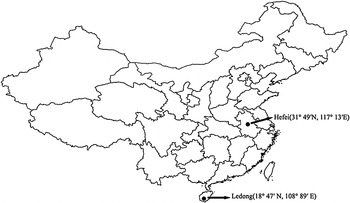
Two strains of O. furnacalis used in this investigation were the HF strain from HF city (31°49′N, 117°13′E) in Anhui Province and the LD strain from LD county (18° 47′ N, 108° 89′ E) in Hainan Province (fig 1). About 40 females in each strain were collected from corn fields in early June 2013 in the two regions. These adults were placed into plastic bags with 10% honey–water to produce egg masses. After hatching, larvae were transferred to plastic boxes (diameter 12 cm, height 15 cm) and reared on an artificial diet (Qiao et al., Reference Qiao, Zheng, Cheng and Li2008) under a diapause-averting long photoperiod of LD 16:8 at 25 °C until pupation. Pupae were placed individually in plastic boxes with 24 holes for eclosion. Adults were sexed on the day of eclosion and females were allowed to mate with males from the same or a different strain.
The location of collection sites of samples of O furnacalis.

Crosses
Pure strains and reciprocal parental crosses were made as follows: HF × HF (females shown on the left), LD × LD, HF × LD and LD × HF. At least 80 pairs were used in each cross. The progeny of these crosses were reared under different photoperiods at 22, 25 and 28 °C. Unless otherwise stated, each experimental regime was tested by rearing three replicates of at least 50 newly hatched larvae and observing the incidence of pupation and diapause. The incidence of diapause was determined based on the proportion of mature larvae that failed to pupate within two weeks after comparable control cultures had completed pupation.
Backcrosses and hybrids for F1 crosses were obtained from non-diapausing parents that were reared under LD 16:8 at 25 °C. Upon emergence of adults, the virgin females and males were paired as follows: (HF × HF) × (HF × LD), (HF × HF) × (LD × HF), (HF × LD) × (HF × HF), (LD × HF) × (HF × HF), (LD × LD) × (LD × HF), (LD × LD) × (HF × LD), (LD × HF) × (LD × LD), (HF × LD) × (LD × LD), (HF × HF) × (HF × HF), (HF × LD) × (HF × LD), (LD × HF) × (LD × HF), (LD × LD) × (LD × LD), (LD × HF) × (HF × LD) and (HF × LD) × (LD × HF). The progeny of these crosses were reared under different photoperiods at 25 °C. Each experimental regime was tested by rearing three replicates of at least 50 newly hatched larvae.
All of the equations used for the present analyses were as described by Henrich and Denlinger (Henrich & Denlinger, Reference Henrich and Denlinger1983). In brief, the expected incidences of diapause (E) for an additive model of a backcross to the HF (Bc-HF), LD (Bc-LD) and F2 were generated with the equations:
 $${E_{{\rm Bc - HF}}}=({O_{{\rm HF}}}+{\rm }{O_{{\rm F1}}})/2$$
 $${E_{{\rm Bc - LD}}}=({O_{{\rm LD}}}+{\rm }{O_{{\rm F}1}})/2$$
 $${E_{{\rm F2}}}=({O_{{\rm HF}}}+{\rm }2{O_{{\rm F1}}}+{\rm }{O_{{\rm LD}}})/4$$
where O indicates the observed incidence of diapause of the designated population. If the observed and expected values in the F2 group are equal:
 $$E_{{\rm F2}} =O_{{\rm F2}} $$
 $$4O_{{\rm F2}} - O_{{\rm HF}} - 2O_{{\rm F1}} - O_{{\rm LD}} =0.$$
All experiments were performed in illuminated incubators (LRH-250-GS, Guangdong Medical Appliances Plant, Guangdong, China). Light intensity during the photophase was approximately 1.97 W m−2 and variation of temperatures was ±1 °C.
Termination of diapause
Diapausing larvae (HF, LD, HF × LD, LD × HF strains) induced under LD 12:12 at 20 °C were transferred to LD 16:8, 25 °C to observe diapause termination 45 days after hatching. Pupation was recorded every day until all of the diapausing individuals had pupated.
Statistical analyses
All data were arcsin
 $\sqrt x $
transformed prior to analysis using SPSS 17.0 version (SPSS Inc., Chicago, Illinois). Logistic regression analysis was used to estimate the critical photoperiods for each group and one-way analysis of variance (ANOVA) and Tukey's test were used to compare the differences in critical photoperiod among different groups. One-way ANOVA was used to determine whether differences in the incidence of diapause in different groups under each photoperiod at different temperatures were significant. Pearson's chi-squared (χ2) test was used to test whether the results obtained under LD 12:12, LD 13:11 and LD 14:10 for the F2, Bc-HF and Bc-LD individuals fit the predictions of the additive model for these populations. Bonferroni test was used to determine whether the duration of diapause among different groups was significantly different.
Results
Photoperiodic response curves for the two strains and their F1 progeny
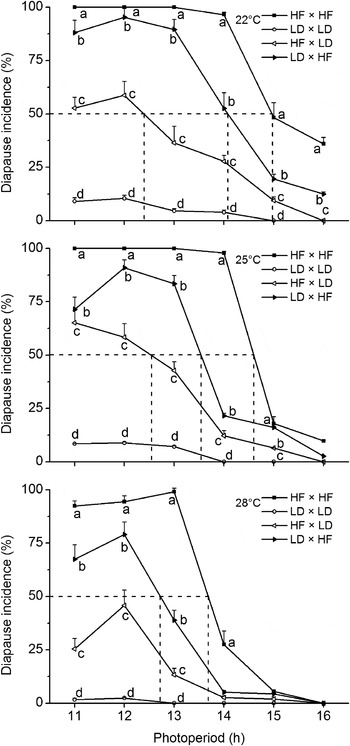
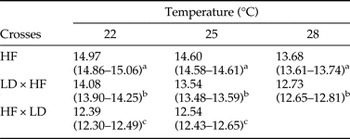
Photoperiodic response curves for the induction of diapause in HF and LD strains and F1 progeny from reciprocal crosses (HF × LD, LD × HF) at 22, 25 and 28 °C are presented in fig. 2. The HF strain showed a clear long-day response at all temperatures with a critical daylength of approximately 14.97 h at 22 °C, 14.60 h at 25 °C and 13.68 at 28 °C (table 1). However, only a few individuals entered diapause under short daylength in LD strain, showing weak photoperiodic responses at 22 and 25 °C. The courses of the photoperiodic response curves of the F1 progeny (LD × HF and HF × LD) at all temperatures were similar to that of their parental HF, but their critical daylengths were significantly shorter than those of the parental HF strain (P < 0.05, table 1). The incidences of diapause under short daylengths of 11, 12, 13 and 14 h at 22 and 25 °C in F1 progeny were significantly lower than those of the parental HF strain and significantly higher than those of the parental LD strain (P < 0.05). These results suggest that the diapause response is not completely dominant. Furthermore, both the incidences of diapause and the critical daylengths between the two F1 crosses were significantly different, with significantly higher diapause rate and longer critical daylengths in LD × HF crosses (with HF strain father) than those in HF × LD crosses (with LD strain father), indicating sexual bias in the inheritance of diapause induction, with the male parent having more influence on the F1 progeny. It is notable that the (HF × LD) cross resulted in with 87.7% of individuals developing without diapause under a daylength of 14 h at 25 °C (close to the critical daylength of 14.6 h for HF strain) because this finding may have important implications for pest management (see Discussion section).
Photoperiodic response curves for the induction of larval diapause in O furnacalis for the diapause strain (HF × HF), non-diapause strain (LD × LD) and their F1 progeny (HF × LD, LD × HF) at 22, 25 and 28 °C. Error bars indicate the SD (n = 132–912). Bars with different lowercase letters at the same photoperiod indicate significant differences in diapause incidence after one-way analysis of variance for proportions after arcsine transformation (P < 0.05) (22 °C, 11 h: F = 2357.711, d.f. = 3, 8, P ≤ 0.001; 12 h: F = 7314.578, d.f. = 3, 8, P ≤ 0.001; 13 h: F = 1331.636, d.f. = 3, 8, P ≤ 0.001; 14 h: F = 772.399, d.f. = 3, 8, P ≤ 0.001; 25 °C, 11 h: F = 2457.80, d.f. = 3, 8, P ≤ 0.001; 12 h: F = 3932.918, d.f. = 3,12, P ≤ 0.001; 13 h: F = 12752.234, d.f. = 3, 12, P ≤ 0.001; 14 h: F = 2839.965, d.f. = 3, 8, P ≤ 0.001; 28 °C, 11 h: F = 1536.197, d.f. = 3, 8, P ≤ 0.001; 12 h: F = 6246.578, d.f. = 3, 8, P ≤ 0.001; 13 h: F = 881.112, d.f. = 3, 8, P ≤ 0.001; 14 h: F = 416.370, d.f. = 3, 8, P ≤ 0.001). The dashed lines show critical daylengths.

Critical daylength (h) of the Hefei (HF) and Ledong (LD) strains of O furnacalis and their F1 progeny based on their responses to various photoperiods at 22, 25 and 28 °C.

Data are means and 95% confidence intervals; values followed by the same superscript lowercase letter within a column do not differ significantly at the 5% level by Tukey's test after one-way analysis of variance. HF, the subtropic Hefei strain; LD, the tropical Ledong strain.
Photoperiodic response curves for the backcrosses and reciprocal F2
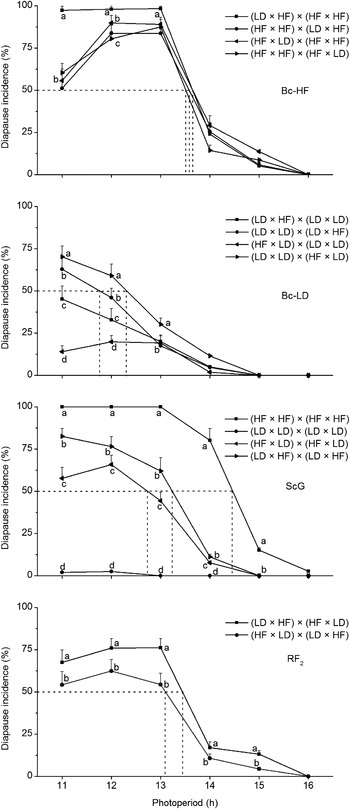
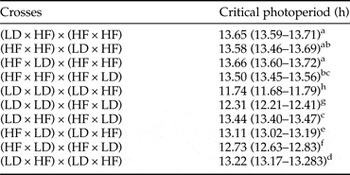
Photoperiodic response curves in the backcrosses and reciprocal F2 all showed a clear long-day response with different critical daylengths (fig. 3, table 2). The critical daylength in backcross to HF was highest in the (LD × HF) × (HF × HF) cross (with a grandfather gene of HF strain), significantly higher than that in (HF × HF) × (HF × LD) cross (with a grandfather gene of LD strain) (P < 0.05, fig. 3 Bc-HF and table 2). The critical daylength in backcross to LD was also significantly different between the (LD × LD) × (LD × HF) and (LD × LD) × (HF × LD) crosses and between the (LD × HF) × (HF × LD) and (HF × LD) × (LD × HF) crosses (P < 0.05, fig. 3 Bc-LD and fig. 3 RF2 group, table 2). The critical daylength in (LD × HF) × (LD × HF) cross (with a grandfather gene of HF strain) was significantly higher than that in (HF × LD) × (HF × LD) cross (with a grandfather gene of LD strain as male) (P < 0.05, fig. 3 ScG and table 2). All these results indicate that critical daylength was affected by the direction of the crosses.
Photoperiodic response curves for the induction of larval diapause at 25 °C in O furnacalis for the backcross diapause group (Bc-HF), backcross non-diapause group (Bc-LD), the self-cross group (ScG) and the reciprocal F2 group (RF2) (n = 125–808). Error bars indicate the SD. Bars with different lowercase letters at the same photoperiod indicate significant differences in diapause incidence after one-way analysis of variance for proportions after arcsine transformation (P < 0.05). The dashed lines show critical day lengths.

Critical day length of the reciprocal backcrosses of O furnacalis based on their responses to various photoperiods at 25 °C.

Means and 95% confidence intervals, values followed by the same superscript lowercase letter do not differ significantly at the 5% level by Tukey's test after one-way analysis of variance. HF, the subtropic Hefei strain; LD, the tropical Ledong strain.
Genetic analysis of diapause
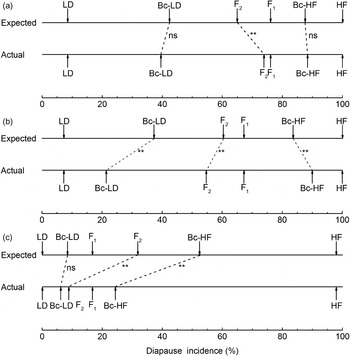
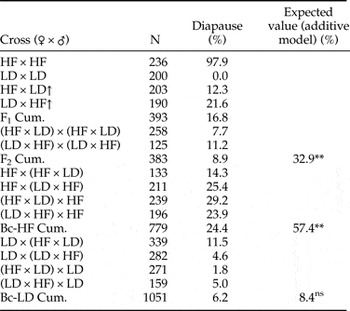
The diapause incidence data obtained from all crosses under LD 12:12, LD 13:11 and LD 14:10 at 25 °C were used to evaluate the inheritance of diapause in this moth (tables 3–5 and fig. 4). The actual pooled F1 incidence (75.9% diapause under LD 12:12; 67.2% under LD 13:11) was significantly higher than the average diapause incidence between the parents (54.4% under LD 12:12; 53.6% under LD 13:11) (12 h: χ2 = 158.310, P < 0.01; 13 h: χ2 = 50.512, P < 0.01), suggesting that diapause is inherited additively with an incomplete dominance. However, the actual pooled F1 incidence under LD 14:10 (16.8%) was significantly lower than the average diapause incidence between the parents (49%) (14 h: χ2 = 99.970, P < 0.01), suggesting that non-diapause is dominant over diapause.
A comparison between the observed diapause incidence under LD 12:12 (A), LD 13:11 (B) and LD 14:10 (C) at 25 °C among the progeny of crosses involving lines of O furnacalis and the results predicted by an additive model with incomplete dominance (χ2 test, **P < 0.01; ns, not significant different at 5% level) (see also tables 3–5). Bc-LD, backcross to the LD strain; Bc-HF, backcross to the HF strain.

The incidences of diapause in the LD × HF crosses (91% under LD 12:12 and 83.4% under LD 13:11) were similar to those of the HF strain; the incidences of diapause in the HF × LD crosses (58.4% under LD 12:12 and 42.8% under LD 13:11) were intermediate between their parents; the incidence of diapause in the LD × HF (21.6%) and the HF × LD (12.3%) crosses under LD 14:10, however were similar to non-diapause LD strain. These results indicate that diapause is not merely promoted by the F1 genotype but that diapause induction is also strongly influenced by interactions between F1 genotype and photoperiod. There were significant differences in diapause incidence between the LD × HF and HF × LD crosses (12 h: χ2 = 227.766, P < 0.01; 13 h: χ2 = 263.235, P < 0.01; 14 h: χ2 = 6.027, P < 0.05), indicating that male parents play a much stronger role in the determination of diapause than female parents. Such a paternal influence was also found in F2 crosses. The incidences of diapause in (LD × HF) × (LD × HF) crosses under LD 12 :12 and LD 13:11 (76.5% under LD 12:12 and 62.0% under LD 13:11) were significantly higher than those in (HF × LD) × (HF × LD) crosses (65.8% under LD 12:12 and 44.3.0% under LD 13:11) (12 h: χ2 = 11.344, P < 0.01; 13 h: χ2 = 31.852, P < 0.01). The incidence of diapause was also higher in (LD × HF) × (LD × HF) cross (11.2%) than that in the (HF × LD) × (HF × LD) cross (7.7%) under LD 14:10, although there was no significant difference between the two crosses (χ2 = 1.238, P > 0.05).
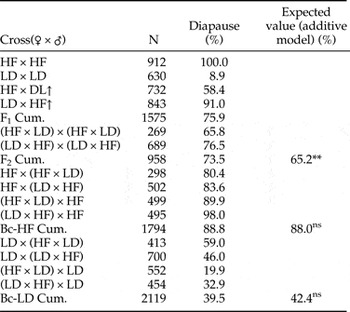
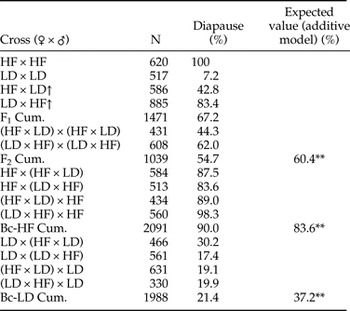
Results from the χ2 tests revealed that the pattern of diapause was different under different photoperiods. The data of diapause incidence in Bc-HF and Bc-LD crosses under LD 12:12 adequately fit the modified additive model (Bc-HF: χ2 = 0.533, P > 0.05; Bc-LD: χ2 = 3.631, P > 0.05; table 3 and fig. 4a). By contrast, the incidences of diapause under LD 13:11 in F2, Bc-HF and Bc-LD were significantly different from expectations (F2: χ2 = 7.092, P < 0.01; Bc-HF: χ2 = 37.476, P < 0.01; Bc-LD: χ2 = 120.470, P < 0.01; table 4 and fig. 4b), showing that the pattern of diapause was not additive. The pattern of diapause in F2 and Bc-HF crosses under LD 14:10 was also not additive (F2: χ2 = 66.867, P < 0.01; Bc-HF: χ2 = 175.402, P < 0.01; table 5 and fig. 4c). These results suggest that genetic and genetic-environmental interactions are involved in diapause induction.
Incidence of larval diapause of the parental strain, F1, F2 and backcross progeny in crosses and backcrosses of the HF strain and LD strain of O furnacalis under LD 12:12 h at 25 °C.

ns P > 0.05, ** P < 0.01 (χ2). Bc-HF, backcross to the subtropic Hefei strain; Bc-LD, backcross to the tropical Ledong strain; Cum., cumulative number for each corresponding reciprocal group.
Incidence of larval diapause of the parental strain, F1, F2 and backcross progeny in crosses and backcrosses of the HF and LD strains of O furnacalis under LD 13:11 h at 25 °C.

** P < 0.01 (χ2). Bc-HF, backcross to the subtropic Hefei strain; Bc-LD, backcross to the tropical Ledong strain; Cum., cumulative number for each corresponding reciprocal group.
Incidence of larval diapause of the parental strain, F1, F2 and backcross progeny in crosses and backcrosses of the HF and LD strains of O furnacalis under LD 14:10 h at 25 °C.

ns P > 0.05, ** P < 0.01 (χ2). Bc-HF, backcross to the subtropic Hefei strain; Bc-LD, backcross to the tropical Ledong strain. Cum., cumulative number for each corresponding reciprocal group.
The duration of larval diapause
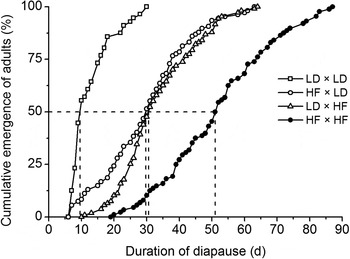
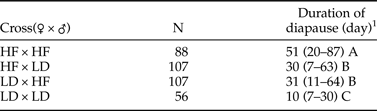
The cumulative percent pupation from HF × HF, LD × LD and their hybrids (HF × LD and LD × HF) is shown in fig. 5. Days required for 50% pupation was longest for HF strain (51 days), shortest for LD strain (10 days) and intermediate for F1 progeny (31days in LD × HF and 30 days in HF × LD). There was a significant difference in diapause duration among these treatments (Kruskal–Wallis test: χ2 = 106.794, d.f. = 3, P < 0.01; table 6). The duration of diapause in the progeny of hybrid strains seemed to be influenced by both parents, suggesting polygenic inheritance of diapause duration. The duration of diapause in F1 progeny was nearly the same, indicating that an equal genetic contribution to diapause intensity was made by each parent.
Termination of larval diapause in O furnacalis for the HF strain, LD strain and their F1 progeny (HF × LD, LD × HF) (n = 56–107) at 25 °C, LD 16:8. Diapause was induced at 20 °C, LD 12:12.

Duration of larval diapause in O furnacalis at 25 °C, LD 16:8.

Diapause was induced at 20 °C, LD 12:12. Diapausing larval were transferred to 25 °C, LD 16:8 to terminate diapause 45 days after hatching. HF, the subtropic Hefei strain; LD, the tropical Ledong strain.
1 Data are shown as the median (minimum–maximal value). Values followed by different letters are significantly different by Bonferroni test (P = 0.0001 < 0.01).
Discussion
In previous studies, reciprocal crosses made between the tropical LD strain from LD County (18° 47′ N, 108°89′ E) and the subtropic NC strain from Nangchang city (28°46′N, 115°50′E) at 25 °C in O. furnacalis showed a critical daylength of 13.5 h for the NC strain, 12.5 h for LD × NC cross and 12 h for NC × LD cross (Xia et al., Reference Xia, Chen, Tu, Yang and Xue2012). However, the present experiments of reciprocal crosses made between the tropical LD strain and the HF strain from the north of subtropic region (31°49′N, 117°13′E) showed a relatively longer critical daylength of 14.6 h for HF strain, 13.5 h for LD × HF cross and 12.5 h for HF × LD (table 1). Interestingly, the critical daylength was about 1 h longer in the HF strain than in the NC strain, whereas the critical daylength was also 1 h longer in the LD × HF cross than in the LD × NC cross. The incidence of diapause in F1 progeny under LD 13:11 at 25 °C was 25.4% for LD × NC and 3.3% for NC × LD (as seen in table 2 in Xia et al., Reference Xia, Chen, Tu, Yang and Xue2012); whereas the incidence of diapause in F1 progeny under the same conditions was much higher with 83.4% in LD × HF cross and with 42.3% in HF × LD cross (table 4). The differences in the critical daylength and diapause induction between the two cross-mating experiments suggest that diapause is more dominant over non-diapause in the northern strain than the southern strain of O. furnacalis. We surmise that diapause may be completely dominant in the most-northern strain under diapause-inducing short daylength if the northernmost strain males are crossed with the tropical LD strain females. The cross-mating experiment between the tropical LD strain and the northernmost HB strain from Haerbin City (44.9°N, 127.2°E) is currently being performed in our laboratory.
Most studies of lepidopteran diapause have shown intermediate hybrid values suggesting polygenic inheritance. However, these species typically indicate paternal effects rather than maternal effects. For example, diapause incidence in the pink bollworm, Pectinophora gossypiella (Raina et al., Reference Raina, Bell and Klassen1981), the European corn borer, Ostrinia nubilalis (Ikten et al., Reference Ikten, Skoda, Hunt, Molina-Ochoa and Foster2011), the comma butterfly, Polygonia c-album (Söderlind & Nylin, Reference Söderlind and Nylin2011), the Asian corn borer, O. furnacalis (Xia et al., Reference Xia, Chen, Tu, Yang and Xue2012) and the cotton bollworm, Helicoverpa armigera (Chen et al., Reference Chen, Xia, Chen, Xiao and Xue2012) is largely determined by the paternal line; in reciprocal crosses high diapause strain fathers produced a higher incidence of diapause among their offspring than low diapause strain fathers. The present cross-mating experiments under different photoperiods and temperatures further confirmed the paternal effects in lepidopteran species. Such a paternal effect is intriguing, although the precise mechanism and relevance is unknown. As Lepidoptera males are homogametic (Robinson, Reference Robinson1971), sex-linkage cannot readily explain such patterns (Nylin, Reference Nylin2013). Such a genetic background may provide a genetic means to suppress pest populations (Showers, Reference Showers, Denno and Dingle1981, Showers et al., Reference Showers, Keaser, Witkowski, Clement, Chiang and Sparks1990). As shown above, the (HF × LD) cross resulted in 87.7% individuals developing without diapause under a daylength of 14 h at 25 °C (close to the critical daylength of 14.6 h for HF strain). A daylength of 14 h and 25 °C in HF region occurs between the middle and end of August when the third generation of adults begins to emerge. If a large number of LD strain males are released to the corn field in the HF region during this time and allowed to mate with HF females, most larval progeny produced by the cross would pupate and produce the next generation. Consequently, large numbers of HF larvae will emerge as adults during late September and October, die, and thus reduce the number of available adults for mating and egg-laying the following spring.
Results from the interline crosses under LD 12:12, LD 13:11 and LD 14:10 at 25 °C in O. furnacalis reveal the involvement of genetic and genetic–environment interactions in the induction of diapause. The incidences of diapause in the LD × HF crosses (91% under LD 12:12, 83.4% under LD 13:11 and 27.5% under LD 14:10) and in the HF × LD crosses (58.4% under LD 12:12, 42.8% under LD 13:11 and 12.3% under LD 14:10) were significantly different under different photoperiods, suggesting that induction of diapause can be influenced by interactions between the F1 genotype and photoperiod. The χ2 tests in O. furnacalis showed different diapause patterns (tables 3–5 and fig. 4). The inheritance of diapause under LD 13:11 did not fit an additive hypothesis (table 4 and fig. 4c); whereas the Bc-HF and Bc-LD data adequately fit the modified additive model under LD 12:12 (table 3 and fig. 4a). Under LD 14:10, only the Bc-LD data showed an additive mode (table 5 and fig. 4c). This suggests that the pattern of diapause inheritance in O. furnacalis is highly influenced by photoperiod. In fact, diapause induction in the HF strain highly depends on photoperiod. As shown in fig. 2, more than 90% of individuals entered diapause under short daylengths of 11, 12 and 13 h even at the high temperature of 28 °C. Therefore, diapause response of O. furnacalis seemed dominant under short daylength conditions and recessive under long daylength conditions (≥14 h). To better understand the inheritance of diapause, cross-mating experiments should be performed under different photoperiods and temperatures.
There have been fewer studies on the inheritance of diapause intensity or duration than on diapause incidence, probably because of the greater difficulty and time required to collect the data. In the anise swallowtail, Papilio zelicaon (Sims, Reference Sims1983), the fly Drosophila triauraria (Kimura, Reference Kimura1988), the blow fly Callofora vicinia (McWatters & Saunders, Reference McWatters and Saunders1997) and the cotton bollworm, H. armigera (Chen et al., Reference Chen, Xia, Chen, Xiao and Xue2012), all reciprocal crosses produced hybrids with diapause intensity intermediate to parental values, suggesting that the duration of diapause was inherited in a quantitative manner. In O. furnacalis, the duration of diapause in reciprocal crosses (LD × HF and HF × LD) were similar and were intermediate between and significantly different from either parent strain (table 6). Unlike diapause induction, in which there was a sexual asymmetry in the incidence of diapause, with the male parent exerting a greater effect on diapause incidence than the female parent (figs 2 and 3), the duration of diapause for the reciprocal crosses in O. furnacalis was equally influenced by their parents. Our results indicate that the inheritance pattern of diapause incidence does not resemble that of diapause intensity, suggesting that the two mechanisms are controlled by different genes. We believe this to be the first report where separate systems are involved in the control of diapause incidence and maintenance in O. furnacalis.
Acknowledgements
We thank Dr. Shaohui Wu from Department of Entomology in Rutgers University for advice and comment on the manuscript. The research was supported by a grant from National Natural Science Foundation of the People's Republic of China (grant no. 31260430).