Introduction
In order to properly understand the epidemiology of malaria, information on the ecology and bionomics of the local vector population is required. Information on factors such as population density, survival rate, infection rate, blood-feeding frequency, time and location of biting, as well as host preference, all affect the ability of a mosquito population to transmit malaria. In West Africa, the most important vectors are the M and S forms of Anopheles gambiae. These are ‘incipient’ species in which hybrids are fertile and can be readily produced in the laboratory. Where they occur in sympatry in the wild, however, they often show low rates of hybridization. (Diabate et al., Reference Diabate, Dao, Yaro, Adamou, Gonzalez, Manoukis, Traoré, Gwadz and Lehmann2009).
To paraphrase Voltaire, ‘If Anopheles gambiae did not exist, man would have created him’. Humans created the larval ecological niche, puddles in exposed forest, exploited by An. gambiae. We have also provided shelter and food for the adults since we first arrived on the planet but especially since the beginning of agriculture when the species went through a population expansion (Donnelly et al., Reference Donnelly, Licht and Lehmann2001). The creation of other larval habitats with expanding agriculture may be an evolutionary driving force in the An. gambiae complex in general and in An. gambiae s.s. in particular. The M and S forms differ in their most commonly used breeding sites. The pan-African S form predominates in temporary pools, the archetypal An. gambiae breeding site, whilst high population densities of M form An. gambiae are associated with rice cultivation. In many such irrigated sites, despite the large numbers of mosquitoes, transmission is low, leading to the so called ‘paddy paradox’ (Ijumba & Lindsay, Reference Ijumba and Lindsay2001).
Examination of the behaviour of young mosquitoes has rarely been undertaken (Charlwood et al., Reference Charlwood, Pinto, Sousa, Ferreira, Petrarca and do Rosario2003a), and the reason for the relatively low survival and infection rates in mosquitoes from rice growing areas remains unknown. It may have something to do with their behaviour when newly emerged. From their emergence as adults to the time of their first oviposition, female An. gambiae undergo a number of physiological changes such as a rise in juvenile hormone (Noriega, Reference Noriega2004) and perform a number of ‘one-off’ behaviours, including mating and the taking of a pre-gravid blood meal, that are not repeated in subsequent oviposition cycles.
Should, as a result of these activities, they enhance the likelihood of their acquiring an infection, it may affect eventual transmission since, assuming age specific mortality rates, these are the mosquitoes that are most likely to survive to become vectors. In previous studies, parous/nulliparous rates, obtained by dissection at dispersed intervals, have been used to assess mosquito survival. More detailed dissections, undertaken on a nightly basis, provide more detailed information (Charlwood et al., Reference Charlwood, Birley, Dagaro, Paru and Holmes1985; Holmes & Birley, Reference Holmes and Birley1987; Mutero & Birley, Reference Mutero and Birley1989).
Mosquitoes taking their first blood meal can be distinguished from other age groups by the early state of development of their ovaries in which follicles have little or no yolk and which are surrounded by tightly coiled trachea. They can, by examination of the reproductive tract, be further separated into virgins, insects that have recently mated (with a mating plug) and those that are mated but in which a mating plug is not seen. Whilst mating per se is unlikely to affect biting behaviour in anophelines (Klowden, Reference Klowden2001; Charlwood et al., Reference Charlwood, Pinto, Sousa, Ferreira, Gil and de Rosario2003b), information on the proportion of first-feeding insects that feed as virgins or that have recently mated can provide insights into what a female does following emergence.
Differences in behaviour between M and S form An. gambiae when newly emerged may affect their eventual vectorial capacity. Factors that might influence the likelihood of acquiring an infection are time and place that the mosquitoes feed, late biting endophagic insects being more likely to bite humans than exophagic early biting ones. The development of risk-free tent traps, such as the Furvela trap (Govella et al., Reference Govella, Chaki, Geissbuehler, Kannady, Okumu, Charlwood, Anderson and Killeen2009), for the collection of biting mosquitoes before they enter houses enables a comparison between indoor and outdoor biting mosquitoes to be easily performed. The trap, which collected similar numbers of S form An. gambiae to the CDC light trap when tested in Tanzania (Govella et al., Reference Govella, Chaki, Geissbuehler, Kannady, Okumu, Charlwood, Anderson and Killeen2009), has yet to be tested in West Africa where M form An. gambiae predominate.
Both M and S form An. gambiae at high densities have been described from Okyereko, a village in an irrigation scheme in Ghana (Yawson et al., Reference Yawson, McCall, Wilson and Donnelly2004, Reference Yawson, Weetman, Wilson and Donnelly2007; Okoye et al., Reference Okoye, Wilson, Boakye and Brown2005). Temperature is one factor that appears to determine the distribution of M and S forms of An. gambiae in Ghana, the M form being apparently better adapted to higher temperatures than the S form (De Souza et al., Reference De Souza, Kelly-Hope, Lawson, Wilson and Boakye2010). We therefore examined the population dynamics of both endophagic and exophagic mosquitoes at the start of the rains from Okyereko and applied a more detailed dissection than has previously been applied to these mosquitoes (Dzodzomenyo & Simonsen, Reference Dzodzomenyo and Simonsen1999). A possible explanation for the paddy paradox is provided.
Methods
Okyereko (5° 24.87′N, 0° 36.25′W), some 70 km to the west of Accra, consists of 80 relatively run-down cement houses, 5 km from the coast, and is bordered on two sides by extensive irrigated rice fields. According to Yawson et al. (Reference Yawson, Weetman, Wilson and Donnelly2007), the village had 35% S to 65% M form An. gambiae whilst, according to Dzodzomenyo & Simonsen (Reference Dzodzomenyo and Simonsen1999), the proportion was 99% M form. During the study, some of the fields, each 100×50 m in size, were being harvested whilst others were recently planted. At the start of the study, one field in particular, 350 m to the south of the collection sites, with rice at an early stage of cultivation (fig. 1), contained large numbers of small pools, each with large numbers of larvae of An. gambiae s.l. By the end of the study, this was no longer suitable for mosquito larvae (the rice having grown and the water having largely dried up), but pools in another set of recently cultivated fields, 200 m to the west of the collection sites, contained mosquito larvae (fig. 1).
Map of Okyereko showing the location of sample sites and a selection of fields. The other fields to the south, east and west of the village were not mapped. The rice paddies observed to contain large numbers of Anopheles gambiae larvae at the start and end of the study are indicated by a star ( , canal;
 , road;
 , footpath; •, tent-trap; ○, light-trap;
 , larvae).

Peridomestic and indoor biting mosquitoes were collected with a Furvela tent trap and a CDC light trap, respectively. The traps sample mosquitoes at slightly different phases of the hunting cycle. Tent traps catch mosquitoes that are attracted to odour (i.e. in the initial approach to a bait), rather like the Odour Baited Entry Trap (OBET) of Costantini et al. (Reference Costantini, Gibson, Brady, Merzagora and Coluzzi1993), with the difference that no entry behaviour is required of the insect, whilst light traps catch hungry mosquitoes in the act of leaving a bedroom after an unsuccessful attempt to feed on a host protected by a mosquito bednet. Some species may also be attracted to light per se, which might bias the light trap results whilst the way the mosquitoes respond to the tent trap may reflect a similar approach to houses rather than a completely exposed host in the open. Nevertheless, previous results indicate that the Furvela tent trap and light traps have a very similar sampling efficiency (Govella et al., Reference Govella, Chaki, Geissbuehler, Kannady, Okumu, Charlwood, Anderson and Killeen2009).
During the study, a CDC light trap was run on a daily basis inside the bedroom of a house close to the edge of the village. The trap was hung ∼1.5 m from the floor, close to the end of the bed in which the householder slept under a mosquito net. The trap was run from 18:00 h to 06:30 h of the next day.
A slightly modified version of the Furvela tent trap described by Govella et al. (Reference Govella, Chaki, Geissbuehler, Kannady, Okumu, Charlwood, Anderson and Killeen2009) for the collection of outdoor biting mosquitoes was also run on a daily basis. The trap differed in that wire, instead of string, was used to attach the trap to the tent. A three-person bell tent, with two adult hosts (JDC & EVET) inside it was used. On five nights, the collection bag on the tent trap was changed at three-hourly intervals, enabling an assessment of biting activity by time to be made.
Following identification and separation into species or species group, females of the An. gambiae complex were separated according to abdominal condition and dissected under a stereo-microscope using transmitted light to determine their gonotrophic age. Based on the appearance of their ovaries, female mosquitoes were separated into the following classes:
(i) First blood-feeding
Virgin: spermatheca empty, ovarioles Stage I.
Plug: sperm in the spermatheca, a mating plug in the common oviduct, ovarioles Stage I.
Nulliparous I: sperm in the spermatheca but without a mating plug ovarioles at Stage I.
(ii) Second blood-feeding
Plug-blood: mating plug present, old dark blood from previous feed in stomach.
Nulliparous II: spermatheca with sperm, mating plug not present, ovarioles Stage II, i.e. yolk present in terminal ovariole.
(ii) Subsequent blood-feeding
Parous with sacs: a sac with some distension still present, indicating that the mosquito had returned to feed shortly after oviposition.
Parous without sacs: the sac from the previous oviposition had contracted, indicating that there had been a delay between oviposition and re-feeding.
The presence of retained Stage V eggs in parous females, according to the sac stage, was also noted.
Estimated numbers of each age group collected were determined by multiplication of the number caught in a trap by the proportion in that category.
Samples of the An. gambiae complex were stored over silica gel for later species and form determination and for an assessment of infection with Plasmodium falciparum.
DNA extraction was performed individually following Collins et al. (Reference Collins, Petrarca, Mpofu, Brandling-Bennett, Were, Rasmussen and Finnerty1988). DNA samples were used to determine the molecular form by polymerase chain reaction (PCR)-restriction fragment length polymorphism (RFLP) (Fanello et al., Reference Fanello, Santolamazza and della Torre2002).
The presence of circumsporozoite (CS) antigens of P. falciparum was determined using the sandwich enzyme-linked immunosorbent assay (ELISA) using the protocols of Wirtz et al. (Reference Wirtz, Zavala, Charoenvit, Campbell, Burkot, Schneider, Esser, Beaudoin and Andre1987).
Rainfall data was obtained from the National Meteorological Service at Winneba, 5 km to the west of Okyereko, and temperature data was obtained from Apam, 30 km to the east of Okyereko (no thermometer being available in Winneba).
The village boundaries, selected rice fields, and locations of tent and light traps were marked with a hand-held GPS unit (Garmin).
Results
A total of 235 individual An. gambiae s.l. were used for species and molecular form identification, half of them were collected with the tent trap and the other half with a light trap. Of these, 234 were An. gambiae s.s., (230 (98%) being M molecular form, three S form, one an M/S hybrid and one was An. melas). All four S form specimens, including the hybrid, were collected indoors. Given their overwhelming frequency, in all further discussion, it is assumed that we were dealing only with M form An. gambiae.
The total number of mosquitoes collected in tent and light trap is shown in table 1. In both traps, An. gambiae was by far the most common mosquito collected.
Total number of mosquitoes collected by species in tent and light traps, Okyereko, Ghana, June 2009.

The great majority of the mosquitoes collected were unfed. Only 3.4% of the mosquitoes in the tent trap (including an unspecified number of those seen to enter the tent when collection bags were being changed) and 2.8% in the light trap were either blood fed or part fed. A total of 2110 An. gambiae s.l. were dissected, 795 from the light trap and 1315 from the tent trap. Parous rates from both collections were very low throughout the experiment (table 2).
Age structure of unfed M form An. gambiae collected from tent and light traps, Okyereko, Ghana, June 2009.

Fisher's exact test (two-tail) virgin/plug ratios tent/light trap P=0.507; sac/no-sac tent/light trap P=0.399; NI/NII tent/light trap P=0.38.
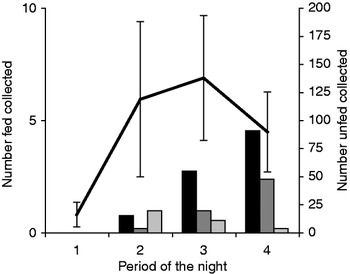
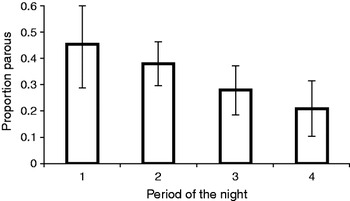
Mean numbers of unfed, part-fed, engorged and gravid females collected in the tent trap by night time from five collections in which collection bags were changed are shown in fig. 2. Most unfed and gravid females were collected in the middle two periods of the night, whereas numbers of part-fed and engorged insects, although small, increased during the night. The proportion of the collection that was parous decreased during the night (fig. 3) although the proportion of these that had sacs remained more or less constant, as did the proportion of first-feeding insects with mating plugs.
Outdoor biting activity of M form An. gambiae determined using the Furvela tent trap, Okyereko, Ghana, June 2009 (▪, part-fed;  , engorged;
 , gravid;
 , unfed).

Parous rates by collection period of the night of M form An. gambiae collected using the Furvela tent trap, Okyereko, Ghana, June 2009.

On one night of collection, the battery used in the light trap was not properly charged and, although numbers collected were sufficient for the purposes of dissection, they were a fraction of the number expected. Hence, the collection data from the light trap on this day was not included in the analysis.
Overall, approximately two thirds (0.62) of recently emerged mosquitoes had mating plugs in both traps (192 of 311 dissected from the light trap and 354 of 574 dissected from the tent trap). Similarly, there were no differences between overall proportions of the other age groups collected in the two traps. This again implies that both traps are sampling the same population of mosquitoes.
The wet season started on the 11th of June (148 mm being recorded in Winneba, the town 5 km from Okyereko). More An. gambiae than expected were caught in the light trap and less in the tent trap on this night. The sum of the numbers collected in both traps was, however, similar to the expected number, as was the proportion of newly emerged insects that had a mating plug (0.64). Thus, the rain had not apparently affected mating behaviour nor overall host seeking activity.
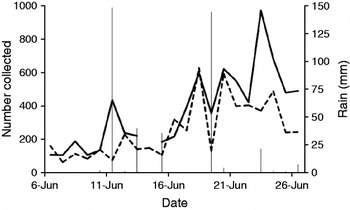
After the 11th, a total of 251.2 mm of rain was recorded on 11 of the remaining 13 days of the study. On four of these days, two of them at night, more than 20 mm of rain fell. On those two nights, the proportion of the total collection was lower than usual in the tent trap (fig. 4). The number of mosquitoes in both traps was also less than expected on the 19th of June when 144.2 mm of rain fell from the evening until 02:40 am on the 20th, although the drop was greatest in the tent trap. The proportion of newly emerged insects with a mating plug was higher on this day than on all other days (0.9 having plugs compared to a mean of 0.63 on the other days). The correlation coefficient between the numbers collected in the light trap and tent trap for all nights (including those when more than 5 mm of rain fell) was 0.506. This improved to 0.761 when the nights when more than 5 mm of rain fell were excluded from the calculations. Variation in numbers collected in both traps was also greater in days subsequent to the rainstorm on the 19th than in the period leading up to it. After the rainstorm, numbers of An. gambiae in the tent trap declined, whilst numbers in the light trap continued to increase (fig. 5).
Relationship between the numbers of M form An. gambiae collected in light trap and tent trap on nights with and without rain, Okyereko, Ghana, June 2009. (The regression equation for the trend line between the two traps is 0.785x+1.5078.) (◊, No-rain; ▪, Rain).

Numbers of M form An. gambiae collected in CDC light traps indoors and Furvela tent traps outdoors and daily rainfall, Okyereko, Ghana, June 2009 (——, Light trap; - - - -, Tent trap).

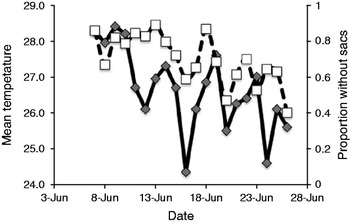
Parous mosquitoes classified as having sacs were more likely to have retained Stage V (i.e. unlaid) eggs in their ovaries than mosquitoes classified as not having sacs (two-tailed probability from a Fisher's exact test P=0.005) (table 3). This implies that such eggs are voided with time after oviposition as the sacs contract. Mean air temperatures in Apam decreased during the study (from a mean of 28.4°C on the 9th of June to 24.4°C on the 16th), as did the proportion of mosquitoes dissected without sacs (r2 between the proportion of parous insects with sacs and mean temperature=0.299), giving rise to a lowered estimation of the mean oviposition cycle length over time (fig. 6).
Proportion of parous M form An. gambiae from both light and tent traps in Okyereko, Ghana, returning to feed without large ovariolar sacs and mean daily temperature measured in Apam, 30 km to the west, June 2009 ( , mean temp).

Number of parous M form An. gambiae with and without sacs and numbers with retained Stage V eggs dissected, Okyereko, Ghana, June 2009.

Fisher's exact test (two-tail) P=0.005.
As expected from the low parous rates, infection in the mosquito was low. No oocysts were seen on the stomachs of parous insects dissected and only four (0.3%) of the 1296 mosquitoes analyzed in the ELISA tested positive for P. falciparum circumsporozoite protein. All of the positive mosquitoes came from the 753 tested from the light trap, each of the three days of collection yielding at least one positive mosquito, compared to none of the three days tested for the tent trap. Among the expected parous population from these days, overall sporozoite rates increased to 1.9%, whilst the rate from the light-trap samples increased to 5.2%.
Discussion
Our results indicate that, in both East and West Africa, on calm nights, the Furvela tent trap and CDC light trap sample similar fractions of the local An. gambiae populations. The tent trap has a number of advantages over the light trap, particularly for spatial studies. It collects host-seeking mosquitoes that are attracted to kairomones rather than relying on light. Light traps collect mosquitoes in the act of departing from a house and can only be hung where there are houses. The kind of house in which a trap is hung influences the number of mosquitoes entering, hence the number caught. Tent traps, on the other hand, provide a uniform sample, and can, within reasonable limits, be located anywhere. They also use considerably less power than a light trap but do require the payment of a sleeper that increases their running costs.
The population of female An. gambiae, an archetypal ‘invasive’ species, went through a log-scale change in density during the three weeks of the study. Given this increase, it is not surprising that parous rates and malaria transmission were low and similar to the rates observed by Okoye et al. (Reference Okoye, Wilson, Boakye and Brown2005) who found four of 2411 (0.2%) An. gambiae from Okyereko positive for sporozoites. Such low sporozoite rates have been described from other rice-growing areas of West Africa (Robert et al., Reference Robert, Gazin, Boudin, Molez, Ouedraogo and Carnevale1985, Reference Robert, Gazin and Carnevale1987; Ijumba & Lindsay, Reference Ijumba and Lindsay2001; Diuk-Wasser et al., Reference Diuk-Wasser, Touré, Dolo, Bagayoko, Sogoba, Sissoko, Traoré and Taylor2007). Although in the study presented here we could not distinguish between catastrophic mortality in young insects vs. exodous from the study area, our data on parous rates and sporozoite rates provides insight into what might be happening in the population. Assuming age-specific mortality (Clements & Paterson, Reference Clements and Paterson1981), young insects should be the age group whose survival is at a premium, and even small mosquitoes that manage to take a blood meal should survive as well as any (Takken et al., Reference Takken, Klowden and Chambers1998a). Although sporozoite rates among the whole population were low, when only the expected parous population was taken into consideration, rates were typical for a population of African vector. Similarly, when first-feeding insects were removed from survival rate calculations, an estimate similar to other studies was obtained (Gillies & Wilkes, Reference Gillies and Wilkes1965; Charlwood et al., Reference Charlwood, Kihonda, Sama, Billingsley, Hadji, Verhave, Lyimo, Luttikhuizen and Smith1995, Reference Charlwood, Billingsley, Takken, Lyimo, Smith and Meuwissen1997; Takken et al., Reference Takken, Charlwood, Billingsley and Gort1998b). This implies that, in older age groups, survival was unexceptional, which itself implies that rather than dying, an excess of young insects were leaving the area. Dispersal of young An. arabiensis was also observed in Tanzania, a ‘pulse’ of insects being collected along a transect of traps into the village of Namawala following a mass emergence at the periphery (Takken et al., Reference Takken, Charlwood, Billingsley and Gort1998b). Greater dispersion of young An. culicifaces, compared to old ones, was also observed in Sri Lanka by Rawlings et al. (Reference Rawlings, Curtis, Wickramasinghe and Lines1981). Such a phenomenon may be occurring, but with overlapping generations, in Okyereko.
Dispersion of recently mated first-fed (pre-gravid) mosquitoes would explain the dearth of ‘plug-blood’ mosquitoes in the collection. Such a phenomenon does not necessarily require radically different behaviours among insects of different ages. Gravid mosquitoes might fly toward oviposition sites at a variable distance from the village by responding to, for example, oviposition-site odours or humidity gradients, whereas first-blood feeders might be expected to fly in less specific directions, responding to mating cues in the case of virgins with a first blood meal, or to host cues in the case of mated females that have taken just the first blood meal. This might lead to more of one group than the other leaving the study area, depending on the distribution of resources and the associated cues that stimulate directed movement. There is, however, no information available on the pattern of movement of gravid females to support or challenge this hypothesis.
Whether the increase in numbers collected during the study was due to eclosion from several breeding sites or to the maturation of a single site is also unknown. Bearing in mind its limitations, the data indicates that the former took place. Certainly, the very productive field observed at the start of the study was no longer producing adult mosquitoes in any number by the end of the study. Not only had it dried up substantially but also the rice had grown from short to medium height. Changes observed in a number of population parameters indicate that at least two separate processes were occurring during the period of observation. The first is the drop in the estimated duration of the oviposition cycle (fig. 6) and the second is the rise in the proportion of first feeding insects (with follicles at Stage I) that were collected mated but without a mating plug (data not shown).
Temperature appears to determine the distribution of M and S forms of An. gambiae in Ghana (De Souza et al., Reference De Souza, Kelly-Hope, Lawson, Wilson and Boakye2010), and it may have influenced the behaviour of the mosquitoes in the present study. Thus, the change in the observed proportion of parous mosquitoes collected with sacs could be associated with one or more of the following factors: a drop in temperatures as a result of the rain, slowing of the contraction of sacs, or that the population of mosquitoes was generally ovipositing closer to the collection site during the latter period of observation. Further studies determining the rates of sac contraction at different temperatures and mapping of breeding sites would help elucidate these points. We do not know why, among first-feeding mosquitoes collected in the first part of the study, a higher proportion had apparently mated earlier than those that were collected in the latter part of the study. Given the high densities of larvae observed in Okyereko, independent estimates of eclosion could be made using emergence-traps.
Heavy rainstorms tend to have a negative effect on mosquito populations, since they drown or flush out the larvae (Paaijmans et al., Reference Paaijmans, Wandango, Githeko and Takken2007); but this, to a certain extent, depends on the terrain and the level of the water table. In the present study, the two rainstorms, on the 11th and 19th of June, had different effects on the mosquito population. On the 11th of June, the behaviour of the An. gambiae was altered such that they were collected in greater numbers than expected in the light trap, whilst fewer than expected were collected in the tent trap. Overall, though, the rain did not affect the total number collected on this and subsequent days. Such an outcome in response to rain may enhance subsequent malaria transmission since the mosquitoes are more likely to take an infected bloodmeal inside than they are outside the house, where alternative hosts are to be found.
The rainstorm on the 19th had more profound effects. It severely reduced the numbers collected on that night and was associated with a greater subsequent variability in numbers in both traps. The water from the first rainstorm was largely absorbed within hours. Subsequent rain left numerous puddles in the village. The higher water table on the 19th June may have resulted in some flushing of late larvae in the rice fields, reducing numbers emerging and, hence, the numbers in the collections. The very high proportion of mated mosquitoes collected on that night was probably due to a deficit of virgin females in the collection rather than an exceptional amount of mating occurring.
A short but heavy rainstorm (71.5 mm of rain during three hours during the night) was shown to inhibit host-seeking behaviour, without affecting mortality, among An. farauti from Papua New Guinea (Charlwood et al., Reference Charlwood, Graves and Marshall1988). In that case, however, mosquitoes survived and merely delayed coming to feed until the following day.
Despite the eventual presence of numerous puddles within the confines of the village, none were observed with anopheline larvae. These were sites typically preferred by the S form of An. gambiae. Less than 2% S form An. gambiae were collected during the study. These may have started to colonise the puddles, but numbers may have still been too low for them to be detected during the larval surveys.
Acknowledgements
We are grateful to the villagers of Okyereko for allowing us to work in their village. This study was financed in part by the IAEA (contract 14738) and DBL Centre for Health Research and Development, Denmark. PS was supported by CMDT and by a post-doctoral grant (SFRH/BPD/34395/2006) from Fundação para a Ciência e Tecnologia, Portugal. RJP thanks Dr Larry Zwiebel and the Department of Biological Sciences, Mosig Fund, for travel support.