


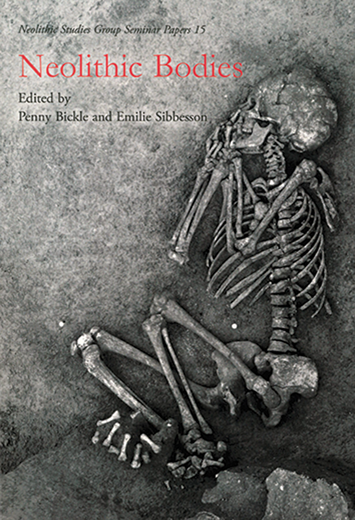
Given the increased focus on the archaeology of the body over the past 30 years, it is good to see a Neolithic Studies Group book on this topic. The series publishes papers presented in an annual one-day conference, and the volumes tend to give a good representation of the theme rather than attempt comprehensive coverage. This book fits that pattern, and provides a neat sample of recent work on Neolithic bodies. Chapters range from the Early Neolithic fertile crescent to Late Neolithic Britain, and discuss topics including food consumption, health and stress, bodily representations, mortuary practices, and personhood and ontology.
The introduction from the editors provides a solid context for the book and a succinct indication of the content of each chapter. Oliver Harris (Chapter 2) works across different contexts within Neolithic Britain to explore personhood and bodily ontologies; keeping human bodies embedded in their material worlds, he focuses on an interplay between bodily permeability and partibility in life and death. Abigail Ash and Ron Pinhasi (Chapter 3) take a rigorous osteobiographical approach to the question of whether those living on the frontiers of an expanding Linearbandkeramik (LBK) way of life experienced greater stresses than those living in already established areas. Their results identify bodily evidence for diversity in LBK lives, including differences between those living in frontier zones and those elsewhere, while highlighting the complexities of what this meant in terms of, for instance, stress at different times in life. Emilie Sibbesson's chapter (Chapter 4) explores relationships between food and pottery in Neolithic Britain, considering the range of different kinds of foodstuffs that can be produced. While it very ably situates the production and use of pottery within Neolithic foodways, it says less concerning what this tells us about Neolithic bodies. Sam Walsh and Roger Matthews (Chapter 5) analyse Neolithic mortuary practices at settlements in the Zagros Mountains, identifying evidence for cranial modification in life and varied, staged, mortuary manipulations of human remains within house structures (including burial within house floors). They afford the transformation of the bodies of the dead in these houses a key role in increasing sedentism during the period. Kenny Brophy, Gavin MacGregor and Gordon Noble (Chapter 6) associate the emergence of certain “high-status locations” (p. 81) in Late Neolithic Britain with cremation, and consider the impact of the experience of participating in cremation on the living. Having stayed up all night to fuel and tend reconstruction pyres, they describe the event as emotionally and physically draining and discuss how such dramatic acts sear funerals into the memory. Philippe Lefranc, Anthony Denaire, Christian Jeunesse and Bruno Boulestin (Chapter 7) examine those buried in unconventional postures in pits at Michelsburg and Munzingen settlements in Central Europe. These unconventional burials often show signs of bodily mutilation or dismemberment. Some individuals buried in more standardised positions (predominantly women) were accompanied by unconventional burials, with the latter usually being juveniles: the authors interpret these as people—possibly enslaved during life—killed to accompany higher-ranking deceased individuals into the grave. In cases where unconventional burials occurred alone, especially those showing signs of violent treatment, they argue that the individuals were sacrificed to supernatural forces on behalf of the community. They present a wide-ranging review of anthropological examples to illustrate the basis for these interpretations. Some tabulation of the Neolithic evidence for peri-mortem trauma would be useful, but the chapter details specific examples. As the authors conclude, this is an area where further work is needed; perhaps stable isotope analyses and assessment of biological relatedness among the burials may help in future. Claudia Defresne (Chapter 8) argues that decorated statue-menhirs from Valcamonica should be understood as “gendered stone-bodies” (p. 114), equivalent to, yet different from, the growing flesh bodies of their human counterparts. In that context, the presence of animal motifs on the stones is particularly interesting. Employing a sophisticated methodology to assess variations in the stones, motifs, compositions of motifs and landscape location, Defresne situates the statue-menhirs within broader technologies of the self and treatments of bodies emerging in Chalcolithic northern Italy. She makes a strong case for statue-menhirs as stone beings embodied in ways that chimed with human bodies even though they were also distinctively different. A closing chapter by Julian Thomas reflects on those prior to it while setting out a case for seeing Neolithic bodies as distinct from those of other periods: a body that was newly “cyborg” (p. 135); that coped with new kinds of routine, food, disease, and violence; a skilled, performed body, monitored and controlled not just in life but following death. In doing so, it draws general similarities from the diverse chapters into a large-scale, long-term characterisation and ties the book together nicely.
The book is produced and presented to a high standard. Individually, the chapters are insightful, thorough and thought-provoking, but overall some key topics are under-represented or absent from the book. Ash and Pinhasi make interesting observations about age, but most chapters say little about gender (despite some of those involved in the volume producing recent inspiring work on this topic (e.g. Robb & Harris Reference Robb and Harris2018; Bickle Reference Bickle2019)). Bodily representation is only really addressed in Defresne's chapter on Chalcolithic Valcamonica. There is relatively little mention of the use of stable isotope analyses, and nothing is said about what contribution aDNA analyses may make to understanding Neolithic bodies. That said, the book covers much important ground, and provides a very good snapshot of some current avenues of research into Neolithic bodies.


