Introduction
In the reproduction of viviparous animals, fertilized embryos are semi-allografted to the mothers, develop into blastocysts in the uterus, implant in the uterine epithelium, and then develop to full-term without rejection by the mothers. The precise mechanism responsible for this immunotolerance of the mother to the fetus and placenta is unclear, although it is generally thought that the immunotolerance arises from anatomic separation of the mother and fetus by the placenta (Davis, Reference Davies2007). Even if embryos are genetically different from the mothers, which is the case in animal embryo transfer, a high proportion of embryos develop to young. When mouse blastocysts recovered from F1 (C57BL/6J × CBA, H-2b/d) females previously mated with F1 males are transferred to pseudopregnant outbred ICR females, 75% of them develop to normal young (Li et al., Reference Li, Kato and Tsunoda2005). When Japanese Black bovine embryos are transferred to recipient Holstein females, a large proportion of embryos develop to calves (Numabe et al., Reference Numabe, Oikawa, Kikuchi and Horiuchi2000). Although immunologic rejection in pregnant recipients does not usually occur, immunologic rejection is considered to be one reason for unexplained infertility in humans (Laird et al., Reference Laird, Tuckerman, Cork, Linjawi, Blakemore and Li2003). Immunologic rejection is also observed in intergenic embryo transfer (Tsunoda et al., Reference Tsunoda, Iritani and Nishikawa1978; Nan et al., Reference Nan, Lei, Zhao, Shi, Quyang, Song, Sun and Chen2007) or abortion-prone interspecies hybrid reproduction (Chaouat et al., Reference Chaouat, Kiger and Wegmann1983). When fertilized rat embryos are repeatedly transferred into the rabbit uterus, antibodies against rat tissues are detected in the rabbit serum (Tsunoda et al., Reference Tsunoda, Iritani and Nishikawa1978).
The in vitro developmental potential of somatic cell nuclear-transferred (SCNT) oocytes is high, but a large proportion of embryos dies at various stages after transfer to recipients and, with very few exceptions, only a few embryos develop to term (Kato et al., Reference Kato, Tani, Sotomaru, Kurokawa, Kato, Doguchi, Yasue and Tsunoda1998; Campbell et al., Reference Campbell, Fisher, Chen, Choi, Kelly, Lee and Xhu2007). In mice, more than 50% of SCNT oocytes develop to blastocysts and 50% of the transferred embryos implant, but only 1–7% of them develop to young (Kishigami et al., Reference Kishigami, Mizutani, Ohta, Hikichi, Mizutani, Bui and Wakayama2006; Menge et al., Reference Meng, Wang, Stanca, Bodo and Dinnyes2008; Tsuji et al., Reference Tsuji, Kato and Tsunoda2009). The mechanisms that underlie the high incidence of abortion during pregnancy are not clear, but placental abnormality due to the improper epigenetic modification of key regulatory genes essential for normal reprogramming of somatic cell nuclei in oocytes is considered to be one of the main causes (Palmieri et al., Reference Palmieri, Loi, Ptak and Della Salda2008). The disturbed embryo–maternal communication during the peri-implantation period is also considered a reason for these placental abnormalities (Bauersachs et al., Reference Bauersachs, Ulbrich, Zakhartchenko, Minten, Reichenbach, Blum, Spencer and Wolf2009). Considering the important role of the placenta for immunologic tolerance and the abnormal expression of major histocompatibility complex (MHC) class I antigens by trophoblast cells in SCNT pregnancy (Hill et al., Reference Hill, Schlafer, Fisher and Davis2002; Davies et al., Reference Davies, Hill, Edwards, Schrick, Fisher, Eldridge and Schlafer2004; Aston et al., Reference Aston, Li, Hicks, Sessions, Davis, Winger, Rickords, Stevens and White2009), we hypothesized that immunologic rejection may occur in pregnant recipients receiving SCNT embryos. Cyclosporin A (CsA) is an immunosuppressive agent used for successful organ transplantation (Sketris et al., Reference Sketris, Yatscoff, Keown, Canafax, First, Holt, Schroeder and Wright1995) as well as for the inhibition of abortion in abortion-prone interspecific hybrid mice (Du et al., Reference Du, Dong, Zhou, Yan and Li2007; Zhou et al., Reference Zhou, Dong and Du2008). In the present study, we examined whether administration of CsA increases the potential of SCNT mouse embryos to develop to fetuses.
Materials and methods
All experiments and protocols were performed in strict accordance with the Guiding Principles for the Care and Use of Research Animals adopted by the Kinki University Committee on Animal Research and Bioethics.
Media and reagents
All chemicals were purchased from Sigma-Aldrich Chemical Co. unless otherwise stated. Flushing holding medium (FHM) was used as the handling medium and potassium simplex optimized medium (KSOM) (Erbach et al., Reference Erbach, Lawitts, Papaioannou and Biggers1994) was used for embryo culture. Stock solutions of cytochalasin B (CB) and trichostatin A (TSA) were dissolved in dimethyl sulfoxide at 1 mg/ml and 1 mM, and used at 5 μg/ml and 100 nM, respectively. CsA (Nacalai Tesque Co., Kyoto, Japan) was dissolved in 50% ethanol at 2 mg/ml.
Preparation of recipient oocytes and donor cells
Metaphase oocytes at the second meiosis were collected from BDF1 (C57BL/6 × DBA, H-2b/d) female mice following superovulation induced by 5 IU of pregnant mare serum gonadotropin and 5 IU of human chorionic gonadotropin (hCG), 48 h apart. Females were killed 14 h after hCG and cumulus–oocyte complexes (COCs) were released into the FHM. The COCs were then treated with 300 U/ml hyaluronidase and denuded oocytes were used as recipient oocytes. Isolated cumulus cells were collected and used as donor cells.
Nuclear transfer and in vitro culture
Oocytes were enucleated in FHM containing 5 μg/ml CB as reported previously (Tsunoda and Kato, Reference Tsunoda and Kato1995). Single cumulus cells were directly injected into enucleated oocytes (Wakayama et al., Reference Wakayama, Perry, Zuccotti, Johnson and Yanagimachi1998) and nuclear-transferred oocytes were cultured at 37 °C in 5% CO2 in air within 2 h after nuclear transfer. The reconstructed oocytes were cultured for 6 h in Ca-free KSOM containing 10 mM SrCl2, 5 μg/ml CB, and 100 nM TSA (Kishigami et al., Reference Kishigami, Mizutani, Ohta, Hikichi, Mizutani, Bui and Wakayama2006; Rybouchkin et al., Reference Rybouchkin, Kato and Tsunoda2006). The activated oocytes were cultured in KSOM for 64 h after the start of activation and then the oocytes were further cultured for 32 h in KSOM supplemented with essential and nonessential amino acids (Invitrogen) and glucose (final concentration 3.5 mg/ml) (Kishigami et al., Reference Kishigami, Mizutani, Ohta, Hikichi, Mizutani, Bui and Wakayama2006; Rybouchkin et al., Reference Rybouchkin, Kato and Tsunoda2006).
Experimental design
Experiment 1
The effect of administration of CsA to recipients that received fertilized embryos on the ability of embryos to develop to full term was examined. Zygotes were recovered from superovulated BDF1 females mated with males of the same strain 20 h after hCG injection and cultured for 20 h. Groups of five to 10 embryos at the 2-cell stage were transferred to the oviducts of day-1.0 pseudopregnant outbred ICR strain females (in which the H-2 complex was not fixed), and then the ICR females were divided into four groups; control females were injected intraperitoneally with 50% ethanol on day 4.5 (Group 1), and other females were injected with 5 mg/kg CsA in 50% ethanol on day 4.5 (Group 2), day 5.5 (Group 3), or day 6.5 (Group 4) (Du et al., Reference Du, Dong, Zhou, Yan and Li2007). Females were killed on day 10.5 or day 18.5 to evaluate the number of implantation sites, fetuses, and the size of living fetuses or the weight of the placentae.
Experiment 2
When SCNT oocytes developed to the 2-cell or blastocyst stage, 10 to 24 embryos were transferred into the oviducts of day-1.0 pseudopregnant ICR strain females, and then the recipients received an intraperitoneal injection of 5 mg/kg CsA on day 4.5 or days 4.5, 6.5, and 8.5. Recipients were killed on day 10.5 or day 18.5 to evaluate the number of implantation sites, fetuses, and the size of living fetuses or the weight of the placentae.
Statistics
Developmental data were analyzed using a chi-squared test, and body and placenta size and/or weights were compared using Student's t-test. A p-value of less than 0.05 was considered to be statistically significant.
Results
Effect of CsA treatment on the in vivo development of fertilized embryos
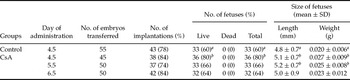
The developmental potential of fertilized embryos transferred to recipients after CsA administration is shown in Tables 1 and 2. The proportion of embryos that developed to fetuses by day 10.5 was significantly higher when CsA was administered to recipients on day 4.5 compared with control (80% vs 60%; Table 1). CsA administration on days 5.5 and 6.5, however, did not increase the proportion of fetuses that developed (66% and 64% vs 60%). The length, weight, and number of somites of the fetuses in the CsA-treated groups on days 4.5 and 5.5 were significantly higher than those of controls.
Effect of CsA administration to receipients receiving fertilized embryos on the development to fetuses on day 10.5

a,b Values in the same column are significantly different (p < 0.05).
Effect of CsA administration to recipients receiving fertilized embryos on the development to fetuses on day 18.5

Table 2 shows the proportion of fertilized embryos that developed to full term after CsA administration. In contrast to the potential to develop into fetuses by day 10.5, the proportion of full-term fetuses after CsA administration on day 4.5 was slightly, but not significantly, lower than that of controls (56% vs 63%). The weights of the fetuses and placentae did not differ between the CsA-treated and control groups.
Effect of CsA administration on the in vivo development of SCNT embryos
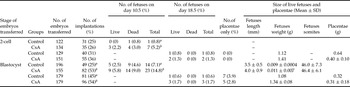
Based on the findings using fertilized embryos, CsA was administered to recipients receiving SCNT embryos on day 4.5. The proportion of SCNT embryos transferred at the 2-cell or blastocyst stages that developed into fetuses in the CsA group was significantly greater than that in the control group (5.2% vs. 0.8% for the 2-cell stage and 14.8% vs. 7.1% for the blastocyst stage; Table 3). More than half of the fetuses in both the control and CsA groups, however, did not have a heart beat. The sizes of the live fetuses did not differ between the control and CsA groups.
Effect of CsA administration to receipients receiving SCNT embryos on the development to fetuses

a,bValues in the same column and same group are significantly different (p < 0.05).
The proportion of SCNT embryos transferred at the 2-cell or blastocyst stage that developed into full-term live fetuses was slightly higher in the CsA-administered groups than in controls (1.3% vs 0.8% for the 2-cell stage and 1.7% vs 0.6% for the blastocyst stage; Table 3). The small number of samples prevented a statistical comparison of fetus and placental weights between the control and CsA groups. When SCNT embryos were transferred at the blastocyst stage, placentae without fetuses were frequently observed in both the CsA and control groups (2.8% and 3.9%).
Table 4 shows the potential of SCNT embryos to develop to full-term after three injections of CsA. The proportion of live fetuses in the CsA group was slightly greater than in the control group (2.9% vs 1.4%). Although the number of live fetuses obtained was small in both groups, the weights of the fetuses and placentae did not differ between the two groups.
Effect of repeated CsA administration on the development of SCNT embryos to fetuses on day 18.5

Discussion
In natural mammalian reproduction, fetuses are semi-allografted to the mother but develop to term without immunologic rejection. Several reasons for this immunotolerance have been postulated, such as: (i) anatomic separation of the mother and fetus by the placenta; (ii) downregulation of the polymorphic MHC antigen on the trophoblast cells that form the external epithelial layer of the placenta (Davies et al., Reference Davies, Hill, Edwards, Schrick, Fisher, Eldridge and Schlafer2004; Davies, Reference Davies2007); (iii) maintenance of an immunosuppressive environment by hCG (Perrier d'Hauterive et al., Reference Perrier d'Hauterive, Berndt and Tsampalas2007) and progesterone (Blois et al., Reference Blois, Albam Soto, Tometten, Klappm, Margnim and Arck2004); (iv) presence of blocking antibodies to paternal antigens (Takakuwa et al., Reference Takakuwa, Goto, Hasegawa, Ueda, Kanagawa, Takeuchi and Tanaka1990); and (v) shift of Th2 cytokines to Th1 cytokines (Raghupathy, Reference Raghupathy2001). In normal pregnancy, fetuses developing in the uterus express both maternally and paternally derived MHC antigens (Jenkinson & Searle, Reference Jenkinson and Searle1979), but such antigens do not stimulate a cell-mediated immune response in the mother because the major trophoblast cells in direct contact with the maternal circulation are devoid of classical class I MHC molecules (Billington, Reference Billington1993). Voland et al. (Reference Voland, Becker, Hooshmand and Hunt1994) demonstrated that unusual expression of the allogeneic class I antigen in trophoblast cells results in abortion in some of the females, but Shomer et al. (Reference Shomer, Toder, Egorov and Ehrlich1998) reported that this expression does not affect fetal development.
The proportion of SCNT oocytes that develop into blastocysts and implant after transfer to recipients is high, but a large proportion of embryos are aborted before parturition (Campbell et al., Reference Campbell, Fisher, Chen, Choi, Kelly, Lee and Xhu2007). The precise mechanisms for the high incidence of abortion are not clear, but failed SCNT pregnancies are associated with placental abnormalities such as placentomegaly, reduced vascularization, and hypoplasia of the trophoblastic epithelium (Palmieri et al., Reference Palmieri, Loi, Ptak and Della Salda2008). Such placental failure originates from abnormal embryo–maternal communication during the peri-implantation stage that leads to immune-mediated abortion in cloned pregnancy (Bauersachs et al., Reference Bauersachs, Ulbrich, Zakhartchenko, Minten, Reichenbach, Blum, Spencer and Wolf2009). Bovine trophoblast cells do not normally express classical MHC class I antigens, which contributes to immuno-mediated rejection, before day 120, but the majority of SCNT conceptuses express MHC class I antigen between day 30 and day 90 (Davies et al., Reference Davies, Hill, Edwards, Schrick, Fisher, Eldridge and Schlafer2004; Davies, Reference Davies2007). In addition to the morphologic abnormalities of SCNT placentae, the fact that placentae express maternal histocompatibility antigens during early pregnancy (Davies et al., Reference Davies, Hill, Edwards, Schrick, Fisher, Eldridge and Schlafer2004; Davies, Reference Davies2007) and even in the blastocyst stage (Pfister-Genskow et al., Reference Pfister-Genskow, Myers, Childs, Lacson, Patterson, Betthuser, Gouelek, Koppang, Lange, Fisher, Watt, Forsberg, Zheng, Leno, Schultz, Liu, Chetia, Yang, Hoeschele and Eilertsen2005) suggests that the immunotolerance mechanisms do not work normally in SCNT pregnancies. Actually, in addition to unexplained infertility in humans (Laird et al., Reference Laird, Tuckerman, Cork, Linjawi, Blakemore and Li2003), immunologic rejection occurs in recipient rabbits receiving rat embryos (Tsunoda et al., Reference Tsunoda, Iritani and Nishikawa1978), mice receiving rat embryos (Nan et al., Reference Nan, Lei, Zhao, Shi, Quyang, Song, Sun and Chen2007), and abortion-prone mated mice (Chaouat et al., Reference Chaouat, Kiger and Wegmann1983).
These findings led us to examine whether the proportion of fetuses that develop from cloned pregnancies could be improved by administering CsA, which is widely used to prevent organ rejection (Sketris et al., Reference Sketris, Yatscoff, Keown, Canafax, First, Holt, Schroeder and Wright1995), to recipients. Calcineurin regulates nuclear factor-activated T-cell (NFAT) transcription to express interleukin 2 (IL2). The CsA/cyclophilin complex inhibits contact between calcineurin and NFAT. CsA leads to the phosphorylation of NFAT, so that NFAT cannot induce the transcription of IL2 (Liu et al., Reference Liu, Sakane and Tsunematsu1992; Crabtree & Olson, Reference Crabtree and Olson2002), resulting in immunosuppression (Schreiber and Crabtree, Reference Schreiber and Crabtree1992). CsA is also effectively used to inhibit abortion in abortion-prone mating (Du et al., 2008; Zhou et al., Reference Zhou, Dong and Du2008). Du et al. (Reference Du, Dong, Zhou, Yan and Li2007) reported that CsA treatment of abortion-prone matings, that is, CBA/J (H-2k) females mated with DBA (H-2d) males, significantly decreases the abortion rate by elevating Th2 cytokines, and slightly increases the weights of the fetus and placenta on day 14. CsA treatment, however, has no effect on CBA/J females mated with BALB/c (H-2k) males with normal fertility (Du et al., Reference Du, Dong, Zhou, Yan and Li2007).
In the present study, in which 2-cell embryos that developed from zygotes recovered from F1 (C57BL/6 × DBA, H-2b/d) females mated with males of the same strain were transferred to pseudopregnant ICR females (in which the H-2 complex was not fixed), CsA treatment significantly increased the proportion of fetuses that developed and their weight on day 10.5. These observations are consistent with the report of Du et al. (Reference Du, Dong, Zhou, Yan and Li2007), which demonstrated that CsA treatment of recipients in abortion-prone matings decreases the resorption rate and increases fetal weight.
The present study also demonstrated that CsA administration to recipients receiving SCNT embryos both at the 2-cell and blastocyst stages on day 4.5 significantly increased the number of fetuses that developed on day 10.5 compared with that in vehicle-administered controls. In the CsA treatment group, 57% (4/7) and 61% (14/23) of fetuses obtained on day 10.5, however, did not have a heartbeat. The morphologic appearance of the fetuses treated with CsA was not significantly different from that of the control group fetuses, although a more detailed anatomic examination is required. The proportion of full-term fetuses among CsA-treated recipients compared with controls was 1.6-fold higher in recipients receiving 2-cell embryos than in controls (1.3% vs 0.8%), 2.8-fold higher in recipients receiving blastocysts than in controls (1.7% vs 0.6%), and 2.1-fold higher in recipients receiving 3 injections of CsA than in controls (2.9% vs 1.4%), although statistical examination was difficult due to the small number of fetuses. To our knowledge, this is the first study to report that CsA administration increased the proportion of fetuses developing in pregnant mice that received SCNT embryos.
Although the precise reasons for the effectiveness of CsA administration to SCNT recipients are not known, the following mechanisms are considered. Because enucleated oocytes and donor cumulus cells were obtained from F1 (C57BL/6 × DBA, H-2b/d) mice, fetal placentae might express H-2 antigens in a manner different from that of ICR females (Davies, Reference Davies2007) and recipient females could recognize them as foreign bodies which would lead to an abortion. Similar to the case in abortion-prone mating mice (Du et al., Reference Du, Dong, Zhou, Yan and Li2007; Zhou et al., Reference Zhou, Dong and Du2008), CsA administration might downregulate CD80/86, CD28, leading to the induction of a Th2 bias, which might suppress the abortion of SCNT embryos. To test these hypotheses, the effects of CsA treatment on immune cell populations, secreted factors, and placenta analyses should be examined.
Acknowledgements
This work was supported by a grant from Ministry of Education, Science, and Culture (no. 21028022), and a Research Fellowship of the Japan Society for the Promoting of Science for Young Scientists to Y. Tsuji.