Pilgrimage was a central and wide-ranging phenomenon in Medieval and Early Modern Europe, encompassing extensive networks of routes, spanning diverse regions, and engaging a broad spectrum of religious, social, and economic actors as well as of spiritual services.Footnote 1 However, scholarly attention has largely focused on the religious and cultural aspects of shrines, often overlooking their economic significance and the entrepreneurial strategies adopted by churchmen to attract pilgrims and donors of alms and testamentary legacies within what was a highly competitive market for spiritual services.Footnote 2 As Bell and Dale argue, pilgrimage can be interpreted as an economic and business ecosystem based on three interrelated dimensions: an implicit contract in which pilgrims’ donations were exchanged for expected spiritual or social benefits; shrine networks that operated like franchise enterprises under the Church’s umbrella, actively marketing saints and channeling offerings into clergy, building projects, and charity; and a broader service economy sustained by pilgrims’ demand for accommodation, food, and transport, which connected devotional travel to local and regional markets.Footnote 3
In a complementary vein, Casson and Casson emphasize that the medieval Church was a key arena for entrepreneurship, as churchmen exercised judgment under uncertainty, mobilized resources, and developed innovative organizational and financial initiatives —an approach that can be extended to spiritual services such as pilgrimage—thereby shaping emerging markets and institutions through asset management, project coordination, and participation in wider economic networks.Footnote 4 Scholarship has also identified promotional practices and competitive dynamics among pilgrimage centers.Footnote 5 Yet the analytical lens of branding has rarely been applied to spiritual services in the Medieval and Early Modern age, even though certain initiatives developed around shrines closely resemble what we would today describe as brand-building strategies.
Building on these perspectives, this paper addresses the economic and managerial dimensions of spiritual services by examining the Hieronymite Monastery of Saint Mary of Guadalupe, with particular attention to the organization of pilgrimage to the shrine of Our Lady of Guadalupe and to the monastery’s role in managing the Guadalupe’s brand within a competitive market for spiritual benefits. The interest in this case study relies on several reasons. First, while distinct from the foremost pilgrimage centers of Christendom, many second-tier Marian shrines in Europe attracted substantial numbers of pilgrims from distant regions in the late medieval period.Footnote 6 Thus, this paper contributes to reconstructing these comparatively underexplored pilgrimage centers by examining the shrine of Our Lady of Guadalupe in southwestern Spain. There, in the fifteenth century, the Hieronymite Order—founded in the mid-fourteenth century and closely tied to the Castilian nobility—developed an exceptionally large and efficient network for collecting alms and testamentary legacies, offering a privileged vantage point from which to reassess how second-tier shrines operated within late medieval markets for spiritual services.Footnote 7
Second, from its formal establishment in 1389, the Monastery of Guadalupe functioned as a large-scale enterprise encompassing spiritual services, agriculture, livestock, and manufacturing.Footnote 8 Such a holding, administered through sophisticated accounting methods, flourished until the mid-sixteenth century.Footnote 9 Unlike most monastic economies,Footnote 10 it was built around the exploitation of an intangible asset: the miracles attributed to the Virgin of Guadalupe. Moreover, it was sufficiently diversified to avoid an exclusive dependence on donations, which constituted the principal, if not the sole, source of income for other pilgrimage centers.
Third, the case of Guadalupe sheds new light on how the institutional context influenced the pilgrimage business. Our research illustrates how spiritual services were supported not only by the well-documented role of the ChurchFootnote 11 but also by the less explored yet crucial involvement of the other major institution of the Ancien Régime: the Monarchy. Finally, this case examines early forms of branding, thereby extending business history research beyond its customary focus on the industrial era.Footnote 12
The economy of the Monastery of Guadalupe, like that of other monasteries located in the same region of the Iberian Peninsula, has been reconstructed and analyzed in previous scholarship, which has highlighted the economic significance of these centers, particularly their expansion in livestock farming, as well as the innovative organizational and financial initiatives developed to manage them.Footnote 13 However, none of these studies has examined how the monastery’s authorities managed the shrine-brand of Guadalupe as a means of promoting the institution’s economic and social development. By contrast, this article emphasizes the role that branding played in the monastery’s economic success from the late fourteenth century to the first half of the sixteenth century.
The sources used for this purpose are diverse, combining contemporaneous testimonies with the monastery’s primary documentation, mainly preserved in the Archive of the Monastery of Guadalupe (Archivo del Monasterio of Guadalupe, AMG) and the National Historical Archive of Spain (Archivo Histórico Nacional, AHN). The monastery’s archive alone contains over 260 codices and approximately 175 bundles of documents relating to the history of the Marian shrine of Guadalupe and the Hieronymite house itself. The principal primary sources used in this research document, notably for the period 1389–1620s, the evolution of the size and profitability of the monastery’s livestock holdings,Footnote 14 the development of its territorial patrimony,Footnote 15 the collection of alms and the organization of pilgrimage (including records of miracles attributed to Our Lady),Footnote 16 and the monastery’s grain and cash income.Footnote 17
The paper is structured as follows. After an introduction to the pilgrimage business and the theoretical framework applied to our study, we provide a narrative history of the evolution of the Hieronymite Monastery of Saint Mary of Guadalupe from its foundation in 1389 through 1562, when the last purchase associated with this monastic enterprise was made. This period spans the rise of the Guadalupe shrine as a second-tier pilgrimage destination and its subsequent decline from the late fifteenth century, brought about by several external and internal factors. These included changes in forms of religiosity as well as inquisitorial proceedings that damaged its brand reputation and by the statute of blood purity, which excluded converts of Jewish or Muslim origin from monastic life and deprived the Hieronymites of valuable human capital. Grounded on this narrative approach,Footnote 18 in the conclusion we discuss how our case study contributes to business history scholarship on management and branding of spiritual services.
Branding and Promotion in Pilgrimage
Medieval pilgrimage centers functioned as a form of franchise operating under the umbrella brand of the Church.Footnote 19 The shrines offered two main spiritual services to devotees and pilgrims: potential miracles and indulgences. Supposed miracles could occur either before or after the pilgrimage and they were not free goods; the beneficiary had to be “paid for” through the act of pilgrimage itself and through an appropriate donation to the devotional center.Footnote 20 Indulgences, or remission of punishment for sins, were often proportional to the distance traveled. Pilgrims also expected shrines to provide them with both physical and spiritual protection, and frequently, free accommodation and sustenance.
Throughout medieval and early modern Europe, a large number of devotional centers flourished, attracting pilgrims from across the continent. This proliferation of shrines remained significant up until the sixteenth century, when a combination of factors, including the Protestant Reformation, the more inward-focused religiosity promoted by the Catholic Counter-Reformation, and the disruptions of wars, led to a marked decline in pilgrimage activity.Footnote 21 Yet even during the height of pilgrimage popularity, shrines were in direct competition with one another, striving to protect their spiritual offerings and to assert the superior efficacy of their patron saints and holy relics in terms of miraculous power and the granting of indulgences.Footnote 22 This competitive dynamic manifested in the meticulous recording and promotion of miracles, the suppression of fraudulent claims and imitators, and deliberate efforts to enhance the overall pilgrimage experience. This included not only the embellishment of sacred spaces with architectural grandeur and visual richness but also the provision of practical services such as lodging, medical care, and charitable attention to pilgrims during their stay. Business historians have thus highlighted the promotional practices, including brand management, historically developed around the pilgrimage business, although research on this phenomenon remains limited and largely focused on England.Footnote 23
Among the many definitions offered in academic literature, a brand may be defined as a name, term, sign, symbol, or design, or a combination thereof, created by an organization to differentiate its products or services from those of its competitors.Footnote 24 Unlike patents and copyrights, which expire after a set period to encourage the spread of new knowledge, brands can last indefinitely, granting firms permanent monopoly power.Footnote 25 Trademarks provide the legal protection for brands, but a brand’s success also depends on its reputation, what is the outcome of a process of endorsement.Footnote 26 Firms can endorse brands directly, e.g. associating their brands with leading figures of the organization, or through third-party certifications.Footnote 27 Consumer’s perceptions about brands connections with certain values (like high quality or honesty) can also act as a sort of indirect endorsement, as well as cultural and social practices.Footnote 28
Traditionally neglected, branding has increasingly attracted the attention of the business history scholarship. Research on branding has traced the origins of brand creation to the use of premodern craft marks within the context of guilds.Footnote 29 Guilds functioned as precursors of modern branding by using collective marks and reputations to guarantee quality, protect producers and consumers, and differentiate goods in pre-industrial markets.
However, most scholarship has focused on the industrial era, particularly from the late nineteenth century onward.Footnote 30 Above all, business historians have examined how brands are constructed and sustained through social and economic processes that draw on multiple actors, technologies, and narratives, often mobilizing historical memory to confer enduring values and associations.Footnote 31 Branding and trademarks, furthermore, have been conceptualized not only as outcomes of commercial activity and economic growth, but also as instruments for nation branding and export promotion.Footnote 32 Business historians have also examined the legal foundations of the trademark system, showing that the formal regimes established since the late nineteenth century have been crucial in safeguarding the interests of both producers and consumers.Footnote 33 Courts have historically navigated the tension between enforcing trademark rights and promoting market competition, shaping the reach and authority of brands, and delineating the boundaries between innovation, intellectual property, and monopoly.Footnote 34
Scholarship has, therefore, largely concentrated on industrial times and on the branding of products, while much less is known about branding activities in services, such as pilgrimage tourism, or about other enforcement institutions beyond guilds and courts, including the Church and absolutist monarchies. This article seeks to address this gap by examining the specificities of branding in services and specifically in pilgrimage. Owing to their intangible, heterogeneous, and perishable nature, services present distinctive challenges of quality control, with reputation and location emerging as central determinants of brand success.Footnote 35 In pilgrimage and spiritual tourism, branding and other marketing strategies are used to segment the market and highlight authenticity, with pilgrims seeking a connection they perceive as real and rooted in the destination, and thus linked to a “spiritual experience.”Footnote 36 The “4Ps of marketing” (Product, Price, Promotion, Place) also apply here, capturing the nature of the service offered, its direct or indirect price, the promotional tools employed, and the features of the place where it is delivered.Footnote 37
The Origins of the Monastery of Guadalupe
The origins of the Monastery of Guadalupe are closely linked to the early development of the Hieronymite Order. The Hieronymites emerged as the result of the convergence of two eremitical groups, one established in central Castile and the other originating in Italy and associated with Spiritual Franciscanism. These hermits were led primarily by two members of the Castilian court nobility, Fernando Yáñez and Pedro Fernández Pecha. They eventually embraced cenobitic life and formally established the Order after obtaining the bull Sane petito in 1373, which granted them a rule, constitutions, a habit, and the authority to found four monasteries. The first monastery founded was San Bartolomé de Lupiana, located in the central Iberian Peninsula. From there, in 1389, its prior, Fray Fernán Yáñez, together with thirty-one other friars, departed to assume responsibility for the spiritual and material care of the shrine of Our Lady of Guadalupe, transforming what had previously been a secular priory into a regular monastic community and giving rise to the Royal Monastery of Saint Mary of Guadalupe.Footnote 38
Situated in the remote and sparsely populated region of Villuercas in southwestern Spain, the newly established monastery was entrusted not only with the sanctuary but also with the adjacent church and the surrounding village of La Puebla de Guadalupe. This transfer of authority conferred the right to collect tithes and other revenues associated with the property, along with a substantial patrimony, both territorial, in the form of several fully operating farms, and spiritual, as devotion to Our Lady of Guadalupe and pilgrimage to the Villuercas had already become deeply rooted practices among Castilian believers.Footnote 39
The cult of the Virgin of Guadalupe can be traced back to the late thirteenth century, when, according to the shrine’s foundational tradition, the Virgin appeared to a shepherd and directed him to the miraculous discovery of her image near the Guadalupe River, an event authenticated by an inaugural miracle—most commonly the revival of a dead cow (and, in some versions, the resurrection of the shepherd’s son).Footnote 40 The earliest known document referring to the shrine dates from 1326: an indulgence issued by the Avignon ecclesiastical authorities for those who made pilgrimage to Guadalupe on specified feast days, suggesting that by that time the sanctuary’s appeal had already extended beyond its immediate local setting.Footnote 41 This cult emerged within the broader expansion of Marian devotion that spread across Western Europe, gradually displacing traditional centers of worship that had been anchored in the thaumaturgic power attributed to the bodies and relics of martyrs, hermits, and holy bishops.Footnote 42
But the most important factor in the rise of Guadalupe was the extensive set of rights and privileges granted by the Castilian monarchs from at least the 1330s onward.Footnote 43 These privileges included, beyond the concession of the aforementioned church and manor, land for the construction of a new temple and dwellings for clergy and residents, fields for cereal cultivation and vineyards, tax exemptions, the right to hold a weekly market and an annual trade fair, and legal protection against surrounding councils and ecclesiastical administrations, several of which, due to Guadalupe’s frontier location, sought to exert control over the region and its assets.Footnote 44
Among these privileges, one was especially significant: the right to move livestock freely throughout Castile. This allowed the Order to, like most sheepmasters in medieval and early modern Spain, practice transhumance—a seasonal system of livestock migration between summer and winter pastures. Transhumant shepherds, organized into a powerful guild known as the Mesta, were granted royal permissions to access pastures and move their flocks across the kingdom, effectively creating one of the most influential lobbies at court. In addition, the Castilian monarchs authorized the sanctuary’s managers (secular clergy) to establish a nationwide network of demandaderos or alms collectors.Footnote 45 This proved to be an important source of income for the sanctuary, but also a source of dispute with the neighboring clerical administrations.Footnote 46
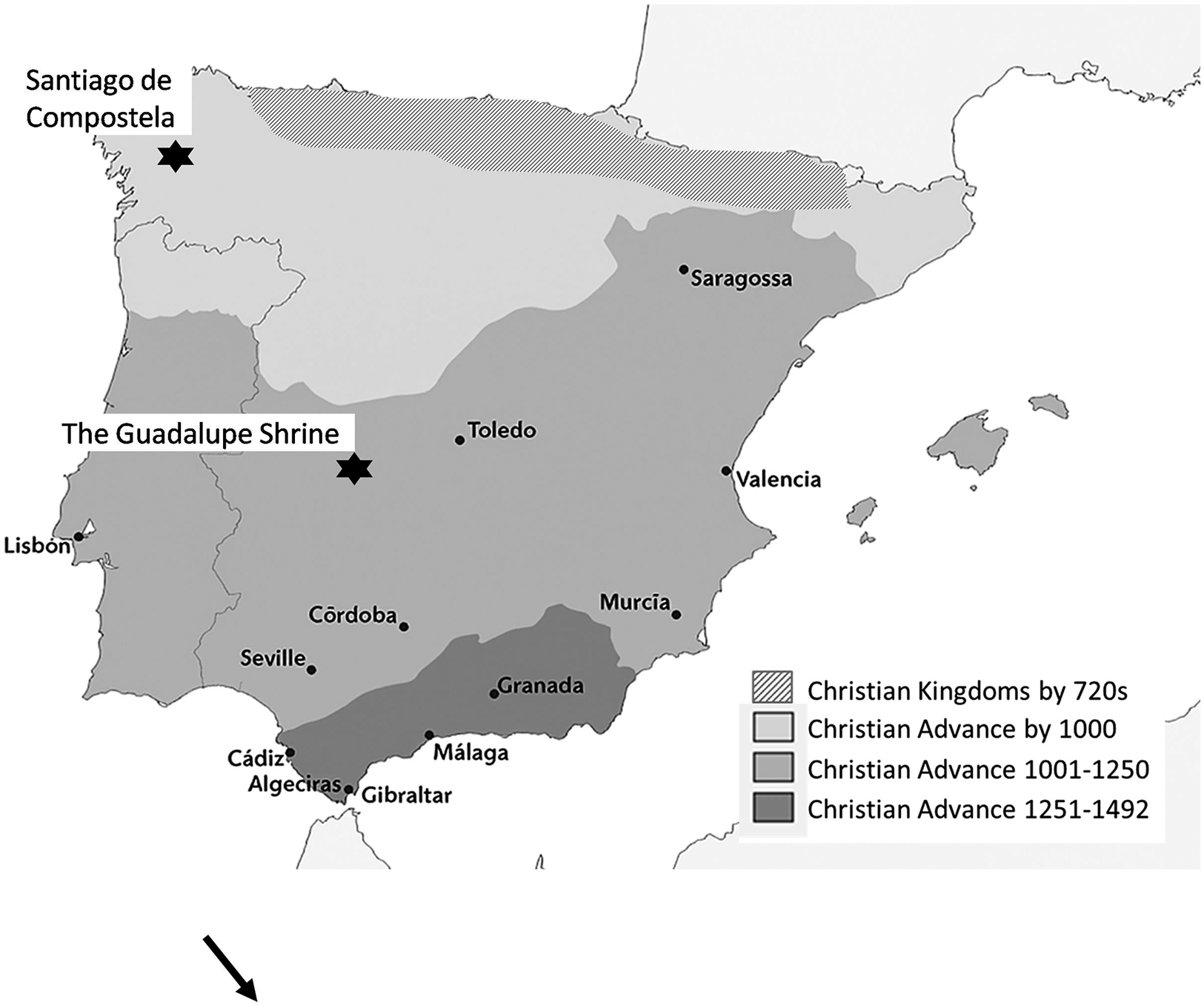
Behind the effective support of the Castilian monarchs for the remote and borderland shrine of Guadalupe lay more than mere devotion to the Virgin; though Alfonso XI, the shrine’s earliest royal patron, famously entrusted himself to her in his successful campaigns against the Muslim kingdoms.Footnote 47 The Castilian rulers also pursued several geostrategic objectives following the conquest of western Andalusia during the Reconquista. Footnote 48 The marriage of Alfonso XI to María of Portugal in 1328 likely heightened the king’s interest in the regions bordering the Portuguese kingdom. Meanwhile, the colonization of the region where the Guadalupe shrine was located (Extremadura) had been relatively late and limited in scope, even as the region’s pastures became increasingly vital for sustaining the growth of transhumant livestock economies in various parts of Castile.Footnote 49 In this context, the development of the Villuercas sanctuary facilitated the repopulation and Christianization of a vast and underutilized territory (see Figure 1).Footnote 50 This, in turn, promoted the circulation of goods, livestock, and people across Castile.Footnote 51
Localization of the Guadalupe shrine and the reconquest process of the Iberian Peninsula.
Source: Own elaboration using AI tools.

Figure 1. Long description
Starting in the northwest, Santiago de Compostela is marked with a black star. Southeast of it, the Guadalupe Shrine is labeled with a black star and a white box. The map includes cities: Lisbon in the west, Toledo in the center, Saragossa in the northeast, Valencia on the east coast, Murcia southeast, Córdoba, Seville, Cádiz, Algeciras, Gibraltar in the south, Málaga and Granada further east. Four shaded regions indicate Christian control: diagonal hatching in the north for Christian Kingdoms by the 720s, light gray for Christian advance by 1000, medium gray for advance from 1001 to 1250, and dark gray for advance from 1251 to 1492. The legend at the bottom right explains these categories. The southernmost cities, including Granada, are within the darkest region, indicating the last phase of reconquest.
By the late fourteenth century, however, it appears that the former custodians of Guadalupe had failed to sustain among pilgrims and local inhabitants the level of religious fervor expected in such a sacred, and strategically significant, site.Footnote 52 For this reason, and within the broader context of a deeper reform of the Spanish Church, the Castilian monarch at the time, Juan I, resolved to entrust the sanctuary to the recently founded Order of Saint Jerome.Footnote 53
Although the decision was supported by influential figures within the Spanish Church, it was nonetheless unexpected. The first Hieronymites had originally lived as hermits, seeking isolation, silence, intense devotion to prayer, and a life of strict austerity.Footnote 54 Managing the Guadalupe sanctuary required abandoning the Hieronymites’ traditional life of religious reclusion in favor of more practical and administrative responsibilities, a requirement that initially met with resistance from some members of the order. However, the order’s leadership at the time, many of whom possessed strong political connections as well as experience in diplomacy and economic affairs, ultimately viewed the king’s offer, and his insistence, as a valuable opportunity to expand the order’s influence and enhance its economic and political standing.Footnote 55 Thus, the Hieronymites accepted the offer, which led to a remarkable expansion of the sanctuary’s assets. The following sections outline the key foundations of the Hieronymites’ success.
The Economic and Social Rise of the Monastery of Guadalupe (1389–1562)
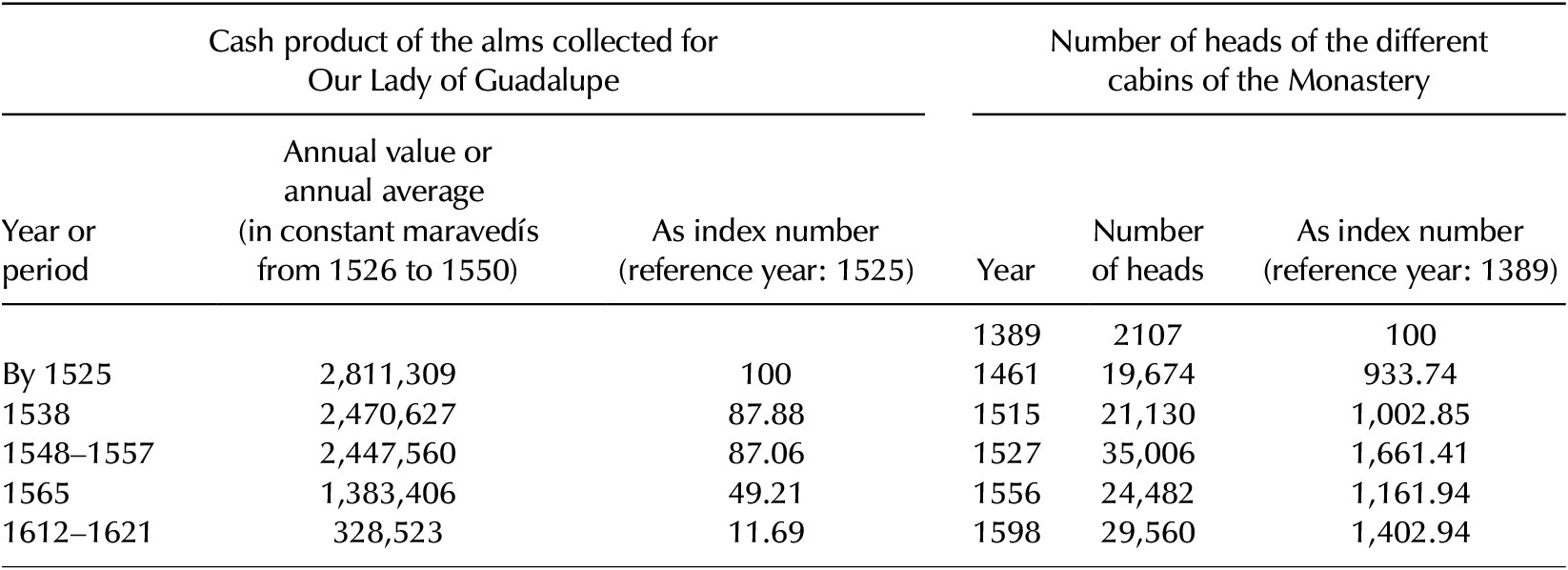
Without neglecting the large and important heritage received, the Hieronymites accelerated the economic development of the Guadalupe monastery in the fifteenth and the first half of the sixteenth century. For instance, livestock figures rose from 2,107 animals in 1389 to nearly 35,000 in 1557 (Table 1); while the number of meadows (mainly for pastures beyond the region of Villuercas) rose from 17 to 60 in the same period.Footnote 56 A similar increase took place in the arable land, as well as in the monetary income.Footnote 57
Different data on the Monastery’s sources of income and investments

Table 1. Long description
The table is split into two horizontal sections. The left section, titled Cash product of the alms collected for Our Lady of Guadalupe, has three columns: Year or period, Annual value or annual average in constant maravedís from 1526 to 1550, and As index number with reference year 1525. The right section, titled Number of heads of the different cabins of the Monastery, also has three columns: Year, Number of heads, and As index number with reference year 1389. Data in the left section are as follows: By 1525, 2,811,309 maravedís, index 100; 1538, 2,470,627 maravedís, index 87.88; 1548–1557, 2,447,560 maravedís, index 87.06; 1565, 1,383,406 maravedís, index 49.21; 1612–1621, 328,523 maravedís, index 11.69. Data in the right section are: 1389, 2,107 heads, index 100; 1461, 19,674 heads, index 933.74; 1515, 21,130 heads, index 1,002.85; 1527, 35,006 heads, index 1,661.41; 1556, 24,482 heads, index 1,161.94; 1598, 29,560 heads, index 1,402.94. The table shows a decline in cash value of alms over time, while the number of livestock heads generally increases, peaking in 1527, then fluctuating. All values are aligned by year or period for comparison.
Sources: For the alms collected, see “Relación, sumario y valoración hecho este año del Señor de MDXXXVIII…” [Report, Summary, and Valuation Drawn Up in the Year of Our Lord 1538], AMG, bundle 72/2; “Libro y memorial de todas las heredades y dehesas, rentas y juros…” [Book and Memorandum of All Estates and Pastures, Rents, and Juros/debt claims], AMG, codex 229, ff. 166v y 174v; “Rentas que esta casa de nuestra señora de Guadalupe tiene en dinero –1565–” [Cash Rents Held by This House of Our Lady of Guadalupe, 1565], AMG, bundle 95; Ladero, “Mecenazgo real”, 425. For deflation purposes, Martín Aceña, “Los precios,” 364. For the livestock cabins, AHN, Clero [Church], bundle 1.429/I-b; “Libro de Oficios” [Book of Offices (and Duties)], AMG, codex 99, ff. 51r-53r y 58v-59r; Gerbet (1982), Appendix II; “Estados de la casa” [House Accounts], AMG, bundle 143; and “Hojas de Ganado” [Livestock Sheets], AMG, bundle 127.
Soon after their arrival, the Hieronymites realized that their economic and social rise relied on how successfully they were able to manage the sanctuary’s liturgical potential. The priority was the construction of the monastery, including cells, a refectory, a cloister, and a choir large enough to accommodate all the monks during the many hours they had to dedicate daily to pray. Places for artisan workshops and administrative units were also enabled, as well as several hospitals, better systems of water conduction, water mills, and grain stores, among other facilities. The works were almost uninterrupted throughout the whole fifteenth century and the first decades of the sixteenth.
In addition, the first Hieronymites institutionalized, increased, and diversified the charitable services that had been providing the preceding secular priory up to 1389. The main policies developed in this area focused on low-income pilgrims, to extent pilgrimage far beyond the wealthiest groups, and the poorest families living around Guadalupe. Regarding the former, the monks gave them accommodation and food for three days, a pair of shoes, health-care services, and some bread and wine for their way back.Footnote 58 Guadalupe was also a destination for members of the Castilian nobility, who, unlike poorer pilgrims, did not seek charitable assistance but were accommodated in specially designated quarters befitting their status.Footnote 59 Pilgrims were informed about the benefits granted through the shrine’s wider communicative infrastructure, including the circulation of miracle accounts, the activities of alms collectors, and other channels that promoted Guadalupe beyond its immediate region. Within this broader framework of attraction and promotion, medicine and surgery were both taught and practiced in the monastery’s hospitals. The quality and growing reputation of these health-care services, particularly at their peak in the second half of the fifteenth century, formed part of the Hieronymites’ strategy for enhancing the shrine’s appeal.Footnote 60 These promotional activities are examined in detail in the following section.
In the case of Guadalupan neighbors, the poorest received some economic help, particularly in kind, as well as medicines for free from the monastery Order.Footnote 61 In case of crop failure or particularly severe economic difficulties, the aid increased and was furthermore extended to other nearby villages.Footnote 62 Perhaps the most innovative measure in terms of care assistance was the creation of an early form of social security for the regular workforce, which provided loyal servants who could no longer work with free medical care and a lifelong pension, while extending certain benefits also to the widows of some servants.Footnote 63 Not surprisingly, the number of citizens in La Puebla (the manor ruled by the monastery) grew as a result, from around 300 people in 1407, some 500 toward 1446, and more than 1,200 in 1480.Footnote 64
The Hieronymites’ also opened a school. Children could study there for up to three years, learning to read and sing for the choir service, although over time the curriculum was expanded to include grammar and higher studies in the sciences.Footnote 65 Toward 1462 a teacher and an assistant were in charge of 25 students.Footnote 66 Students, which grew over time, helped in the monastery’s concierge as well as in some religious services. As part of its charitable services, the monastery maintained a foundlings’ cradle from the late fourteenth century, raising abandoned children and, from the age of seven, incorporating survivors as apprentices, often in weaving.Footnote 67
All these services demanded considerable funds. In its early years, the Monastery relied mainly on alms and testamentary legacies gathered by an extensive network of voluntary collectors. Though little is known about its management, available records suggest a hierarchical organization operating across the largest clerical jurisdictions in Castile and Portugal.Footnote 68 Collectors were likely unpaid, motivated instead by religious fervor, honor, or the privileges (real or perceived) associated with the role. Although there is evidence that fraud and occasional thefts did occur,Footnote 69 the largely undetectable nature of such practices prevents us from reconstructing their scale with any precision. Even so, the system remained highly cost-effective, with net revenue close to gross. Documentation is limited, but the available evidence suggests that collections increased steadily throughout the fifteenth century, peaking around 1530 at over 2.8 million constant maravedís (the contemporary Castilian currency) and remaining high into the 1560s at roughly 87% of that peak level (see Table 1).Footnote 70
The effectiveness of the Order’s diplomatic efforts also secured an extension of papal privileges, granting the right to raise funds for Our Lady and exempting the monastery from both episcopal taxes and the need to seek permission to collect alms.Footnote 71 Moreover, the Castilian monarchs offered protection to the alms collectors, a support that proved crucial in thwarting attempts by bishops and other ecclesiastical institutions to appropriate the funds.
The Hieronymites, summing up, played a key role in redistributing wealth, channeling much of the income from donations and real estate into charitable services. They firmly believed that this strategy not only enhanced the sanctuary’s reputation but also ensured the continued flow of alms, as the image projected through charity was essential to its long-term success.Footnote 72 Sustaining such extensive assistance, however, required stable revenues, ultimately secured through the promotion of the Virgin of Guadalupe and the investment of part of donations into other economic activities, an issue addressed in the next section.
Management and Branding of Spiritual Services at the Guadalupe Shrine
The early leaders of the Monastery of Guadalupe quickly recognized the remarkable capacity of the image of Our Lady to generate resources. Focusing on innovative forms of religious marketing, the Hieronymites sought to create an appealing and spiritually immersive site of devotion to enhance the pilgrims’ thaumaturgic experience. This explains the extensive health care and accommodation services provided to travelers, as discussed in the previous section.
The Order also expanded the sanctuary to better serve its growing number of visitors. The strategy was not only to attract as many pilgrims as possible but also to ensure they experienced such intense emotional devotion that they would later spread word of Our Lady of Guadalupe’s power and greatness. Many travelers were already awed by the grandeur of the monastic complex upon arrival, including its advanced hydraulic infrastructure and the ordered management of water throughout the site.Footnote 73 Once inside, the beauty of the church, the richness of its ornamentation, the solemnity of the Divine Office performed by dozens of monks, the splendor of their vestments and liturgical objects, and the surrounding choral music all served to heighten the pilgrims’ fervor and deepen their spiritual experience.Footnote 74
Pilgrims’ astonishment and reverence reached their height when they claimed to “feel” the miraculous powers attributed to the Virgin. It was not uncommon for individuals to witness miracles firsthand or, at the very least, to hear credible accounts from others who had experienced them. The monastery’s reputation was further elevated by the frequent visits of Castilian monarchs, most notably the powerful Catholic Monarchs, whose presence conferred additional legitimacy and prestige upon the site. Furthermore, the Church granted special indulgences and spiritual benefits to those who made pilgrimages to Guadalupe during specific religious festivities.Footnote 75 As noted in the previous section, the monarchy supported the sanctuary for decades through various economic privileges and legal protections. In turn, the Hieronymite monks made every effort to ensure that the monarchs, and the aristocracy more broadly, were favorably impressed by the quality of services and hospitality offered at Guadalupe.
The Hieronymites quickly grasped that controlling Our Lady of Guadalupe’s miracles, by assessing which supernatural events could be legitimately attributed to her intervention, secured their role as sole intermediaries between the pilgrims and the Virgin. To consolidate the “Guadalupe brand” and suppress rival narratives, the monks formalized the Virgin of Villuercas’s origin legend and systematically compiled her miracles into codices, read aloud to pilgrims at the sanctuary entrance.Footnote 76 Particularly in the fifteenth century, the miracle accounts highlighted the Virgin’s role in inspiring and facilitating the conversion of Muslim individuals, demonstrating her evangelical reach beyond the Iberian Peninsula and reinforcing the Spanish Monarchs’ support for the shrine.Footnote 77
In a clear effort toward product differentiation, the Hieronymites strategically positioned the sanctuary of Guadalupe as specializing in particular types of miracles, namely, the liberation of Christians from Muslim captivity and maritime rescues.Footnote 78 The inhabitants of the southern Iberian Peninsula, a large portion of the pilgrims, were particularly concerned about the dangers of the sea, Muslim attacks, and, above all, captivity and the threat of apostasy.Footnote 79 These miracle specialties allowed the shrine to stand out among other pilgrimage sites and contributed to the first major wave of devotion to the Virgin of Guadalupe, which gained widespread support within Christian society. The association of the Virgin of Guadalupe with major military victories over the Muslims, such as the Battle of Salado (1340) and the conquest of Granada (1492), predates the rise of pilgrimage to this shrine.Footnote 80
That’s why one effective form of publicity emerged from pilgrims who had escaped or been released from Muslim captivity, some of whom arrived at the sanctuary still bearing their chains as tangible proof of their ordeal and deliverance. These dramatic personal testimonies further enhanced the sanctuary’s reputation and reinforced its connection to Christian triumph over Islam. Likewise, sea rescues helped spread devotion beyond regional borders, as sailors carried the cult of the Virgin across maritime routes. According to Friar Gabriel de Talavera, who conducted an in-depth study of the monastery based on primary sources, there was no need for formal promotion of the Virgin’s miracles for a long time.Footnote 81 Pilgrims themselves served as the most effective agents of devotion. By the early fifteenth century, Guadalupe was the most popular Marian destination in the Spanish Peninsula.Footnote 82
The economic success derived from the exploitation of spiritual services laid the foundation for the subsequent accumulation of tangible assets and the diversification of the monastery’s income streams. The Hieronymites invested primarily in meadowlands, promoting the monastery’s specialization in livestock farming. This strategy proved effective, as market conditions remained favorable for livestock by-products such as wool, oxen, and meat, at least until the 1530s. Moreover, livestock farming required relatively little labor, which made it particularly advantageous in the region surrounding Guadalupe, where population density was low and labor was both scarce and costly. Livestock could also be used for agricultural purposes, adding further utility and economic resilience to the monastic estate.Footnote 83 Due to the high transportation costs of the time and the considerable distance between Guadalupe and the major Castilian markets, the Hieronymites sought to promote self-sufficiency within the territory under their control. As a result, a portion of their investments was directed toward arable land and artisanal production, as well as into real estate assets, aimed at reducing dependence on external supply chains and reinforcing local economic autonomy.Footnote 84 Even at their historical peak, donations never exceeded 40% of the monastery’s total revenue, a markedly lower share than at many other shrines, where offerings constituted the primary source of income.Footnote 85
Decision-making regarding the economic exploitation of the Monastery’s assets, taking into account the performance of each individual investment as well as the share of production intended for internal consumption, required appropriate accounting oversight. To this end, a novel accounting system was developed, known as Hojas de Ganado (or Livestock Sheets), which marked a departure from the prevailing cash-based accounting practices of the time towards a more analytical and results-oriented system similar to today’s profit and loss accounting system.Footnote 86 This emerging system enabled the Monastery’s administrators to make informed decisions based on profit assessments, thereby supporting the efficient management of its lands and overall economic operations.
The mayordomo (steward) managed the monastery’s economic activities, while the arquero (archer) was in charge of spiritual services, including the icon of Our Lady of Guadalupe’s promotion.Footnote 87 This division of managerial responsibilities was a notable innovation which may have emerged in response to the scale and complexity of the activities undertaken at Guadalupe. But it also reflected internal tensions within the Hieronymite community, especially over monastic ideals, the Order’s business activity, and the active shrine exploitation.Footnote 88
The monastery’s operations relied heavily on a highly qualified ecclesiastical staff. At the time of its foundation, the Hieronymite Order assigned some of its most capable members to Guadalupe. In the following decades, the expansion of the monastery’s economic activities and the broad range of roles available to the monks, combined with the growing fame of the Guadalupan shrine, led to a significant increase in the number of those aspiring to join the community. By 1424, the monastery housed over 100 religious; this number rose to 120 by 1435, approximately 150 by 1467, and around 140 by 1495.Footnote 89
Until the introduction of the estatuto de limpieza de sangre (the blood purity laws) within the Order in 1496,Footnote 90 a significant proportion of the monastery’s leadership came from noble or well-established converso families, many of whom had engaged in professional activities prior to entering the Order.Footnote 91 The geographical origins of the monastery’s members were notably diverse.Footnote 92 The substantial number of individuals seeking to join the religious community allowed the Hieronymites to be selective in their admissions. A kind of virtuous circle emerged: the spiritual, social, and material prestige of the sanctuary attracted skilled individuals; the monastery could then admit only the most qualified; and their integration into the community further reinforced and accelerated the growth of the Hieronymite monastic economy.
Branding Undermined: Inquisition and Social Conflict in the Decline of the Guadalupe Shrine
By the mid-sixteenth century, the prestige and influence of the shrine of Guadalupe had begun to erode. This decline resulted from a series of interconnected institutional, religious, social, and cultural developments, both within and beyond the Order, that ultimately undermined the shrine’s brand identity. Chief among these was the lasting legacy of the Spanish Inquisition. Three inquisitorial trials in the late fifteenth century, the first of which involved members of the ecclesiastical community, led to the condemnation of several monks and lay residents for Judaizing practices, with one of them sentenced to death at the stake.Footnote 93 These highly publicized cases of crypto-Jewish monks, eagerly exploited by anti-converso propaganda, further damaged the monastery’s reputation among pilgrims.Footnote 94
After the Inquisition condemned several of its monks for Judaizing practices, the Hieronymite Order sought to restore its reputation by instituting a Statute of Purity of Blood within its ranks. A breve (papal decree) issued on December 22, 1495, decreed that no descendant of converts up to the fourth generation could be admitted into the order. Enforcing this provision, however, proved difficult due to resistance from within the Hieronymite community. Only from 1520 onward was the statute systematically applied, drastically reducing the pool of qualified recruits and leaving enduring effects on the Order’s human capital that ultimately weakened its institutional resilience.Footnote 95 Tensions between Old and New Christians intensified thereafter, within the Hieronymite community, among the citizens in the village surrounding the Monastery, and in the relations between the townspeople and the monastery.
The traditional ecclesiastical enemies of the monastery, encouraged by its weakening, intensified their criticism of the numerous and important privileges enjoyed by the Hieronymite Order.Footnote 96 The monastery’s extraordinary economic success had already sparked conflicts with other ecclesiastical institutions, particularly those competing for patronage and political influence. This internal clerical rivalry fostered growing suspicion toward Guadalupe’s wealth and power, ultimately contributing to a shift in its reputation.
The other major institutional supporter of the Guadalupe shrine, the Spanish Monarchy, also underwent changes that ultimately worked against the sanctuary’s interests. The accession of the Habsburg dynasty, beginning with Charles I of Spain (also Emperor Charles V) in 1516, led to a gradual decline in royal attention and favor toward the monastery.Footnote 97 This shift in institutional backing further undermined the shrine’s legitimacy and its ability to maintain its prestige. Compounding this decline, from the early sixteenth century onward, there were also reports of illicit behavior among the alm collectors, which further damaged the monastery’s reputation.
The broader economic context also contributed to the decline of pilgrimage to Guadalupe and other sacred sites. As Spain entered an economic downturn in the mid-1500s, the demographic profile of pilgrims began to shift: the number of beggars, vagrants, and petty criminals rose noticeably, tarnishing the shrine’s social image and weakening its aura of spiritual exclusivity.Footnote 98 At the same time, religious sensibilities were evolving. Popular attitudes toward miraculous apparitions and the sanctity of specific pilgrimage sites were increasingly shaped by ecclesiastical skepticism and the influence of humanist thought, especially that of Erasmus of Rotterdam.Footnote 99 Erasmus openly rejected the idea that physical locations held privileged access to the divine, thereby undermining the theological foundations of pilgrimage-based devotion. Even within the Hieronymite community itself, some voices had always questioned the form of popular religiosity embodied by the shrine, centered as it was on the icon of the Virgin, her miracles, indulgences, and mass pilgrimage.Footnote 100
In short, the decline of the Guadalupe brand was not the result of a single cause but of a convergence of factors: shifting consumer preferences, reputational damage from inquisitorial and social conflict, and the erosion of legal and political support. Although the monks attempted to counter these trends through various strategies, their efforts met with only limited success. By the late sixteenth century, the Virgin of Guadalupe’s icon had lost much of its capacity to generate revenue, a decline nearly complete by the century’s end and offset by the continued growth of the monastery’s other economic activities.Footnote 101
Conclusion: Management and branding of spiritual services in early modern times
Before the foundation of the Monastery of Guadalupe in 1389 by the Hieronymite Order, the worship toward the Virgin of Guadalupe was already widespread across Castile. However, it was under the Hieronymite’s rule when the spiritual potential of the shrine was fully exploited, resulting soon in an enterprise devoted to pilgrimage, but also agriculture, livestock, and manufacturing.
This success can be partly attributed to the spread of Marian devotions across Europe, which reached their peak in the fifteenth century, as well as to the broader rise of the Castilian economy at that time.Footnote 102 The decisive factors, however, lay in three other interrelated aspects: the marketing innovations introduced by the Order to exploit the spiritual potential of the Guadalupan shrine, particularly the creation of a reputed brand of “Guadalupan spiritual services”; the human capital accumulated around the monastery management; and the support granted by the legal authorities of the time, the Monarchy, and the Church. In this section, we discuss how the interaction of these three factors shaped management and branding of spiritual services in the early modern era.
Certainly, the Hieronymites’ original commitment to the Divine Office effectively legitimized the spiritual services tied to the worship of sacred icons (protection against, and remedy to, misfortune), in particular the Virgin of Guadalupe. However, it was their pioneering development of a branded, differentiated service centered on the icon of Our Lady of Guadalupe that accounts for the decisive rise of this pilgrimage destination. The effective exploitation of this brand provided the financial foundation for subsequent expansion into other economic sectors and mitigated the decline, and eventual collapse, of alms collection from the late fifteenth century onward.
Although other Marian shrines were popular in medieval Europe—such as the Most Holy Annunciation in Florence, Our Lady of Rocamadour at Notre-Dame de Rocamadour, and the Holy House of Loreto—the existing literature suggests that none developed the economic strategies identified at Guadalupe.Footnote 103 In the Guadalupan case, the Hieronymites built a comparatively more extensive and dense a collection network of alms and testamentary legacies and concentrated greater institutional power. Like other shrines, the Hieronymites relied on devotees’ offerings to sustain pilgrimage services and supplement incomeFootnote 104; however, they stood out for their entrepreneurial attitude, reinvesting part of these revenues to expand assets and develop an agrarian holding.
How did the Hieronymites create such a successful brand around the icon of Our Lady of Guadalupe and in such a remote location? The Hieronymites provided pilgrims with a differentiated spiritual service. In a period of fervent popular religiosity, they encouraged visits to the sanctuary by offering extended accommodation and medical care, spiritual prerogatives for those who stayed during certain religious festivities, and, above all, an especially intense liturgical experience. This was achieved through the magnificence of the sanctuary’s architecture, the refinement of its liturgical objects, the solemnity of the monks’ prayers, the illumination of the church, and the active dissemination of the miracles attributed to the Virgin of Guadalupe. These miracles were eventually recorded and read aloud to travelers, creating narratives that reinforced the authenticity of the spiritual journey. By emphasizing specific specialties, notably the liberation of Christians from Muslim captivity and maritime rescues, both highly valued in the region at the time, the sanctuary further enhanced its differentiated spiritual experience.
The Hieronymites had to ensure that they remained the sole intermediaries between pilgrims and the Virgin, as was likewise the case with miracles attributed to other sacred icons.Footnote 105 For the image of Guadalupe, the rampant proliferation of miracles throughout the region posed a serious risk: imitation and counterfeiting could undermine its uniqueness and authority. To counter this danger, the Hieronymites relied on the systematic registration of miracles attributed to Virgin, thereby reinforcing both their exclusive mediating role and the authenticity of the cult.
This raises two related issues: which factors legitimized the Hieronymites’ actions, and why people trusted their guidance in distinguishing genuine miracles from false ones. On the one hand, legitimacy derived from the Order’s founding values and reputation; on the other, it was reinforced by the endorsement of the two institutions of ultimate authority in the Medieval and Early Modern period: The Church and, crucially, the Spanish Monarchy. Whereas much of the literature has emphasized ecclesiastical enforcement of shrine authority,Footnote 106 this paper shows that the Monarchy also played an active role in legitimizing and effectively “enforcing” the Guadalupe brand. Both institutions supported the Hieronymites’ activities through regular visits to the sanctuary, the granting of economic privileges, and the concession of spiritual prerogatives for pilgrimage during specific festivities. Such backing not only strengthened the Hieronymites’ credibility as arbiters of miraculous authenticity but also facilitated the expansion of their network of alms collectors. Not surprisingly, and in contrast to other eremitic movements, the Hieronymites never criticized the Castilian ecclesiastical hierarchy.Footnote 107
Examining the management of spiritual services by the Hieronymites in Guadalupe during the fourteenth and fifteenth centuries reveals key features commonly attributed to brands. These include the so-called 4Ps of marketing: the service itself (protection against misfortune and miracles as remedies for disgrace), the price (donations from the wealthy alongside granted economic privileges), the promotion strategy (narratives, miracle specialization, and a distinctive liturgical environment), and the place of delivery (a lavish shrine). The development and exploitation of branding, combined with an extensive network of alms collectors, enabled the monks to expand the sanctuary’s tangible assets (land and livestock) and to improve facilities and services for pilgrims, thereby further enhancing the Guadalupan brand. In doing so, this case contributes to scholarship on the foundations and management of brands in services, particularly spiritual services, by highlighting early forms of branding practices.
Our case study can also be meaningfully interpreted through the lens of religious branding theory, which emphasizes the strategic construction and maintenance of symbolic capital to sustain institutional visibility, trust, and authority within a competitive spiritual marketplace. The Guadalupe case illustrates how brand value in religious contexts is shaped not only by internal management or devotional appeal, but also by broader institutional and cultural forces. The brand’s deterioration, driven by inquisitorial restrictions, social stigmatization, and shifting religious sensibilities, reveals the collapse of the mechanisms of legitimacy and audience alignment. The shrine’s reduced capacity to recruit qualified personnel, attract respected pilgrims, and maintain the royal endorsement undermined the key pillars of what branding scholars define as symbolic differentiation and trust-based positioning. Guadalupe’s decline, therefore, is best understood not merely as the erosion of political or spiritual relevance but as the failure to adapt its brand narrative to a rapidly changing religious and institutional ecosystem.
Although this article does not aim to reconstruct the monastery’s economy in full, it is important to underscore that Guadalupe functioned as a large-scale and highly diversified economic unit. From 1389 onward, the Hieronymites managed the shrine alongside an extensive portfolio of productive and service activities—including livestock, agriculture, artisanal production, and real estate—supported by a broad territorial patrimony and by income from alms and testamentary legacies. Over the fifteenth and early sixteenth centuries, the monastery expanded its tangible assets (especially pasturelands and herds), invested in infrastructure that sustained both production and pilgrimage (mills, grain stores, hospitals, workshops), and pursued a strategy of relative self-sufficiency in a low-density region where labor was scarce and costly. This economic complexity was matched by managerial innovations, including the development of analytical accounting tools and a division of responsibilities between officials overseeing material revenues and those directing the administration of spiritual services, allowing Guadalupe to operate not only as a devotional center but also as an integrated enterprise within the regional economy.
The manner in which the Hieronymites constructed the Guadalupan brand and managed the various enterprises that developed around it provides, therefore, a compelling example of managerial and financial innovation in the late Medieval and Early Modern period. Their activities unfolded within what may be described as a pre-industrial entrepreneurial ecosystem, where economic, institutional, and cultural factors were tightly interwoven. In this respect, the case also sheds light on a largely overlooked phenomenon in business history research: Church entrepreneurship.Footnote 108 However, further examination of this topic falls outside the scope of this work.