INTRODUCTION
The north-east Atlantic waters to the north-west of Scotland are inhabited by a diversity of baleen and toothed whale species including the Risso's dolphin (Grampus griseus, Cuvier, 1812) and the common bottlenose dolphin (Tursiops truncatus, Gervais, 1855) (hereafter referred to as ‘bottlenose dolphin’). Both of these species occur through a range of habitats in this geographical region, including deep waters along and seaward of the shelf break and nearshore shallow waters (Weir et al., Reference Weir, Pollock, Cronin and Taylor2001; Reid et al., Reference Reid, Evans and Northridge2003).
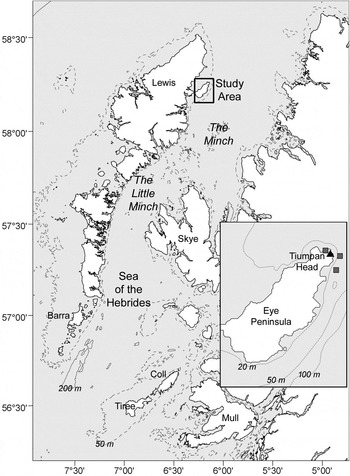
The regular occurrence of Risso's dolphins in the shallow coastal waters of the Minch (located between Lewis and mainland Scotland: Figure 1) has been well-documented (Evans et al., Reference Evans, Lewis, Parsons and Swann1993; Atkinson et al., Reference Atkinson, Gill and Evans1998; Weir et al., Reference Weir, Pollock, Cronin and Taylor2001; Reid et al., Reference Reid, Evans and Northridge2003; Dolman & Hodgins, Reference Dolman, Hodgins, Chen, Hartman, Simmonds, Wittich and Wright2013). This species was the focus of dedicated studies around the Eye Peninsula on Lewis during the 1990s (Atkinson et al., Reference Atkinson, Gill and Evans1998) and more recently since 2010 (this study). Worldwide the Risso's dolphin preferentially occurs over topography with steep-sloped bottoms near the outer edge of the continental shelf or upper slope (Jefferson et al., Reference Jefferson, Weir, Anderson, Ballance, Kenney and Kiszka2014), and its occurrence in nearshore shallow waters around Lewis is therefore less typical.
Location of the Eye Peninsula study area (north-east Lewis, UK) and places mentioned in the text. The inset shows the location of the shore-based study site from which four sightings were recorded (black triangle) and the locations of three boat-based sightings (grey squares) (see Table 1).

Risso's and bottlenose dolphins are seen throughout the Hebrides, but bottlenose dolphins are more commonly recorded from The Little Minch southwards (particularly around Mull, Coll, Tiree, and Barra) while the Risso's dolphin is more frequently observed in The Minch and along the Atlantic seaboard (HWDT, 2014). Studies in the area in the 1990s never observed bottlenose dolphins around the Eye Peninsula (Alison Gill, personal communication). However, recent survey effort (between 2010 and 2013) in the same area has recorded bottlenose dolphins in 2011 and 2012, including some mixed-species associations with the Risso's dolphin (WDC, unpublished data).
The occurrence of mixed-species associations in sympatric cetacean species provides opportunities for interspecific sexual interaction and the potential for hybridization (Bérubé, Reference Bérubé, Perrin, Würsig and Thewissen2009). Although infrequently observed, hybrids between various odontocete species have been recorded, both in the wild and in captivity (Sylvestre & Tasaka, Reference Sylvestre and Tasaka1985; Reyes, Reference Reyes1996; Herzing & Johnson, Reference Herzing and Johnson1997; Karczmarski, Reference Karczmarski, Thornton and Cockcroft1997; Herzing et al., 2003; Bérubé, Reference Bérubé, Perrin, Würsig and Thewissen2009). Suspected wild cetacean hybrids are typically observed without prior knowledge of parental interactions. Therefore their detection and identification in the field is problematic and the number of documented incidences in the wild to date is limited (for a review, see Bérubé, Reference Bérubé, Perrin, Würsig and Thewissen2009). Collecting genetic evidence to verify the occurrence of live wild hybrid dolphins is logistically difficult, and has associated welfare considerations (biopsying wild cetaceans is intrusive and potentially risky; e.g. Bearzi, Reference Bearzi2000). However, morphological analyses of captive-born hybrid dolphins indicate that the offspring consistently exhibit intermediate characteristics of both parent species (Sylvestre & Tasaka, Reference Sylvestre and Tasaka1985; Zornetzer & Duffield, Reference Zornetzer and Duffield2003). Consequently, the occurrence of individuals exhibiting intermediate morphological characteristics in the field may represent a valid method of identifying wild-born hybrids.
This paper describes three ‘atypical’ dolphins with mixed morphological characteristics that were photographed in 2011 and 2012 during cetacean fieldwork off Lewis, north-west Scotland. We provide evidence to suggest that these individuals may be the result of hybridism between wild Risso's and bottlenose dolphins.
MATERIALS AND METHODS
This fieldwork utilized a combination of land- and boat-based methods as briefly described below.
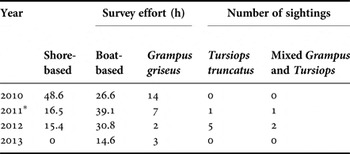
Land-based surveys were conducted from a fixed land-based site (approximately 50 m above sea level) at Tiumpan Head, on the Isle of Lewis (Figure 1). Data were collected using a standardized scan sampling protocol (Pierpoint et al., Reference Pierpoint, Baines and Earl1998), during which a single observer slowly scanned across a predefined sector of sea using 7 × 50 reticulated binoculars with built-in compass. Whenever cetaceans were sighted, standardized data were logged including species, group size, behaviour, distance from shore and direction of travel. A total of 80.4 h of land-based survey effort (sea state ≤3) was carried out between 2010 and 2012 (Table 1).
Survey effort (in sea state ≤3) and sightings of Risso's (Grampus griseus) and bottlenose (Tursiops truncatus) dolphins during field survey work at north-east Lewis between 2010 and 2013.

*, excludes one sighting comprising an atypical dolphin (ATD2) seen travelling with a dolphin of uncertain identity (IND4).
Vessel-based surveys were focused primarily on photo-identification methods, carried out under licence and therefore designed to maximize encounters with dolphins. Different vessels were used in each year. In 2010, the survey vessel was ‘MV Puffin’, approximately 5 m motor boat. In 2011, the survey vessel was ‘MV Fish n’ Trips', a 6 m motor boat and in 2012 a 6.5 m rigid inflatable boat (RIB) also named ‘MV Fish n’ Trips' was used.
The boat survey route depended on prevailing weather conditions and on whether sightings had been reported from land-based sites. Two observers searched continuously from the port and starboard sides respectively and the vessel position was continually recorded at 1 min intervals using a handheld Garmin GMAP 76CSx GPS. Whenever cetaceans were seen standardized data (including position, species, group size and behaviour) were logged and the boat was manoeuvred carefully towards the animals to attempt photo-identification. A total of 111.1 h of boat-based survey effort (sea state ≤3) was carried out between 2010 and 2013 (Table 1).
Photo-identification was attempted from both the shore site (when dolphins passed sufficiently close to the cliff) and from the boat. Photographs of dorsal fins and other body marks were taken using a Canon 7D digital SLR camera with a 100–400 mm lens. The photography and subsequent cataloguing of individual dolphins was carried out by a single person (the lead author), according to standard protocols (Würsig & Jefferson, Reference Würsig, Jefferson, Hammond, Mizroch and Donovan1990).
RESULTS
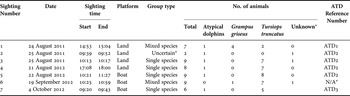
A total of 26 groups of Risso's dolphins, six groups of bottlenose dolphins and three mixed-species groups were recorded off north-east Lewis between 2010 and 2013 (Table 1). Three individual ‘atypical’ dolphins (ATD1–3) were photo-identified during 2011 and 2012 (Table 2), the only years in which bottlenose dolphins were recorded. All of the sightings of atypical animals occurred in close proximity to Tiumpan Head (Figure 1).
Details of seven sightings off north-east Lewis in which three atypical dolphins (ATD), consistent with the potential hybridization between free-ranging Risso's (Grampus griseus) and bottlenose (Tursiops truncatus) dolphins, were photographed at north-east Lewis between 2010 and 2013.

*, these records relate to a further individual (IND4) which was also suspected to be atypical.
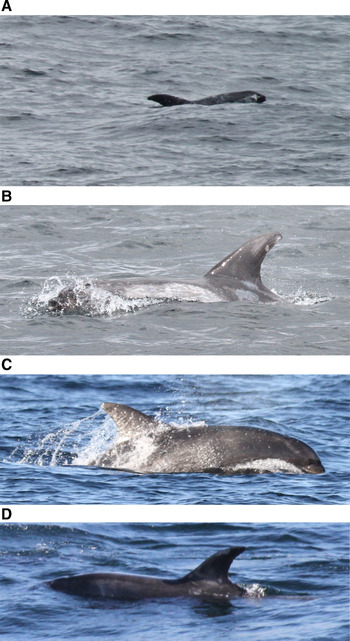
Two of the atypical dolphins were photographed on single occasions: ATD1 (Figure 2A) within a mixed-species school of Risso's and bottlenose dolphins in 2011 and ATD3 (Figure 2C) with five bottlenose dolphins during 2012. ATD2 (Figure 2B) was photographed in two sightings in 2011 and two sightings in 2012, once together with an animal of uncertain species (IND4 (Figure 2D): see below) and three times in association with schools of bottlenose dolphins (including one further occasion where IND4 was present) (Table 2).
(A) Photograph of atypical dolphin 1 (ATD1) photographed off north-east Lewis. ATD1 exhibits morphological characteristics consistent with hybridization between Risso's and bottlenose dolphins; (B) photograph of atypical dolphin 2 (ATD2) photographed off north-east Lewis. ATD2 exhibits morphological characteristics consistent with hybridization between Risso's and bottlenose dolphins; (C) photograph of atypical dolphin 3 (ATD3) photographed off north-east Lewis. ATD3 exhibits morphological characteristics consistent with hybridization between Risso's and bottlenose dolphins; (D) photograph of one suspected atypical dolphin (IND4) photographed off north-east Lewis.

One atypical dolphin was observed within a mixed-species school of Risso's and bottlenose dolphins. With the exception of sighting number two (uncertain group composition), the remaining sightings all involved atypical animals travelling within bottlenose-only schools (Table 2). Atypical dolphins were never recorded within a Risso's-only school.
The morphological characteristics of the three atypical dolphins are described below.
ATD1
This was immediately noted to be a particularly large animal, with an estimated body size approximately 50% larger than the accompanying bottlenose dolphins. The dorsal fin was prominent and very broad-based, being double the size of the bottlenose dolphins and slightly larger than the fins of the accompanying Risso's dolphins. The head shape was intermediate between Risso's and bottlenose dolphins, with a sloped forehead and a very short (cf. bottlenose) but defined rostrum (Figure 2A). Overall body coloration was a uniform dark grey with little scarring or white lesions/patches visible; however, the weather was overcast and details of body coloration were obscured. This animal was observed within a mixed-species school of bottlenose and Risso's dolphins (Table 2).
ATD2
This animal had similar (possibly slightly larger) body and dorsal fin size to a Risso's dolphin and was estimated to be approximately 25% larger than accompanying bottlenose dolphins. It was also Risso's-like in coloration, exhibiting a uniform grey base colour but with extensive white linear scarring and some white lesioning on the flanks (Figure 2B). Although body size, coloration and the broad dorsal fin were similar to a Risso's dolphin, the head comprised a rounded melon, distinct crease and well-defined short beak resembling the morphology of a bottlenose dolphin. Moreover, this animal was observed accompanying bottlenose dolphins on three occasions, two of which involved the presence of three mother/calf pairs, and IND4 on one occasion (Table 2), but was not observed with Risso's dolphins.
ATD3
This animal resembles a bottlenose dolphin in overall body size and appearance (coloration and dorsal fin shape). However, the head shape is atypical, with a more sloped and less-rounded melon than a bottlenose dolphin and a less distinct crease than usual (Figure 2C). The rostrum is particularly short when compared with a typical bottlenose dolphin.
IND4
In addition, a further individual (IND4) was photographed that was also suspected to be atypical (Figure 2D). This animal was observed twice in association with ATD2 and once in a mixed-species school of Risso's and bottlenose dolphins (Table 2). It had similar overall appearance to a bottlenose dolphin, with a uniform dark body colour and areas of lesioning. One poor-quality image also suggested the presence of a rounded melon and a short well-defined beak. However, it was noted to be 25% larger in body size than accompanying adult bottlenose dolphins and with a prominent large dorsal fin (Figure 2D). The species affiliation of this animal was uncertain.
DISCUSSION
Opportunities for hybridism
As noted by Bérubé (Reference Bérubé, Perrin, Würsig and Thewissen2009), cetacean hybrids are most common within genera where the different species have similar life histories and habitat requirements. Clearly, two species must overlap in habitat in order to provide opportunities for social interaction and mating. Additionally, opportunities for interspecific mating would be greatest amongst species that regularly form mixed-species associations. Risso's dolphins and bottlenose dolphins are two species which overlap in habitat in many geographical regions and are known to form mixed-species schools. The occurrence of mixed-species schools comprising these two species have been reported from areas as varied as California (Bearzi, Reference Bearzi2005), the Gulf of Mexico (Maze-Foley & Mullin, Reference Maze-Foley and Mullin2006), the west coast of Africa (Weir, Reference Weir2011) and the Indian Ocean (Ballance & Pitman, Reference Ballance and Pitman1998). However, most of those associations have been observed in offshore, deep waters rather than from the coastal neritic habitat documented in this paper. This is presumably because the Risso's dolphin is predominantly found in habitat seaward of the shelf edge in most of its geographical range (Jefferson et al., Reference Jefferson, Weir, Anderson, Ballance, Kenney and Kiszka2014). Nevertheless the species does occur in a wide range of habitats from the coast to deep oceanic waters, and the shelf waters along the Atlantic seaboard of Britain and Ireland are one notable geographical region where the species regularly inhabits relatively shallow, coastal waters (Reid et al., Reference Reid, Evans and Northridge2003). A mixed-species association between bottlenose and Risso's dolphins has been recorded in very shallow, nearshore habitat on at least one previous occasion (Jefferson et al., Reference Jefferson, Weir, Anderson, Ballance, Kenney and Kiszka2014). In this paper we report three mixed-species associations between the two species in the coastal waters off Lewis, including at least one in which an atypical individual was present. Collectively, these accounts indicate that the associations between these two species regularly occur throughout the world and in a wide range of habitats, and clearly provide opportunity for hybridism between the species.
HYBRIDISM BETWEEN RISSO'S AND BOTTLENOSE DOLPHINS
The atypical individuals described here are consistent with hybridism between free-ranging Risso's dolphins and bottlenose dolphins for three reasons: (1) the morphological characteristics of the three individuals appeared intermediate between those two species; (2) their occurrence within schools of one (or both) of those two species; and (3) the three observations of mixed-species schools of those two species within the study area. In particular, the pronounced, broad-based falcate dorsal fins seen on all three of the individuals were consistent with Risso's dolphin, while their short, defined beaks were consistent with (though shorter than) the bottlenose dolphin (however, the forehead in ATD1 was far more sloped than in a bottlenose dolphin). Given the absence of molecular data to confirm the genetic affiliation of these animals, we cannot be certain that these animals are hybrids between Risso's dolphins and bottlenose dolphins and cannot rule out that these are hybrids involving other sympatric species such as Lagenorhynchus or Globicephalus. However, other instances where hybrids have been initially described by morphological traits and then later confirmed by molecular analysis (e.g. Spilliaert et al., Reference Spilliaert, Vikingsson, Arnason, Palsdottir, Sigurjonsson and Arnason1991; Bérubé & Aguilar, Reference Bérubé and Aguilar1997) suggest that the identification of hybrids based on observed morphological features is reasonable.
This is not the first evidence for hybridism between wild Risso's dolphins and bottlenose dolphins in north-west Europe. On 31 May 1933 three dolphins stranded in Blacksod Bay, County Mayo in Ireland, and all showed intermediate morphological and skeletal characteristics relating to both the bottlenose dolphin and the Risso's dolphin (Fraser, Reference Fraser1940). Two had short well-defined beaks (6.4 and 8.9 cm respectively) and the third animal lacked a beak and had a strongly-sloped forehead (Fraser, Reference Fraser1940). This seems comparable in description to the short beaks photographed in ATD2 and ATD3, and the sloped forehead photographed in ATD1. Generally, the stranded animals described by Fraser (Reference Fraser1940) had rostrums that were shorter and wider, tooth counts lower, and craniums wider than found in the bottlenose dolphins, and he considered hybridism between Risso's and bottlenose dolphins to represent the most likely explanation. Despite the observations reported in this paper, no wild hybrids between the two species have been reported stranded to date in UK waters (Paul Jepson & Andrew Brownlow, personal communications).
Several confirmed incidences of hybridism between Risso's and bottlenose dolphins have been recorded in captivity (Sylvestre & Tasaka, Reference Sylvestre and Tasaka1985; Shimura et al., Reference Shimura, Numachi, Sezaki, Hirosaki, Watabe and Hashimoto1986). While we acknowledge that the circumstances of captivity produce behaviours that would not occur naturally in the wild, these records at least provide evidence that hybridism between the two species is possible and that such hybrids may reach maturity. Sylvestre & Tasaka (Reference Sylvestre and Tasaka1985) compiled 13 accounts of hybrids born to captive Risso's and bottlenose dolphins, all of which occurred at Enoshima Marineland in Japan. The offspring bore intermediate morphological traits between their two parental species, one individual having the colour of a bottlenose dolphin with a small and distinct rostrum, a dorsal fin shape that was the same as a Risso's dolphin, and a melon a little bit more predominant than in bottlenose dolphins (Sylvestre & Tasaka, Reference Sylvestre and Tasaka1985). None reached physical maturity. However, a hybrid dolphin born to a female bottlenose dolphin and a male Risso's dolphin at Minami Chita Beachland in Japan in 1993 (Cetabase, 2013) is still alive, indicating that these hybrids can live long enough to reach physical maturity. The morphological features described in these captive hybrids are very similar to those we describe here for wild atypical animals photographed off Lewis.
The functional explanations for the formation of mixed-species cetacean associations primarily comprise foraging advantages and predator avoidance, although there could be additional social and reproductive advantages (Stensland et al., Reference Stensland, Angerbjorn and Berggren2003). While interspecific mating could happen during relatively brief interactions between species, our observations of associations between bottlenose and Risso's dolphins around Lewis are suggestive of a more stable affiliation between the species. Predation (from sharks or killer whales, Orcinus orca, (Linnaeus, 1758)) is unlikely to be a primary driver for multi-species associations in Scottish waters, although killer whales are occasionally sighted in the study area (Nicola Hodgins, personal observation). Strandings evidence from stomach contents indicates that Risso's and bottlenose dolphins exhibit different prey preferences in Scottish waters. The octopus Eledone cirrhosa (Lamarck, 1798) comprised almost 90% of the total reconstructed prey weight of stranded Risso's dolphins (mostly from the north and west coasts) (Macleod et al., Reference Macleod, Santos, Burns, Brownlow and Pierce2013), while sampled bottlenose dolphins (mostly from the east coast) fed upon a variety of benthic and mid-water fish and some cephalopods (Santos et al., Reference Santos, Pierce, Reid, Patterson, Ross and Mente2001). Consequently, the functional explanation for this association remains unclear, and they may rather have some type of social basis as has been suggested for other odontocete species associations (e.g. Melillo et al., Reference Melillo, Dudzinski and Cornick2009). Whatever the driver may be, the existence of these associations provides opportunity for hybridism.
Hybrids originating in captive situations are most likely to be the result of lack of mate choice due to their artificial confinement. However, this is not always the case; a captive hybrid in Japan born to a female bottlenose dolphin and a male Risso's dolphin was apparently conceived even though a mature male bottlenose dolphin was present in the same pool at the time of the matings (Sylvestre & Tasaka, Reference Sylvestre and Tasaka1985). The driver for interspecific matings amongst wild cetacean species is even less clear, although such matings have been documented for a number of sympatric cetacean species (see Bérubé, Reference Bérubé, Perrin, Würsig and Thewissen2009). The context of these matings may be varied and not necessarily reproductive, with alternative explanations including ‘practice’ matings by immature animals to improve adult reproductive success and to diffuse aggressive tension between species (Melillo et al., Reference Melillo, Dudzinski and Cornick2009). Not all interspecific matings seem to lead to conception and hybridization. For example, matings between wild bottlenose and Atlantic spotted (Stenella frontalis, Cuvier, 1829) dolphins in the Bahamas are very frequent, and yet only a single possible hybrid has been reported (Herzing et al., Reference Herzing, Moewe and Brunnick2003). Nevertheless, the number of reported hybrids is likely to increase as advances in molecular analysis techniques and biopsy sampling are made. Indeed, DNA analysis is now providing evidence of hybridization events that occurred in the past. For example, recent evidence suggests that past hybridization between spinner (Stenella longirostris, Gray, 1828) and striped (S. coeruleoalba, Meyen, 1833) dolphins was of sufficient frequency to produce a new species, the Clymene dolphin (S. clymene, Gray, 1846) (Amarel et al, Reference Amaral, Lovewell, Amato and Rosenbaum2013).
The observations of three atypical dolphins off north-east Lewis are consistent with hybridization between free-ranging Risso's and bottlenose dolphins, the first such occurrence to be documented for these species in UK waters. The context and significance of these hybridization events is unknown. Since wild cetacean hybrids are rare, the occurrence of four atypical dolphins consistent with hybridism in one small geographical region is highly unusual. However, the three hybrid animals reported by Fraser (Reference Fraser1940) in Ireland indicate that this is not an altogether unprecedented scenario. If these individuals do indeed represent hybrids, it raises interesting questions regarding their fertility, lifespan and relatedness.
ACKNOWLEDGEMENTS
The financial support of WDC, DEFRA, BBC Wildlife Fund, Elite Couriers and David Henriques enabled this field project. The authors would like to thank Scottish Natural Heritage for granting WDC photo-id licences (Licence Numbers 10991 and 13371) and everyone who made the surveys possible, especially Lewis Mackenzie at Hebrides Fish n'Trips, Tim Atkinson and the SNH Stornoway office. The authors are also grateful for comments from three anonymous referees that helped improve this manuscript.