INTRODUCTION
One of the main goals of current marine ecology is to clarify the controlling factors that influence the distributional patterns of sessile organisms. These patterns vary over distance from a few metres to several kilometres (Menge et al., Reference Menge, Berlow, Blanchette, Navarrete and Yamada1994), depending on interrelationships between physical and biotic factors such as settlement rate, habitat selection, competition and predation (Menge & Sutherland, Reference Menge and Sutherland1976; Connell & Slatyer, Reference Connell and Slatyer1977; Lubchenco & Gaines, Reference Lubchenco and Gaines1981; Underwood & Denley, Reference Underwood, Denley and Strong1984; Osman et al., Reference Osman, Whitlatch and Zajac1989; Havenhand & Svane, Reference Havenhand and Svane1991; Osman & Whitlatch, Reference Osman and Whitlatch1995a; Fraschetti et al., Reference Fraschetti, Giangrande, Terlizzi and Boero2003).
Among these factors, the recruitment rate is of paramount importance and is spatially and temporally variable especially in relation to the availability of competent larvae transported to appropriate sites (Roughgarden et al., Reference Roughgarden, Gaines and Possingham1988; Carroll, Reference Carroll1996). Moreover, the dynamics of recruitment can be driven by the presence of resident adults in the community, most of which are filter feeders, influencing both pre- and post-settlement mortality (Jørgensen, Reference Jørgensen1966, Reference Jørgensen1975, Reference Jørgensen1989; Mann & Lazier, Reference Mann and Lazier1996; Fraschetti et al., Reference Fraschetti, Giangrande, Terlizzi and Boero2003). These processes have long been recognized as key components of succession theory (Connell & Slatyer, Reference Connell and Slatyer1977; Osman & Whitlatch, Reference Osman and Whitlatch1995a; Fraschetti et al., Reference Fraschetti, Terlizzi and Benedetti-Cecchi2005) and can determine the fate and the direction of community evolution (Sutherland, Reference Sutherland1996).
Fouling communities in confined areas are ideal targets to investigate these ecological processes as they consist of a small number of species compared to marine assemblages (Dean & Hurd, Reference Dean and Hurd1980; Sutherland & Karlson, Reference Sutherland and Karlson1987; Sutherland, Reference Sutherland1996; Railkin, Reference Railkin2004). Underwood & Andersen (Reference Underwood and Andersen1994) have suggested that solitary species traits, including recruitment strategies and ability to resist invasions, should be more carefully considered in models and mechanisms of succession in the marine environment.
Studies on the benthic fauna of the Taranto seas (Mar Grande, Mar Piccolo and Taranto Gulf) have underlined the presence of a rich filter feeder community, characterized by the dominance of bivalve molluscs (Parenzan, Reference Parenzan1969; Gherardi, Reference Gherardi and Cacucci1973; Gherardi & Lepore, Reference Gherardi and Lepore1974; Tursi et al., Reference Tursi, Pastore and Panetta1974a, Reference Tursi, Piscitelli, Gherardi and Matarrese1978, Reference Tursi, Matarrese, Scalera Liaci, Gherardi, Lepore, Sciscoli, Piscitelli and Chieppa1980; Panetta et al., Reference Panetta, Mastrototaro, Matarrese, Tanzarella and Dalessandro2004; Mastrototaro et al., Reference Mastrototaro, Giove, D'Onghia, Tursi, Matarrese and Gadaleta2008a), sponges (Scalera Liaci et al., Reference Scalera Liaci, Sciscioli and Fiordiponti1976; Pulitzer-Finali, Reference Pulitzer-Finali1983; Scalera Liaci & Corriero, Reference Scalera Liaci and Corriero1993; Longo et al., Reference Longo, Scalera Liaci, Manuel and Corriero2004), annelids (Gherardi et al., Reference Gherardi, Lepore and Sciscioli1993; Mastrototaro et al., Reference Mastrototaro, Giove, D'Onghia, Tursi, Matarrese and Gadaleta2008a), and ascidians (Tursi et al., Reference Tursi, Pastore and Panetta1974a, Reference Tursi, Gherardi and Leporeb, Reference Tursi, Gherardi, Lepore and Chieppa1976, Reference Tursi, Matarrese and Scalera Liaci1977, Reference Tursi, Matarrese, Sciscioli, Vaccarella and Chieppa1979; Matarrese et al., Reference Matarrese, Tursi, Scalera Liaci, Montanaro and Cecere1980; Mastrototaro et al., Reference Mastrototaro, Giove, D'Onghia, Tursi, Matarrese and Gadaleta2008a, Reference Mastrototaro, D'Onghia and Tursib). Among them, Mytilus galloprovincialis Lamarck (Mollusca: Bivalvia) and Sabella spallanzanii Gmelin (Polychaeta: Sabellida) are among the most represented. The former is one of the most abundant species in the basins, due to the presence of a widespread natural population and a huge mussel farm, producing 40,000 tons of mussels y−1 (Prioli, Reference Prioli2004). Sabella spallanzanii is widespread on hard substrates, mostly represented by artificial structures, such as those of the mussel farms (Giangrande et al., Reference Giangrande, Gicciano, Paggiara and Gambi2000; Giangrande et al., Reference Giangrande, Cavallo, Licciano, Mola, Pierri and Trianni2005).
Over the decades the Taranto seas have been subjected to a significant depletion in water quality (Cardellicchio et al., Reference Cardellicchio, Annicchiarico, Leone, Marra, Paterno, Piraino and Ragone1991, Reference Cardellicchio, Buccolieri, Di Leo, Giandomenico and Spada2008). In particular, in the Mar Piccolo of Taranto the dystrophic events responsible for widespread mortality crises have become more frequent (Caroppo et al., Reference Caroppo, Cardellicchio and Cavallo1994).
Although fouling communities have been well investigated in the Mediterranean Sea, most of these papers focus on their negative impact on submerged structures (e.g. Relini, Reference Relini, Gambi and Dappiano2003). The fouling communities of the Taranto seas have been previously investigated by several authors (e.g. Gherardi & Lepore, Reference Gherardi and Lepore1974; Tursi et al., Reference Tursi, Piscitelli, Gherardi and Matarrese1978, Reference Tursi, Matarrese and Montanaro1984a, b, Reference Tursi, Matarrese, Costantino, Pollicoro and Cecere1990; Cecere et al., Reference Cecere, Cormaci, Furnari, Tursi and Caciorgna1991). Most of the available papers on this area concern descriptive analysis of the community and few of them focus on ecological successions and structural analysis (e.g. Tursi et al., Reference Tursi, Matarrese and Montanaro1984a, Reference Tursi, Matarrese, Scalera Liaci, Montanaro and Cecereb). For this paper, the recruitment and succession of fouling organisms were examined in three different sites in the Mar Piccolo of Taranto (Ionian Sea), with the aim of identifying differences at the medium–small spatial scale in community structure.
MATERIALS AND METHODS
Study area and data collection
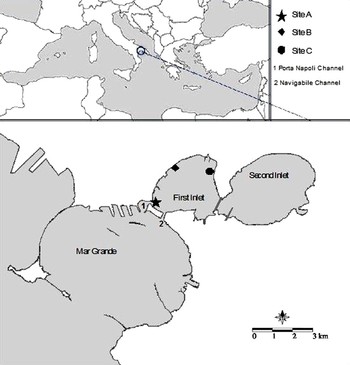
The experiments were carried out in the Mar Piccolo of Taranto (Figure 1), an ‘internal sea’ made up of two elliptical basins called the First Inlet and the Second Inlet connected by a narrow channel called ‘Punta Penna’. The Mar Piccolo has a total surface area of about 20 km2, with a maximum depth of about 15 m in the First Inlet and about 10 m in the Second Inlet. The Mar Piccolo is connected to the Mar Grande (belonging to the Ionian Sea) by two narrow channels, the Navigabile and the Porta Napoli. The mean water temperature shows a typical seasonal trend ranging from 8.6 to 26.22°C (Mastrototaro et al., Reference Mastrototaro, D'Onghia and Tursi2008b). The mean salinity of the basin is 36.5 psu. While in the Mar Grande there are only minor variations in salinity between summer and winter, in the Mar Piccolo these differences are more pronounced ranging between 35 and 38 psu (Alabisio et al., Reference Alabisio, Cannaliere, Ghionda, Milillo, Leone and Caciorgna1997; Mastrototaro et al., Reference Mastrototaro, D'Onghia and Tursi2008b). From a hydrographical point of view, the two inlets of the Mar Piccolo have been considered as two different ecosystems influencing each other (Vatova, Reference Vatova1972). From a pedological point of view most of the bottoms in the Mar Piccolo of Taranto are covered with sludge and mud (Matarrese et al., Reference Matarrese, Mastrototaro, D'Onghia, Maiorano and Tursi2004), natural hard substrates are extremely rare and confined to a small area within the First Inlet. Most of the available substrates for benthic communities are represented by artificial structures either floating or fixed to the bottom.
Map of the investigated area with the location of the three different sites.

Inside the First Inlet of the Mar Piccolo three sites were investigated, randomly selected among many with almost the same depth and substrate type. Site A was located in a tourist port near a connection channel between the Mar Piccolo and Mar Grande; Sites B and C were placed near two mussel farms along the coast of the First Inlet (Figure 1).
Replicate square collectors (50 × 50 cm) were made with 1-cm mesh PVC nets, supported by plastic-covered iron wire to avoid collapse of the structures due to the weight of fouling. Polyvinyl chloride was selected as the substratum for the present study due to its strength and resistance to harsh conditions (weight of fouling and current). The structures were then closed to form a cylindrical shape, in order to reduce the effect of the prevailing current. The settlement pattern of foulers was studied by suspending these cylindrical panels at a depth of 3 m, bound to ropes fixed to poles vertically inserted into the sea bottom.
A total of 27 panels (9 in each site) were positioned in December 2003. Starting from May 2004 three panels were collected by SCUBA divers bi-monthly (T1 = May 2004, T2 = July 2004, T3 = September 2004) from each site (A, B & C) and shipped to the laboratory without preservatives, where the tubular structures were opened. To avoid errors due to their different exposure, only the external surfaces were analysed, moreover, to ensure the independence of data the panels were used only once.
Taxonomic and coverage analysis
In the laboratory, the collectors were placed in trays containing seawater and analysed for taxonomical identification through direct observation. The density of fouling was evaluated as coverage percentage, according to Dethier et al. (Reference Dethier, Graham, Cohen and Tear1993), using a reference mask placed over the sample. A 40 × 40 cm mask divided into 25 squares, each single square having a value of 4% of the total surface, was used. The smaller size of the mask made it possible to exclude the edges of the panels and avoid confusion with a possible margin effect. All the organisms were analysed as relative cover in each single square, without distinction between colonial and solitary ones.
Where organisms grow on each other, it is easy to obtain coverage values exceeding 100%. For this reason we chose to ideally compress all the layers, so estimating the coverage through vision from above. This excludes portions of the level below the overgrowing species and above ensures values do not exceed 100% coverage. When possible, organisms were identified at species level, sometimes at genus or higher taxonomic units. For the estimates of diversity the number of taxa and the Shannon index were evaluated.
Statistical analysis
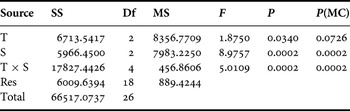
The experimental design consisted of two factors: Time (T = three levels, crossed and fixed) and Site (S = three levels, crossed and random), with N = 3. Samples were analysed for number of species, percentage coverage, Shannon index, and similarity. Before analysis, the data were tested using Cochran's C-test for homogeneity of variance and appropriately transformed when necessary (Underwood, Reference Underwood1997). Differences in coverage, number of taxa, and Shannon index, were tested by analysis of variance (ANOVA) using GMAV 5 software (University of Sydney). When interaction between main effects was significant (P < 0.05), data were analysed by a posteriori test. Data were expressed as means of experimental values and standard error (SE) was associated.
To identify the percentage contribution of each taxon to the observed value of the Bray–Curtis dissimilarity, the similarity percentage procedure (PRIMER SIMPER routine) was used. According to the repetitiveness level of some species within sites, a cut-off criterion was applied to allow the identification of a subset of species whose cumulative percentage contribution reached 90% of the dissimilarity value.
Differences between the community structures within a site were tested by permutational multivariate analysis of variance (PERMANOVA). Analysis was conducted on Bray–Curtis dissimilarities, based on untransformed data. Graphical representations of multivariate patterns of species assemblage were obtained by non-metric multi-dimensional scaling (nMDS) ordination of replicates of each site. Centroids were not used and nMDS plots were based on Bray–Curtis dissimilarities. Each term was tested using 4999 random permutations (Anderson, Reference Anderson2001; Anderson & ter Braak, Reference Anderson and ter Braak2003).
RESULTS
Taxonomy, coverage and diversity
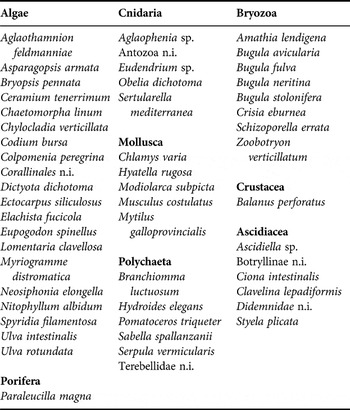
A total of fifty-two taxa was identified, mainly at species level (Table 1). Algae were the most represented with 20 taxa identified, Porifera and Crustacea were least represented with only one species. Cnidaria, Mollusca, Polychaeta, Bryozoa and Ascidiacea were represented by 5–8 taxa. Most of the recorded species were characteristic of fouling communities such as Mytilus galloprovincialis, Sabella spallanzanii, Hydroides elegans, and Schizoporella errata.
List of the recorded taxa on the fouled panels in all the sites and sampling times.

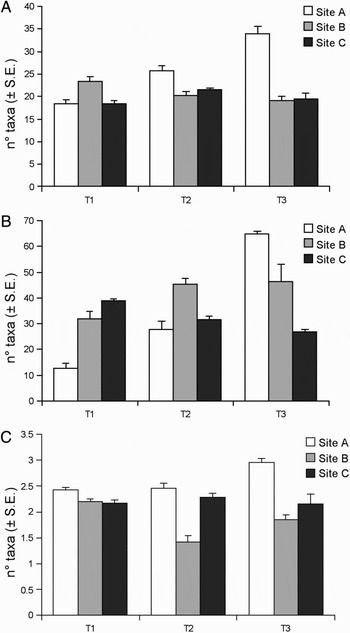
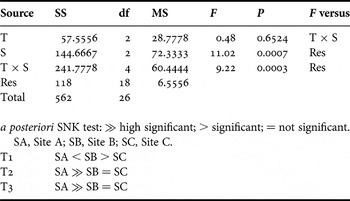
Considering the number of identified taxa (Figure 2A), Site A (near the connecting channel) showed a steady increase throughout the entire period of observation. The highest number of identified taxa in the experiment was recorded at this site at T3 (Figure 2A). By contrast the highest value at T1 was recorded at Site B. This site showed a moderate decrease at T2 holding steady to the end. Site C showed a value similar to Site A at T1 but this remained constant up to T3 (Table 2).
Plots of the tested parameters: (a) temporal trend of number of recorded taxa; (b) variations in covering percentage; (c) Shannon index variation among sites. Data are expressed as average values and ±SE is associated.

Experimental design and results of ANOVA test on number of taxa on factor Site. The a posteriori SNK test on Time factor is shown at the end of the table. Transform: None; Cochran's test C = 0.2768 (not significant).

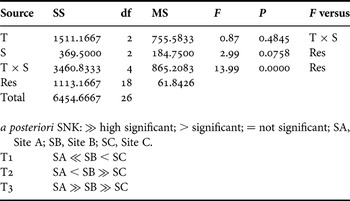
Regarding total coverage, Site A showed the lowest recorded value at T1. Starting from T2, it began to grow almost exponentially, reaching at the last observation, values equal to more than double the other two sites, close to 70% of total coverage (Figure 2B). Site B almost always showed intermediate values between Sites A and C, except for T2 when it showed the highest value recorded at this time. Site C showed the highest initial values, followed by a slight decrease on reaching T3 the lowest value registered at this time, as confirmed in the results of the a posteriori SNK test reported in Table 3.
Experimental design and results of ANOVA test on percentage coverage on Site factor. The a posteriori SNK test on Time factor is shown at the end of the table. Transform: None; Cochran's test C = 0.7601 (not significant).

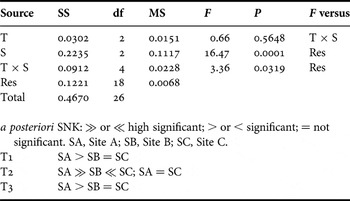
With respect to the Shannon index, Site A showed the highest value of diversity among sites and times (Figure 2C). Site B showed higher value at T1 and a discontinuous trend in the other sampling periods. Site C always showed moderately high values which remained constant throughout the period of observation. The higher diversity of Site A was confirmed by the statistical analysis a posteriori SNK test (Table 4).
Experimental design and results from ANOVA test on Shannon index values on Site factor. The a posteriori SNK test on factor Time is shown at the end of the table. Transform: None; Cochran's test C = 0.4677 (not significant).

SIMPER analysis
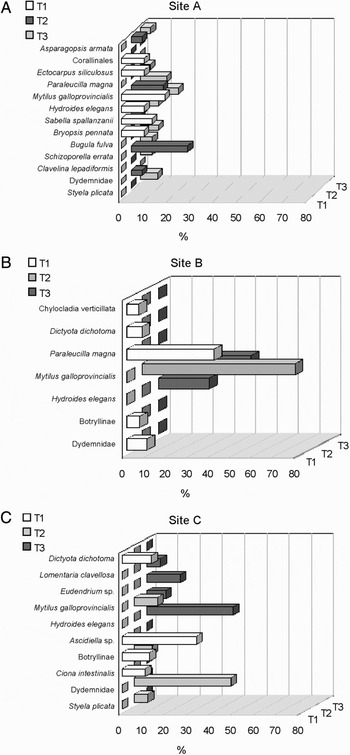
Data on coverage assessment, compared with SIMPER analysis, are shown in Figure 3. The 90%-cut-off criterion for cumulative percentage, according to the high similarity level between species within sites, was further reduced to 70% within the plot.
The SIMPER analysis showing the differences in specific composition of structural species between sampling times: T1, May 2004; T2, July 2004; T3, September 2004 at the three Sites A, B and C. The cut-off within the plots was reduced to 70% of total coverage to highlight the presence of structural taxa.

Site A reached the cut-off limit of 70% with 13 taxa (Figure 3), the highest value recorded amongst all sites. Among these taxa, many molluscs and polychaetes were exclusive to this site or more abundant here, represented by some permanent species characterizing the communities, such as Mytilus galloprovincialis and Sabella spallanzanii. These species, along with the polychaete Hydroides elegans and the sponge Paraleucilla magna, made a strong cumulative contribution towards differences between the three sites, often accounting for more than 50% of the observed value of dissimilarity. Among the representative species, H. elegans was found at Site A from the beginning of the experiment with a peak of abundance in the last period while it appeared at the other two sites only at the end (T3). Paraleucilla magna had a structural role in this site at T3. Other species, mostly algae, were instead present mainly at T1 decreasing or disappearing at T2 and T3. The bryozoan Bugula fulva, the ascidians Clavelina lepadiformis and Styela plicata, and the hydroid Eudendrium sp., occurred secondarily.
Seven taxa characterized Site B and the sole red algae Chylocladia verticillata is exclusive. Paraleucilla magna had a structural role in Site B at T1 where it occurred together with algae and ascidians, but disappeared at T2 which had a community ruled mainly by M. galloprovincialis, together with a strong presence of H. elegans often overgrowing the blue-mussel shells (Figure 3).
Lastly, Site C showed, as a whole, an intermediate structural diversity between Sites A and B (Figure 3). It was dominated by ascidians especially during the first two sampling times, replaced in the last period mainly by the serpulid H. elegans and the hydroid Eudendrium sp. The only structuring algal species among the pioneer taxa was Dictyota dichotoma (Figure 3).
Paraleucilla magna had a structural role in Site A at T3, in Site B at T1 and was never present at Site C.
Hydroides elegans was found at Site A from the beginning of the experiment with a peak of abundance in the last period while it appeared at the other two sites only at the end (T3).
Mytilus galloprovincialis was well represented in all the investigated areas, reaching the highest density at Site B, while S. spallanzanii was observed to be a structural species only at Site A.
Structural analysis
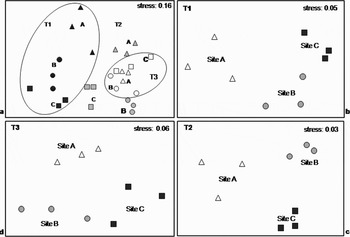
The structure of fouling assemblages significantly differed between the three sites, as portrayed in the nMDS ordination (Figure 4). This was obtained by plotting all the replicates for each site and not the related centroids, according to the high similarity levels between replicates. Results obtained by the analysis of the variables represented within the plot were obtained on the basis of the Bray–Curtis dissimilarity and the related statistical test is shown in Table 5. From a temporal point of view (Figure 4a), the three periods of observation are well represented and while samples of Sites A and C were regularly distributed, Site B samples at T2 and T3 showed a similar pattern. The ordination models referred to the subset of data related to the factor time (Figure 4b–d) indicate rather high differences between sites, which persist over time.
The nMDS plot showing differences on fouling assemblages, (a) between sites at the three sampling times (T1, May 2004; T2, July 2004; T3, September 2004); (b) on T1 subset of data; (c) on T2 subset of data; and (d) on T3 subset of data. Each point represents the single (no centroids) replicate assemblage based on the Bray–Curtis dissimilarities on untransformed data.

Multivariate analysis of the variables on the basis of the Bray–Curtis dissimilarity matrix on untransformed data set. Number of permutations used = 4999.

DISCUSSION AND CONCLUSIONS
In the First Inlet of Mar Piccolo of Taranto there are distinct fouling communities structurally different at the large–medium spatial scale. This could be due to both internal ecological and physical features of the inlet as well as to external interference. In fact, the three investigated sites of the inlet differ largely from each other in type and number of species, population density and structural homogeneity.
Similarity percentage analysis (SIMPER) showed a stable set of species for each site over time. Mytilus galloprovincialis is widespread and constantly present, reaching the maximum density in Site B. Sabella spallanzanii characterizes Site A, and ascidians are present especially in Site C. By contrast, variability at a smaller scale within each site (replicates) appeared less marked, both in space and time.
Differences between sites are maintained over time with a difference in community structure even if there is a tendency towards a higher similarity in species composition. This tendency to similarity was well described in previous experiments carried out in the same area (Tursi et al., Reference Tursi, Matarrese and Montanaro1984a, Reference Tursi, Matarrese, Scalera Liaci, Montanaro and Cecereb). Multivariate analysis confirmed this trend, but it was less clear in Site B, where, after T2, a different evolution of community structure seems to be present probably due to a drastic change in species composition with the sharp dominance of Mytilus galloprovincialis. However, Site A shows a less scattered distribution over time, even though there is a more marked spatial separation of the replicates during the first sampling period. The changes of trajectories between sites were observed during the summer period when the Mar Piccolo of Taranto undergoes anoxic crisis, particularly strong in the more confined areas. During the summertime the reduction of winds and the diminished input of inland freshwater reduce the hydrodynamic circulation, with a marked water stratification and reduced oxygen supply on the bottom (Caroppo & Cardellicchio, Reference Caroppo and Cardelicchio1995). During the period of observation, an exceptionally high water temperature was recorded (G. Portacci, unpublished data) that, coupled with the conformation of the basin, negatively influenced most polychaetes with the exception of Hydroides elegans. This species was present at all sites in the last period even if it was more abundant in Site B, most likely linked to the high density of M. galloprovincialis.
Site A proved to be quite different from the other two inner sites, also showing higher diversity, initial covering values, and temporal stability in species composition. The recruitment of S. spallanzanii was higher in this site where the species remained one of the more abundant throughout the observation period.
Differences between sites could be linked to difference in recruitment rate of species at the starting time, probably influenced by different hydrodynamic features present in the three sites, and acting especially on larval transport, accumulation, and habitat selection. However, some post-settlement events must also be taken into consideration. For instance, although M. galloprovincialis is widespread in the whole area and its larvae are transported everywhere, it seems to have higher post-recruitment success in areas where interspecific competition is lower. This is the case of Site B characterized by a low number of taxa. By contrast its density is kept low in areas where more species colonize the substratum and probably biotic factors become more important (Site A). However, its density is also low in Site C characterized by a low number of taxa and in this case it can be hypothesized that this is due to low larval supply. Site C is in a zone characterized by low hydrodynamics (Scroccaro et al., Reference Scroccaro, Matarrese and Umgiesser2004) to which ascidians seem to be better adapted. Hydrodynamics could also explain the absence of S. spallanzanii in this site (linked to the high sedimentation rate) and its abundance in Site A characterized by higher water movement and higher larval supply.
More marked temporal trends in number of species and percentage cover were present in the two internal sites, with M. galloprovincialis very abundant at Site B, especially from the second sampling time and remained the most abundant taxon until the end of the study. After its appearance, a decrease in number of species was observed. This can indicate a negative effect of this species on the rest of the community. The phenomenon of monopolization of the substrate by this species is well known and was first pointed out in the pioneering work of Paine (Reference Paine1966), leading us to hypothesize that in the studied environment, as generally occurs in physically controlled habitats, predation is not a key factor (Bertness & Callaway, Reference Bertness and Callaway1994) and that M. galloprovincialis becomes competitively dominant at high recruitment rates.
Finally, differences in community dynamics can also be due to different succession mechanisms induced by resident species. As already mentioned, M. galloprovincialis, S. spallanzanii and ascidians are the most abundant large sized organisms in the area. These taxa can monopolize the substrate but at the same time can act as structuring taxa, sensu Hacker & Gaines (Reference Hacker and Gaines1997), creating secondary substrate and modifying the habitat. In particular, S. spallanzanii with its tube perpendicular to the substrate can generate a canopy effect, acting as a physical and a biological barrier. This species has been proved to play a key role in the evolution of the community, affecting recruitment and larval abundance of sessile invertebrates (Holloway & Keough, Reference Holloway and Keough2002a, Reference Holloway and Keoughb).
Further experimental studies are in progress to determine the influence on community evolution due to the peculiar features of S. spallanzanii.
Ascidians also seem to be able to influence the larval settlement when there are resident adults in the community, in relation to predation on the larvae of some taxa and the facilitation of others (Andrè et al., Reference Andrè, Jonsson and Lindegarth1993; Osman & Whitlatch, Reference Osman and Whitlatch1995b).
Among the collected species it is interesting to underline the occurrence of Paraleucilla magna, a calcareous sponge recently described along the Brazilian coast (Klautau et al., Reference Klautau, Monteiro and Borojevic2004) and reported for the Mediterranean Sea by Longo et al. (Reference Longo, Scalera Liaci, Manuel and Corriero2004, Reference Longo, Mastrototaro and Corriero2007). The sponge plays a structural role within the studied fouling community. In particular, P. magna characterizes the last period of observations at Site A, while it acts as a pioneer species at Site B, suddenly replaced by M. galloprovincialis. In both cases, this recently introduced species, seems to be able to interfere with the pattern of colonization of indigenous species. The occurrence of P. magna on panels of different periods led us to consider its recruitment to be extremely variable in time and space. Styela plicata and Didemnidae showed the same tendency. These species were seen to settle independent of seasonal factors. The presence of a stock of species with these features is described from several authors in the same area (Tursi et al., Reference Tursi, Matarrese, Scalera Liaci, Montanaro and Cecere1984b) and in other areas (Relini & Ravano, Reference Relini and Ravano1971; Chimenz-Russo & Taramelli, Reference Chimenz-Russo and Taramelli1973).
The presence of an alien species (P. magna) in a stock along with other indigenous species is not surprising in the area. The Taranto seas are continuously subjected to alien species introduction, mainly due to the presence of one of the most important commercial and military harbours in the Mediterranean, as well as numerous mussel farms and industries. Several alien species have been recorded within these basins in the last ten years (e.g. Mastrototaro et al., Reference Mastrototaro, Matarrese and D'Onghia2003, Reference Mastrototaro, Petrocelli, Cecere and Matarrese2004; Brunetti & Mastrototaro, Reference Brunetti and Mastrototaro2004; Mastrototaro & Dappiano, Reference Mastrototaro and Dappiano2005; Mastrototaro & Brunetti, Reference Mastrototaro and Brunetti2006; Longo et al., Reference Longo, Mastrototaro and Corriero2007; Lorenti et al., Reference Lorenti, Dappiano and Gambi2008), underlining how the physical–chemical alterations of the inlet probably play a leading role in controlling community structure. Whereas the arrival of alien species in the harbours is almost constant, and considering that most invasions fail, the possibility that alien species may prevail over indigenous ones is very low. This possibility becomes likely when the environment is so disturbed (mainly due to anthropogenic factors) that it is removed from the optimal range for the indigenous species. Byers (Reference Byers2002) called this phenomenon Selection Regime Modification (SRM) and considering that harbours are most affected by the presence of alien species, they may be considered storage tanks and starting points for possible invasions. In this sense, artificial structures in disturbed environments can provide a suitable habitat for non indigenous species and can function as corridors for their expansion (Bulleri & Airoldi, Reference Bulleri and Airoldi2005).
ACKNOWLEDGEMENTS
This paper was realized within a wider project supported by a Regional fund, on the possibility of co-culturing Sabella spallanzanii within Mytilus galloprovincialis farms, to avoid or reduce environmental impact of mussel farming (bioremediation), and to increase the biomass production in a completely unfed culturing system.
The authors wish to thank: Giuseppe Portacci (CNR IAMC Taranto) for his help during field operations, Antonio Terlizzi for useful help in statistical analysis, Antonella Petrocelli for the classification of algae, and the staff of Tourist Port Sant'Eligio (Taranto) for their cooperation during sampling.