Introduction
Extant research on posttraumatic stress disorder (PTSD) in older adults has primarily focused on the prevalence (e.g. Kessler et al., Reference Kessler, Berglund, Demler, Jin, Merikangas and Walters2005, Pietrzak et al., Reference Pietrzak, Goldstein, Southwick and Grant2012), and the course and severity of PTSD (e.g. Solomon and Mikulincer, Reference Solomon and Mikulincer2006; Yehuda et al., Reference Yehuda2009). This work has revealed that PTSD is a prevalent disorder in older adults, with notable differences in symptom profiles, as well as symptom course over time, compared to younger persons (Böttche et al., Reference Böttche, Kuwert and Knaevelsrud2012). For example, while some studies of the longitudinal course of PTSD in older adults have observed a decline in PTSD severity over time (e.g. Yehuda et al., Reference Yehuda2009), others have documented a delayed onset or a gradual increase of symptoms over time was examined in subgroups of older adults with early-life trauma (e.g. Solomon and Mikulincer, Reference Solomon and Mikulincer2006). While this work has helped characterize the prevalence and burden of PTSD in older adults, little is known about common clinical manifestations of this disorder, which can vary with respect to the heterogeneous symptom clusters that characterize this disorder.
Several dimensional models of PTSD exist. The 3-factor DSM-IV and ICD-10 models consist of intrusion, avoidance and hyperarousal symptom clusters (APA, 2000; WHO, 1992). However, many studies found that this 3-factor structure failed to fit the observed data adequately (e.g. Naifeh et al., Reference Naifeh, Elhai, Kashdan and Grubaugh2008; Elhai et al., Reference Elhai, Ford, Ruggiero and Frueh2009). A 4-factor numbing model proposed by King and colleagues (Reference King, Leskin, Kind and Weathers1998), which separates the avoidance cluster into two distinct factors (avoidance and emotional numbing) (e.g. Asmundson et al., Reference Asmundson, Stapleton and Taylor2004; Palmieri et al., Reference Palmieri, Marshall and Schell2007; Naifeh et al., Reference Naifeh, Elhai, Kashdan and Grubaugh2008, Naifeh et al., Reference Naifeh, Richardson, Del Ben and Elhai2010) has been found to provide a better dimensional representation of these symptoms. Informed by these findings, DSM-5 criteria for PTSD (APA, 2013) now include four PTSD symptom clusters; Criterion B - intrusion, Criterion C – avoidance, Criterion D – negative alterations in cognitions and mood, and Criterion E – alterations in arousal and reactivity.
To date, only two studies have evaluated the dimensional structure of PTSD in older adults (Schinka et al., Reference Schinka, Brown, Borenstein and Mortimer2007; Pietrzak et al., Reference Pietrzak, Goldstein, Southwick and Grant2012). In one study of 134 older adults who survived the 2004 Florida hurricanes, the four-factor numbing model (intrusion, avoidance, numbing and hyperarousal) provided the best fit of nine tested models (Schinka et al., Reference Schinka, Brown, Borenstein and Mortimer2007). More recently, a study of 206 older adults affected by Hurricane Ike found that the four-factor numbing model provided a better data fit than the DSM-IV model and equally well as a more refined 5-factor model (Pietrzak et al., Reference Pietrzak, Goldstein, Southwick and Grant2012). However, there was some support for a five-factor model (i.e. splitting avoidance and hyperarousal into two factors, respectively: intrusion, avoidance, numbing, dysphoric arousal, anxious arousal) fitting the data better, although the χ2-difference test did not indicate a significant difference between these two models.
In addition to evaluating the dimensional structure of PTSD, there is increasing interest in identifying predominant typologies or subgroups of individuals with PTSD, which provide insight into qualitatively distinct clinical presentations of this disorder. However, only a few studies to date have examined predominant symptom profiles (i.e. latent classes) of PTSD and all have focused on adolescent and middle-aged adult samples (e.g. Naifeh et al., Reference Naifeh, Richardson, Del Ben and Elhai2010; Ayer et al., Reference Ayer, Danielson, Amstadter, Ruggiero, Saunders and Kilpatrick2011; Steenkamp et al., Reference Steenkamp, Nickerson, Maguen, Dickstein, Nash and Litz2012; Pietrzak et al., Reference Pietrzak, el-Gabalawa, Tsai, Sareen, Neumeister and Southwick2014). The studies have revealed three distinct classes of PTSD symptom severity (no, intermediate and pervasive disturbance with respect to each PTSD symptom) in community samples of young and middle-aged adults (Breslau et al., Reference Breslau, Reboussin, Anthony and Storr2005), adolescents (Ayer et al., Reference Ayer, Danielson, Amstadter, Ruggiero, Saunders and Kilpatrick2011), as well as in a national sample of early adulthood veterans (Steenkamp et al., Reference Steenkamp, Nickerson, Maguen, Dickstein, Nash and Litz2012). In a general adult clinical sample of veterans, Naifeh and colleagues (Reference Naifeh, Richardson, Del Ben and Elhai2010) found two distinct classes of severity (intermediate and pervasive disturbance). These studies suggested that PTSD may have heterogeneous clinical manifestations in trauma-exposed samples with regard to distinguishable symptom severity classes (no disturbance: participants exhibit little distress, intermediate disturbance: participants exhibit moderate distress and pervasive disturbance: participants endorsed most PTSD symptoms). To date, however, no study has evaluated predominant typologies of PTSD specifically in older adults. PTSD in older adults has been found to differ with respect to severity of symptoms (Chopra et al., Reference Chopra2014), and even subsyndromal levels of PTSD symptoms have been linked to elevated rates of psychiatric comorbidity (Pietrzak et al., Reference Pietrzak, Goldstein, Southwick and Grant2012). Thus, characterization of predominant typologies of PTSD symptoms in older adults can provide an understanding of predominant patterns of PTSD symptom expression that are specific to this population.
We had three objectives of this study: (1) evaluate predominant typologies of PTSD in a sample of treatment-seeking older adults, (2) examine demographic and trauma-related factors associated with these typologies; and (3) evaluate how the typologies relate to comorbid symptoms of anxiety, depression, and somatization in this age-specific cohort. Based on the results of Naifeh et al., (Reference Naifeh, Richardson, Del Ben and Elhai2010), we hypothesized that the manifestation of PTSD symptoms in this age cohort would be best represented by two classes of disturbance (intermediate and pervasive). Findings in older adults with early-life traumatization indicate an increase of avoidance symptoms in the long-term course (e.g. Trappler et al., Reference Trappler, Braunstein, Moskowitz and Friedman2002; Yehuda et al., Reference Yehuda2009) and therefore, represent a delayed onset PTSD (Andrews et al., Reference Andrews, Brewin, Philpott and Stewart2007). Based on these findings, we further hypothesized that the pervasive disturbance group would be best characterized by a higher level of avoidance symptoms.
Methods
Participants
Recruitment occurred between May 2008 and February 2013 and was conducted through public advertisements (e.g. radio, newspaper, websites). Participants were treatment-seeking older adults with a history of childhood war-related traumatization during or in the aftermath of World War II (i.e. until 1946/47). To be included in this study, participants had to: 1) have experienced a war-related traumatic event as a child or adolescent during WW II that met Criterion A for PTSD as specified in DSM-IV; 2) indicate this trauma as the event which troubled them the most in the last month; and 3) were able to understand German language.
Initial contact with participants was either via Internet or telephone. All potential participants were invited to fill out a password-protected, internet-based questionnaire. Those who did not have access to the Internet received a paper version of the questionnaire. In total, 333 participants were assessed and 164 participants were found to be eligible for the study. The Ethical Committee of the University of Greifswald, Germany approved the study and all participants provided informed consent.
Assessments
Sociodemographic data (e.g. age, gender, education), as well as sample-specific characteristics (e.g. number of traumatic events) were collected. The amount of disclosure concerning the war-related trauma that troubled them the most in the last month was also assessed with one item (“Did you talk with anyone about the traumatic event?”) on a 9-point Likert scale (1 = never 2 = once, 3 = once a year, 4 = a few times/year, 5 = once a month, 6 = a few times/month, 7 = once a week, 8 = a few times/week; 9 = daily).
PTSD symptoms were evaluated using the Posttraumatic Stress Diagnostic Scale (PDS, Foa et al., Reference Foa, Cashman, Jaycox and Perry1997). The scale is a self-report measure mapping onto DSM-IV criteria. Part I indicates potential traumatic events and Part II the response to the most traumatic event. In Part III, 17 items assess the frequency of current PTSD symptoms on a 4-point Likert scale (0 = never to 3 = nearly always). The severity index ranges from 0 to 51 (1–10 mild, 11–20 moderate, 21–35 moderate to severe, 36–51 severe). The PDS demonstrated highly satisfactory validity and reliability for screening and assessing PTSD (Foa et al., Reference Foa, Cashman, Jaycox and Perry1997). In our study, the PDS had good internal consistency (Cronbach's α = 0.86).
Depression, anxiety and somatization symptoms were assessed using subscales of the Brief Symptom Inventory-18 (BSI-18, Derogatis, Reference Derogatis2000). The BSI-18 consists of 3 subscales (depression, anxiety, somatization) with 6 items each. Items range on a 5-point Likert scale from “0 = not at all” to “4 = extremely.” T-scores (converted from raw scores) of 63 or higher in two or more of the subscales suggest a positive case (Derogatis, Reference Derogatis2000). The BSI-18 has demonstrated in general good psychometric properties, reliability and validity (Derogatis, Reference Derogatis2000) and also provides good internal consistencies for older adults (Petkus et al., Reference Petkus, Gum, Small, Malcarne, Stein and Loebach Wetherell2010). In our study, the BSI exhibited good internal consistencies for the three subscales (Cronbach's α = 0.70–0.85)
Data analysis
Based on the large body of empirical evidence supporting a four-factor emotional numbing model of PTSD (King, et al., Reference King, Leskin, Kind and Weathers1998), we used the DSM-IV PTSD symptom clusters of intrusion (5 items), avoidance (7 items) and hyperarousal (5 items) but split the avoidance cluster into symptoms of avoidance (2 items) and of numbing (5 items). This four-factor model is also most similar to the PTSD symptom clusters in DSM-5 (APA, 2013).
Latent profile analyses (LPA) were conducted to model latent typologies of PTSD symptom clusters using Mplus 5.0 (Muthén and Muthén, Reference Muthén and Muthén1998–2007). LPA performs the equivalent of latent class analyses (LCA) on continuous variables. In this study, latent profiles were identified on the basis of the four PTSD symptoms clusters, which represent the sum scores of the 17 defining PTSD symptoms of the PDS (Foa et al., Reference Foa, Cashman, Jaycox and Perry1997). The aim of LPA is to identify the smallest number of latent profiles that can account for the relationship among the observed symptoms. To identify the best-fitting model, we assessed (1) the Bayesian Information Criterion (BIC), (2) the entropy (the highest entropy value indicates the best-fitting model), and (3) the likelihood ratio tests (bootstrap likelihood ratio test, BLRT; and Lo-Mendell-Rubin adjusted likelihood ratio test, LMR). The BIC is the most appropriate information criterion to use in comparing models in small samples, with lower BIC values indicating better fit (Nylund et al., Reference Nylund, Asparouhov and Muthen2007). The BLRT and the LMR also both identify the optimal model, although the LMR tends to overestimate the number of classes (Nylund et al., Reference Nylund, Asparouhov and Muthen2007). In both likelihood tests, a significant value indicates that the estimated model with g classes fits the data better than a model with g-1 classes. A non-significant p-value indicates that the model with g-1 classes fits better.
A multinomial logistic regression analysis was conducted to examine sociodemographic and trauma-related predictors of class membership derived from the best fitting model. We then conducted one-way analyses of covariance (ANCOVAs) to evaluate how the classes compared on measures of comorbid depression, anxiety, and somatization symptoms. Class membership was entered as an independent variable; sociodemographic and trauma-related variables as covariates, and depression, anxiety, and somatization symptoms as dependent variables in separate analyses. Pairwise comparisons were computed using the Bonferroni method, and Cohen's d values were computed to estimate effect sizes of significant differences. Descriptive and regression analyses as well as ANCOVAs were performed using the IBM Statistical Package for Social Sciences (SPSS), version 22.0 for MAC OS X.
Results
Descriptive analyses
The sample was comprised of 97 women (59.1%) and 67 men (40.9%). The average age was 71.2 years (SD = 4.96) and participants had completed an average of 11.3 years of education (SD = 1.79). The majority of the sample was married (54.9%, n = 90), 23.8% were divorced (n = 39), 12.2% were widowed (n = 20) and a small percentage was single (6.1%, n = 10) or lived in a civil union (2.4%, n = 4).
Twenty-seven participants never (16.5%) or rarely (39.1%, n = 64) spoke to someone about their traumatic childhood events. One third (31.3%, n = 52) sometimes disclosed their experiences and only 2.4% (n = 4) and 9.7% (n = 20) spoke about the traumatic events “often” or “very often,” respectively. Sixty-six participants had completed 12/13 years of education (40.9%), 18.9% had completed 9 years (n = 31) or 10 years (n = 31) of education, respectively. Thirty-one participants (18.9%) reported another educational level, and for 3.0% (n = 5) the information was missing. The number of traumatic events in this sample ranged from 1 to 8 (M = 3.58, SD = 1.77).
The mean PDS score was 18.67 (SD = 10.19) indicating a moderate severity of PTSD symptoms. The means of the four PTSD symptoms clusters were as follows: intrusion (M = 5.42, SD = 3.71), avoidance (M = 1.83, SD = 1.89), numbing (M = 5.10, SD = 4.06) and hyperarousal (M = 6.32, SD = 3.59).
The mean anxiety, depression and somatization scores, as assessed by the BSI-18, for the full sample were M = 7.04 (SD = 4.81), M = 7.54 (SD = 5.14) and M = 5.22 (SD = 3.95), respectively. According to the criteria (at least 2 subscales achieved a T-score of 63 or higher), 66 participants (40.3%) can be designated as potential cases.
Latent profile analyses
The model fit indices for 1- to 4-class solution are shown in Table 1. Fit indices indicated that a 3-class solution was superior to a 2- or 4–class solution. Although the bootstrap likelihood ratio test suggested that a 4-class solution fit the data better than a 3-class solution (p = 0.018), the Lo-Mendell-Rubin test did not (p = 0.540) and indicated a 3-class solution. Also, BIC values were lowest and entropy values were largest for the 3-class solution. Figure 1 shows the estimated means of the symptom clusters for the 3-class solution.
Model fit indices for latent profiles of PTSD symptoms

Notes: BIC, Bayesian information criterion; LMR, Lo-Mendell-Rubin; LRT, likelihood ratio test.
Best fitting model is highlighted in bold.
Estimated means of PTSD symptom clusters for each of the 3 latent classes (error bars denote 95%CI).

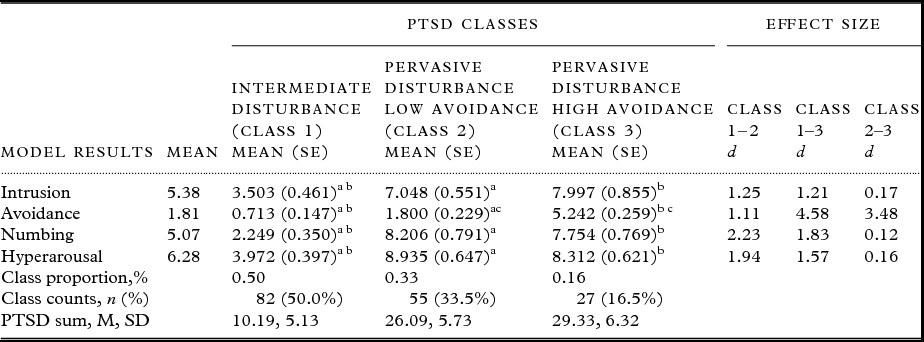
Means as well as standardized means of symptoms for the 3-class model are presented in Table 2. The Intermediate Disturbance class (n = 82, 50.0%) had significantly lower scores for all symptom clusters than the Pervasive Disturbance classes. Class 2 (n = 55, 33.5%) and 3 (n = 27, 16.5%) both exhibited pervasive disturbance but differed with regard to severity of avoidance symptoms; t(80) = −15.55, p < 0.001, with the Pervasive Disturbance-Low Avoidance class (class 2) having significantly lower avoidance symptoms than the Pervasive Disturbance-High Avoidance class (class 3). The Intermediate Disturbance group had a mean PTSD score of 10.19 (SD = 5.13), which is indicative of mild symptom severity, whereas the Pervasive Disturbance-Low Avoidance class (M = 26.09, SD = 5.73) and Pervasive Disturbance-High Avoidance class (M = 29.33, SD = 6.32) had mean scores indicative of moderate-to-severe PTSD symptom severity.
Results of class membership for a 3-class solution

Notes: d, Cohen's d; M, Mean; SD, Standard Deviation; SE, Standard Error, aSignificant difference between Class 1 and 2, p < 0.001; bSignificant difference between Class 1 and 3, p < 0.001; cSignificant difference between Class 2 and 3, p < 0.001.
Prediction of class membership
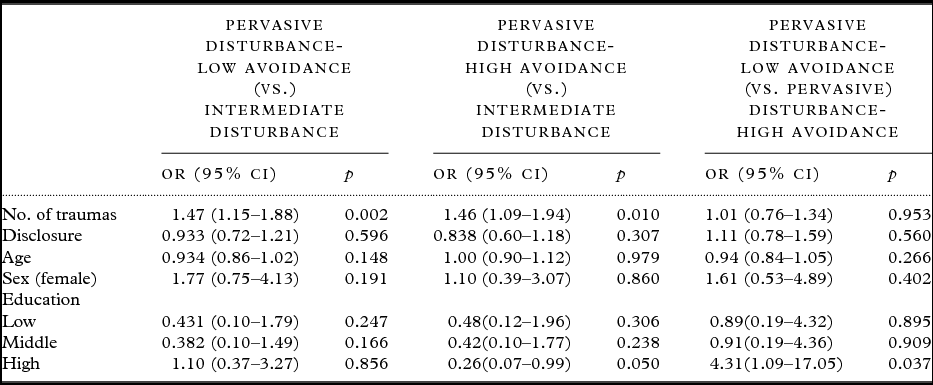
Multinomial logistic regression analyses were used to assess predictors of class membership. The included predictors were: age, sex, level of education (low = “9th grade,” middle = “10th grade,” high = “12th or 13th grade,” other), number of traumatic events, and amount of disclosure concerning the trauma. Results of this analysis are presented in Table 3. The Pervasive Disturbance-Low Avoidance and Pervasive Disturbance-High Avoidance classes both reported a significantly higher number of traumatic events (M = 4.08, SD = 1.71 and M = 4.16, SD = 1.52, respectively) than the Intermediate Disturbance class (M = 3.06, SD = 1.75). The two pervasive classes (class 2 and 3) differed with respect to level of education, with the Pervasive Disturbance-Low Avoidance class (class 2) having higher education (47.3% completed 12th or 13th grade) compared to the Pervasive Disturbance-High Avoidance class (22.2% completed 12th or 13th grade).
Results of multinomial logistic regression

Notes: class 1, intermediate; class 2, pervasive-low avoidance; class 3, pervasive-high avoidance; CI, Confidence Interval; OR, Odds Ratio; p, p-value; R2 = 0.19 (Cox & Snell), 0.22 (Nagelkerke). Model x2 (14) = 29.31, p = 0.009.
Differences in comorbid depression, anxiety, and somatization symptoms across the typologies
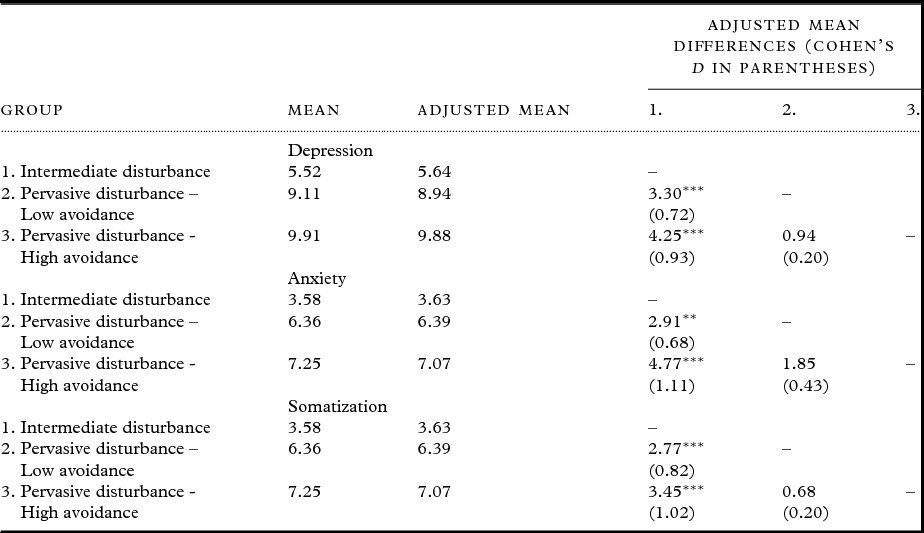
As shown in Table 4, results of the three ANCOVAs demonstrated a significant main effect of PTSD class membership on severity of comorbid depression, anxiety and somatization symptoms: F(2,134) = 10.24, p < 0.001, anxiety: F(2,134) = 12.31, p < 0.001, somatization: F(2,134) = 12.75, p < 0.001. Pairwise contrasts revealed that the Pervasive Disturbance-High Avoidance class and Pervasive Disturbance-Low Avoidance class had significantly greater severity of depression, anxiety and somatization symptoms than members of the Intermediate Disturbance class. No significant differences were observed between the Pervasive Disturbance classes (all p's > 0.05).
Pairwise comparisons of comorbid disorders by class membership

Discussion
This study evaluated predominant typologies of PTSD in a sample of treatment-seeking older adults with childhood war-related trauma. Three latent classes were found to optimally characterize the data, which represent 2 different levels of symptom severity (intermediate and pervasive). Our hypothesis that two classes of disturbance would best represent the manifestation of PTSD symptoms was partly supported. Class 1 (50.0%) represents an intermediate disturbance in all PTSD symptom clusters. Classes 2 and 3 exhibited both pervasive disturbances; however, these classes differed with respect to the severity of the avoidance symptom cluster, with Class 2, labeled Pervasive Disturbance-Low Avoidance (33.5%), showing pervasive disturbances in intrusion, numbing, and hyperarousal clusters and intermediate disturbance in the avoidance cluster, whereas Class 3, labeled Pervasive Disturbance-High Avoidance (16.5%), showed pervasive disturbances in all four symptom clusters. In sum, three different classes were identified, which represent two levels symptom severity (intermediate and pervasive). These levels are consistent with our hypothesis, however, as two subtypes of the pervasive disturbance category were identified. The absence of a class without elevated symptoms is likely due to the treatment-seeking nature of the sample. Thus, the differentiation in two different severity groups (intermediate and pervasive) is consistent with findings of Naifeh and colleagues (Reference Naifeh, Richardson, Del Ben and Elhai2010) who also examined latent profiles of PTSD in a clinical sample and found that a two-class solution that differed based on symptom level provided the best fit to the data.
A notable finding of this study is that the Pervasive Disturbance classes differed only with respect to severity of avoidance symptoms. Available data indicated an increase of avoidance symptoms (using DSM-IV criteria) in the long-term course of PTSD in older adults (Trappler et al., Reference Trappler, Braunstein, Moskowitz and Friedman2002; Yehuda et al., Reference Yehuda2009). A possible explanation for increased avoidance symptoms in the Pervasive Disturbance-High Avoidance class could be related to delayed-onset PTSD (i.e. an exacerbation or reactivation of PTSD symptoms, Andrews et al., Reference Andrews, Brewin, Philpott and Stewart2007). Thus, the Pervasive Disturbance-High Avoidance class could represent a delayed-onset PTSD subsample, whereas the Pervasive Disturbance-Low Avoidance class could represent a chronic PTSD subsample. However, given the cross-sectional design of this study, we could not directly evaluate the course of PTSD symptoms; and age of onset of PTSD was not assessed. Another possibility is that these groups differed with respect to trauma histories. Additional research that employs more nuanced measures of trauma history and course of PTSD symptoms will be useful in evaluating factors that might differentiate these two groups.
Regarding the degree of disturbance, the three classes are characterized by intermediate (class 1) and moderate to severe (class 2 and 3) PTSD symptom severity. The absence of an extremely severe symptom class is consistent with findings of a general decline in PTSD symptom severity over the life course in older adults (Böttche et al., Reference Böttche, Kuwert and Knaevelsrud2012). Nevertheless, half of the participants reported moderate to severe PTSD symptom severity (class proportion of class 2 and 3: 33.5% and 16.5%, respectively). This finding is comparable to the proportion in the clinical sample of Naifeh and colleagues (Reference Naifeh, Richardson, Del Ben and Elhai2010).
The analyses predicting class membership showed significant contributions in distinguishing the classes. Compared to the Intermediate Disturbance class, both of the Pervasive Disturbance classes reported a significantly higher number of experienced traumatic events. This finding is consistent with existing studies that have indicated a relationship between the number of traumatic events and PTSD (e.g. Kolassa et al., Reference Kolassa, Ertl, Eckart, Kolassa, Onyut and Elbert2010). This cumulative effect of trauma on severity of PTSD has also been observed among older adults (Ogle et al., Reference Ogle, Rubin and Siegler2014). The Pervasive Disturbance-Low Avoidance class reported a higher educational level compared to participants in the Pervasive Disturbance-High Avoidance class. One explanation for this finding may be that higher education facilitates reappraisal strategies and social support seeking, which can help to mitigate symptoms of avoidance. Thus, additional research will be useful in better understanding how education may help to mitigate avoidance symptoms in older adult trauma survivors. Other demographic and trauma-related characteristics, namely age, sex, and the degree of trauma-associated disclosure, were unrelated to latent classes.
Finally, results of the ANCOVAs showed that, relative to the Intermediate Disturbance group, the Pervasive Disturbance classes had significantly greater severity of depression, anxiety and somatization symptoms, even after controlling for sociodemographic and trauma-related variables. These results support the notion of a severity gradient, with more severe PTSD symptom profiles being associated with greater severity of commonly comorbid trauma-related comorbid disorders. This finding could have practical implications for the assessment of PTSD in older adults and applicable treatment approaches, especially in older adults with PTSD who are often misdiagnosed as having depression or anxiety.
Taken as a whole, these results have two overarching clinical implications for geriatric mental health practice. First, they suggest that assessment of the full spectrum of PTSD and symptom clusters from contemporary phenotypic models of this disorder may be useful in understanding the nature of PTSD symptoms such as sleep disturbance (which may possibly be misdiagnosed as somatic disease), flashbacks (which may possibly be misdiagnosed as hallucinations) or problems of concentration (which may possibly be misdiagnosed as mild cognitive impairment); such an assessment can ultimately match patients to treatment that treat the broad constellation and predominant phenotypic presentation of PTSD instead of single symptoms. Second, given the severity gradient observed in the latent classes, these results suggest that the clinical presentation of comorbid symptoms – depression, anxiety, and somatization – may warrant attention in assessment and treatment of older trauma survivors with PTSD. For example, assessment of unique trauma and clinical histories (i.e. comorbidity profiles, natural courses) of older persons with PTSD may help inform more personalized approaches to treatment in this population.
Several limitations of the study should be noted. First, data were collected via self-report questionnaires, so it is unclear if results were differed if data were obtained via clinical interview. Second, data were mainly gathered through Internet-based questionnaires which as yet have not been completely validated for Internet-based administration. Nevertheless, there is evidence for equivalence in reliability and validity of paper-pencil and Internet-based questionnaires especially in the context of anxiety disorders (Carlbring et al., Reference Carlbring2007). Third, we used a cross-sectional design which precludes us from understanding temporal relationships among study variables. In light of longitudinal results of Ayer and colleagues (Reference Ayer, Danielson, Amstadter, Ruggiero, Saunders and Kilpatrick2011) indicating a qualitative change in the PTSD class structure over time and of existing literature reporting a change in the symptom profile in older adults (e.g. Trappler et al., Reference Trappler, Braunstein, Moskowitz and Friedman2002), further research is to evaluate possible changes in PTSD class structure over time. Fourth, the generalizability of these findings to the broader population of treatment-seeking older adults remains unclear. The sample comprised older adults who were seeking treatment for early-lifetime war traumatization and its consequences. Therefore, generalizability is thus limited to this subgroup. In a next step, it will be important to examine PTSD typologies of older adults experiencing recent as well as accidental or other man-made traumatic events. Fifth, PTSD symptoms were assessed based on DSM-IV criteria which did not represent the recent valid diagnostic criteria of the four symptom clusters of PTSD (DSM-5, APA, 2013). Nevertheless, a splitting of DSM-IV Criterion C into avoidance and numbing is justified due to the consistent findings indicating that these are separate and distinct constructs (Asmundson et al., Reference Asmundson, Stapleton and Taylor2004), and also represent the factor structure of PTSD in older adults (Schinka et al., Reference Schinka, Brown, Borenstein and Mortimer2007; Pietrzak et al., Reference Pietrzak, Goldstein, Southwick and Grant2012).
Despite these limitations, our findings are consistent with prior data, which have identified heterogeneous PTSD typologies that differ with respect to symptom severity and symptom presentation. They extend this work to suggest that there are three predominant typologies of PTSD symptoms in treatment-seeking older adults, which are differentiated with respect to education, number of traumatic events, and psychiatric comorbidities. That the Pervasive Disturbance classes differed only with respect to severity of avoidance symptoms aligns with a large body of confirmatory factor analytic studies (e.g. Palmieri et al., Reference Palmieri, Marshall and Schell2007; Naifeh et al., Reference Naifeh, Richardson, Del Ben and Elhai2010), suggesting that the splitting of the DSM-IV cluster C into two separate factors (avoidance and negative alterations in cognitions and mood) in DSM-5 is important to be able to qualitatively evaluate differences in PTSD symptom profiles. Although replications are necessary, especially in other older adult samples and using DSM-5 criteria for PTSD, results of this study underscore the importance of considering the heterogeneous manifestations of PTSD symptoms in treatment-seeking older adults.
Conflict of interest
None.
Description of authors’ roles
M. Böttche were responsible for carrying out the statistical analysis and wrote the first draft of the paper; M. Böttche and R. H. Pietrzak were responsible for the formulation of the research questions and the statistical design of the study; C. Knaevelsrud and P. Kuwert designed and supervised data collection; and all authors contributed to the writing, editing, and revising of the paper.