R1. Introduction
The fundamental human capacity to conceive of future events has received surprisingly little attention in the behavioral and brain sciences. Ten years ago we first discussed the nature, development, and evolution of mental time travel in a rather low-key monograph (Suddendorf & Corballis Reference Suddendorf and Corballis1997). That article was based on Suddendorf's masters thesis (Suddendorf Reference Suddendorf1994), and it took much persistence to get it published after initial rejections from several journals, including this one. It is thus a delight to see how far we have come, as is evident in the wide interest the target article elicited. Today, mental time travel is recognized as an important topic of inquiry with discussions in the top generalist and specialist journals. In fact, since writing this target article last year, there has been, as Schacter & Addis, Tulving & Kim, and Okuda note, an explosion of articles published on various aspects of the subject. We look forward to reviewing progress in another 10 years' time, though extrapolating from the recent surge in interest, that task will probably be a lot more difficult.
We thank the commentators for providing their perspectives and will reply according to the five main research areas from which they derive: cognitive psychology, neuroscience, developmental psychology, comparative psychology, and evolutionary psychology. This division should make it easier to find the relevant sections for scholars mainly interested in some of these areas.
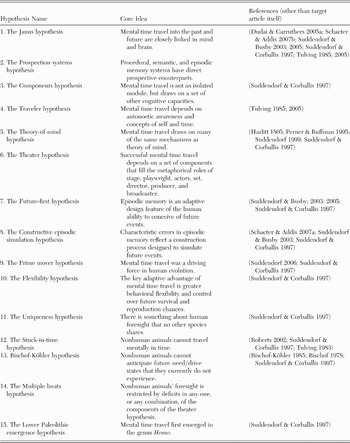
Tulving & Kim counsel that researchers should carefully distinguish concepts and terminology in the forthcoming debate. To avoid confusion, we therefore begin our reply by explicitly naming and distinguishing various hypotheses from the target article that attracted comment (see Table R1). Many of the commentaries take issue with only one of these and may not bear on others.
R2. Mental time travel and cognitive psychology
The study of memory has always been a cornerstone of cognitive psychology. It remains something of a mystery, though, why memory research has attracted so much more attention than the study of future-oriented processes. One reason, we suspect, has to do with the ease of testing memory accuracy and the difficulties associated with testing foresight. We have argued that an evolutionary perspective must shift the focus to what these capacities can do for the present and the future, and the commentaries offer strong support for the Future-first hypothesis (but see Nelson). In fact, it seems that the future of thinking about the future is now, as Schacter & Addis put it. We are delighted to read that memory researchers such as Tulving & Kim and Schacter & Addis fundamentally agree with our proposal and endorse a fresh look at foresight and how memory may support it.
There is almost unanimous agreement on the general hypothesis that there are some fundamental links between mental time travel into the past and the future (Janus hypothesis). Several commentators substantiate this claim with further evidence (Brüne & Brüne-Cohrs; Buckner; Carr & Viskontas; D'Argembeau & Van der Linden; Hurford, Flaherty,& Argyropoulos (Hurford et al.); Okuda; Schacter & Addis). Nonetheless, it is probably prudent to remain cautious about the extent of these links, as Friedman suggests. The details of the relation are still to be determined (Bar) and we suspect that both shared and unique processes for episodic memory and foresight will be established. None of the commentators made the case that mental time travel might be a separate module. Instead, in addition to episodic memory providing raw material for mental simulation of future events, the link may be based on both past and future travels drawing on the same cognitive resources (Components hypothesis). We suggested a range of components with the Theater hypothesis.
R2.1. Theatrical concerns
Although generally commending the Theater hypothesis, Hurford et al. query the role of the broadcaster (see also Sterck & Dufour). By adding the broadcaster to the metaphor, they suggest, we preclude possible research on episodic memory in nonhumans. The broadcaster can be most clearly identified with language, but we did mention the possibility that nonhuman animals might in principle be able to communicate past episodes (e.g., by using mime). In any case, we did not mean to imply that the broadcaster was a necessary component of the theater metaphor; we wrote, “Although language is not necessary for mental time travel, it provides the clearest evidence of it” (sect. 4.7).
The causal relation, though, may run the other way. That is, mental time travel may have been critical to the evolution of the broadcaster. Indeed, as we hinted in the target article, language seems exquisitely adapted to the description of events that are remote in place and time. So it is that language comprises symbols to represent nonpresent objects, actions, emotions, and the like, and has systems of tense for signaling past and future (see Corballis & Suddendorf, in press, for further discussion). It has become commonplace to refer to one component of memory as declarative memory; conversely, we suggest, much of language consists of memorial declaration. It also consists of declarations about the future, as evident in recent discussions about the consequences of global warming.
Dessalles, though, seems to think that the broadcaster may have come first, arguing that episodic memory evolved as an outgrowth of language (see also Nelson), providing us with worthwhile things to talk about. This seems to us the wrong way around, rather like suggesting that feet evolved to allow us to play football. It is surely more likely that language evolved to allow experiences and plans, and also knowledge, to be shared. Dessalles' position, moreover, appears to be somewhat circular: We can tell of events because they are tellable – hence episodic memory evolved in support of language performance. Although there may be individual differences in the extent that people disclose, we suspect that every clinically normal person has memories and anticipations that they do not share with others. In fact, we think it is at times very difficult to put into words what has happened or what we expect to happen. And although telling exciting stories of the unusual and surprising may have social (and perhaps sexual) pay-offs, it surely does not stop people from remembering the mundane and even talking about it. I well remember getting on the bus last week, but it is not a story I would tell. We agree with Dessalles that this is so because it conveys little new or unexpected information. But why is unexpectedness important? Nelson claims that it is only humans who share events they have experienced. We concur, and this broadcasting of one's mental time travel can indeed be extremely adaptive, in that it allows people to learn from others' mistakes and successes without even having to experience the events themselves. Those who tell such useful tales may be encouraged and rewarded by those who learn. Thus, these are stories worth telling and worth listening to.
Whereas Hurford et al. think the Theater hypothesis goes too far, Ainslie suggests that it does not go far enough, since it neglects the audience. In so doing, it fails to consider the question of what motivates us to indulge in mental time travel rather than live in the present. Questions about motivation for mental time travel are perhaps separate from questions about mental time travel itself, just as the description of a theater production is not a description of who will go to see it. Nevertheless, Ainslie raises interesting points. He notes that people have little tolerance for a bad lecture – or reading a boring article, we might add – and it may be precisely in such circumstances that they will indulge in some future fantasy, or revel in some past glory. Buckner and Carroll (Reference Buckner and Carroll2007) suggest that this may in fact be the human default mode. Even so, different scenarios must compete with each other and with present needs. Ainslie suggests that they may compete in terms of entertainment value and suggests that a primary motivator may be the very uniqueness of scenarios that we can envisage; that uniqueness may in turn result from our ability to use combinatorial principles to generate novelty (see sect. R2.5), and also perhaps from what Locke and Bogin (Reference Locke and Bogin2006) recently termed the “instinct for inventiveness” (see also Whiten & Suddendorf [in press] on the evolution of inventiveness).
R2.2. The role of emotion
D'Argembeau & Van der Linden offer some detail on the role of emotion in mental time travel. Their interesting work has documented links between past and future time travel (Janus hypothesis), adding depth to the study of its content. They suggest that in addition to enhancing future fitness, mental time travel serves to regulate emotion and create the sense of self. We suspect it has many other functions as well. In fact, many human emotions, such as remorse and hope, may fundamentally depend on mental time travel. Individual differences in the emotional content of imagined episodes may underlie various mental disorders (see also Brüne & Brüne-Cohrs); thus depressed people generate fewer positive episodes; and anxious patients, more negative episodes (MacLeod & Byrne Reference MacLeod and Byrne1996). On the other hand, they note that people with stronger visual imagery generate more detailed event representations and rate these as more meaningful (D'Argembeau & Van der Linden Reference D'Argembeau and Van der Linden2006), and they ask whether this may also be associated with a stronger ability to make adaptive choices. There is reason to suspect that this might be so, as other work has found that individuals with stronger concern for the future show better health-preserving behavior (e.g., Mahon et al. Reference Mahon, Yarcheski and Yarcheski1997). However, this comes at a price, as they are also more prone to stress (Zimbardo & Boyd Reference Zimbardo and Boyd1999). As Ainslie points out, there are serious problems associated with being, like Walter Mitty, too “fantasy-prone.” It is easy to see how the adaptive ability to concern oneself with the future confronts humans with all kinds of cognitive, motivational, and emotional complexities and dilemmas (e.g., Suddendorf & Busby Reference Suddendorf and Busby2005). For example, one may struggle to stop thinking about the same events (as in posttraumatic stress syndrome), or worry about events that may never occur. Brüne & Brüne-Cohrs make the interesting suggestion that obsessive-compulsive disorder might be the result of too much mental time travel activity of this latter kind (Brüne Reference Brüne2006).
Sometimes, though, the sense of time can be seen as a solution rather than a dilemma. Viola in Shakespeare's Twelfth Night, masquerading as a man, finds herself in an impossible predicament, and is moved to say
We often live in the hope that problems will simply go away.
According to Atance & Meltzoff, present affective state is not so much a consequence of mental time travel as a cause of it. They suggest that mental time travel arises because we experience some desire for a future goal in the present, and work toward it by constructing future scenarios. This is similar to the point raised by Ainslie that we need to consider what motivates a person to indulge in future thinking in the present, or to think about one scenario rather than another. Emotional considerations are no doubt important (e.g., D'Argembeau & Van der Linden), but it is not clear to us that mental time travel is always suffused with emotion, and the role of emotion in memory has a controversial history. Some of the things we remember seem banal and without obvious affect (see also our response to Dessalles), and they may serve more as part of the vocabulary from which to construct future scenarios.
R2.3. About time
Hurford et al. suggest what they call a “radically different” taxonomy from the Prospection-systems hypothesis we summarized in our Figure 1, although their alternative ideas do not really impinge on the notion of mental time travel itself. They see no distinctions between semantic memory and (semantic) prospection, or between procedural memory and procedural prospection, since both semantic and procedural memory are essentially timeless. Semantic memory is indeed timeless in the sense that it does not record and allow us to re-experience a specific event that occurred at a specific point in time, but we can of course have semantic memories that refer to time. We can know, for example, when we were born, or the date at which Columbus discovered America. Further, some semantic knowledge is clearly directed toward the future, such as knowledge of an upcoming birthday party, and influences our planning as much as the episodic constructions that may guide the specific form of the celebrations. As we noted in the discussion of the reminiscence bump in the target article, with increasing age we may rely less on mental time travel and increasingly on the semantic system. The notions of past and future can be embedded in semantic knowledge as well. We suggest, though, that the semantic representation of time itself depends on the initial emergence of mental time travel, both in evolution and development.
This possibility receives some support from Friedman, who rightly points out that our sense of the time at which events occurred in the past is fragmentary and generally based on inference rather than on direct experience (see also Eacott & Easton). He thus suggests that episodic memory should be understood as having to do with events that have occurred on a particular occasion, rather than at a specific time. In a sense, then, our concept of time is an extrapolation from incomplete data. Nevertheless, we certainly understand time to be a continuum, running smoothly from some infinite past (or perhaps from the big bang that created the universe) to a future that is hopefully distant, global warming or not. Time is therefore woven into our semantic knowledge about the world. But such notions, we argue, can only emerge from an initial understanding of a contextualized, event-filled time (cf. Gerrans Reference Gerrans2007).
Merker suggests that our “entire argument is built on a perfect symmetry between past and future,” despite our having written “There is a fundamental causal asymmetry [between past and future], and one simply cannot know the future as one knows the past”. More seriously, perhaps, he suggests that semantic prospection is all that is needed for optimal future planning (cf. Hegdé) and asserts that we have provided no concrete evidence that mental time travel ever yields greater efficacy. As noted earlier, mental time travel may be necessary to construct such semantic prospection. Furthermore, his view of prospection seems too passive, as though mental time travel into the future is little more than a guessing game. Thus he suggests that we cannot know which one of several possible future events will actually eventuate, and that particularities gleaned from past episodes might make prediction worse by adding to the number of possible alternatives. On a more proactive view, though, those particularities can surely help us actually shape future events, as distinct from merely trying to anticipate what will happen.
R2.4. Beyond past and future
Mental time travel may be based on components that are also used to achieve other goals (the Components hypothesis). The Theory-of-mind hypothesis, for example, suggests that humans use the same mechanisms to simulate the mental states of others. This idea is not new (as Bischof-Köhler & Bischof and Sterck & Dufour seem to imply), but was a central argument in our original article (Suddendorf & Corballis Reference Suddendorf and Corballis1997). Other authors have also pointed to links between theory of mind and mental time travels into past (Perner & Ruffman Reference Perner and Ruffman1995) and future (Hazlitt Reference Hazlitt1805). Bischof-Köhler & Bischof cite additional developmental support for this hypothesis, and make the interesting case for taking the Gestalt psychological concept of “frame-of-reference awareness” as a perspective for understanding mental time travel. Buckner and Okuda provide additional reasons why theory of mind and mental time travel (and possibly some other forms of “self-projection” such as in navigation) might draw on the same components, and none of the commentators made a case for conceiving of mental time travel as an informationally encapsulated module. In the target article, we proposed that mental time travel draws on a range of sophisticated components (the Theater hypothesis) that may serve a range of other cognitive functions, including theory of mind.
The relation between mental time travel and theory of mind may be quite complex. On the one hand, both may draw on basic component abilities such as metarepresentation and executive functions (e.g., Suddendorf Reference Suddendorf, Corballis and ea1999), or “frame-of-reference awareness”; on the other hand, each appears to be intimately intertwined with the other. For example, to understand what oneself and others might do in the future typically requires some appreciation of different mental states. Conversely, mental time travels are mental states, and understanding others' minds often depends on understanding what happened to them, and what their plans and goals might be. The recursion evident in theory of mind (e.g., I believe that you know what she wants) is also evident in mental time travel (e.g., I remember that I thought yesterday about what you are going to do tomorrow).
R2.5. Combinations and recombinations
Although we proposed that past episodes provide a vocabulary from which to construct possible future episodes, using recursive, combinatorial principles similar to those involved in theory of mind and language, Hegdé misinterprets us as implying that “one can mentally create only those future events that one has specifically experienced in the past.” Like Merker, Hegdé also argues that the information provided by episodic memory is not needed and can even place “untenable limitations on one's ability to imagine.” He suggests that prospection is most efficiently accomplished entirely through the use of Bayesian principles (which he does not specify) based on generic prior knowledge, although he does concede that the Bayesian approach can use episodic memory without being dependent on it. We agree that imagining future episodes is based on both semantic knowledge and episodic memory, but suggest that Hegdé may have underestimated the constructive, combinatorial aspect of our account. We recognize that humans can imagine whatever, wherever, and whenever (Suddendorf & Busby Reference Suddendorf and Busby2003b), and we emphasized the generative nature of mental time travel both in the target article and in the original formulation:
One characteristic of mental time travel that distinguishes it from instinct and associative learning is its flexibility. That is, given a basic vocabulary of actors, objects, and events, we can construct unique episodes in the past and create scenarios to deal with unique contingencies in the future. (Suddendorf & Corballis Reference Suddendorf and Corballis1997, p. 147)
This generativity may be an asset for flexible foresight, but it may serve less well for accurately recording events of the past, lending support to our argument (the Future-first hypothesis) that episodic memory may in fact be a design feature of the foresight system (cf., D'Argembeau & Van der Linden). Schacter & Addis reinforce our claim that the error-prone nature of episodic memory is the result of a system geared towards flexible recombination of future events, rather than towards faithful reconstruction of the past – and suggest we should call this idea the Constructive episodic simulation hypothesis (Schacter & Addis Reference Schacter and Addis2007a). The malleability of memory that we have known of since Bartlett's (Reference Bartlett1932) pioneering studies is often forgotten by researchers who use correct recall as the dependent variable. Several commentators (e.g., Ainslie; Schacter & Addis) agree with us that the veracity of episodic memory cannot be used to define it. Just as visual illusions hold vital clues to studying normal vision, so errors of memory also hold clues to understanding the system (see also Brüne & Brüne-Cohrs), as is well illustrated by Schacter's (e.g., Reference Schacter1999) seminal work on these “sins of memory.”
In the playwright section of the theater metaphor, we focused especially on the peculiar human capacity for recursion, which drives the recombination of elements not only in mental time travel but also in other spheres such as language, theory of mind, and music (Corballis Reference Corballis2007). This may have distracted from other aspects of the story line. Nelson therefore argues for the importance of narrative in mental time travel. We are sympathetic to her view (see also the discussion in sect. R4) and have acknowledged previously (Suddendorf & Corballis Reference Suddendorf and Corballis1997) Freud's observation that even memories that reveal themselves as images require a story grammar if remembrance is to be distinguished from random hallucinations. We thought the use of the theater metaphor itself would have gone a long way to emphasizing the importance of the story or narrative being played out.
R3. Mental time travel and neuroscience
We are grateful to the commentators who extended and updated our coverage of evidence from brain research. These include Brüne & Brüne-Cohrs, Buckner, Carr & Viskontas, Okuda, and Schacter & Addis. This evidence overwhelmingly confirms the strong overlap between brain areas involved in imagining the future and in recollecting the past, and hence the Janus hypothesis. Most human brain-imaging studies, such as those summarized by Buckner, Okuda, and Schacter & Addis, suggest that the prefrontal and parietal regions play critical roles in both episodic memory and future thinking (e.g., Addis et al. Reference Addis, Wong and Schacter2007, Okuda et al. Reference Okuda, Fujii, Ohtake, Tsukiura, Tanji, Suzuki, Kawashima, Fukuda, Itoh and Yamadori2003, Szpunar et al. Reference Szpunar, Watson and McDermott2007).
Nevertheless, Carr & Viskontas take us to task for overemphasizing the role of the frontal lobes at the expense of the medial temporal lobe, and more particularly the hippocampus. They challenge the Stuck-in-time hypothesis concerning nonhuman animals, since the role of the hippocampus in memory is widely documented in many species, including birds. In the target article, we suggest that the prefrontal cortex may provide at least part of the extra ingredients that permit mental time travel. Carr & Viskontas cite a recent study (Raby et al. Reference Raby, Alexis, Dickinson and Clayton2007) suggesting that birds are capable of planning, despite having no prefrontal cortex. We are skeptical of this finding for reasons elaborated below, but it is becoming clear in any case that the neopallium in birds has evolved many of the functions of the neocortex (Jarvis et al. Reference Jarvis, Gunturkun, Bruce, Csillag, Karten, Kuenzel, Medina, Paxinos, Perkel, Shimizu, Striedter, Wild, Ball, Dugas-Ford, Durand, Hough, Husband, Kubikova, Lee, Mello, Powers, Siang, Smulders, Wada, White, Yamamoto, Yu, Reiner and Butler2005). Nevertheless, there can be no doubt, as Carr & Viskontas document, that the hippocampus is indeed critical to declarative memories (e.g., de Haan et al. Reference de Haan, Mishkin, Baldeweg and Vargha-Khadem2006) and probably to foresight (e.g., Hassabis et al. Reference Hassabis, Kumaran, Vann and Maguire2007), and we were perhaps remiss in not emphasizing it enough. In a recent essay, de Hoz and Wood (Reference de Hoz and Wood2006) have reviewed evidence that hippocampal “place” cells in rodents might code “when” as well as “where,” perhaps providing a substrate for episodic-like memory, or the “stage” component of the Theater hypothesis. It is possible that the hippocampus plays a more complex role in humans than in other species. For example, Aggleton and Brown (Reference Aggleton and Brown1999) have proposed a model in which the hippocampus and other diencephalic structures are activated differently by semantic and episodic memory, at least in humans, although in both cases the prefrontal cortex is implicated as well (see also Maguire et al. Reference Maguire, Vargha-Khadem and Mishkin2001).
Another possibility, suggested by Schacter & Addis, is that laterality may hold the key, with evidence that the right hippocampus shows greater activity during construction of future events compared to past ones (Addis et al. Reference Addis, Wong and Schacter2007). But again, this same evidence also implicates a medial part of the right anterior prefrontal cortex (BA10), which they suggest may be the seat of an “episodic buffer” (Baddeley Reference Baddeley2000) that binds multimodal information. According to the HERA (hemispheric encoding retrieval asymmetry) model (Habib et al. Reference Habib, Nyberg and Tulving2003), the left prefrontal cortex (PFC) is more involved than the right PFC in episodic memory encoding, whereas the right PFC is more involved than the left PFC in episodic memory retrieval (but see Owen Reference Owen2003, for a critique). So far as we know, this model has been applied only to humans, although the once-common belief that cerebral asymmetry is uniquely human has now been thoroughly refuted (Vallortigara & Rogers Reference Vallortigara and Rogers2005).
In the target article, we noted evidence that neural loops involving the cortex and basal ganglia might be involved in mental time travel, but Okuda suggests that these are more likely to be involved in procedural prospection rather than in mental time travel as we defined it. His own work, and that of others, implicates brain networks involving medial aspects of prefrontal, temporal, and parietal cortices. He and Buckner also suggest that the brain areas involved in mental time travel may also be involved in mental traveling in space, and into the minds of others, as well as in time (see also sect. R2.4). As Okuda points out, these extensions are understandable in terms of the Theater hypothesis we advanced, and it is also worth noting that time travel almost always takes us to different places.
Buckner finds that the Theater hypothesis and the Prospection systems hypothesis offer useful frameworks, but chides us for adopting a behavioral perspective rather than a neural one. He quotes with disapproval our statement that we are not making any claims about “simulation or any other mechanisms by which this may be instantiated in the brain”. Our disclaimers with respect to the Theater hypothesis were partly intended to avoid any impression that we were supporting the so-called Cartesian theater so effectively debunked by Dennett (Reference Dennett1995), but also to disavow any expertise as to precisely how the components of mental time travel might be implemented. To make no claims is not to disapprove of such claims, and elsewhere we noted that, in the absence of phenomenological evidence from nonhuman animals, we might in future be in a position to use neurophysiological evidence as a proxy – a prospect Tulving & Kim are also optimistic about. We are grateful, especially to Buckner, Okuda, and Schacter & Addis, for their insights as to how the components of mental time travel suggested by the Theater hypothesis might indeed be instantiated in the brain.
Brüne & Brüne-Cohrs make the additional point that studies of dementias and other psychopathological conditions may hold important clues. They contrast Alzheimer's disease and Korsakoff's syndrome, and suggest also that aspects of schizophrenia might be understood in terms of the Theater hypothesis. Failure in any one of the components may lead to no mental time travel, or to disturbances that may indeed be, as Lorenz suggested, more informative about the physiology than studying the intact system. Double dissociations are particularly informative, and we agree that further interdisciplinary exchange is highly desirable. Clues may come from various other syndromes (e.g., autism; Suddendorf & Corballis Reference Suddendorf and Corballis1997; Williams et al. Reference Williams, Whiten, Suddendorf and Perrett2001) and disorders (e.g., delusions; Gerrans Reference Gerrans2007). Our considerations, in turn, may inform different lines of research in psychopathology (as Brüne & Brüne-Cohrs demonstrate). For example, the discussion of animal capacities is important to developing potential “animal models” for certain conditions. Putative disturbances of the capacity to travel mentally in time can only be informed by such models to the extent that there are animal parallels. If the Uniqueness hypothesis is correct, then some aspects of these disorders may be uniquely human, too. Identification of what is not shared with other species can also hold vital clues, however, as it would seem likely that these traits are related to distinct attributes of the human brain.
R4. Mental time travel and developmental psychology
Few studies have attempted to directly investigate the development of mental time travel into the past and future (e.g. Busby & Suddendorf Reference Busby and Suddendorf2005), but there is a relatively large literature on the development of related concepts such as autobiographical memory. Autobiographical memory is generally taken to include not just episodic memory, but also semantic knowledge that one may have about one's history. Recently studies are beginning to explore the distinction (e.g., Piolino et al. Reference Piolino, Hisland, Ruffeveille, Matuszewski, Jambaque and Eustache2007). We did not include a full discussion of the developmental literature bearing on mental time travel largely due to space constraints (but see Suddendorf & Busby Reference Suddendorf and Busby2005; Suddendorf & Corballis Reference Suddendorf and Corballis1997), but we do believe that developmental studies of mental time travel are important and that they may offer vital clues to the other relevant disciplines, too (Atance & Meltzoff; Shettleworth).
Nelson is one of the key figures in this field, and we fully agree with her, and other prominent contributors to this literature that social and cultural factors play an important role in the development of episodic memory (e.g., Fivush et al. Reference Fivush, Haden and Reese2006). This literature has documented how young children first begin to refer to small parts of past events and, gradually, with the help of their caregivers, turn them into full narratives. Through the social interactions with adults and the scaffolding provided by talk about past events, children slowly seem to acquire the narrative skill required to construct their autobiographies and a more mature sense of self and other (e.g., Nelson & Fivush Reference Nelson and Fivush2004; Reese Reference Reese2002). Although we have no doubt these social processes play an important role in determining inter- and intra-individual differences in children's abilities, we caution that these factors are not necessarily the sole determinants of mental time travel.
One of the key lines of evidence for the importance of sociocultural effects comes from the analysis of mother–child conversations. Many studies have shown that children of mothers who elaborate more in their conversations about past events score higher on measures of autobiographical memory (for a review, see Fivush et al. Reference Fivush, Haden and Reese2006). There is also some, though much more limited, evidence of a similar link between elaboration and children's thinking about the future (Hudson Reference Hudson2006). But there can be various reasons for such correlations. For example, high-elaborating mothers may have passed on the genes that are responsible for high elaboration to their offspring. However, some data, such as differential effects of the timing of adult–child conversations on memory (e.g., McGuigan & Salmon Reference McGuigan and Salmon2004), cannot be explained in that way and suggest that the conversations themselves do influence children's memory. Nonetheless, increased parental elaboration may not so much change or cause mental time travel per se, but may teach and encourage their reporting. In terms of the Theater hypothesis, we are dealing here entirely with the role of the broadcaster. Learning how to broadcast and understanding others' broadcasts are no doubt important. But that does not mean that it induces the other abilities we propose are involved in mental time travel. If it did, then elaborate conversations should offer a cure for people who suffer from amnesia. And conversely, people deprived of sociocultural narrative interaction (e.g., the deaf-and-blind Helen Keller) should not develop mental time travel. We argue that there is more to mental time travel than just talk.
Although the importance of adult–child conversation is a common theme in the literature, most developmental theorists subscribe to something like the Components hypothesis and argue that a range of emerging capacities such as language, self-concept, and theory of mind are related to the development of autobiographic memory (e.g., Howe & Courage Reference Howe and Courage1997; Levine Reference Levine2004; Nelson & Fivush Reference Nelson and Fivush2004; Perner Reference Perner, Tulving and Craik2000; Reese Reference Reese2002; Suddendorf & Corballis Reference Suddendorf and Corballis1997; Welch-Ross Reference Welch-Ross1995). The relation between these abilities may be multidimensional and involve other factors (e.g. such as in the Theory-of-mind hypothesis). In Suddendorf & Corballis (Reference Suddendorf and Corballis1997), we note, for example, that the self in the present may be a prerequisite of mental time travel, whereas a temporally extended sense of self may be its consequence. The Theater hypothesis adds to the list of implicated skills, and we encourage developmental psychologists to study these components in addition to direct measures of mental time travel.
Little is yet known about the development of children's thinking about the future (for reviews, see Haith et al. Reference Haith, Benson, Roberts and Pennington1994; Moore & Lemon Reference Moore and Lemmon2001), offering fertile ground for future research (Atance & Meltzoff). Perhaps children's mental time travel is initially more influenced by talk about the past than the future, as Nelson claims, and the Future-first hypothesis may hold only for evolution rather than for development. However, key developments in foresight appear to also emerge over the preschool years (e.g., Atance & O'Neill Reference Atance and O'Neill2005; Suddendorf & Busby Reference Suddendorf and Busby2005), and when asked to tell something they did do yesterday and something they will do tomorrow, 3- to 5-year-old children perform similarly on both sets of questions (Busby & Suddendorf Reference Busby and Suddendorf2005).
One area that has been studied more extensively is children's ability to differentiate between the times of events. Friedman reviews some of his pioneering work on this development and highlights the diverse range of mechanisms humans use in determining the times of past and future events (see Friedman Reference Friedman2005, for a review). Children develop these skills gradually from about age 4 onwards.
Bischof-Köhler & Bischof draw attention to a large-scale German study in which children were tested on a set of innovative measures aimed at assessing mental time travel (Bischof-Köhler Reference Bischof-Köhler2000). It remains a bit unclear what role some of the measures, such as judging which of two egg timers finishes first, play in the capacity under discussion. However, the author found associations between these tasks and standard measures of theory of mind, substantiating the Theory-of-mind hypothesis. Furthermore, they maintain the hypothesis that we named after them (Bischof-Köhler hypothesis): that nonhuman animals cannot anticipate future need states they do not directly experience (Suddendorf & Corballis Reference Suddendorf and Corballis1997). Experimental designs have been proposed to assess future need anticipation, as future-directed action could demonstrate nonverbal capacities (Suddendorf Reference Suddendorf1994; Suddendorf & Busby Reference Suddendorf and Busby2005; Tulving Reference Tulving, Terrace and Metcalfe2005). Atance & Meltzoff warn, however, that as developmental psychologists we should not focus too much on this specific ability as the litmus test of mental time travel. We agree that the full spectrum of the emerging ability deserves study, including future-need anticipation. Very little is yet known about how children come to develop foresight, and we suspect that developments continue well into adolescence.
R5. Mental time travel and comparative psychology
Unsurprisingly, several commentators question the claim that nonhuman animals cannot travel mentally in time (the Stuck-in-time hypothesis) and cite new research that has been published since completion of the target article in support (Bar; Carr & Viskontas; Hurford et al.; Osvath & Gärdenfors; Raby, Alexis,Dickinson, & Clayton (Raby et al.); Shettleworth; Sterck & Dufour). Although we remain skeptical about some of these conclusions as outlined here next, we commend this innovative work and, unlike Shettleworth, want to encourage more of it.
R5.1. Are behavioral tests possible?
Raby et al. lament that we did not articulate our hypotheses in specific behavioral terms, and complain that we rely too heavily on phenomenology. They also argue that phenomenology may be the only difference between episodic and semantic memory. We do not think that this is the only difference. Clearly, loss of episodic memory in amnesic patients is not merely the loss of a phenomenological sensation, or quale, but has fundamental consequences for the sufferer. In any case, the charge that we are relying too heavily on phenomenology is misleading. We took pains here and elsewhere (Suddendorf & Busby Reference Suddendorf and Busby2003b; Reference Suddendorf and Busby2005) to move beyond first-person experience and towards objective indicators. Indeed, we pointed out that natural selection needs something to get its teeth into, and an internal feel alone is inadequate for that. We suggest that future-directed action is the key towards mapping animals' competence and understanding the evolution of mental time travel.
Of course, what Raby et al. want are predictions that are instantly translatable into tests with nonhuman species, such as scrub jays. Clayton and colleagues (e.g., Clayton et al. Reference Clayton, Bussey, Emery and Dickinson2003; Dally et al. Reference Dally, Emery and Clayton2006b; Raby et al. Reference Raby, Alexis, Dickinson and Clayton2007) have been prolific in developing clever ways of turning mental time travel questions into experiments involving jays caching and retrieving food. The components we discuss in the Theater hypothesis offer several new avenues, but Raby et al. dismiss components such as recursion and secondary representation that may not so easily be translated into this caching context. Yet, these are behavioral criteria that lend themselves to comparative inquiry. Suddendorf and Whiten (Reference Suddendorf and Whiten2001), for example, have shown that there is convincing evidence for secondary representation (the stage component) in great apes, and we see no reason why scrub jays could not be tested similarly. We thus reject the charge that we do not provide enough relevant behavioral criteria and are happy to suggest more.
Raby et al. further charge that we did not adequately explain why we advocate a focus on non-species-typical behavior in attempts to demonstrate mental time travel in animals. We made the case that the key adaptive advantage of mental time travel is the flexibility it offers for acting now to increase future survival and reproduction chances (the Flexibility hypothesis), and note that the human capacity is not restricted in content in any apparent way, but instead is open-ended and domain general. We thus argued that comparative research should focus on non-species-typical behavior because it (a) provides evidence for such flexibility and (b) rules out any role of non-cognitive behavioral predispositions governing future-directed behavior (as appears to be the case, for example, in hibernators). Scrub jays, like various other bird species, develop caching in predictable stages that suggest a prominent role of innate factors. For example, they have an early tendency to place food, as well as many other objects, without recovering these caches. Raby et al. counter that human children develop mental time travel also in a predictable fashion. However, it is not yet clear whether or not this is so. It has certainly been argued that this development is not uniform, but that there are individual and cultural differences in the way children first acquire mental time travel (see Nelson). More developmental research is required to settle this, and we maintain that studies with nonhuman animals (as well as with children) are best advised to employ novel contexts to ascertain that the behavior of interest is the result of an individual's faculty for mental time travel.
R5.2. New data on animal foresight
As we acknowledged in the target article, the Bischof-Köhler hypothesis cannot be true in the superficial sense that food caching is directed toward future gratification. Many species secure future needs, whether in food caching, nest building, or migration. These behaviors, though, are largely instinctive, and the hypothesis may still hold for “individual, flexible situations involving non-instinctive behaviors” (sect. 3.3 of the target article).
Several commentators (Bar; Carr & Viskontas; Hurford et al.; Osvath & Gärdenfors; Raby et al.; Schacter & Addis; Sterck & Dufour) refer to the study by Raby et al. (Reference Raby, Alexis, Dickinson and Clayton2007) as evidence that caching by scrub jays does display sufficient flexibility to refute the Bischof-Köhler hypothesis. In this study, eight scrub jays received breakfast in one cage and no breakfast in another cage, on alternating days. When later given the opportunity to store food while currently satiated, they cached more in the place where no breakfast was to be expected. In a second experiment, they were given different kinds of food in different locations, and later they cached more food of each particular kind in the location not associated with that food. These were taken to be clear cases in which a nonhuman species, currently satiated, cached food in anticipation of a future state of hunger or food preference. An alternative, perhaps, is that the birds based the caching, not on anticipated hunger, but on a general heuristic to balance food sources, based on previous experience of imbalance.
A closer look at the procedure raises some doubt about whether the birds were in fact acting with specific future hunger in mind. Because of counterbalancing, half the jays had received breakfast the morning of the test and the other half had not. Thus, four of the birds had reason to expect no breakfast the next day, whereas the other four should have expected to receive breakfast. Yet, the results for these two groups were combined, revealing only that, overall, the jays were caching more in the cage that was associated with no breakfast. To conclude that the jays were planning for the next morning rather than having acquired a more general rule, these two conditions would need to be compared rather than amalgamated.
Nevertheless this experiment does show flexibility beyond that expected of a purely instinctive behavior. If jays can be shown to act for specific future events, it will be interesting to see how far into the future they can “plan” and if they can also discriminate between multiple future events. In all this, however, there remains also the nagging suspicion that the flexible behavior associated with caching in scrub jays is restricted to the particular speciality of food storage. We agree with Shettleworth (Reference Shettleworth2007) that it remains to be seen whether this ability is available to jays in other contexts. As we noted previously, if the same animals pass different versions of such tasks (involving different contexts and needs), then this evidence for flexibility would make the Bischof-Köhler hypothesis increasingly untenable (Suddendorf & Busby Reference Suddendorf and Busby2005).
Some of the same commentators (Bar; Hurford et al.; Osvath & Gärdenfors; Sterck & Dufour) also referred to a study by Mulcahy and Call (Reference Mulcahy and Call2006), who claimed to show that apes save tools for future use, thereby refuting the Bischof-Köhler hypothesis. The limitations of this study were addressed in the target article, as well as by Suddendorf (Reference Suddendorf2006), and Hurford et al. praise our assessment. Sterck & Dufour, however, misunderstood our main critique to be that tool selection was based on current needs because the apparatus was visible, and report that in their own unpublished work, chimpanzees managed to select the right tool even when the apparatus was out of sight. But we already noted in the target article that Mulcahy and Call's “third experiment showed that the apes could pass the task even when they could not see the apparatus during tool selection”. The issue of need in this context is not about seeing the apparatus, but about the internal motivational state (see also Bischof-Köhler & Bischof), and we merely observed that these were neither controlled nor manipulated (and that it is likely that the apes desired grapes throughout).
Osvath & Gärdenfors point to another recent test of the Bischof-Köhler hypothesis in which Naqshbandi and Roberts (Reference Naqshbandi and Roberts2006) manipulated the supply of drinking water available to their subjects. They found that over repeated trials two squirrel monkeys (but not rats) gradually reversed their natural preference for four pieces of dates over one piece, when choosing four pieces resulted in provision of water after a long delay (3 hours), and choosing one piece was followed by water supply after a short delay (1/2 hour). Eating dates induces thirst, and subsequently not having access to something to drink for a while causes discomfort. Thus, one explanation for the gradual reversal of choice from four pieces of dates to one piece would be that the monkeys took their future thirst into account (i.e., evidence against the Bischof-Köhler hypothesis). As Shettleworth (Reference Shettleworth2007) noted, however, the repeated exposure to the conditions means that associative learning could possibly explain the results. We would add that gradual change in preference from four pieces of dates to one piece would not necessarily be the behavior we would predict from mental time travel. If the monkeys did think ahead about the best outcome, why did they not continue to select four date pieces and simply choose to eat one or two and keep the others until enough water was available?
Eacott & Easton report on clever experiments with rats in which they compare behavioral measures thought to tap recall with those based on familiarity. Fornix-;[?tjl]>dissected rats fail on the “recall” task, yet still succeed on a “recognition” task. This innovative approach is a nice illustration of a comparative neuroscientific approach. However, the distinction between recall and recognition is not equivalent to the distinction between episodic and semantic memory (e.g., Wheeler et al. Reference Wheeler, Stuss and Tulving1997). We can recall that Wellington is the capital of New Zealand, but that is because we know it, not because we can remember being told it. Thus, although the task may tap an important difference between procedural and declarative memory, no mental time travel may be involved. Nonetheless, comparing the neuronal implementation of analog behavior such as that between rats and humans, as Buckner submits, may hold vital information to clarifying the component processes of the Theater hypothesis (cf. our response to Brüne & Brüne-Cohrs in sect. R3).
R5.3. Continuity in animal competence
Hurford et al., in spite of agreeing that there is a large gulf between animal and human mental time travel, are not convinced that animals lack it entirely. They point to an anecdote from Kanzi and to the studies with the gorilla King, which they interpret appropriately cautiously. We are of course also not convinced and acknowledge that we cannot prove the Stuck-in-time hypothesis. We believe that there is something unique about human mental time travel (the Uniqueness hypothesis) and suggest that only extensive further study can determine what, if anything, that might be. The Traveler hypothesis and the Bischof-Köhler hypothesis are two proposals. In the target article we put forward the theater metaphor and suggest that various deficits in the components we discuss could limit mental time travel (Multiple limits hypothesis). For example, foresight may be severely constraint without a capacity for recursive thought to generate content (Corballis Reference Corballis2007; Suddendorf & Corballis Reference Suddendorf and Corballis1997).
Bar suggests that we should consider foresight as a continuum, with nonhuman animals having as much foresight as their environment and life require, and since animal lives are less complex, they need less foresight than humans. In response, we note first that the causality may well be the other way around: Mental time travel makes human lives more complex than those of animals. Second, the idea that foresight is based on a continuum runs counter to the case we made for the Prospection systems hypothesis. Bar's notion of foresight is equivalent to what we called “future-directed capacities.” However, there are reasons to distinguish between mental time travel and the various other kinds of future-directed capacities, such as instinctual, procedural, and semantic prospection. It may be possible to make a case for a unitary model of foresight, just as some scholars have done for a unitary model of memory. But such models have to explain why there are dissociations between different kinds of prospection and how they come about. For example, why does an amnesic patient, such as D.B. (Klein et al. Reference Klein, Loftus and Kihlstrom2002b), have selective impairment of mental time travel, but little problem providing semantic information about past and future?
Nonetheless, a case for quantitative differences in mental time travel could still be made (e.g., Carr & Viskontas; Hurford et al.). In fact, some of the proposals we discuss could be regarded as setting quantitative limits. The Bischof-Köhler hypothesis, for example, suggests a limit to the extent of foresight (i.e., anticipation of future needs). The difference between being and not being limited in such a way could of course amount to a qualitative shift – without future need anticipation, there is little point in considering any genuinely remote future events. The Multiple limits hypothesis suggests that species might be limited by a variety of other deficits that may have both quantitative and qualitative effects.
The clever experiments we discussed in the previous section suggest that nonhuman animals may have some competence, and future research may well whittle away at some suggested limits. There are perhaps two questions here (see also sect. R5.1). One is whether such phenomena remain tied to narrow specialties, such as food-caching in birds, or whether they can cover the broad range of contexts that characterizes our own ability to travel forward and backwards in time. The second is whether examples from nonhuman animals can display the generativity of our own ability to conjure imagined events. Bar suggests that even human mental time travel may reduce to associations, but this again neglects the inventive component of human imagination, just as animal communication fails to display the generativity of human language.
Sterck & Dufour provide further evidence about future-oriented capacities in chimpanzees, who can learn to hold a desired cookie for up to 8 minutes in order to exchange it for a larger one. Research with children (e.g., Mischel & Mischel Reference Mischel and Mischel1983) suggests that they can delay gratification for longer when the salience of the reward is decreased (e.g., when looking at a photo of the reward rather than at the actual reward), suggesting that the extent of the delay reflects inhibition or executive control, rather than the capacity to travel mentally to the future event per se. Still, this is a fairly impressive performance for chimpanzees compared to other animals. But these data do not challenge the Bischof-Köhler hypothesis, and it remains unclear how such relatively brief delay of gratification relates to the flexible capacity of humans to travel mentally to any future scenarios, be they a year or only a few minutes away. We agree of course with Sterck & Dufour that we should not prejudge animal competence, and we acknowledged that “it remains to be established what exactly the nature and extent of modern apes' foresight (and that of other animals) is” (target article, sect. 3.3, para. 7). We also stated that “a substantial body of comparative data is required before it can be concluded that any trait is uniquely human” (target article, sect. 3.3, para. 6).
We do, however, need to start with the null hypothesis that nonhuman animals do not have this faculty or the necessary components, and we encourage researchers to attempt to falsify these statements one by one. We think it remains important, though, to stay cautious and not be too quickly impressed by apparent positive results. We recommend keeping Occam's razor sharp. Note that negative findings are seldom published, and hence Osvath & Gärdenfors' observation that most studies have reported positive results for animal foresight may not be surprising. There are, of course, good epistemological reasons not to emphasize failures to reject the null hypothesis, but we might be missing out on instructive information about the systematic failures of nonhuman animals. We would therefore like to encourage comparative researchers to also investigate and report the limits of their subjects' capacities.
R5.4. The future of animal studies of mental time travel
In stark contrast to our call for more studies, Shettleworth thinks this is all heading in the wrong direction and suggests a moratorium on animal studies of mental time travel (at least until developmental psychology has made some progress). Shettleworth thinks our questions are flawed because we can never know what is on an animal's mind, and because it moves the field in non-productive directions. The first charge is easily dispelled. We can also never know for certain what even another human's mental experience is like (language or not), but that does not stop us studying the mind (though it did during the behaviorist era). With respect to the second charge, quite contrary to Shettleworth's assertion, recent work on mental time travel in animals has been very productive indeed (in addition to our review, see also Dere et al. Reference Dere, Kart-Teke, Huston and Silva2006; Roberts Reference Roberts2006; Zentall Reference Zentall2006). In fact, Shettleworth (Reference Shettleworth2007) herself proceeds to demonstrate this when discussing Raby et al.'s (2007) recent study. If these researchers had followed her suggestion, that paper would not exist. As Raby et al. acknowledge at the beginning of their commentary, our analyses have provided a theoretical framework for their work. Whether one agrees or disagrees with our proposals and interpretations, there can be little argument that the questions we have raised have sparked very productive research programs.
We agree with Shettleworth that questions like “what components of process X are and are not shared among what species and why, in evolutionary, functional, and perhaps neurological terms?” are productive, and indeed our target article raised many more questions than the Stuck-in-time hypothesis (e.g., Table 1). Since humans can travel mentally in time, the natural question of whether nonhuman animals can do so, too, can inspire the pursuit of more detailed analyses of animal capacities. Raising such big questions about consciousness and its evolution can be very useful. Consider the case of theory of mind, a field instigated by Premack and Woodruff's (Reference Premack and Woodruff1978) seminal Behavioral and Brain Sciences article in which they searched for an existence proof. The article sparked a flurry of comparative research that has led to real progress. In the process, it kick-started perhaps one of the most productive research areas in developmental psychology and galvanized research in neuroscience, philosophy, and other disciplines. Would it be more productive to retreat to questions that dare not mention mind or consciousness for fear of a return to anthropomorphism?
Key hypotheses discussed in the target article

Of course, we advocate that comparative psychologists be cautious with their interpretation – after all, we have been promoting such caution in regard to claims about mental time travel. But that does not mean we would want to abandon these efforts. There are various reasons why such questions are popular, as Shettleworth (Reference Shettleworth2007) herself noted: “These include Donald Griffin's exhortations to ethologists to tackle animal consciousness, legitimisation of the study of consciousness in the cognitive sciences generally, and the prospect of understanding the neural and genetic bases of conscious processes using ‘animal models’” (p. 826) Whereas the first point merely offers a glimpse at the author's position, the latter two are very compelling reasons to pursue these research questions, we think. We may learn a lot about cognition and the brain in the process (see Buckner; Carr & Viskontas; Eacott & Easton; Hurford et al.; Tulving & Kim).
Another good reason to study what is unique about the human mind, and what is not, is that this can in various ways inform us about the evolution of the human mind (Suddendorf Reference Suddendorf2004). In this context, convergent evolution of some capacities (as perhaps in jays) may be less relevant than the potentially homologous abilities of our closest living primate relatives.
R6. Mental time travel and evolutionary psychology
The Prime mover hypothesis has not attracted much controversy. Several commentators acknowledge that humans have an extraordinary capacity for foresight (e.g., Ainslie; Bischof-Köhler & Bischof; Buckner; Osvath & Gärdenfors) whether or not they argued for some abilities in other primates. We certainly think that foresight has played a major role in human survival, providing us with unparalleled flexibility in adaptive and proactive behavior (the Flexibility hypothesis). Consider, for example, the long history of humans carrying with them diverse sets of tools in preparation for future happenings (e.g., Suddendorf Reference Suddendorf2006). The capacity for mental time travel would on the face of it appear to be necessary for the emergence of civilizations. Yet, as Mesoudi points out, it still needs to be established how specifically, and to what extent, mental time travel has in fact influenced the evolution of human culture.
Some versions of Darwinian cultural evolution suggest that cultural change is just as blind as biological change. Thus, the very existence of mental time travel can be seen as a potential threat to the notion of Darwinian cultural evolution, as Mesoudi considers so thoughtfully. We agree that the evidence we present makes simple denial that humans have foresight an untenable escape. We also agree that this does not imply that Darwinian cultural evolution is a lost cause. As Mesoudi et al. (Reference Mesoudi, Whiten and Laland2006) have shown, there are many parallels between cultural and biological evolution that are worth considering, even if there are also important differences. In modern history there are certainly cases of explicit social engineering where, say, Marxism was implemented based on plans for future change. Although this demonstrates that cultural change can be induced by foresight, the failures of these attempts also illustrate that foresight is not fortune telling. Just as Mesoudi makes a distinction between the capacity for culture and the content of culture, then, we need to distinguish the capacity for mental time travel and its content (cf. Tulving & Kim). We suspect that many aspects of human culture are not top-down, but bottom-up related to our shared ability to reconstruct past and imagine future events. Discussion of these effects goes beyond the scope of the current treatment, but we would like to support Mesoudi's call for researchers to investigate how mental time travel might influence cultural change.
In turn, of course, culture and language may also influence the way people travel mentally in time, as Nelson points out. For example, cultures may determine what it is that is important to remember or to anticipate. Some cultures may value the future more than the past, or vice versa, and some may emphasize the here-and-now (Nelson & Fivush Reference Nelson and Fivush2004). For example, in one study Chinese autobiographical memories were more social than those of U.S. participants who recalled more events oriented towards the self (Conway et al. Reference Conway, Wang, Hanyu and Haque2005). Nonetheless, the reminiscence bump was evident across the cultural groups tested. Mental time travel seems to be a cross-cultural universal (cf. Tulving & Kim). People of all cultures, with the possible but controversial exception of an Amazonian tribe, the Piraha (Everett Reference Everett2005), can plan for next week and can remember what happened last week.
Osvath & Gärdenfors prudently advise that one should be agnostic about whether animals have some mental time travel capacity or not. They nonetheless suspect that primates may have some proficiency in the social realm. Although we agree that primate social intelligence is very impressive, we do not think it is “almost equally developed” as that of humans (e.g., consider the scale of human cooperation). Nonetheless, we agree with Osvath & Gärdenfors that social factors alone cannot explain why humans but not other primates may have evolved mental time travel. In fact, we pointed to this problem for social accounts of the evolution of human intelligence more generally when we wrote: “One problem for such an account is to explain why the cognitive arms race seems to have persisted longer in humans than in other primates, resulting in apparently unique cognitive skills, including, perhaps, mental time travel” and we pointed to a way out of the conundrum:
A potential explanation, suggested by Alexander and colleagues (Alexander Reference Alexander, Mellars and Stringer1989; Flinn et al. Reference Flinn, Geary and Ward2005), is that once early hominins obtained a certain level of “ecological dominance,” … they were faced with increased competition from their own species.
This “ecological dominance” may have led our ancestors down a different path of intergroup competition, resulting in the emergence of language, theory of mind, mental time travel, and so forth.
Note, however, that we did not really advocate the social-intelligence account, even in this modified form. Instead we discussed two alternative (and potentially complementary) accounts, one based on fire and one on throwing. Indeed, we refer readers to Osvath and Gärdenfors' (Reference Osvath and Gärdenfors2005) own excellent analysis in this context. As explicitly stated in the target article, however, we remain agnostic about which, if any, of these accounts is correct, and instead discuss them to show that there are viable explanations that do not demand that we ascribe higher mental capacity to modern apes, and to our common ancestor with apes, than is currently accepted.
We suggest that mental time travel evolved in the genus Homo (the Lower Paleolithic emergence hypothesis). The archaeological record indicates to us that by 1.5 million years ago our ancestors already had some mental time travel ability. Osvath & Gärdenfors agree that “advanced” mental time travel was evident then and provide reasons to suggest that some capacity was already present in the Oldowan culture. Though the details of its effect still need be established, as Mesoudi warns, we maintain that only with the capacity for mental time travel could human cultures have invented such fundamental characteristics of civilization as trade, law, and religion.
R7. Conclusion
In conclusion, the commentaries signal an increased multidisciplinary interest in mental time travel. We hope this treatment will galvanize these fledging developments, regardless of whether or not our specific proposals stand the test of time.