The lemon shark, Negaprion brevirostris (Poey, 1868), and the nurse shark, Ginglymostoma cirratum (Bonaterre, 1788), are large coastal species (at least 360 and 308 cm total length (TL), respectively) that occur throughout continental and insular shelves of the tropical western Atlantic, and along tropical sections of the eastern Atlantic and eastern Pacific oceans (Compagno, Reference Compagno1984). Currently, the conservation assessment for N. brevirostris is ‘near threatened’, while G. cirratum is globally listed as ‘data deficient’ (International Union for Conservation of Nature, 2008). However, the western Atlantic populations of both species are regarded as vulnerable off South America, where population reduction and localized extinctions have been reported as a result of unmanaged coastal fisheries and commercial aquarium fisheries (Gruber & Sundström, Reference Gruber and Sundström2000; Rosa et al., Reference Rosa, Castro, Furtado, Monzini and Grubbs2005).
As the recruitment of sharks to adult population is closely linked to the number of breeding females, an increased understanding of the location and habitat requirements during their initial life cycle has been regarded as a critical first step towards defining and preserving essential habitats (Camhi et al., Reference Camhi, Fowler, Musick, Bräutigam and Fordham1998). Thus, herein is reported the occurrence of neonate individuals of both species in Fernando de Noronha Archipelago (FN), an isolated group of volcanic islands located 345 km off north-eastern Brazil.
The archipelago is located at 3°52′s 32°25′W and is under the influence of the northern branch of the South Equatorial Current. Mean water temperature is 26°C and mean salinity is 36‰. The leeward seascape is mainly composed of descending slopes with large scattered boulders and patch reefs, whereas the windward side of the archipelago is characterized by extensive algal-vermetid ridges along rocky shorelines (Maida & Ferreira, Reference Maida and Ferreira1997).
The occurrences of neonate G. cirratum were occasionally recorded between 1997 and 2000. In the years 2001 to 2007, the occurrences of neonate N. brevirostris and G. cirratum were recorded ad libitum (Altmann, Reference Altmann1974) while conducting random daytime dives at various habitats around the archipelago. Additional observations were occasionally recorded while commercial and recreational fisheries were landed. Negaprion brevirostris is born 60 to 65 cm TL and is identified by its second dorsal fin that is as large as the first (Compagno, Reference Compagno1984). Ginglymostoma cirratum measure about 28–30 cm TL at birth and have small black spots covering the entire body with alternate bands of lighter and darker pigmentation that occur until it is up to 55 cm long (Castro, Reference Castro2000). To supplement data from Fernando de Noronha, Brazilian museum collections and the Database of Fish Biodiversity in the Neotropics (NEODAT <http://www.neodat.org>) were surveyed to identify other areas in the south-western Atlantic Ocean where neonates of both species occurred.
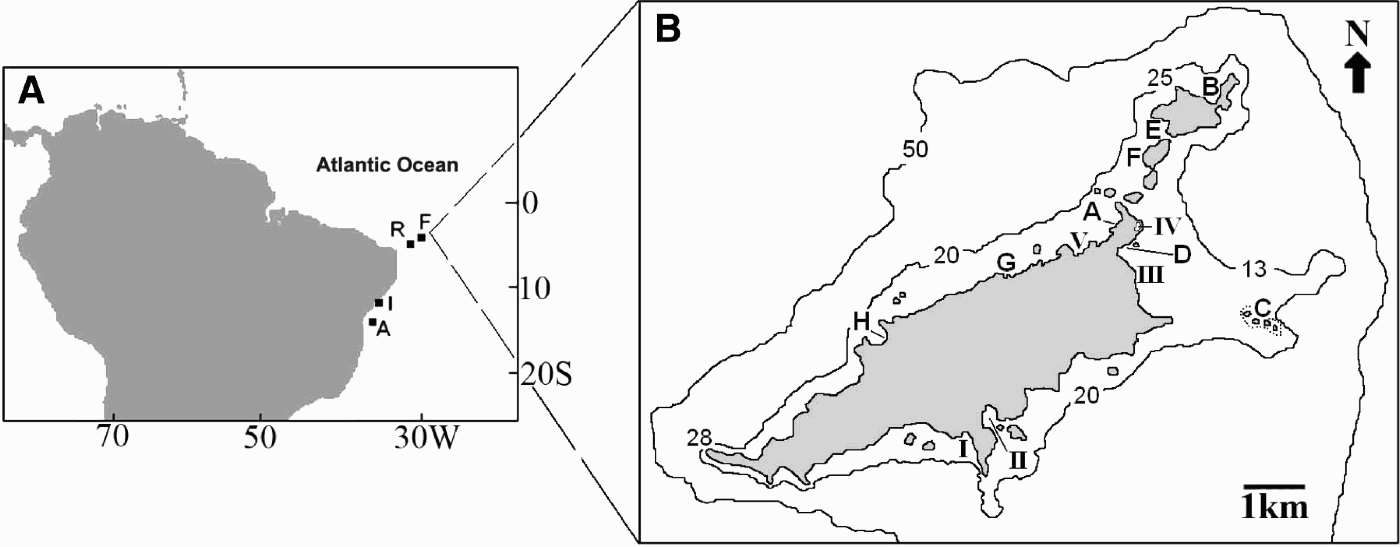
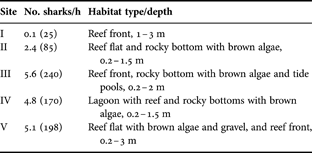
Snorkelling was employed in depths up to ten metres, totalling 493 dives and 785 hours, whereas SCUBA diving was performed in areas from 11 to 30 m depth, resulting in 391 dives and 571 hours of survey time. Records of young N. brevirostris are summarized in Table 1. Although a wide depth range was searched, individuals of this species were never observed in sites with depths above five metres. Aggregations of up to 12 young N. brevirostris were observed every year, in depths from 0.2 to 5 m along the intertidal zones of the shoreline with turbid waters over reef or rocky bottoms covered by brown algae. Locations with those features occur in several sections of the windward side, but young sharks were mainly observed in four sites of this side of the archipelago and in the only site of the leeside that shares similar characteristics (see Figure 1 for location). In those sites, lone individuals and groups of three to five sharks were observed patrolling the edge of the reef front during low tides. As the tide rose, they aggregated at the top and back portions of the reef where the water is warmer, with mean temperatures of 29–30°C. Neonates with estimated TL of 60 to 80 cm were generally segregated from juveniles with estimated TL of 90 to 150 cm, and aggregations of each size-class were usually located in distinct and specific sections of the shoreline. Overall, neonates were observed from mid-November to April and juveniles during the rest of the year. Also, three individuals with open umbilical scars were captured and released in February 2003 (1 female and 2 males measuring 68, 63 and 62 cm TL, respectively; Figure 2). Examination of a number of Brazilian ichthyology collections revealed one neonate male 67 cm TL captured at Abrolhos Archipelago (see Figure 1 for location), deposited in the Museu de Zoologia, Universidade de São Paulo (MZUSP 53076). As this work was completed, a female N. brevirostris 2.5 m TL with mature oocytes was captured by fishermen in mid-February in waters less than 30 m depth around Itaparica Island, located approximately 1200 km south of Fernando de Noronha (photographs provided by Dr C.L.S. Sampaio, Universidade Federal da Bahia – UFBA).
(A) Location of Fernando de Noronha Archipelago (F), distance 345 km from the Brazilian coast, and other localities in the south-western Atlantic Ocean where the occurrence of young Negaprion brevirostris has been recorded: Atol das Rocas (R), Abrolhos Archipelago (A) and Itaparica Island (I), located 267 km, 65 km and 8 km from the Brazilian north-eastern coast, respectively; (B) sites of Fernando de Noronha Archipelago where young N. brevirostris (Arabic numbers) and neonate Ginglymostoma cirratum (Roman numbers) have been recorded.

(A) Neonate male of Negaprion brevirostris 63 cm TL captured and released in February 2003. The black arrow indicates the open umbilical scar; (B) neonate Ginglymostoma cirratum of unidentified sex and approximately 25 cm TL photographed in February 2003 (Photograph: S. Fonseca).

Mean number of records (no. sharks observed/hour diving) of young Negaprion brevirostris within Fernando de Noronha Archipelago from 2001 to 2007. Numbers in parenthesis indicate the total number of sightings (see Figure 1 for location).

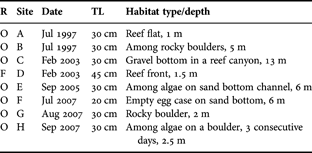
Records of newborn G. cirratum (Figure 2) are summarized in Table 2. In addition, in July 1996 a fisherman landed two near term embryos with estimated 25 cm TL from a female of 2.5 m TL, captured over 50 m depth. Neonate or young specimens measuring less than 50 cm TL were not recorded in the Brazilian ichthyologic collections surveyed or in NEODAT.
Underwater observations (O) and fisheries landings (F) of neonate Ginglymostoma cirratum in Fernando de Noronha Archipelago between 1997 and 2007 (see Figure 1 for location).

R, type of record; TL, estimated total length.
Observations indicate that both species utilize nearshore waters of this oceanic insular area during their initial life cycle. Although the presence of neonates and juveniles is considered by some authors to be the lowest level of evidence for defining nursery areas (Beck et al., Reference Beck, Heck, Able, Childers, Eggleston, Gillanders, Halpern, Hays, Hoshino, Minell, Orth, Sheridan and Weinstein2001), it is still an important step towards defining and preserving essential habitats required for effective shark conservation and fisheries management. Despite being a marine protected area since 1988, both species were previously exploited in FN by a shark fishery from 1992 to 1997. In this regard, the presence of neonates in consecutive years testifies to the potential of this area for contributing to the recruitment of their populations in this part of the Atlantic. Fernando de Noronha and Atol das Rocas are currently regarded as the southernmost nurseries for N. brevirostris in the South Atlantic Ocean (Feldheim et al., 2001). However, the capture of a mature female 1200 km south of FN coupled with the examination of an immature museum specimen from Abrolhos Archipelago, located approximately 1650 km south of FN, offer the possibility that other sites may be used as nursery areas by N. brevirostris in this part of the Atlantic Ocean. This is further supported by observations of other researchers in Abrolhos Archipelago, which indicate that neonate individuals are common on the shoreline during summer months in consecutive years (Dr C.L.S. Sampaio, UFBA, personal communication). Thus, in this context, fishery monitoring and dive observations may be useful in confirming that area as a nursery, and also in obtaining information about the distribution and location of potential nursery habitats for this species in other sites along tropical regions of the Brazilian coast.
In addition, records indicate neonate and juvenile N. brevirostris exhibit site fidelity to specific sites of the shoreline and that parturition in FN takes place during the tropical summer. This is supported by studies in the north-western (Compagno, Reference Compagno1984) and south-western Atlantic (Freitas et al., Reference Freitas, Rosa, Gruber and Wetherbee2006) that report similar site fidelity behaviour and a birth season coincident with that time of the year. Observations also indicate that young lemon sharks use sections of the shoreline with rough and turbid waters, and shift from deeper to shallower habitats to explore different parts of the reef profile during tidal fluctuations. As FN has a very small mangrove (0.01 km2) that is functional for a brief period of the year or can be isolated from the sea for several years, this behaviour probably is a consequence of the reduced availability of shelter, which may cause young sharks to be more exposed to predators relative to other nurseries in mangrove areas. Supporting this assumption, a similar use of the reef topography has been observed in a nearby nursery devoid of mangroves (Wetherbee et al., Reference Wetherbee, Gruber and Rosa2007).
On the other hand, observations indicate that G. cirratum parturition occurs from July to September, though neonates may be found occasionally in other periods of the year. This is in accordance with data from another nursery in the south-western Atlantic, located 150 km west of FN, where one neonate and some egg cases were observed in August (Castro & Rosa, Reference Castro and Rosa2005). This pattern of distinct parturition times of sympatric shark species using the same nursery has been suggested to reduce interspecific competition and predation mortality during the first few months among species with great discrepancies in their size at birth (Motta et al., Reference Motta, Gadig, Gadig Namora and Braga2005). Although this hypothesis needs further investigation, the size at birth of N. brevirostris is nearly twice that of G. cirratum and the former is born in a later period of the year, suggesting that this reproductive tactic may occur in this nursery habitat.
ACKNOWLEDGEMENTS
Financial support was provided by CAPES (to J.G. Jr). The authors thank Samuel Fonseca, Fábio B. Pereira and Mica de Souza for allowing use of image records, and Lisandro B. Almeida for providing detailed records of his dive logbook. Special thanks to Dr Cláudio L.S. Sampaio for providing photographic records and information on lemon sharks in Bahia State.