Introduction
Late life depression is an increasingly important public health problem in many aging countries as its prevalence is estimated to be around 15% among people aged 65 years and over (Gottfries, Reference Gottfries2001). Addressing late life depression is essential because it has been associated with poorer quality of life, reduced social and physical functioning, and increased morbidity and mortality (Unutzer, Reference Unutzer2007). The negative effects of late life depression are pronounced in South Korea, a rapidly aging society with a comparably high rate of late life depression at around 22% (Park et al., Reference Park2012). South Korea also ranks first among Organization for Economic Cooperation and Development (OECD) countries in suicide rate, which is highly linked to depression (Organization for Economic Cooperation and Development, 2010). Yet, because societal recognition of late life depression is comparatively poor and often negatively perceived in South Korea, it has become particularly significant to address the associated factors (Park et al., Reference Park, Kim, Cho and Lee2015).
Intergenerational discordance in the perception of family values resulting from rapid demographic and societal changes has been identified as a factor associated with late life depression. South Korea has experienced rapid industrialization and economic development since the late 1960s and notable demographic and societal changes have taken place. The general marriage rate and fertility rates have declined, whereas the average age at first marriage and general divorce rates have increased (Statistics Korea, 2015). The proportion of unmarried males increased from 1% in 1970 to 18% in 2005 and the age at first marriage increased from 26.7 in 1972 to 32.4 in 2014. At the same time, the proportion of unmarried females rose from 1% to 19% and the age at first marriage increased from 22.6 to 29.8 (Kim, Reference Kim2009; Statistics Korea, 2015). The crude divorce rate (number of divorces per 1,000 population) has also increased from around 0.4 in 1970 to 2.3 in 2014, with the average age at divorce at 46.5 for males and 42.8 for females (Statistics Korea, 2015). Unsurprisingly, these alterations have been accompanied by numerous societal shifts, including a noticeable decrease in fertility rate, a weakening of traditional values emphasizing the importance of continuing family lineages, an increase in the number of nuclear families partially resulting from urbanization, and an escalation of women receiving higher education or participating in the labor force (Chung and Gupta, Reference Chung and Gupta2007). However, because changes have taken place in a relatively short period of time, they have inevitably contributed to generational gaps resulting from discordance in marital values between the different generations, which in turn have been associated with the mental health status of older adults.
Apart from offspring marital status, the education level of offspring can also influence the mental health status of parents. This is because many East Asian countries, including South Korea, have been influenced by Confucian values that favor high educational status, with educational prestige often allowing upward mobility during the period of fast industrialization (Kim, Reference Kim and Kim1999). Considering that parents are impacted by their children's accomplishments and that the South Korean society frequently assesses competitiveness based on educational attainment, education level can serve as a central factor to contemplate (Anderson and Kohler, Reference Anderson and Kohler2013). Furthermore, because the pension system in South Korea is relatively weak, offspring education level can also imply more stable intergenerational support (Park et al., Reference Park, Phua, McNally and Sun2005). Due to such interconnections, the marital status and education level of adult offspring may interact to impact the depression levels of parents. Therefore, this study aimed to investigate the association between the marital status of offspring aged 40 years and over and depressive symptoms in parents.
Methods
Study population
Data from the Korean Longitudinal Study of Aging (KLoSA) for the years 2006, 2008, 2010, and 2012 were used. The KLoSA is a nationally representative longitudinal database composed of individuals aged 45 and over and is conducted by the Korean Labor Institute. Households are selected using a multistage stratified sampling method based on geographical areas. Surveys are collected biennially through the computer assisted personal interviewing (CAPI) technique and cover topics that include demographics, family and social networks, physical and mental health, employment and retirement, income, and wealth. The original 2006 baseline data contained 10,254 individuals and after accounting for follow up loss, the 2008 data contained 8,688 individuals, the 2010 data contain 7,920 individuals, and the 2012 data contain 7,486 individuals.
Of the 10,254 individuals in the 2006 data, only individuals with offspring aged 40 years and over were included in this study as it aimed to examine how the marital status of older aged offspring was associated with depressive symptoms in parents. In fact, young adult offspring remaining single were not likely be related to parental depressive symptoms as it is considered generally normative, and the average age of marriage in South Korea has been reported to be 32.4 for males and 29.8 for females in 2014 (Statistics Korea, 2015). Hence, 319 participants without any offspring and 7,231 participants without any offspring aged 40 years and over were excluded from the analysis, leading to the inclusion of 2,704 participants with offspring aged 40 years and over. Afterwards, because this study investigated the effect of offspring being either never married, separated (divorced, widowed, and separated), or both, only individuals with two or more offspring were included since parents with only one offspring could not have both never married and separated offspring. Thus, 164 individuals with only one offspring aged 40 years and over were excluded. As a result, 2,540 individuals with two or more offspring aged 40 years and over remained to form the 2006 baseline study population.
Measures
Depressive symptoms
The outcome variable of this study was depression score. Depression scores were measured in the KLoSA using the Center for Epidemiological Studies and Depression (CES-D) 10 scale developed at the Boston site of Established Populations for Epidemiological Studies of the elderly. The CES-D 10 inquires the following 10 items felt or carried out during the past week: (1) “I was bothered by things that usually do not bother me;” (2) “I had trouble keeping my mind on what I was doing;” (3) “I felt depressed;” (4) “I felt that everything I did was an effort;” (5) “I felt hopeful about the future;” (6) “I felt fearful;” (7) “My sleep was restless;” (8) “I was happy;” (9) “I felt lonely;” and (10) “I could not get going.” Afterwards, the responses to the 10 questions are dichotomized into a yes or a no, which yields a total score of 0–10. A cut-off score of 4 in the CES-D 10 indicates probable depression in the elderly (Irwin et al., Reference Irwin, Artin and Oxman1999). The validity of the CES-D 10 as a screening tool for older adults has been proven and the α coefficient for the Boston version of the CES-D 10 was 0.92 for the middle aged and 0.80 for the elderly (Andresen et al., Reference Andresen, Malmgren, Carter and Patrick1994). The CES-D has also been validated in the South Korean population, with an α coefficient of 0.909 (Cho and Kim, Reference Cho and Kim1993).
Marital status of offspring
The marital status of offspring was obtained based on the following question: “Is your child (child name) currently in marriage?” This question was asked for each of the offspring a study participant had identified. In this study, the marital status of offspring was categorized into married, never married, separated (divorced, widowed, and separated), and both never married and separated categories. If individuals cited that all of their offspring were married, individuals were categorized into the married category. If individuals had an offspring that never married and an offspring that had divorced, this individual was classified into the both category. This study incorporated the marital status of the first, second, and third offspring in the analysis.
Covariates
Individual and offspring characteristics were included as covariates. Individual characteristics included sex (male or female), age (55–64, 65–74, or 75 years and over), education level (high school or below or university and beyond), equalized household income (quartiles), wealth (quartiles), marital status (single or married), labor status (non-active or active), number of offspring (two, three, four, or above), chronic disease status (yes or no), and the number of impaired ADLs. Offspring characteristics included sex (male only, female only, or both), education level (high school graduate only or at least one university graduate), and labor status (all non-active, all active, or both).
Statistical analysis
The study participants’ general characteristics were examined using t-tests and analysis of variance (ANOVA) to compare differences in CES-D 10 scores and standard deviations. In analyzing the association between offspring marital status and depression scores in parents, the generalized estimating equation (GEE) model was used. The GEE model is an extension of the quasi-likelihood approach and can be used to analyze longitudinal correlated data, accounting for time variation and the correlations among repeated measurements present in a longitudinal study design (Hanley et al., Reference Hanley, Negassa and Forrester2003). The GEE model was applied in this study because the KLoSA is longitudinal and can contain annual repeated measurements of the same individuals. Hence, individuals originally included in the 2006 baseline and their CES-D 10 outcomes were continuously followed up and measured in 2008, 2010, and 2012. Subgroup analysis was performed based on offspring education level to further investigate its influence on the relationship between the marital status of offspring and depressive symptoms in parents. The calculated p-values were two-sided and considered significant at p < 0.05. Analysis was performed using the SAS software, version 9.4 (SAS Institute, Cary, NC, USA).
Results
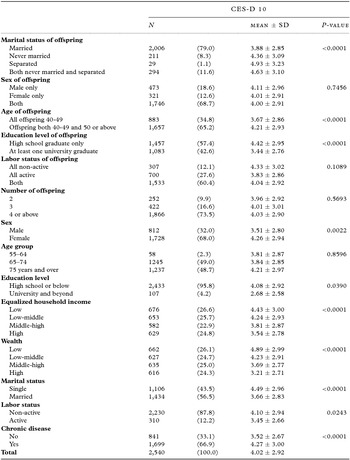
The general characteristics of the study participants in the 2006 baseline are shown in Table 1. With regard to the marital status of offspring, 2,006 (79.0%) individuals had offspring who were all married, 211 (8.3%) individuals had offspring who never married, 29 (1.1%) individuals had offspring who separated, and 294 (11.6%) individuals had offspring who never married and offspring who separated. The mean CES-D 10 scores were 3.88 ± 2.85 in the married group, 4.36 ± 3.09 in the never married group, 4.93 ± 3.23 in the separated group, and 4.63 ± 3.10 in the both never married and separated group. The mean number of impaired Activities of Daily Living (ADL) was 0.42 ± 1.44 for the baseline study population.
General characteristics of the study participants at 2006 baseline

CES-D 10 score is expressed as mean ± SD.
Separated includes separated, divorced, or widowed individuals.
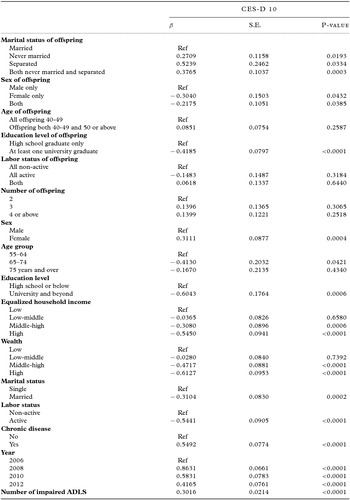
The results of the GEE model analyzing the effect of offspring marital status on CES-D 10 scores of parents are shown in Table 2. When the parents of the married offspring group were set as reference, the parents of the never married offspring group (β: 0.27, p = 0.02), the separated offspring group (β: 0.52, p = 0.03), and the both never married and separated group (β: 0.38, p < 0.001) showed increases in depression scores.
Results of the GEE analyzing the effect of offspring marital status

CES-D 10 score is expressed as mean ± SD.
Separated includes separated, divorced, or widowed individuals.
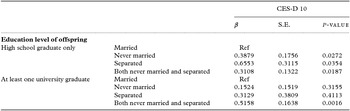
The results of the GEE model analyzing the effect of offspring marital status and participant CES-D 10 scores by offspring education level are shown in Table 3. The trends shown in Table 2 were generally maintained regardless of offspring education level. For parents with only high school graduate offspring, statistically significant higher depression scores were seen in parents of the never married offspring group (β: 0.39, p = 0.03), the separated offspring group (β: 0.66, p = 0.04), and the both never married and separated offspring group (β: 0.31, p = 0.02) compared to the married offspring group. Similar tendencies were shown in parents with at least one university graduate offspring but statistical significance was found only in parents belonging to the both never married and separated offspring group (β: 0.52, p = 0.00).
Results of the GEE analyzing the effect of offspring marital status and participant CES-D 10 scores by the education level of offspring

CES-D 10 score is expressed as mean ± SD.
Separated includes separated, divorced, or widowed individuals.
Adjusted for marital status of offspring, sex of offspring, age of offspring, education level of offspring, labor status of offspring, number of offspring, sex, age, education level, household income, wealth, marital status, labor status, chronic disease status, number of impaired ADLs, and year.
Discussion
The results of this study show that parents with offspring aged 40 years and over who never married, separated, or both have higher depression scores than parents with only married offspring. To the best of our knowledge, no previous studies have explicitly investigated the effect of older adult offspring marital status on parental depressive symptoms in the South Korean population. Regarding offspring who have never married, it is noteworthy that the trends toward late marriage have been comparatively pronounced in East Asia (Raymo et al., Reference Raymo, Park, Xie and Yeung2015). The reasons behind this phenomenon are relatively complex in which increasing urbanization, female education attainment, higher living costs, and uncertain labor markets have been cited as contributing factors (Jones and Yeung, Reference Jones and Yeung2014). The worldwide 2008 economic crisis may have also taken part, as economic instability has been associated with increases in the mean age at first marriage (Chin, Reference Chin2010). Furthermore, there have also been changes in societal perceptions of marriage, with marriage becoming increasingly considered as an individual's choice rather than a necessity (Choe, Reference Choe2006; Chung and Gupta, Reference Chung and Gupta2007). In fact, the number of people who responded "yes" to the statement "it is essential to marry" has decreased by around 10% from 1998 to 2008 in South Korea (Chin, Reference Chin2010). Additionally, these changes have also led to an increased prevalence of cohabitation among younger people. Such escalations have not only been related with a stronger incentive to stay single, but have also been associated with an increased likelihood of prolonged co-residence with parents or experiencing divorce (Bramlett and Mosher, Reference Bramlett and Mosher2002; Cherlin, Reference Cherlin2004).
As a result of the rapid societal changes that have taken place in many East Asian countries, discordance between generations in the perceptions and norms about marriage has become profound. In contrast to the younger generations that increasingly view marriage as a voluntary choice, late marriage is generally not considered normative in the traditional East Asian kinship system emphasizing family lineages, and remaining single has rarely been culturally acceptable, particularly for women (Ban, Reference Ban2012). Yet, because aging has lengthened the number of years shared between different generations and a drop in fertility rates has enlarged the number of across generational contacts compared to within generational contacts, intergenerational differences have become more conflicting and complex (Farkas and Hogan, Reference Farkas and Hogan1993; Bengston, Reference Bengston2001). Moreover, delayed marriage until midlife has also been related with an increased likelihood of co-residence with parents, which can act as a stressor in relationships if involuntary (Raymo et al., Reference Raymo, Park, Xie and Yeung2015). Thus, considering that cultural norms serve as important factors in family relationships, the dissimilarities in perceptions of marriage between different generations are likely to be associated with late life psychosocial well-being among parents of older aged offspring (Koropeckyj-Cox, Reference Koropeckyj-Cox2002; Van Gaalen and Dykstra, Reference Van Gaalen and Dykstra2006).
Apart from delayed marriage, problems in a child's marriage, for instance divorce, can also influence the parent–offspring relationship (Knoester, Reference Knoester2003). Strains result because life course transitions in an adult offspring have the potential to impact the lives of parents and their quality of relationships. Previous studies have shown that divorced and widowed offspring marital status is associated with increased strains in the offspring–parent relationship (Umberson, Reference Umberson1992). In particular, as divorce is associated with difficult alterations in financial and family structure, offspring divorce can deteriorate the quality of intergenerational relationships (Brubaker, Reference Brubaker1990). Such tendencies may be particularly significant in East Asia because divorce was considered undesirable and not normative in past patriarchal societies (Raymo et al., Reference Raymo, Park, Xie and Yeung2015). However, in contrast to previously held values, the crude divorce rate proliferated by around 10.7 times between 1970 and 2007 in South Korea as a result of weakening traditional family values and the financial economic crisis that took place in the 1990s (Paik, Reference Paik2009). Since this increase has been very recent and has added to the weakening of strong traditional family norms, it will most likely be in conflict with the conservative values held by older cohorts (Awang, Reference Awang2011). Therefore, given that the psychosocial benefits of parenthood in old age often depend on good quality relationships, the marital status of offspring can be seen to be associated with the mental health status of parents (Koropeckyj-Cox, Reference Koropeckyj-Cox2002).
In addition to the marital status of offspring aged 40 years and over, the education level of offspring may also be interrelated with the level of depression in parents. In South Korea, socioeconomic status (SES) is often viewed based on academic achievement and education has been perceived as an essential factor in reflecting social status (Seth, Reference Seth2002). In fact, the educational effect on health is marked in South Korea because it is strongly associated with occupational position and material well-being (Son, Reference Son2004). Hence, when considering that marriages in South Korea often attempt to match socioeconomic backgrounds and that the economically disadvantaged people suffer most from the shortage of spouses, it is probable that the education level of offspring will exert a psychosocial impact on parents (Das Gupta and Shuzhuo, Reference Das Gupta and Shuzhuo1999). The results of this study also present that the general trends of the effect of offspring marital status on the depression scores of parents are more pronounced among parents with only high school graduate offspring than those with at least one university graduate offspring. Therefore, this study implies that the mental health status of parents can be impacted by the marital status of middle aged offspring and that offspring education level can take part in the stated relationship.
This study has some limitations. First, this study excluded all individuals with only one offspring in the analysis because it aimed to examine offspring marital status using the categories married, never married, separated, and both never married and separated. However, the effect of this exclusion may have been minimal as the number of individuals with only one offspring was relatively small. Second, this study only investigated how the marital status of the first, second, and third offspring was related to the depression scores of parents due to KLoSA database structure. Third, a few previous studies have cited that the quality of parent–offspring relationships can act as a mediator in the relationship between offspring marital status and parental depressive symptoms. This aspect was not specifically investigated in the present study due to data limitations. Future studies incorporating this factor may hence be able to provide further insights regarding the factors associated with the investigated relationship. Despite the limitations stated above, this study offers new insights in that it examines the relationship between offspring marital status and parent depression scores in South Korean individuals.
Conclusion
The marital status of offspring aged 40 years and over was associated with depression scores of parents. Parents of never married, separated, or both never married and separated offspring expressed higher depression scores than parents of only married offspring. Additionally, the education level of offspring also showed a relationship as the mental health effects of offspring marital status were more prominent among parents with only high school graduates than parents with at least one university graduate. Therefore, the results of this study reveal that it is important to monitor the mental health status of parents with never married, separated, and both never married and separated offspring aged 40 years and over as this group may be comparatively vulnerable to depressive symptoms.
Conflict of interest
None.
Description of authors’ roles
W. K. designed the study, collected the data, performed the statistical analysis, and wrote the manuscript. W. K., E. C. P., K. T. H., T. H. L., and T. H. K reviewed and edited the manuscript. T. H. K is the guarantor of this work and, as such, has full access to all of the data. T. H. K assumes responsibility for the integrity of the data and accuracy of the data analysis. All authors read and approved the final manuscript.