I. INTRODUCTION
Noble metal nanoparticles have attracted much interest owing to their unique properties, which has been widely used in various research fields, such as electrocatalysis, Reference Giovanni, Poh, Ambrosi, Zhao, Sofer, Šaněk, Khezri, Webster and Pumera1,Reference Tian, Zhou, Sun, Ding and Wang2 surface-enhanced roman scattering, Reference Alessandri, Ferroni and Depero3 sensing, Reference Jean, Chiu, Chen, Chen and Liu4 information storage, Reference Murray, Sun, Doyle and Betley5 antibacterial, cancer cell imaging, and photothermal therapy. Reference Liu, Sun, Zhao and Zhang6,Reference Huang, EI-Sayed, Qian and EI-Sayed7 Over the past decades, much effort has been made to fabricate gold nanoparticles (Au NPs) owing to Au nanoparticles with fascinating optical properties resulting in their important application in catalysis reaction with the characteristics of high reactivity and selectivity. Reference Zijlstra, Chon and Gu8,Reference Zhang, Yang, Zhan, Sun, Wang, Song and Li9 Up to date, deposition–precipitation, Reference Qian, Luo, Bao, Hua, Jiang and Huang10 chemical reduction, Reference Nikabadil, Shahtahmasebil, Rokn-Abadil, Mohagheghi and Goharshadi11,Reference Li, Zhang, Zhao, Zou and Zhao12 galvanic replacement, Reference You, Mao and Ge13 and seed-mediated growth Reference Kim, Park, Lee, Jin, Lee, Lee, Yang, Kim, Kim, Cho and Hyeon14 for the synthesis of Au nanoparticles (Au NPs) have been achieved so far. In contrast to other preparation methods, solution approaches including chemical reduction methods are usually carried out in an easy and mild way, which generally involves the reduction reagents used, such as hydroxylamine hydrochloride, Reference Srnová-Šloufová, Vlčková, Bastl and Hasslett15 carboxylic acid, Reference Mandal, Selvakannan, Phadtare, Pasricha and Sastry16 glucose, Reference Yang and Qi17 hydrazine hydrate, Reference Adhyapak, Singh, Vijayan, Aiyer and Khanna18 and so on. As is well known, the catalytic properties of Au nanostructures are related to their size, with the smaller particles having higher activities on the basis of equivalent Au mass content. According to the previous reports, Au NPs only with sizes below 5 nm showed high catalytic activities. Reference Chen and Goodman19,Reference Falsig, Hvolbæk, Kristensen, Jiang, Bligaard, Christensen and Nørskov20 However, the Au nanoparticles with smaller size should aggregate in media with a high electrolyte content, resulting in a loss of catalytic activities. Hence, Au nanoparticles are usually embedded into solid substrates to stabilize the Au nanoparticles against aggregation, leading to retention of the catalytic activities. Graphene oxide, Reference Lu, Ning, Qin, Zhang, Chang, Liu, Luo and Sun21 polystyrene, Reference Zhou, Ren, Wu, Zhang, Xiao, Xu and Jiang22 carbon spheres, Reference Tang, Vongehr, Zheng, Liu and Meng23 polyacrylonitrile Reference Anka, Perera, Ratanatawanate and Balkus24 have been used as the substrates to stabilize the Au nanoparticles. In contrast to other matrix, silica occupies its unique advantages owing to its better chemical stability and optical transparency. Reference Malynych and Chumanov25
In this work, we present a facile process for the synthesis of SiO2/Au hybrid microspheres via galvanic replacement of SiO2/Ag hybrid microspheres and chlorauric acid (HAuCl4) solution and the typical protocol has been shown in Fig. 1. The silica microspheres are decorated with ultrasmall Au nanoparticles with an average diameter of 4 nm and the SiO2/Au hybrid microspheres are about 200 nm in diameter, which exhibit superior catalytic reduction of 4-nitrophenol (4-NP) to 4-aminophenol (4-AP).
Schematic illustration of the formation of the mesoporous SiO2@Au hybrid microspheres.

II. EXPERIMENTAL
All chemicals were of analytical grade and received from Shanghai Chemical Ltd Co., which used without purification.
A. Synthesis of amorphous silica microspheres
The amorphous silica microspheres with a diameter of 200 nm have been achieved via a modified protocol. Reference Hu, Luo, Yang, Yao, Zhang and Qian26,Reference Hu, Yang, Lin, Ye, He, Zhang and Qian27 In a typical process, 2 mL of TEOS and 2 mL of double-distilled water were added to 20 mL absolute ethanol to form clear solution, and then 1 mL of ammonium hydroxide was added to the above solution with vigorous stirring and kept at room temperature for 24 h. The product was collected by centrifugation and washed with ethanol for three times, and dried at 60 °C for 12 h.
B. Synthesis of the SiO2/Ag hybrid microspheres
The SiO2/Ag hybrid microspheres can be achieved by one-step hydrothermal method. Reference Liu, Cao, Peng, Qian, Yang and Zhang28 Typically, 0.25 g of amorphous silica microspheres was added to 21 mL of deionized water with vigorous stirring for 5 min to obtain homogenous colloid solution, and then 3 mL of Ag(NH3)2 + solution (in the supporting information) was added to the above colloid solution. Subsequently, the solution was transferred to 30 mL Teflon-line autoclave and kept at 180 °C for 24 h. The SiO2/Ag hybrid microspheres were collected by centrifugation and washed with deionized water and ethanol for several times, and dried at 60 °C for 4 h.
C. Preparation of the SiO2/Au nanospheres
The synthesis of SiO2/Au hybrid microspheres has been successfully achieved from the galvanic replacement of SiO2/Ag hybrid microspheres and HAuCl4 solution. In a typical protocol, 0.05 g of prepared SiO2/Ag microspheres were well dispersed using 10 mL of ethanol, and then 1 mL 1% (wt.%) of HAuCl4·aqueous solution was added to the solution dropwise with vigorous stirring for 1.5 h, and the final product was collected by centrifugation and washed with the saturated NaCl solution and absolute ethanol for several times, and then dried at 60 °C for 12 h.
D. Catalytic reduction of 4-nitrophenol
The reduction of 4-nitrophenol (4-NP) was carried out in a quartz cuvette at room temperature. First, 0.24 mL of 4-NP aqueous solution (0.01 M) was mixed with 0.8 mL of freshly prepared NaBH4 solution (0.1 M), and then diluted to 20 mL using distilled water. Subsequently, 2 mg of SiO2/Au hybrid microspheres was added to the mixture solution with vigorous stirring at room temperature. The concentration of 4-nitrophenol was measured by UV-vis spectrophotometer (2501 PC model; Shimadzu, Kyoto, Japan) at given intervals.
E. Characterization
The phase of the as-prepared product was characterized by x-ray power diffraction (XRD) analysis, which was carried out on a Philips X’Pert PRO SUPER x-ray diffractometer (Amsterdam, Netherlands) equipped with graphite monochromatized Cu Kα radiation and the operation voltage and current were maintained at 40 kV and 40 mA, respectively. The morphology and size of the samples were investigated by field-emission scanning electron microscopy (FESEM, JEOL-6700F, JEOL, Kyoto, Japan) and transmission electron microscopy (TEM, JEOL 3010, Kyoto, Japan). The UV-vis spectroscopy was recorded on SHIMADZU UV-2501 (Kyoto, Japan).
III. RESULTS AND DISCUSSION
A. Synthesis of the SiO2 and SiO2/Ag hybrid microspheres
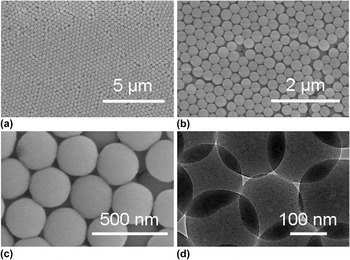
The SiO2/Ag hybrid microspheres have been achieved via a hydrothermal process from the silica microspheres and Ag(NH3)2 + solution. Scanning electron microscopy and TEM images shown in Fig. 2 demonstrated that the as-prepared SiO2 spheres and SiO2/Ag hybrid microspheres were both about 200 nm in diameter. The TEM images of the silica/Ag microspheres have been shown in Fig. 2(d), illustrating the silica microspheres successfully decorated with small aggregates of ultrasmall Ag nanoparticles with an average diameter of 4 nm. X-ray diffraction analysis of the as-prepared SiO2/Ag hybrid microspheres is shown in Fig. S1 (in the supporting information).
(a, b) SEM images of amorphous silica; (c) SEM image of the as-prepared SiO2/Ag microspheres; (d) TEM image of the as-prepared SiO2/Ag microspheres.

B. Synthesis of the SiO2/Au hybrid microspheres
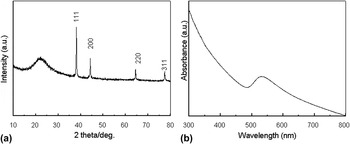
Ag nanostructures have commonly been used as a sacrificial template for synthesizing different morphologies of Au via the galvanic replacement reaction (GRR) since the standard reduction potential of the AuCl4 −/Au pair (0.99 V versus standard hydrogen electrode, SHE) is much higher than that of the AgCl/Ag pair (0.22 V versus SHE). Reference Huang, Vongehr, Tang, Lu, Shen and Meng29,Reference Liusman, Li, Chen, Wei, Zhang, Schatz, Boey and Mirkin30 The galvanic replacement reaction has been widely used as a simple and versatile route to synthesize hollow nanostructures of noble metals with tunable and well-controlled properties. Reference Xia, Wang, Ruditskiy and Xia31,Reference Cao, Zhou, Xu, Cheng, Yao and Fan32 The loaded Ag nanocrystals of the SiO2/Ag hybrid microspheres were oxidized into Ag+ with the addition of HAuCl4 aqueous solution resulting in the formation of Au0 and AgCl solids. Reference Lampre, Pernot and Mostafavi33 Figure 3(a) showed XRD pattern of the as-prepared sample obtained from the reaction of 0.05 g of SiO2/Ag microspheres and 1 mL 1% (wt.%) of HAuCl4·4H2O solution at room temperature for 1.5 h, in which the peaks located at 38.2, 44.4, 64.8, and 77.7° can be readily indexed to the 111, 200, 220, and 311 of crystal planes for face-centered cubic Au (JCPDS Card No. 04-0784). Reference Kim, Bryan, Chung, Park, Jacobson and Lee34,Reference Mo, Li, Zheng, Yuan, Xiao and Choi35 The UV-vis absorption spectra have been used to characterize the optical properties of the as-prepared SiO2/Au hybrid microspheres and the peak located at 530 nm showed a typical adsorption of Au nanoparticles, as shown in Fig. 3(b). Reference Chen, Chen, Guo, He, Chen, Zhou, Feng and Shi36
X-ray diffraction pattern (a) and UV-vis absorption spectra (b) of the as-prepared SiO2@Au hybrid microspheres.

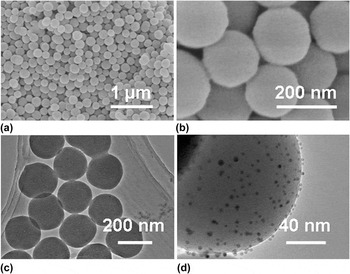
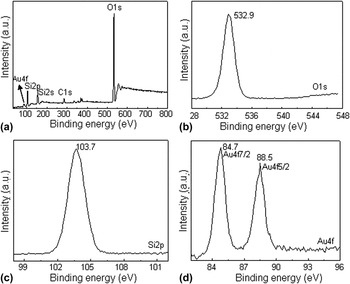
The morphology and size of the as-prepared samples were characterized by the scanning electron microscopy (SEM) and TEM. As shown in Fig. 4, the obtained SiO2/Au hybrid microspheres are about 200 nm in diameter and the silica microspheres were decorated with Au nanoparticles of approximately 4 nm, which is in well accordance with the silica microspheres and SiO2/Ag hybrid microspheres shown in Figs. 2(a)–2(c). The chemical compositions and states of the as-prepared silica/Au hybrid microspheres were characterized by the x-ray photoelectron spectra (XPS). The binding energies at 532.9 and 103.7 eV can be assigned to the binding energies of O1s and Si2p, respectively [Figs. 5(b) and 5(c)]. Figure 5(d) showed the binding energies at 84.7 and 88.5 eV, which could be indexed to the characteristic signal of metallic Au. Reference Tunc, Suzer, Correa-Duarte and Liz-Marzán37 The element compositions of the as-prepared SiO2/Au microspheres from XPS analysis are also listed in Table S1 (in the supporting information) indicating 0.46 at.% of Au. In the present study, solvent played an important role in the formation of the SiO2/Au hybrid microspheres with well-controlled size of Au nanoparticles. For comparison, the solvent was changed to the distilled water, the reaction speed of the galvanic replacement reaction of Ag and HAuCl4 was greatly enhanced because the diffusion speed of reactants in aqueous solution resulting in formation of Au nanoparticles with bigger size, as shown in Fig. S2 (in the supporting information). So, ethanol was chosen as the reaction medium to obtain uniform and smaller size of Au nanoparticles decorating on the substrate.
(a, b) SEM images and (c, d) TEM images of the as-prepared silica/Au hybrid microspheres.

The x-ray photoelectron spectra (XPS) of SiO2/Au composite: (a) survey spectrum; (b) O1s, (c) Si2p, (d) Au4f.

C. Catalytic reduction of 4-nitrophenol
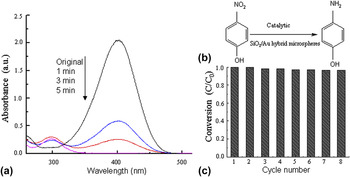
The catalytic reduction of 4-nitrophenol (4-NP) to 4-aminophenol (4-AP) by NaBH4 was chosen as a model reaction to examine the catalytic properties of SiO2/Au hybrid microspheres. Reference Du, Chen, Chen and Xu38 The concentration of 4-NP is determined according to the absorption at 400 nm which was measured by a UV-vis spectrophotometer. Figure 6(a) showed typical absorption spectra of aqueous 4-NP solution after visible light irradiation for various time periods using the as-prepared SiO2/Au hybrid microspheres as the catalyst, which demonstrated catalytic conversion from 4-NP to 4-AP quickly finished in five minutes. The as-prepared SiO2/Au hybrid microspheres exhibited superior catalytic properties over conversion from 4-NP to 4-AP. What's more, for a useful catalyst, it should be stable after repeated use. To test the repeatability of 4-NP catalytic reduction using the as-prepared SiO2/Au hybrid microspheres, the catalytic conversion of 4-NP experiments was carried out and repeated eight times. As shown in Fig. 6(c), more than 90% of 4-NP solution (16.57 mg L−1, 20 mL) could be catalytic reduction to 4-AP over the as-prepared SiO2/Au catalyst for the eighth time. In addition, the TEM images of the silica/Au hybrid microspheres obtained after eight successive cycles of the catalytic reduction to 4-AP are shown in Fig. S3 (in the supporting information), which showed no difference between the before and after successive cycles of the catalytic reduction demonstrating the excellent chemical stability of the as-prepared SiO2/Au hybrid microspheres. Therefore, the as-prepared SiO2/Au hybrid microspheres showed superior catalytic properties with good stability.
(a) UV-vis spectra showing the catalytic reduction of 4-nitrophenol by NaBH4 in the presence of the as-prepared SiO2@Au hybrid microspheres and the relationship of degradation rate of 4-nitrophenol with the irradiation time; (b) the catalytic reduction equation of 4-nitrophenol reaction; (c) conversion (C/C 0) of 4-NP during repeated catalytic conversion when the catalytic condition was kept at the same.

IV. CONCLUSION
In summary, a facile process for the synthesis of SiO2/Au hybrid microspheres has been successfully developed via the galvanic replacement of SiO2/Ag hybrid microspheres and chlorauric acid (HAuCl4) solution. The SiO2/Au hybrid microspheres are about 200 nm in diameter and the silica microspheres are decorated with ultrasmall Au nanoparticles with an average diameter of 4 nm. In particular, the SiO2/Au hybrid microspheres show strong chemical stability and superior catalytic reduction of 4-nitrophenol (4-NP) to 4-aminophenol (4-AP). The as-prepared SiO2/Au (Ag) hybrid microspheres would be found widely used in wastewater treatment, catalytic reaction, and bacteriostatic and bactericidal applications.
Supplementary Material
To view supplementary material for this article, please visit http://dx.doi.org/jmr.2014.1460.
ACKNOWLEDGMENTS
This work was financially supported by the National Science Foundation of China (Grant No. 21101140), the Fundamental Research Funds for the Central Universities (2013HGCH0001, 2013HGXK0022), and the Zhejiang Provincial Natural Science Foundation of China (Grant No. LQ12C05001). X.H. Liu and B.B. Ding contributed equally to this work.