1. Introduction
With the intensification of crustal movement since the beginning of the 21st century, all parts of the world have been continuously impacted by natural disasters, such as earthquakes, landslides, and mudslides, which have presented huge obstacles to global economic and social development.Reference Peng, Zhu and Zhang 1 , Reference Xu, Liu and Wang 2 Natural disasters cause hundreds of billions of dollars in damage and thousands of deaths and injuries every year.Reference Zeng, Guo and Deng 3 , Reference Zeng, Fu and Deng 4 Among them, earthquakes have a wide range and cause great harm, making them one of the most serious natural disasters. 5 From 2008 to 2018, there were 169,908 geological disasters in China, resulting in 572,995 casualties and direct economic losses of 182,698.09 million dollars. Among them, earthquakes caused 97.2% of these casualties and 95.8% of the economic losses. 6 Many scholars believe that the most effective way to reduce earthquake disaster losses is to ensure that the at-risk population takes appropriate preparation and protection measures.Reference Hong, Kim and Xiong 7 –Reference Tomio, Sato and Matsuda 9 Therefore, knowing how to improve the preparedness of residents of the areas hardest hit by earthquake disasters has become the focus of academic and political circles.Reference Zhuang, He and Yong 10 , Reference Zhuang, He and Deng 11
Effective disaster preparedness can reduce the harm to individuals and families caused by earthquake disasters.Reference Godschalk, Rose and Mittler 12 –Reference Peng, Tan and Lin 14 For example, Godschalk et al. found that every $1 increase in disaster preparedness can reduce earthquake disaster losses by $4.Reference Godschalk, Rose and Mittler 12 Disaster preparedness is essential for individual, community, and even national earthquake disaster risk reduction. However, when a disaster such as an earthquake comes, local and national relief resources may not be the first to reach the earthquake disaster area.Reference Hoffmann and Muttarak 13 , Reference Peng, Tan and Lin 14 At this time, individuals and families are usually considered to be the smallest units that are affected and can respond.Reference Ma, Guo and Deng 15 , Reference Wu, Yang and Deng 16 Therefore, family disaster preparedness plans based on individual or family responsibilities are essential to improving the resilience of families.Reference Becker, Paton and Johnston 17 –Reference Diekman, Kearney and O’Neil 19 However, some studies have found that even in areas where residents are aware of the threat of earthquake disasters, disaster preparedness is poor.Reference Kapucu 20 , Reference Norris, Stevens and Pfefferbaum 21 Therefore, research has always focused on disaster preparedness and its driving mechanisms. However, in reality, academic circles have mostly focused on disaster experience,Reference Becker, Paton and Johnston 17 , Reference Huang, Zhou and Han 22 risk perception,Reference Kohn, Eaton and Feroz 23 , Reference Paek, Hilyard and Freimuth 24 and social media,Reference Hong, Kim and Xiong 7 , Reference Huang, Zhou and Han 22 , Reference Eisenman, Wold and Fielding 25 and there has been little research on the correlation between social capital and disaster preparedness.
China’s rural areas are a network society of human relations based on blood, kinship, and geography; social capital plays an important role in disaster risk management.Reference Martin, Bender and Raish 26 Dynes et al believes that earthquake disasters will damage many aspects of the livelihood capital of residentsReference Murphy, Cody and Frank 27; however, compared with material, natural, economic, and human capital, social capital will suffer the least. Social capital, as a special informal capital, is a relatively reliable, stable, and sustainable network of relationships established in kinship, blood, clan, and geopolitical relationships that can provide risk security and assistance to farmers in rural society.Reference Tierney 28 , Reference Dynes 29 First of all, families with sufficient social capital can use their own social networks to receive more earthquake disaster-related information, and use community mutual support to obtain immediate assistance and initial recovery assistance.Reference Kohn, Eaton and Feroz 23 , Reference Paek, Hilyard and Freimuth 24 , Reference Xu, Peng and Liu 30 Uekusa put forward disaster altruism, that is, the temporary social ties developed between victims (and external agents) in order to collectively deal with earthquake disasters.Reference Xu, Qing and Deng 31 He found that the threat and damage of earthquake disasters are common, which leads to a new shared social identity, strengthens the cohesion among residents, and thus urges farmers in communities to help each other and share resources. Sadeka et al. found that earthquake disasters may devalue social capital through the disconnection of network members, the breaking of network ties, and the weakening of network resource capabilities.Reference Poussin, Botzen and Aerts 32 The destruction of social capital may reduce the individual’s ability to resist earthquake disasters; therefore, increasing social capital can enhance residents’ ability to resist and prepare for disasters.Reference Martin, Bender and Raish 26 , Reference Uekusa, Matthewman and Lorenz 33 In addition, while social capital may directly affect farmers’ disaster preparedness, it may also indirectly affect it through their disaster risk perception. However, the academic community has seldom explored the correlation between social capital and the disaster preparedness of people living in mountainous settlements where natural disasters are common. Nor has it paid much attention to how farmers’ disaster risk perception mediates this correlation.Reference Aldrich 34 , Reference Pelling and High 36
To rectify this, this study analyzed data from a survey of 327 farmer households in the disaster zone of China’s Wenchuan and Ya’an earthquakes, and a binary logit model was used to examine the role of disaster risk perception in mediating social capital and disaster preparedness. This provides useful information in the construction of disaster prevention systems for regional resilience, to reduce the vulnerability of farming households, and to provide a reference for the establishment of related policies. This study aims to solve the following three problems:
-
(1) What are the characteristics of the social capital, disaster risk perception, and disaster preparedness of farmers in earthquake-stricken areas?
-
(2) What is the correlation between the social capital and disaster preparedness of rural households in earthquake-stricken areas?
-
(3) Does farmers’ disaster risk perception have a mediating role between social capital and disaster preparedness in earthquake-stricken areas?
2. Theoretical Analysis and Research Hypotheses
2.1. Social Capital and Disaster Preparedness
Social capital refers to the collection of social actors and their relations, which can provide social support and share risks. Its basic view is to regard the bond relationship between individuals and organizations as an objectively existing social structure and resource.Reference Bourdieu 37 –Reference Pretty 39 In rural areas of China, social capital has the role of risk sharing, raising income, and promoting employment. The richer the social capital, the stronger the ability to resist risk impact.Reference Uekusa, Matthewman and Lorenz 33 Social capital can, therefore, serve as the basis for effective responses by households and communities to disasters. Linking social capital to disaster preparedness may help reduce the impact of disasters and improve sustainable livelihoods. However, different dimensions of farmers’ social capital may have different impacts on their disaster preparedness.Reference Xue, Guo and Liu 40 Referring to Onyx and Bullen, Pelling and High, Ostromand and other studies, this study divides social capital into three aspects: social networks, social support, and social participation. We analyze the theoretical relationship between social capital and disaster preparedness and make corresponding research assumptions.Reference Adger 35 , Reference Ostrom and Ahn 38 , Reference Onyx and Bullen 41 The specific analysis is as follows.
A social network refers not only to the strong connections between united and emotionally close individuals (such as family members) but also to the weak connections between loosely connected individuals. By maintaining bilateral relationships, trust, and sharing of information and risk, these networks promote employment and reduce opportunistic behavior, thereby improving farmers’ ability to deal with risk.Reference Martin, Bender and Raish 26 A social network contains abundant material and/or information resources, and people often rely on this network to obtain key information about disasters. For a relatively closed mountainous rural society, a social network may be an important way for residents to obtain material and/or information resources.Reference Jones, Faas, Murphy, Lorenzo, López-Vázquez and Marván 42 When farmers encounter risk impact, farmers provide risk guarantee and help to farmers with special emotional ties with relatives, neighbors, and villagers, so as to remove them from risk impact.Reference Elliott, Haney and Sams-Abiodun 43 , Reference Tracy and Zhu 44 Durlauf et al. found that farmers have the attributes of social people, and their decision is inevitably affected by others.Reference Durlauf and Fafchamps 45 Due to the limitations of their own knowledge level and judgment ability, farmers’ disaster avoidance preparation behavior is manifested as the convergence with the surrounding farmers. Maurer et al. found that the larger the scale of the residents’ social networks, the greater the opportunities to share and disseminate information and to obtain material and emotional support, thereby increasing the likelihood of disaster preparedness.Reference Maurer 46 Based on this, we propose research hypothesis H1a:
H1a: Farmers’ social network level is positively correlated with their disaster preparedness.
Social support refers to the social relationships and mutual support between people in a society or group. This may include obtaining information from others, the ability to communicate and process information with each other, and the influence of the social network on support. In China, especially in rural areas, social support may play a particularly large role in disaster preparedness.Reference Xue, Guo and Liu 40 Ersing et al. found that friends, community groups, and neighbors are important sources of social support to help farmers cope with emergencies and enhance their ability to fight disasters.Reference Ersing 47 Han et al. found that participants facing external risk impact and receiving less social support had a low awareness of risk, which then weakened the effect of social support on disaster avoidance preparedness.Reference Han, Wang and Cui 48 Xu and Wang believe that social support can reflect the quantity and quality of farmers’ social resources, and that farmers who get less social support are at a disadvantage in resource acquisition and self-confidence.Reference Xu and Wang 49 Sadeka et al. found that the farmers who received less social support had low concern and participation in group activities and poor subjective happiness.Reference Sadeka, Mohamad and Reza 50 Therefore, most farmers showed a negative attitude toward the preparation for disaster avoidance. Generally speaking, farmers with higher political status, economic status, and social status receive more social support, and the more social information they control and master, the easier to prepare for disaster avoidance. Based on this, the study proposes research hypothesis H1b:
H1b: Farmers’ social support level is positively correlated with their disaster preparedness.
Social engagement is manifested as the process of individuals participating in collective public affairs and making full advantage of their own strengths to achieve needs or improve personal condition,Reference Luo 51 , Reference Liu, Lu and Li 52 manifested as the individual’s participation and attention to collective activities. When farmers encounter risk impact, they generate communication, interaction, and trust through social participation and social groups, which contributes to the formation of farmers’ risk awareness and then promotes farmers’ disaster preparedness.Reference Xue, Guo and Liu 40 Social engagement, which helps to link people from different regions and social statuses, can enhance social cohesion, and the depth of public participation directly affects the magnitude of disaster losses.Reference Koh, Cadigan, Kawachi, Subramanian and Kim 8 , Reference Krishna 53 Bubeck et al. argue that social participation can “provide impetus” for democratic collective action and that learning from the social environment has a positive impact on risk-reducing behavior.Reference Bubeck, Botzen and Suu 54 Furthermore, Sadeka and Tomio found that community and agency members play an important role in providing practical relief or important disaster information to the victims.Reference Tomio, Sato and Matsuda 9 , Reference Poussin, Botzen and Aerts 32 Generally speaking, farmers who actively participate in village public affairs and collective activities will expand their social capital by participating in the activities, the more information and social resources they have, and the easier for farmers to prepare for disaster avoidance. Based on this, the study proposes research hypothesis H1c:
H1c: Farmers’ social participation level is positively correlated with their disaster preparedness.
2.2. Social Capital and Disaster Risk Perception
Many studies have found that social capital has an important influence on farmers’ risk perception.Reference Fiore, Becker and Coppel 55 As a social resource, social capital can provide various types of disaster information to residents, influence individual thinking and judgment of risks,Reference Inkpen and Tsang 56 and continuously affect farmers’ disaster risk cognition.Reference Koku and Felsher 57 , Reference Wachinger, Renn and Begg 58 For example, Terpstra found that farmers’ social support can provide them with material support and guarantees, and strengthen their disaster risk perception.Reference Terpstra 59 In addition, social connections in the community also play an important role in the formation of individual risk perception.Reference Terpstra 59 , Reference Han, Lu and Hörhager 60 It can be said that personal perception of disaster risk is not only the product of personal factors but is also the product of interpersonal and social networking processes. Based on this, the study proposes research hypothesis H2:
H2: Farmers’ social networks, social support, and social participation are positively correlated with their disaster risk perception.
2.3. Disaster Risk Perception and Preparedness
Many studies have shown that residents’ perception of disaster risk is an important influence on their disaster preparedness.Reference Zhou, Guo and Deng 61 –Reference Zhou, Ma, Guo and Deng 62 The more frequently farmers receive and transmit disaster information, the more likely they are to accurately perceive disaster risks and prepare for disasters.Reference Wu and Li 63 Social capital not only has a direct effect on farmers’ disaster preparedness but also creates risk awareness through discussion and information dissemination via television and mobile phones. This can help them better understand their risk environment and improve their daily disaster preparedness ability.Reference Xu, Qing and Deng 31 Based on this, the study proposes research hypothesis H3:
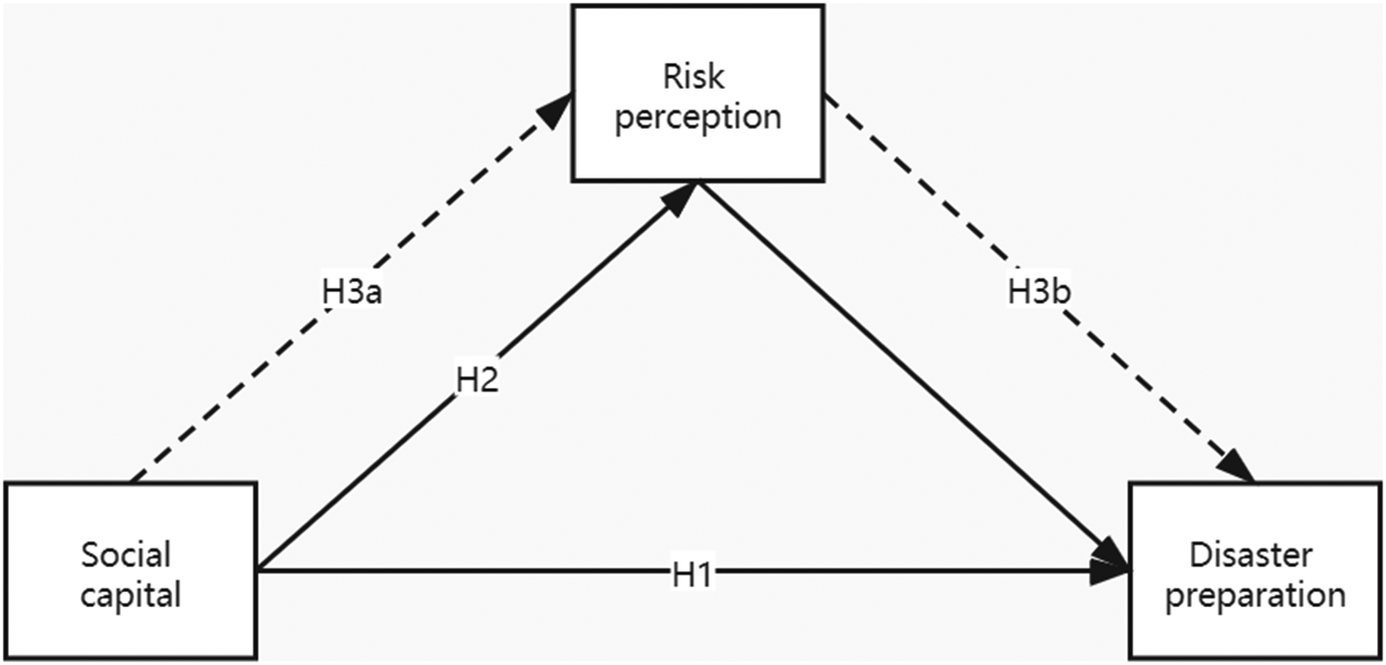
H3: Disaster risk perception is an intermediary factor between farmers’ social capital and disaster preparedness.
3. Data and Methods
3.1. Research Area
Wenchuan County and Ya’an City are located in a mountainous area on the western margin of the Sichuan Basin within the Longmen Shan fault zone. This zone is located within the Himalayan-Mediterranean seismic belt, which is one of the most active seismic belts in Sichuan Province. Since 1169 AD, there have been more than 20 earthquakes measuring ≥6 on the Richter scale in this seismic zone, which have caused serious damage to the lives and property of residents. Among them, the Wenchuan earthquake (M 8.0 in 2008) and Ya’an earthquake (M 7.1 on the Richter scale in 2012) were the largest earthquakes in China in the 21st century. They caused about 900,000 casualties and direct economic losses as high as 1.75 trillion Yuan. 6 The region also has other frequent natural disasters. Strong earthquakes break mountain rock masses, which, along with rainfall, can produce landslides, mudslides, and other disasters, increasing the risk of serious disaster for rural farmers in mountain areas.Reference Beniston 64 –Reference Zimmermann and Keiler 66
3.2. Data Source
The data used in this study comes from a questionnaire survey conducted by the research group with farmers in the areas hardest hit by the Wenchuan and Ya’an earthquakes in July 2019, by hiring 13 strictly trained researchers to conduct semi-structured interviews with community farmers.Reference Zhang, Bao and Deng 67 –Reference Qing, Guo and Deng 68 The questionnaire focused on: (1) the basic situation of farmers, including their gender, age, and disaster experience; (2) the social capital of peasant households; (3) the disaster risk perception level of farmers; and (4) the disaster preparedness behavior of farmers. In order to ensure the representativeness of selected regions and samples, the research regions and samples were determined by stratified random sampling, and Beichuan County, Pengzhou City, Lushan County, and Baoxing County were determined as the districts and counties for the investigation. Specifically, according to the level of economic development, two sample districts and counties were selected in each area affected by the 2 earthquakes, forming a total of 4 sample districts and counties. Subsequently, according to the degree of disaster, economic development level, and per capita net income of each township in the four sample districts and counties, 2 sample townships were selected in each; a total of 8 townships. According to the economic development of each village and the distance to the nearest township/town government office, 2 sample villages were selected in each sample township; a total of 16 sample villages. Finally, according to a random number table, 20-23 households were randomly selected from each sample village as sample households. After data screening to eliminate missing data and inconsistent questionnaires, 327 valid farmers’ questionnaires were obtained.
3.3 Methods
3.3.1. Selection and definition of model variables
The goal of this study is to explore the effects of the social capital and disaster risk cognition of farmers in earthquake-stricken areas on their disaster preparedness. To achieve this goal, some key variables need to be measured, as follows:
-
(1) Dependent variable
The dependent variable of this study is the disaster preparedness behavior of farmers in earthquake-stricken areas. This was measured based on the question “Does your family prepare disaster emergency items at ordinary times (Mainly includes food, water, special drugs, etc.)?” This was answered as 1 = yes or 0 = no.
-
(2) Focus variables
The core variable of this study is farmers’ social capital. Referring to Hurlbert et al., Parks et al., Wulandari et al., and other studies,Reference Hurlbert, Beggs, Haines, Lin, Cook and Burt 69 –Reference Wulandari, Muryani and Karyanto 71 indicators were designed to measure this variable from the three dimensions of social network, social support, and social participation (Table 1). Finally, the indicators in Table 1 were processed by the entropy method to obtain an objective value for social capital (refer to 1 for an introduction to the entropy method).
-
(3) Mediator variable (Figure 1)
Questionnaire items used to measure the livelihood capital of farming households

Table 1. Long description
The table has four columns labeled Dimension, Entry, Mean, and Standard. The first group, Social network, includes two entries: average monthly telephone expenses at home with mean 218.39 and standard 164.04, and whether the family calls to greet relatives and friends during the Spring Festival with mean 8.12 and standard 10.29. The next group, Social support, has three entries: number of village and township cadres or public officials in the family with mean 1.50 and standard 3.00, number of families that can help with large expenses with mean 4.38 and standard 6.57, and number of families that can help find work opportunities with mean 6.15 and standard 19.28. The final group, Social participation, includes three entries: participation in disaster-related knowledge training (0 equals No, 1 equals Yes) with mean 0.46 and standard 0.50, participation in decision-making related to village public affairs (0 equals No, 1 equals Yes) with mean 0.77 and standard 0.42, and number of associations the family participates in with mean 0.16 and standard 0.38.
Mechanism diagram of research core variables.

The mediator variable used in this study is farmers’ perception of disaster risk. Considering the study area and referring to Xu et al. and other studies on disaster risk perception measurement,Reference Tierney 28 we measured this variable from the two dimensions of possibility perception and severity perception (Table 2). Before factor analysis, the reliability of each dimension was tested. The results show that the Cronbach values of the two dimensions of possibility perception and severity perception are 0.70 and 0.68, respectively, and the Cronbach values of all entries are 0.70, indicating that the entries designed in this study have high reliability. Effectiveness analysis was performed by the KMO (Kaiser-Meyer-Olkin) test with a KMO of 0.768, and the farmer risk perception index system constructed in this study passed the KMO test, indicating that the sample data had good reliability and validity and was suitable for subsequent analysis. Then, factor analysis was used to reduce the dimension of entries in each dimension, and comprehensive scores of possibility perception and severity perception were obtained. Finally, referring to the research of Xu et al.,Reference Tierney 28 the efficacy coefficient method was used to convert the scores of the above two dimensions into percentile scores.
-
(4) Control variable
Questionnaire risk perception measurement items

Table 2. Long description
The table has four columns: Dimension, Item, Mean, and Standard Deviation. The first group, Possibility Perception, includes three items: ‘In the next 10 years, will an earthquake disaster occur near your home?’ with mean 2.83 and standard deviation 1.12; ‘Do you always feel that an earthquake disaster will occur sometime in the future?’ with mean 3.08 and standard deviation 1.32; ‘In recent years, have the signs of earthquake disasters become increasingly obvious?’ with mean 3.18 and standard deviation 1.35. The second group, Perception of severity, includes: ‘In the next 10 years, if an earthquake disaster occurs, will it affect your life and that of your family?’ with mean 3.35 and standard deviation 1.31; ‘If an earthquake occurs, will the productivity and lives of village residents be seriously affected?’ with mean 4.16 and standard deviation 1.06; ‘In the next 10 years, if there is a disaster, will your home and land be affected?’ with mean 3.84 and standard deviation 1.14. Footnotes clarify that 1 equals totally agree and 5 equals totally disagree, and S D stands for standard deviation.
a 1 = Totally agree, 2 = agree, 3 = neutral, 4 = disagree, 5 = totally disagree
b SD = Standard deviation.
To test the robustness of the concerned variables, some variables reflecting the individual characteristics of the respondents (such as age, gender, and years of education) and their families’ characteristics (such as family population and income) were added as control variables. Please refer to Table 3 for the definition and measurement of the specific variables.
Research variable setting and data description

Table 3. Long description
Starting from the top row, the table is organized into six columns: Variable, Measure, Mean, and Standard. The dependent variable is disaster preparedness, measured by whether farmers are prepared with emergency disaster avoidance items, with a mean of 0.25 and standard deviation of 0.43. The independent variable is social capital, subdivided into social network (mean 0.02, standard deviation 0.02), social support (mean 0.03, standard deviation 0.03), and social participation (mean 0.10, standard deviation 0.08). The mediation variable is risk perception, divided into possibility perception (mean 47.44, standard deviation 20.93) and severity perception (mean 67.19, standard deviation 18.76). Control variables include personal characteristics (gender: mean 0.46, standard deviation 0.50; age: mean 53.44, standard deviation 13.40), family characteristics (family size: mean 0.99, standard deviation 0.11), and disaster experience, which is split into number of experiences (mean 8.58, standard deviation 12.72) and disaster severity (mean 4.56, standard deviation 0.76). The disaster severity scale is defined as 1 equals very not serious, 2 equals not serious, 3 equals average, 4 equals serious, and 5 equals very serious.
Note. a1 = Very not serious, 2 = not serious, 3 = average, 4 = serious, 5 = very serious.
3.3.2. The models
The goal of this study is to explore how disaster risk perception mediates between social capital and disaster preparedness. The dependent variable of the model, whether farmers have disaster preparedness items, is a binary variable, so we used a binary logit mediating effect model to estimate the parameters. The Sobel test was used to test the mediating effect. Stata 14.0 was used to implement the whole model.
4. Results
4.1. Descriptive Statistics of the Variables
Table 3 shows the descriptive statistics of the variables involved in the model. As can be seen, only 25% of the 327 interviewees had undertaken disaster preparedness. As far as the core variables are concerned, the mean values of social network, social support, and social participation are 0.02, 0.03, and 0.10, respectively, which indicates that the social capital of farmers in this region is relatively weak. In the perception of disaster risk, the average values of farmers’ possibility perception and severity perception of disaster recurrence are 47 points and 67 points, respectively. It shows that compared with the uncertainty of disaster occurrence, farmers’ severity perception of disaster risk is stronger than that of possibility perception. As far as the control variables are concerned, the respondents were mostly middle-aged and male (mean age 53.44 years, 54% male). The education level was generally low (mean years of education = 6.29 years). The sample households had large families (mean members = 4.11). In addition, the average number of disasters experienced by the sampled farmers was 8.58, and the average severity perception of disaster evaluation value was 4.56, which shows that earthquakes have left deep impressions on local farmers and caused serious losses.
4.2. Model Results
Table 4 shows the regression results of the models. Model 1 considers farmers’ social capital and disaster preparation. Models 2 and 3 consider farmers’ social capital and disaster risk perception. Model 4 is based on Model 1 and combines the possibility perception and severity perception of regression results (for ease of explanation, the marginal effects of all regression coefficients are reported in Table 4). According to the overall significance test statistics (F-values) of the models, all were significant at the level of 0.01. At the same time, there were no serious multicollinearity problems among the independent variables of the models (the correlation coefficients among the model variables were all <0.7), so subsequent regression analysis can be conducted.
Results of social capital and disaster risk perception on farmers’ disaster risk perception in mountainous areas and disaster preparedness

Table 4. Long description
The table consists of five columns. The first column lists variables: social network, social support, social participation, possibility perception, severity perception, gender, age, family size, experiences, disaster severity, and observations. The next four columns present results for Disaster preparedness (Model 1), Possibility (Model 2), Severity (Model 3), and Disaster preparedness (Model 4). For each variable, the coefficient is listed, with standard errors in parentheses directly below. Social network shows significant positive effects on disaster preparedness in both Model 1 (3.519, standard error 1.273, triple asterisk) and Model 4 (3.559, standard error 1.262, triple asterisk). Social support is significant at the 0.1 level in Models 1 (1.050, standard error 0.602, single asterisk) and 4 (0.994, standard error 0.599, single asterisk). Social participation is significant and positive in Models 1 (0.766, standard error 0.277, triple asterisk) and 4 (0.736, standard error 0.281, triple asterisk), but negative and significant for possibility (Model 2, -27.177, single asterisk) and severity (Model 3, -33.181, double asterisk). Possibility perception is only included in Model 4, with a small negative coefficient (-0.002, single asterisk, standard error 0.001). Severity perception in Model 4 is not significant (0.001, standard error 0.001). Gender, age, family size, and experiences show mostly non-significant coefficients across models. Disaster severity is only significant in Model 3 (5.520, standard error 1.335, triple asterisk). Observations are 327 for all models. The note at the bottom clarifies that standard errors are in parentheses, triple asterisk indicates P less than 0.01, double asterisk P less than 0.05, and single asterisk P less than 0.1.
Note. Standard errors in parentheses; *** P < 0.01, ** P < 0.05, * P < 0.1.
As shown by Model 1, farmers’ social network, social support, and social participation are positively correlated with their disaster preparedness. Specifically, with other conditions unchanged, the possibility of disaster preparedness increases by 3.519 units, on average, for every unit increase in farmers’ social network. For every additional unit of farmers’ social support, the possibility perception of disaster risk increases by 1.05 units on average. For every additional unit of farmers’ social participation, the possibility perception of disaster risk increases by 0.766 units on average. As shown by Model 2, farmers’ social participation is negatively correlated with the possibility perception and severity perception, while farmers’ social network and social support have no correlation with possibility perception and severity perception. Specifically, with other conditions unchanged, for every additional unit of farmers’ social participation, their possibility perception decreases by 27.177 units, and their severity perception decreases by 33.181 units.
Table 5 shows the results of the analysis of the intermediary effect of disaster risk perception between social capital and disaster preparedness. As shown in Table 4, there is a positive correlation between social network and social support and farmers’ disaster preparedness (c, significant); there is no correlation between social network and social support and the two variables representing disaster risk perception (a, not significant); and there is no correlation between disaster risk severity perception and disaster preparedness (b, not significant). Therefore, disaster risk severity perception does not mediate between social network/social support and disaster preparedness. There is a negative correlation between possibility perception of disaster risk and disaster preparedness (b, significant). A Sobel test was needed to examine the mediating role of possibility perception of disaster risk in the relationship between social network/social support and disaster preparedness. The results show that the possibility perception of disaster risk has no mediating role between social network/social support and disaster preparedness. Social participation has a positive correlation with disaster preparedness (c, significant) and a positive correlation with the two dimensions of disaster risk perception (a, significant), while disaster risk severity perception has no correlation with disaster preparedness (b, not significant). Sobel tests were carried out to examine the mediating role of disaster risk severity perception between social participation and disaster preparedness. The results show that there is no mediating role. There is a correlation between possibility perception of disaster risk and disaster preparedness (b, significant). Therefore, only possibility perception has a mediating effect between social parts.
Test results of the mediating effect of disaster risk perception on social capital and disaster preparedness

Table 5. Long description
From the top row downward, each path is listed in the first column: social network to possibility perception to disaster preparation, social network to severity perception to disaster preparation, social support to possibility perception to disaster preparation, social support to severity perception to disaster preparation, social participation to possibility perception to disaster preparation, and social participation to severity perception to disaster preparation. For each path, the columns display c the total effect, a, b, Sobel test, c prime direct effect, and inspection conclusion. Significant values are marked with asterisks: three for P less than 0.01, two for P less than 0.05, one for P less than 0.1. Most paths show ‘the mediating effect was not significant,’ except for social participation to possibility perception to disaster preparation, which shows ‘partial mediating effect was significant.’ Specific values include c the total effect ranging from 0.766 to 3.519, a ranging from negative 37.027 to 36.486, b values of negative 0.002 or 0.001, Sobel test values where present, and c prime direct effect values from 0.736 to 3.559. Standard errors are noted in the table foot.
Note. Standard errors in parentheses; *** P < 0.01, ** P < 0.05, * P < 0.1.
5. Discussions
Compared with previous studies, this paper makes the following marginal contributions. First, a theoretical framework of disaster risk perception, social capital, and disaster preparedness analysis was established, and the mediating effect of disaster risk perception on farmers’ social capital and disaster preparedness was empirically analyzed. The theoretical framework and empirical analysis used in this study can provide a reference for similar studies. Second, this study divides social capital into the aspects of social network, social support, and social participation, which is more in line with the rural reality in China’s earthquake disaster-threatened areas, and can provide a reference for studying the relationship between social capital and disaster preparedness in other areas. In addition, there are some similarities and differences between the results of this study and those of existing studies, as follows.
There are differences with Lai et al. and other studies, which are consistent with the research assumptions H1a, H1b, and H1c.Reference Lai, Chib and Ling 72 This study found that the three dimensions of farmers’ social capital (social network, social support, and social participation) are positively related to their disaster preparedness. The possible reason is that social support of peasant households tends to take the form of mutual communication between households rather than material support. On the one hand, if a person’s close friends receive practical social support for a particular disaster that is socially relevant, sharing disaster-related information with their close relatives and friends will help improve their emergency preparedness. On the other hand, the increase of social support may boost the morale of the victims, thus enhancing their preparedness for disaster avoidance. At the same time, contrary to hypothesis H2, this study found that social network and social support were not correlated with residents’ disaster risk perception, while social participation was negatively correlated with individual possibility perception of disaster risk and severity perception. This contrasts with Buchecker and Maidl, Griffin et al.,Reference Buchecker and Maidl 73 , Reference Griffin, Yang and TerHuurne 74 who found that higher social capital is associated with higher individual perception of disaster risk. The possible reasons are as follows: on the one hand, even though farmers have good social networks, they do not use their functions completely, which weakens the effect of social networks on disaster risk perception. On the other hand, farmers may have received disaster-related information but did not form risk awareness through communication. However, farmers with strong social support are often able to get more risk protection, such as financial support from relatives and friends or opportunities to work outside their village, which weakens the effect of social support on disaster risk perception. In addition, the more farmers participate in society, the more likely they are to obtain material and emotional support from it. They may make them “fearless” and underestimate the possibility perception and severity perception of disasters. However, farmers with high social participation will form firm emotional bonds with other farmers, which can provide strong emotional support and reduce their fear of risk. In addition, this study confirmed hypothesis H3, that the perception of possibility perception of disaster risk has mediating effects between social capital and disaster preparedness. This shows that individual perceptions of possibility perception of disaster risk explain the influence of some social capital on farmers’ disaster preparedness.
Furthermore, there are some deficiencies in this study. For example, this study considers only static data collected at one time; however, farmers’ social capital and risk perception change over time, therefore, adopting longitudinal data may be more appropriate. At the same time, this paper only discusses the intermediary relationship between social capital and risk awareness of farmers in the disaster-hit areas of the Wenchuan earthquake and the Lushan earthquake. Whether the research results are applicable to other earthquake-hit areas needs to be further explored. In the future, it is necessary to expand the scope of research subjects and explore the relationship between social capital, risk perception, and disaster preparedness of farmers in earthquake-disaster areas.
6. Conclusions and Implications
Based on the investigation of 327 households in areas affected by the Wenchuan and Ya’an earthquakes in Sichuan Province, this study systematically analyzed the correlations among farmers’ social capital, disaster risk perception, and disaster preparedness. The main conclusions are as follows:
-
(1) The level of disaster preparedness of farmers in earthquake-hit areas is relatively low, with only about 25% taking disaster preparedness measures. At the same time, the overall social capital level of farmers is low.
-
(2) Social network, social support, and social participation are positively correlated with farmers’ disaster preparedness. With other conditions remaining unchanged, the possibility of disaster preparedness of farmers increases by 3.519, 1.050, and 0.766 units for each additional unit of social network, social support, and social participation.
-
(3) The possibility perception of disaster risk has a partial mediating effect between the social participation dimension of social capital and disaster preparedness.
The results of this study also have important policy implications. For example, the study found that the three dimensions of peasant households’ social capital are all positively correlated with their disaster preparedness. This suggests that the government should give full consideration to the guiding role of community social capital and improve peasant households’ disaster preparedness through social capital when regulating policies related to disaster risk management. At the same time, the study found that the possibility perception of disaster risk had a partial mediating effect between the social participation dimension of social capital and disaster preparedness. This suggests that the government could hold some targeted community activities and improve residents’ disaster risk perception level and disaster risk management ability through social participation.
Author’s contribution
Research design: Wenfeng Zhou and Dingde Xu; Methodology: Zhixing Ma and Xin Deng; Funding: Dingde Xu; Writing and revising: Wenfeng Zhou and Dingde Xu.
Acknowledgments
We gratefully acknowledge financial support from the National Natural Science Foundation of China (41801221) and the Special Program for Cultivating Excellent Young Talents under the Dual Support Plan of Sichuan Agricultural University. The authors also extend great gratitude to the anonymous reviewers and editors for their helpful review and critical comments.
Competing interests
None.