Introduction
The last decade has seen considerable shifts in approaches to teaching and learning in Higher Education, with a greater emphasis on student learning and performance alongside the transmission of subject content (Ramsden, Reference RAMSDEN2003). These have brought increasing understanding of the significance of the relationships which develop between students and teachers in all contexts, from one-to-one interactions, to lecturing with a large class (Denicolo et al., Reference DENICOLO, ENTWISTLE and HOUNSELL1992; Schwartz & Webb, Reference SCHWARTZ and WEBB1993; Brockbank & McGill, Reference BROCKBANK and MCGILL1998; Prosser & Trigwell, Reference PROSSER and TRIGWELL1999; Crosling & Webb, Reference CROSLING and WEBB2000; Ramsden, Reference RAMSDEN2003).
The impact of student–teacher relationships is amplified by several particular dimensions of Higher Education: the vulnerability of students in a transitional process from school to adult and professional life, often living away from home for the first time, and from education to the professional world; the pressures of adapting to new cultural contexts for international students; and the expectations of using higher-level processing skills, greater self-responsibility and autonomy in directing work, and effective time-management (Crosling & Webb, Reference CROSLING and WEBB2000; Creech et al., Reference CREECH, PAPAGEORGI, DUFFY, MORTON, HADDON, POTTER, DE BEZENAC, WHYTON, HIMONIDES and WELCH2008). Furthermore, the significance of student–teacher relationships, perhaps already emphasised in the context of one-to-one tuition, may be complicated by a social aspect of the relationship which develops outside of the teaching interaction. In Higher Education there is greater freedom, uncertainty and possibility for negotiating the relationship beyond the framework of lessons themselves, and what occurs in that context will almost certainly affect the relationship within the classroom (Schwartz & Webb, Reference SCHWARTZ and WEBB1993). In one-to-one tuition in music, the boundaries between teaching, professional and social contexts are even more nebulous, given the vocational focus, with teachers often in a position to offer work and to draw students into the professional world. The impact of these relationships on learning is therefore likely to be even more keenly felt.
In the training and education of classical musicians in Higher Education, one-to-one tuition has long been accepted as the most effective teaching/learning environment, and continues to be highlighted as central to success (Bloom, Reference BLOOM1985; Manturszewska, Reference MANTURSZEWSKA1990; Schmidt, Reference SCHMIDT1992; Davidson et al., Reference DAVIDSON, HOWE, SLOBODA, Hargreaves and North1997; Gholson, Reference GHOLSON1998; Hanken, Reference HANKEN2001; Kennell, Reference KENNELL, Colwell and Richardson2002; Presland, Reference PRESLAND2005; Purser, Reference PURSER2005; Burt & Mills, Reference BURT and MILLS2006; Barrett & Gromko, Reference BARRETT and GROMKO2007; Gaunt, Reference GAUNT2008, Reference GAUNT2009), but the nature and impact of the one-to-one relationship itself on student learning has had less attention.
A number of studies have focused on aspects of personality types (Rosenthal, Reference ROSENTHAL1984; Hepler, Reference HEPLER1986; Schmidt, Reference SCHMIDT1989; Donovan, Reference DONOVAN1994), perhaps because these are immediately identifiable and measurable. Schmidt (Reference SCHMIDT1989) analysed the relationship between personality traits and teacher behaviours, and found that personality traits were significantly related to approvals, rate of reinforcement, teacher modelling or performing, and pace in a lesson, but were not significantly related to disapproval, teacher amount of talk or questioning strategies. So, for example, extrovert characters seemed to apply a more interactive teaching style with plenty of pace and approval of the student, and an ease in communication skills.
Donovan (Reference DONOVAN1994) used the Myers–Briggs Type Indicator to identify personality traits which contributed to effective one-to-one teaching relationships between university students and staff in the USA. She found that students with extrovert teachers did better than those with introvert teachers, and that dissimilar personality types worked best in a one-to-one teaching pair. The personality type of the student seemed to be less important than the combination of the student–teacher types. The significance of relationships underpinning instrumental/vocal learning (student–teacher, student–parent dyads and student–teacher–parent triads) has been emphasised in several studies focusing on younger children (Creech & Hallam, Reference CREECH and HALLAM2003; Haddon, Reference HADDON2009; McPherson, Reference MCPHERSON2009).
Studies which have focused on the detailed ‘reflection-in-action’ at Higher Education level between teacher and student made possible in one-to-one tuition, have tended to conceptualise the musical development, professional and personal mentoring evident in this context in terms of apprenticeship (Rosenthal, Reference ROSENTHAL1984; L'Hommidieu, Reference L'HOMMIDIEU1992; Gholson, Reference GHOLSON1998; Burwell, Reference BURWELL2006; Barrett & Gromko, Reference BARRETT and GROMKO2007), in keeping with the model of professional learning premised on collaborative reflection-in-action and reflection-on-action outlined by Schon (Reference SCHON1983, Reference SCHON1987). Schon's formulation of the dynamics of professional apprenticeship has been extremely influential and captures much of the power of the zone of proximal learning immediately evident, for example, in a musical masterclass. However, although the relationship described in his case study of a piano masterclass was characterized as a glowing success, the parallel case study of the architect's studio also demonstrated that there could be considerable contrasts in the experiences of the different students. So, for example, one student seemed to enter into a positive relationship with the master architect and continued to learn at a remarkable pace, but another student was baffled and frustrated in the relationship, lacked motivation, and struggled to develop (Schon, Reference SCHON1987, pp. 100–156). These contrasts highlighted just how much the particular student–teacher relationship informed learning.
Similarly in instrumental/vocal tuition, some literature has indicated potential difficulties arising in the relationship (Persson, Reference PERSSON1994; Burwell, Reference BURWELL2005; Gaunt, Reference GAUNT2008, Reference GAUNT2009). Abeles et al. (Reference ABELES, GOFFI and LEVASSEUR1992) referred to a ‘halo’ effect, where they found that students were unable to discriminate between the performing abilities of their teachers. A study of university students in the UK specialising in performance (Burwell, Reference BURWELL2006) identified potential problems particularly for the more able students in terms of developing interpretative skills, self-directed study and autonomous artistic judgement. Here teachers seemed to invest more in the most talented students, but actually as a result tended more towards a transmission model of teaching, rather than facilitating students in taking responsibility for their own learning and developing their own skills of musical interpretation.
Kennell (Reference KENNELL1992) identified the difference between problem-solving involved in practising and the zone of proximal learning in a lesson. This highlighted the power of a developmental process in a lesson, and how this very experience might work against the longer-term need to develop independent learning skills. Furthermore, a study of instrumental undergraduate students at a conservatoire in the UK questioned the ability of music students to transfer what they had learned to other contexts (Mills, Reference MILLS2002), suggesting that although students greatly valued their one-to-one lessons and were developing many instrumental skills, they were not necessarily learning to be able to transfer these skills, for example to a teaching context.
Anecdotally we also know in conservatoires, although it has rarely been acknowledged publically, that the success of one-to-one tuition can be mixed: sometimes it works fantastically well, sometimes problems develop. Although the successes and difficulties experienced inevitably depend in part on the ability of the student and the qualities of the teacher, less thought has perhaps been given to the nature of the relationship that develops between them, the ways in which this impacts on learning, and the ways in which greater awareness of it may enable more consistently productive learning.
One-to-one tuition in the context of PhD supervision
One of the closest parallels which may shed some light on the one-to-one relationship in instrumental/vocal tuition in Higher Education is the process of PhD supervision. There are some clear differences, for example, between the nature of musical performance and the written medium of research, between the mixture of musical and verbal interaction in one-to-one tuition and largely verbal interaction in supervision, or between the number and regularity of student–teacher interactions. Nevertheless there are also important parallels relating, for example, to aspects of interpersonal intensity in the interactions, and induction into a professional community of practice achieved through the relationship.
Phillips and Pugh (Reference PHILLIPS and PUGH2005) emphasised the significance of craft skills and research training. Salmon (Reference SALMON1992), on the other hand, emphasised the personal direction of a PhD project, rooted in an individual's history and viewed supervision first and foremost in terms of an individual relationship. She suggested that it would most likely involve huge emotional as well as intellectual transformation, and characterised good supervisory relationships as mutual, personally intimate and adventurous, and based fundamentally on trust. However, she emphasised the difference between students, and the level of empathy on both sides required to support each project.
Potential difficulties of one-to-one student–teacher relationships have also been articulated (Salmon, Reference SALMON1992; Phillips and Pugh, Reference PHILLIPS and PUGH2005), drawing attention, for example, to the gulf which some students perceive between themselves and their apparently outstandingly brilliant tutors, and the tendency for some tutors, on the other hand, to bathe in the reflected glory of the achievement of their students. These issues could reinforce feelings of dependency on the part of the student, which are particularly problematic in a situation where the teacher is in a position to support the student's emerging career through providing access to professional work. The power of supervisors often remaining hidden, and the tendency for individuals in a supervisory relationship to respond in less than open, professional ways, perhaps by avoiding discussion about the relationship, or easily becoming defensive about their own part in it, were identified. Salmon also acknowledged the potential damage which can be caused by inappropriate criticism. Supervisors, however well qualified, could inadvertently undermine ‘the personal confidence which is so fundamental to the carrying through of original research’ (1992, p. 88). The loneliness and intensity of a long period of individual study with a single focus were also found to be a big psychological challenge which could exacerbate difficulties experienced in supervision. Finally, difficulties arising from a sexual relationship between supervisor and student were discussed by Phillips and Pugh. They suggested that the processes of criticism between supervisor and student could become more difficult to negotiate, and that an intimate relationship could disrupt relationships with other staff and students within an institution.
The appeal for both students and teachers of the one-to-one student–teacher relationship in music is easy to appreciate, and may be perceived, as Yarborough (Reference YARBOROUGH1996) underlined, as having a certain mystique. It is clear, however, that such relationships have the potential to generate particular tensions, for example in establishing where the responsibility for the success of a student lies (Jorgensen, Reference JORGENSEN2000), and in nurturing the student towards artistic and professional autonomy. Over-dependence on both sides is a risk, and may result, for example, in a reluctance of students to value other relationships and interactions as significant. In this context Williamon and Thompson (Reference WILLIAMON and THOMPSON2006) found that first-year conservatoire students were most reliant on their one-to-one instrumental teacher for advice with health issues rather than turning to health professionals. Chesky was concerned that some one-to-one teachers attempted to provide all the answers for a student, about medical and personal issues as well as instrumental and musical ones (Chesky, Reference CHESKY2004).
It is essential therefore to build greater understanding of the nature of the one-to-one relationship in instrumental/vocal tuition in Higher Education, and how it impacts on learning. This is much needed for practitioners in order to promote consistency in the quality of provision for students. Understanding of the impact of one-to-one tuition on learning will also help to shape its place more effectively within the complete offer of higher music education, so that for example learning in this context may complement dimensions of peer and informal learning, whose importance are increasingly being demonstrated (e.g. Monson, Reference MONSON1996; Lebler, Reference LEBLER2006).
Methods
This study addressed the following questions:
• How do students and teachers characterise their relationship in one-to-one tuition?
• What boundaries do they perceive to this relationship?
• How do students perceive their current relationship compared with the relationships with previous instrumental/vocal teachers?
• How are the dynamics of power in the relationship perceived by teachers and students?
• What is the impact of the one-to-one relationship on learning?
Data presented in this paper come from a larger study focusing on the perceptions of teachers and students in a UK conservatoire about one-to-one tuition. The overview of findings from the study has been published (Gaunt, Reference GAUNT2008, Reference GAUNT2009) and is referred to as appropriate in the discussion of findings below. The study used a framework of empirical phenomenology to analyse interview data gathered from in-depth interviews (Tesch, Reference TESCH1990; Cooper & McIntyre, Reference COOPER and MCINTYRE1993) with instrumental/vocal teachers (n = 20) and students (n = 20) spread across four music departments: Keyboard, Strings, Wind, brass and percussion, and Vocal studies.
The teachers were part-time tutors, who teach students of their own specialism on a one-to-one basis. Their teaching loads ranged from 3 to 26 hours per week. Nine teachers were female, 11 were male, and they were drawn from the four principal study departments: Keyboard, Strings, Voice, and Wind, brass, percussion. They were selected to be a representative sample in terms of gender, and to cover a broad range of teachers' professional profiles and teaching experience in higher education. The students came from a total cohort of 650 music students at the conservatoire. Fifteen were undergraduate BMus students and five were postgraduate MMus students, and all were studying with one of the teachers interviewed. They ranged in age from 17–31 years. eight were female and 12 were male. In order to identify potential student participants, each teacher interviewed was asked to recommend four or five of their students at different stages of professional development, who were studying with them, and who they felt would be willing to articulate their ideas. They were asked not to suggest only those students with whom they felt that one-to-one tuition was working most effectively, but to suggest a cross-section of students. From these lists, 20 students were selected, to create a balanced sample in terms of gender, instrumental/vocal discipline, age and stage of development. The student selection was not, therefore, random, but ensured that some student–teacher pairs could be considered.
A method of semi-structured interviews to gather a body of data about participants’ perceptions was chosen because it was both practical in the context of the conservatoire, and had the potential to generate rich evidence. An informant-style interview encouraged rapport between interviewer and participant, and authenticity in the construction of teacher and student perceptions (Powney & Watts, Reference POWNEY and WATTS1987; Cooper, Reference COOPER1993). The interview schedules drew on specific themes arising from the literature, and are shown in the Appendix. The interview transcripts were submitted to recursive thematic comparative analysis (Cooper & McIntyre, Reference COOPER and MCINTYRE1993), using NVivo. In the presentation of this material, the teachers are referred to as T1–20, the students as S1–20, and the interviewer as Int.
Gathering data in this field presents a number of potential difficulties, such as general scepticism of participants about research relating to teaching and learning, and fear of participation impacting negatively on the relationship of trust between teacher and student. This study aimed to be as sensitive as possible to these issues. My own position as a teacher in the conservatoire meant that I was an insider. Whilst this had disadvantages in the bias of my approach, it afforded me relatively easy access to potential participants, and the possibility of generating an atmosphere of trust around the research. This made it easier to make participants feel understood, and to avoid discussion which was simply plausible rather than authentic (Cooper, Reference COOPER1993). It also meant that I could use the research process to build trust in critical reflection on teaching within the School and to begin to stimulate professional development in this area where very few teachers have any pedagogical training (Gaunt, Reference GAUNT2008).
Ethical considerations
Participation in the research was voluntary. A written summary of the research rationale and methodology was provided and explained before the interview. Students were informed that their instrumental/vocal teacher had participated in the research, but they were not shown the transcript of the interview and its content was not discussed. Each participant had the opportunity to edit the transcript of their interview, and a guarantee that anyone deciding to withdraw from the project would not be disadvantaged with regard to their position in the School, access to teaching, or assessment. Written, informed consent to use the data for analysis and public dissemination was sought. Potential risks and benefits of participating in the research were discussed.
Validity and reliability
Validity and reliability were considered within the context of qualitative research, focusing on generating a dependable set of evidence, and a dependable analysis (Cohen et al., Reference COHEN, MANION and MORRISON2000). Validity was sought through selecting a cross-section of teachers and students, and creating a depth of data through informant-style interviews. Authentic perceptions were sought, particularly through building up detailed accounts of the participants’ perceptions with specific exemplification, and by looking at the logical consistency of these accounts.
My role as a teacher in the conservatoire undoubtedly affected the research perspective. On the one hand it strengthened the ecological validity of the study: it enabled sufficient confidence to be built within the institution for the research to be allowed to take place, and for the process and findings to be integrated into a developing programme of staff development. On the other hand it may have affected the participants’ contributions in the interviews. Care was taken to minimize this effect through the informant-style interview, the time allocated to each interview, encouraging participants to speak as honestly as possible about their experiences, and clarifying ethical guarantees of anonymity in the reporting of findings. Recursive analysis was designed to reach beyond my immediate bias, to allow detailed concepts to emerge, and to enable issues and questions which had not been foreseen to surface. Reliability was further developed by having the categories in the emerging themes reviewed with the supporting data by an experienced researcher, as a way of reflecting critically on the analysis.
Findings and discussion
Characterising the relationship
Teachers and students all viewed the one-to-one relationship as a vital part of instrumental/vocal learning. Teachers often focused on the intensity of the relationship:
T11: With some students it is better to keep a distance and just be nice as they don't want more than a formal lesson . . . but for those who really care about music and do their best to develop . . . I can give everything . . .
Most commonly they characterised it in terms of friendship, or parent–child relations, or a mixture of the two:
T15: it's a cross between parenting and friendship that makes the best relationship. I think parenting in as much as you shouldn't underestimate how much guidance they still need at this age . . . in terms of their personal lives . . . because you're the only person they see on a one-to-one . . . Just a little experience of life to be able to give a bit of advice . . . and friendship . . . because unless they feel that you're on their side, you can't give them when you need to give . . . I find that if I've made a good friend of them, then when I tell them that they've done well, or I can give them confidence, support them . . . I think they believe you . . . It's the balance of praise and criticism, to handle praise and criticism long term over three or four years, to have that balance . . .
In two instances, teachers referred to doctor–patient dynamics:
T4: It's a bit like going to the doctors isn't it? If you go to the doctors and say ‘look I've a terrible pain here in my neck here’ or bad stomach . . . he's only doing what we are doing, he says ‘well I think it's so-and so, so get these pills from the chemist and come and see me next week’. You go back the following week and he goes ‘how did you go?’ and you go ‘it's still the same’ . . . ‘Did you take the pills?’ . . . ‘No.’ So he doesn't know if they would work or they didn't. If you took the pills and they don't work – you still have the same problem, then he knows that that is the wrong thing.
Common themes emerged here around negotiating a balance between enabling personal dimensions and intimacy to develop, and maintaining detachment, or between focusing on transmitting instrumental/vocal skills and enabling students to develop their own autonomy as musicians and professional people. In personal terms, it was often clear that this was a delicate balance to strike:
T8: . . . I try not to know who they're having affairs with, because I think it's not good to know too much . . . you're slightly in the parental role . . . But on the other hand if they've got a problem I'll let them talk to me . . . I try to make them aware they can tell me what they want but they don't have to tell me things.
There was some sense that the characteristics of the relationship might change over time, as the student progressed:
T14: It's different with different years . . . I might react differently to a fourth year in comparison to a first year . . . give the fourth year more freedom . . . ‘In the last analysis it's down to you, it's your playing. I can't tell you what to do now, I can only suggest things . . . facilitate.’
These changes, however, tended to be discussed more in terms of maturing musicianship and learning than in terms of the student–teacher relationship.
The students were less inclined to use terminology of friendship and parenting, but all referred to the unique nature of each relationship:
S19: I feel it is very individual because every student is different, and the teacher has to respond to that individual, so I feel treated as an individual . . . and that makes me feel very special . . . And there is no such thing as a prototype or model that you can impose on every student . . .
Their perceptions focused less on the student–teacher relationship itself, and most frequently expressed how the interactions benefited their technique, musicianship and professional voice:
S13: I think it is very important we do have regular one to one sessions just because what he says to me might be very different from what he would say to another person who's at a different stage of . . . development . . . so what I am being taught is, I presume, and I do feel, is geared to what [I] can cope with, or what [I am] going to do . . .
One or two students felt that one-to-one tuition reduced the potential for competition, allowing them to go at their own pace:
S2: I feel it's very much me developing at my own level and at my own pace, and being pleased with the progress that I make rather than comparing myself to everyone else . . .
The concept of rapport with a teacher was important for all the students. For some it was based on a sense of personal connection, liking and respect:
S2: . . . she is a great teacher, but I don't think I would benefit as much . . . if I didn't get on with her personally . . .
For others the relationship could feel too personal and they preferred a more formal approach:
S13: I would say that our relationship is quite formal . . . I think I like that more than with [teacher B], I got a bit too involved. She was going through a tricky time . . . I found that I was talking about that in my lessons when I'd travelled an hour and a half to get there, and it was not on.
Any hint, however, of a teacher being distant or somehow disengaged was not appreciated:
S2: what I don't like about [my teacher] is sometimes she can be quite distant and it can switch quite quickly . . . if I do want to talk about something to do with my music, but just a slight aside, she may not, or sometimes isn't helpful . . .
For the majority of the students, there was an important feeling that the support a teacher offered extended beyond the years of formal study:
S9: I think that there is a good basis here of staff, that if you rang them up they would be willing to help you, I think. If I rang [my teacher] in 10 years time and said ‘I am having problems learning this Handel, will you help me’, I think that I can guarantee that she would.
Furthermore, where a teacher had a particularly good reputation, students indicated that this might increase their own chances of professional success:
S16: . . . my current teacher . . . has a very strong reputation, and he has had a lot of successful students in the past. So obviously that also influences people in deciding to go to him . . . I guess that puts him in a little bit of a halo . . . [with him] I will be successful, perhaps he will spot something in me just as he spotted something in X person who has gone on to do this.
The longevity of the relationship therefore seemed important. From the students' point of view the emphasis here was on enabling professional development and entry to a community of practice. From the teachers' point of view, the aspects of long-term friendship were also highlighted:
T6: I mean some students one warms to as human beings . . . I have a wide circle of friends who are all ex-pupils of mine now . . . I'm trying to think, I think most of them were people I warmed to when I was teaching them thinking back 20, 25 years now . . .
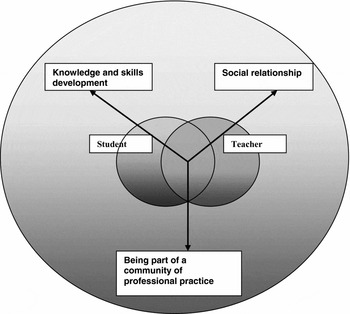
These characterisations began to demonstrate complex patterns of personal relations developing alongside the acquisition of knowledge and skills within the student–teacher relationship, and a close connection between these and professional integration for the students. These are summarised in Fig. 1.
Critical dimensions of the student–teacher relationship

Boundaries
Issues of boundaries to the relationship elicited varied responses. From the teachers' point of view, five actively sought social relationships with their students outside the lessons. Seven avoided them if at all possible, and eight socialised with their students occasionally (Gaunt, Reference GAUNT2008, pp. 20–21). Amongst the students, there were similar differences in how they perceived social dimensions of the relationship with their teacher(s) (Gaunt, Reference GAUNT2009, pp. 12–13). For seven, social engagement was regular, six did not see their teachers socially at all, and for seven it was an occasional occurrence.
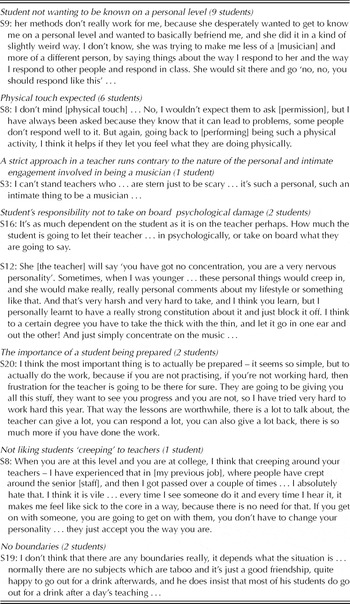
The students nearly all had strong opinions about the degree to which personal lives should be discussed within the student–teacher relationship. Nine students suggested that they did not want their teachers to get involved in discussions about personal aspects of their life; another three students who had strong social relationships with their teacher(s) were also quite clear that the personal side of their lives should not be the subject of discussion during lesson times. Six students, however, were clear that physical touch would be a necessary part of the learning in a one-to-one lesson, and that a boundary of physical touch would be detrimental to the learning process. Teachers were divided on this subject. Whilst many agreed that physical touch was essential, others avoided it:
T4: I think it is . . . too close, too personal and could be misinterpreted, and with one-to-one teaching there are lots of difficulties inherent with that . . . teaching the same sex or the other sex, so I avoid it at all times.
Psychological boundaries tended to be more implicit in the interviews with students. Two of them suggested that it was the responsibility of the student not to take on board anything which was actually going to be damaging emotionally. Two others emphasised the importance of respecting a teacher's commitment to the relationship and so not testing this by turning up to lessons unprepared. One student indicated his distaste for the way in which some students used their position to try and gain favour and perhaps professional work from their teacher(s). Examples of the students' attitudes to the boundaries of the student–teacher relationship are shown in Table 1.
Students' perceptions of the boundaries around the one-to-one relationship

Current and past teachers, and the process of making a change
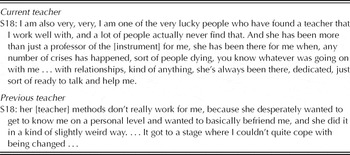
Another striking finding with the student data was the extremely positive perceptions of their current teacher compared with often a more critical view of a past teacher. An example is shown in Table 2.
Student perceptions of current and past teachers

This tendency might have been determined by the context of the research interview, with students not wishing to be critical of a teacher in the school. However, many of the criticisms about past teachers were in fact made about staff also working in the school, and it may be that the evidence indicates in part the huge investment students were making in the current teacher, where to be in any way negative about them would threaten that investment. In contrast, having less of an investment in a previous teacher enabled them to be freer in their assessment.
This idea is supported by the evidence of the ways in which students handled the difficulties they experienced in the relationship. In all cases, the current match between student and teacher(s) seemed to be working well (Gaunt, Reference GAUNT2009, pp. 14–15). On the other hand, 12 of the teachers indicated that they had experienced difficulties with students, and of the 20 students interviewed, four had changed teacher whilst at the school, three because of feeling dissatisfied, and of these, two had had traumatic experiences, had delayed the process out of fear of the consequences, and had not felt able to talk directly to the teacher. The other student had talked to the teacher and felt it had left a residue of bad feeling.
In each of these cases, the process had produced considerable anxiety, and the students experienced difficulty in coming to the point of asking to change teachers. One student reported:
S2: He's a perfectly nice guy [teacher], it was fine, but I think from my first lesson I . . . didn't feel inspired to practise from the word go, and I thought ‘well, I will see this through and persevere’ and I really tried, but by the end of the first term, well I had this platform and I had a lesson the day before my first ever platform . . . he didn't say anything about it, he was just sort of saying ‘oh how can you play every note exactly the same’ and he was demonstrating . . . he'd never put his [instrument] down, he would always have to have his [instrument], and sort of play absolutely amazingly, and try and get me to do it and I couldn't. I would just feel stupid. I would be in floods of tears and down the phone to my mum saying ‘I am going to leave the Guildhall’ . . . it was as though I was having to make myself practise rather than I wanted to do it.
In the end he found it impossible to talk to his teacher about the difficulties, but went independently for a consultation lesson with another teacher, and then asked to change through the Head of Department.
Another student felt unable to talk to her teacher about her concerns, and was only finally able to take action after being inspired by another teacher:
S9: But I got to the stage where I was very close to changing and then I decided I couldn't actually tell [teacher A] that I wanted to go, because I didn't know how she would react . . . But then . . . I was [performing] in a . . . class and [teacher B] was taking it, and I got up and [performed] and felt happy with the rapport which we had with each other automatically . . . I thought ‘well this can't be bad’ and it got to the end of the lesson and a few of my year group came up to me and said ‘he did wonders for you in that 10 minutes’.
The process then of discussing the change with her existing teacher proved to be awkward:
S9: . . . she rang me . . . and I said to her . . . ‘I need to talk to you and do you mind if the pianist comes 10 minutes later?’ and she said ‘oh what's it about?’ I said ‘I can't tell you over the phone, and I will tell you later’ and she was like ‘oh ok’, and when I did speak to her she was like, ‘I was going to ask you to change anyway’. I was thinking that's an interesting defence mechanism working there.
These examples provide a quite different perspective on the dynamics of the relationship. They suggest a polarisation between on the one hand investment in a current relationship promoting positive, even idealised perceptions, and on the other hand distance from a relationship providing an outlet for strong negative attributions.
Dynamics of power in the relationship
For both teachers and students trust was an essential characteristic of a successful relationship. In a few cases, the importance of mutual trust was articulated:
T6: I have to trust my students that they're carrying out what I advise them to do . . . But they've got to trust me. They've got to trust that I'm giving them good advice and what I'm saying actually comes from experience and understanding.
More often, however, and particularly with students, it was framed in terms of the trust which a student had for the teacher:
S5: Well, I think first of all you have to kind of believe in him, like if you start to doubt in what he is saying, you are not going to try hard . . . I realize now . . . I am a bit more distant because I see him as a person, before it was like my teacher, like, I don't know, somebody from on top, I mean upper than me, or something like that. I followed him without thinking really, because I thought he was right . . .
In this situation it was clear that teachers wielded considerable power over their students, through students' investment in the relationship for their learning, and through its intimacy:
T14: I often think that I am the boss, that my word goes, but I try not to be too ‘sergeant-major’ about it. I'm aware that I do have power, and where it is necessary to use it, I do say ‘well I think you ought to do this’.
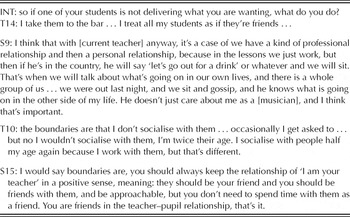
Evidence of power in the relationship was also shown in this study in comparing student–teacher pairs. A pattern emerged suggesting that students tended to be strongly influenced by their teachers in terms of their opinions about appropriate social dimensions of the relationship. Two examples of contrasting student–teacher pairs are given in Table 3. These illustrate how types of interaction were apparently controlled by the teacher, rather than negotiated: the students bought into the teacher's view, trusting that this would be the most beneficial for them. Although this may not have been the intention of the teachers, there seemed to be little scope for the students to take a different view of social interaction from that held by the teacher.
Perceptions of the social relationship in student–teacher pairs

There was often additional power which came through teachers' positions in the school sitting on assessment boards and in the wider music profession where they could assist students in finding professional work. In one case a teacher also remembered the issue of power in relation to her own learning, the musical and instrumental awe in which she held her own teachers, and how this had felt artistically and professionally overwhelming. Nevertheless, power in student–teacher relationships remained implicit for the most part, and was openly discussed or acknowledged by only four teachers and none of the students. This was perhaps surprising given the potential for power to conflict with trust, and to generate quite some anxiety in students about the success or failure of the relationship. Nevertheless this area merits further investigation as the impact of anxiety on learning has rapidly gained attention more widely in Higher Education (Nicholls, Reference NICHOLLS2002; Trigwell, Reference TRIGWELL2005).
The impact of the dynamics of power on student learning, professional development and lifelong learning
These characterisations, and issues around the dynamics of power raise questions. To what degree did the one-to-one student–teacher relationship mature in terms of strengthening their autonomy in learning, and in finding an individual artistic and professional voice? To what extent was the reflection-in-action and on-action a collaborative exploration of ideas stimulating the creativity of both teacher and student?
In spite of being sure about wanting to pursue a career in music, nine of the students could not articulate more specific ideas about what kinds of work they would pursue, and were taking more of a ‘wait and see what comes along’ approach (for detail see Gaunt, Reference GAUNT2009, pp. 18–22). Most students were giving occasional concerts outside the school, but as and when they were invited to do so, and only a few were more seriously proactive in attempting to develop a profile through taking part in national and international competitions, or through working professionally giving concerts and teaching. Most importantly, there seemed to be little natural progression in professional outlook and activity from the early undergraduate years through to postgraduate years, and two of the busiest musicians were first-year undergraduates.
Three of the eight students who were about to leave the school were thinking about strategies that they would use, for example utilising the time they would suddenly have to develop skills further, and to assimilate the intensive work of the previous years. One student, for example, concentrated on continuing to develop instrumental skills:
INT: How will you do that?
S4: Continue to practise, I might have a few more lessons, and try and play as much as I can as well . . . I suppose it is getting a bit more repetitive now, what they are telling me, it is the same as what they told me before, so trying to think about that myself while I am practising, rather than relying on them to tell me.
There was remarkably little awareness and focus on professional integration and the skills this would require. This is particularly an issue in the light of research now demonstrating the diversity of opportunities in professional music, and the flexibility and versatility which musicians need in order to be successful (Creech et al., Reference CREECH, PAPAGEORGI, DUFFY, MORTON, HADDON, POTTER, DE BEZENAC, WHYTON, HIMONIDES and WELCH2008; Gaunt & Papageorgi, Reference GAUNT, PAPAGEORGI, Hallam and Creech2010). The student in this example appeared to have become arguably too comfortable or rather passive in the relationship, struggling to see new opportunities and take initiative beyond building musical skills in already familiar ways. Although there is insufficient evidence from this study to show a causal relationship between the dynamics of the one-to-one student–teacher relationship and aspects of student autonomy as learners, individual artistic voice and readiness for professional life, the findings do suggest that this is an area which would merit further exploration. What are the ways in which the student–teacher relationship and its interaction can be most effectively managed by the teacher to promote the maturing of the student as a learner and as an autonomous professional?
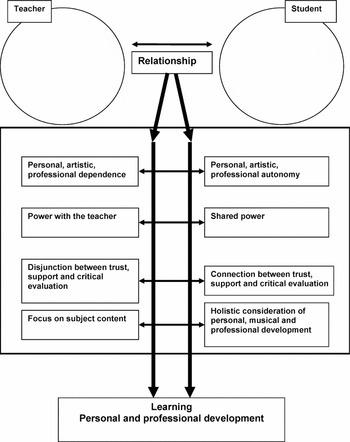
This study demonstrated the complexity of the student–teacher relationship dealing with elements of long-term personal and professional development as well as acquisition of musical and instrumental/vocal skills. It indicated the individuality of each relationship over a sustained period of time. It also began to demonstrate a number of areas of potential tension within the relationship: between individual autonomy and dependence in student and teacher; between power invested largely in the teacher and shared power; between trust, support and immersion necessary to the work and the need to stand back and evaluate critically; and between focusing on musical issues alone and attending holistically to a student's overall development. A tentative model of these dynamics within the learning environment of the relationship is proposed in Fig. 2.
Dimensions of creative tension within the student–teacher relationship

The model proposes these continua as dynamic features continually negotiated within student–teacher pairs, albeit often implicitly, whose individual and combined balance informs the success of the relationship for both student and teacher.
Implications
Although this study was limited in scope, the findings suggested that the one-to-one student–teacher relationship in itself was complex, characterised in diverse ways, and had a major impact on student perceptions, and on their learning. In particular it was clear that the teachers were invested with a lot of power in the relationship. This tended to remain implicit, and indeed few aspects of the relationship seemed to be discussed or negotiated between student and teacher. If in some respects there was an assumption of shared understanding, in fact the reality of the boundaries to the relationship, or the implicit ‘contract’ entered into, were largely constructed by the teacher.
Research in the field of one-to-one instrumental/vocal tuition has highlighted both the unique potential of this context of learning, and on the other hand some of its limitations. As the data from this study begin to suggest, the relationship itself may be a pivotal feature in determining the degree of success for the student in learning, and clearly more research is needed to explore student–teacher dyads in conservatoires from psychological and psycho-dynamic perspectives, in relation to their impact on learning, personal and professional development. This is particularly important in the context of current funding pressures in the UK. More empirical evidence is needed to help conservatoires and university music departments structure one-to-one tuition, and ensure that provision consistently maximizes student learning.
As well as considering how the benefits and challenges of one-to-one tuition may be balanced most effectively with opportunities for self-directed, peer and informal learning, attention also needs to be given to the ways in which teachers may build greater awareness of the dynamics of the one-to-one relationship, and its various phases through Higher Education, and the skills to negotiate these productively with different students. How can teachers be enabled to reflect critically and reflexively on their student–teacher relationships? How can such reflection be embodied systematically with staff development? How can structures within conservatoires such as allocating teachers to students, monitoring student progress, processes for changing teacher, and staff development such as co-mentoring or teacher support groups similar to the supervision built into professional requirements for psychotherapists or coaches support student–teacher relationships?
It is noticeable that one-to-one interaction is currently burgeoning as professional practice, in coaching and mentoring as well as counselling and psychotherapies. These clearly confirm a contemporary deep interest and belief in the benefits of one-to-one communication. Their particular aims and processes may offer important insights for the field of one-to-one instrumental/vocal tuition. Much of the literature on mentoring, for example, highlights the importance of negotiating goals, managing the relationship, self-awareness and reflexivity, in an effective mentor, and the ways in which successful mentoring brings about mutual learning and growth (Brooks, Reference BROOKS2006; Megginson & Clutterbuck, Reference MEGGINSON and CLUTTERBUCK2006; Renshaw, Reference RENSHAW2006). They are also significant in terms of the professional frameworks which they have adopted to ensure the quality of delivery. Professional coaching and mentoring, for example, are supported by professional associations which accredit individuals through accumulation of hours of work, continuing professional development and supervision.
Another field with similarities to instrumental/vocal tuition is international level sports coaching, particularly in the level of craft skill mixed with individual flair which students are expected to acquire to reach peak performance. In this domain, a single athlete is usually surrounded by a significant team of professionals, with a lead coach, each bringing a different area of expertise, from fitness to nutrition to psychology, carefully moulded into a unique training programme. Although musicians may have access to and input from a number of professionals other than their one-to-one teacher: academic teaching staff, chamber coaches, health professionals etc., there is perhaps rarely the same kind of teamwork organized between them, nor the detailed building of a personalized training and development programme. The one-to-one teacher, for example, in Higher Education music often still works in relative isolation, with little connection to a student's other learning experiences and teachers.
Key aims for one-to-one tuition in Higher Education must be to consider the relational aspects of one-to-one tuition in more detail, building the research evidence base, drawing on the experience of other fields of one-to-one interaction, and enabling staff development. It will also be vital to reconfigure how one-to-one tuition and its teachers are embedded within cross-discipline teams, focused on individual student pathways, so that they can work to shape their combined support most effectively in nurturing the overall development of the emerging professional artist who is able to work effectively within society.