INTRODUCTION
The National Institute for Health and Clinical Excellence (NICE) Improving Supportive and Palliative Care for Adults with Cancer guidelines (2004) summarize the evidence showing that, around the time of a diagnosis of cancer, approximately half of all patients experience significant psychological distress severe enough to affect their quality-of-life. This reduces to approximately one-quarter of all people at six months but rises to 50% in those who experience recurrence of disease. NICE (2004) suggest that these patients are likely to benefit from professional psychological support in some form. Only 10% are thought to require intervention from specialist psychological/psychiatric services, with the remaining patients requiring access to psychological support from other health care professionals. NICE (2004) outlined four levels of psychological support for patients. Levels 1 and 2 of psychological support should be provided by health and social care professionals directly responsible for the care of people with cancer, while levels 3 and 4 of psychological care should be provided by a variety of psychological specialists.
Level 2 staff is defined as health and social care professionals with additional expertise. In practice, it is commonly the Clinical Nurse Specialist (CNS) who is ideally placed to provide this level of psychological support. However, a survey of United Kingdom palliative care clinical nurse specialists showed that 92% felt that they required further training in assessing and managing depression (Lloyd-Williams & Payne, Reference Lloyd-Williams and Payne2002). In response, clinicians have been developing programs to train level 2 staff to recognize psychological distress, assess and provide appropriate psychological interventions, such as basic cognitive-behavioral techniques (e.g., Jenkins et al., Reference Jenkins, Alberry and Daniel2010). Delvaux et al. (Reference Delvaux, Razavi and Marchal2004) ran a 105 hour psychological training program for health care professionals dealing with cancer patients. They found that after the training, nurses felt less stressed in general and felt better prepared to provide emotional support to patients and family. Delvaux et al. (Reference Delvaux, Razavi and Marchal2004) focused on improvements in communications skills (for example, facilitative behaviors) rather than specific skills in psychological assessment and management of psychological problems. Jenkins et al. (Reference Jenkins, Alberry and Daniel2010) reported that a course consisting of four half-day sessions was effective in improving the confidence of level 2 staff for identifying and managing psychological distress in patients and families. NICE, however, suggest that it is important to supervise and support professionals providing psychological care. Mannix et al. (Reference Mannix, Blackburn and Garland2006), therefore, evaluated the effectiveness of a cognitive behavioral therapy (CBT) training program which included supervision sessions. While the authors argue that this constituted level 3 psychological training, there is some difference in opinion with NICE guidance stating that practitioners at level 3 are required to be suitably qualified and accredited by a mental health professional body (such as the British Association for Behavioral and Cognitive Psychotherapies). Mannix et al. reported a significant gain in participants CBT skills upon completing the six-month course which comprised 12 days teaching plus weekly skills-building group supervision for three months. However, subsequent follow-up indicated that those who were randomized to discontinue supervision demonstrated a reduction in their CBT skills and their self-confidence in using these skills. In contrast, the group who continued to receive supervision enhanced their CBT skills and maintained their self-confidence. Mannix et al. argue, therefore, that training alone is insufficient to equip professionals with sustainable skills and that supervision is an essential element to ensure that both the skills themselves, and the confidence to use them, are maintained.
The purpose of this report is to contribute to the emerging evidence base relating to the evaluation of education interventions focused on developing psychological assessment and support. A summative evaluation of a pilot program developed by the Yorkshire Cancer Network (YCN) Psychology Group aimed at enhancing the level 2 psychological skills of clinical nurse specialists, is provided. The program was delivered over three full-days, with the addition of a minimum of three sessions of clinical supervision. Participants were also required to complete a portfolio of evidence to enable them to demonstrate and record development of knowledge, understanding, and specific competencies. All participants had completed the national Advanced Communication Skills Training course (“Connected”) as a pre-requisite to this program.
METHOD
Program Design
Based on the NICE (2004) Model of Professional Psychological Assessment and Support recommendations at level 2, the Skills for Health (2010) and the NHS Knowledge and Skills Framework Dimensions (Department of Health, 2004), competencies for the training program were developed. A portfolio of learning and evidence was created to encourage participants to apply their learning to their specific needs and to record, reflect on, and analyse their experiences. The competencies, in addition to the NICE (2004) guidance, and identification of relevant evidence-based psychological interventions for screening and management of distress were used to develop a training program. Teaching days 1, 2, and 3 were delivered at monthly intervals. The teaching was followed by a minimum of three supervision sessions each lasting half an hour per participant. These were normally provided in a group format (for example, a 1.5 hour session for three participants) and were facilitated by a Clinical Psychologist (level 4 practitioner). Six-months after the last teaching day a half-day evaluation session was undertaken.
The content of the training sessions is described. Day 1: Introduction to the course and overview of the portfolio; overview of the Supportive and Palliative Care Guidance and holistic assessment; assessing patients psychological needs (including information on using specific measures, for example, the Distress Thermometer (National Comprehensive Cancer Network, 2007) and the Hospital Anxiety and Depression Scale (Zigmond & Snaith, Reference Zigmond and Snaith1983), and holistic assessment in general; recognizing anxiety and depression; assessing sensitive areas (e.g., sexuality, religion, finances); refreshing skills learnt on advanced communication skills training courses; theories of coping, empowerment approaches; self-care, and managing stress.
Day 2: Specific techniques to help patients to cope with psychological problems including: cognitive behavioral approaches to managing anxiety, panic, and depression; assessment and management of suicide risk; and when to consider referring onto psycho-oncology teams. Day 3: Theories of loss and grief; managing loss, adjustment and grief; containment; meaning making; problem-solving; managing change and goal setting. Participants then had a choice to explore one issue in greater depth within small groups — the topics were psychological approaches to pain, nausea, breathlessness, and fatigue.
Trainers
Six Clinical Psychologists working at NICE (2004) psychological level 4 facilitated the training sessions and the clinical supervision sessions. All work in Psycho-Oncology or specialist palliative care psychology services within the YCN.
Participants
Participants were recruited through the Lead Cancer Nurses for each NHS Trust within the YCN. Program information was distributed by the YCN Nurse Director to Lead Cancer Nurses who cascaded the information to level 2 staff working within their organizations. All participants (N = 10) were CNSs working in Oncology, Hematology or Palliative Care and had completed the Advanced Communication Skills (Connected) program.
Method of Evaluation
Questionnaires were developed to measure participants’ levels of confidence in 15 competencies. Confidence was rated on a 10-point Likert scale where 1 = “not at all confident” and 10 = “very confident.” Three competencies were related to knowledge of psychological theories, four were related to psychological assessment, seven were related to psychological interventions, and one related to clinical supervision.
The questionnaires were administered before the program started (pre-program) and after the completion of the teaching and supervision sessions (post-program). Summative evaluation was undertaken with data accrued from pre- and post-program questionnaires. At the evaluation day, a focus group interview was undertaken with participants asked to provide narrative feedback about the program including reflecting on their experiences, identifying the strengths and challenges of the program, alongside any suggestions for changes to the program.
Data Analysis
Mean confidence scores for each competency were calculated for the pre-program stage and post-program stage. The main themes from the evaluation day were noted and are described.
RESULTS
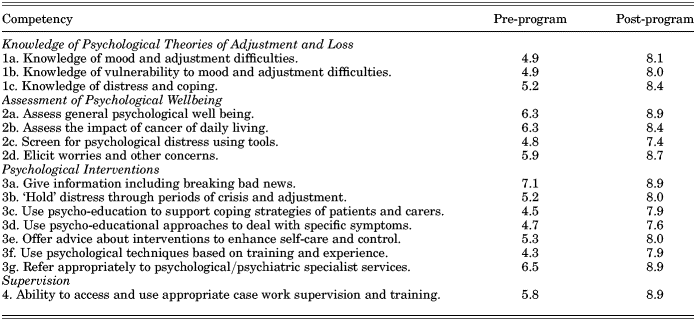
A total of 10 people completed the program. As illustrated in Table 1, prior to the program, participants were least confident on competency 3f, which asked about using psychological techniques (average score of 4.3) and on competency 3c, which referred to using psycho-education to support the coping strategies of patients and carers (average score of 4.5). They were most confident on competency 3a, which referred to the ability to give information and break bad news (average score of 7.1).
Mean confidence scores by competency at pre-program and post-program (where 1 = not at all confident and 10 = very confident)

Following the program, participants rated their confidence as having increased across all areas. The largest increase was found on competency 3c, which assessed participants’ confidence in providing psycho-education to support the coping strategies of patients and carers. This was one area in which the group was least confident in at the beginning of the training.
Thematic analysis of participants’ feedback indicated that they felt all aspects of psychological care relevant to the CNS role were covered during the program. Participants found it useful to reflect on the CNS role in providing psychological care and to increase the emphasis in this respect. They felt the structure of the program was appropriate, with sufficient time between the teaching sessions to reflect on the issues discussed. They valued the cross-network approach, both meeting new colleagues and sharing ideas, as well as meeting the Clinical Psychologists who work across the Network and seeing their different styles and approaches. Participants identified that the supervision sessions allowed an opportunity for solidifying the work and discussing more difficult aspects. Most participants wanted the supervision aspect to continue beyond the program.
Program enhancements were suggested particularly in relation to the portfolio. Participants requested that this should be introduced earlier in the program with guidance/exemplars of how to complete it. In addition, discussing the portfolio in supervision and to explain how to record their reflections was suggested. Participants also explained that they struggled to prioritize the supervision sessions in their busy clinical schedules. Suggestions were proposed as to how this could be made easier, for example, having the session at the beginning or end of the day. With regard to the content of the teaching, the participants identified that teaching related to the holistic assessment could be linked more explicitly with the YCN and national guidelines.
DISCUSSION
The results of this small pilot study indicate that the program was effective in improving participants’ confidence on all of the specified competencies: improving their knowledge of psychological theories, skills in assessment and intervention with psychological difficulties, and accessing and using supervision appropriately.
Prior to the program the CNSs rated their confidence in their ability to give information and break bad news as the highest out of all the competencies. This is perhaps unsurprising given the extent that this is addressed in other communication skills courses, such as the Connected course (the national Advanced Communication Skills Course.) Given that completion of the Connected course is a pre-requisite for attending the YCN Psychological Skills program, it is perhaps unnecessary to address this competency as part of the level 2 psychological training program.
The biggest change was in the CNSs' confidence to provide psycho-education to support the coping strategies of patients and carers. This was particularly targeted during the training, as basic cognitive-behavioral therapy approaches to managing difficulties such as anxiety and depression involve psycho-education. For example, working with patients to highlight links between thoughts, feelings and behaviors. Psycho-education has been demonstrated to be very effective when treating psychological distress in patients with cancer (e.g., Helgeson et al., Reference Helgeson, Cohen and Schulz1999).
One of the key learning experiences valued by participants was the opportunity for clinical supervision. These sessions provided inter-professional (CNS and psychologist) events for reflection-on, and discussion, of key learning. The value of such learning opportunities is reinforced by Lave and Wenger (Reference Lave and Wenger1991; Reference Lave, Wenger, McCormick and Paechter1999) who described “situated learning” whereby learning is a process of participation in a community of practice. For the CNSs, the program offered opportunities to form a community of practice with the psychologists to develop their insight, knowledge, understanding and skills in psychological support. Within communities of practice, and as suggested through the participants’ feedback, people share knowledge, and, through dialogue with more skilled members (psychologists), bring this to the surface, exchange ideas and experiment with new methods of practice. This may offer some explanation as to why those participants in Mannix et al. (Reference Mannix, Blackburn and Garland2006) study who did not receive continuing supervision reported a loss of confidence in providing psychological support.
A challenge in clinical practice is enabling CNSs to prioritize supervision sessions within their busy schedules. As demonstrated from the participant feedback, despite the value placed on supervision sessions, CNSs struggled to prioritize attendance. The Psychological Peer Review Measures (National Cancer Action Team, 2010) have stipulated that each Multi-disciplinary Team (MDT) should have a member with level 2 psychological skills and that this individual should attend regular supervision sessions for a minimum of 1 hour per month. It is hoped, therefore, that supervision sessions will become prioritized within these individuals' job plans so that attendance is increased and maintained. Another specific improvement suggested by the participants regarding explanation of how to use the portfolios to enhance their learning has already been addressed in the following year's program.
LIMITATIONS
This is a pilot study with a small number of participants, so the results cannot be generalized at this stage. In addition, the CNSs who elected to come on the program did so out of personal interest rather than being randomly assigned to the program. This may influence the findings.
Participants were asked to give confidence ratings to assess their competency in a specific set of psychological skills and these responses were not anonymized. This may lead participants to overestimate or underestimate their skills. They may have also felt pressure to demonstrate change, because of the time involved in attending the training and supervision sessions. In addition the link between confidence and objective competency is not clear with some researchers suggesting that self-perceived competence correlates poorly with objectively measured competence (in medical students) (Lai et al., Reference Lai and Teng2011). Davidson and Scott (Reference Davidson and Scott2009) report that relatively few studies have examined the relationship between practitioner competence and clinical outcomes in psychotherapeutic settings. In future it would be helpful to find another way of assessing the change in skill level, such as through observation of consultations and formal rating of the skills used, as carried out by Mannix et al. (Reference Mannix, Blackburn and Garland2006). A measure of patient response to the assessment and intervention would also provide useful evidence about the efficacy of training. Indeed Turner et al. (Reference Turner, Kelly and Clarke2011) have published a study protocol of a randomized study which will evaluate the effectiveness of brief tailored psychosocial interventions delivered by health professionals who have undergone focused training (via a self-directed manual and participation in a skills development session) and have participated in clinical supervision, which will look directly at this issue. Longitudinal follow-up is also indicated to assess how well skills are maintained.
CONCLUSION
The results of this small pilot study indicate that a 3-day program with at least three supervision sessions was effective in improving CNSs’ confidence level in specific psychological competencies. In particular, their knowledge of psychological theories, skills in assessment and intervention with psychological difficulties, and access and appropriate use of supervision were all rated as improved. Continued development and refinement of courses to train CNSs in level 2 psychological skills is needed to establish the most effective way to train and maintain these skills. Future research should also focus on the impact of these skills within consultations (a more objective way of measuring skill change) and on patients.