Success in the domain of work is one of the most salient developmental tasks of adulthood and a key indicator of adaptive function in the evaluation of health and psychopathology (Havighurst, Reference Havighurst1982; Masten, Burt, & Coatsworth, Reference Masten, Burt, Coatsworth, Cicchetti and Cohen2006; Roisman, Masten, Coatsworth, & Tellegen, Reference Roisman, Masten, Coatsworth and Tellegen2004; Vondracek, Reference Vondracek1998; Wiesner, Vondracek, Capalid, & Porfeli, Reference Wiesner, Vondracek, Capaldi and Porfeli2003). In his classic developmental volume, Childhood and Society, psychoanalytic theorist Erik Erikson (Reference Erikson1950/1963, pp. 264–265) attributed to Sigmund Freud the now-famous answer to the question of “what a person should be able to do well.” “Lieben und arbeiten” (to love and to work), Freud reportedly quipped. Societies, as well as individuals, families, and communities, have a stake in the work success of their young people because of the economic and social value placed on work competence and, therefore, a stake in children developing the capabilities for future work success. Concomitantly, symptoms of psychopathology that disrupt the capacity for work success in the present or future concern these stakeholders as well. In applied psychology and psychiatry, work function long has been viewed as central to diagnosis and treatment because of its significance for etiology, prognosis, and treatment (Masten et al., Reference Masten, Burt, Coatsworth, Cicchetti and Cohen2006). Yet, despite the central importance of work competence and its development, there has been surprisingly little focus on the development of work competence. The purpose of this study was to examine the predictive significance of childhood competence in age-salient domains of adaptive behavior for work outcomes 10 and 20 years later in emerging and early adulthood.
Competence in Developmental Theory: Cascades and Developmental Tasks
Competence is a broad construct referencing a family of concepts related to doing well in life (Masten et al., Reference Masten, Burt, Coatsworth, Cicchetti and Cohen2006). Developmental theory for over a century has suggested that competence in adulthood has roots in childhood (Masten et al., Reference Masten, Burt, Coatsworth, Cicchetti and Cohen2006). More recently, there was a resurgence of interest in the development of competence with the emergence of developmental psychopathology, research on resilience, and prevention science (Masten, Reference Masten2006, Reference Masten2007). Developmental psychopathology highlighted the significance of research on pathways to good adaptation as well as paths to problems and disorders (Cicchetti & Cohen, Reference Cicchetti and Cohen2006). Resilience science focused on understanding how people manage to do well in the context of threats to healthy function of development and the assessment of competence played a central role in this body of work (Masten & Coatsworth, Reference Masten and Coatsworth1998). Resilience research focused attention on positive adaptation and development in the context of high risk or adversity, requiring investigators to define, assess, and follow good as well as poor adaptation over the life course; at the same time, prevention scientists realized that promoting competence was an effective way to prevent problems and also that preventing problems resulted in better competence outcomes (Luthar, Reference Luthar, Cicchetti and Cohen2006; Masten et al., Reference Masten, Burt, Coatsworth, Cicchetti and Cohen2006).
Recent theory and research on developmental cascades has underscored the importance of understanding how behavior in one domain of competence or psychopathology may come to influence other domains over time, in a progressive cascade or chain reaction (Masten et al., Reference Masten, Roisman, Long, Burt, Obradovíc and Riley2005, Reference Masten, Burt, Coatsworth, Cicchetti and Cohen2006). In developmental theory, competence begets competence as the skills formed in one period of development become the tools for achieving success in the future, and the evidence supporting this general axiom of developmental science is growing (Heckman, Reference Heckman2006; Masten et al., Reference Masten, Burt, Coatsworth, Cicchetti and Cohen2006; Masten, Long, Kuo, McCormick, & Desjardins, Reference Masten, Long, Kuo, McCormick and Desjardins2009). Failures in major domains of competence also may spill over to influence other domains of function, including psychological well-being and symptoms of psychopathology (Obradović, Burt, & Masten, Reference Obradović, Burt and Masten2010). Symptoms of psychopathology also may undermine adaptive behavior, with lingering or spreading consequences (Patterson, Reid, & Dishion, Reference Patterson, Reid and Dishion1992). There are numerous causal theories of how such cascades might occur and growing evidence that they do occur (Masten et al., Reference Masten, Burt, Coatsworth, Cicchetti and Cohen2006; Rutter, Kim-Cohen, & Maughan, Reference Rutter, Kim-Cohen and Maughan2006; this special issue).
Competence can be defined developmentally as the capabilities, processes, or outcomes pertaining to effective performance in developmental tasks for a given age period, cultural, and historical context (Masten et al., Reference Masten, Burt, Coatsworth, Cicchetti and Cohen2006). In the Project Competence longitudinal study of competence and resilience, as well as a number of other studies (for a review, see Masten et al., Reference Masten, Burt, Coatsworth, Cicchetti and Cohen2006), competence has been defined and measured in terms of age-salient developmental tasks (Masten et al., Reference Masten, Coatsworth, Neemann, Gest, Tellegen and Garmezy1995, Reference Masten, Hubbard, Gest, Tellegen, Garmezy and Ramirez1999).
The concept of developmental tasks has deep roots in theories of adaptation and development, although the work of Erik Erikson, Robert Havighurst, and Alan Sroufe has been particularly influential in contemporary theory (Masten et al., Reference Masten, Burt, Coatsworth, Cicchetti and Cohen2006). Developmental tasks are benchmark expectations by which adaptation in life is judged in cultures and societies; achievements in these tasks represent psychosocial milestones of development (Havighurst, Reference Havighurst1972; Masten et al., Reference Masten, Burt, Coatsworth, Cicchetti and Cohen2006). These tasks represent broad, developmentally based standards for behavior serving as indicators that development is proceeding in such a way that future success in the cultural and social context is deemed likely. Although there are culturally specific developmental tasks, many others appear to be widely shared across cultures. Universal developmental tasks presumably reflect common observations across diverse societies and cultures about what matters for building future competence.
Developmental tasks also wax and wane in salience over the life course. School achievement, for example, is salient during the early decades of life and wanes in salience in adulthood. In contrast, work competence, which emerges later, becomes more salient with the transition to adulthood and usually does not wane in salience until late adulthood.
The conceptualization and assessment of competence in developmental tasks has been central to the Project Competence study (e.g., Garmezy, Masten, & Tellegen, Reference Garmezy, Masten and Tellegen1984; Masten et al., Reference Masten, Coatsworth, Neemann, Gest, Tellegen and Garmezy1995; Roisman et al., Reference Roisman, Masten, Coatsworth and Tellegen2004). In childhood, the core developmental task domains of focus in Project Competence were academic achievement, social competence with peers, and rule abiding conduct versus aggressive–disruptive behavior. As children grew older, the nature of expected behavior and the nature of our assessments changed to reflect developmental change. In childhood, for example, social competence with peers was measured by reputation among classmates and having friends, whereas in adolescence, the assessments of peer social competence placed a greater emphasis on the quality of friendship. Thus, close friendship was a key indicator of social competence with peers in adolescence. In adolescence, we also began to focus attention on two emerging domains of competence—romantic relationships and competence in paid jobs, although the domains of conduct, academic, and social competence remained central. By early adulthood, we defined work and romantic competence as salient developmental tasks, and at the point when individuals in the cohort began to have children, parenting competence became salient for those who were parents (Masten et al., Reference Masten, Burt, Roisman, Obradović, Long and Tellegen2004).
In the overall conceptualization of the Project Competence longitudinal study, we hypothesized that competence in childhood developmental tasks would forecast success in the future, including success in the domain of work (Masten & Powell, Reference Masten, Powell and Luthar2003). Thus, we expected work competence to have roots in earlier competence, as well as concurrent associations with function in other competence domains.
“Work,” of course, is a broad concept that can encompass formal (paid employment) and informal work (paid by family or neighbors to complete chores), volunteer work, and also important unpaid family responsibilities in the care and rearing of children, maintaining a home, and related chores and responsibilities (Elder & Conger, Reference Elder and Conger2000; Mortimer & Zimmer-Gembeck, Reference Mortimer, Zimmer-Gembeck, Skorikov and Patton2007). Although a wide range of these activities were assessed in the course of this study, the definition of work competence for the present study focused on indicators of success in formal work or employment, as evidenced by the track record of success or problems in employment, and judgments of informants (e.g., self, parents) about how well the person was doing in regard to employment. The assessment instruments encompassed a period of time rather than a single point in time, in order to gather information on the recent track record rather than only current status. Indicators of work competence were based on information or ratings about the recent history of employment, whether a person had been fired and why, nature of job responsibilities (greater responsibility vs. less), and general reliability in carrying out responsibilities of work.
Developmental Findings on Work Competence
The longitudinal evidence linking adult work outcomes to competence or symptoms in childhood or adolescence is scattered across a variety of studies, including basic studies of development, research on delinquency and other problems, and intervention studies. Even though few of these studies were designed specifically to focus on work, the data are compelling in their consistency: aggressive or antisocial behavior and related peer problems in childhood predict employment problems in adulthood; cognitive ability or academic success in childhood or adolescence forecasts work success; and these effects often appear to be mediated by continuity in antisocial behavior or academic failure or both (Caspi, Wright, Moffitt, & Silva, Reference Caspi, Wright, Moffitt and Silva1998; Dubow, Huesmann, Boxer, Pulkkinen, & Kokko, Reference Dubow, Huesman, Boxer, Pulkkinen and Kokko2006; Kokko & Pulkkinen, Reference Kokko and Pulkkinen2000; Kokko, Bergman, & Pulkkinen, Reference Kokko, Bergman and Pulkkinen2003; Pinquart, Juang, & Silbereisen, Reference Pinquart, Juang and Silbereisen2003; Wiesner et al., Reference Wiesner, Vondracek, Capaldi and Porfeli2003).
Young men and women in the United States, and presumably many other countries, appear to have different work patterns in adolescence and early adulthood, and some of the data suggest that there may be gender differences in the links over time among domains of competence and work (Apel, Paternoster, Bushway, & Brame, Reference Apel, Paternoster, Bushway and Brame2006; Masten et al., Reference Masten, Coatsworth, Neemann, Gest, Tellegen and Garmezy1995; Roisman et al., Reference Roisman, Masten, Coatsworth and Tellegen2004). Antisocial behavior, for example, may pose more problems for the work success of males, whereas academic achievement may have greater significance for work success of females. These differences may be related to the nature of job availability or interest for males and females, or to gender differences in the levels of antisocial behavior or academic achievement or some combination of these effects.
Both cross-sectional and longitudinal studies of academic achievement and work corroborate the association of adaptive behavior in these two domains (Dubow et al., Reference Dubow, Huesman, Boxer, Pulkkinen and Kokko2006; Masten et al., Reference Masten, Burt, Coatsworth, Cicchetti and Cohen2006; Wiesner et al., Reference Wiesner, Vondracek, Capaldi and Porfeli2003). Work success has long been associated with academic attainment, in part, because so many jobs have academic requirements and highly specialized skills acquired in specific academic programs, but also because school and work success presumably require many of the same underlying capabilities and skills, such as thinking, reading, and writing, achievement motivation, getting along with other people and self-discipline. This is hardly surprising, given that schooling was developed in some respects to nurture the skills needed for success in society.
One of the most important studies focused on the development of work, its origins, and consequences has been conducted by Mortimer and colleagues in the Youth Development Study (Mortimer, Vuolo, Staff, Wakefield, & Xie, Reference Mortimer, Vuolo, Staff, Wakefield and Xie2008; Mortimer & Zimmer-Gembeck, Reference Mortimer, Zimmer-Gembeck, Skorikov and Patton2007). Findings from this cohort longitudinal study indicate that there are different pathways to a career or work success in adolescence and emerging adulthood. Some young people invest early in a career trajectory and less in high school achievement, with more intensive early labor force participation, whereas others invest in the higher education path. Intensive work schedules during the school year, with long hours (i.e., ≥20 hr/week), are not conducive to academic achievement. Other studies have observed an inverse relation between work intensity among adolescents and school engagement or achievement (e.g., Roisman, Reference Roisman2002; Steinberg, Fegley, & Dornbusch, Reference Steinberg, Fegley and Dornbusch1993). Results of the Youth Development Study also indicated that the quality of the work experience was related both to current satisfaction and the lasting value of work for future employment.
Work success or failure also has been linked to antisocial behavior (Caspi et al., Reference Caspi, Wright, Moffitt and Silva1998; Apel et al., Reference Apel, Paternoster, Bushway and Brame2006; Masten et al., Reference Masten, Coatsworth, Neemann, Gest, Tellegen and Garmezy1995; Wiesner et al., Reference Wiesner, Vondracek, Capaldi and Porfeli2003), likely for multiple reasons. Clearly, externalizing symptoms and antisocial behavior could result directly in failure in the work domain if an individual breaks rules for conduct in the workplace. Similarly, characteristics associated with antisocial behavior, ranging from substance abuse to irresponsible behavior, could undermine function for most kinds of employment. Moreover, a track record of trouble with the law also can make it difficult to find a good job. To complicate matters further, antisocial behavior often co-occurs with academic and social problems, so it is difficult to differentiate specificity of effects.
Developmental theories about competence also suggest that social competence with peers in childhood will forecast adult success in the domain of work (Collins & van Dulmen, Reference Collins, van Dulmen, Huston and Ripke2006; Masten et al., Reference Masten, Burt, Coatsworth, Cicchetti and Cohen2006; Waters & Sroufe, Reference Waters and Sroufe1983). Data support this expectation, although longitudinal data are scarce and limited in terms of controlling for correlated predictors. In the Minnesota Parent–Child Project (Collins & van Dulmen, Reference Collins, van Dulmen, Huston and Ripke2006), peer social competence predicted work competence in emerging adulthood, and also appeared to mediate the effect of early caregiving quality on work outcomes. In Project Competence, peer reputation in elementary school (assessed by peer nominations on the Revised Class Play [RCP]) predicted work competence 10 years later, controlling for academic achievement and IQ in childhood. Children viewed by peers as prosocial (e.g., trustworthy, fair, polite) had better job competence outcomes, whereas peer exclusion (which was related to antisocial behavior) predicted worse outcomes in the work domain (Gest, Sesma, Masten, & Tellegen, Reference Gest, Sesma, Masten and Tellegen2006). Neither of these longitudinal studies controlled fully for earlier and concurrent competence in other salient domains of competence.
Consistent with the findings from studies on the natural course of development, intervention studies focused on preventing antisocial behavior and/or promoting academic success have shown intervention effects on long-term work outcomes in adulthood. Examples include the Seattle Social Development Study (Hawkins, Kosterman, Catalano, Hill, & Abbott, Reference Hawkins, Kosterman, Catalano, Hill and Abbott2005, Reference Little and Rubin2008) and the Chicago Longitudinal Study (Reynolds et al., Reference Reynolds, Temple, Ou, Robertson, Mersky and Topitzes2007). Prevention efforts that result in reducing antisocial behavior or boosting academic attainment or both also appear to improve work outcomes in early adulthood.
Although the body of literature linking child or adolescent competence to adult work success is consistent in indicating the potential significance of competence in the domains of conduct, academic and interpersonal competence for later work success, the findings to date are limited by study design and statistical approach. None of the studies that we located have examined the question of linkages among competence domains over time with adequate controls for stability over time within domains and the expected covariation within time and across domains among areas of adaptive functioning. As a result, for example, the predictive significance of child or adolescent antisocial behavior may reflect the ongoing current association of antisocial behavior with work competence and the high level of stability in the domain of antisocial behavior. Rarely do studies control for expected continuity within domains and the concurrent covariation among domains at all points in time.
There are many reasons for this scarcity of studies with strong tests for across-time, across-domain effects. Perhaps the most important factors are the difficulty of collecting the kind of data required for stringent testing of directional effects and the accessibility of suitable statistical methods, which improved with software development in recent years. Multivariate, cascade models of adaptive behavior were developed explicitly to test whether there are cumulative and directional effects over time among domains of adaptive function (competence or psychopathology) beyond concurrent (potentially bidirectional) cross-domain effects and longitudinal, within-domain, stability effects (Cole & Maxwell, Reference Cole and Maxwell2003; Masten et al., Reference Masten, Roisman, Long, Burt, Obradovíc and Riley2005, Reference Masten, Burt, Coatsworth, Cicchetti and Cohen2006).
The Present Study: Testing Cumulative Cascade Models for Work Competence
The goal of the present study was to test cumulative cascade models linking competence in age-salient developmental task domains of conduct, academic achievement, and social competence to later work competence over a 20-year time span, drawing on data from the Project Competence longitudinal study. Earlier analyses from this study focused on competence over time had indicated that work competence in emerging adulthood (around age 20) had links to both concurrent and earlier (childhood) competence (Masten et al., Reference Masten, Coatsworth, Neemann, Gest, Tellegen and Garmezy1995). In addition, a study of competence in emerging adulthood as a predictor of later adult competence indicated that work competence in early adulthood (around age 30) was linked to competence in emerging adulthood 10 years earlier (Roisman et al., Reference Roisman, Masten, Coatsworth and Tellegen2004). The latter study found that academic and social competence in emerging adulthood had unique predictive significance for work competence in early adulthood. However, the analytic approach did now allow for full control of covariance related to concurrent associations and stability within domains. The goal of the present analysis was to conduct a more integrative analysis linking competence in multiple domains to work over the full 20-year span of the data available (spanning childhood to early adulthood), utilizing structural equation modeling (SEM) methods that afforded more stringent testing of cascade effects over time.
Initial studies of cascade effects in Project Competence focused on cross-domain linkages among externalizing and internalizing symptoms and academic and social competence (Burt, Obradovic, Long, & Masten, Reference Burt, Obradović, Long and Masten2008; Masten et al., Reference Masten, Roisman, Long, Burt, Obradovíc and Riley2005; Obradović et al., Reference Obradović, Burt and Masten2010). Based on developmental theory and earlier empirical studies, we hypothesized that externalizing problems (disruptive–aggressive behavior vs. rule-governed conduct) would spread to academic and social function, with consequences for psychological well-being, and internalizing symptoms as well. Findings supported these expectations.
Our conceptual models and hypotheses for the present study of work competence were based on the literature as well as empirical findings from the same data set in earlier cascade analyses. We expected that competence across major developmental task domains within a given assessment window (childhood, emerging adulthood, early adulthood) would show within time covariation, reflecting both transactional effects (presumably bidirectional) taking place within a time period of a given assessment window and common underlying fundamental skills and motivations (e.g., basic cognitive and self-regulation skill, motivation for relationships, mastery). We also assumed that competence within domains would show continuity in the sense of coherence over time; thus, we expected stability within task domains despite alterations in measurement to assess more mature forms of competence in a given domain. Stability was expected to be especially high in the conduct (externalizing) and academic domains over time.
Given these two major expectations alone (within-time covariance and across time stability), there would be multiple pathways by which problems in one domain could spread to other domains over time. Bidirectional influences occurring among domains within time would be carried forward across time. However, the main purpose of this analysis was to test for additional, cumulative cascade effects across domains, controlling for covariation links among domains observed within time or stability within domains over time.
We hypothesized that there would be cumulative cascades from competence in age-salient developmental tasks of conduct (rule-abiding vs. externalizing behavior), academic competence, and social competence to work. Work emerges later than the other competence domains in the life course, and theoretically, competence in these earlier domains would be important for work competence. Therefore, we expected work to be associated with adaptive behavior in these three other domains when measured concurrently in emerging adulthood. In addition, however, we expected to find cascade effects from earlier-emerging salient domains of competence to the later-emerging domain of work, consistent with the expectation that rule-governed conduct, social competence with peers, and academic achievement in childhood or adolescence provide a foundation for later work competence. It was less clear when these cascades might occur or how long they might be evident. Thus, we tested for early cascades (childhood to emerging adulthood) and later cascades (emerging adulthood to early adulthood). Gender differences were considered because of earlier evidence that externalizing problems may play a greater role for males and academic success for females in the pathways to work.
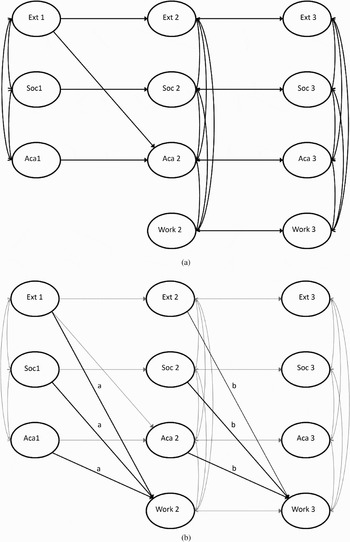
Figure 1 visually summarizes the central conceptual models tested in our analyses, involving links for three time points and four developmental task domains of adaptive behavior: externalizing (Ext) behavior in the conduct domain, competence in the academic domain (Aca), social (Soc) competence, and competence in work (Work). We tested a set of a priori alternative models consistent with the literature on antisocial behavior and competence in relation to work. One cascade effect, the cascade from externalizing behavior in childhood to later academic achievement, was taken as a “given” in these analyses because of its robust presence in earlier cascade models in this study as well as other research. The most parsimonious model we were willing to consider included this cascade path but no other cascades among the four domains of adaptive behavior (Figure 1a). This model was nested in all other models tested, and other models were compared to this model by fit and efficiency criteria delineated in the Statistical Approach Subsection. We tested an early cascade model with paths from all early competence domains at Time 1 (T1) to work at Time 2 (T2), indicated in Figure 1b paths marked with the letter “a.” We also tested a late cascade model focused paths from competence domains at T2 to work at Time 3 (T3), indicated in Figure 1b with paths marked “b.” An early plus late cascade model combined the early and late cascade paths to work, including all paths illustrated in Figure 1b. The most complex models we tested included early and late cascades to work plus either gender effects or the effects of work to the other three competence domains (representing transactional effects). Although we did not hypothesize effects linking work over time to later academic, social, or externalizing behavior, such effects would capture the view that “success in work is good for you” in terms of promoting competence in other domains (Elder & Conger, Reference Elder and Conger2000).
An illustration of the selected models tested in the analyses. Ext, externalizing problems versus good conduct; Aca, academic achievement/attainment; Soc, social competence with peers. The numbers indicate the assessment time period (1, 2, or 3). (a) Stability plus Ext1 cascade (to Aca2) represents the most parsimonious model considered, and it was embedded in all other models and included one cascade effect (Time 1 [T1] Ext to Time 2 [T2] Aca) that has been well established in this data set. (b) An illustration of three core models of cascades to work. The early cascade model included all cascade paths from T1 competence domains to Work2, indicated by the letter “a,” in addition to all the paths of the most parsimonious model shown in (a). The late cascade model included paths labeled “b,” reflecting cascades from T2 competence domains to Work3, in addition to all of the most parsimonious model paths. The early and late cascades to work model included all “a” and “b” paths plus all of the paths of the most parsimonious model. Additional models testing for gender moderating effects and transactional paths from Work2 to competence domains at T3 are described in the text and summarized in Table 3.

Methods
Sample and procedure
Data for this study were collected from 205 individuals (91 males, 114 females), comprising the Project Competence longitudinal study cohort (Burt et al., Reference Burt, Obradović, Long and Masten2008; Garmezy et al., Reference Garmezy, Masten and Tellegen1984; Masten et al., Reference Masten, Garmezy, Tellegen, Pellegrini, Larkin and Larsen1988, Reference Masten, Coatsworth, Neemann, Gest, Tellegen and Garmezy1995, Reference Masten, Hubbard, Gest, Tellegen, Garmezy and Ramirez1999, Reference Masten, Roisman, Long, Burt, Obradovíc and Riley2005; Obradović et al., Reference Obradović, Burt and Masten2010; Roisman et al., Reference Roisman, Masten, Coatsworth and Tellegen2004). Participants were recruited in the late 1970s from two elementary schools in a diverse, urban Minneapolis catchment area when they were in third to sixth grade and around 8–12 years old (average age about 10). Twenty-nine percent of participants were ethnic/racial minorities (18% African American, 7% American Indian, 3% Hispanic, 1% Asian), which was similar to the estimated district proportion of minority students at the time. There were 26 sibling pairs in the study sample. The sample also reflected the diverse array of socioeconomic backgrounds present in the catchment area neighborhoods at the time, ranging from individuals with little education who were receiving public assistance to well-educated professionals (Duncan Socioeconomic Index, range = 7–92, average status = ~43, the socioeconomic index level for a family of lower to middle working class status and occupations such as skilled labor and clerical positions; Hauser & Featherman, Reference Hauser and Featherman1977; Hauser & Warren, Reference Hauser and Warren1997). The sample also had standardized IQ and achievement test score averages close to normative mean levels for the general child population (see Masten et al., Reference Masten, Coatsworth, Neemann, Gest, Tellegen and Garmezy1995, Reference Masten, Hubbard, Gest, Tellegen, Garmezy and Ramirez1999). After initial participation, follow-up assessments were conducted approximately 7, 10, and 20 years later. Data for the present study were drawn from the follow-ups after 10 and 20 years, with retention of 98% and 90%, respectively.
During the initial assessment (T1, around age 10) of this longitudinal study, extensive multimethod, multi-informant data were collected, with particular emphasis on the measurement of competence, symptoms of psychopathology, family history and activities, and other child or family attributes viewed as potential risk or protective factors. Data at this time point were collected from parent interviews and questionnaires, participant interviews and questionnaires, teacher ratings and questionnaires, school records, and peer ratings. Extensive assessments were also conducted during the 10-year follow-up (T2 for purposes of this analysis, occurring around age 20), which included participant interviews, parent interviews, and questionnaires completed by both the participants and their parents. Because of limited resources and the wide dispersion of the participants, the 20-year follow-up (T3, around age 30) was conducted via postal mail. Participants and their parents were asked to complete several questionnaires that were similar to those used in the previous assessment, but with developmentally appropriate modifications.
Measures
Multiple indicators for each of the competence domains considered in this study were available, and final indicators were chosen based on multiple methods with strong psychometric properties, multiple informants, and carefully defined competence concepts (see Burt et al., Reference Burt, Obradović, Long and Masten2008; Garmezy et al., Reference Garmezy, Masten and Tellegen1984; Masten et al., Reference Masten, Coatsworth, Neemann, Gest, Tellegen and Garmezy1995, Reference Masten, Burt, Roisman, Obradović, Long and Tellegen2004, Reference Masten, Roisman, Long, Burt, Obradovíc and Riley2005; Masten & Obradović, Reference Masten and Obradović2006; Masten & Powell, Reference Masten, Powell and Luthar2003; Roisman et al., Reference Roisman, Masten, Coatsworth and Tellegen2004). Given the limited sample size and the multivariate design of the present analyses, we aimed for three indicators for each latent construct, compositing within method or informant as indicated when there were additional indicators available. Every effort was made to balance the informants and methods within and across time. Parents and the target participants were informants at each assessment (through questionnaires and/or interviews), often supplemented by the perspective of clinical judges independently reviewing interview or questionnaire responses. In childhood, when all of the participants were still in school, classmates and teachers also were informants.
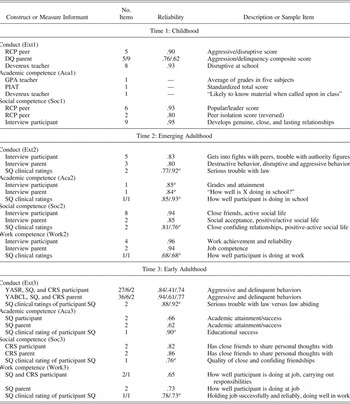
Table 1 presents a summary list of all indicators for the SEM analyses. Reliabilities are indicated in the table or text, including intraclass correlation coefficients for interrater agreement at the item or scale level for scores based on judges’ ratings and/or coefficient alpha values for internal consistency of composited multi-item scales. Descriptions or examples of item content are also provided in Table 1 and the text.
Measures of competence

Note: When multiple scores have been composited, the reliabilities of the components are provided. Reliability values generally refer to coefficient alpha for scales and the intraclass correlation coefficient for single ratings. RCP, Revised Class Play; DQ, Developmental Questionnaire; GPA, grade point average; PIAT, Peabody Individual Achievement Test; SQ, Status Questionnaire; YASR, Young Adult Self-Report; CRS, Competence Rating Scales; YABCL, Young Adult Behavior Checklist.
aIntraclass correlation coefficient.
Externalizing problems versus good behavioral conduct
Time 1 externalizing/conduct was assessed with three indicators. The first was a composite (averaging z scores) of parents’ reports of delinquent (e.g., “stealing”) and aggressive (e.g., “bullies other children”) behaviors from the Development Questionnaire (Masten et al., Reference Masten, Roisman, Long, Burt, Obradovíc and Riley2005). The Development Questionnaire problem checklist was based on an instrument used in Minneapolis clinics to assess psychiatric symptoms prior to publication of (but very similar to) the Child Behavior Checklist (Achenbach & Edelbrock, Reference Achenbach and Edelbrock1983). Peer ratings of aggressive behaviors from the RCP peer nomination procedure (Masten, Morison, & Pellegrini, Reference Masten, Morison and Pellegrini1985; Gest et al., Reference Gest, Sesma, Masten and Tellegen2006) comprised the second indicator. The third indicator was based on teacher ratings of classroom disruptiveness from the Devereux Elementary School Behavior Rating Scale (Devereux; Spivack & Swift, Reference Spivack and Swift1967; Finkelman, Ferrarese, & Garmezy, Reference Finkelman, Ferrarese and Garmezy1989).
At T2, externalizing versus good conduct was also defined by three indicators. Two of the indicators were based on independent interviewer ratings: a composite of five ratings of aggressive and disruptive behavior based on the participant interview and a comparable but independent composite of three ratings based on the parent interview. Ratings based on the participant and parent interviews were completed by the individuals who conducted the interview session using a set of scales developed to cover multiple domains of competence. The interviewer ratings had shown good reliability based on a subset of second ratings by independent judges who either accompanied the interviewer or listened to the complete interview (see Masten et al., Reference Masten, Hubbard, Gest, Tellegen, Garmezy and Ramirez1999). The third indicator was based on independent clinical ratings of conduct based on the responses of parents and participants to the Status Questionnaire (SQ), which was a structured questionnaire developed for the study to efficiently obtain parent or participant reports of adaptation status in major domains of competence as well as information on life history and health. Two sets of independent judges, blind to all other project data, generated the SQ ratings through their evaluation of SQ responses completed by parents or participants covering several broad areas of adaptation (see Masten et al., Reference Masten, Coatsworth, Neemann, Gest, Tellegen and Garmezy1995).
Externalizing/conduct was assessed at T3 using three composite indicators drawn from participant reports, parent reports, and clinical judges. The first composite combined three scores: (a) the participants’ self-reported aggressive, delinquent, and intrusive behavior on the Young Adult Self-Report (Achenbach, Reference Achenbach1997); (b) the participant's self-reported antisocial behaviors on the SQ (e.g., in prison during the past 3 years); and (c) participants’ responses on the conduct subscale of the Competence Rating Scales (CRS), with high scores indicating externalizing behavior (e.g., gets into fights). The CRS is an instrument adapted (with the assistance of Susan Harter and Jennifer Neemann) from preliminary versions of the Self-Perception Scale for Adolescents (Harter, Reference Harter1982) and the Self-Perception Scale for College Students (Neemann & Harter, Reference Neemann and Harter1986). The Project Competence CRS showed excellent reliability and construct validity, comparable to similar competence rating scales developed by Harter (e.g., Masten et al., Reference Masten, Coatsworth, Neemann, Gest, Tellegen and Garmezy1995). For this first indicator, standardized scores on the SQ and CRS were combined first and then averaged with standardized Young Adult Self-Report scores. The second indicator was a parallel composite to the first, but based on parent reports on the Young Adult Behavior Checklist (Achenbach, Reference Achenbach1997), the SQ, and the CRS. The third composite combined independent clinical ratings of seriousness of trouble with the law and overall law-abiding behavior scores based on judge's reviewing participant responses to SQ questions on law-abiding or law-breaking behavior.
Academic competence
In line with developmental theory, conceptualization of academic competence and, therefore, its measurement shifted over the course of the study. In childhood, academic competence was assessed in terms of academic achievement (e.g., grades, test scores, teacher appraisals of academic performance), whereas later in life it was conceptualized in relation to academic attainment (e.g., how far the individual went in school, degrees, and success in higher education). At T1, academic competence was assessed using school records of teacher assigned grades to compute a grade point average, standardized total score from the Peabody Individual Achievement Test (Dunn & Markwardt, Reference Dunn and Markwardt1970), and teacher ratings of comprehension from the Devereux (Spivack & Swift, Reference Spivack and Swift1967). Indicators for academic competence at T2 included independent ratings of academic achievement by the participant interviewer and the parent interviewers (with both sets of ratings showing excellent interrater reliability), plus a composite of independent clinical ratings of parents’ and participants’ responses to the SQ (also showing excellent interrater agreement). In early adulthood, T3, academic competence indicators included a composite of participants’ self-reported educational success and highest level of education, parallel items completed by participants’ parents, and independent clinical ratings of participants’ SQ responses.
Social competence
Social competence in childhood was conceptualized broadly to include peer acceptance, social skills, the formation of friendships, and the maintenance of those relationships. Indicators of social competence at T1 included the popular/leader subscale of the RCP, the peer isolation subscale of the RCP, and a composite score of nine ratings of the participants’ close friendships, getting along well with others, and global social acceptance based on participant interviews.
In adolescence, the conceptualization of social competence shifted to emphasize more heavily the quality and closeness of friendships, along with general social acceptance. For the T2 social competence indicators, three composites were based again on participant, parent, and clinical judge perspectives: a composite of eight participant interview ratings of close friendship and general social acceptance, a composite of two parent interview ratings of participants’ social acceptance and positive/active social life, and a composite of independent clinical ratings based on review of participants’ and parents’ responses on the SQ.
In early adulthood, the conceptualization of developmentally appropriate social competence focused more exclusively on the closeness and quality of friendships. The three composites used to index social competence in adulthood were based on participant and parent reports on the CRS measure for the friendship items, and the clinical ratings of participants’ SQ responses pertaining to qualities of friendships.
Work competence
In modern societies such as the United States, although children often are required to do chores around the home, employment is not viewed as a salient developmental task in childhood. Employment opportunities emerge in adolescence for most young people, and therefore job competence was not assessed until adolescence in this study. At T2 and T3, work competence was conceptualized as a track record showing the ability to hold down a job successfully and reliably and the ability to carry out responsibilities at work. Some scales were not rated if a person had never been employed during a window of assessment; however, others were rated for everyone (e.g., compared to other people this age, how would you rate how well you [this person] has done in the area of work?).
Time 2 work competence indicators included composites based on participant interviews, parent interviewers, and independent clinical judgments of SQ responses by participants and parents. Four ratings from the participant interviews were composited for one indicator. Two parent interview ratings of work competence were composited for the second indicator. For the third indicator, the SQ ratings scores for work (each based on independent ratings of the participant or parent SQ) were averaged. Compared to other people this age, how would you rate how well this person has done in the area of work?).
At T3, the three composite indicators for work were based on participant, parent, or clinical perspectives. The first indicator combined participant self-ratings for work competence on the CRS (e.g., “do quite well at job”) and SQ ratings (e.g., “how well does [target] carry out responsibilities of job”). The second indicator consisted of SQ ratings based on parent report (regarding “do quite well at job”). The third indicator was the average of two independent judges’ ratings of work competence based on the participant SQ (“holding a job successfully”; “how well [target] has done in the area of work”).
Statistical approach
The statistical analyses for this study were performed in Mplus version 5.2 (Muthén & Muthén, Reference Muthén and Muthén2007). Two data issues were initially addressed: (a) missing data and (b) nonnormality of some of the indicators. Descriptive statistics (not presented) showed that missing data ranged from 0% to 33% with a mean of 9% over all indicators and times. Statistical procedures, as described below, permitted the use of all 205 subjects under certain missing data assumptions. Descriptive analysis showed that some indicators were slightly skewed. However, the departure from normality was not extreme, and the raw form of the variables was considered appropriate for the normal-based methods described below.
Dependency of the 26 sibling pairs was examined by comparing pairwise correlations between siblings and random participants (i.e., not of the sibling pair) on several indicators. On the whole, correlations between siblings were not stronger than correlations between siblings and random participants, suggesting the sibling dependency was not substantial. Furthermore, the maximum likelihood (ML) estimator described below is robust to nonindependence of observations and provides proper standard errors for correlated data (Muthén & Muthén, Reference Muthén and Muthén2007, chap. 14).
SEM was used to fit a series of hypothesized models. Models were estimated using ML and ML with robust standard errors (MLR). When the missing data mechanism is at least missing at random, both estimation methods provide valid inference in the form of unbiased estimators (Little & Rubin, Reference Little and Rubin1989).
The relative fit of the hypothesized models was evaluated using the Bayesian information criterion (BIC; Raftery, Reference Raftery1995). Theoretical and simulation studies of the BIC suggest it is useful in model selection, particularly for the situation in which the researcher wants to guard against the inclusion of unnecessary parameters (Kadane & Lazar, Reference Kadane and Lazar2004). The BIC allows comparison of nested and nonnested models with the best fitting model having the lowest BIC value. Using the criteria of Burnham and Anderson (Reference Burnham and Anderson2004) models with a BIC difference of 2 or less are considered to have equivalent fit, models with a difference of 10 or greater are considered to have substantially different fit, and differences between 2 and 10 are less clear. It was decided a priori that in the situation where the BIC did not favor one model over another, that the most parsimonious model would be selected, as the additional paths did not greatly improve model fit.
In addition to relative fit, absolute fit (not in reference to other hypothesized models) was determined for each model using the Tucker–Lewis index (TLI), the comparative fit index (CFI), the root mean square error of approximation (RMSEA), and the standardized root mean square residual (SRMR). Using conventional criteria (see, e.g., Marsh, Hau, & Wen, Reference Marsh, Hau and Wen2004) good fit was determined by a model exhibiting simultaneous values of TLI and CFI ≥ 0.900, RMSEA ≤ 0.050, and SRMR ≤ 0.080.
MLR was used initially as our set of hypothesized models contained gender interaction terms that could not be estimated using ML (Muthén & Muthén, Reference Muthén and Muthén2007, chap. 5) and to account for dependency among the sibling pairs (described above). Although the BIC can be computed based on MLR, the estimation procedure does not allow the full array of absolute fit indices to be computed nor standardized coefficients. Therefore, the BIC based on MLR was used for comparison of models, but ML was then used to calculate additional fit indices and obtain standardized values.
Measurement models
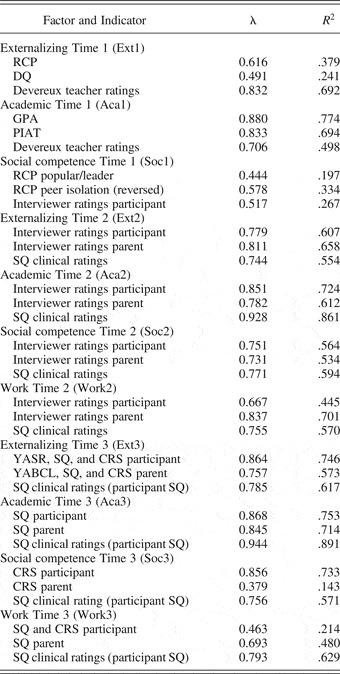
To keep the analysis manageable and interpretable, we examined the measurement models at each cross section of time prior to fitting the structural models (cascade models). The measurement models consisted of correlated factor models with three indicators per factor (see Table 2). Initial fit of the measurement models was poor for certain time points, especially T3. As a result, we allowed indicator residuals of the same method to covary within a time point for each measurement model. This greatly improved fit and was done for the measurement models at all three time points. The standardized path coefficients and R 2 values are shown in Table 2. Good global model fits were obtained at both T1 and T2 (in each case, CFI > 0.900, TLI > 0.900, RMSEA < 0.050, and SRMR < 0.050) but less adequate fit was found for T3 (CFI = 0.900, TLI > 0.900, RMSEA = 0.078, and SRMR = 0.054). However, fit across time was good for the final model when indicator residuals from common methods were allowed to covary and no further modifications were done to improve the fit of the T3 measurement model.
Descriptions, method, factor loadings, and variance explained for indicators used in the final model (“early cascade model”)

Note: RCP, Revised Class Play; DQ, Developmental Questionnaire; GPA, grade point average; PIAT, Peabody Individual Achievement Test; SQ, Status Questionnaire; YASR, Young Adult Self-Report; CRS, Competence Rating Scales; YABCL, Young Adult Behavior Checklist.
Cascade models
Thirteen hypothesized nested and nonnested cascade models were fit using the robust methods described above. Table 3 shows the primary cascade paths for each of the tested models. In all of the models, latent constructs within time were allowed to covary (not depicted in Table 3). For example, Aca1, Ext1, and Soc1 were allowed to covary. As previously described, within-time indicator residuals originating from the same method were allowed to covary (not depicted in Table 3).
Hypothesized nonnested structural equation modeling models tested in the cascade analysis

Note: T1–T3, Times 1–3; Ext1–3, externalizing problems versus good conduct at assessment T1–3, Aca, academic competence; Soc, social competence; Work, work competence.
aIncluded in all subsequent models.
bTotal of 3 cross-domain paths.
cTotal of 3 cross-domain paths.
dTotal of 6 cross-domain paths.
eTotal of 6 cross-domain paths.
fTotal of 6 cross-domain paths.
gTotal of 12 cross-domain paths.
hTotal of 6 cross-domain paths.
iTotal of 6 cross-domain paths.
jTotal of 9 cross-domain paths.
kTotal of 9 cross-domain paths.
lTotal of 9 cross-domain paths.
mTotal of 12 cross-domain paths.
As discussed in the introduction above, Model 1 (baseline model), was the most parsimonious model examined containing first-lag directed stability paths within constructs plus the Ext1 to Aca2 cascade (Masten et al., Reference Masten, Roisman, Long, Burt, Obradovíc and Riley2005). The remaining models, Model 2 through Model 13, contain the stability structure of Model 1 with additional cascade paths. Model 2 (early cascade model) added three early cross-domain paths to Model 1. Model 3 (late cascade model) added three late cross-domain paths to Model 1. Model 4 (early and late cascade model) added three early and three late cross-domain paths to Model 1.
In addition, three models with gender cascade interactions were tested. These models added additional latent variable interaction paths to Models 2 through 4. Gender was allowed to interact with the latent predictors on the cascading paths as the relatively small sample size (N = 205) prevented examination of gender moderating effects via multigroup modeling. As an example of a gender interaction term, gender and Aca1 were allowed to interact in explaining Work2. Model 5 (early cascade model + gender) added three early gender interaction paths to Model 2. Model 6 (late cascade model + gender) added three late gender interaction paths to Model 3. Model 7 (early and late cascade model + gender) added three early and three late gender interactions to Model 4. However, Model 7 was unable to be estimated because of convergence problems and was not examined further.
Models 8 through 13 were transactional models. These models contained additional cross-domain paths that originated in Work2 and went to Ext3, Aca3, and Soc3. Model 8 (early cascade + transactional model) added three cross-domain transactional effects to Model 2. Model 9 (late cascade + transactional model) added three cross-domain transactional effects to Model 3. Model 10 (early and late cascade + transactional model) added three cross-domain transactional effects to Model 4. Models 11–13 all added gender interactions to the transactional pathways for Models 8 through 10. Model 11 (early cascade + transactional with gender model) added three transactional gender interactions to Model 8. Model 12 (late cascade + transactional with gender model) added three transactional gender interactions to Model 9. Model 13 (early and late cascade + transactional with gender model) added three transactional gender interactions to Model 10.
Results
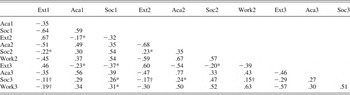
The intercorrelations among latent constructs are shown in Table 4. A set of latent regressions was conducted to capture the overall predictability of work at T2 and T3 from earlier competence. Work at T2 was regressed on the set of earlier latent competence constructs as predictors from T1 (Ext, Aca, Soc) and work at T3 was regressed on the latent predictors from T1, T2 (Ext, Aca, Soc, Work), and T1 plus T2 simultaneously. Work at T2 was significantly related to competence 10 years earlier at T1 (R 2 = .29, p < .001). Work at T3 was significantly related to competence at T1 (R 2 = .13, p < .01) and strongly related to competence at T2 (R 2 = .46, p < .001). When all of the T1 and T2 competence predictors were included simultaneously, Work3 was strongly related to earlier competence (R 2 = .48, p < .001). However, there were no significant effects of competence at T1 when all the T2 competence variables were included, suggesting that T1 effects were mediated by T2 competence.
Intercorrelations of latent constructs

Note: Ext1–3, externalizing problems versus good conduct at assessment Times 1–3; Aca, academic competence; Soc, social competence; Work, work competence. Correlations are p ≤ .001 unless otherwise indicated.
†p > .05. *p < .05.
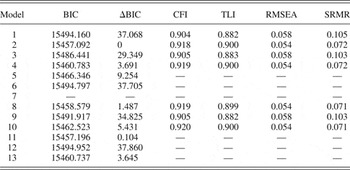
Table 5 shows the results of the cascade analysis. The second column of the table shows the BIC value for each hypothesized model, the next column shows the difference in BIC between each model and the model with the lowest BIC (Model 2, early cascade model). The results show that Model 2 (early cascade model), Model 8 (early cascade + transactional model), and Model 11 (early cascade + transactional with gender model) had essentially identical fit. Model 4 (early and late cascade model), Model 10 (early and late cascade + transactional model), and Model 13 (early and late cascade + transactional with gender model) also displayed similar fit to the best model. The remaining models had substantially worse fit than these models and might be considered less plausible. Models 5 through 7 represented the gender-moderated cascade models. These models all had poorer fit relative to the cascade only models. As mentioned previously, Model 7 could not be estimated because of convergence problems. Models 8 through 13 represent the transactional models with Models 10 through 13 having gender-moderated transactional paths. In general, these models displayed a poorer fit relative to the cascade models and similar fit to the gender-moderated cascade fit.
Relative and absolute fit indices for the 13 examined models

Note: BIC, Bayesian information criterion; ΔBIC = BICi − BICmin, where BICi is the BIC value for the ith model and BICmin is the minimum value; CFI, comparative fit index; TLI, Tucker–Lewis index; RMSEA, root mean square error of approximation; SRMR, standardized root mean square residual. All fit indices are based on maximum likelihood, except the BIC based on maximum likelihood with robust standard errors. Models 5, 6, and 11–13 could only be estimated with maximum likelihood with robust standard errors and Model 7 could not be estimated because of convergence problems.
The absolute fit indices for all the models demonstrated acceptable to good fit (see Table 5). These indices were nearly identical for the Models 2, 4, and 8. Models 1 and 3 displayed the worst fit of all the models examined but still had acceptable overall fit. Absolute fit indices were unable to be estimated for Models 5, 6, and 11 through 13 as these could only be estimated with MLR because of the presence of the gender moderating pathways.
The results from the relative and absolute fit indices argued for the adoption of Model 2 (early cascade model). Model 2 was the most parsimonious and best fitting model. It had better relative fit than all the other models with the exception of Model 8 and 11, whose fit could be considered identical. Whereas Models 8 and 11 had nearly identical fit relative to Model 2 (based on both relative and absolute fit indices for Model 8 and relative fit indices for Model 11 presented in Table 5), they contained additional pathways that did not greatly improve their fit relative to Model 2. The transactional pathways in Model 8 were not significant and it was not possible to estimate standardized pathways for Model 11. Model 4 (early and late cascade model) was another plausible model. This model, however, did not add any significant pathways beyond those accounted for in Model 2. In addition, Model 2 is nested within these models and the absolute fits did not greatly improve moving to these more complex models. These results supported the adoption of Model 2, the early cascade model.
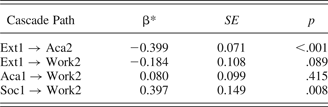
Table 6 shows the standardized coefficients and statistical significance for all cascade paths in the adopted Model 2. Ext1 to Aca2 and Soc1 to Work2 were the only significant cascade paths. These cascade paths remained statistically significant in the presence of both the late cascade and transactional paths (i.e., Models 4 and 8). In addition, nonsignificant early cascade paths did not become significant in the presence of late cascade or transactional paths.
Path coefficients for all cascade paths in Model 2
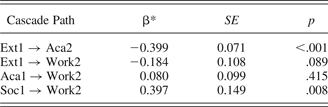
Note: β*, standardized path coefficient; Ext1–3, externalizing problems at Times 1–3; Aca, academic competence; Soc, social competence; Work, work competence.
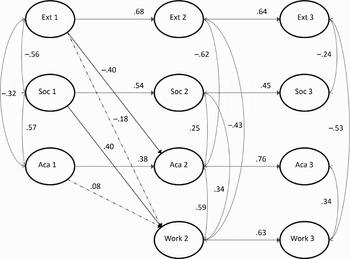
Figure 2 illustrates the adopted model, indicating standardized path coefficients and R 2 for the significant paths in Model 2. All indicator (not shown in Figure 2) and stability paths were significant. Within time latent construct covariance paths were significant with the exception of the following: Ext3 with Soc3 (p = .408), Ext4 with Aca4 (p = .135), Aca4 with Soc4 (p = 0.306), and Soc4 with Work4 (p = .193).
The standardized path coefficients for the significant paths of Model 2, which was the most parsimonious of the best-fitting models. The numbers denote the time points of data collection. Ext, externalizing problems; Aca, academic competence; Soc, social competence; Work, work competence. All numeric paths are significant at p < .05, except the dotted paths.

Discussion
Results of this study provide compelling evidence of origins in childhood and adolescence of work competence in early adulthood through multiple pathways. These pathways implicate the role of competence in the key domains of conduct, academic achievement, and social competence. In addition, results corroborate findings in the literature on the strong association of work competence in young people with concurrent competence in other salient competence domains of adaptation, particularly with respect to externalizing problems (vs. good conduct) and academic achievement. Moreover, by emerging adulthood (around age 20), work competence could be measured with good reliability and showed considerable stability during the third decade of life. The most notable direct cascade effect for work, over and above the observed stability within domain and within-time concurrence across competence domains, involved the effect of social competence with peers in childhood on work. Childhood social competence showed a striking and unique predictive effect over time to work competence in emerging adulthood. However, the cascade effect from childhood externalizing problems to later academic success appeared to be an important indirect pathway by which early conduct problems may influence later work outcomes.
The results are highly congruent with the literature showing strong links between work competence in early adulthood and academic achievement, investment, or attainment (Dubow et al., Reference Dubow, Huesman, Boxer, Pulkkinen and Kokko2006; Mortimer et al., Reference Mortimer, Vuolo, Staff, Wakefield and Xie2008; Mortimer & Zimmer-Gembeck, Reference Mortimer, Zimmer-Gembeck, Skorikov and Patton2007; Wiesner et al., Reference Wiesner, Vondracek, Capaldi and Porfeli2003). This pattern of results suggests that strong connections between academic and work competence may peak during the emerging adulthood period when many young people make the transition from school to work. Given that academic achievement is by nature cumulative and prevention studies that focus on boosting school success find beneficial outcomes for the work domain (e.g., Hawkins et al., Reference Hawkins, Kosterman, Catalano, Hill and Abbott2005, Reference Hawkins, Kosterman, Catalano, Hill and Abbott2008), there is good reason to believe that the concurrent associations found in this study reflect in part causal pathways from academic to work success, particularly during adolescence and the transition to adulthood. However, our results suggest also that it is important to consider the concomitant role of rule-abiding versus antisocial conduct.
The results from this study are also highly congruent with evidence linking antisocial behavior to problems in the work domain (Caspi et al., Reference Caspi, Wright, Moffitt and Silva1998; Dubow et al., Reference Dubow, Huesman, Boxer, Pulkkinen and Kokko2006; Kokko & Pulkkinen, Reference Kokko and Pulkkinen2000; Kokko et al., Reference Kokko, Bergman and Pulkkinen2003; Wiesner et al., Reference Wiesner, Vondracek, Capaldi and Porfeli2003). The findings of the present study corroborate a strong cascade effect we have consistently found in this study from externalizing/conduct in childhood to academic achievement in emerging adulthood, albeit in a new analytical context here (see Masten et al., Reference Masten, Roisman, Long, Burt, Obradovíc and Riley2005; Obradović et al., Reference Obradović, Burt and Masten2010). Moreover, externalizing behavior shows strong concurrent associations with work competence at both assessment points in emerging and early adulthood, strong stability from childhood through to adulthood, and strong early links in childhood to social competence with peers, which (as noted above) shows a cascade effect for work. These patterns converge to suggest that externalizing behavior problems in childhood have ominous implications for work success, through multiple pathways, within and across time.
This study's results highlight the potential significance of social competence with peers in childhood for later work success. Results offer rare and rigorous empirical support for developmental theory on the importance of peer competence and social skills for later success in life (Collins & van Dulmen, Reference Collins, van Dulmen, Huston and Ripke2006; Masten et al., Reference Masten, Burt, Coatsworth, Cicchetti and Cohen2006; Waters & Sroufe, Reference Waters and Sroufe1983). It is interesting to note that it was childhood social competence that showed a cascade to work success and also that there was no association of social competence in adulthood as assessed here (with a focus on friendship with self-chosen peers) with work competence in adulthood. Getting along with colleagues at work and having the social skills to land a job in the first place may be more akin to the construct of social competence as defined in childhood for this analysis, which had a greater emphasis on getting along with peers in the classroom, where one does not have a choice of who will be one's peer classmates. Self-chosen relationship quality and skills may be important for building close friendships and social support, but social skills with unselected people, including coworkers and supervisors, may be more important for work success in early adulthood. Future studies might examine whether a broader definition of social competence in emerging and early adulthood would “bring forward” the role of social competence for work competence. It also may be important to assess social competence specifically in the work domain.
The strong stability observed in work competence from emerging adulthood over the subsequent 10 years was surprising. In an earlier study, we did not find this stability from emerging to early adulthood (T2 to T3 in this study; Roisman et al., Reference Roisman, Masten, Coatsworth and Tellegen2004). However, the present analysis had better measurement models, included earlier and concurrent competence, and adopted a stronger statistical approach (SEM). The stability of competence in the work domain was similar to the other competence domains examined here. In future studies, it will be interesting to study the development of work competence more closely in longitudinal studies that include more frequent assessments, in an effort to examine the course of its emergence and ties to early precursors of employment in the form of household chores and other informal work. By T2 in this study, work appeared to be quite robust as a competence domain, and already strongly tied to other competence domains. It also is possible that the patterns of association of work competence with other domains of competence, such as academic achievement, could vary depending on the career paths of adolescents and young adults (Mortimer et al., Reference Mortimer, Vuolo, Staff, Wakefield and Xie2008; Mortimer & Zimmer-Gembeck, Reference Mortimer, Zimmer-Gembeck, Skorikov and Patton2007). Young people who settle into careers of work early and forego higher education, may invest less in school and more in work. The relative significance (and timing) of social and academic competence could be different for these young people compared to those who seek advanced professional degrees.
Models implicating gender-moderating effects were not supported in this study. However, the sample size afforded limited power for testing the most complex models including the gender-moderating effects. Thus, gender effects should be investigated further in studies with more power.
This study had a number of limitations in addition to the limited power related to sample size. The study focused on an urban school sample, which may not generalize to other samples of young people. It was not feasible to examine the role of minority status in the correlates and predictors of work competence because of small numbers for diverse racial/cultural groups. Assessments were spaced far apart and the age spread was not optimal for pinpointing cascade effects in time. Context changes (e.g., leaving home) were not considered. In other words, this study offers a portrait in “broad strokes” of patterns representing the possible interplay among competence domains. These broad patterns require closer examination in future studies, both to replicate these findings and also to study potential explanatory processes more closely.
It is also important to note that by T1 in this study, the major domains of competence assessed were already showing strong interconnections. Clearly, there are earlier antecedents of competence and cascade effects to consider that were not part of this study.
Conclusions
Work competence in early adulthood has significant links to concurrent and antecedent competence in other salient domains of competence. Patterns of association found in this study suggest that there are numerous pathways by which competence domains may influence each other and eventually work competence, both concurrently and cumulatively over time. Cascade effects highlight the potential significance of both conduct (antisocial vs. rule-abiding behavior) and social competence with peers in childhood for later work competence, in addition to the ongoing role that academic attainment may have for work success. Of course, there may be additional intervening mediators of these observed effects that were not included in the present study.
The results of this study suggest that competence in childhood in the developmental task domains of conduct, academic achievement, and peer relations has important implications for future life success both in similar domains of adaptation and in newly emerging domains such as work. This conclusion has implications for interventions and policies that aim to promote competence in young people, suggesting that it is important to promote success in childhood and also to time preventive interventions in specific domains before potential cascades occur (Masten et al., Reference Masten, Burt, Coatsworth, Cicchetti and Cohen2006, Reference Masten, Long, Kuo, McCormick and Desjardins2009). Much more research is needed to delineate the processes and timing of this interplay among domains in the development of competence and its implications, both for psychopathology and success in adulthood. Nonetheless, the approach illustrated by the present study appears to be a promising one for building a body of knowledge to improve strategic targeting and timing of interventions and policies to promote competence and prevent problems in development.