The acquisition of phonological skills in children indicates a hierarchy to the organization of knowledge in the phonological lexicon. Rime and segmentation abilities form the basic structural foundation of this hierarchy upon which further refinement of phonological knowledge occurs. The acquisition of these basic skills is set off with early acquisition of higher level phonological units, that is, syllables and rimes, which are considered to be holistic units that are easier to process (Bonte & Blomert, Reference Bonte and Blomert2004; Jusczyk, Reference Jusczyk1993). This ability is followed by the acquisition of segmentation, the ability to parse individual phonemes in speech as a consequence of progressive restructuring of the phonological lexicon into smaller, phoneme-sized units (Goswami, Reference Goswami2002; Metsala & Walley, Reference Metsala, Walley, Metsala and Ehri1998).
The strength of phonological knowledge achieved thus determines competence in both production and perception. For instance, studies investigating phonological abilities in perception indicate that children as young as 7 years experience difficulties segmenting phonemes from the speech stream (e.g., Liberman, Shankweiler, Fischer, & Carter, Reference Liberman, Shankweiler, Fischer and Carter1974). Similar evidence from production tasks indicates ongoing acquisition and refinements of the phonological lexicon into finer speech segments (e.g., Edwards, Beckman, & Munson, Reference Edwards, Beckmen and Munson2004). This knowledge is further deemed critical for the development of phonemic awareness and for decoding orthographic to phonemic patterns in reading. Therefore, performances in phonological tasks in both production and perception undergo changes with age depending on the stage of acquisition of phonemic knowledge. Adultlike control of phonological categories in production and perception is achieved at puberty or later (e.g., Hazan & Barrett, Reference Hazan and Barrett2000; Lee, Potamianos, & Narayanan, Reference Lee, Potamianos and Narayanan1999).
In this study we test changes in phonemic competence with age by investigating verbal monitoring abilities in children. We took the approach of testing the basic phonemic skills (rime and segmentation) in a picture-naming task requiring covert (rather than overt) production and monitoring. Participants were required to monitor self-generated covert speech for phoneme and rime units. This task has been used in adults to infer the time course of monitoring and phonological encoding (Wheeldon & Levelt, Reference Wheeldon and Levelt1995). Our aim was to design and administer age-appropriate tasks to test the speed at which typically developing children between 7 and 13 years of age monitor the higher and lower level sublexical units of speech, namely, rimes and segments, in a production task. Past studies investigating age related changes in phonemic knowledge (e.g., Brooks & MacWhinney, Reference Brooks and MacWhinney2000; Edwards et al., Reference Edwards, Beckmen and Munson2004; Masterson, Laxon, Carnegie, Wright, & Horslen, Reference Masterson, Laxon, Carnegie, Wright and Horslen2005) have not used verbal monitoring tasks to test such skills in children. The use of this task to investigate phonemic competence offers the advantage of studying the changes with age in processes that have typically been attributed a crucial role in fluent speech planning and production.
VERBAL MONITORING: THEORETICAL CONSIDERATIONS
Several theoretical approaches in both fluent speakers and in individuals with fluency disorders (i.e., developmental stuttering) consider verbal monitoring as a critical component of speech production. According to Levelt's speech production model, self-monitoring of inner or silent speech occurs at the output of phonological encoding. Levelt and colleagues (Levelt, Reference Levelt1989; Levelt, Roelofs, & Meyer, Reference Levelt, Roeloffs and Meyer1999) argued that speakers monitor their speech output for errors in the speech plan before sending the code for articulatory planning and execution. Speakers have access to the output of phonological encoding, the phonological speech code, and monitor this code for syllable- and segment-level errors. Thus, self-monitoring requires access to sublexical units, rimes, and phonemes, during speech production and has been identified as a prerequisite for a just in time, incremental approach to fluent speech planning and production (Blackmer & Mitton, Reference Blackmer and Mitton1991; Levelt, Reference Levelt1989). Several experimental procedures including phoneme, syllable, and stress monitoring during covert and overt speech production, have been employed in adults to study verbal monitoring (Morgan & Wheeldon, Reference Morgan and Wheeldon2003; Wheeldon & Levelt, Reference Wheeldon and Levelt1995; Wheeldon & Morgan, Reference Wheeldon and Morgan2002). Wheeldon and Levelt (Reference Wheeldon and Levelt1995) required participants to monitor target phonemes across four consonant positions of bisyllabic words during a Dutch–English translation task. The primary dependent variable was speed of monitoring target phonemes in syllable initial and final (coda) positions. They found that participants monitored phonemes serially during silent translation; the syllable-final phonemes were monitored slower than the syllable-initial phonemes. The authors interpreted the monitoring latencies as reflecting the serial nature of phonological encoding. Morgan and Wheeldon (Reference Morgan and Wheeldon2003) in a similar paradigm reported differences in the time course of monitoring phonemes in production versus perception, indicating that response time delays in such tasks are reflective of the cognitive subprocesses involved in performing verbal monitoring.
Several theories in the developmental stuttering literature postulate a role for verbal monitoring. Postma and Kolk (Reference Postma and Kolk1993) argued that stuttering is the result of overt compensations, namely, repetitions, blocks, and prolongations, reflective of the covert mechanisms involved in correcting errors in the speech plan. They postulated that persons who stutter exhibit a higher rate of errors in the speech plan due to delayed phonological encoding. Accordingly, the verbal monitoring loop identified in Levelt's model would play a critical role in this process. Vasić and Wijnen (Reference Vasić, Wijnen, Hartsuiker, Bastiaanse, Postma and Wijnen2005) proposed that individuals who stutter exhibit a deficit not in phonological encoding per se, but in their speech monitoring skills. This vicious circle hypothesis states that persons who stutter exhibit rigid monitoring of the speech produced by self and others. However, only a few studies have tested verbal monitoring abilities in children and adults who stutter. Postma, Kolk, and Povel (Reference Postma, Kolk and Povel1990) reported comparable performance between adults who stutter and typically fluent adults in error monitoring of self-generated speech, although some group differences were observed in the monitoring of speech generated by others. Sasisekaran and De Nil (Reference Sasisekaran and De Nil2006) used a silent naming paradigm to compare adults who stutter and typically fluent adults in phoneme monitoring and found that the stuttering participants were slower in phoneme monitoring compared to typically fluent speakers only in the production task (p = .02, η2p = 0.64), but not in the perception task (p = .07, η2p = 0.15). Differences between stuttering and typically fluent speakers in the neural networks supporting self-monitoring of covert speech have also been reported (e.g., Lu et al., Reference Lu, Ning, Peng, Ding, Li and Yang2009). Although such findings support a role for verbal monitoring in stuttering, further testing is required to understand the precise role of such skills in fluent speech production, particularly in childhood.
STUDIES OF VERBAL MONITORING IN CHILDREN
Development of verbal monitoring skills in children has been inferred largely from the presence of errors and disfluencies in the spontaneous speech of typically developing children (Colburn & Mysak, Reference Colburn and Mysak1982; Jaeger, Reference Jaeger1992; Rispoli, Reference Rispoli2003; Rispoli, Hadley, & Holt, Reference Rispoli, Hadley and Holt2008; Stemberger, Reference Stemberger1989). Verbal monitoring abilities have traditionally been inferred from studies requiring children to respond to requests for identifying and clarifying errors in speech. For instance, Levy (Reference Levy1999) showed that children as young as 2 years were able to monitor their speech to locate errors, although they were unable to repair all such errors. Rispoli (Reference Rispoli2003) tested 52 children between the ages of 1 year, 10 months and 4 years for stalls and revisions in speech. Rispoli (Reference Rispoli2003) hypothesized that stalls are strategies used to complete delays in speech formulation, whereas revisions result from repair of errors achieved by self-monitoring the speech plan. The findings indicated that the number of revisions increased with grammatical development while the number of stalls continued to remain unchanged. Rispoli (Reference Rispoli2003) interpreted the findings to suggest that grammatical development is associated with increasing self-monitoring of speech. The above findings suggest that verbal monitoring is acquired simultaneously with language comprehension and production and reflect increasing linguistic proficiency and fluency. On a cautionary note, the dependent variables used to infer monitoring abilities in earlier studies are limited to the number and types of speech errors and disfluencies, which are primarily postlexical repair mechanisms. Moreover, such studies have tested verbal monitoring abilities in children less than 4 years of age, whereas speech fluency skills continue to evolve throughout childhood.
COGNITIVE PROCESSES RELEVANT TO VERBAL MONITORING PERFORMANCE
Verbal monitoring in production emerges with increasing language proficiency, although the cognitive processes tied to the emergence of this skill are not well defined. Based on Levelt and colleagues (Bock & Levelt, Reference Bock, Levelt and Gernsbacher1994; Levelt, Reference Levelt1989; Levelt et al., Reference Levelt, Roeloffs and Meyer1999), potential links between changes in the ability to monitor rime and segment-level units with progressive refinement of sublexical, phonemic level representations seem plausible. This hypothesis can be accommodated presently within some theoretical frameworks of language development in children. For instance, Metsala and colleagues (Metsala, Reference Metsala1997, Reference Metsala1999; Metsala & Walley, Reference Metsala, Walley, Metsala and Ehri1998) proposed the progressive restructuring framework that young children start with wordlike holistic lexical representations and progress to adultlike segmental/phonemic representations of lexical items. Metsala and Walley (Reference Metsala, Walley, Metsala and Ehri1998) suggested that access to sublexical units, including rimes, phonemes, and syllable onsets, can be attributed to the restructuring of the phonemic lexicon. Thus, improving verbal monitoring skills are likely to be an epiphenomenon of restructuring of lexical representations to adultlike segmental units. During typical development this restructuring is achieved in several stages but minimally requires the ability to process rimes and segments in speech. Therefore, it is hypothesized that verbal monitoring abilities will improve with changes in underlying skills with age.
Several tasks (rhyme judgment, phonological priming, and nonword repetition) have been used to infer the refinement of rime and segmentation skills in speech production. Findings from studies employing these tasks suggest that the ability to process higher level units, such as syllables and rimes, is acquired earlier followed by the ability to segment the larger units into phonemes. Thus, the time course of acquisition of rime and segmentation skills differ (Brooks & MacWhinney, Reference Brooks and MacWhinney2000; Coch, Grossi, Coffey-Corina, Holcomb, & Neville, Reference Coch, Grossi, Coffey-Corina, Holcomb and Neville2002; Kail & Miller, Reference Kail and Miller2006; Masterson et al., Reference Masterson, Laxon, Carnegie, Wright and Horslen2005; Trieman & Zukowski, Reference Treiman and Zukowski1996; Weber-Fox, Spencer, Cuadrado, & Smith, Reference Weber-Fox, Spencer, Cuadrado and Smith2003). Coch et al. (Reference Coch, Grossi, Coffey-Corina, Holcomb and Neville2002) tested children between 7 and 21 years in an auditory rhyme task and reported improving accuracy, response time, and event-related potential profiles with age. Such findings suggest that the neural systems mediating rhyming skills develop early and continue to undergo gradual fine-tuning with age.
Studies of segmentation skills in children suggest that restructuring of lexical representations to segments eventually results in the ability for just in time, incremental speech planning and production. Brooks and MacWhinney (Reference Brooks and MacWhinney2000) studied the emergence of phonological encoding across different age groups of typical speakers in a cross-modal priming paradigm (target pictures presented visually while primes were presented auditorily). They tested the effect of onset consonant and rime primes compared to neutral primes (the word “go”) in 90 children in three age groups (5–6, 7–8, and 9–12 years) and compared their performance to 30 adults. Picture naming was facilitated by onset-related primes in adults (e.g., clock, clown), but no such facilitation was evident in children; however, there was a tendency for the younger age groups to exhibit a facilitatory effect in picture naming for rime primes (e.g., clock, sock). The authors interpreted the findings as evidence for the gradual reorganization of the phonemic lexicon to allow the emergence of word onset as the primary organizational structure in word production.
Nonword repetition has also been used to understand the underlying structure of phonological knowledge and competence in children. Masterson et al. (Reference Masterson, Laxon, Carnegie, Wright and Horslen2005) tested nonword repetition in 4- to 6-year-olds and reported that 6-year-olds were better at nonword repetition than 4-year-olds. In both age groups children with poor nonword repetition abilities showed more difficulty with nonwords that had few phonological neighbors compared to better repeaters. Edwards et al. (Reference Edwards, Beckmen and Munson2004) reported higher production errors and disfluencies for low-frequency nonword sequences in both children and adults. Furthermore, the frequency effect was magnified in children with lower expressive vocabulary scores. The findings were interpreted to suggest that sublexical knowledge emerges with generalizations made over lexical items. The findings from these studies support progressive restructuring of sublexical phonemic representations and improving phonemic competence and segmentation skills with age.
Summarizing, studies of rime and segmentation abilities suggest that the acquisition of such skills transition from whole-word or rime to segment level units. This transition is reflective of the refinement of phonemic level representations (e.g., Metsala & Walley, Reference Metsala, Walley, Metsala and Ehri1998). Although requiring further testing, a potential link between increasing segmentation skills and the emergence of verbal monitoring abilities seems plausible. Past studies of verbal monitoring during speech production in children have focused primarily on grammatical development and fluency. To our knowledge, direct investigation of verbal monitoring abilities in children has not been undertaken, although such studies in adults have facilitated better understanding of the nature of speech planning and production (Morgan & Wheeldon, Reference Morgan and Wheeldon2003; Wheeldon & Levelt, Reference Wheeldon and Levelt1995; Wheeldon & Morgan, Reference Wheeldon and Morgan2002). In this study we use verbal monitoring tasks to study differences in phonemic competence in a cross-section of children between 7 and 13 years of age. This paradigm involves active phonological level processes and offers a window into the changes in the cognitive processes associated with ongoing speech planning and production with age. Our long-term goal is to use these tasks to test phonemic knowledge and competence in children who stutter to study the link between monitoring abilities and speech fluency.
According to Levelt et al. (Reference Levelt, Roeloffs and Meyer1999) monitoring sublexical units during silent naming requires retrieval of the lemmaFootnote 1 corresponding to the picture, followed by phonological encoding of the syllable, metric, and individual phonemic information, and eventual self-monitoring of the output of phonological encoding for the presence/absence of a target segment or rime. Wheeldon and Morgan (Reference Wheeldon and Morgan2002) investigated the time course of monitoring in a silent production and a perception task in adults. For the silent production task participants were required to produce bisyllabic words silently and respond simultaneously to the presence or absence of target sounds in the words. For the perception task participants were required to monitor target phonemes in auditorily presented target words. Consistent with previous work their findings supported the left to right incremental nature of phoneme monitoring in silent production (see also Wheeldon & Levelt, Reference Wheeldon and Levelt1995). The production and perception tasks differed in the time course of monitoring with slower monitoring in silent production than in perception.
PURPOSES OF THE PRESENT STUDY
In the present study a silent picture-naming task was chosen to mimic processes associated with overt naming, that is, lexical retrieval, phonological encoding, and monitoring of the speech code. This was done to minimize involvement of the speech motor system and to exclude the possibility of eliciting monitoring responses based on external auditory feedback. Furthermore, by limiting the requirement for phonemic decoding (orthography to phonology transition) the phonological system was accessed primarily via the production mechanism. Participants were required to monitor self-generated silent (or covert) speech for the presence or absence of a rime or phoneme match. Performance in the verbal monitoring tasks was compared to a nonverbal task that required participants to monitor tone-sequence pairs for a pattern match, a task similar in design to the rime task in terms of the larger size of the units being monitored. The tone task was included as a control task because, although it does not involve monitoring self-generated speech, it does involve comparing and judging tone-sequence pairs to monitor the presence or absence of a pattern match and thus is independent of emerging linguistic skills.
Past studies comparing verbal and nonverbal task performance in children have reported age-related differences in such tasks. Kail and Miller (Reference Kail and Miller2006) tested children at 9 years and 14 years in the speed of processing verbal and nonverbal tasks. The verbal tasks included rhyme, phoneme, and grammatical judgments, picture naming, and truth value, whereas the nonverbal tasks were simple motor response, visual search, and mental rotation. They found age related differences in processing speed in both verbal and nonverbal domains. The 9-year-olds were faster in the verbal compared to the nonverbal tasks; no differences were observed in processing speed between the verbal and nonverbal domains in the 14-year-olds. Based on such reports we hypothesize that the time course of the phoneme, rime, and the tone monitoring tasks will be different in the age groups tested. We also tested for a potential link between the emergence of segmentation skills and verbal monitoring by comparing phoneme monitoring of singleton phonemes versus phonemes located within consonant clusters. Brooks and MacWhinney (Reference Brooks and MacWhinney2000) reported increasing segmentation of lexical–phonemic representation in children between 5 and 12 years of age. In addition, there is evidence supporting progressive improvements in isolating phonemes within consonants clusters with age (Bruck & Treiman, Reference Bruck and Treiman1990; Treiman & Weatherston, Reference Treiman and Weatherston1992; Treiman & Zuckoswki, Reference Treiman and Zukowski1996). We hypothesized that the reported differences in processing consonant clusters with age will be evident in the phoneme monitoring task. Based on earlier findings we predicted that younger compared to older children will exhibit poor segmentation skills evident as slower monitoring of phonemes located within consonant clusters versus singletons.
METHODS
Participants
Participants were 28 children subdivided into three age groups: 7 and 8 years (N = 9), 10 and 11 years (N = 9), and 12 and 13 years (N = 10). We chose children in these age groups based on evidence that children as young as 7 years can make rime decisions (e.g., Coch et al., Reference Coch, Grossi, Coffey-Corina, Holcomb and Neville2002). Only male participants were included to limit potential influences of gender-related differences in language and fluency (e.g., Shaywitz et al., Reference Shaywitz, Shaywitz, Pugh, Constable, Skudlarski and Fulbright1995). Participants were primarily recruited from the Twin Cities area (Minneapolis–St. Paul) through fliers posted around the University of Minnesota campus and through advertisements placed in the local newspaper. All participants spoke North American English as the primary language and attended schools within the Twin Cities school districts. Four participants were recruited from the greater Lafayette area, Purdue University. All procedures were approved by the Institutional Review Board, University of Minnesota, and participants received reimbursement for participating in the study. The initial screening and test protocol were administered by a trained research assistant under the supervision of the principal investigator.
Based on initial screening all participants had a negative history of (a) neurological deficits; (b) language, speech, reading, hearing difficulties; and (c) current usage of medications likely to affect the outcome of the experiment (e.g., for attention-deficit/hyperactivity disorder and antianxiety). All participants passed a hearing screening test performed at 0.5, 1, 2, 4, and 8 kHz (20 dB) in both ears. The parents of all participants reported age and grade-appropriate reading skills. In addition, a reading sample was obtained from each participant to ensure that participants could read age-appropriate reading material. Samples from the 7- and 8-year-olds were elicited using the “Arthur the Rat” passage, whereas samples from the older age groups were obtained using “The Rainbow Passage.”
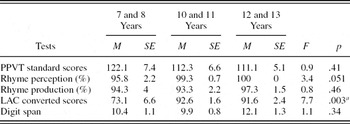
Vocabulary, short-term memory, and phonemic awareness skills. A series of tests were administered to evaluate skills critical to performing the experimental tasks. Participants from all age groups were required to perform at age appropriate levels on the standardized tests as part of the initial screening procedure in order to participate in the study. Receptive vocabulary was tested using the Peabody Picture Vocabulary Test, Fourth Edition (Dunn & Dunn, Reference Dunn and Dunn2007). Short-term memory span in all age groups was determined using the forward digit span test (Weschler's Memory Scale; Weschler, Reference Wechsler1997). Rime and segmentation components of phonemic awareness skills were tested in all participants. Rime awareness was assessed using an informal test in which participants were required to identify rhymes in word (N = 10) and nonword pairs (N = 5) in a perception and a production task. In the production task participants heard a word or a nonword and were asked to produce a word or nonword that rhymed with the target. In the perception task participants heard word and nonword pairs and were asked whether the pairs rhymed or not. Segmentation skills were tested using the two subtests of the Lindamood Auditory Conceptualization Test—2 (LAC-2; Lindamood & Lindamood, Reference Lindamood and Lindamood1979). The LAC is used to test the cognitive ability to perceive, conceptualize, and manipulate speech sounds, skills that are indicative of reading readiness. Subtest 1 measures participants’ familiarity with isolated phoneme and phoneme sequences patterns. For this subtest participants were asked to arrange colored blocks in a sequence depending on how many sounds they heard and the order in which the sounds were repeated within a sequence (e.g., if a participant heard the sound /s/ twice they would choose two cubes of the same color and place them adjacent to each other). Subtest 2 measures phoneme discrimination skills in monosyllables and participants were asked to rearrange and add new cubes to a preestablished sequence based on changes to a nonsense syllable sequence (e.g., if the participant heard the syllable “ip” change to “op,” they would indicate this by changing the first cube in a two-cube sequence to a different color). The LAC does not have standardized scores and raw scores are typically reported as a converted score (maximum = 100) with the difficult items from each subtest being weighted more heavily. Table 1 shows the mean (standard error) scores for the age groups in the test measures. For all tests except the LAC the scores were not significantly different between the three age groups, although some descriptive differences were observed. Group performances in the LAC subtests are discussed in the Results Section.
Language and digit span test results

Note: PPVT, Peabody Picture Vocabulary Test; LAC, Lindamood Auditory Conceptualization Test.
aAll tests except the LAC had scores that were not significantly different between the three age groups.
Stimuli for the monitoring tasks
Twenty-eight monosyllabic high-frequency nouns were chosen as target items for the phoneme and rhyme monitoring tasks (see Appendix A). The words carried seven target consonants, each occurring twice as a singleton and twice in a consonant cluster. The target phonemes were balanced in distribution across word-initial and coda positions. Black and white line drawings representing the target words were selected from Snodgrass and Vandervart (Reference Snodgrass and Vandervart1980) and used as stimuli for eliciting silent picture naming responses. Appendix A shows the age of acquisition, word familiarity (5-point rating scale where 1 = least, 5 = most; M = 3.3, SD = 1.03), and image agreement (M = 3.5, SD = 1.02) for the target words as reported by Snodgrass and Vandervart (Reference Snodgrass and Vandervart1980). Twenty-eight monosyllabic nonwords developed from the target words formed the nonword stimuli. The target phonemes and nonwords spoken by a native English speaker were recorded and digitized using PRAAT software. The prerecorded stimuli were then used in the phoneme and rhyme monitoring tasks. For the tone monitoring task the original stimuli were 14 tone-sequences generated using MATLAB consisting of three pure tones in each sequence (e.g., 0.5, 1, and 2 kHz; 4, 8, and 1 kHz). The 14 sequences were paired such that half of the pairs (N = 14) were identical (e.g., 0.5, 1, and 2 kHz; 0.5, 1, and 2 kHz) and the other half were mismatched (e.g., 0.5, 1, and 2 kHz; 4, 8, and 1 kHz) and required a “no” response. The overall length of each tone-sequence was matched to the average duration of the target words spoken by a native English speaker and measured acoustically using PRAAT. The average duration of the target words was 568.26 ms (SD = 92.7); therefore, the overall length of each tone-sequence was 500 ms with an interval of 100 ms between the tones.
Procedures and tasks
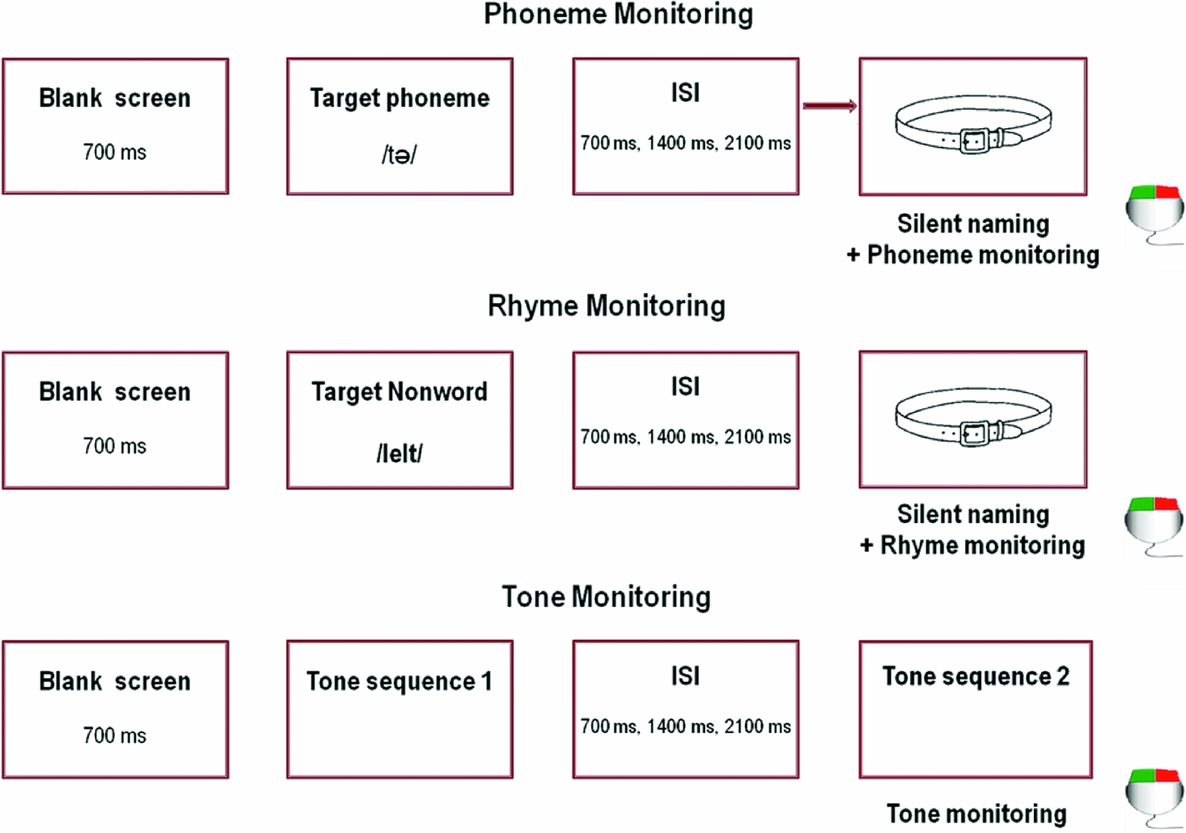
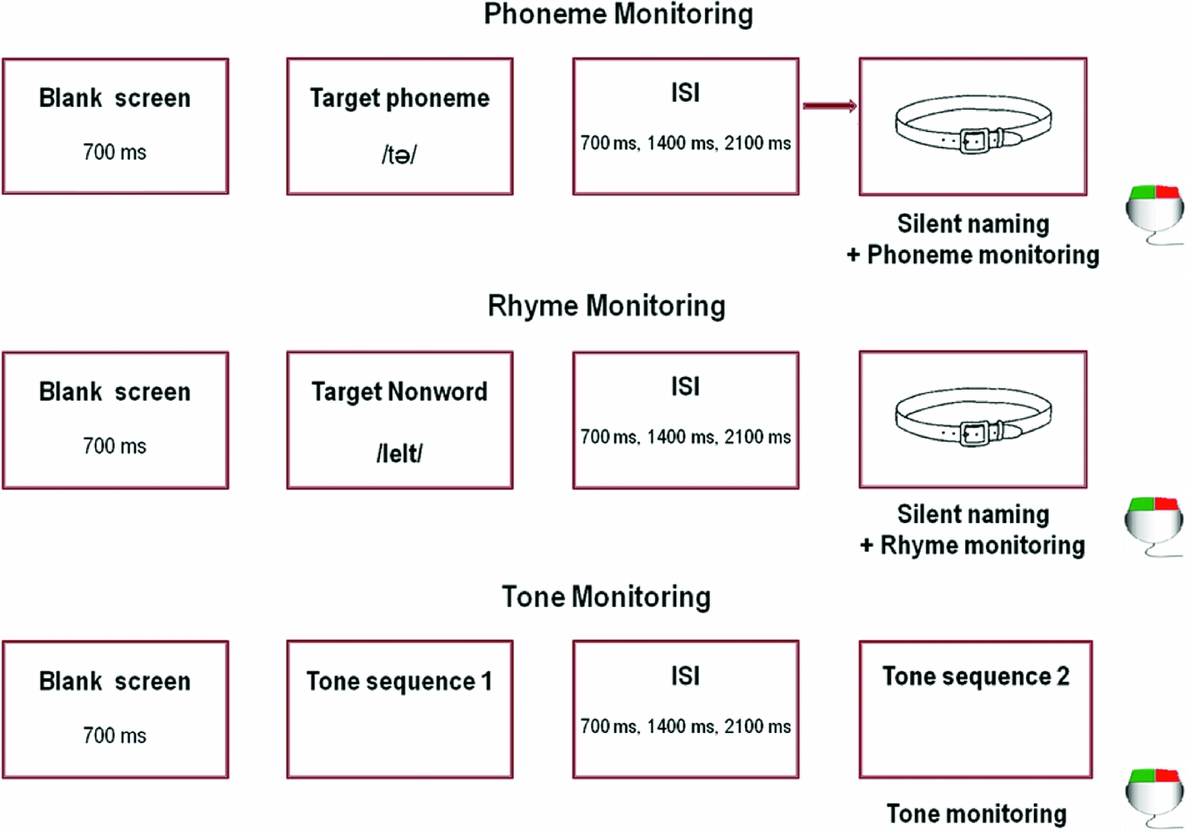
The experiment-proper consisted of four tasks: (a) picture naming, (b) phoneme monitoring, (c) rhyme monitoring, and (d) tone-sequence monitoring. Figure 1 illustrates the event sequence within a single trial of each task. The phoneme and rhyme monitoring tasks were always presented in succession, but counterbalanced in order of occurrence across participants. The picture-naming task was presented prior to the phoneme or rhyme monitoring tasks. The tone monitoring task was presented either before or after the verbal monitoring tasks and the order of presentation of this task was also counterbalanced across participants (e.g., Subject 1, task order: picture naming, phoneme monitoring, rhyme monitoring, tone monitoring; Subject 2, task order: tone monitoring, picture naming, rhyme monitoring, phoneme monitoring). In the following subsections, each of these tasks is described in detail.
An illustration of the events in each trial of the phoneme, rhyme, and tone tasks. [A color version of this figure can be viewed online at journals.cambridge.org/aps]
Picture naming. The primary purpose of this task was to familiarize participants with the names associated with the target pictures used in the monitoring tasks. During the task the 28 target pictures were presented individually on a computer screen and participants were asked to name each picture. Participants were corrected for errors in picture naming at the end of the naming task. Because participants were not familiarized with the pictures before the naming task, a majority of participants had about two to three errors on their first attempt. However, all naming errors were corrected before proceeding to the phoneme and rhyme monitoring tasks.
Phoneme monitoring. The purpose of this task was to investigate changes in response times to phoneme monitoring during silent picture naming across three age groups of children. Participants were presented with two blocks of 28 stimuli with each target word occurring once in each block. The phonemes to be monitored (/t/, /k/, /d/, /n/, /f/, /l/, /r/) occurred in either word initial1 or coda positions,2 C1 VC2 (e.g., the sound /k/ in “c 1at” and “duck”2 (singleton), “cl 1own” and “fork”2 (consonant cluster). Half of the target words in a block carried a target phoneme and required a “yes” response and the other half required a “no” response. The order of presentation of the target words was randomized within each block and each target phoneme occurred twice, once as singleton and once within a consonant cluster distributed evenly across word-initial and coda positions (e.g., target phoneme /k/; Block I: “c 1 at,” “fork”2; Block II: “duck,”2 “cl 1own”). The order of the blocks was counterbalanced across participants.
Participants were seated comfortably in front of a 15-in. computer screen. Prior to the experiment participants were given the following instructions:
In this task, you will hear a sound, for example, /t;ə/, /pə/, or /fə/, and this will be followed by one of the pictures that you named earlier. You are required to silently name the picture while looking for the presence or absence of the sound in the picture's name. The sound could be present either at the beginning, middle, or end of the picture's name. Press the green button on this box as soon as you identify the target sound in the name and the ‘red’ button if the sound is absent. You will see the same picture another time after you press the button and this time you have to name the picture aloud. Wait after you name the picture aloud for the next sound and picture.
Following instructions, three to five practice trials were used to familiarize participants with each task. Participants were instructed to monitor the target phoneme irrespective of the sound preceding or following it. A trial in each block consisted of the following series of events: (a) an orienting screen for 700 ms followed by auditory presentation of a prerecorded target phoneme (each target phoneme was always presented along with a schwa vowel although participants were asked to monitor the target phoneme irrespective of the sound preceding or following it); (b) an interstimulus interval of 700, 1400, or 2100 ms between hearing the target phoneme and seeing the target picture (interstimulus intervals were varied to reduce anticipatory button press responses from participants); (c) target picture presented on the screen for 3 s (participants pressed the green [“yes”] or the red [“no”] button using the index and middle fingers of the dominant hand to indicate the presence/absence of a phoneme in the target); and (d) manual response initiated the presentation of the same picture again and participants’ were instructed to name each picture aloud. This was done to ensure that pictures were named correctly during each trial. Presentation of the next trial in the sequence was initiated by the experimenter after participants’ response or automatically after 3 s in case of no response.
Rhyme monitoring. The purpose of this task was to investigate the changes in response times to rhyme monitoring in nonword–word pairs during silent picture naming across three age groups of children. The task design was similar to the phoneme monitoring task except that the order of stimuli presentation in the rhyme monitoring blocks was different. Participants were instructed to monitor the presence or absence of a rhyme match between a made-up word that they would hear and the name of the picture. Participants were instructed to click the green (“yes”) button on a response box associated with the stimulus presentation program if the nonword and the picture's name rhymed and the red (“no”) button if the nonword–picture name did not rhyme. As indicated in Figure 1 the trials in this task were similar to the phoneme monitoring task with the exception that the child monitored for a rhyme match.
Tone-sequence monitoring. The purpose of this task was to investigate the changes in response times to the presence or absence of a tone-sequence match across three age groups of children. Tone-sequence monitoring was chosen in order to enable comparison between monitoring of larger units in the verbal (rhymes) versus nonverbal (tone-sequences) domains. Target tone sequences were paired and presented in two blocks of 28 stimuli each. Prior to the task participants were familiarized with a few tone sequence pairs. They were instructed to monitor the presence or absence of a sequence match between tone sequences in a pair and to click the green (“yes”) button on a response box if the tone sequences were identical and the red (“no”) button in case of absence of a sequence match. As indicated in Figure 1, the trials in this task were similar to the verbal monitoring tasks with the exception that the participant monitored for a tone-sequence match.
Instrumentation
The experimental stimuli were programmed and presented using Super Lab v2.0 software. A laptop was used to present the stimuli for the tasks. Manual responses from the monitoring tasks were recorded using the Cedrus response box. Spoken responses from the overt picture-naming trials were recorded using a digital voice recorder. Reaction time measured in milliseconds, the time between presentation of the stimuli and subject response across the monitoring tasks, was automatically recorded by Super Lab and stored on to the hard drive.
Data scoring
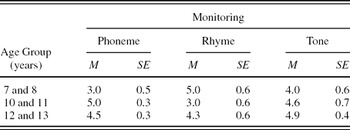
Trials in each task were categorized as correct, error, and outlier responses. Correct responses included trials where participants identified correctly the presence or absence of a phoneme, rhyme, or tone match. Outlier responses included trials where the response time was 2 SD above or below the individual's mean response time. Table 2 provides a summary of the percent outliers that were excluded from each age group for the three tasks. Error responses included both incorrect and no responses, with incorrect responses including trials where participants responded with a false positive or a false negative response to the presence or absence of a phoneme, rhyme, or tone match. Only correct responses were included in the response time analysis, whereas both outlier and error responses were excluded. Two 7-year-olds were unable to complete one of the two tone monitoring blocks. Data from the completed block were included in the response time analysis.
Percentage of outliers excluded from analysis for each age group by task

Statistical analysis
Response time, the primary dependent variable, was analyzed to study differences between children in the three age groups in the phoneme, rhyme, and tone monitoring tasks. Only correct responses, that is, both “yes” and “no,” were included in the response time analysis to determine age and task effects.
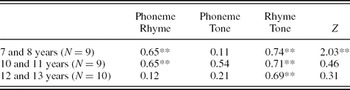
Preliminary data analysis. Several preliminary analyses were run on the monitoring time data to verify normality of distribution and independence of observations. First, the response time data were tested for normality of distribution using the Kolmogorov–Smirnov test. Nonsignificant p values from this test indicated that the response time data obtained from each age group for the three tasks fit the normal distribution curve. Second, a Steiger's test of correlation was performed on the monitoring time data to determine if the response times across the three tasks were intercorrelated for each age group. A lack of dependent correlation would allow independent interpretation of any age effects across the three tasks. This analysis (see Table 3) revealed different patterns of correlation for the three age groups across phoneme, rhyme, and tone monitoring with significant correlation observed only for the 7- and 8-year-olds, Steiger Z (6) = 2.03, p = .01. Finally, although monitoring times from the three tasks were the primary dependent variable, in order to ensure that the observed differences in monitoring time were independent of a speed–accuracy trade-off, the percent monitoring error responses from the phoneme, rhyme, and tone monitoring tasks for the three age groups were analyzed in a one-way analysis of variance (ANOVA). Descriptive analysis of the error data revealed that the 7- and 8-year-olds had more errors in the phoneme, rhyme, and tone tasks: phoneme: M = 17.2 (SE = 3.2); rhyme: M = 6.5 (SE = 1.1); tone: M = 12.9 (SE = 4.1), compared to the 10- and 11-year-olds: phoneme: M = 11.7 (SE = 2.2); rhyme: M = 5.5 (SE = 0.74); tone: M = 8.3 (SE = 2.1), and the 12- and 13-year-olds: phoneme: M = 12.5 (SE = 1.4); rhyme: M = 5.5 (SE = 1.1); tone: M = 5.9 (SE = 0.69). The ANOVA revealed the age groups to be comparable in the percent errors in phoneme, F (2, 25) = 1.6, p = 0.21, rhyme, F (2, 25) = 0.32, p = 0.72, and tone monitoring, F (2, 25) = 1.8, p = 0.17.
Steiger's Z test of dependent correlations

**p = .01.
Analysis of the monitoring time data. In order to address the central question of whether differences are evident in phoneme, rhyme, and tone monitoring performance with age, two types of analyses (repeated-measures ANOVA, regression analysis) were conducted on the monitoring time data. In the repeated-measures ANOVA, age group was classified as a categorical between-subjects factor (7 and 8, 10 and 11, 12 and 13 years) and task (phoneme, rhyme, tone) as the within-subjects factor in order to study age-specific effects on task performance. In addition, a regression analysis was performed on this data with age as a continuous variable (7–13 years) to identify the extent to which general changes in processing speed with age can account for performance variability (R 2) in the verbal and nonverbal monitoring tasks. A second repeated-measures ANOVA was conducted only on the phoneme monitoring time data to investigate the link between segmentation skills and the development of phoneme monitoring abilities. This analysis included only the “yes” responses for which response times varied based on the location of the target singletons or consonant clusters with each word. The analysis was conducted with age group as the between-subjects, and complexity (singleton, consonant cluster) and position (word initial, coda) as the within-subjects factors. All post hoc comparisons were made using paired-samples t tests and the p values were adjusted using Bonferroni corrections.
RESULTS
Phoneme awareness skills
The LAC test was administered to investigate phoneme awareness skills in each age group. One-way ANOVA revealed significant differences between the groups in both subtests of the LAC: LAC I: F (2, 24) = 5.0, p = .015, η2 = 0.29; LAC II: F (2, 24) = 7.6, p = .003, η2 = 0.38. Levene's test of homogeneity of variance was significant for subtest 1, F (2, 24) = 7.7, p = .002, and nonsignificant for subtest 2, F (2, 24) = 3.25, p = .056. Therefore, post hoc comparisons on LAC I scores were performed using the Dunnete's test and on LAC II using the Bonferroni test. Significant differences between groups were observed in LAC II scores. The 7- and 8-year-olds scored lower than the older age groups: 10- and 11-year-olds, t (7) = −2.67, p = .01; 12- and 13-year-olds, t (7) = −2.07, p = .03. Furthermore, negative correlations were observed between phoneme monitoring times and average LAC scores from the two subtests (Pearson r = −.51, p = .003) and between rhyme monitoring times and LAC scores (Pearson r = −.35, p = .03).
Repeated-measures ANOVA of monitoring time data
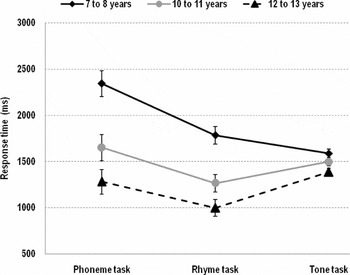
This analysis was performed to investigate the effects of age as a categorical variable on task performance. Mauchly's test indicated violation of the sphericity assumption for the repeated-measure task, χ2 (2) = 10.7, p = .004; therefore, the adjusted Hyun–Feldt (H-F) estimates (ɛ = 0.83) are provided for the main effect of task and Task×Age Group. A main effect of age group, F (2, 50) = 20.6, p = .00001, η2 = 0.62, indicated significant differences between all three groups with the 7- and 8-year-olds being the slowest in performing both the verbal and the nonverbal monitoring tasks (M = 1904.8 ms, SE = 77.7). Significant differences were also observed between the older age groups (10- and 11-year-olds, M = 1471.27 ms, SE = 77.7; 12- and 13-year-olds, M = 1222.3 ms, SE = 73.7). A significant main effect of task, F (1.6, 41.6) = 21.3, H-F, p = .000001, η2 = 0.46, indicated that responses to phoneme monitoring were slower compared to both rhyme and tone monitoring (phoneme, M = 1758 ms, SE = 79.8; rhyme, M = 1349.2 ms, SE = 53.4; tone, M = 1490 ms, SE = 25.4). Figure 2 illustrates the mean (standard error) of response times for the phoneme, rhyme, and tone monitoring tasks in the three age groups. A significant Age Group×Task effect indicated differences between the age groups in speed of phoneme and rhyme monitoring with no overall group differences in tone monitoring, F (3.3, 41.6) = 8.3, H-F, p = .00003, η2 = 0.40. Post hoc comparisons using paired samples t tests (Bonferroni-corrected p value, .05/9 = .006) revealed that the 7- and 8-year-olds were slower in phoneme monitoring compared to the 10- and 11-year-olds, t (8) = 2.89, p = .009. Significant differences were observed between the 7- and 8-year-olds and the 12- and 13-year-olds, t (8) = 5.1, p = .0005. The 10- and 11-year-olds were descriptively slower in this task compared to the oldest age group, t (8) = 2.8, p = .01. The older age groups were also comparable in rhyme monitoring performance, t (8) = 2.2, p = .03, whereas the 7- and 8-year-olds were significantly slower in this task, versus 10 and 11 years, t (8) = 3.72, p = .003; versus 12 and 13 years, t (8) = 5.4, p = .0003. For the tone-monitoring task, significant differences were observed only between the 7- and 8-year-olds and the 12- and 13-year-olds, t (8) = 5.1, p = .0005. It is interesting that the 7- and 8-year-olds were comparable in monitoring time responses to the rhyme and tone tasks, t (8) = 1.8, p = .05), whereas responses to rhyme monitoring were faster in the older age groups, 10 and 11 years, t (8) = −4.2, p = .001; 12 and 13 years, t (9) = −8.3, p = .00001.
The response time (mean and standard error) for phoneme, rhyme, and tone monitoring tasks across the three age groups.

Regression analysis of monitoring time data
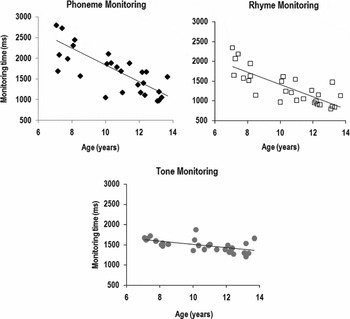
This analysis was performed to investigate the effects of age as a continuous variable on task performance. Figure 3 illustrates the slope of the simple regression for the monitoring time data from the three tasks. Age was a strong predictor of performance, contributing 30% to 60% of variance across the three tasks. Age was also a better predictor of performance in the verbal monitoring tasks compared to the nonverbal tone-monitoring task. For the verbal tasks, age was a stronger predictor of performance as indicated by an R 2 of .61 for the rhyme (t = −6.7; p < .001) and .52 for the phoneme monitoring task (t = −5.5, p < .001). For the tone-monitoring task, the observed variance was lesser in magnitude compared to the verbal tasks (R 2 = .31; t = −3.6, p = .001).
The regression slopes for phoneme, rhyme, and tone monitoring performance with age.

Monitoring time: Complexity effects
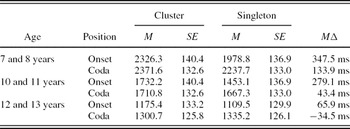
This analysis was performed to investigate the link between segmentation skills and the development of phoneme monitoring abilities. Table 4 shows the mean and standard error and response time differences between monitoring singletons versus phonemes within consonants clusters in the three age groups. A significant main effect of age group, F (2, 25) = 18.5, p = .00001, η2 = 0.59, reaffirmed findings from the earlier analysis and indicated that the three age groups were significantly different in the response time to phoneme monitoring with the 7- and 8-year-olds being the slowest (M = 2228.6 ms, SE = 119.1 ms) and significantly faster responses time with increasing age (10- to 11-year-olds, M = 1640.8 ms, SE = 119.1 ms; 12- to 13-year-olds, M = 1230.2 ms, SE = 112.98 ms). A significant position effect, F (1, 25) = 7.83, p = .0097, η2 = 0.24, indicated that phonemes located at syllable onset were monitored faster compared to those located at coda position by 143 ms (onset: M = 1611.8 ms, SE = 74.2 ms; coda: M = 1754.4 ms, SE = 70.4 ms). A significant effect of complexity, F (1, 25) = 18.5, p = .0002, η2 = 0.43, revealed that children in all age groups were slower in monitoring phonemes within consonant clusters (M = 1750.5 ms, SE = 64.7 ms) compared to the singletons themselves (M = 1615.7 ms, SE = 73.9 ms). A significant Complexity×Position interaction, F (1, 25) = 4.5, p = .044, η2 = 0.15, was obtained. Post hoc comparisons using paired samples t tests (Bonferroni-corrected p value, .05/4 = .01) revealed that monitoring of phonemes within consonant clusters located in syllable initial and coda positions were comparable, t (27) = −1.13, p = .13, whereas monitoring of singletons located in syllable initial position was faster compared to the other categories: versus coda, t (27) = −2.9, p = .006; versus cluster onset, t (27) = −4.1, p = .0003. A significant Age Group×Complexity effect was obtained in this analysis, F (2, 25) = 4.3, p = .025, η2 = 0.26. Post hoc comparison using paired samples t test (Bonferroni-corrected p value, .05/6 = .008) revealed that the 7- and 8-year-olds were significantly slower in monitoring the consonant clusters during the silent naming task compared to the 10 and 11 years: singleton, t (8) = 2.8, p = .01; cluster, t (9) = 2.9, p = .008. The 7- and 8-years-olds were also significant slower than the older age group in monitoring both singletons and cluster: singleton, t (8) = 5.3, p = .0003, cluster, t (8) = 5.3, p = .0005. The 10- and 11-year-olds were significantly slower than the 12- to 13-year-olds in the speed of monitoring consonant clusters, t (8) = 3.4, p = .005, although the groups were comparable in the monitoring times for singletons, t (8) = 2.6, p = .016. Finally, differences in monitoring times for singletons versus consonant clusters was not evident in the 7- and 8-year-olds, t (8) = −2.8, p = .01. Similarly, the 12- and 13-year-olds were also comparable in the speed of monitoring responses to singletons versus consonant clusters, t (9) = −.57, p = .27. The 10- and 11-year-olds were significantly slower in monitoring phonemes within consonant clusters compared to the singletons, t (8) = −3.5, p = .004. The interaction effects of Age Group×Position, F (2, 25) = .24, p = .78, and Age Group×Complexity×Position were nonsignificant, F (2, 25) = .21, p = .80.
Mean, standard error, and mean differences (syllable onset, coda) in monitoring times for singletons versus phonemes within consonant clusters for the three age groups

DISCUSSION
We investigated phonemic competence in a cross-section of children between 7 and 13 years of age using verbal monitoring tasks that are thought to underlie phonological processes in production. Earlier studies have inferred verbal monitoring skills in children based on the presence of speech errors and disfluencies (e.g., Rispoli, Reference Rispoli2003). We tested phonemic competence in production using two experimental tasks (phoneme and rhyme monitoring) that have been used previously to test the time course of verbal monitoring in adults (e.g., Morgan & Wheeldon, Reference Morgan and Wheeldon2003; Wheeldon & Levelt, Reference Wheeldon and Levelt1995). This study differs from a majority of earlier studies in the use of a response time paradigm to test phonemic competence in children. Present findings indicated that children as young as 7 years are able to perform the verbal monitoring tasks during silent naming. We observed differences between the younger and older children in the time taken to monitor the early (rime) versus later (segments) acquired phonemic units. In addition, the 7- and 8-year-olds were slower than the older groups in monitoring phonemes within clusters. Differences for the 7- and 8-year-olds in the time taken to monitor phonemes located in consonant clusters compared to singletons did not reach significance; however, this difference was significant in the 10- and 11-year-olds. Differences were also evident between the age groups in the verbal versus nonverbal tone monitoring tasks. We attribute the observed differences between age groups in the verbal monitoring tasks to the emergence of cognitive processes critical to performing such tasks, namely, whole-word or rime and segmentation skills, in addition to changes in general processing speed with age. The findings are interpreted as supportive evidence for a possible link between improving segmentation skills and verbal monitoring abilities.
Interpretation of phoneme and rhyme monitoring performance
We found differences between the age groups in response times to phoneme versus rhyme monitoring. Participants in all age groups were faster in rhyme monitoring compared to phoneme monitoring. Furthermore, response time differences were evident between all age groups in phoneme monitoring, whereas significant differences were seen in rhyme monitoring only between the youngest versus older age groups, that is, 7 and 8 years versus 10 and 11 years and 12 and 13 years. We interpret the response time differences as indicative of ongoing changes in phonemic competence in children between 7 and 13 years. Furthermore, faster responses to rhyme monitoring than phoneme monitoring across the age groups is interpreted as evidence in support of earlier acquisition of higher level rime units followed by segment-level units (e.g., Brooks & MacWhinney, Reference Brooks and MacWhinney2000; Trieman & Zukowski, Reference Treiman and Zukowski1996). This difference in response time between the rhyme and phoneme tasks is evident not just for phonemes located at coda position, but also for phonemes located at word onset, which suggests that phoneme monitoring responses are slower than rhyme monitoring despite earlier availability of information pertinent to making monitoring decisions (onset versus coda). This difference in response times between rhyme and phoneme monitoring (∼409 ms) indicates that children in all age groups found phoneme monitoring to be cognitively more challenging. We attribute this difference partly to ongoing development of segmentation skills with age, which is likely to have made the phoneme monitoring task difficult for the younger age group. This interpretation is further supported by differences between the age groups in the LAC test, which indicated improvements in phonemic competence because the tasks used in LAC require phonemic segmentation. In addition, a significant negative correlation was observed between improving LAC scores and decreasing response times to phoneme monitoring across the age groups, which offered additional support to the evidence that phoneme monitoring abilities are related to increased phonemic proficiency. A similar negative correlation was also observed for rhyme monitoring, although to a lesser extent, which suggests that the rhyme task may have been cognitively less challenging compared to the phoneme task.
The 7- and 8-year-olds were slower in rhyme monitoring compared to the older age groups. This finding is consistent with earlier reports of improving performance (measured as response time) in rhyme judgment from 7 through 21 years of age using other tasks, such as auditory rhyme judgments of word pairs (e.g., Coch, Grossi, Coffey-Corina, Holcomb, & Neville, 2000). Although the present findings of comparable error responses in rhyme monitoring between the age groups seems inconsistent with such reports, caution is warranted in comparing directly the present findings to the earlier findings for two reasons. First, closer examination of the error data from Coch et al. (2000) revealed that the overall improvements in rhyme monitoring with age was not immediately evident in the younger age groups, for instance, the 9- and 10-year-olds showed higher error rates than the 7- and 8-year-olds. This suggested that the acquisition of rhyming skills is gradual with higher performance variability evident in the younger age groups. Second, the nature of the rhyme task used in this study is different and required participants to monitor the presence or absence of a rhyme match during silent naming. Both the rhyme and phoneme monitoring tasks used in this study were designed to be cognitively more challenging and to activate rime and segment-level processes in production (e.g., Levelt, Praamstra, Meyer, Helenius, & Salmelin, Reference Levelt, Praamstra, Meyer, Helenius and Salmelin1998; Wheeldon & Levelt, Reference Wheeldon and Levelt1995). Future studies are required to test the emergency of rime and segmentation skills using monitoring tasks in a wider age range of children to compare the findings to studies that have tested such skills using other tasks.
Complexity effects. Potential links between improving segmentation skills and monitoring abilities were studied by comparing phoneme monitoring of singleton phonemes versus phonemes within consonant clusters. We hypothesized that improving segmentation skills with age will be evident in the older age groups as better monitoring performance in consonant clusters. The findings indicated that children in the 7- and 8-year-olds were slower (group differences approached significance) in monitoring phonemes located within consonant clusters compared to singletons and this difference reached significance in the 10- and 11-year-olds. The 12- and 13-year-olds were significantly faster than the younger age groups in monitoring the clusters and comparable in monitoring speed across the singleton versus cluster conditions. We interpret this finding as support, in part, for a link between protracted development of segmentation abilities and phoneme monitoring skills in children. Monitoring of phonemes within consonant clusters requires segmentation of the cluster to its constituent phonemes and therefore faster monitoring of clusters in the older age group and comparable speed of monitoring of singletons and consonant clusters can be attributed to improving segmentation skills. On the contrary, better segmentation skills and phoneme monitoring performance could also be attributed to a third untested factor, namely, phonemic decoding skills or reading abilities. Although it is acknowledged that children between 7 and 13 years are continuing to acquire proficiency in reading, we argue that such skills may not solely contribute to the observed differences between the age groups. In particular, the design of the rhyme and phoneme monitoring tasks and the accompanying instructions were defined to elicit phonological processes in production with negligible involvement of the processes associated with phonemic decoding. Together, the findings offer some support for the lexical restructuring hypothesis (Metsala, Reference Metsala1997; Metsala & Walley, Reference Metsala, Walley, Metsala and Ehri1998), which postulates improving segmentation skills with age due to progressive restructuring of the lexicon from whole-word (rimelike) units to segments. However, further systematic testing is required to confirm a causal link between segmentation skills and phoneme monitoring abilities.
Performance differences between the verbal and nonverbal tasks
Past investigations of performance speed have revealed differences in the rate of development of verbal and nonverbal tasks (e.g., Kail & Miller, Reference Kail and Miller2006). We found differences in rate of development of the verbal and nonverbal tone monitoring tasks. The repeated-measures ANOVA revealed significant differences only between the youngest and the oldest age groups in the auditory task. In addition, the regression analysis indicated that age accounted for 30% of the performance variance in this task. The finding that age contributes to performance in the nonverbal tone task corroborates other reports of developmental differences in response speed to a varying extent on both simple and complex nonverbal tasks (e.g., Kail & Miller, Reference Kail and Miller2006; Kohnert & Windsor, Reference Kohnert and Windsor2004). The findings also indicated that monitoring times for the rhyme and tone tasks were comparable in the younger age groups, whereas the older children were significantly faster in rhyme monitoring, suggesting ongoing changes in the verbal domain. Similar findings have also been reported in both children and adults (e.g., Kail & Miller, Reference Kail and Miller2006; Lawrence, Myerson, & Hale, Reference Lawrence, Myerson and Hale1998). Present findings of differences between verbal and nonverbal monitoring are consistent with theoretical approaches that posit a different rate of development of verbal processing speed (e.g., Kail, 1997), with the younger children showing more variability in performing the verbal monitoring tasks. We speculate that in addition to changes in general processing speed with age, such differences may also be determined by the nature of the nonverbal task and the emergence of the relevant cognitive processes underlying task performance.
CONCLUSIONS AND FUTURE DIRECTIONS
Studies of verbal monitoring using experimental tasks have been undertaken in adults (Morgan & Wheeldon, Reference Morgan and Wheeldon2003; Wheeldon & Levelt, Reference Wheeldon and Levelt1995), whereas none such exist in children. We hypothesized that if verbal monitoring skills are linked to language proficiency then assessment of such skills in children will provide better understanding of the associated cognitive processes. Our long-term goal is to design tasks that can be used to assess phonological competence in children who are closer to the onset of stuttering, to test claims of links between verbal monitoring and fluency, and to test for possible links between phonemic competence and verbal monitoring abilities. Present findings indicate that the phoneme and rhyme monitoring tasks provide a means for investigating phonemic competence in children and demonstrated that children between 7 and 13 years show improvements in such skills. We interpret the observed differences between age groups in the rhyme versus phoneme-monitoring tasks as evidence for the presence of a structured hierarchy to the acquisition and organization of phonemic knowledge and competence. Our findings corroborate the findings of studies that have reported earlier acquisition of riming abilities and protracted emergence of segmentation skills with age (e.g., Brooks & MacWhinney, Reference Brooks and MacWhinney2000; Edwards et al., Reference Edwards, Beckmen and Munson2004; Masterson et al., Reference Masterson, Laxon, Carnegie, Wright and Horslen2005).
Note that interpretation of the current findings must take into account that all three tasks (phoneme, rhyme, and tone monitoring) required manual responses from the participants. This raises the question of a potential role for motor development to the observed response time differences. Although the contributions of a developing motor system to the observed response time differences between the age groups are undeniable, the observed differences in performance between the verbal and nonverbal tasks in these age groups indicate that such differences cannot be attributed entirely to motor maturation. Changes in response time for nonlinguistic motor, linguistic, and nonverbal cognitive tasks with age have been investigated in several cross-sectional and longitudinal studies and the findings indicate a need for better understanding of the role of the individual components in typically developing children and in children with speech and language impairments (Kohnert & Windsor, Reference Kohnert and Windsor2004; Miller et al., Reference Miller, Leonard, Kail, Zhang, Tomblin and Francis2006). Although the observed changes in phonemic competence based on monitoring performance and LAC scores can also be attributed to changes in literacy skills with age, this relationship is not documented in this study. The present findings are a first indication of protracted emergence of verbal monitoring abilities in school-age children, particularly for phonological segments. The study lays the groundwork for future longitudinal studies of verbal monitoring to explore the relationships between phonemic competence and speech fluency while taking into consideration other critical variables including literacy skills.
APPENDIX A
List of items and Snodgrass and Vandervart (Reference Snodgrass and Vandervart1980) norms for the target pictures

Note: (—) Norms unavailable for age of acquisition of corresponding concepts; C, consonant; V, verb.
aInitial singleton.
bInitial cluster.
cCoda singleton.
dCoda cluster.
ACKNOWLEDGMENTS
This study was funded in part by Research Grant R03 (Award R03DC010047) and a New Investigator Grant from the American Speech Language Hearing Association (to J.S.). We thank the participants and extend gratitude to Dr. Edward Carney for technical assistance and Erin Bodner for assistance with data collection and analysis.