INTRODUCTION
The crustaceans of the estuaries of the north-west or Pacific coast of Baja California have been relatively well studied (Bonfil et al., Reference Bonfil, Carvacho and Campos1992; Campos & Campos, Reference Campos and de Campos1989, Reference Campos and de Campos1998; Campos & López, Reference Campos and López1998; Campos, Reference Campos and Cartlon2007; Kuris & Sadeghian, Reference Kuris, Sadeghian and Cartlon2007; Kuris, et al., Reference Kuris, Sadeghian, Carlton, Campos and Carlton2007; Campos et al., Reference Campos, de Campos and Manriquez2009). Natural and artificial changes in the coastal environment (see Harley et al., Reference Harley, Hughes, Hultgren, Miner, Sorte, Thornber, Rodriguez, Tomanek and Williams2006; Aguirre Muñoz et al., Reference Aguirre Muñoz, Mendoza Alfaro, Arredondo Ponce Bernal, Arriaga Cabrera, Campos, Contreras-Balderas, Elías Gutiérez, Espinosa García, Fernández Salas, Galaviz Silva, García de León, Lazcano Villareal, Martínez Jiménez, Meave de Castillo, Medellin, Naranjo García, Olivera Carasco, Pérez Sandi, Rodríguez Almaraz, Salgado Maldanado, Samaniego Herrera, Suárez Morales, Vibrans, Zertruche González and Sarukan2009), have prompted us to undertake a monitoring programme in the three major estuaries of this region to seek changes in the species richness and the presence of non-native species. The brachyuran crabs have been selected as a target group, because there is a large amount of published information on taxonomy, distribution, life history and ecology along the Californian Marine Province: Point Conception, California, USA, to Magdalena Bay, Baja California Sur, Mexico (see Schmitt, Reference Schmitt1921; Garth & Abbott, Reference Garth, Abbott, Morris, Abbott and Haderlie1980; Bonfil & Carvacho, Reference Bonfil and Carvacho1989; Carvacho & Bonfil, Reference Carvacho and Bonfil1989; Bonfil et al., Reference Bonfil, Carvacho and Campos1992; Campos et al., Reference Campos, de Campos and Manriquez2009; Wicksten, Reference Wicksten2012). Thirteen species belonging to 6 families of brachyuran crabs have been recorded in several shore communities: sand, mud or vegetated areas dominated by pickleweeds (Salicornia spp.) or cordgrass (Spartina foliosa Trim. 1840) in the estuaries of Punta Banda, False Bay-San Quintín and Laguna Manuela, on the Pacific Ocean coast of the state of Baja California, Mexico. The species include epifaunal and shallow burrowing crabs as well as symbiotic pinnotherids, which live in burrows of infaunal macroinvertebrates. The present paper updates the distributional range of the brachyuran crabs of these estuaries.
MATERIALS AND METHODS
The three major estuaries of the west coast of the State of Baja California, Mexico were visited: Punta Banda in Todos los Santos Bay, Ensenada (31°40′–31°56′N116°36′–116°56′W); La Chorera (30°27′23.77″N 116°1′51.04″W), Half Way (30°23′38.76″N 115°59′48.12″W) and La Bocana-Mazo Cape (30°23′04.84″N 115°59′44.71″W), False Bay, in San Quintín, Ensenada and Laguna Manuela, Ejido Jesus Maria, Ensenada (28°14′54.1″N 114°05′15.21″W). Epifaunal brachyuran crabs and those inhabiting shallow burrows in mud and sand were collected manually. Larger crabs, e.g. cancrids and portunids, were collected, identified in the field and released. Smaller species living as symbionts in deep burrows of thalassinideans or other unidentified invertebrates were collected using a yabby pump (see Manning, Reference Manning1975; Campos et al., Reference Campos, de Campos and Manriquez2009) or by excavating with a shovel in muddy habitats (see Dumbauld et al., Reference Dumbauld, Armstrong and Feldman1996; Campos et al., Reference Campos, de Campos and Manriquez2009). In sandy areas, the contents of each core were sieved through a 2 mm mesh and the collected specimens were placed in plastic bags, labelled, and frozen. In mud and sandy gravel areas, the specimens, once collected, were similarly preserved. In the laboratory, specimens were carefully washed with clean fresh water and sieved through 0.2 mm mesh to recover small crabs. All material was preserved in 80% ethanol and voucher specimens have been deposited in the Laboratory of Systematics of Invertebrates, Facultad de Ciencias, Universidad Autónoma de Baja California.
Classification at family and genus level follows the classification proposed by de Grave et al. (Reference De Grave, Pentcheff, Ahyong, Chan, Crandall, Dworschak, Felder, Feldmann, Fransen, Goulding, Lemaitre, Low, Martin, Ng, Schweitzer, Tan, Tshudy and Wetzer2009). Original descriptions, redescriptions, or specialized keys for identification by Rathbun (Reference Rathbun1918), Guinot (Reference Guinot1969), Crane (Reference Crane1975), Garth & Abbott (Reference Garth, Abbott, Morris, Abbott and Haderlie1980), Hart (Reference Hart1982), Hendrickx (Reference Hendrickx1984), Bonfil & Carvacho (Reference Bonfil and Carvacho1989), Campos & Campos (Reference Campos and de Campos1989, Reference Campos and de Campos1998), Bonfil, et al. (Reference Bonfil, Carvacho and Campos1992), Zmarzly (Reference Zmarzly1992), Campos (Reference Campos2006, Reference Campos and Cartlon2007) and Wicksten (Reference Wicksten2012), were used to identify the material.
We follow the National Institute of Statistics and Geography of Mexico (http://www.inegi.org.mx/) to refer the formal names of the following states: Baja California, Baja California Sur, Sonora, Sinaloa and Jalisco.
RESULTS
SYSTEMATICS
Order DECAPODA Latreille, 1802
Suborder PLEOCYEMATA Burkenroad, 1963
Infraorder BRACHYURA Linnaeus, 1758
Section EUBRACHYURA de Saint Laurent, 1980
Family CANCRIDAE
Metacarcinus anthonyi (Rathbun, 1897)
Distribution
Humboldt Bay, California, USA, to Magdalena Bay, Baja California Sur, Mexico, uncommon north of Los Angeles County, California (Nations, Reference Nations1975; Garth & Abbott, Reference Garth, Abbott, Morris, Abbott and Haderlie1980; Wicksten, Reference Wicksten2012).
Remarks
This is a common marine species that supports an important fishery in Baja California. Its presence in estuaries seems to be restricted to the limited rocky areas on sand or mud substrates. Five specimens of this species were collected under rocks in sand–mud flats in La Bocana-Mazo Cape, False Bay, in San Quintín.
1. Metacarcinus gracilis (Dana, 1852)
Distribution
Prince William Sound, Alaska USA, to Playa Maria Bay, Baja California, Mexico (Nations, Reference Nations1975; Garth & Abbott, Reference Garth, Abbott, Morris, Abbott and Haderlie1980; Wicksten, Reference Wicksten2012).
Remarks
One specimen of this species was recorded at Half Way, False Bay in San Quintín. It was associated with the alga Ulva sp., in sand–mud flats.
2. Romaleon jordani (Rathbun, 1900)
Distribution
Coos Bay, Oregon, USA to Cape Thurloe (near Los Morros, Tortugas Bay), Baja California Sur, Mexico (Nations, Reference Nations1975; Garth & Abbott, Reference Garth, Abbott, Morris, Abbott and Haderlie1980; Wicksten, Reference Wicksten2012).
Remarks
One specimen was collected in the lower intertidal associated with the algae Ulva sp., in sand–mud flats in Half Way, False Bay, San Quintín Bay. Garth & Abbott (Reference Garth, Abbott, Morris, Abbott and Haderlie1980) pointed out that it lives under rocks, subtidal to 104 m.
Family GRAPSIDAE
3. Goniopsis Pulchra (Lockington, 1877)
Distribution
West coast of Baja California: False Bay, San Quintín Bay, Ensenada (new record) and Magdalena Island, Baja California Sur; Gulf of California: Kino Bay, Sonora and Santa Rosalía, Baja California Sur, Mexico to Las Vacas near Capón, Peru (Rathbun, Reference Rathbun1918; Brusca, Reference Brusca1980; Villalobos-Hiriart et al., Reference Villalobos Hiriart, Nates Rodríguez, Díaz Barriga, Valle Martínez, Flores Hernández, Lira Fernández and Schmidtsdorf Valencia1989; Hendrickx, Reference Hendrickx1995; present paper).
Material examined
1 male, La Chorera, False Bay, San Quintín, Ensenada, Baja California, in marsh channels among Salicornia spp., at the head of the estuary.
Remarks
This record extends the northern distribution of G. pulchra on the west coast of Baja California by about 750 km. It is not known if this record is extralimital or if a permanent reproductive population exists in San Quintín. The absence of published records between Magdalena Bay and San Quintín may suggest that this crab was translocated to this latter locality. The expansion of the distribution of this species, however, like that reported by Cassone & Boulding (Reference Cassone and Boulding2006) for P. crassipes, may be connected with the higher sea surface temperatures caused by the increased frequency and intensity of El Niño events (see below).
4. Hemigrapsus oregonensis (Dana, 1851)
Distribution
Resurrection Bay (Alaska), USA to Punta Banda estuary, and False Bay San Quintín, Baja California and Tortugas Bay, Baja California Sur, Mexico (Campos & Campos, Reference Campos and de Campos1989; present paper). San Felipe and Los Ángeles Bay, Baja California (Gulf of California) (Luke, Reference Luke1977; Campos & Campos, Reference Campos and de Campos1998).
Remarks
This is a somewhat common species that has been recorded in Estero Punta Banda and False Bay, San Quintín Bay, associated with Ulva sp., and among Spartina foliosa, both in sand and mud flats. No specimens have been found during the past ten years in Laguna Manuela estuary and other southern localities. Previous records south of San Quintín include collection of only few specimens in Tortugas Bay, Baja California Sur (see Campos & Campos, Reference Campos and de Campos1989) and probably this locality should be considered extralimital.
5. Pachygrapsus crassipes Randall, 1840
Distribution
Bamfield, Vancouver Island, British Columbia, Canada; Charleston Oregon to Santa Margarita Island, and Alijos Rocks, Pacific coast of Baja California Sur and Tiburon Island, (Gulf of California), Sonora, Mexico; western Pacific coasts of Japan and Korea (Rathbun, Reference Rathbun1918; Bonfil et al., Reference Bonfil, Carvacho and Campos1992; Wicksten, Reference Wicksten and Schmieder1996, Reference Wicksten2012; Cassone & Boulding, Reference Cassone and Boulding2006).
Remarks
This is a very common species in the Baja California estuaries inhabiting the Spartina foliosa community in sand and mud flats. It lives in shallow burrows and it is associated with H. oregonensis and Uca princeps (Smith, 1870) in False Bay, San Quintín. Cassone & Boulding (Reference Cassone and Boulding2006) pointed out that this species is extending its distribution northwards along the Pacific coast. They extended its range from Charleston, Oregon, USA, to Vancouver Island, Canada. They also discovered that the American populations are genetically homogeneous while the mitochondrial cytochrome c oxidase subunit I gene of the American and Korean haplotypes of this species differs an average of 2.5% (maximal divergence found was 3.6%). This discovery led to the hypothesis that Inter-Pacific populations may represent two different species or subspecies. Cassone & Boulding (Reference Cassone and Boulding2006) suggest that interbreeding experiments may help to test this hypothesis. A comparative morphological study of both populations may provide evidence of divergence of the American and Korean populations. The records of P. crassipes in the Gulf of California by Rathbun (Reference Rathbun1918) and Brusca (Reference Brusca1980) have not been confirmed by collections made after 1985 (see Villalobos-Hiriart, et al., Reference Villalobos Hiriart, Nates Rodríguez, Díaz Barriga, Valle Martínez, Flores Hernández, Lira Fernández and Schmidtsdorf Valencia1989; authors, personal observations).
Family OCYPODIDAE
6. Uca (Leptuca) crenulata (Lockington, 1877)
Distribution
Goleta Slough, Santa Barbara, California, USA, to Tenacatita Bay, Jalisco, including the Gulf of California, Mexico (Hubber & Dugan, 1989; Hendrickx, Reference Hendrickx1995).
Remarks
This is the most abundant brachyuran crab in the Baja California estuaries living on the upper intertidal in sand, and less frequently in mud, mud–sand and within Salicornia spp., and Spartina foliosa vegetation. Individuals remain in their burrows during the coolest months of the year.
Crane (Reference Crane1975) recognized two subspecies of Uca crenulata: U. c. crenulata for California, Baja California and the tropical Mexican Pacific including the Gulf of California; and U.c. coloradensis (Rathbun, 1893) to the north limit of the Gulf of California. This classification was subsequently followed by Garth & Abbott (Reference Garth, Abbott, Morris, Abbott and Haderlie1980), Bonfil et al. (Reference Bonfil, Carvacho and Campos1992), Villalobora-Hiriat, et al. (1989) and Hendrickx (Reference Hendrickx1995) although Rosenberg (Reference Rosenberg2001) treated both subspecies as full species. Additional morphological study should provide evidence for the specific status of these taxa or to test the hypothesis that U. crenulata sensu lato actually consist of a complex of species.
7. Uca (Uca) princeps (Smith, 1870)
Distribution
West coast of Baja California: Half Way, False Bay, San Quintín, Ensenada, Baja California (new record) and San Bartolome Bay (= Tortugas Bay), Baja California Sur. Gulf of California: from Rancho Percebú, San Felipe, Baja California and Raza Island, and Empalme, Guaymas, Sonora, Mexico, south to Zamurilla River, Peru (Villalobos-Hiriart et al., Reference Villalobos Hiriart, Nates Rodríguez, Díaz Barriga, Valle Martínez, Flores Hernández, Lira Fernández and Schmidtsdorf Valencia1989; present paper).
Material examined
5 males, 5 females, Half way, False Bay, San Quintín, Ensenada, Baja California.
Remarks
The fiddler crab, Uca princeps, is either extending its northern distribution on the west coast of Baja California or for many years this population was overlooked. The new locality is about 350 km north of Tortugas Bay, the most northern locality previously known (see Campos & Campos, Reference Campos and de Campos1989). In San Quintín, this species inhabits in the transition of mud–sand flats and Spartina foliosa communities. Other decapod species observed in this habitat include Pachyrapsus crassipes, Hemigrapsus oregonensis, Scleroplax granulata Rathbun, 1894 and two thalassinidean shrimps Neotrypaea californiensis (Dana, 1854) (Callianassidae) and Upogebia macginiteorum Williams, 1986 (Upogebidae). Crane (1973), followed by Brusca (Reference Brusca1980), Villalobora-Hiriat et al. (1989) and Hendrickx (Reference Hendrickx1995) among others recognized a subspecies, U. p. monilifera Rathbun, 1914, occurring to the north limit of the Gulf of California. We concur with Rosenberg (Reference Rosenberg2001) and consider that Uca princeps is probably a species complex, and definitely different from Uca molinifera. Differences observed between these species include body colour and shape of the chelipeds (see http://www.fiddlercrab.info). We consider that a morphological and molecular study of U. princeps along its geographical range could provide evidence of the presence of a species complex.
Family PANOPEIDAE
8. Cyrtoplax schmitti Rathbun, Reference Rathbun1935
Distribution
West coast of the Baja California: Laguna Manuela, Ensenada (new record). Gulf of California: Topolobampo, Sinaloa, Mexico and Salinas, Ecuador (Rathbun, Reference Rathbun1935; Hedrickx, 1995; present paper).
Material examined
1 male, 1 female, Laguna Manuela, 20 July 2006.
Remarks
This is the first record of C. schmitti outside the Gulf of California and the third record after its description by Rathbun (Reference Rathbun1935). Guinot (Reference Guinot1969) discussed the taxonomy of the species included in this genus and provided morphological information for the identification of C. schmitti. This species was collected in Laguna Manuela, in shallow burrows in mud. Other decapods collected include Panopeus purpureus Lockington, 1877, Pachygrapsus crassipes, Uca crenulata and Scleroplax granulata and the thalassinidean shrimps Neotrypaea gigas (Dana, 1852) and N. californiensis.
Malacoplax californiensis (Lockington, 1877)
Distribution
Morro Bay, California, and throughout the Gulf of California, Mexico, south to Golfo Dulce, Costa Rica (Garth, Reference Garth1960, Reference Garth1961; Hendrickx, Reference Hendrickx1984, Reference Hendrickx1995; Hubbard & Dugan, Reference Hubbard and Dugan1989; Campos et al., Reference Campos, Félix-Pico and Garcia-Dominguez1995).
Remarks
This species lives in estuaries and protected bays in shallow burrows in mud. It has been collected only in the Punta Banda estuary. It is possible that it has been overlooked in San Quintín and Laguna Manuela since this species has been collected in a southern estuary, El Conchalito, La Paz Bay, Baja California Sur in the Gulf of California (Campos et al., Reference Campos, Félix-Pico and Garcia-Dominguez1995). Other species collected in Punta Banda in the same habitat include, Scleroplax granulat, Uca crenulata, the thalassinidean shrimps Neotrypaea gigas, the alpheid shrimp Betaeus ensenadensis (Alpheidae), and the razor clam Tagelus californianus (Conrad, 1837) (Solecurtidae).
Panopeus purpureus Lockington, 1877
Distribution
West coast of Baja California: Cedros Island, and Laguna Manuela (new locality). Gulf of California: San Felipe, Baja California, and Guaymas, Sonora, Mexico, to Tumbes, Peru (Rathbun, Reference Rathbun1930; Garth, Reference Garth1960; Hendrickx, Reference Hendrickx1984).
Material examined
1 female, Laguna Manuela, 20 July 2006.
Remarks
This species was collected in shallow burrows in mud habitat. It cohabits with Cyrtoplax schmitti, Pachygrapsus crassipes, Uca crenulata crenulata and Scleroplax granulata and the thalassinidean shrimps Neotrypaea californiensis and N. gigas.
Family PINNOTHERIDAE
9. Pinnixa barnharti Rathbun, Reference Rathbun1918
Distribution
Puget Sound, Washington, USA, to Punta Banda, Todos Santos Bay, Ensenada, Baja California, Mexico (Campos et al., Reference Campos, Díaz and Gamboa-Contreras1998).
Remarks
This species has been recorded as a symbiont in the cloaca of the sea cucumber Caudina arenicola (Stimpson, 1857) (Caudinidae). Another pinnotherid that is occasionally found in this holothuroid is Opisthopus transversus Rathbun, 1893, but this species has not yet been collected in estuaries in Mexico. Caso (Reference Caso1964) reported the pinnixid crab Pinnixa barnharti at Ixtapa Island, Zihuatanejo, Guerrero, Mexico in the sea cucumber Paraholothuria riojai Caso, Reference Caso1964 (= H. kefersteini Selenka, 1867) (Holothuridae). Campos et al. (Reference Campos, Díaz and Gamboa-Contreras1998) pointed out that the crab found in P. riojai is not P. banharti but a species of the genus Holothuriophilus Nauck, 1880. These specimens belong to Holothuriophilus trapeziformis (Nauck, 1880) (see Campos et al., in press).
Pinnixa franciscana Rathbun Reference Rathbun1918
Distribution
San Francisco Bay, California to Tortugas Bay, Baja California Sur (Garth & Abbott, Reference Garth, Abbott, Morris, Abbott and Haderlie1980).
Remarks
This is a common inhabitant of the burrows of the thalassinidean shrimps Neotrypaea californiensis (preferred host), N. gigas, Upogebia macginiteorum and U. pugettensis (Dana, 1852) and the echiuran Urechis caupo Fisher & MacGinitie, 1928 (Urechidae) (Zmarzly, Reference Zmarzly1992; Campos et al., Reference Campos, de Campos and Manriquez2009) in the Punta Banda and San Quintín estuaries. Pinixa franciscana prefers the burrows of N. californiensis in sand flats over the mud burrows of other species. Zmarzly (Reference Zmarzly1992) reported, two slightly but consistently different forms, usually females, of P. franciscana in California. Mature females from open-coast showed greater lateral elongation of the carapace (carapace length:carapace width (cw/cl) ratio 2.1:2.4) than bay specimens (cw/cl ratio 1.9:2.1). Open-coast females larger than 4.0 mm carapace width possessed an acute transverse ridge in the cardiac region while bay females, including the holotype, varied with respect to the sharpness of the ridge, ranging from a blunt hump to an acute ridge. The propodus of the third walking leg was visibly longer (1.4–1.8 times) than wide in bay females as opposed to more square (1.0–1.2 times longer than wide) in comparably sized specimens from the open-coast. Specimens from Baja California estuaries agree well with the morphology of the bay specimens recorded by Zmarzly (Reference Zmarzly1992).
Pinnixa longipes (Lockington, 1877)
Distribution
Bodega Bay, Califomia, to La Bocana, False Bay, San Quintín, Ensenada, Baja California, Mexico (new record); intertidal to 128 m (Garth & Abbott, Reference Garth, Abbott, Morris, Abbott and Haderlie1980; Zmarzly, Reference Zmarzly1992; present paper).
Material examined
1 male, La Bocana, False Bay, San Quintín, Baja California, Mexico.
Remarks
Collected in a burrow of an unrecorded host in the sand flats habitat of the mouth of False Bay, San Quintín. Previous recorded hosts include the polychaete worms Axiothella rubrocincta, Pectinaria californiensis, Cistenides (formerly Pectinaria) brevicoma, and Pista elongata; it is also occasionally found in burrows of the echiuran Urechis caupo (Schmitt et al., Reference Schmitt, McCain and Davidson1973; Bonfil et al., Reference Bonfil, Carvacho and Campos1992; Zmarzly, Reference Zmarzly1992).
Scleroplax granulata Rathbun, 1894
Distribution
Vancouver Island, British Columbia, Canada to El Coyote estuary, Punta Abreojos, Baja California Sur, Mexico (Campos, Reference Campos2006).
Remarks
This crab is a symbiont associated with burrows of the thalassinidean shrimps Neotrypaea californiensis (preferred), N. gigas and U. macginiteorum in Punta Banda and San Quintín estuaries. Other hosts recorded include the echiuroid Urechis caupo, and the mud shrimp Upogebia pugettensis. Additional symbionts associated with S. granulata include P. franciscana and the shrimp Betaeus ensenadensis Glassell, 1938. Observations indicate that all these species prefer the burrows of N. californiensis in sand flats over burrows of the other mud-burrowers. Campos (Reference Campos2006) and Campos et al. (Reference Campos, de Campos and Manriquez2009) provided additional remarks on the systematics, distribution and ecology of this species.
Family PORTUNIDAE
10. Portunus (Portunus) xantusii xantusii (Stimpson, 1860)
Distribution
South of Santa Cruz Island, and south-east of Santa Barbara Point, California to Marquis Point, Baja California; and from San Ignacio Bay to near Punta Piaxtla, Sinaloa, Mexico (Garth & Stephenson, Reference Garth and Stephenson1966; Garth & Abbott, Reference Garth, Abbott, Morris, Abbott and Haderlie1980).
Remarks
This is the most common intertidal and shallow water portunid in sandy bottoms of estuaries and protected bays of Baja California. Two other subspecies are known in the Pacific, P. xantusii minimus Rathbun, 1898 and P. x. affinis (Faxon, 1893). Garth & Stephenson (Reference Garth and Stephenson1966) pointed out that these subspecies are found in the southern part of the Gulf of California, but only P. x. xantusii extends north on the west coast of Baja California and California, USA, while P. x. minimus ranges north into the Gulf of California and P. x. affinis extends south of Tecanatlita, Mexico to Peru. Two other portunid crabs have been recorded from estuaries and protected bays on the west coast of Baja California north to Magdalena Bay. Callinectes arcuatus Ordway, 1863 ranges from Los Angeles Harbor, California to off Puerto Pizarro, Peru; and C. bellicosus (Stimpson) from San Diego, Califomia, USA, throughout the Gulf of California, and south to the Gulf of Tehuantepec, Mexico (Garth & Stephenson, Reference Garth and Stephenson1966). The northern distribution of these species, which may reach southern California, probably is extralimital, (Garth & Abbott, Reference Garth, Abbott, Morris, Abbott and Haderlie1980). They are common and abundant along the subtropical–tropical Pacific including Magdalena Bay and the entire Gulf of California where the commercial harvest may reach to thousands of tons per year (Carta Nacional Pesquera, 2010).
DISCUSSION
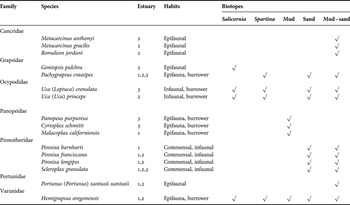
A total of sixteen species of brachyuran crabs were inventoried in the three main estuaries along the Pacific coast of Baja California, Mexico (Table 1). The highest diversity was recorded in Punta Banda and San Quintín with 9 and 12 species respectively. Additional fieldwork is necessary in Laguna Manuela since the diversity of brachyuran crabs in this place is likely to have been underestimated. The most species-rich family is Pinnotheridae with four species. The discovery of Goniopsis pulchra and Uca princieps in San Quintín, within the Californian Province is noteworthy. Both species normally occur in the tropical–subtropical region (see Villalobos-Hiriart et al., Reference Villalobos Hiriart, Nates Rodríguez, Díaz Barriga, Valle Martínez, Flores Hernández, Lira Fernández and Schmidtsdorf Valencia1989; Hendrickx, Reference Hendrickx1995). Whether or not San Quintín should be considered the most northern locality for these species, overlooked for many years, or just an extralimital zone remains unknown. It is nevertheless possible that these species are expanding their distribution northwards along the eastern Pacific coast, like P. crassipes from Oregon to Canada (Cassone & Boulding, Reference Cassone and Boulding2006), in connection with the increase in sea surface temperatures caused by El Niño events (see Wang & Fielder, Reference Wang and Fiedler2006) and by the effects of global warming. A potential introduction of these species cannot be discarded because the use of living crabs as bait is extensive among foreign anglers in Mexico, and a possible pathway may include the escape or release of live crabs from fishing boats. These boats, on returning from the Mexican tropical Pacific to the United States or Canada, frequently stop in estuaries and protected bays along the Baja California peninsula to buy fuel, for fishing and rest.
Brachyuran crabs from estuaries of the west coast of the state of Baja California, Mexico. Classification at family and genus level follows de Grave et al. (Reference De Grave, Pentcheff, Ahyong, Chan, Crandall, Dworschak, Felder, Feldmann, Fransen, Goulding, Lemaitre, Low, Martin, Ng, Schweitzer, Tan, Tshudy and Wetzer2009). 1, Punta Banda; 2, San Quintín; 3, Laguna Manuela.

The highest species richness, eleven species, was found in the sand and sand–mud habitats. The species of Cancridae (except Metacarcinus gracilis) and Portunidae prefer to inhabit subtidal areas and their systematic collection in the intertidal area is unexpected. Even so, the eight additional taxa are common residents in these communities. With the exception of M. gracilis that lives associated with Ulva sp., on mud substrates, the remaining seven species build their own burrows (e.g. Uca crenulata or Uca princeps), or inhabit as symbionts (e.g. Scleroplax granulata, Pinnixa franciscana, Pinnixa banharti and P. longipes) of infaunal macroinvertebrates (see Campos et al., Reference Campos, de Campos and Manriquez2009).
ACKNOWLEDGEMENTS
We remain indebted to Mary K. Wicksten, from Texas A&M University (College Station) and an anonymous referee for their detailed revision which improved the clarity of this paper. This research was supported by projects UABC-204 and UABC-213 (13th and 15th internal call respectively) and the Exotic Species Thematic Network of Mexico (SEP-PROMEP).