INTRODUCTION
Research on island organisms has contributed much to our understanding of the selective pressures that shape phenotypic diversity (Losos & Ricklefs Reference LOSOS and RICKLEFS2009, Schluter Reference SCHLUTER2000, Wallace Reference WALLACE1902, Whittaker & Fernández-Palacios Reference WHITTAKER and Fernández-Palacios2007). Modern comparative studies emphasize the importance of using phylogenetically distinct taxonomic units in an effort to eliminate pseudoreplication (Harvey & Pagel Reference HARVEY and PAGEL1991, Hurlbert Reference HURLBERT1984). Thus, the majority of comparative studies of insular biota have concentrated on endemic species and multi-species radiations (Roughgarden Reference ROUGHGARDEN1995, Schluter Reference SCHLUTER2000), which have often been isolated for hundreds of thousands, or even millions, of years. While studies that consider phylogenetically independent taxa are useful, they have an often overlooked drawback: the determination of selective mechanisms that have shaped phenotypic diversity in populations over long periods of time (geological scales) is difficult because the role that past ecological conditions play in current morphological or genetic divergence is unknown (Huey & Bennett Reference HUEY and BENNETT1987). By examining multiple populations of one species that have been recently isolated on islands which vary in their ecological conditions, we may reasonably assume that observed differences between these populations are related to current conditions (Garland et al. Reference GARLAND, HUEY and BENNETT1991, Grant & Grant Reference GRANT and GRANT2002, Reference GRANT and GRANT2003, Schluter Reference SCHLUTER2000, Whittaker & Fernández-Palacios Reference WHITTAKER and Fernández-Palacios2007).
In this study, we focused on insular populations of the lizard Anolis lemurinus, and build upon a single, previous study examining the phylogeographic history of this species in the Bay Islands and Cayos Cochinos of Honduras. Klutsch et al. (Reference KLUTSCH, MISOF, GROSSE and MORITZ2007) supported a ‘stepping stone’ model of archipelago colonization whereby A. lemurinus independently colonized the distant islands of Roatan and Utila after first arriving in the Cayos Cochinos from the mainland. Their observations, as well as those of other authors (Kohler Reference KOHLER2003, McCranie et al. Reference MCCRANIE, WILSON and KOHLER2005) suggest that the population on Utila is somewhat divergent in general ecology and morphology from those in the Cayos Cochinos and on mainland Honduras, and probably represents a good species. Anolis lemurinus in the Bay Islands thus appear to be in the midst of a radiation event. Klutsch et al. (Reference KLUTSCH, MISOF, GROSSE and MORITZ2007) also found, however, that populations in the Cayos Cochinos were genetically and morphologically indistinguishable from one another and from mainland populations, suggesting that they have undergone limited evolutionary differentiation or that gene flow between them is ongoing. Nevertheless, these authors did not consider potential differences in habitat use, and only examined coarse aspects of morphology.
This system offered an opportunity to examine ecological and morphological divergence among populations exposed to differing environmental conditions after a relatively recent colonization event. Due to noticeable differences in the abiotic and biotic environments among islands in the Cayos Cochinos, we hypothesized that A. lemurinus populations would differ in aspects of morphology and habitat use not considered by Klutsch and colleagues, and that these differences would provide evidence of recent selection or phenotypic plasticity despite genetic homogeneity among populations.
STUDY SITE
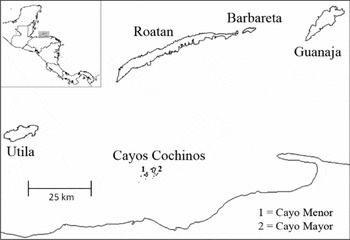
Anolis lemurinus occurs on mainland Central America and on the Bay Islands of Honduras (Kohler Reference KOHLER2003, Wilson & Hahn Reference WILSON and HAHN1973). The Bay Islands were formed after the coastal plain of northern Honduras was inundated at the end of the Wisconsin glacial period approximately 10 000 y ago (Bermingham et al. Reference BERMINGHAM, COATES, CRUZ, EMMONS, FOSTER, LESCHEN, SEUTIN, THORN, WCISLO and WERFEL1998). Soon after isolation, mainland A. lemurinus colonized a geographically more proximate subset of the Bay Islands known as the Cayos Cochinos (Klutsch et al. Reference KLUTSCH, MISOF, GROSSE and MORITZ2007; Figure 1). Anolis lemurinus occurs on the two largest islands of the Cayos Cochinos, Cayo Menor (area = 0.64 km2) and Cayo Mayor (area = 1.67 km2; Bermingham et al. Reference BERMINGHAM, COATES, CRUZ, EMMONS, FOSTER, LESCHEN, SEUTIN, THORN, WCISLO and WERFEL1998, McCranie et al. Reference MCCRANIE, WILSON and KOHLER2005). Cayo Menor and Cayo Mayor sit 18 km from mainland Honduras and are separated by approximately 2.5 km (McCranie et al. Reference MCCRANIE, WILSON and KOHLER2005).
The Bay Islands and Cayos Cochinos of Honduras. Adapted from Green (Reference GREEN2010).

Although Cayo Menor and Cayo Mayor are geographically proximate to one another, they differ noticeably in their biotic environments (Bermingham et al. Reference BERMINGHAM, COATES, CRUZ, EMMONS, FOSTER, LESCHEN, SEUTIN, THORN, WCISLO and WERFEL1998). For example, a species of palm in the genus Attalea is particularly abundant on Cayo Mayor, and has noticeably altered understorey and midstorey structure on that island, but does not occur on Cayo Menor (Bermingham et al. Reference BERMINGHAM, COATES, CRUZ, EMMONS, FOSTER, LESCHEN, SEUTIN, THORN, WCISLO and WERFEL1998). Additionally, several species of mammalian and reptilian predators (Rattus rattus, Dasyprocta punctata, Leptophis mexicanus) occur on Cayo Mayor, but are absent from Cayo Menor (Bermingham et al. Reference BERMINGHAM, COATES, CRUZ, EMMONS, FOSTER, LESCHEN, SEUTIN, THORN, WCISLO and WERFEL1998, McCranie et al. Reference MCCRANIE, WILSON and KOHLER2005). Lastly, Cayo Mayor has a permanent source of fresh water, which may increase the carrying capacity or decrease water stress for anoles on that island.
Despite apparent differences in the biotic and abiotic environments of Cayo Menor and Cayo Mayor, very little is known of the morphological or ecological variation of anole populations on these islands. Anolis lemurinus is primarily a mainland species (nested within a mainland-derived lineage; Guyer & Savage Reference GUYER and SAVAGE1986). As far as we know, they represent the only example of a mainland anole that has successfully colonized an island system in recent geological history (Nicholson et al. Reference NICHOLSON, GLOR, KOLBE, LARSON, HEDGES and LOSOS2005). Thus, one purpose of our study was simply to document aspects of A. lemurinus morphology and habitat use in this archipelago.
METHODS
Sampling procedure
Anolis lemurinus populations on both islands were sampled during the dry season between June and August during 2 y (2008 and 2009). Due to the small size of both Cayo Menor and Cayo Mayor, all areas on both islands with suitable A. lemurinus habitat were searched with equal effort. Lizards were captured by hand or by noosing (Blomberg & Shine Reference BLOMBERG, SHINE and Sutherland2006).
On Cayo Menor all lizards were processed in the laboratory and returned to their respective capture locations within 48 h. On Cayo Mayor, lizards were processed in the field and released immediately at capture locations. In 2008, to avoid repeat sampling of individuals, each lizard was marked on its ventral surface with a streak of white paint, and no single location was sampled more than twice – once initially, and a second time when a subsample of lizards was returned to a particular location. Anolis lemurinus exhibit strong territory affinity and small home-range size (Savage Reference SAVAGE2002), and these properties were assumed to provide for low re-sampling bias. In 2009, lizards were toe clipped for individual identification. Although we did not permanently mark individuals in 2008, it appears that annual adult mortality in this population is nearly 100% (we did not recapture any individuals during our annual surveys in 2010 and 2011). It is therefore likely that few, if any of the individuals sampled in 2008 were re-sampled in 2009. Additionally, because of large differences in the number of adult versus juvenile lizards sampled on each island, and the potential non-linearity of the relationship between body size and other morphological traits, only adult lizards (snout–vent length ≥50 mm) were included in this study.
Morphology and habitat use
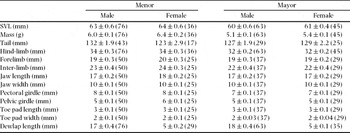
We measured 12 morphometric variables (Table 1). Mass was measured (to a precision of 0.1 g) using a 10-g-capacity Pesola® spring scale and other morphometric variables were measured (to a precision of 1 mm) with digital calipers. We were interested in potential differences in dewlap size for each population, and in 2008 we measured dewlap length with calipers. We considered ‘dewlap length’ to be the longest distance from the tip of the organ when fully extended to the point where it contacts the chin. We fully extended the dewlap of each male by clasping the second ceratobranchial cartilages with forceps (Cox et al. Reference COX, STENQUIST, HENNINGSEN and CALSBEEK2009). However, it was unclear whether dewlap length was a reliable proxy for dewlap area, so in 2009 we calculated dewlap areas for 30 males from Cayo Mayor and 29 males from Cayo Menor. We quantified dewlap area using digital photographs in the image analysis program PhotoJ®, a method that produces highly repeatable results (Vanhooydonck et al. Reference VANHOOYDONCK, HERREL, VAN DAMME, MEYERS and IRSCHICK2005a). We hypothesized that dewlap length and area would be tightly correlated so that the former could be used as a proxy for the latter.
A summary of the morphology of Anolis lemurinus on the islands of Cayo Menor and Cayo Mayor in the Cayos Cochinos (mean ± SE; sample size in parentheses). Snout–vent length, a measure of body length, is abbreviated as SVL.

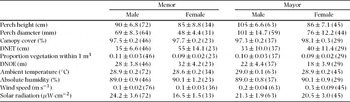
At each site where lizards were captured we measured 10 habitat and micro-meteorological variables (Table 2). GPS coordinates, elevation, time of capture, observed behaviour, presence or absence of tail breaks, and sex were also recorded. Sex was determined from an examination of dewlap size and the presence or absence of a hemipenal bulge at the base of the tail. Perch height and distance from the nearest tree whose crown reached the forest canopy were measured with a tape measure. Calipers were used to measure perch diameters ranging from 0 to 15 cm, and diameter tape was used to measure perch diameters greater than 15 cm. Canopy cover was estimated using a concave spherical densiometer. The distance from each observation to the closest open environment was determined with a metric tape measure or estimated visually if that distance was more than 10 m. However, since most individuals were more than 10 m from an open environment, these data lack precision and should be interpreted with caution. An ‘open environment’ was considered to be a canopy gap ≥5 m2. Gaps of this size permit a large amount of solar radiation to reach the forest floor, and likely provide unsuitable microclimates for shade-loving A. lemurinus (Savage Reference SAVAGE2002). ‘Vegetation within 1 m3’ was recorded by visually approximating 1 m3 around the lizard and estimating the per cent volume of that cube containing vegetation. Ambient temperature, absolute humidity and wind-speed were measured using a Kestrel® wind meter. Solar radiation was measured using a Mannix® UV light meter.
A summary of habitat use of Anolis lemurinus in the Cayos Cochinos (mean ± SE; sample size in parentheses). ‘Distance to nearest emergent tree’ and ‘Distance to nearest open environment’ are abbreviated ‘DNOE’ and ‘DNOE’, respectively.

Statistics
Morphometric and habitat use variables were logarithmically transformed for normality. Sexual dimorphism within and among islands in each morphometric and habitat-use variable was examined using fully-factorial ANCOVAs. The effects of sex, island and all possible interactions were examined for morphology and habitat-use, and non-significant higher-order effects were removed from the final models. For morphometric ANCOVAs, we also included SVL as a covariate to remove the effects of body size. Lastly, a Bonferroni correction was applied to all P-values to correct for inflated Type I error associated with testing multiple hypotheses on the same set of observations (Sokal & Rohlf Reference SOKAL and ROHLF1995).
To determine whether morphology and habitat use (as aggregate ‘variables’ in multivariate space) could be used to distinguish among populations, we performed discriminant analyses on habitat and size-corrected morphometric variables. The effect of size was removed from morphometric variables by generating residual values from regressions of each logarithmically transformed variable on logarithmically transformed SVL. We considered the residuals of mass regressed on SVL to represent an index of body condition. Discriminant functions were based on correlation matrices, and prior probabilities were based on the number of lizards sampled from each island. Coefficients reported are standardized by within-group variances. Due to potential sexual dimorphism and differences in sex ratio among islands, separate discriminant functions were derived for males and females. We derived two discriminant functions for each sex; one for habitat use and one for morphology.
RESULTS
General description of sample
Total sample size consisted of 220 Anolis lemurinus (139 males and 81 females). In 2008, we captured 50 males and 25 females on Cayo Menor and 37 males and 29 females on Cayo Mayor. In 2009, we captured 26 males and 11 females on Cayo Menor and 26 males and 16 females on Cayo Mayor. Dewlap length measured with calipers was highly correlated with dewlap area taken from digital photographs of males from both islands in 2009 (N = 59, Pearson coefficient = 0.856, P < 0.001). We therefore considered dewlap length to be an accurate proxy for dewlap area.
Univariate examination of sexual dimorphism
The maximum SVLs of Cayo Menor males and females were 70 mm and 68 mm, respectively. The maximum SVLs of Cayo Mayor males and females were 67 mm and 66 mm, respectively. Fully factorial ANCOVAs examining sexual dimorphism in Anolis lemurinus in the Cayos Cochinos revealed that males had narrower pelvic girdles (significant effect of sex; F 1,137 = 23.2, P = 0.001) and longer toe pads (significant effect of sex; F 1,137 = 8.78, P = 0.048) on both islands. Additionally, significant interactions between sex and SVL for dewlap length (F 1,136 = 8.62, P = 0.048) indicated that this character scaled differently with body length between the sexes. There was also a significant interaction between sex and island for tail length (F 1,109 = 12.9, P = 0.001), which indicates that the magnitude of difference between the sexes varied among islands. Sexes did not differ in any of the 10 habitat variables we examined (all P > 0.160).
Two additional patterns were revealed through univariate analysis. First, there was an effect of island, but not sex, on mass (F 1,216 = 12.1, P = 0.012). Second, body condition was positively correlated with relative hind-limb length (but no other variable) in males (islands pooled; N = 139, Pearson coefficient = 0.263, P = 0.002), but not females (P > 0.05).
Multivariate comparisons among islands
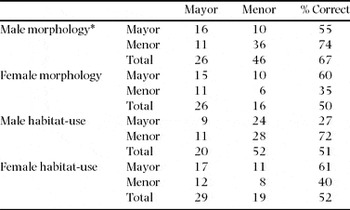
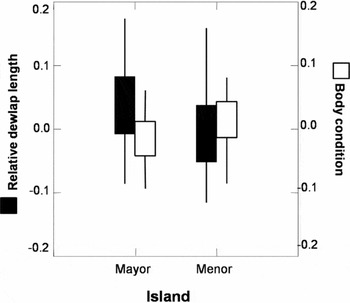
Using discriminant analyses, populations could be distinguished based on male morphology (Wilks’ Lambda = 0.718; F 12,59 = 1.93, P = 0.049). Relative hind-limb length (coefficient = −0.636), body condition (coefficient = −0.848), and jaw width (coefficient =0.515) were most heavily weighted in the male-morphology model. Relative dewlap length was moderately weighted in the model (coefficient = 0.286). Classification matrices are displayed for the discriminant functions derived from habitat and morphological variables partitioned among sexes (Table 3). Thus, the discriminant function for male morphology indicates that males on Cayo Menor were in better body condition and had longer hind limbs, narrower jaws and smaller dewlaps at a given SVL than Cayo Mayor males (Figure 2). Females were not distinguishable based on morphology (Wilks’ lambda = 0.730, F 12,29 = 0.90, P = 0.562), and neither males nor females were distinguishable based on habitat use (Wilks’ lambda = 0.864, F 10,61 = 0.96, P = 0.489 and Wilks’ lambda = 0.646, F 10,37 = 2.02, P = 0.059, respectively).
Jack-knifed classification matrices for discriminant analyses of males and females using functions derived from either morphological or habitat-use variables, including the percentage of individuals that were classified correctly to their island of origin (last column). An asterisk denotes the function that was able to statistically distinguish among populations.

Body condition (indexed as the residuals from a regression of mass on SVL) and relative dewlap length for adult male Anolis lemurinus in the Cayos Cochinos.

DISCUSSION
Morphological differences between island and mainland populations
The majority of anoles display male-biased sexual size dimorphism (Butler & Losos Reference BUTLER and LOSOS2002, Losos Reference LOSOS2009, Fitch Reference FITCH1976). In contrast, female A. lemurinus from mainland Central America are reported to be equal to or greater in size than males (Corn Reference CORN1981, Savage Reference SAVAGE2002), and this pattern held for the island populations we studied as well (Table 1). Conversely, Savage (Reference SAVAGE2002) and Guyer & Donnelly (Reference GUYER and DONNELLY2005) reported little difference in dewlap size among sexes in mainland populations, but male dewlaps were approximately three times larger than that of females in the Cayos Cochinos. Why mainland and island populations differed in this respect is unclear, although sexual dimorphism in dewlap size is often attributed to the role this organ appears to play in territorial defence and courtship behaviour (Jenssen et al. Reference JENSSEN, ORRELL and LOVERN2000, Ord Reference ORD2008, Vanhooydonck et al. Reference VANHOOYDONCK, HERREL, VAN DAMME, MEYERS and IRSCHICK2005a). Additionally, both mainland and island populations of A. lemurinus are described as having red dewlaps with black spots (Kohler Reference KOHLER2003, McCranie et al. Reference MCCRANIE, WILSON and KOHLER2005, Savage Reference SAVAGE2002), however, the dewlaps of every individual we observed in the Cayos Cochinos had white spots.
Sexual dimorphism in morphology
Males had longer toe pads and narrower pelvic girdles on both islands, and on Cayo Menor (but not Cayo Mayor) males had longer tails. Broader pelvic girdles in females are consistent with constraints on egg-laying (Castilla & Bauwens Reference CASTILLA and BAUWENS2000). The sex that is more active in the perch matrix is expected to have larger toe pads and longer tails because long tails confer increased balance in arboreal habitat (Gillis et al. Reference GILLIS, BONVINI and IRSCHICK2009, Pizzatto et al. Reference PIZZATTO, ALMEIDA-SANTOS and SHINE2007) and toe pad size is positively correlated with subdigital lamellae number (and therefore clinging ability; Glossip & Losos Reference GLOSSIP and LOSOS1997, Irschick et al. Reference IRSCHICK, AUSTIN, PETREN, FISHER, LOSOS and ELLERS1996). Increased male activity associated with territory defence and courtship behaviour may provide an explanation for these differences, however, the behavioural data needed to test this hypothesis are unavailable.
Sexual dimorphism in habitat use
Differences in behaviour among male and female anoles often lead to differences in structural or climactic habitat use. In general, this may explain much of the variation in morphology among sexes in Anolis lizards (Losos Reference LOSOS2009). Nevertheless, male and female A. lemurinus in the Cayos Cochinos did not differ in any of the 10 habitat variables we measured.
Differences among islands
Habitat use in multivariate space (discriminant analyses) could not be used to distinguish among populations. This lack of divergence in habitat use is particularly striking given the obvious differences in vegetation structure among islands. Similarity among populations may be a product of niche conservatism (Holt & Barfield Reference HOLT and BARFIELD2008, Losos et al. Reference LOSOS, LEAL, GLOR, DE QUEIROS, HERTZ, SCHETTINO, LARA, JACKMAN and LARSON2003, Warren et al. Reference WARREN, GLOR and TURELLI2011), phylogenetic constraint (Harvey & Pagel Reference HARVEY and PAGEL1991), or gene flow (Klutsch et al. Reference KLUTSCH, MISOF, GROSSE and MORITZ2007, Lenormand Reference LENORMAND2002). Unfortunately, because we did not quantify the difference in habitat availability on either island, it is impossible to determine the degree to which lizards are choosing habitat non-randomly.
Despite no discernable difference in habitat use, populations could be discriminated based on male morphology. Cayo Mayor and Cayo Menor males differed in body condition, relative hind-limb length, jaw width and relative dewlap length, as indicated by the coefficients of these variables in the discriminant function derived from male morphological data. Hind-limb length is often positively correlated with perch diameter in anoles as this confers a biomechanical advantage (Calsbeek et al. Reference CALSBEEK, SMITH and BARDELEBEN2007, Irschick & Losos Reference IRSCHICK and LOSOS1999, Langerhans et al. Reference LANGERHANS, KNOUFT and LOSOS2006). Although males on Cayo Menor had longer hind-limbs than males on Cayo Mayor, we found no difference in perch use among populations. Interestingly, within populations, hind-limb length was positively correlated with body condition, and thus the difference we observed in hind-limb length among islands may have been a result of this correlation.
Differences in male dewlap size and body condition
Surprisingly, males on Cayo Mayor were in worse body condition but had larger dewlaps. We expected lizards that were in better body condition to have more energy to invest in dewlap development, all else remaining equal. Variation in intraspecific density among islands may explain this pattern. Although abundance data were not collected during the study period, it was apparent from the time required to sample lizards on each island that A. lemurinus individuals on Cayo Mayor were much more abundant per unit area than those from Cayo Menor. Males of many lizard species are highly territorial, and at higher densities territorial behaviours such as dewlap extension become increasingly important (Calsbeek & Smith Reference CALSBEEK and SMITH2007, Lister & Aguayo Reference LISTER and AGUAYO1992, Ord Reference ORD2008). Therefore, males with larger dewlaps might be more successful at defending territories and driving away other males. Additionally, a high population density necessarily results in a reduced per-capita prey base. Thus, density-dependence may be exerting an effect on dewlap size and body condition independently via competitive interactions among males for both territory and prey (Calsbeek Reference CALSBEEK2009, Grether Reference GRETHER1996).
The dewlap appears to be an important feature of anole evolution, and several hypotheses (other than population density) have been put forward to explain inter- and intraspecific patterns of dewlap size among anoles (Losos & Chu Reference LOSOS and CHU1998). Of these, only the ‘predator deterrence hypothesis’ (Vanhooydonck et al. Reference VANHOOYDONCK, HERREL, MEYERS and IRSCHICK2009) is congruent with our data. This hypothesis suggests that selection for larger dewlaps should occur when a population is exposed to heighted predation risk because males use their dewlap to advertise escape ability or bite strength to an approaching predator (Vanhooydonck et al. Reference VANHOOYDONCK, HERREL, VAN DAMME and IRSCHICK2005b). Of the primary predators of Anolis lizards in the Cayos Cochinos, two lizard-specialist snake species (Leptophis mexicanus and Oxybelis aeneus; Henderson Reference HENDERSON1982, Savage Reference SAVAGE2002) occur solely on Cayo Mayor or are at much higher abundance on that island (Bermingham et al. Reference BERMINGHAM, COATES, CRUZ, EMMONS, FOSTER, LESCHEN, SEUTIN, THORN, WCISLO and WERFEL1998, Boback et al. Reference BOBACK, MONTGOMERY, REED and GREEN2006, McCranie et al. Reference MCCRANIE, WILSON and KOHLER2005). Moreover, feral cats, dogs and rats (Rattus rattus) occur solely on Cayo Mayor and likely add to predation pressure on that island (Bermingham et al. Reference BERMINGHAM, COATES, CRUZ, EMMONS, FOSTER, LESCHEN, SEUTIN, THORN, WCISLO and WERFEL1998, Gasc et al. Reference GASC, DURYEA, COX, KERN and CALSBEEK2010). Thus, it is likely that predation as a whole has been weaker on Cayo Menor where there is a lower diversity of potential predators, supporting the predator deterrence hypothesis as an explanation for dewlap size patterns in the Cayos Cochinos.
Concluding remarks
The factors driving sexual dimorphism among insular Anolis lemurinus remain unclear. However, further research into activity budgets and behavioural differences among sexes may reveal potential explanations. Among islands, A. lemurinus males differ in several morphological characters, and these differences persist despite no difference in habitat use and a lack of genetic differentiation among populations. As such, we suggest that differences in anole population density or predation pressure among islands may explain these patterns. Quantitative assessments of anole behaviour and morphology replicated across potentially important environmental gradients within each island are critical for further evaluation of these hypotheses. Our results illustrate the potential for divergent ecological forces to override the homogenizing effect of low genetic differentiation in natural populations.
ACKNOWLEDGEMENTS
Our methodologies were approved by the University of Texas-Arlington Institutional Animal Care and Use Committee (protocol A08.023). Funding for this project was provided by Operation Wallacea, the East Texas Herpetological Society, and Phi Sigma. We would like to thank D. Manier, B. Smith, R. Cox and two anonymous reviewers for helpful comments on drafts of the manuscript. This project would not have been possible without the assistance of the Honduran Coral Reef Foundation, S. Green, J. Frazier, A. Oviedo, A. Cubas, T. Coles, J. Saunders, A. Tozer, T. McLaughlin, P. Muellman, C. Cox, J. Meik, J. Robinson, D. Formanowicz, A. Ives, M. Haughey, M. Overstrom-Coleman, R. Logan and J. Logan. Lastly, we would like to thank B. McCowan, L. Jacobson and the people of East End, Cayo Mayor, for their wonderful hospitality and support. Any mention of trade, firm, or product names is for descriptive purposes only and does not imply endorsement from the US Government.