Introduction
Since the entry of Spain into the European Union in 1986 and the adoption of the milk quota system, the country has seen a large reduction in the number of dairy farms. Between 2001 and 2008, there has been a 55% reduction in the number of dairy farms in Spain, from 53,224 to 24,133. This trend in dairy production along the Atlantic Coast of Spain, which accounts for 79% of the milk quota holders, has followed the national trendReference Álvarez Pinilla and Pérez Méndez1. While there has been a dramatic reduction in the number of milk quota owners, accompanied by a limited reduction in the number of cows milked, average milk production of remaining farms has experienced a large increase. Genetically improved dairy cattle usually make up the herds of these remaining producers, who have increased the percentage of concentrates in the feedReference Kennedy, Dillon, Delaby, Faverdin, Stakelum and Rath2.
Since the cost of inputs (labor, cows, feed, etc.) has increased, but the price of milk and milk products has remained steady or even declined, farmers need to become more efficient to remain profitable. Grazing has been proposed as an essential strategy for the efficient use of pastoral resources which are abundant in damp, temperate areas. Northern Spain has a marine west coast climate, generally warm and wet summers, and fairly mild winters. Annual rainfall is above 900 mm and the mean annual temperature is approximately 13°C. These climatic conditions allow annual grazing, which have been used traditionally across Atlantic Europe.
Milk contains a high proportion of saturated fatty acids (SFA; 70–75%), which has made it target of criticism by diet and nutrition experts3. However, about 2% of milk fatty acids (FA) are polyunsaturated fatty acids (PUFA), including n-3 FAs, rumenic and vaccenic acidsReference Dewhurst, Scollan, Lee, Ougham and Humphreys4, which have health benefits for consumersReference Belury5. Increasing the concentration of desirable FAs in ruminant products has received greater attention recentlyReference Bauman, Mather, Wall and Lock6. Fresh grass contains a high proportion of its total FA content in the form of C18:3. Cows grazing fresh grass produce milk with improved acid profiles for human health, as shown by a higher proportion of PUFA, especially conjugated linoleic acid (CLA) and linolenic acidReference Dewhurst, Shingfield, Lee and Scollan7, Reference Morales-Almaráz, Soldado, González, Martínez-Fernández, Domínguez-Vara, de la Roza-Delgado and Vicente8. Moreover, pasture feeding imparts agreeable sensorial qualities to milk: grassy flavors can be easily recognized by some consumersReference Bendall9. Accordingly, feeding fresh forage extends the role of grazing as a natural and sustainable production system with potential health benefits.
The aim of this study was to examine milk characteristics among dairy herds along the Atlantic Coast of Spain (Asturias). Information from the study sought to elucidate differences in FA profiles of milk fat from representative feeding methods, thereby identifying potential value-added attributes of milk.
Materials and Methods
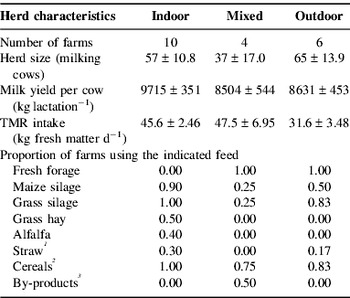
The milk of 20 commercial Holstein–Friesian dairy herds from northern Spain was examined in spring of 2008. All herds were enrolled in a routine dairy control program (run by Asturiana de Control Lechero, S. Coop. L.) consisting of regular monitoring of milk yield and quality, and cow reproduction and health (Table 1). The total number of dairy cows making up these herds was 1106, approximately 1.25% of all dairy cows in Asturias.
Differences in production variables (means±standard error) and proportion of feed used in each management system. Data are based on farm records and survey responses from a questionnaire.

1 Wheat, barley and/or oat.
2 Mixed concentrate feeds.
3 Sugar beet pulp or apple pulp.
All farms prepared the total mixed ration (TMR) in a mixer-wagon. The selected herds were divided into three groups according to their management: (1) Indoor herds (n=10): representing the conventional production and feeding system now used in the Atlantic arc. These herds were fed TMR with grass and maize silages plus cereals at a concentrate:forage ratio of 1:1. (2) Mixed herds (n=4): representing a system with low use of preserved forage and a high input of concentrates and by-products. The cows of these farms grazed for up to 6 h per day. (3) Outdoor herds (n=6): representing a low-input system. These cows grazed between 6 and 18 h per day. Low levels of concentrate were included in the TMR in these herds. Obtaining additional representative farms using grazing and mixed feeding regimes was difficult due to an unwillingness of local producers to be involved in the study. Consequently, the numbers of herds in each treatment was unbalanced.
Milk bulk tanks were sampled weekly from April to June 2008. Milk samples were taken from the bulk tank after stirring following at least two milkings at each participating farm. One sample of freshly made TMR was taken fortnightly from April to June along the feeders from each farm. Before the cattle moved to each new plot for grazing, the farmers sampled the pasture of this new plot by cutting 1 kg of the grass with a hand mower to a height of 6 cm from four different areas chosen at random. Rotational grazing management resulted in a change of plot every 2–3 weeks, allowing a total of 46 samples of grass. All samples were kept refrigerated and analyzed immediately upon arrival at the laboratory.
All feed samples were dried (60°C for 24 h) and ground through a 0.75-mm mesh. The nutritive parameters were determined by near infrared spectroscopy (FOSS NIRSystem 5000, FOSS NIRSystems, Inc., Laurel, MD, USA). Milk samples were analyzed for fat, protein, urea and lactose contents by Fourier Transform Infrared in accordance with AOAC standards (MilkoScan FT 6000, FOSS NIRSystems, Inc.).
The FA content of the feeds was analyzed according to Sukhija and PalmquistReference Sukhija and Palmquist10 using modifications of Palmquist and JenkinsReference Palmquist and Jenkins11. For milk FA analysis, fat was isolated as described by Feng et al.Reference Feng, Lock and Garnsworthy12 and transesterified as described by ChristieReference Christie13 with modifications of Chouinard et al.Reference Chouinard, Corneau, Barbano, Metzger and Bauman14. FA methyl esters were determined by gas–liquid chromatography (Varian 4000 GC/MS, Varian Inc., Palo Alto, CA, USA) in both milk and feed samples. Methyl esters were separated using a 100 m×0.25 mm i.d. fused silica capillary column (CP-Sil 88 Varian). Individual FA peaks were identified by comparison of their retention times and mass spectra with those of pure methyl ester standards (Matreya Inc., PA, USA and Sigma-Aldrich Inc., MO, USA).
Feedstuff and milk data collected over 12 weeks were analyzed using a GLM procedure for unbalanced ANOVA. The statistical analysis was preformed using the SAS statistical package15 according to the model:

where Yijk is the dependent variable, μ is the overall mean, Mi is the effect of management system, Wj is the week of sampling, Hk is the effect of the herd and Eijk is the residual error. Significant differences were accepted if P⩽0.05.
Results
Chemical composition of feedstuffs and pasture
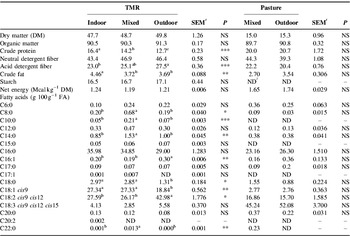
No differences were observed between farms in terms of the dry matter, organic matter, neutral detergent fiber, starch or net energy contents of TMR (Table 2). The TMR for indoor herds had higher crude protein and crude fat contents and a lower acid detergent fiber content than the TMR for the mixed and outdoor herds. Nearly 90% of the FA of the feedstuffs was composed of palmitic (C16:0), oleic (C18:1 cis9) and linoleic (C18:2 cis9 cis12) acids. The TMR given to the mixed herds had higher concentrations of caprylic (C8:0), capric (C10:0) and myristic (C14:0) acids than that given to the indoor and outdoor herds, and had a lower C16:1 content than outdoor herd TMR. The outdoor herds’ feed showed a higher proportion of linoleic and lower stearic (C18:0) and oleic acid contents than those of the mixed and indoor herds. The chemical composition of the pasture was similar between mixed and outdoor systems, and was typical for the region during a wet springReference Piñeiro, Díaz, de la Roza-Delgado, Martínez-Fernández and Carballal-Samalea16. The predominant FAs in pasture were linolenic (C18:3 cis9 cis12 cis15), palmitic and linoleic acids, which comprised nearly 90% of total FA measured.
Chemical composition (% dry matter basis) and FA profiles of the feed and pasture under different herd management systems.
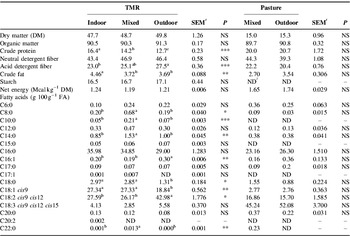
a,b,c Means in a row with unlike letters differ significantly. *P<0.05, **P<0.01, ***P<0.001, NS: not significant.
1 SEM, standard error of the means.
2 ND, not detected.
Milk composition and FAs profile
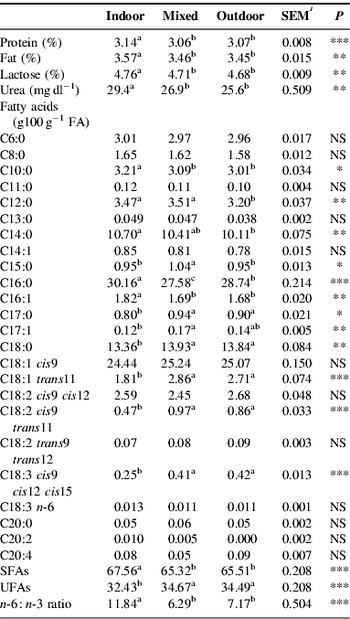
Indoor herds showed the highest concentration of protein, fat, lactose and urea (Table 3). The indoor and mixed herds produced milk with a higher content of short-chain FAs compared to the outdoor herds (11.52 and 11.35 versus 10.89 g 100 g−1 FA, respectively; P⩽0.05). Saturated medium-chain FA concentration of the indoor and mixed herd milk was higher than that of outdoor herds. Indoor herd milk had lower concentrations of heptadecanoic (C17:0) and heptadecenoic (C17:1) acids and higher concentration of palmitoleic (C16:1) acid than that of the mixed or outdoor herds. In addition, the total medium-chain FA concentration of the indoor herd milk was higher (45.38 g 100 g−1 FA, P⩽0.001) than that of the mixed and outdoor herd milk (42.63 and 43.26 g 100 g−1 FA for mixed and outdoor herds, respectively). The concentrations of oleic and linoleic acids were not affected by the management system. The indoor herd milk showed lower concentrations of stearic, vaccenic (C18:1 trans11), rumenic (C18:2 cis9 trans11) and linolenic acids than that of the outdoor and mixed herds. In addition, the total long-chain FA content of the indoor herd milk was lower (P⩽0.001) than that of the mixed and outdoor herd milk (43.09, 46.00 and 45.83 g 100 g−1 FA, respectively).
Milk composition and FA profile according to herd management system.

a,b,c Means in a row with unlike letters differ significantly. *P<0.05, **P<0.01, ***P<0.001. NS, not significant.
1 SEM, standard error of the means.
The indoor herd milk had a higher (P⩽0.001) content of SFA (65.52 g SFA 100 g−1 FA) than the mixed and outdoor herd milk (65.25 and 65.47 g SFA 100 g−1 FA, respectively). The SFA:UFA ratio of the indoor herd milk was significantly greater (P⩽0.001) than that of the mixed and outdoor herd milk (2.09 versus 1.91 and 1.89, respectively). The desaturase activity of the mammary glandReference Kelsey, Corl, Collier and Bauman17, estimated for pairs of FAs C14:1–C14:0, C16:1–C16:0 and C18:1–C18:0 was similar for all herd management systems. However, the CLA:C18:1 trans-11 ratio was higher (P⩽0.01) for the outdoor and mixed (0.32) herds than for the indoor herds (0.20).
Discussion
Lower dry matter intake and milk production are typically associated with grazing relative to more intensive feeding systemsReference Bargo, Muller, Delahoy and Cassidy18. Certainly, in the present work, milk yield per lactation was higher under the indoor system compared to the other systems, while FA profiles of the herds under the three management systems differed. Fresh forage fed to the mixed and outdoor herds was the main factor behind these differences. The diet of the indoor herds explains the higher short- and medium-chain FA content of their milkReference Morales-Almaráz, Soldado, González, Martínez-Fernández, Domínguez-Vara, de la Roza-Delgado and Vicente8, Reference Kay, Roche, Kolver, Thomson and Baumgard19. This diet could change ruminal fermentation towards propionate production because of a higher proportion of cereal feedstockReference Latham, Sutton and Sharpe20. Acetate and β-hydroxybutyrate are necessary for the de novo synthesis of FAs in the mammary glandReference Bauman and Griinari21. Variations in the milk concentration of short- and medium-chain FAs have been reported, although some authors report no differences in the milk produced by herds under grazing and intensive management systemsReference White, Bertrand, Wade, Washburn, Green and Jenkins22. The low concentrations of palmitic and palmitoleic acids in milk for the mixed and outdoor herds might be a consequence of low energy intake or body pool mobilizationReference Palmquist, Beaulieu and Barbano23. However, palmitic acid concentration in milk fat seems to result from its content in the dietReference Latham, Sutton and Sharpe20, because if body fat had been mobilized, the milk oleic acid concentration should have increased, since this FA is the most concentrated in the body reserveReference Leiber, Kreuzer, Nigg, Wettstein and Scheeder24. In this work, the oleic acid content was similar in the milk of all three herd types. Nevertheless, this hypothesis cannot be ruled out since the oleic acid in milk can also be obtained from de novo synthesis via the desaturation of stearic acid in the mammary glandReference Bauman, Baumgard, Corl and Griinari25.
Although grass intake was not estimated for this study, a direct relationship between daily grazing time and grass intake has been observedReference Morales-Almaráz, Soldado, González, Martínez-Fernández, Domínguez-Vara, de la Roza-Delgado and Vicente8. Therefore, it can be assumed that cows in outdoor management eat more grass than cows in mixed management. However, according to data provided by farmers in this study, the TMR intake was similar in indoor and mixed farms, which is in agreement with previous studiesReference Morales-Almaráz, Vicente, González, Soldado, Martínez-Fernández, de la Roza-Delgado, Joy, Calvo, Calvete, Latorre, Casasús, Bernués, Panea, Sanz and Balcells26. Therefore, elevated rumenic and vaccenic acid contents in outdoor and mixed herd milk are associated with fresh forage consumption. This confirms the results of several authors who studied the effect of grazing-based management systems on milk FA concentrationReference Butler, Nielsen, Slots, Seal, Eyre, Sanderson and Leifert27; although it should be noted that some authors have not found differences in the rumenic acid concentration of milk produced by cows under indoor and outdoor systemsReference Toledo, Andrén and Björck28.
The high proportion of unsaturated FAs, especially linolenic acid, in fresh forage would explain the increase of linolenic acid in the milk of cows feeding on grass, despite being the PUFA most susceptible to ruminal biohydrogenationReference Wachira, Sinclair, Wilkinson, Hallett, Enser and Wood29. Up to 99% of dietary linolenic acid intake may be totally or partially hydrogenated in the rumen, synthesizing vaccenic and stearic acidsReference Song30. Vaccenic acid is desaturated in the mammary gland producing rumenic acid with the addition of a double bond between carbon 9 and 10Reference Griinari, Corl, Lacy, Chouniard, Nurmela and Bauman31. The CLA:C18:1 trans-11 ratio serves as a marker of Δ-9 desaturase activityReference Baumgard, Matitashvili, Corl, Dwyer and Bauman32. When fresh forage was included in the diet, this index was higher, reflecting greater desaturase activity in grazing cows. The finding of increased vaccenic and rumenic acids in the milk of the mixed and outdoor herds is consistent with that described by other authorsReference Dewhurst, Shingfield, Lee and Scollan7. This shows that fresh forage intake can improve the concentration of healthy FAs in milk, while feeding on high proportions of concentrates and conserved forage reduces their content.
The lower concentration of SFAs and the higher concentration of UFAs in the outdoor and mixed herd milk agree with the results of other studies in which fresh forage was included in the dietReference Dewhurst, Shingfield, Lee and Scollan7, Reference Morales-Almaráz, Soldado, González, Martínez-Fernández, Domínguez-Vara, de la Roza-Delgado and Vicente8. The SFA:UFA ratio of the indoor herd milk (2.09) was above the current dietary limit of 2.033, while in the outdoor and mixed herd milk it was less than 2. The n-3 FA concentration increased significantly in the milk of the mixed and outdoor herds, while the n-6 FA concentration was not affected by the management system. However, the n-6:n-3 ratio in the mixed and outdoor herd milk was 6.7, while in the indoor herd milk possessed a ratio of 11.8, which exceeded FAO dietary recommendations regarding essential FA intake33.
The differences in milk fat and protein concentrations between the indoor and mixed/outdoor systems were in agreement with Bargo et al.Reference Bargo, Muller, Delahoy and Cassidy18. However, our results contrast with other authors, who reported lower fat and protein contents in the milk of herds fed preserved forage (maize silage, grass silage and cereal straw) and concentratesReference Butler, Nielsen, Slots, Seal, Eyre, Sanderson and Leifert27 or TMRReference Cranix, Steen, Van Laar, Van Nespen, Martín-Tereso, De Baets and Fievez34 than in herds whose diets included fresh forage. Other authors report no differences in the fat and protein contents of the milk of cows fed TMR or grassReference Kay, Roche, Kolver, Thomson and Baumgard19. The TMR of the present indoor herds was based on preserved forage and a high level of concentrates. This could have increased the metabolizable energy (ME) intake as well as the concentration of propionate in the rumen, and it would result in an increase in milk proteinReference Sutton35. In this paper, the TMR offered in indoor farms had higher, although not significant, net energy concentration than TMR in mixed and outdoor farms. In general, the first limitation to milk protein synthesis in grazing systems is the amount of ME available since grass has an excess of degradable proteinReference Walker, Dunshea and Doyle36. Thus, the differences in the protein concentration of the milk of the outdoor herds compared to that of the indoor herds might be due mainly to the formers’ low ME and/or degradable protein intake. In this sense, increasing ME intake increases the rate of microbial protein synthesis and propionate relative to acetate in the rumenReference Latham, Sutton and Sharpe20, resulting in increased rates of synthesis of milk protein, lactose, and to a lesser degree, fat in the mammary glandReference Sutton35. This may have occurred with indoor management.
Conclusion
Fat and protein in milk increased under the indoor feeding system, but milk FA profiles improved for both the mixed and outdoor systems. Therefore, milk from herds whose diets included fresh forage from grazing was of better quality in terms of total FA content, SFA and SFA:UFA ratio. Grazing appears to increase linolenic, vaccenic and rumenic acids in milk, while maintaining the n-6:n-3 ratio within current nutrition recommendations.
Acknowledgements
This work was funded by Spanish projects INIA-RTA2007-00058-C02 and PCTI-PC06-006. Mr Morales-Almaráz was financed by CONACYT-Mexico. The authors gratefully acknowledge the help of the milk producers, associated with ASA enterprise, who participated in this study and the staff of Laboratory of Animal Nutrition (SERIDA) for undertaking laboratory determinations.