Introduction
The songs that form the musical experience of children comprise a body of knowledge that serves communities in their endeavour to socialise their young. Indigenous Kenyan children's songs have been identified as useful, appropriate cultural tools for the teaching of musical skills, societal norms and mores, and for intellectual development. Through this artistic, aesthetic medium, Kenyan communities have nurtured new generations of people who are versed in their traditions, able and willing to take up their part in society and capable of generating solutions to the challenges that face society on a day to day basis.
The Kenyan education system has undergone some significant changes in its concept and process since independence in 1963. The 8-4-4 system (eight years of primary education followed by four years of secondary school and four years of college or university) was introduced in 1985 to mainly equip learners with practical skills that would enable them be self-reliant particularly when the government could not create enough jobs to absorb the population. The system has, however, gone through much transformation, losing much of its intended purpose. Instead of a focus on self-reliance, school leavers are now more dependent on white collar jobs than on self-employment through practical skills. This may be attributed to a shift from practical aspects in the process of teaching and the withdrawal of certain practical, skill-based disciplines from the list of examinable subjects in the curriculum. This means that learners and teachers do not take practical subjects as seriously as examinable subjects that can provide a route to employment. It is the former subjects, however, for example the creative and expressive arts, that allow learners to identify their talents and make it possible for educators to nurture this talent from an early age in schools.
Despite these changes, the school programme still retains avenues through which children can engage in music making. In the lower primary school, the subject called Creative Arts provides scope for singing and working with song material for 6–8-year-old learners. Skilled teachers who are able to take advantage of this provision can provide early exposure to quality song repertoire and further use this learning material to enhance development of various capacities in children.
The problem
The practice of education in Kenyan primary schools creates opportunities for the use of diverse resources to facilitate knowledge and skills transfer. Music, a resource that is available and that has been found efficient in the socialisation of children, is abundant in the schools in Kenya, as it is elsewhere in Africa (Akuno et al., Reference AKUNO, ANDANG'O, IMBWELE, NEL, OMOLO-ONGATI and ONDIEKI2013). There is, however, no evidence that this rich material is appropriated to learners’ advantage. In the past, indigenous educational practices allowed the song material to be part of the child's socialisation through its inclusion as a pertinent and vital component of important things (Zake, Reference ZAKE1986). Today, this song material is experienced in school, alongside other learning activities. This begs the question as to how the song material is appropriated to enhance the development of the child's abilities and capacities. A secondary question concerns what the teacher needs to know and do to ensure that children's involvement in singing results in substantial learning, and that it is not relegated as a pastime or for entertainment.
Related literature
Song content
Akuno (Reference AKUNO1997) analysed the song repertoire of Kenyan children of 6–8 years. This age group forms the lower primary school cluster, the first three years of primary education in Kenya. At this level, singing occurs as:
• Learner initiated – at play, during leisure hours.
• Teacher initiated – in class, formally organised, during assembly, for presentation at school and community functions, for competitions including the Kenya Music Festival.
The study established that indigenous Kenyan children's songs:
• Addressed topical issues.
• Used simple language, with little symbolism.
• Relied on explicit and implicit messages, with direct and coded communication.
• Adhered to communal song forms, thereby being similar to adult songs.
• Comprised an education package – with learning material and methods contained in the content and processes of each song.
Similarly, Andang'o (Reference ANDANG'O2009), dealing with music in early childhood learning, found an abundance of songs that served a variety of learning needs. This reflects Weinberg's (Reference WEINBERG1984) observation that despite many years of Westernisation and formal education, indigenous songs are still known, and a lot are performed by children. For a cultural element to survive the onslaught of a systematically initiated and operated socialisation process, such as happened with formal (Western) education, the element must be significant to the people who utilise it. The element must also be versatile, adaptable and resilient. Through the interrogation of the music processes within one of these songs, this article articulates the songs' role in developing music-making skills, perceptual skills and values. This reiterates their role in developing children's abilities, sensibilities and sensitivities.
Music's role
Music's role in sensitising the individual is underscored in various studies on children's music making in Kenya (Mulindi, Reference MULINDI1984; Mwaniki, Reference MWANIKI1986; Andang'o, Reference ANDANG'O2009). A holistic experience of music results in the impartation of knowledge (Ondieki, Reference ONDIEKI2010) and development of creativity (Mushira, Reference MUSHIRA2010) and perceptual skills (Owino, Reference OWINO2010). These skills and attitudes are significant for the negotiation of social and other challenges. From birth, children are exposed to lullabies and cradle songs, music that is performed to them, giving them an early exposure to the sonic element of their cultural environment. As they develop, they get involved in other music experiences, including the songs that they sing (as opposed to songs sung to them).
In indigenous music, the socio-cultural occasion shapes the song, as it must fit into and accompany or give substance to or propel the event at which it is performed. ‘Occasions for music among many members in the traditional African societies . . . are extraordinary, varied and numerous’ (Ntsihlele, Reference NTSIHLELE1982, p. 10). The lived experiences, the social and political landscape, provide experiences that find expression and contemplation in song. As these experiences change, new experiences become new contexts for music and the lyrics of songs adjust appropriately. The indigenous songs therefore adapt to new situations in order to continue serving the socialisation needs of society. A new type of lullaby, for example, has arisen in Kenya, where instead of the traditional mother will come, one now sings hunger/war will end as the motivation for the baby to hush.Footnote 2 Such a song exposes a displaced, starving community, situations with which many Kenyan children are all too familiar. These emerging situations, a new way of living in Kenya, provide a new performance and creative space for young and old musicians. They provide stimulus for creativity, and are bound to be evident in the song repertoire of children, just as Digolo (Reference DIGOLO2003) reports similar trends in the traditional songs of adults in Siaya District of Kenya. Simako (Reference SIMAKO2009) reiterates this by stating that children's songs reflect the form and essence of songs performed by adults.
Theoretical perspectives
Conceptual considerations
This paper underlines education as a complex developmental activity, whose procedures revolve around a threefold agenda, leading to the development of:
• Ability, the capacity to perform actions, a physical process.
• Sensibility, the capacity to engage mentally with situations and issues and make judgements, a mental process.
• Sensitivity, the capacity to feel and relate to issues in a humane, ethical and responsible manner, a psychological process.
The physical, mental and psychological processes are contributors to holistic development, that which enables an individual to function effectively in society and to relate functionally with members of the community. Education is essentially a communal event. Activities of communal nature and structure are potential contributors to its achievement. Song, a participatory communal activity, therefore has educative potential. The use of songs in childhood education must therefore be seen as a formidable force in the development of body, mind and emotion.
Theoretical framework
The Luo saying thum wero ng'at ma nitie’Footnote 3 is a principle that reiterates the impact of experiences on perception and perspective development. The current events influence what one does, and are the topic of contemplation. In our indigenous music, we sing about reality. Our striking daily experiences find their way into our song repertoire. So when the text of the lullaby is changed as in the example above, it is because mama's coming is no longer assured, but hunger and war are ever present, such that for the lullaby to allay all fear, it promises not mother's return, but the end to these hardships. The new lullaby's ‘monster’ is not mother's absence (insecurity) or the ogre's arrival (threat), but hunger and war. Things that are significant to us are the focus, subject or theme of our music.
This leads to experientialism, a concept where the individual is preoccupied with the things going on in life because:
• We learn from them and through them.
• We are inundated with them.
• We talk about them.
• We create means of negotiating them.
In music, they are present in the sung and spoken text.
Children learn through the text of songs (Weinberg, Reference WEINBERG1984). The content of their song texts are related to the context of the song. Our songs praise the mighty and the brave among us and lament the significant events that challenge our existence. ‘Music also functions as a vehicle for teaching children ways of living their lives according to the fundamental values of a culture’ (Campbell & Scott-Kassner, Reference CAMPBELL and SCOTT-KASSNER1995, p. 4). These fundamental values are to be found in the activities and relationships that characterise living in the child's environment. They define their daily experiences. Song has functional life-guiding and life-giving properties. Being the ‘repository of historical traditions and contemporary ideas . . . the development of musical creativity, both conceptual and practical, appears to be the result of the interaction of factors of environment, musical thought or cognition and individual intellectual and personal traits’ (Campbell & Scott-Kassner, Reference CAMPBELL and SCOTT-KASSNER1995, pp. 5, 245). This environment is the sum total of learners’ cultural and artistic expressions. Within these cultural expressions are the activities of and in musical arts. The individual's daily experiences are embedded in the expressions that include song. Through participation in song making, children should be expected to develop knowledge and skills that will help them negotiate the intricacies of living in the given environment.
Learning labelled ‘experiential’ also denotes a process of development. It is relatively fluid in the form and nature of knowledge and skill impartation and acquisition. In experiential education the learner is led to the ‘correct’ mode of behaviour in the course of performing a task. Instruction goes hand in hand with execution. It is precise and focused, providing instruction on how to perform a given task.
Experiential learning through indigenous music-making is focused teaching in a practice-based learning situation, designed to enable the participants to fulfil their role. In Kenyan schools, children are not taught how to sing as a subject, but they are taught songs for specific purposes. In these songs, they learn facts and develop skills. The learning of these information and skills is not the purpose of singing, and neither is the technique of voice production or diction, or the discrimination of intervals and rhythmic patterns. The concepts and skills developed are acquired in the process of negotiating and mastering complex rhythmic and melodic patterns in the music performed, and re-producing, properly or adequately, the sounds and musical moments necessary for the performance at hand. The voice production and related techniques acquired and imparted cannot be considered knowledge for knowledge's sake, but to facilitate adequate execution of the selected music. Learning is designed to facilitate achievement of broader goals. This was the process that characterised music learning in the Music for Literacy Development Project project. Learners concentrated on mastery of repertoire, paying attention to specific details of correctness of pitch, rhythm and diction.Footnote 4 This experiential mode of instruction however led to development of related skills that transcend the performance of music/song.
Methodology – the project
The Music for Literacy Development (MLD) project was a 20-week intervention for the development of literacy and language skills for 6–8-year-old pupils in seven primary schools in Nyanza in the counties of Kisumu (rural) and Siaya. The project, which was initiated by the Technical University of Kenya (TU – Kenya), Nairobi, Kenya in collaboration with the Society for Education, Music and Psychology Research (SEMPRE) in London, UK had the following objectives:
• To enhance literacy and linguistic skills in children of 6–7 years in public primary schools.
• To engage children in music-making experiences.
• To build teacher capacity through the development of skills, confidence and resource mobilisation towards using music in the classroom.
The project activities were mainly informed by a baseline surveyFootnote 5 carried out in May/June 2013 in five counties in the country, namely Nairobi, Vihiga, Kakamega, Kisumu and Siaya. The research had the following objectives:
1. To establish if there was music in Primary Schools.
2. To determine what the music experiences entailed.
3. To articulate what resources were available.
4. To establish how the resources were used.
The survey had established that there was music in the primary schools although taught and used informally since it was not in the school examination schedule. It also established that there were limited resources for music in the public schools, and that most schools gave priority to sports in their Free Primary Education budget rather than music as a co-curriculum activity. In schools where there was music, resources such as percussion instruments were normally improvised by learners and teachers. These resources were utilised heavily for accompaniment of performances for entertainment.
The MLD project involved carrying out the following activities:
1. Assessing and determining language and literacy levels of children in selected schools of this age group.
2. Analysing the learning activities and resources currently in use in the selected schools for curriculum delivery in the selected areas of learning.
3. Ascertaining the place of music in the selected schools.
4. Designing a music-based intervention to facilitate learning in the area.
5. Developing relevant learning materials and preparing personnel for the interventions.
6. Mobilising teachers through music application skills development and material selection and application for the programme.
7. Mentoring teachers in the use of music in the classroom.
8. Rolling out a dual approach towards Music for Literacy Development; training teachers to use music in the classroom and providing children with music experience for literacy and language development.
The project assumed a quasi-experimental design. An initial workshop engaged teachers in deliberations over the school syllabus, identification of songs that they used in class, what singing happened in their class and the development of reading and singing test material for the project. Over the next 20 weeks, learners from six of the seven schools in the project were exposed to a structured experience of song within their daily learning activities. Following a pre-test, learners in the experimental group received weekly instruction from facilitators, with their teachers observing for later reinforcement. This instruction included rote learning of new songs in English and Kiswahili, creation of tunes to words that they encountered in the subjects they were learning and the generation, rehearsal and performance of a dramatised narrative with songs. Another set of teachers observed the facilitation for replication with their own learners while one school served as the control.
Teachers’ role in the implementation of the programme
1. The teachers carried out the pre-test. In particular, they were able to pay full attention to each learner's singing ability and capacity as they guided them through the singing pre-test. This had hitherto not mattered, as the focus of singing had neither been the development of musicianship nor the identification of singing skills in learners.
2. During the project, the teachers were to be co-implementers of the programme activities with the facilitator. They observed one lesson per week convened by the facilitator, and had the responsibility of carrying on with the activities during the rest of the week. They would therefore ensure that learners learnt and performed songs as an integral part of their learning activities.
3. Finally, the teachers carried out the post-test, observing and evaluating the difference in the learners after 20 weeks of concerted effort to improve the children's singing ability.
Observations
1. During the pre-project workshop, the teachers generally did not indicate an awareness that learners at this age could be required to sing purposefully. Their singing had hitherto been to communicate a specific subject content, and for entertainment. As the workshop progressed with the exercise of drawing up the singing test, they noticed that there were qualities to be looked for and aspired to in the evaluation and teaching of singing.
2. During the implementation, teachers were keen to observe that for the facilitator, it was not a question of learners singing ‘loudly’. Rather, the focus was on their conveying an understanding of the song's content. This was very clear when some text of the dramatised narrative was set to music to ensure proper communication.
3. The learners selected to take principal roles in the music-drama were coached to sing with clear articulation, good projection and tone control, as well as focused attention to the character that they were portraying in the play.
4. Since both the learners and teachers had no access to music scores, the songs were taught by rote. The facilitators therefore became models for the learners to emulate where the tone and diction of their singing was quickly adopted by the learners.
5. Teachers were involved in the post-test, where they observed the change in their learners after exposure to meaningful/purposeful singing under the guidance of the facilitators.
6. With this evaluation came the realisation that singing was not just a tool for learning subject content, but also an avenue for developing and enhancing technical vocal skills.
Discussion
Learning through indigenous children's songs
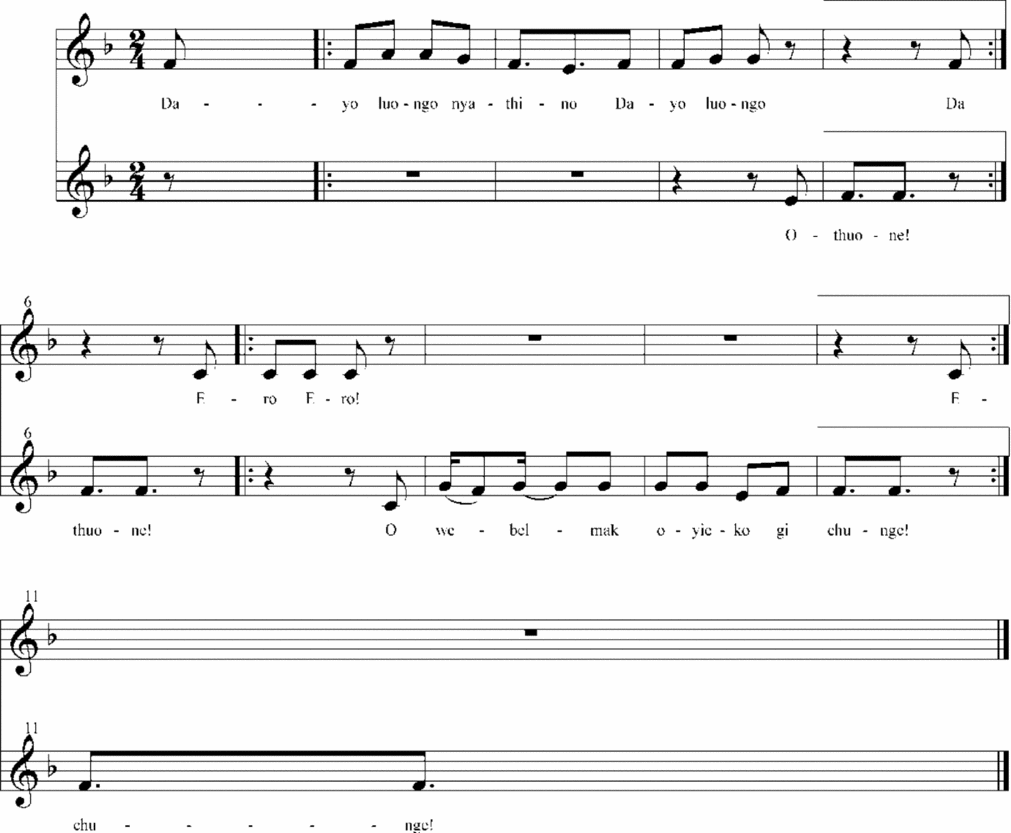
In performing children's songs there are activities that present various avenues through which children develop. These revolve around the content of the song, which involve children in various modes of behaviour. Below is an excerpt from a song that is common to children's repertoire in the region of project, and that typifies the song-based activities that children regularly performed (Figure 1).
Luo song.


This is a stylised Luo dance. Children sing as they go round in a circle, performing various movements. The song text is a commentary on a stubborn child who does not complete the task of cleaning sorghum.
A. The movements – physical development
The dance for this song includes a rotating, where the feet remain still, but the hands' anti-clockwise motion is reflected in the circular movement of the trunk from side to side. This movement later translates to the graceful rotations of the dodo and owalo song-dances of older women. The performance of other songs requires the negotiation of different complex activities. The physical activities in childhood music develop techniques that are called upon for later musical performance. These include vocal capacities as children engage in song and movement, the simultaneous activity that trains and develops the physical and mental coordination characteristic of musical arts expressions. Musical arts are multi-media expressions where verbal utterances, musical rendition and body movement are negotiated at once. Children's participation in songs and singing games is the development of abilities.
B. The pulse – perceptual development
As children sing and dance, the pulse that they maintain is strongly felt. Stepping the initial beat after the anacrusis in this song is training in feeling and maintaining the beat/pulse, a vital ingredient and ability for all aspects of musical perception. The feeling for time is crucial for music literacy and performance, both of which rely on discrimination and identification of musical sound, a mental process. This is the development of analytical skills, requisite to the development of sensibilities.
C. The message – value development
The text in children's songs sometimes appears irrelevant. Close scrutiny reveals expressions of pertinent truths. It is not known how Dayo Luongo came about, but the seriousness of the charge indicates a reality that is important for existence. If the cereal crops are unprepared, there is likely to be no food. With such a habit entertained, the risk of the child developing a careless attitude and lazy habit is real and must be nipped in the bud. The song ridicules such behaviour as the consequences could be very serious and thus the value of industry and obedience in the young person is instilled. Through song text, the mores and norms that society holds dear are passed down to the young. Engagement in song develops their concept of what is proper and desirable, their sensitivities.
Learning
Weinberg (Reference WEINBERG1984) distinguished between learning and education. There is a formal process whereby children learn the values and skills of their culture and the acquisition of knowledge through book-learning, an education that is formal and institutionalised. Under the former ‘children learnt through language and through observing and participating in traditional events and also through the text of songs’ (p. xi), an experiential process.
Music making is an integral part of a community's life. Children learn to sing and dance at an early age (Weinberg, Reference WEINBERG1984: xiv; Simako, Reference SIMAKO2009), a practice through which all, irrespective of ability, engage in community-specified modes of personal intellectual and social development. Through the experience of daily communal events the young acquire knowledge and skills that make them fully participate in the community's activities. This is the development of their abilities, sensibilities and sensitivities without which they would be ineffective.
Akuno (Reference AKUNO1997, Reference AKUNO2005) reflects this in summing up some of the categories of children's songs from Kenya. A number of these (Akuno, Reference AKUNO2009) are songs for learning things, containing technical vocabulary for colour, animals, names of places/clans etc. They also contain words and phrases that reveal society's perception of certain types of behaviour. Through these satirical and mockery songs, children learn what their community accepts as good. ‘Very derogatory appellations are coined according to the trait that people find in a person’ (Ntsihlele, Reference NTSIHLELE1982: 39). Simple rules of etiquette are disseminated and children are expected to assimilate them at an early age. Life skills and norms are imparted though this medium of instruction. ‘Praise and ridicule act as a potent means of encouraging both young and adult to behave properly’ (Ntsihlele, Reference NTSIHLELE1982, p. 44). Song remains an effective avenue for the development of sensitivities, the values that facilitate integration and relationships.
Singing to learn
During the MLD pre-project workshop, the teachers were quick to note that they used song to teach many things. It transpired that they had a couple of tunes over which they put lyrics to help with information assimilation.Footnote 6 They used melody to help learners grasp facts, with numeracy and language benefiting heavily from this learning approach. Songs were also used to aid recall, and so shapes, colours, soil types, names of local towns etc. were memorised in chants and songs. Song became the tool for learning various portions of the curriculum.
Learning to sing
While working with students in generating songs with subject-specific content, facilitators demonstrated to teachers the creative process that leads to coming up with singable tunes and lyrics. The issues of musicianship hitherto unaddressed became central in the rendition of the music, with choice of a memorable, balanced tune preferred. This ensured that learners were not encumbered with a technically demanding song/tune as well as the technical information that it was used to convey. In all this, beautiful singing was emphasised by the facilitator and teachers observed this keenness on the music sound that was produced by learners. Pitching, diction and sound quality are non-verbalised elements that learners picked by observation.
The process of generating songs required an adequate command of language and sense of musical form. Facilitators were keen to ensure that the words fitted comfortably in the selected tunes. When they composed music, there was harmony between the music and text, so that the song was coherent. These, when observed by the teachers, demonstrated the care with which the composition of songs for children is treated. This was a lesson to the teachers on the need to ensure that learners are exposed to good quality music, irrespective of the objective of singing, for the correct choice of song is as much a contributor to good singing as the act of singing itself.
One of the by-products of this project was the actual musical development of learners. As stated above, musical creativity was exercised when facilitators engaged in generating songs for learning things. Teachers would participate in this activity right from the pre-project workshop. The easiest way was for individuals to come up with the tune. However, the workshop facilitator encouraged group composition, to ascertain that all teachers experienced a level of music composition. Having collectively composed a brief poem on a subject, the group members took turns generating tunes for each line of text. It was clear at this stage that the element of form, the notion of balance etc. were not familiar to the teachers. The workshop facilitator subsequently led a discussion of each line composed, and finally a usable tune was developed. This was by way of training the teachers on how they could create tunes for their learners. This freedom to create usable tunes would prepare them to be adequate facilitators of music learning for their students.
The songs generated by teachers for the spelling exercises were often based on known tunes. During the workshop, the teachers had experienced a basic process of generating a short song on a given topic through the process of collaborative composition. The facilitators further engaged learners in generating new tunes. The students’ creative ability was exercised, with ‘home grown’ songs coming up for learning. The learners eventually did not just sing to learn, but also participated in generating the songs for learning, and exercise of creativity that serves adults in this region well due to the improvisatory nature of music making.
With the songs created, the learners were exposed to both tune and lyrics, mostly by rote. It was noticed that learners at this age tried to emulate the teacher's vocal tone and articulation. They did not just try to learn the song, they tried to learn how to sing, an activity that one takes for granted in that part of Kenya, where singing is widespread and song a very common and immediate form of music-making. Rote learning is valuable for transmitting required standards of sound production to the learner. By following the model, learners are capable of getting it right at the outset, thereby making learning efficient.
The choice of musical themes is important due to the cultural significance of music. Tunes, made up of intervals and rhythmic patterns, are a reflection of the context of their composition. This translates to a cultural group, often with a language whose tonal and rhythmic inflections are embodied in the song tune. When learners get engrossed in music that is associated with a cultural group, they get a glimpse of the characteristics of that community. Performance leads them to develop a sense of identity. Cultural identity is developed by engaging with cultural objects. These include intangible elements like musical sound idioms and verbal language. Song combines both sound and language, and is a vital resource for enabling learners to develop cultural identity.
The songs created or used in MLD learning exercises were mostly in either English or Kiswahili. As they were presented, learners were able to experience songs of the two types as cultural entities. Learners therefore learnt to sing English and Kiswahili songs. They would have been able to experience and perhaps note any significant or subtle differences between the two. These may not necessarily have been principally melodic differences, but the combination of text and sound in song would compound the cultural issues that one must attend to when singing in any language.Footnote 7 The learners were all from the Luo community who mostly spoke Dholuo in their daily activities. At this level of learning, their command of both English and Kiswahili is low, especially in the rural areas such as those in the study. This exercise therefore taught them to sing in English and Kiswahili through the activity of teaching them English and Kiswahili songs.
Singing
Children sing freely without much attention to the process of generating sound with their internal music instruments. Further, they create music when at play, from chants to song dances. These are cultural activities that children engage in that facilitate learning of various things in their environment. Singing is an avenue for self-expression, and a medium of creativity that affords an individual a fulfilling aesthetic experience. In the act of singing, there is often collaboration between various players, be they fellow choristers, or leaders of the singing, and in several instances, the instrumentalists and dancers who lend their expertise to the music-making activity.
Culturally in the community that hosted the project, singing is not just a purely vocal activity, because musical arts entail more than just the generation of vocal sounds. They include expressive body movements in response to the sound stimulus, and hence demand close attention to the same. The discussion of body movement in Dayo Luongo above is testament to the close association between song and movement. The way the voice is used creates an atmosphere that evokes and is reflected in these movements. Further, the instruments that accompany the singing complement this sonic environment. When learners generated songs in relation to a story line, the performance was associated with activities, gestures and movements that reflected the drama in the story. Learners experienced performance, and not just singing, a multi-faceted expressive event. They were taught how singing happens culturally, and that artistic expression is a composite activity.
In developing song as an element in the bigger dramatised narrative, the multi-disciplinary nature of the musical arts was made plain to learners. Teachers observed and worked with the facilitator in shaping the final play performance, to the extent that in one school, learners were the directors. This level of training developed independence, confidence and understanding, without which no artistic performance would succeed.
The singing teacher
The teacher in this project went through a number of activities that put him/her in different roles. At the workshop, teachers came with their knowledge and experiences that were deemed useful for the success of the project. Their knowledge of the full curriculum layout, content and schedule of implementation was helpful in guiding the development of the project instruments. Their familiarity with childhood behaviour, and their experience in teaching at this level ensured that the activities developed were within their reach. They were however to appreciate that culturally, the music teacher is first and foremost a musician, no matter their level of proficiency.
The process of developing research instruments, and the act of administering the pre-test (and later post-test) required that the teacher possess and demonstrate some important music skills and knowledge, the most crucial being aural discrimination. The project demanded a musician-teacher with further skills in leading/guiding learner development. At the outset, they were a keenly listening analytical audience who engaged with learners’ rendition critically. They proceeded to become composers and performers – ingredients that make for an effective music teacher.
In articulating the curriculum Kwami (Reference KWAMI1989) expounds on the intricacies of apprenticeship learning and training. The role of the teacher in this mode of education varies from heavily involved at the outset, to detached-observer at the farthest end. In between, there are stages that include demonstrator and coach. Viewed at four levels, this appears as is shown in Figure 2.
Changing teacher roles with learner advancement
The teachers in the project are a mirror of the calibre of teachers all over the Republic of Kenya. At this level of education, they do not have specialised skills in music or performance, except for those who, out of personal interest, may have delved into the arts. Teaching music within the creative arts subject requires a fully committed artist-educator. Irrespective of the teacher's arts orientation, they have something to contribute to learner development. The nature of activities that leads to learning at this level require that the teacher is fully involved in designing, presenting, monitoring and evaluating learners’ participation to ensure assimilation of appropriate concepts and development of relevant skills. In the performing arts, learners today are exposed to a wide array of artists, some of whom do not necessarily represent their disciplines well. The teacher's model is important as it is the yardstick for measuring learner achievement. Learners often secretly aim at achieving their perception of the teacher's performance. The demonstrator must be knowledgeable enough to exude the confidence and professionalism that can be emulated by learners.
Conclusion
Children's songs, in form and content, emphasise the meaningful contribution that song makes to the life of the community. Simako (Reference SIMAKO2009) notes that Tswana children's songs resemble those performed by adults. Since songs enable children to develop into performing adults, childhood singing is the development for adult singing, as does the dance above. Since song participation is experiential education, the content of the songs divulge what children are learning. The content and process of this learning are evident in the songs’ verbal and musical content while the accompanying activities reveal the product of the learning.
This conclusion is based on a content-context-product relay, where an input, a result of the environment, produces directly or otherwise, a related outcome. The outcome of learning is observed in children's ability to perform tasks, knowledge of facts, attitude and response to situations. If we want this outcome to be of a musical nature, the input must have significant musical qualities, and learners must engage with these in a supportive environment, peopled by good role-models. In early civilisation, music, just as other arts, was regarded as ‘part science in its theoretical analysis, and part art, in its performance practice’ (Campbell & Scott-Kassner, Reference CAMPBELL and SCOTT-KASSNER1995, p. 8). In 18th century Europe, music instruction was viewed as ‘basic to the education of all children’ (p. 8). This speaks of a universal aesthetic education, and provides support for quality and early exposure to music-making because ‘music instruction has provided children with skills for their musical expressions and knowledge of their cultural heritage’ (p. 11). This intellectual development serves them well in later years, as they have grounding in matters of cultural significance that guide their perceptions and relations. Indigenous Kenyan children's songs play a significant role in enhancing the abilities, sensibilities and sensitivities of Kenyan people.
The primary school music teacher today ought to be a versatile individual capable of carrying out various teaching roles and adapting an appropriate one as occasion may demand. In order to impart musical skills to learners, the teacher must behave skilfully, and that includes listening, creating and performing. These behaviours were adequately demonstrated by the facilitators in the project, resulting in great success in the learning activities that they got learners to undertake. These are regular music-making activities that require skill and diligence to accomplish. Over and above being a music-maker, the teacher then needs to impart these skills to learners, a feat accomplished by getting learners to behave musically with him/her. The transformation of the teacher requires comfort with a dual nature – that of music maker and of knowledge transferor.
Emily Achieng’ Akuno holds a PhD from Kingston University, UK, Master of Music from Northwestern State University of Louisiana, USA and Bachelor of Education (Arts) of Kenyatta University, Kenya. She is Associate Professor of Music and Executive Dean of the Faculty of Social Sciences and Technology at the Technical University of Kenya. Her research interests include cultural relevance in music education and the use of music to develop literacy and language capacities in children.