INTRODUCTION
Most investments in agricultural research have been oriented towards a few crops (e.g. maize, rice, wheat, cotton, soyabean), so that today, only 30 plant species are used to meet 95% of world food energy needs (FAO, 1996). Indeed, the exploitation of the wealth of plant diversity (more than 7000 food species, called neglected, underutilized, minor or orphan crops) remains far lower than the potential. Since 1990, interest in minor crop species has increased throughout the world, with the aim of identifying and developing new crops for the export and domestic markets. Bambara groundnut (Vigna subterranea) is one of the African minor crops receiving growing interest from governments, plant genetic resources institutions and researchers. This is due to its numerous agronomic attributes, particularly, its yielding potential, relatively high resistance to diseases, and adaptability to poor soils and low rainfall (Brink, Reference Brink1999; Collinson et al., Reference Collinson, Clawson, Azam-Ali and Black1997; Reference Collinson, Sibuga, Tarimo and Azam-Ali2000; Elia and Mwandemele, Reference Elia and Mwandemele1986; Massawe et al., Reference Massawe, Azam-Ali and Roberts2003; Mwale et al., Reference Mwale, Azam-Ali and Massawe2007). In addition to these agronomic advantages, the crop is rich in proteins (19–22% of dry matter) and carbohydrates (42–69% of dry matter) (Minka and Bruneteau, Reference Minka and Bruneteau2000; Oliveira, Reference Oliveira1976). Interestingly, these authors reported that bambara groundnut seed proteins are high in the essential amino acids methionine (0.5–1.43 g/16 g N) and lysine (5.4–6.9 g/16 g N).
Recently, scientists from Africa and Europe began a research programme aimed at gathering agronomic, genetic and physiological data, as well as knowledge and perceptions of peasant farmers in order to implement improved production practices for V. subterranea (Heller et al., Reference Heller, Begemann and Mushonga1997; Massawe et al., Reference Massawe, Mwale, Azam-Ali and Roberts2005; Mkandawire, Reference Mkandawire2007; Sesay et al., Reference Sesay, Magagula and Mansuetus2008). These studies, aimed at testing abiotic factors (Elia and Mwandemele, Reference Elia and Mwandemele1986; Mwale et al., Reference Mwale, Azam-Ali and Massawe2007) and some cultural practices (Collinson et al., Reference Collinson, Sibuga, Tarimo and Azam-Ali2000; Karikari et al., Reference Karikari, Chaba and Molosiwa1999) showed variation in the response of bambara groundnut according to cropping system, genotypes and geographical regions.
Dunbar (Reference Dunbar1969) reported from studies carried out in northwestern Tanzania that farmers sow bambara groundnut at an average spacing of 30 cm × 30 cm. In Ghana, Ameyaw and Doku (Reference Ameyaw and Doku1983) suggested a spacing of 60 cm × 30 cm. The seed rate for bambara groundnut has been reported to vary from 25 to 75 kg ha−1, with inter-row and intra-row spacing of 30–75 cm and 10–50 cm, respectively (Duke et al., Reference Duke, Okigbo, Reed and Weder1977). In Eastern Malawi (Chitala), a population density of 167 400 plants ha−1 gave high yields while in Southern Malawi (Thuchila), high yields were obtained at a lower population density (83 720 plants ha−1). Thus it appears that assessing the actual factors influencing the productivity of bambara groundnut requires trials to be conducted throughout contrasted agro-ecosystems and using several landraces.
Reviewing the literature on bambara groundnut also reveals that earlier studies have mainly been conducted in Eastern and Central Africa. In depth scientific investigations on the improvement of bambara groundnut productivity in West Africa are still limited to germination, phenological, pest impact and agronomic evaluation (Adjetey and Ayihi, Reference Adjetey and Ayihi1999; Djè et al., Reference Djè, Bonny and Zoro Bi2005; Doku, Reference Doku1968; Obagwu, Reference Obagwu2003; Ouedraogo et al., Reference Ouedraogo, Ouedraogo, Tignere, Bilma, Dabire and Konate2008; Thottappilly and Rossel, Reference Thottappilly and Rossel1997; Sesay, Reference Sesay2009).
Since 2001, missions to collect local landraces of bambara groundnut have been undertaken throughout the main production zones in Côte d'Ivoire and Burkina Faso. Agronomic evaluation trials and genetic characterization were then undertaken with the aim of accumulating data to allow the implementation of germplasm management strategies and improved cultivation practices as well as promotion of the crop. Accessing the response of crop yield components to planting density and technique is a prerequisite to reach such an objective, since it provides comprehensive data that are useful for management decisions (Echarte et al., Reference Echarte, Luque, Andrate, Sadras, Cirilo, Otegui and Vega2000; Jollife and Gaye, Reference Jollife and Gaye1995). We herein report data on the influence of sowing density and seedbed type on yield and yield components of one of the most common bambara groundnut landraces cultivated in Côte d'Ivoire and Burkina Faso, West Africa.
MATERIAL AND METHODS
Study site
On farm experiments were conducted in 2005, 2006 and 2007 in the village of Manfla (6°49′34.38″N, 5°43′47.68″W) 400 km north Abidjan (Côte d'Ivoire). There are two rainy seasons separated by a short dry period (July–August) and a long dry season (December–February) at the target site. Annual rainfall varies from 800 to 1400 mm with a long-term mean of 1200 mm, and the annual mean temperature is 27 °C. Over the experimental periods (March–July each year), the mean monthly temperature was 26.5 °C, and mean monthly rainfall ranged from 100.8 mm to 117.5 mm with total rainfall per experimental period of 504.2 mm to 586.3 mm. Mean relative humidity was 81%. The vegetation is a woodland savanna. The study site is a natural fallow plot with vegetation mainly composed of Chromoleana odorata and Panicum maximum. Soils in the study area were deep, friable and sandy-silt. Analysis at a soil depth of 20 cm indicated the following characteristics: pH 6.45, 57% sand, 36% silt, 7% clay, 6% organic matter, 3.5 g/kg of total N, 24.4 g/kg of available P and 0.45 g/kg of K. In the study area, bambara groundnut is usually produced during two cropping seasons in a year. In the first cropping season corresponding to the long rainy period, planting and harvest take place in March and July, respectively. The second cropping season corresponds to the short rainy season; here, plants are sown in July–August and harvested in November–December. All experiments were conducted during the first cropping season, and seeds were sown on the first day of significant rainfall. This was 15 March, 17 March and 17 April, in 2005, 2006 and 2007, respectively.
Experimental design and cultural practice
A bambara groundnut landrace with a semi-bunch growth habit designated on the basis of seed colour pattern as BgR (creamy coloured seed with red spots), and widely cultivated in Côte d'Ivoire and Burkina Faso, was evaluated. Seeds were obtained from the collection of the University of Abobo-Adjamé, Abidjan, Côte d'Ivoire. The experimental design was a split-plot with three replicates. Two planting methods regularly used by farmers from the study site to grow bambara groundnut were used: sowing on raised beds and sowing on the flat. Indeed, to prevent weed invasion and facilitate harvest in the target zone, some farmers raise mounds when sowing bambara groundnut. In this experiment, mounds of 60 cm × 60 cm and 30 cm high were raised as seedbeds. From preliminary observations made in the farmers’ fields in the target zone, three densities were determined for the test: low density with 13 900 plants ha−1 (at a spacing of 80 cm × 80 cm), medium density with 62 500 plants ha−1 (at a spacing of 40 cm × 40 cm) and high density with 250 000 plants ha−1 (at a spacing of 20 cm × 20 cm). The subplots had an area of 36 m2 and received 49, 225 and 900 holes for low, medium and high density, respectively.
Four seeds per hole were sown directly and thinned to the final stands at the first leaf-stage. The blocks were weeded weekly with a hoe to prevent the presence of any interaction between planting system, plant spacing and weeds. Disease and pest control was carried out using a carbamate-based insecticide applied when needed.
Data collection and analysis
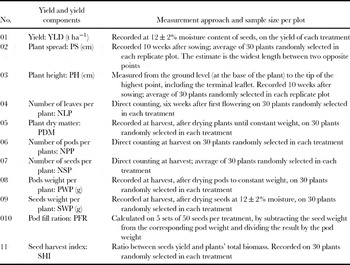
Yields (seeds production and plant dry biomass: YLD and PDM, respectively) and nine agronomic traits selected from the bambara groundnut descriptor (IITA et al., 2000) and identified as yield components elsewhere (Cornelissen, Reference Cornelissen2005; Karikari and Tabona, Reference Karikari and Tabona2004; Ofori, Reference Ofori1996; Ouedraogo et al., Reference Ouedraogo, Ouedraogo, Tignere, Bilma, Dabire and Konate2008) were measured. Further details of the selected traits and related measurement approaches are indicated in Table 1.
Method of measurement of yield components of bambara groundnut in response to planting technique and plant population density.

Combined analysis of variance appropriate to a split-plot design was performed using the general linear model procedure of the SAS statistical package (SAS, 2004). Least significant difference multiple range-tests were used to identify differences among the means of the parameters examined, according to sowing density, seedbed type, years and interactions.
RESULTS
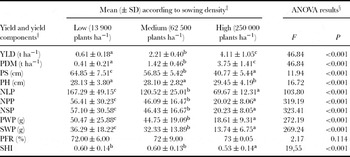
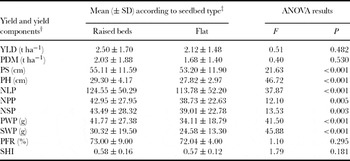
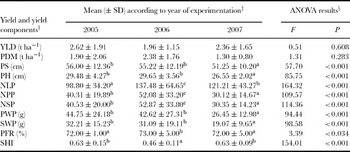
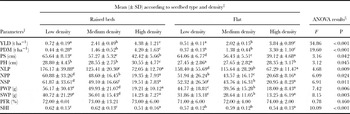
Only one (sowing density) of the three factors tested influenced the marketable yields (YLD and PDM) significantly (Tables 2, 3 and 4). Consequently, only the interactions involving the sowing density were significant for seeds and plant biomass production (Tables 5 and 6). The trend of the results related to the effects of sowing density and seedbed type did not change through the three years of experiment. Thus, data for these two factors were pooled over years and only the means are presented (Table 2 and 3). To assess the results in relation to climatic parameters, means were calculated for each year (Table 4). The two two-way interactions influencing significantly the marketable yield were also analysed (Tables 5 and 6).
Yield and yield components as affected by sowing density of bambara groundnut.

†The abbreviations are defined in Table 1.
‡Means per sowing density were calculated independently of seedbed type and years.
§Mean values within rows by parameter followed by the same superscripted letter were not significantly different at p = 0.05 level, on the basis of the least significant difference test.
Influence of seedbed type on yield and yield components of bambara groundnut.

†The abbreviations are defined in Table 1.
‡Means per seedbed type were calculated independently of sowing density and years.
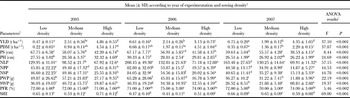
Variation through years, of yield and yield components response to seedbed type and density in bambara groundnut.

†The acronyms are defined in Table 1.
‡Means by year of experiment were calculated independently of seedbed type and density.
§Mean values within rows by parameter followed by the same superscripted letter were not significantly different at p = 0.05 level, on the basis of the least significant difference test.
Response of yield and yield components to crossed effect (interaction) of seedbed type and density in bambara groundnut.

† The abbreviations are defined in Table 1.
‡ Means according crossed seedbed type and density were calculated independently of year of experiment.
§ Mean values within rows by parameter followed by the same superscripted letter were not significantly different at p = 0.05 level, on the basis of the least significant difference test.
Response of yield and yield components to the interaction of year of experimentation and sowing density in bambara groundnut.

† The abbreviations are defined in Table 1.
‡ Means according crossed year of experimentation and sowing density were calculated independently of seedbed type.
§ Mean values within rows by parameter followed by the same superscripted letter were not significantly different at p = 0.05 level, on the basis of the least significant difference test.
All the 11 variables analysed except PFR were significantly influenced by the sowing density (Table 2). The highest values of YLD, PDM and PH were obtained at the highest plant density (250 000 plants ha−1) and decreased with decreasing densities. No significant difference was found between low (13 900 plants ha−1) and medium (62 500 plants ha−1) densities for the plant mean height (PH). For the seven remaining traits tested, the lowest density gave the highest values, followed in decreasing order by the medium and high densities.
Four of the tested parameters (YLD, PDM, PFR and SHI) were not significantly influenced by the seedbed type (Table 3). Highly significant (p < 0.01) differences were found between raised beds and flat planting for the mean values of seven traits (PS, PH, NLP, NPP, NSP, PWP and SWP). The highest values were obtained on raised beds.
No significant differences were observed between years for seed yield and the plant total biomass (Table 4). For the nine other traits, significant differences were observed between years. However, PS, PH, PWP and SWP did not vary significantly between 2005 and 2006. Overall, the yield components tested did not show a clear trend for between-years variation. Indeed, a high number of traits with significantly high or low values was not obtained in any particular year.
Statistical analysis of the interaction between the seedbed type and the sowing density highlighted a significant variation for seed yield and plant biomass, as well as for most of the yield components tested (Table 5). The highest values of the marketable yield and plant biomass were obtained with the high sowing density regardless of the seedbed type. Most of the other traits showed an opposite trend, the highest values being observed on raised beds sown at low density.
Seedbed type × year interaction was not significant (data not shown), due to the fact that the two factors did not influence significantly seed production (t ha−1) and plant biomass (t ha−1). The interactions of sowing density with seedbed type and year of experiment were significant for most of the traits examined (Tables 5 and 6), due to the effect of the sowing density, as demonstrated by the trend of the yields (seed and plant biomass production) that were higher on plots with high sowing density in each of the three years of experiment. The other nine traits did not show a common trend with respect to the interactions.
DISCUSSION
Optimization of plant spatial arrangement and seedbed type is essential for maximizing yield of any crop. Research on manipulations of plant density and seedbed type to fit production factors and objectives are therefore of practical interest for agronomists and breeders. Variation in yield and yield components in relation to factorial change in planting density and technique in a semi-bunch type bambara groundnut revealed relevant trends.
Planting density
All of the yield components estimated on a per-plant basis (PS, PH, NLP, NPP, PWP and SWP) were negatively related to plant density (Table 2). Thus, the lowest density (13 900 plant ha−1) produced the highest mean pod and seed weights per plant (50.5 g and 36.29 g, respectively) and the highest plant density, the lowest mean pod and seed weights per plant (13.74 g and 18.61 g, respectively). This was due to the higher mean numbers of pods and seeds per plant (56.41 and 57.10, respectively) on plots with the lowest plant density. The reduction in seed weight per plant has been associated with increasing plant density in other cultivated legumes such as peanut (Chandrasekaran et al., Reference Chandrasekaran, Somasundaram, Amanullah, Thirukumaran and Sathyamoorthi2007), lentil (Turk et al., Reference Turk, Tawaha and El-Shatnawi2003), chickpea (Bahr, Reference Bahr2007) and faba bean (Idris, Reference Idris2008). Three hypotheses are usually proposed to explain the increase in productivity per plant under lower sowing density: resource availability, intra-species competition and genotype (particularly plant growth habit). The positive effect of plant spacing on the productivity per plant in bambara groundnut could thus be attributed to the fact that in lower densities, developing pods could easily reach the soil surface, due to the spreading growth habit of the plants, leading to better development. Plant growth could also be better with lower planting densities, due to less competition for resources (light, moisture and nutrients), resulting in better pod formation and growth.
In contrast, a direct relationship was observed between plant density and seed and plant dry biomass production estimated on a per-area basis. Similar results have been reported from earlier studies on the same species (Cornelissen, Reference Cornelissen2005). The influence of plant density on seed yield was through the increased production of pods per unit area, but not through increased production of pods per plant. Consequently, in favourable growing conditions, seed yield potential of the bambara groundnut used will increase with increasing plant population to produce more pods per area unit.
Seedbed type
Seed yield (ha−1), biomass production and two yield components (PFR and SHI) were not significantly influenced by the seedbed type. This result could be related to the composition of the soil at the study site. Indeed, with 57% sand, soils are usually so friable that physical management for superficial crusting control is not required (Awadhwal and Thierstein, Reference Awadhwal and Thierstein1985; Bresson, Reference Bresson1995). The results were in accordance with those from a study conducted by Mkandawire and Sibuga (Reference Mkandawire and Sibuga2002) on the same species. The authors reported that when the amount of precipitation is sufficient, i.e. in the long rainy season (the total rainfall reaches 583 mm), planting bambara groundnut on the flat resulted in significantly high grain yield compared to planting in furrows or on ridges. Planting in furrows or on ridges enhanced grain yield only during the short rainy season where rainfalls were low (333 mm). The results related to the effect of seedbed type were also similar to those reported in common bean (Valenciano et al., Reference Valenciano, Casquero, Boto and Guerra2006) and pea (Neumann et al., Reference Neumann, Schmidtke and Rauber2007). Indeed, Valenciano et al. (Reference Valenciano, Casquero, Boto and Guerra2006) showed that sowing common bean on raised beds favoured fast emergence, without yield enhancement.
Effect of climatic parameters
Plant production components (seed and biomass production per unit area) were statistically similar over the three years. Such results were expected since the rainfall during the growing seasons did not vary markedly throughout the three years (504–586 mm). Yield stability is characteristic of bambara groundnut, mainly due to its adaptability to poor soils, high temperatures and low rainfall (Azam-Ali et al., Reference Azam-Ali, Sesay, Karikari, Massawe, Aguilar-Manjarrez, Bannayan and Hampson2001; Brink, Reference Brink1999; Collinson et al., Reference Collinson, Clawson, Azam-Ali and Black1997; Elia and Mwandemele, Reference Elia and Mwandemele1986; Massawe et al., Reference Massawe, Azam-Ali and Roberts2003; Mkandawire and Sibuga, Reference Mkandawire and Sibuga2002; Mwale et al., Reference Mwale, Azam-Ali and Massawe2007). The amount and distribution of seasonal precipitation during the three experimental years appeared to be suitable for the water needs of the genotype used in this study. Using laboratory, greenhouse and field studies, it has been established that the water and temperature requirements of bambara groundnut are around 600 mm and 25 °C, respectively (Collinson et al., Reference Collinson, Sibuga, Tarimo and Azam-Ali2000; Mpotokwane et al., Reference Mpotokwane, Gaditlhatlhelwe, Sebaka and Jideani2008; Sesay, Reference Sesay2009).
CONCLUSIONS
For each production system, there is a population that optimizes the use of available resources, allowing the expression of maximum attainable marketable or biological yield in that environment. The ideal plant number per area will depend on both abiotic and biotic factors. Increasing plant density had a large direct effect on seed production and biomass, and an inverse effect on the yield components of the bambara groundnut landrace tested. For this plant material, a spacing of 20 cm × 20 cm (250 000 plants ha−1) appeared to give the highest grain and biomass yields per unit area, regardless of seedbed type and year of experiment.
Acknowledgments
This research was partly funded by the French Co-operation and Cultural Action Office (Abidjan, Côte d'Ivoire). Helpful comments of Professor Assanvo N'Guetta, Dr Atta Diallo and two anonymous reviewers resulted in significant improvement of the manuscript.