That person for whom the community can be fused together in collective action, that person is noble.
Peter Metcalf and Richard Huntington, Celebrations of DeathOnly the name can inherit, and this is why the name, to be distinguished from the bearer, is always and a priori a dead man's name, a name of death.
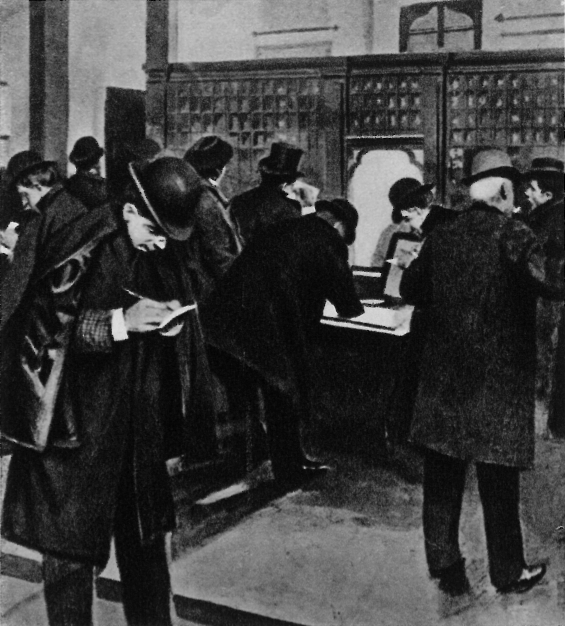
Jacques Derrida, OtobiographiesAt 2.50am on Sunday 27 January 1901, in a first-floor room at the Hôtel Milan, Giuseppe Verdi breathed his last. On the hotel's ground floor, journalists had been keeping vigil since the previous Monday, when news of Verdi's stroke had begun to circulate. He failed to regain consciousness during the week that followed, but doctors kept the journalists up-to-date with regular bulletins, offering details of minor fluctuations in his condition (see Fig. 1). These sometimes hourly dispatches were affixed to a wall near the hotel's entrance: they also provided a focal point for the crowds that gathered there in doleful silence. Meanwhile, along via Manzoni, tram drivers paid tribute by proceeding more slowly and quietly as they passed the hotel. This hushed scene augured the impending necrological newsflash – which was duly accompanied by myriad signs of public grief:
Le finestre dell'appartamento dell'Estinto verso la via Manzoni, e verso la via Croce Rossa (dove era la stanza da letto) furono chiuse subito dopo la morte. Anche l'albergo fu chiuso: e agli angoli della via apparve un manifesto della Giunta Municipale. Molte porte di case si chiusero a metà, in segno di lutto; e sulle botteghe, mezze chiuse, le imposte recavano la scritta: Lutto Nazionale.Footnote 1
[The windows of the apartment of the Deceased facing via Manzoni and via Croce Rossa (where the bedroom was) were closed immediately after death. The hotel was also closed: and on the corners of the street, posters from the Municipal Council appeared. Many houses half closed their doors in a sign of mourning; and the shutters outside shops, half closed, bore the words: National Mourning.]
‘All'Hôtel Milan – I giornalisti che prendono copia dei bollettini sulla malattia di Verdi’ (‘At the Hôtel Milan – Journalists copy bulletins on Verdi's illness’). L'illustrazione italiana (3 February 1901); reproduced from Carlo Gatti, Verdi nelle immagini (Milan, 1941), 212.

Telegrams expressing condolences flooded into the Hôtel Milan, including messages from the royal family, politicians and representatives of various municipalities. In the afternoon, an extraordinary session of the Senate was convened to proclaim the nation's grief.Footnote 2 Echoing the senators' words, the following day's front pages announced ‘LA MORTE DI GIUSEPPE VERDI’ – their stark graphics, like those of the municipal notices that declared national mourning, consisting of a simple black border surrounding particulars of the Great Man's death.Footnote 3
Verdi's demise was undeniably a media event – and one that endured for several weeks.Footnote 4 On the occasion of his funeral, which took place at 6am on 30 January – a dark, freezing winter's morning – 300,000 people turned out on the streets of Milan. Just as enormous were the crowds that assembled on 27 February to watch the coffins of Verdi and his wife Giuseppina Strepponi, who had died in 1897, being moved across the city from the Cimitero monumentale to the Casa di riposo per musicisti (a ‘rest home’ for aged musicians set up on Verdi's initiative, and the final resting place named in his will).Footnote 5 This reburial coincided with the trigesimo, a traditional celebration held 30 days after death, and in this case the occasion for a great wave of Verdian commemoration: in addition to the celebrations in Milan, numerous orations and concerts were held in cities across Italy.Footnote 6 It was on the trigesimo that Gabriele D'Annunzio delivered his notorious ‘Orazione ai giovani’ (Oration to the Young) at the University of Florence, calling on his student auditors to carry forward the national mission of Italian music. However, D'Annunzio's was only one of countless orations dedicated to Verdi that took place on that day and in the months that followed.Footnote 7
Such was, in skeletal form, what we might call the communication network that developed around Verdi's death: an elaborate broadcasting system that this article will attempt to flesh out. In attempting this media archaeology, my aim is to discover both how and, more importantly, why the news travelled on such a national and international scale.Footnote 8 It is, however, on the streets of Milan that we should begin – a site that takes its cue from Figure 1, which was published in L'illustrazione italiana on 3 February. As the newspaper's editors explained, this picture was offered to readers because the constant presence of journalists around the hotel was itself a distinctive feature of the week Verdi died.Footnote 9 These now-ancient paparazzi were, in other words, visible markers of news and thus contributed to the moment's significance. In that respect, their appearance functioned much like the audible signs of respect inscribed on the city scene: the quietened trams and the hushed crowds. The silence of this urban environment – a silence often prefixed by qualifiers such as ‘solemn’, ‘mournful’ or ‘magnificent’ – is routinely mentioned in contemporary accounts. Yet while the city's mute homage added grandeur to Verdi's death, it was in many ways a constructed (and occasionally interrupted) condition – one that, as I will show, could admit of multiple political interpretations.
A day in the life
Non avevo determinato di andare ai funerali di Giuseppe Verdi. ‘Egli – pensai – infine, riposa; io sono stanco invece, e il sonno è necessario compenso per la battaglia del domani, e così sarà ogni giorno, finché riposerò anch'io!' Dunque avevo determinato di non andare.Footnote 10
[I had not decided to go to Giuseppe Verdi's funeral. ‘He’, I thought, ‘is finally at rest; but I am tired, and sleep is a necessary recompense for the battle of tomorrow, and so it shall be every day, until I'm at rest, too!’ So I decided not to go.]
The hour was early enough initially to deter this observer, the novelist Alfredo Panzini.Footnote 11 Yet, along with many others, he eventually assembled around the Hôtel Milan in the early morning of 30 January. What induced him to change his mind? He claimed that his – not entirely voluntary – participation was encouraged by an unusual atmosphere:
Invece a una cert'ora della notte mi trovai desto. I sibili gravi e lugubri delle sirene non squarciavano la sonnolenta aria notturna per chiamare alle officine questo popolo di lavoratori. Ancora la campana dei carri elettrici non aveva squillato giù nella via. La notte era ancora piena. Eppure qualche gran voce doveva gridare nell'aria e qualche campana chiamare a raccolta i cittadini della città!Footnote 12
[Yet at a certain hour of the night I found myself awake. The whirring of sirens, grave and gloomy, was not piercing the sleepy night air to call this populace of workers to their factories. The bells of the electric trams had not yet rung out in the street below. It was still the depth of night. And yet some great voice must have yelled through the air, some bell must have called together the inhabitants of the city!]
People were already on the streets. Impressed by this otherworldly summons, Panzini left his house and followed the masses towards the piazza del Duomo. The crowds there were dense: streets leading to the Hôtel Milan were overwhelmed, while the via Manzoni itself was blocked off by the army. The trams had by now started running – a ‘carousel’ of ‘flashes and flames of lamps was turning around the monument of the Great King, which in that grey dawn stood out blacker and more windblown than ever’.Footnote 13 In a renewed attempt to witness Verdi's cortège, Panzini tried (and failed) to board a tram towards the Cimitero monumentale, but the vehicle was full: on board there was an unfamiliar assembly, both ‘genteel and plebeian, in furs and workers' shirts, packed together in the roaring yellow carriage’.Footnote 14
At length, Panzini reached the cemetery gates in time to catch a glimpse: ‘I turned: a wave of silence came first. Then a rank of Savoyard cavalrymen occupied the entire street … In the middle a priest walked solemnly: two candles at the sides. Then the carriage bearing a narrow black coffin.’Footnote 15 The arrangement that Panzini describes, along with the unadorned funeral cortège pulled by two horses and a single coachman, was – with the conspicuous exception of the military entourage – typical of a second-class funeral.Footnote 16 This had been requested by Verdi in his will, which further specified that his interment should contain none of the ‘solite formole’ (usual ceremonies), should be very modest – without ‘canti e suoni’ (songs and sounds) – and should take place either at dawn or at ‘the evening Ave Maria’.Footnote 17 His instructions were carried out faithfully: the funeral took place at dawn in the church of San Francesco di Paolo, opposite the Hôtel Milan; at 7am Verdi's unadorned cortège – no flowers or garlands – made its way to the Cimitero monumentale, covering the three-mile journey in 45 minutes (a speed deemed by many to be unacceptably brisk); and by 8.15am he was buried. The unexpectedly brief timetable of events left a bewildered crowd at the cemetery gates:
Passò un brivido di epopea, squillarono trombe non viste! Poi più nulla. Il carro scomparve. La gente si asserragliò con strano tumulto, sollevandosi come gonfia l'onda del mare, contro i cordoni delle guardie che precludevano l'ingresso nello spiazzale del cimitero. Quell'impeto si placò in breve. Ma quella folla non si disperse. Rimaneva lì immobile, silenziosa … E il sole intanto rompeva le nebbie e le nubi, e richiamava al lavoro.
[There was an epic thrill, unseen trumpets sounded! Then nothing more. The carriage disappeared. People barricaded themselves in a strange tumult, rising up like an ocean wave against the guards' cordons that denied access to the open square of the cemetery. That eruption soon calmed. But the crowd did not disperse. They remained there immobile, silent … And meanwhile the sun broke through the mists and clouds, and recalled them to work.]
A change in the weather thus sends to work those people who had earlier been called out by imaginary sirens. These elements of mise-en-scène (both real and imagined) enable Panzini to construct a narrative that foregrounds two unwieldy entities: a dead man and a crowd. Their communion is the ceremony's purpose. It is to facilitate this encounter that Panzini imagines unseen trumpets heralding Verdi's arrival, a wave of silence preceding him. However, following a more tumultuous wave, which threatens to break out in disorder, the communal silence takes on a different character, now uncanny and inscrutable. It is – in other words – a silence crying out for interpretation.
In the reporting of Verdi's funeral, crowd silence became something of a trope. As the Gazzetta musicale di Milano put it, ‘The absorption of the crowd, the solemn silence, was the most affecting, the most epic salute that Milan could render to this very great artist’.Footnote 18 It is in one sense not at all surprising that these silences should have been seized on: they are a common manifestation of grief in many cultures.Footnote 19 And the silence of crowds in large-scale acts of commemoration has long been interpreted as a manifestation of collective and (notably since the First World War) national grief.Footnote 20 This national component inheres in the Gazzetta's formulation: the metonymy of crowd and city points towards the dominant interpretation of Milan's silence, which understood Verdi's death in terms of national history. Indeed, it is well known that Verdi and his music gradually became, during the long process of national unification, entwined with narratives of Italy's so-called Risorgimento. According to these narratives – which were everywhere exhumed and newly celebrated in 1901 – Verdi's operas were, beginning with the early Milan premières, a powerful force for nation-building. What is more, these stories acquired new layers of meaning following Verdi's death: on 3 February, L'illustrazione italiana published (probably for the first time) an image showing ‘VIVA VERDI’ being written on a wall in 1859 Milan, thus rekindling the distant memory of this (anti-Austrian) slogan.Footnote 21
Drawing on the same imagery, a young (and as yet pre-futurist) Filippo Tommaso Marinetti heard within the nocturnal silence preceding Verdi's funeral the ‘fanfares of 1848’ – the year of Milan's cinque giornate. In his report of the funeral he explains that ‘the prophetic fanfares must have sounded that night over the city as in the past, such that an entire people collected in that gloomy dawn’.Footnote 22 Whereas Panzini's ‘great voice’ conjures a workers' assembly, Marinetti's fanfares summon a revolutionary crowd; yet in both instances silence is supplemented by an imaginary call to convocation. These virtual noises are perhaps best described as political. In Marinetti's case, fanfares reinscribe the Risorgimento-inspired interpretation of Verdi as a ‘victorious general’. Yet he goes much further, deepening revolutionary undertones with the aim of criticising Italy's political landscape at the turn of the century. Like many intellectuals, Marinetti saw the country's succession of liberal governments and the corruption of Italian civil institutions (notably the banks) as a betrayal of Risorgimento ideals. For him, the enormous crowds taking to the streets in ‘despairing’ silence at Verdi's funeral were proof of widespread discontent.Footnote 23
Marinetti, then, reads Verdi's funeral as a political allegory. The morning hours are laden with revolutionary potential. At 5am, ‘a silent crowd of women, the old, and ragged boys flooded in quick torrents to the piazza del Duomo … The rabble had come from the suburbs and the countryside, rushing, seething in confused masses, cascading in black foam on ledges, the bases of monuments, terraces and rooftops.’Footnote 24 This oceanic multitude soon rumbles along in the ‘confused noise of a riot’. By 7am, the fervour seems to have dwindled, as ‘doleful road sweepers pick up, from the puddles, the dying stars and the yellow tears of street lamps’.Footnote 25 Yet the sight of Verdi's cortège rekindles the crowd's energies: people rush towards the hearse containing the ‘great, singing, glorious soul of Italy’.Footnote 26 Like Panzini, Marinetti later remarks on the crowd's surge against the cemetery gates; he explains it as an outburst of despair provoked by the people's separation from their ‘god’. Within the same framework, he takes the appearance of sunlight as divine consolation, causing the despair to melt away into ‘drunken, indolent, Italian gaiety’. It is no coincidence that, at this point in his account, a young man begins to sing (in a beautiful tenor voice) ‘La donna è mobile’ from Rigoletto. This voice from beyond the grave, like the statues around the cemetery now brightened by the sun, emerges as a consoling emblem of the glorious past.
With this episode of unexpected lightheartedness, Marinetti brings his account of Verdi's funeral to a close. His allegory (clothed in the language of Symbolism) gestures enigmatically towards the nation's past as a way out of present political failures. In this respect, however, Marinetti's politics are directly opposed to Panzini's. The latter acknowledges the national implications of the crowds at Verdi's funeral – but laments them for precisely this reason:
Perché veniva quella gente? per vedere un carro funebre di seconda classe? per assistere ai funerali di uno dei più autentici rappresentanti dell'Italianità, sopravissuto a se stesso da quasi mezzo secolo per un bizzarro capriccio della natura? Giacché i lugubri seppellitori dell'idea della Patria (una morte che non vuol morire e vivrà forse più che i suoi becchini) hanno detto e scritto così! … Muoiono ad uno ad uno questi rappresentanti della Patria Italiana. ‘Non è ancora finita’, par che si mormori a bassa voce con mal celato dispetto, ‘questa schiera degli Eroi?’Footnote 27
[Why did those people come? To see a second-class funeral carriage? To attend the funeral of one of the most authentic representatives of Italianità, who outlived himself by about half a century through some bizarre caprice of nature? The gloomy gravediggers of the idea of the Nation (a cadaver that doesn't want to die and will perhaps outlive its undertakers) have said and written as much! … These representatives of the Italian Nation die one by one. ‘Isn't it finished yet’, the murmur comes, in hushed tones of scarcely concealed disdain, ‘this line-up of Heroes?’]
Many of these glorious dead – Giuseppe Mazzini (1872), Vittorio Emanuele II (1878) and Giuseppe Garibaldi (1882) – had disappeared long ago. By 1901, the pantheon of Risorgimento heroes has worn out; Panzini is exasperated that Verdi's death is being used to revive this brand of history yet again.
Panzini's interpretation of Verdi's funeral clearly takes one of its cues from a more recent event: the 1898 Milan riots. Large-scale public demonstrations supported by socialist, anarchist and republican groups led to an uprising that lasted several days and ended in violent suppression by the army: many were killed, the majority when cannons were fired at the crowd on 8 May. This insurrection, and its brutal repression, hangs in the air on the morning of Verdi's funeral, the memory reawakened by the presence of crowds. The same shadow lingers over Marinetti's account, although he does not mention the riots directly; there were, however, explicit references to 1898 in the contemporary press.Footnote 28 For example, in a special report on Verdi's funeral, journalist Sebastiano Lopez commented on the crowd: ‘It was a mixed, confused gathering following a dead man. Many people! So many people! But if they had been carrying to the grave a worker who had fallen from the top of a bridge, or hit by a cannonball in a riot, there would have been the same crowd.’Footnote 29 As Lopez's report suggests, workers were present in large numbers – so much so as both to recall 1898 and to give the funeral the character of a demonstration.
Pushing this radical imagery further, Verdi himself was, at least according to Lopez, also a worker (operaio). He begins his report on the funeral: ‘With the humility of a modest worker who has completed his long day, Giuseppe Verdi needed to rest’.Footnote 30 By figuring Verdi thus, Lopez encapsulated two contradictory interpretations of the funeral: that it was, on the one hand, a magnificent tribute to Verdi's renowned modesty (attended by masses of workers who were his equals); and, on the other, that the second-class funeral displayed an appalling lack of ‘decorum’ when dedicated to such an important national figure. As Lopez himself summed it up: ‘The humble peasant from Busseto is buried: let us honour the genius of Italy’.Footnote 31 The sense of the funeral's inadequacy would be redressed by the monumental trigesimo celebrations a month later; at that point, the tone of journalistic commentary would shift from subversive silence to more conventional descriptions of commemorative display. Yet before turning to the trigesimo, the broader tensions embodied in Lopez's operista-operaio need to be explored.
Discourse networks
In their Social History of the Media, Asa Briggs and Peter Burke evaluate both travel and communication media since the Middle Ages.Footnote 32 This vast historical purview not only suggests but demands a social perspective – without which, they argue, it is impossible to understand what media have been in the past. Their social perspective is, of course, enlightening when it comes to obsolete media (such as manuscript circulation); but it also helps to circumvent the (all too easy) assimilation of old media, such as phonography and early film, to our own, more recent cultural experiences. A clear example is nineteenth-century telegraphy, which belongs equally to the history of communications and to that of transportation. As Briggs and Burke point out, the development of the telegraph was closely bound up with the railway: it was used as a safety measure, a means of rapid signalling over large distances along railway lines.Footnote 33 What is more, and apart from the fact that the telegraph was the first medium to sever the traditional connection between travel and communication, telegrams were understood as (miraculous) journeys through space – an impression reinforced by their ultimate conveyance by a messenger, in a process that was both labour-intensive and expensive.
The nineteenth-century tram, meanwhile, was not only a means of transport, but also a mobile surface for projecting advertisements and public messages. In Milan, the tram's communicational and economic uses were formalised when, in 1890, the public transport body, the Società anonima degli omnibus, sold the rights to all billboards on the city's tramways to Pubblicità Fernand du Chène.Footnote 34 This was eleven years before Milan's last horse-drawn tram route was replaced by an electric service, on 5 December 1901 – an event accompanied by nostalgia, but also a sense of excitement about a ‘modern’ transportation future.Footnote 35 As historian Luisella Nicastri has pointed out in McLuhanesque terms, ‘the tram is a message’: it ‘informs, evokes images, produces impulses’ through mobile adverts that generate a structure of repeating images.Footnote 36 In short, the tram constructs an imaginary of urban modernity. It is no coincidence that towards the end of the nineteenth century, the tradition developed of stopping trams on Christmas Eve and holding festivities on board, as though to suspend modernity's forward propulsion.Footnote 37
During the week of Verdi's death, the slowing of trams again promoted an awareness of time passing: in particular, the final hours of this dying celebrity. These hours were thus measured against the city's pulse – relaxed, temporarily. In his account of Verdi's funeral, Marinetti describes a similar interruption of urban time, and laments its resumption:
Dès 10 heures, Milan devient la gare d'une ville gigantesque qui n'existerait pas. Le règne de l'électricité e de la vapeur, sonneries, trompettes d'alarme, bicyclettes agressives, fumée et fracas. A Milan, il n'y a pas l'horizon, pas de ciel. A cette ville plate et murée comme un cachot, on a mis des barreaux de prison en guise de plafond. Pour les tramways, dit-on. Pour empêcher les bonds du génie milanais, disent les malins … Au fond, le grand Verdi a eu de la chance de s'en aller au petit jour, avant le réveil des cheminées, des marteaux et des enclumes.Footnote 38
[From 10 o'clock, Milan becomes the station of a gigantic city that did not exist. The reign of electricity and steam, buzzers, alarm bells, aggressive bicycles, smoke and noise. In Milan, there is no horizon, no sky. In this city, flat and bricked up like a dungeon, we have prison bars by way of a ceiling. For the tramways, they say. To prevent the leap of Milanese genius, say the wise … In truth, the great Verdi has had the luck to get out early in the morning, before the awakening of the chimneys, the hammers and the anvils.]
This tirade against the shocks of urban experience might appear out of character: less than a decade later, under the banner of futurism, Marinetti would famously celebrate the city in all its noisy splendour.Footnote 39 Here, though, he takes a sceptical view of urban modernity, Verdi's death prompting a reflection on historical loss. Milan is a ghost town in which noises, mechanisms and tools have replaced human actors.
In Marinetti's bleak assessment, the tram network is described as a constraint on individual liberty – as he puts it, on ‘Milanese genius’. Like Verdi's hearse, whose ‘weary and broken wheels groaned in all the ruts of the earth’, trams restrict the individual to a system of determined routes through the city.Footnote 40 At the same time, Marinetti connects the tram network to the awakening of hammers and anvils, their noises prefiguring a dystopian future. These icons of labour and industry, characterised as forces of destruction, again evoke the 1898 Milan riots, during which people turned trams on their sides to construct barricades against the army. This anarchic connotation also echoes through Panzini's account, in which, as we have seen, the workers and bourgeoisie are ‘packed together in the roaring yellow carriage’; though here the carnivalesque mixing of social classes on board gives Panzini's tram a utopian tinge.
Trams were, in short, over-determined in their political implications in Milan at the turn of the century: utopian, socialist, anarchist and nationalist sentiments are all wired into their urban circuitry. Moreover, Verdi's death was an event that, through the tram, brought multiple political resonances to the surface. At this point, however, we must widen our ambit: in excavating the political unconscious animated by Verdi's death, Milan's trams can only take us so far – the ‘national mourning’ over Verdi, after all, carried well beyond this city. As Franco Contorbia puts it in his history of Italian journalism: ‘during the course of 1901 nothing happens in the world of the press that bears comparison with the authentic marker, both historical and symbolic, that the death of Verdi represents for the age of the Country [Paese]’.Footnote 41 Contoriba clearly implies there was no bigger headline in 1901; but the year before there was an event of even greater national impact.
The crime of the century
On 29 July 1900, King Umberto I was shot by the anarchist Gaetano Bresci. At 10.30pm, Bresci launched himself at the royal entourage as it paraded through the streets of Monza, firing his pistol three times at close range. The sight and sound of Bresci's attack unleashed pandemonium: the police arrested the assassin immediately, but were then obliged to protect him from a furious crowd. Meanwhile, Umberto's carriage sped on to the nearby royal residence. By the time it arrived there fifteen minutes later, the king was dead. Even before she could be told, Queen Margherita, Umberto's wife, guessed what had happened. Apparently in shock, she insisted that a doctor continue trying to revive her husband – but it was too late. Shortly afterwards Margherita began to make practical arrangements, informing the President, arranging for the preservation and transportation of the corpse, the funeral ceremonies and so on; or at least this is the story told by a biographer eager to portray the monarch as ever mindful of her national role.Footnote 42 Also according to this account, Margherita kept vigil over her husband's body throughout the night, immersed in religious contemplation.Footnote 43 Indeed, this nocturnal observance inspired her to write her ‘Preghiera’ (Prayer) for Umberto, which would soon become nationally renowned:
O Signore, Egli non fece che del bene in questo mondo, non ebbe rancore verso alcuno, perdonò sempre a chi Gli fece del male, sacrificò tutta la vita al dovere ed al bene della Patria e fino all'ultimo respiro si studiò di adempiere la missione che Voi, o Signore, Gli avevate affidato in questo mondo. Per quel Suo sangue vermiglio, che sgorgò da tre ferite, per la morte crudele che coronò tutta una vita di bontà e di giustizia, o Signore pietoso e giusto, riceveteLo nelle Vostre braccia e dateGli il premio eterno delle sue virtù.Footnote 44
[O Lord, He did nothing but good in this world, held no grudges, always pardoned those who wronged Him, sacrificed His entire life to duty and the good of the Country and, until His last breath, tried to perform the mission that you, O Lord, had entrusted unto Him in this world. For the sake of His vermilion blood, that gushed out through three wounds, for the cruel death that crowned an entire life of goodness and justice, O Lord, merciful and righteous, receive Him in your arms and grant Him the eternal reward of his virtues.]
During its public afterlife, Margherita's ‘Preghiera’ was encountered by – among many – the ageing composer Giuseppe Verdi. Shortly after Umberto's death, Verdi received a letter from Gerardo Laurini, whom he seems never to have met, asking him to set to music a version of the ‘Preghiera’ that Laurini had rendered in poetic form. Verdi responded in a whimsical vein:
L'età, la salute e i medici non mi permettono qualsiasi più piccola occupazione. Aggiunga poi che non avrei messo in musica quella preghiera ridotta in versi. Nell'originale della Regina vi ha più sincerità, più abbandono ed un colore ‘primitivo’ che manca naturalmente nel verso.Footnote 45
[Age, health and the doctors all dictate against even the smallest occupation. What's more, I would not have set to music that prayer in verse form. In the Queen's original there is more sincerity, greater abandon and a ‘primitive’ colour that the verse naturally lacks.]
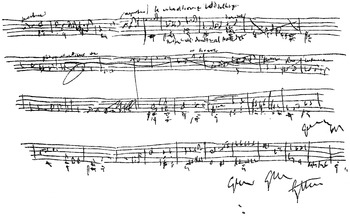
Although Verdi rejected Laurini's proposal, he did sketch a musical setting of the ‘Preghiera’ – in a scrawl that constitutes his final utterance in musical notation (see Fig. 2). Although it mostly resists decipherment, Verdi's setting appears to be in G major and 4/4, emphasising dotted rhythms, which dilate into minims midway (system 3); occasional chords and voice-leading suggest modulation through rising sharp keys (for example, from G to A and B major in system 1). Following the textual cues, it is sometimes possible to line up Margherita's text and Verdi's melody: the descending line (systems 2–3) seems to set ‘fino all'ultimo respiro’. Yet as a piece of music, the sketch is frustratingly incomplete: at best a hieroglyph of fragmentary words and sound images.
Verdi's sketch, c.1900, for Queen Margherita's ‘Preghiera’, taken from Gaetano Cesari and Alessandro Luzio, eds., I copialettere di Giuseppe Verdi (Milan, 1913), table XII.

Verdi's sketch is, in this sense, a ruin on the media landscape traversed by Margherita's ‘Preghiera’, which was recited in Masses for Umberto across the country (despite an ecclesiastical ban on reading it in church), printed in newspapers and commemorative albums, turned into poems (as in Laurini's versification) and set to music (at least ten scores were published by 1901).Footnote 46 This national media context might have motivated Verdi to attempt the ‘Preghiera’ – although discourse networks may guide the author's pen beneath the radar of conscious volition, and with uncanny effects. As Friedrich Kittler understood it, the discourse network around 1900 was dominated by these disturbing encounters with the blank page, whose materiality seemed to resist the act of writing: the author's body falters before the imaginary circulation of texts.Footnote 47 In Verdi's sketch, this confrontation is staged between the composer's (increasingly frail) body on the one hand, and his gesture towards national communication on the other. When the sketch was published in a monumental edition of Verdi's letters in 1913, its editors described a similar opposition, characterised as a standoff between the old man and his national spirit:
Pure le timide proteste del vegliardo non bastarono a sopire le aspirazioni dell'artista. Raccolta la fantasia nella pia soavità delle auguste parole, con mano tremula, egli cercò ancora sulla tastiera quel canto che meglio esprimesse l'angoscia del suo e del sentimento nazionale. Quelle, furono le ultime note di Giuseppe Verdi.Footnote 48
[Yet the fearful protests of the old man were not enough to soothe the aspirations of the artist. Mustering his fantasy in the pious sweetness of the august words, with trembling hand, he searched again on the keyboard for the melody that would best express the agony of both his and the nation's feelings. These were the last notes of Giuseppe Verdi.]
The editors, eminent Verdians Gaetano Cesari and Alessandro Luzio, wanted to use Verdi's final sketch as proof of his nationalism, which was supposedly all the more poignant at the end of his life. Thus the emphasis falls on Verdi's intention rather than his act, while the fact that this sketch evidently ended in failure goes unmentioned. In the end, the hand ‘trembling’ over the keyboard did not transfer a finished song to the page: the artist was trumped by the venerable man, who left his trace in a series of unsuccessful signatures (see Fig. 2, bottom right).
In addition to her ‘Preghiera’, Margherita also supplied the definitive verdict on her husband's death: ‘This is the greatest crime of the century’.Footnote 49 As Margherita's obvious talent for soundbites suggests, she maintained an active presence in the media, fostering identification with her loss – which could thus be understood as a bereavement for the entire nation. The royal household was inundated by telegrams only hours after the event, several addressed to Margherita directly.Footnote 50 These messages were sent by political and municipal groups as well as the institutions of ‘civil’ society (including mutual aid associations and workers' societies).Footnote 51 Just as with Verdi's death six months later, the telegraphic surge largely consisted of traditional, formulaic expressions of condolence. And yet, in both cases, the decision to send a telegram was at once a demonstration of grief and an act of participation within national life – through a medium that was both rapid and highly personalised. As historian Catherine Brice argues, these qualities of speed and personalisation meant that the telegram, far from being a ‘neutral’ medium of communication, became highly political in the wake of Umberto's death: it provided national consensus at a delicate moment.Footnote 52 Moreover, by reprinting telegrams from different places alongside one another in newspapers and commemorative albums, the messages could come to represent an ‘imagined community’ of people engaged in similar tributes across the nation.
It is worth pursuing the parallels between acts of homage to Umberto and Verdi – parallels that put my opening remarks on the performance of grief around the Hôtel Milan in a national context. News of Umberto's death was also greeted by closed shops, black-bordered posters and crowds gathering – but these tributes (along with the closing of schools, suspension of work schedules and flags at half-mast) were repeated on a larger scale in cities and towns across the country.Footnote 53 Some of these observances, such as the hanging of black drapes from balconies, had their roots in ancient rites of public mourning, which also included commemorative Masses and giving alms to the poor.Footnote 54 Other public obsequies were, however, of more recent stamp: the varied crowds and muted trams in Verdi's death; or, correspondingly, the crowds that gathered to pay their last respects at railway stations along the route from Monza to Rome when Umberto's body was transported to the capital by train during the night of 8–9 August. The scene at Genoa, where the train paused at 8pm, was typical: the royal march (Marcia reale) was played before a solemn crowd, heads bowed in ‘silent recognition’.Footnote 55 This silence of the multitude contrasted pointedly with the military band, its national implications clear: as Umberto's railway sepulchre crept towards the capital, arriving there at dawn, it rehearsed national unification in miniature.
Is it possible to trace historically, through the railway, the emergence of these mass silences that gesture towards national grief? For Brice, the scene in Genoa strikingly prefigures the train that bore the Unknown Soldier to Rome 21 years later, commemorating the millions killed in the First World War.Footnote 56 In many countries, though not Italy, the commemoration of the Great War's dead was expressed in one or two minutes' national silence.Footnote 57 Yet Umberto's voyage also has a notable precursor in Mazzini's post-mortem railway procession from Pisa to Genoa (calling at Lucca, Pescia, Pistoia, Bologna, Modena, Reggio, Parma, Piacenza and Alessandria) during the night of 14–15 March 1872 (which in turn recalls the ceremonial train journey from Washington to Illinois of American President Abraham Lincoln's embalmed corpse). A contemporary account describes the scene along the railway line:
da per tutto furono acclamazioni rispettose, serie, solenni, quali si addicevano alla mesta circostanza: da per tutto, ove vi fu qualche fermata, le stazioni erano ingombre di gente, e da per tutto qualche oratore interpretava con acconce parole i sentimenti della popolazione: poi si udiva una risposta muovere dalle vicinanze del feretro, ed era una voce che amorevolmente sostituivasi a quella ch'era spenta per sempre. L'entusiasmo era indescrivibile e dominava egualmente lungo tutta la strada, il che significa ch'era egualmente vivo per tutta l'Italia. Scoppiava in acclamazioni all'avvicinarsi del feretro: le esplosioni si succedevano come se vi fossero stati cumuli di polvere disposti lungo la strada a cui il convoglio passando mettesse fuoco.Footnote 58
[everywhere there were respectful, serious and solemn acclamations, which matched the mournful occasion: everywhere there was a stop, stations were full of people, and everywhere some orator interpreted the sentiments of the populace with fitting words: then one heard a response emerging from near the coffin, and it was a voice that admirably substituted for that which had expired forever. The enthusiasm was indescribable and was repeated along the whole railway – an enthusiasm that was alive for the whole of Italy. It broke out in acclamations as the coffin approached: the explosions followed one another as though there had been piles of gunpowder placed along the tracks, which the passing train ignited.]
In death, Mazzini's revolutionary spirit was, it seems, as explosive as ever – or at least this is the message conveyed by this interpreter, the geologist Paolo Gorini, who was also responsible for an attempt to embalm the revered corpse. As historian Sergio Luzzatto argues, Mazzini's followers seized on his death as an opportunity to further the republican cause: his embalmment meant he would endure as a powerful symbol, a figure around which to rally.Footnote 59 In much the same way – although with greater success (Mazzini's preservation went awry) – his nocturnal train procession elicited impressive shows of popular support. This solidarity was, however, figured in terms of noise rather than silence. And while the volume and effects of this noise may well have been exaggerated by Gorini – a loyal Mazzinian – it is nonetheless significant that he conveyed the public grief in such resonant terms: Mazzini's coffin is embraced by a collective voice, and it ignites noisy acclamation.
The lively celebrations that greeted Mazzini's funeral train may seem the very opposite of the ‘silent recognition’ solicited by Umberto. These contrasting styles of public mourning – or, if you will, modes of audience participation – no doubt attest to the interval between the two historical moments, which represent different points of national history, not to mention antagonistic political outlooks. However, in both cases there was much at stake in the construction of the auditory realm. In Gorini's account, the collective voice ‘emerging from near’ the coffin responds to an orator and carries forward the republican mission. Likewise, Umberto's silent multitudes, who apparently have no voice, bear a heavy semantic load, conveying both national grief and solidarity with the monarchy. Silence can be another way of making crowds speak – of imposing a single, intelligible message on a disparate collective. This is why crowd silence, even more than noisy acclamation, has such an inflated currency in the politics of representation, particularly within nationalist discourses that tend to convert mass displays into an exhibition of the body politic.Footnote 60
In the wake of Umberto's death, the consensus invoked through silence corresponded to a broader political discourse urging the country to pull together. Take, for example, the following comment by Sidney Sonnino, an eminent conservative statesman, who spelled out (in the remarkably convoluted bureaucratic parlance of the day) the implications of the moment:
In omaggio alla venerata memoria del Re Umberto, e quasi ad espiazione del truce assassinio commesso da mano italiana, c'incombe l'obbligo di far sacrificio alla patria non solo di ogni interesse personale, ma anche delle nostre passioni, mettendo da banda per un tempo tutti i nostri dissidi, teorici o personali, elevati o meschini, pubblici o privati, per unirci nel fermo proposito di concentrare ed attuare prontamente qualcuna delle fondamentali riforme che tutti indistintamente riconoscono e dichiarano necessarie per risanamento morale e politico dell'Italia.Footnote 61
[In homage to the venerated memory of King Umberto, and almost to atone for the cruel assassination committed by an Italian hand, it is incumbent on us to sacrifice – for the sake of the country – not only every personal interest, but also our passions, putting aside for a while all our disagreements, theoretical or personal, elevated or base, public or private, to unite in the firm purpose of focusing on, and promptly implementing, some of the fundamental reforms that everyone, without exception, recognises and admits are necessary for the moral and political regeneration of Italy.]
In Sonnino's view, the country was ‘ammalato’ (ill, diseased) – plagued by the selfish interests of political parties, above all the socialists – and thus a fertile ground for apathy, moral decay and anarchism. The regicide was a spectacular symptom of this illness, but also an opportunity to implement Sonnino's political cure. He hoped to build consensus out of a country united in mourning over the dead king, to create unanimous support for his successor, Vittorio-Emanuele III. But to do this, it would be necessary to suspend ‘for a while’ (of unspecified duration) all disagreement and dissent – to silence, in other words, the noise of democracy and proceed instead with ‘common sense’ policies and reforms, which Sonnino then outlined at length.Footnote 62
Sonnino's ‘state of the nation’ demonstrates what was at stake following Umberto's death: politicians (and not only this one) seized the moment as an opportunity to reconfigure the national body around the dead king and his successor. And yet, as Margherita's ‘Preghiera’ and Umberto's nocturnal train ride illustrate, this mobilisation of the national body took place through concrete encounters with various media, which were at once communal and personal. In other words, two distinct perspectives on the media emerge: on the one hand, the circulatory, iterative and cumulative view, from which national implications (such as Sonnino's) can be drawn; on the other, the unique encounter – for example, through a telegram or a train procession, or even a prayer or a song – of an individual with the medium in question. The latter perspective may appear the ‘reverse shot’ of the former, both harmoniously reconciled within the same national outlook. But the personal, of course, bears no stable connection to the national.
This much is shown by Verdi's abortive musical sketch: in his attempt to commemorate Umberto, there were evidently many decisions and revisions. What is more, and as his sketch demonstrates, the personal commemorative act may never find a public. Viewed up close, media begin to look precarious: rather than abstract vehicles for establishing consensus through countless identical acts, they become windows of opportunity for complex individual performances of identity, whose successful execution is by no means assured in advance. This matters in Verdi's own death because there was, once again, a tendency to interpret commemorations – and, above all, the presence of crowds – as exhibitions of the animated national body (a trend lamented by Panzini, as we have seen). To be sure, Verdi's death was widely understood against the background of national mourning, that for Umberto in particular. However, the national interpretation of Verdi's death can also be resisted: through attending to the texture of small-scale, local and individual participations, which are both beneath and (as we shall see) beyond nationalism.
The work of mourning
Le signore ed i signori artisti lirici, attualmente in Milano, che desiderassero tributare solenne omaggio a Giuseppe Verdi col prender parte all'esecuzione del Coro che verrà cantato al Cimitero Monumentale il giorno 27 febbraio 1901, sono pregati ad iscriversi presso la Segreteria dell'Associazione Teatrale di Mutuo Soccorso, via Silvio Pellico, 4.Footnote 63
[Those lyric artists, both ladies and gentlemen, currently in Milan, who would like to pay solemn tribute to Giuseppe Verdi by taking part in the performance of the Chorus that will be sung at the Cimitero Monumentale on 27 February 1901, are invited to register with the Secretariat of the Theatrical Association of Mutual Aid, via Silvio Pellico, 4.]
Two weeks before the trigesimo celebrations, the above notice seeking out local singers was published in the Gazzetta musicale di Milano. This journal had become, since Verdi's death, the official bulletin on his commemorations: each issue opened with a long report on the latest ‘Onoranze a Verdi’. At the same time, and as the advertisement above suggests, the Gazzetta was a vehicle for organising future commemorations – notably an appeal for ‘un monumento internazionale a Giuseppe Verdi da erigersi in Milano’ (an international monument to Giuseppe Verdi to be erected in Milan). Funds for the statue were drawn, in the first instance, from the proceeds of a memorial concert held at La Scala on 1 February; presumably money raised by another concert held in the same venue on the trigesimo also went to the cause.Footnote 64 In the coming weeks the Gazzetta published a full list of individual donors (along with sums given); fund-raising committees were set up in Berlin, Paris, London and Vienna, as though to ensure the tributes were truly international. The Gazzetta published the minutiae of these international diplomacies: they accorded with the journal's dominant interpretation of Verdi's death as a loss for the entire ‘mondo civile’. Nevertheless, the bulk of administrative work took place closer to home, particularly in the run-up to the trigesimo: the ceremonies were planned; performers recruited; national officials invited; and, more practically, the rights obtained to exhume and rebury Verdi's and Strepponi's bodies, as work proceeded on their new crypt at the Casa di riposo per musicisti. All these activities were reported blow-by-blow in the Gazzetta, documenting formidable ‘behind-the-scenes’ organisational efforts.Footnote 65
On the trigesimo, 830 singers turned up at the Cimitero monumentale to sing the famous chorus from Nabucco, ‘Va pensiero’, accompanied by hundreds of orchestral musicians drawn from local theatres.Footnote 66 This mammoth ensemble was installed over the steps of the Famedio, a monumental building at the cemetery entrance. Among the mass of musicians – and elevated to almost twice his normal height – stood the conductor and master of ceremonies, Arturo Toscanini. In front of him, Verdi's bust presided imperiously from the top of the steps, surrounded by national and international dignitaries; behind was a four-metre-high catafalque, replete with mythic lyre, topped with Verdi's and Strepponi's coffins and covered by a black drape. Nearest to this mobile monument, which was drawn by six horses, were representatives of the king, government, parliament and various consuls; an outer phalanx of military officers in uniform completed the cavalcade. At the appointed moment – 1pm exactly – a fanfare announced the beginning of the ceremony, then Toscanini brought in the strings for the prelude to ‘Va pensiero’; when the choir eventually joined them, however, there was a distant noise: as L'illustrazione italiana reported, ‘From the locomotives of the nearby station one hears, at the very beginning, a whistle … What an ungrateful contrast! Could it not have been avoided?’Footnote 67
This ‘ungrateful’ (ingrato) screech punctured an underwhelming choral and orchestral sound: as L'illustrazione italiana described it, the ‘effect of the 830 performers is halved’ in the Famedio's open square. Meanwhile, the number of singers seemed, to the eye, even fewer – ‘they appear to be two hundred, so vast is the space!’Footnote 68 The discussion of these figures reflects a wider anxiety about crowd management and the deployment of commemorative forces on such a vast scale – concerns that were projected onto the choir, whose singers were drawn from disparate sources (including the choruses of both the Teatro alla Scala and the Teatro Lirico, several choral societies, the Scuola popolare della musica, as well as others collected by the Associazione teatrale di mutuo soccorso, as mentioned above).Footnote 69 Perhaps the train whistle was ‘ungrateful’ because it did not respect this musical labour: after all, in this assembly of vocal resources, the combined forces of sound production were laid at the dead composer's disposal (even if its effective surplus value was, as L'illustrazione italiana estimated, no more than 50 per cent). Toscanini's orchestra and choir were, in this sense, an extraordinary labour force tasked with the work of monumental commemoration.
In Rome, meanwhile, the bulk of commemorative work was shouldered by university students. They had the Teatro Argentina decorated for mourning, with Verdi's bust centre-stage draped in the Italian flag; in the afternoon there was a performance of the overture to La battaglia di Legnano (which had premièred at the theatre in a brief moment of republican fervour in 1849) and a chorus from I Lombardi. Later, at 4pm – while in Milan Verdi's catafalque continued its stately procession – this bust and its plinth were mounted on a horse-drawn carriage and, adorned by wreathes and palm fronds, proceeded through dense crowds across the Campidoglio. Here the students picked up the bust and carried it towards the steps of the Palazzo Senatorio, where the city's mayor awaited them, surrounded by Rome's traditional banners and flags of the district. According to L'illustrazione italiana, Verdi's music was played by the municipal band throughout most of the ensuing scene:
Il momento è solenne. Da ogni parte della piazza si applaude entusiasticamente e si grida: ‘Viva Verdi!’ Gli studenti depongono una corona d'alloro sul capo del busto di Verdi, mentre il presidente del Comitato fa la consegna ufficiale del busto al sindaco, fra nuovi e frenetici applausi. Indi il sindaco pronuncia un discorso interrotto da applausi. Infine il busto di Verdi si colloca nella sala senatoriale e il corteo si scioglie.Footnote 70
[The moment is solemn. From everywhere in the piazza there is enthusiastic applause and shouts of ‘Viva Verdi!’ The students place a laurel wreath on the head of Verdi's bust, while the president of the committee performs the official handover of the bust to the mayor, amid renewed and rapturous applause. Then the mayor gives a speech interrupted by applause. Finally, Verdi's bust is placed in the Sala Senatoriale and the procession disperses.]
The celebratory character of Verdi's trigesimo in Rome contrasts sharply with that in Milan, which seemed to be a re-run of the city's ‘silent’ funeral 27 days earlier – although admittedly a marching band featured prominently in Milan's celebrations, too: on arrival at the Casa di riposo, the catafalque paused while the ‘Miserere’ from Il trovatore was played. What is striking in Rome, however, are the regional banners and flags, which mark the capital's distinctive contribution to this national event – one that was, as we saw with Umberto, dependent on the notion that people in cities across the country are simultaneously marking the same observances. Yet these acts, replicated nationwide, exhibited a wide degree of local variation.
Quite different from Rome's noisy acclamations, as well as from Milan, where public orations had been ruled out, was the elucidation of the trigesimo offered at the University of Florence by Gabriele D'Annunzio. His address ‘On the Death of Giuseppe Verdi: Song Preceded by an Oration to the Young’ was conceived as a religious invocation:
Voi siete qui adunati, o Giovani, per assistere ad un servizio divino, per celebrare un rito solenne, per innalzare verso una sacra immagine la vostra preghiera unanime, qui nella sede degli studii severi, nell'edificio dedicato al culto dello spirito, nel recinto dove s'insegna e si apprende, nel focolare stesso dove ogni giorno è nutrita dal vostro intelletto e dalla vostra volontà la fiamma che arde ai Penati venerandi del Pensiero italiano.Footnote 71
[You are congregated here, O Young People, to attend a divine service, to celebrate a solemn rite, to raise up your unanimous prayer towards a sacred image, here in the centre of serious study, in the building dedicated to the cult of the spirit, in the enclosure where one teaches and learns, in that same hearth where every day, fed by your intellect and your will, the flame burns for the venerable Penates of Italian Thought.]
Following this opening gambit, which sutures the Young (along with the entire institution of the university) into a national framework, D'Annunzio's oration continues in the same patriotic vein, while the subsequent ‘Canzone’ places Verdi alongside fellow Penates (ancient Roman protective spirits) of the nation's art – namely, Dante, Leonardo da Vinci and Michelangelo. In other words, D'Annunzio used Verdi's death as an opportunity to affirm the importance of artists within national life and, through a mystical ceremony, urge on the next generation towards greatness: ‘I want this Song, which I'm about to deliver, to seem composed – as it was – in a state of prayer, and want you, in the light of Memory and of Hope, to pray with me, united towards the Past and towards the Future’.Footnote 72
Despite D'Annunzio's motivational aims, his pious rationale for the ‘Canzone’ must have been familiar to his student auditors, awakening recent memories of Margherita's ‘Preghiera’ for Umberto, whose mythical origins lay, as we have seen, in a sleepless night praying over his corpse. Indeed, the ghost of the recent national mourning seems to haunt D'Annunzio's address: his ‘unanimous prayer’ – his exhortation to ‘pray with me, united towards the Past and towards the Future’ – is also reminiscent of politicians such as Sonnino, who called for consensus following Umberto's death. Moreover, D'Annunzio is explicit about the means by which such consensus should be brought about – through common feeling: ‘Were [a] simulacrum placed before you, it would seem, in truth, that the ideal figure – which each one of you held inside during the moment of grief – had been manifested’.Footnote 73 In other words, longed-for unanimity would be achieved through Verdi's eidolic appearance – an effect D'Annunzio strove to approximate through his incantation. To this end, he recalled the story of Vincenzo Gemito's bust of Verdi, taking the opportunity to describe lovingly the drama of Gemito's artistic inspiration, the moulding of clay, the gradual emergence of the composer's lineaments.Footnote 74
In conjuring Verdi's simulacrum, D'Annunzio's interpretation of the trigesimo may seem (as we might expect from him) exceptional. And yet, ‘In morte di Giuseppe Verdi’ stands in the shadow of Margherita's ‘Preghiera’: it is pervaded by the same imaginary of common national sentiment and of simultaneous commemorative acts nationwide. Thus he ended a complex performance of national identity by imagining the flight of his ‘Song’ across the country and beyond:
In these impassioned tones, D'Annunzio fashions a bleak nationalist symbol – with a distinctly Roman tinge, as the ‘aquila giovinetta’ (fledgling eagle) suggests, and in whose proud cry there are unmistakeable pre-echoes of fascist mythologies based on the revival of ancient glories (as well as exhortations to the young).Footnote 75 At the same time – and within the more contemporary context outlined above – we might read these lines as an allegory of the media, a gesture towards their role in broadcasting Verdi's death. After all, D'Annunzio's ‘In morte di Giuseppe Verdi’ was itself national news and soon became a publishing hit, placing anew Verdi's phantasmagoric image before the ears and eyes of readers and listeners.
As my overview of the trigesimo suggests – it has touched on only some of the day's most notable commemorations – the representation and mediation of Verdi's body was a pressing concern. In Milan, where his coffin was mounted on an enormous catafalque (next to Giuseppina Strepponi's, which – as no one wants to mention – was several years old and must have been in a state of some decay), the primary concern was visibility as the cortège passed through enormous crowds. Height serves another important function within funeral commemorations, as Peter Metcalf and Richard Huntington observe: ‘The corpse, by association with its container, is made enduring and larger than life in order that its owner's name be the same’.Footnote 76 This monumental effect was replicated in Rome, where Verdi's decorated bust was transported through the heart of the capital and met by cries of ‘Viva Verdi!’ – a revolutionary message with a long history, as we have seen, but now arriving at its final destination, the man's death. Meanwhile, D'Annunzio prepared another mediation of Verdi's body, with the aim of returning it to the living – as a ghost.
Media afterlives
And so, in one sense, this article comes full circle: the news of Verdi's death, broadcast from the Hôtel Milan, comes to circumscribe a national imaginary in the trigesimo. Thirty days later, ‘national mourning’ gives way to commemoration – the country had moved on, it seems. While orations went on for months in theatres across Italy, these were largely celebratory in tone, a blend of patriotic history mixed with personal reminiscence.Footnote 77 But in this respect, D'Annunzio was perhaps again exceptional: as the above quotations suggest, his oration conveyed (or at least simulated) raw grief, as though time had stood still since Verdi's death.Footnote 78 Symptomatic of this bout of melancholy, he fixated on the moment of Verdi's transmigration:
In this complex – and heavily laboured – image, key tropes of Verdi's death, which we have come across before, reappear: the spirit of the Risorgimento, embodied in Verdi's music, lingers in his ‘funereal silence’; the national body, figured as a chorus, mourns in unison.
However, during the week before and the month after Verdi's death, this national imaginary was complemented, as we have seen, by local, urban and international perspectives. As comparative literature scholar Ann Rigney puts it (updating Benedict Anderson's well-known concept of the ‘imagined community’), ‘not all imagined communities were national, and not all were imagined’.Footnote 80 Such was the case for the ‘Il monumento internazionale … in Milano’. The sculpture (which stands to this day in piazza Buonarroti outside the Casa di riposo per musicisti) owes its genesis to a transnational network of donations – even if the non-Italian contributions were soon to be forgotten.Footnote 81 Nevertheless, it is worth holding on to this vision for a global lieu de mémoire, which is a striking reminder of international utopianism at the turn of the century.Footnote 82
Verdi's death also prompted more lugubrious reflections on the new century – a sepulchral view on the passing of time that is perhaps disclosed by the much-discussed silence of the city and the crowd. In Milan, echoes of cannon fire could be perceived beneath that silence, along with the noises of revolt and anarchism: local memories that, though apparently repressed by the national consensus following Umberto's death (that ‘crime of the century’ six months before), were brought to the surface by Verdi's funeral.Footnote 83 The residues of these sounds in memory are the relics of a political unconscious from the turn of the century. Or, better, audible fossils preserved in their moment's now-prehistoric news cycle, which still have much to say.