

Introduction
A decade after the Financial Crisis triggered a global economic recession, the UK economy has to some degree recovered, but the recovery has been accompanied by a shift in the structure of the economy. While real output has managed to reach its pre-crisis peak and employment has been surprisingly resilient, other economic indicators such as real wages, business investment and labour productivity have performed relatively poorly. The economy has been using capital and labour more intensively, rather than more efficiently, especially the latter. It would appear that in the recovery phase, the UK economy has become a more labour intensive – less efficient – economy (see, for example, Reference PissaridesPissarides, 2013). In this article we wish to explore the financial causes of this change in the input-output mix in the economy.
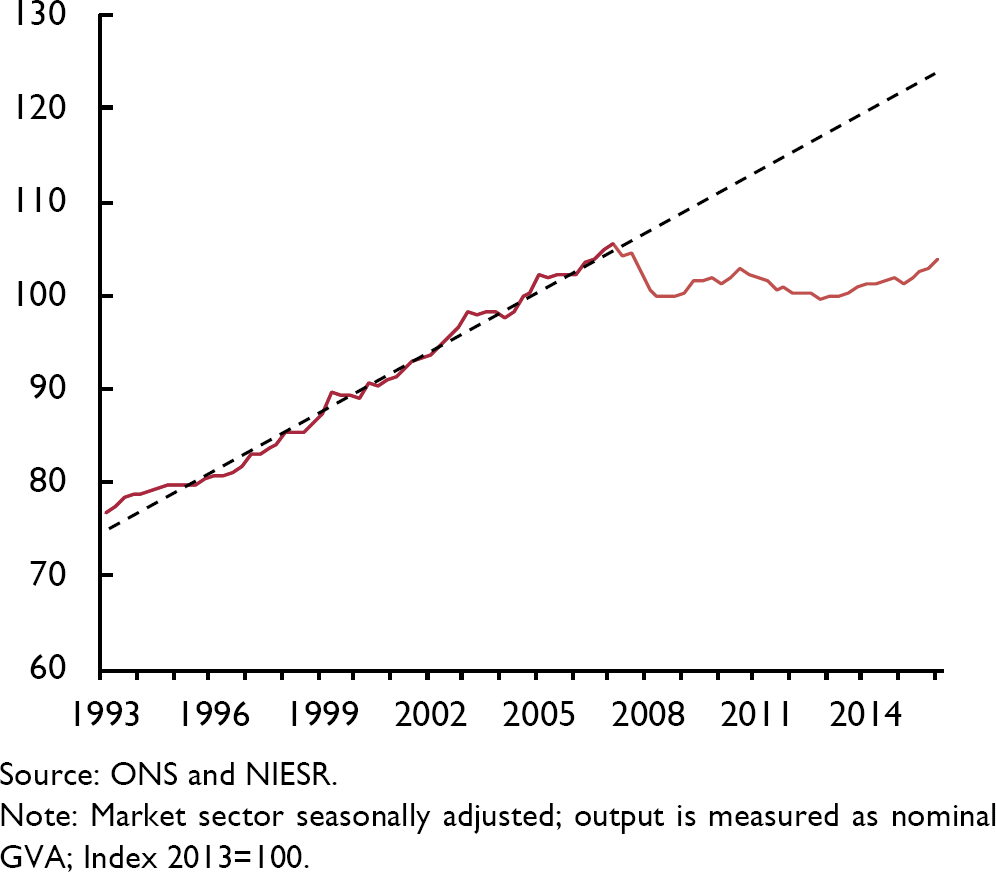
Figure 1 plots output per hour worked which is an economy-wide proxy for labour productivity, and we can note that since the 2008 recession labour productivity has sharply deviated from its pre-crisis trend. As labour and capital inputs tend to adjust more slowly to demand than output, it should be expected that at the time of an economic downturn measured whole-economy productivity drops when demand in the economy is low (see Reference Chadha and WarrenChadha and Warren, 2013). Yet, as the economy adjusted with the help of extraordinarily supportive monetary and fiscal policy and demand recovered, productivity growth did not pick up. Consequently, the productivity gap has been widening over the years since the financial crisis and output per hour is some 18 per cent lower today than it would otherwise have been had productivity stayed on its pre-crisis path.
Output per hour worked

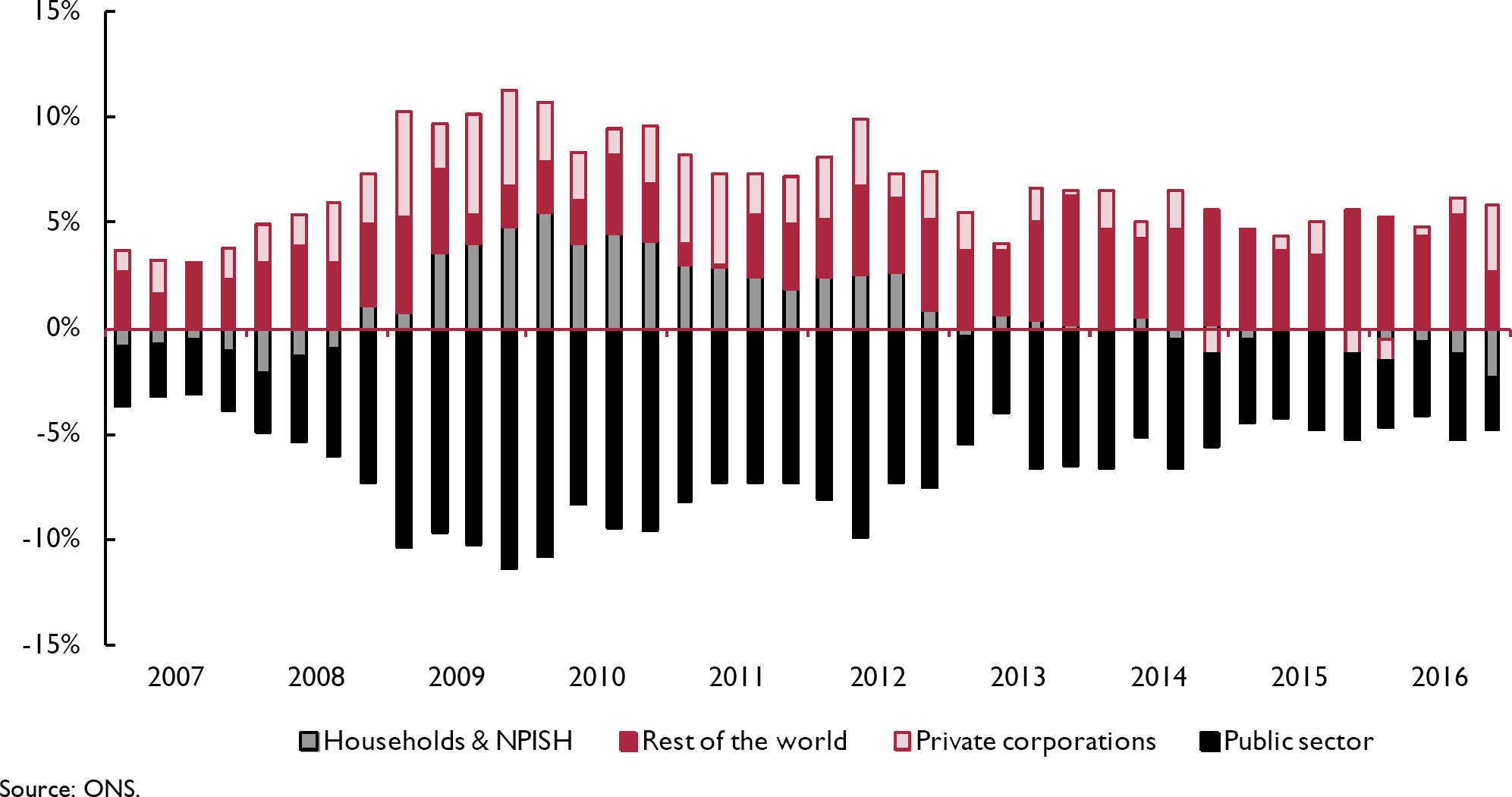
Before turning to examine the various explanations for the puzzle, let us just set out the sectoral balances in the economy, which sum to zero as an identity. Figure 2 shows that in the period since the financial crisis, the public sector has been consistently borrowing from the rest of the economy. Over the same period, the rest of the world through the current account has been lending to the UK. But firms have been small net lenders on average but broadly in balance since the early part of this decade. Households who traditionally supply savings to the rest of the economy, did so from the final quarter of 2008 to early 2013 but have been broadly in balance since then. And so neither households are supplying funds nor are firms borrowing. With neither households nor firms acting as borrowers or lenders in net terms on a sustained or significant basis we might ask ourselves whether this reflects some significant changes in financial relationships.
Sectoral balances

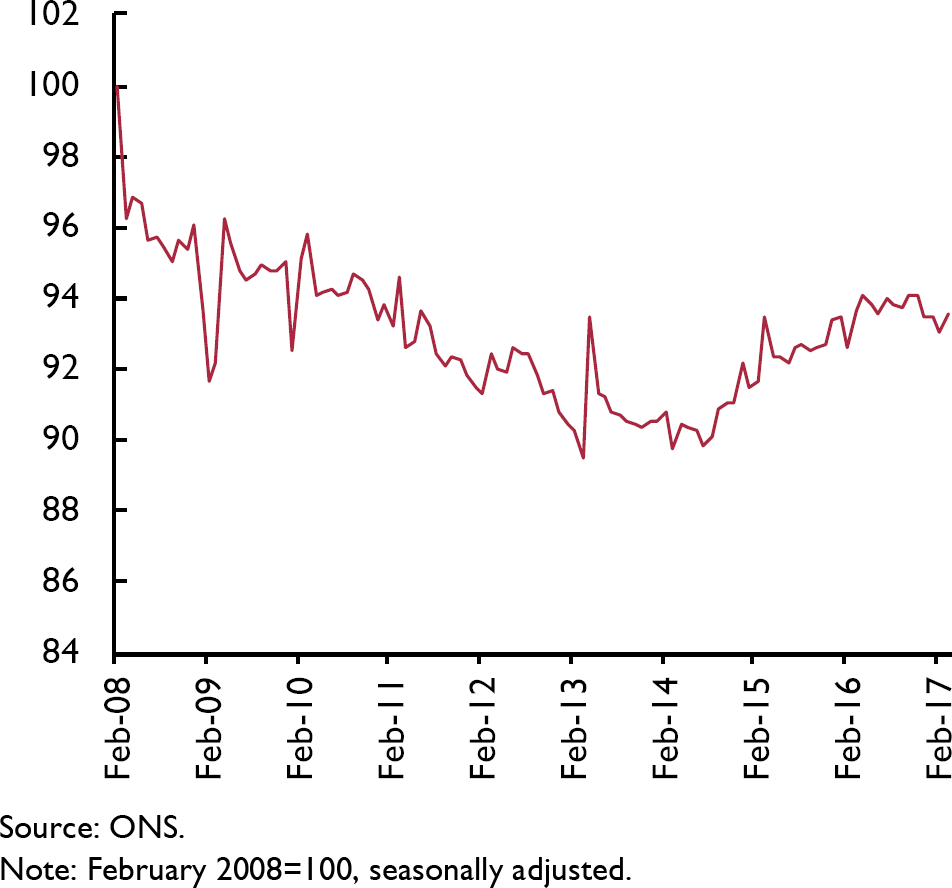
Households' main source of income is real wages, which are closely related in the long run to labour productivity and, although they fell at the time of the crisis in 2008, they have, remarkably, not yet recovered their pre-crisis level; real average weekly earnings in March 2017 were 7 per cent lower than in February 2008 (see figure 3). Stagnant real wages accompanied by a relative flexibility in the use of labour compared to capital have amplified the shift of the UK economy towards a more labour intensive economy and have reduced firms' incentives to provide training for their employees, hence reducing labour productivity (Reference Blundell, Crawford and JinBlundell et al., 2014). It is quite possible that causality between real wages and productivity may go in both directions. Neoclassical economic theory states that wages should equal the marginal productivity of labour inputs and therefore productivity drives real wages. The other side of the story, which UK history of minimum wages corroborates (Reference MetcalfMetcalf, 2007) to some extent, is that an exogenous increase in real wages can push firms to use their pool of labour more efficiently and this may act to increase overall labour productivity.
Real average weekly earnings, February 2005–March 2007

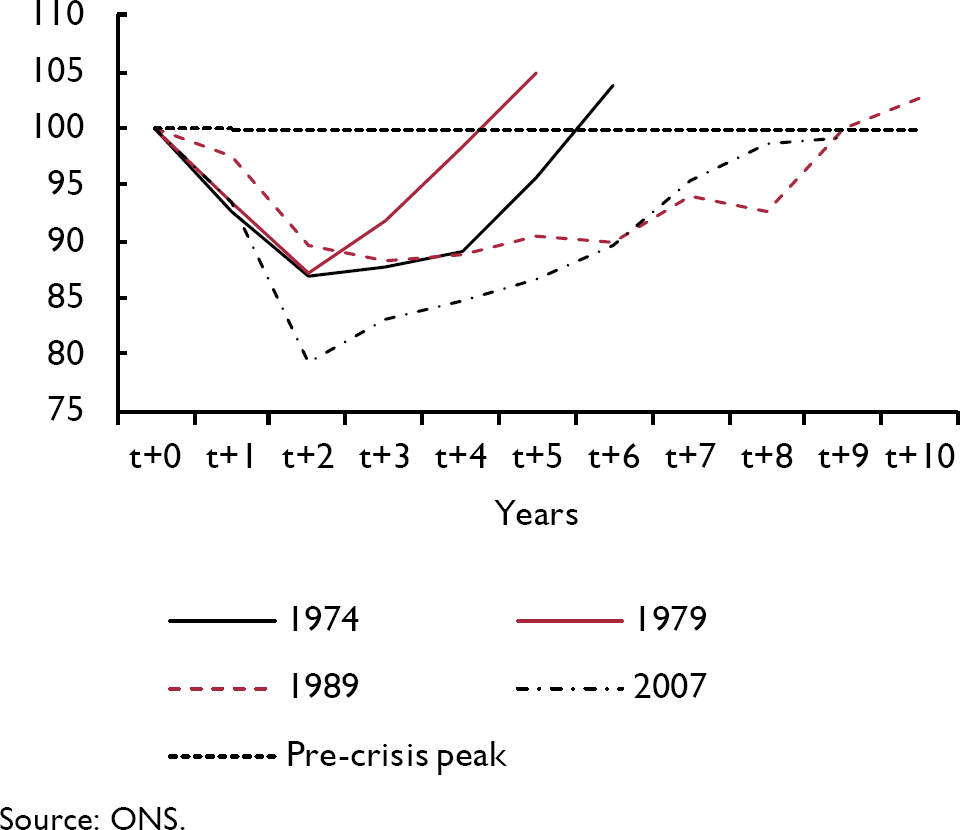
A factor likely to have contributed to both lower levels of labour productivity and real wages is investment. Total real investment fell by more than 20 per cent over the two years following the financial crisis and has not yet recovered its pre-crisis peak.Footnote 1 Real investment can take a number of years to return to its previous peak after a recession (see figure 4) because firms are very sensitive to expectations about likely future demand for their products. Public investment may therefore be a critical factor in escape from an economic downturn, as it might both substitute for private investment and also produce some confidence in the likely state of future demand. However, the escalation in public debt resulting from the recession has put pressure on public finances in advanced economies and acted to limit the fiscal space for government spending in investment projects. The low level of business investment also helps us understand the limited extent of capital deepening (the intensity of capital use per employee), despite large falls in the costs of capital and a lower rate of typical stock depreciation, and this reduction in capital employed contributes directly to lower levels of labour productivity.
Post crises recoveries in the level of real investment

Table 1 shows the contribution of capital deepening and TFP to per capita economic growth in the UK pre and post crisis. In the period leading up to the financial crisis, the near 16 per cent increase in income per head can be explained by some 6 per cent increase in capital deepening and some 10 per cent increase in TFP. But in the years that followed the financial crisis, the capital deepening contribution to per capita growth has been reduced by half, and the contribution from TFP has been negative, dropping by 13 percentage points compared to the pre-crisis period.

Several candidate factors might explain the prolonged stagnation in labour productivity: measurement issues related to the service and also the public sector; demand-side shifts; reallocation of labour to low productivity sectors; financial distortions; boom-bust; lower capital deepening; slowdown of human capital accumulation; labour hoarding and zombie firms. Those factors are certainly not mutually exclusive and independent; it is likely that they all play a role to some extent, and that linkages between these factors exist. In this article we will focus on examining the role of the financial sector and the possible endogenous channels with the other factors. In particular we will examine the financial sector mismeasurement and financial frictions.
Sectoral productivity
One possibility is that the financial sector may have contributed or amplified economic performance prior to the financial crisis and have subsequently performed less well and acted to exaggerate the downturn. Table 2 allows us to examine this possibility using new estimates of sectoral productivity from the ONS for the contribution from each of production, manufacturing and services to the whole economy. In the decade or so prior to the financial crisis, quarterly productivity growth of 0.5 per cent per quarter was reasonably evenly split across the three areas. But we can see after the financial crisis that only manufacturing productivity recovered, albeit not back to its earlier more elevated levels. In the seven measured service sectors, which account for the largest share of overall output, there has on average been a fall of 0.6 per cent since the start of the financial crisis. The largest fall has been in the financial sector, where average growth in productivity has gone from 1.1 per cent to −0.2 per cent.

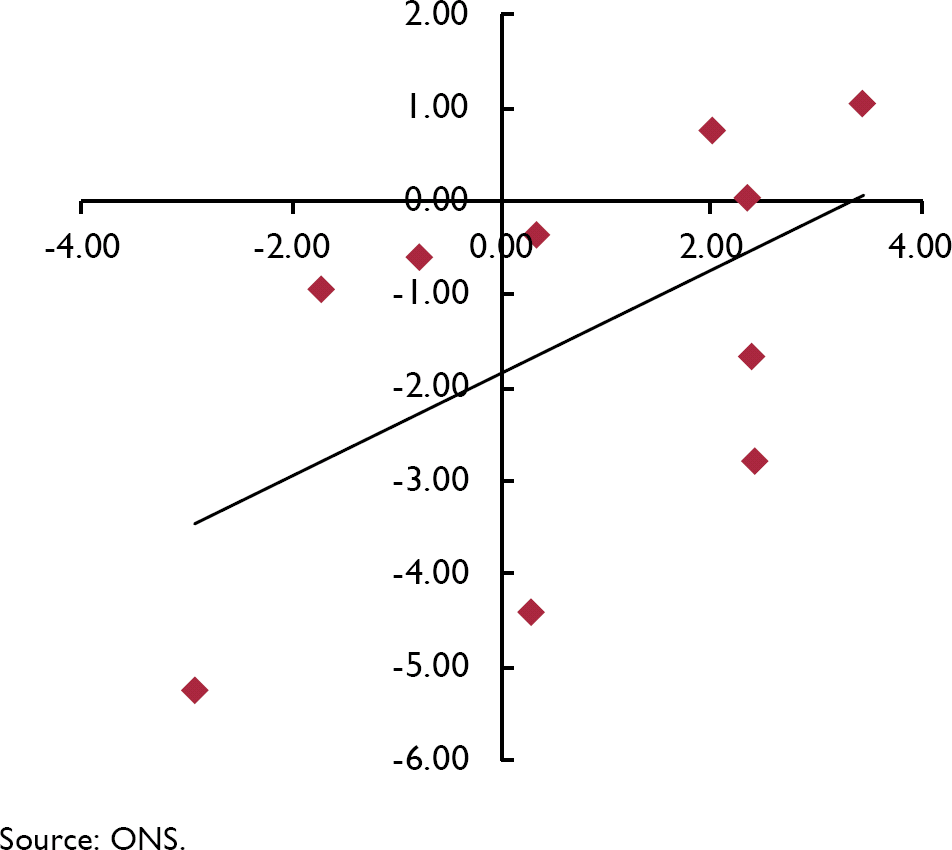
Using the ONS experimental measures in table 3 of multi-factor productivity, we can account for the sectoral contribution to gross value added (GVA). Overall growth in GVA has fallen from 1.4 per cent to −0.9 per cent on average with again the financial sector having the largest swing by moving from 2.4 per cent to −2.8 per cent. One hypothesis to examine is whether sectors, such as financial services, that performed strongest prior to 2007/8, then performed weakest subsequently. If this were the case, it would offer some support for the hypothesis that the boom laid the seeds of the productivity puzzle and we would expect to find a negative in GVA growth in each sector relationship between the two pre and post periods. But what we find is that each individual sector has a lower contribution to GVA on average and that previous levels of GVA are a good guide to current levels, which implies a common rather than sector specific shock of some 2 per cent in figure 5.

MFP contribution of GVA growth before and after the crisis

Measurement problems
It is important to bear in mind that gross value added is subject to measurement issues, notably for services and the public sector. GVA is defined as the total value of output of goods and services produced less intermediate consumption, and to measure it in real terms output and intermediate consumption are deflated using price indices such as the Consumer Price Indices (CPI), Services Producer Prices Indices (SPPI) or the GDP deflator. Table 4 summarises the methodology used to measure GVA for the market and non-market sector.

While output for the manufacturing sector is relatively easily measurable both in value and real terms, government services and services in general are much more difficult to measure (Reference StoneStone, 1984). Many public services for example, such as education, do not have a market price, which makes them difficult to value. To overcome this problem, direct measures of the volume of services provided are made, such as the number of pupils who attend school. The direct measure of output accounts for two thirds of public output; when a direct measure is not feasible, real output is measured as the real value of inputs used in the production process. The UK Centre for the Measurement of Government Activity (UKCeMGA) within the ONS is currently working on improving the measure of output for the non-market sector, and notably incorporating a measure of the quality of services provided.Footnote 2
The difficulty in measuring the service sector is that it encompasses a multitude of activities which all require specific measures of their output. Table 5 illustrates how the financial sector is one of the most challenging sectors to measure and can be divided into three categories: the banking sector, non-bank financial intermediariesFootnote 3 and insurance and pension funds. Banking output consists of fees and commissions receivable, Net Spread Earnings (NSE), other operating income and Financial Intermediation Services Indirectly Measured (FISIM), which is the margin between earnings made on loans minus interests paid on deposits. The latter should be differentiated between FISIM contributing to final demand, such as consumption credits, and FISIM contributing to intermediate consumption, such as mortgages and business loans. A large share of banking activity is therefore considered as intermediate consumption for other businesses. Non-bank financial intermediaries also provide FISIM in addition to asset management. An overestimate of financial intermediaries' FISIM contributing to intermediate consumption will hence lead to higher measured financial sector productivity while reducing other sectors' productivity.

Another issue arises when real GVA indicators are constructed. As previously explained, price indices are used to deflate nominal indicators, however currently the same price index is usually used to deflate both output and intermediate consumption and this can lead to misleading results.Footnote 4 The problem is more profound for the financial sector because we have not yet constructed an adequate price indicator for its output.
Financial frictions
Financial markets are characterised by asymmetric information that generates constraints, or frictions, on the possible set of outcomes for households and firms. For example, the lender, usually a bank, only has incomplete information regarding firm investment projects. Therefore monitoring and insurance costs are necessarily imposed by the lender to engage in financing operations. In order to have access to external finance, firms need to establish their reputation and this is normally solved with the provision of collateral. New firms and SMEs are prone to higher external finance premiums because they may face greater problems in establishing their reputation. In addition, firms that mainly use intangible capital – which are a growing share of total firm capital – may struggle even more to provide collateral. In times of stress, that is in economic crises and recessions, these frictions are likely to be exacerbated. A number of surveys and studies provide evidence for tightening of credit in the post-crisis period, which had a negative impact on firm investment and productivity. In particular, it appears that firms that were credit constrained chose to reduce their investment in intangible capital, which may be one of the main drivers of productivity.
Reference Levina, Melolinna, Saleheen and TatomirLevina et al. (2017) present findings from the Bank of England survey on firms' financing and investment decisions. They show that one third of UK businesses find that their investment has been below the “appropriate level” in the past five years. Although not the biggest barrier, external financing is a major obstacle to investment, both in terms of availability and in terms of cost. They point to the lack of incentive for firms to invest. In particular, firms decided to use their internal funds for other purposes. Real economic obstacles such as uncertainty, low and slow returns and shortage of skilled labour also contributed to constraining firm investment. An important caveat of the survey, however, is that most of the firms in the sample have been in business for over ten years, while it is the case for only 44 per cent of UK businesses. It is an important factor because financial frictions and restrictions to external finances are likely to be more important for new business, which is an important driver of innovation (Reference Haltiwanger, Jarmin, Kulick, Miranda, Haltiwanger, Hurst, Miranda and SchoarHaltiwanger et al., 2016).
An important caveat of the survey, however, is that nearly all of the firms in the sample have been in business for over ten years, while that is only the case for 44 per cent of UK businesses and so the survey may understate the problems faced by new firms.
Several recent empirical studies corroborate the insight of the survey, and show that financial frictions have been a drag on investment and productivity in the UK since the financial crisis. Using firm-level data and a measure of pre-crisis lending relationship, Franklin et al. (2015) find that firms which were funded by banks that suffered more from the financial crisis were more likely to be credit-constrained after the crisis. After controlling for demand in the product market, they conclude that credit misallocation post-crisis contributed to lower productivity growth and investment. Using a similar identification strategy, Reference De Ridderde Ridder (2016) looks at the link between bank vulnerability to the financial crisis and investment in R&D or intangible capital in the US. The prime idea of the authors is that financial crises lead to persistent productivity falls through the endogenous growth channel of investment in intangible capital. Notably, they find that lower investment in intangible capital following the financial crisis led to lower output for about three to six years. Reference Duval, Hong and TimmerDuval et al. (2017) use cross-country firm level data to analyse the role of financial frictions in the productivity growth slowdown. Using a firm-level measure of exposure to the crisis, they find that a weak balance sheet prior to the crisis and tightening credit conditions significantly contributed to the fall in productivity growth. Also, the weaker the financial fragilities of a firm, the more likely a firm was to reduce its investment in intangible capital.
Restrictions on bank lending mean that firms have not been able to undertake the optimum level of investment that they would otherwise have chosen, reducing their capacity to innovate and to increase the efficiency of their production process. Lower levels of investment also contribute to lowering expected demand which in turns depresses investment. Misallocation of capital also implies that the existing stock of capital has not been used efficiently. The most productive investment projects have not been funded at the expense of lower productive investment. Forbearance is a factor of misallocation of capital. Some banks, being reluctant to take losses on their balance sheet, chose to keep rolling funding lines towards firms that they knew would otherwise have been bankrupt. Since the start of the financial crisis, banks have undergone a process of repairing their balance sheets and also building up capital and liquidity buffers.
There has also been a low level of insolvencies given the depth of the recession. The argument has been made that the forbearance shown by banks towards existing firms, and the lack of availability of finance to new firms, has acted to reduce the introduction of new technologies into the overall production function. And although on some estimates the number of so-called zombie firms has increased sharply (BIS, 2017), it is not clear how important this effect has been. Recent research by Reference Arrowsmith, Griffiths, Franklin, Wohlmann, Young and GregoryArrowsmith et al. (2013) found that forbearance might account for some of the shortfall in productivity; however, they only measure the impact on SMEs and therefore the impact on the whole economy may be considerably larger.
A calibrated example
We are interested in explaining the extent to which total factor productivity may be amplified by the productivity of the financial sector. The increase in the productivity of the financial sector results with reference to the prominence of shifts in the supply of bank credit.Footnote 5 One avenue we explore in this paper is motivated by the role of loans as a supplier of payment services to credit constrained households. The price, as a premium above the policy rate, of such loans reflects the marginal costs to banks of their supply and so it responds to increases in the efficiency of supply relative to the demand for loans, which we can think of as financial sector productivity. This relative price can move out of line with the policy rate set by the central bank when there are independent sources of fluctuations in the ability of banks to supply liquidity, for example, as a result of their efficiency in screening loans (monitoring), the value of posted collateral or the costs of meeting regulation requirements.
The quantum and composition of lending in general equilibrium models will matter as it affects consumption (and/or investment) decisions of liquidity constrained households (and/or firms) and the spreads across several financial instruments and assets. The operation of the financial sector may turn out to be the root of instability in the economy. We follow Reference Chadha, Corrado and HollyChadha et al. (2014) by incorporating money and financial spreads into a general equilibrium setting to study the banking sector proposed by Reference Goodfriend and McCallumGoodfriend and McCallum (2007).
The main feature of the model is the inclusion of a banking sector alongside households, production and the monetary authority. The model by Goodfriend and McCallum complements the traditional accelerator effect with an attenuator effect, which is present in the model because monitoring effort is drawn into the banking sector in response to the expansion of consumption, which is accompanied by an expansion of bank lending that raises the marginal cost of loans and the external finance premium.
In this version of the model, households, who are liquidity constrained, decide the amount of consumption and the amount of labour they wish to supply to the goods production sector and to the banking sector, which is an intermediary producing loans. They also demand deposits as a function of the amount of consumption they wish to finance. The production sector is standard, characterised by monopolistic competition and Calvo pricing, with a Cobb-Douglas production function, subject to total factor productivity shocks. Profit maximising firms decide the amount of production they wish to supply and the demand for labour. By clearing the household and production sectors we can define the equilibrium in the labour market and in the goods market. These two sectors also provide a standard relationship for the riskless interest rate and the bond rate.
Here the financial sector requires a bank to match deposit demand from liquidity constrained consumers with a loan producing technology. Specifically, banks employ workers both to carry out monitoring work and to ask for collateral in supplying loans. More monitoring is achieved by increasing the number of people employed in the banking sector and therefore reducing employment in the goods production sector. A fractional reserve requirement with a fixed reserve-deposit ratio is assumed. Given this technology, banks decide on the amount of loans they can supply and the amount of monitoring required subject to the available level of collateral. At the same time households' consumption is affected by the availability of loanable funds.
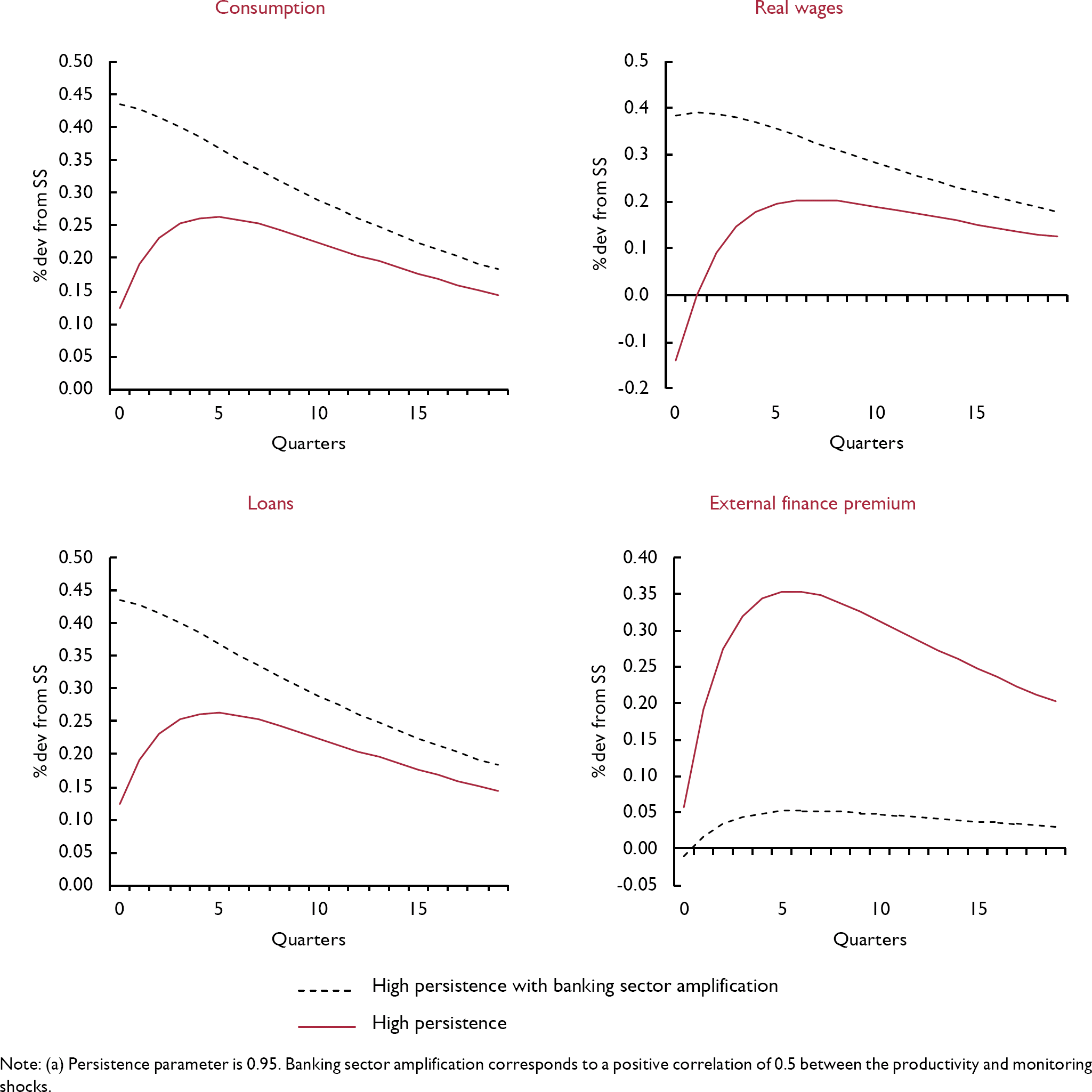
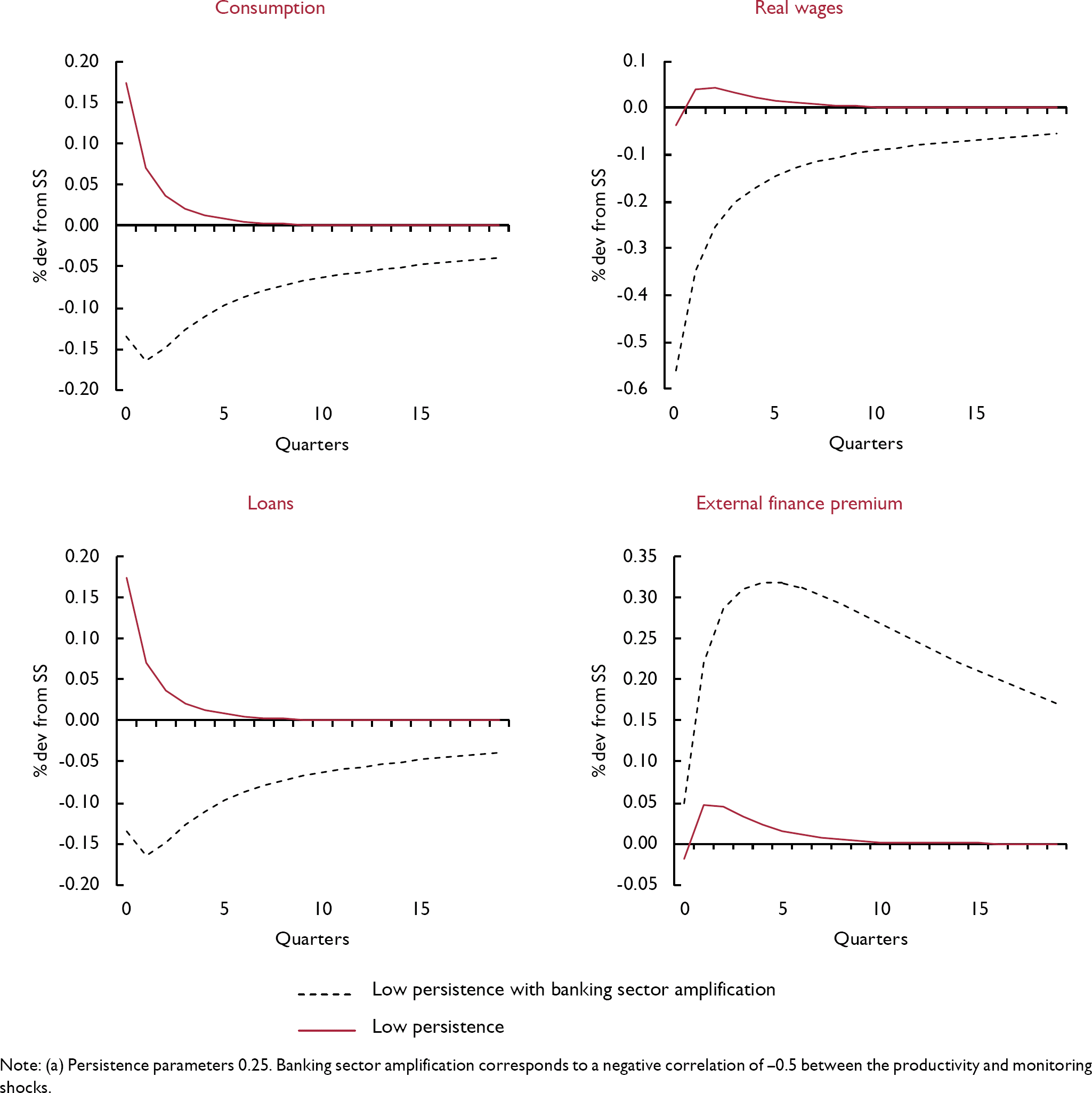
Figures 6 and 7 show a standard simulation of the model with a shock to total factor productivity which is first persistent and then shows little persistence. In the first case consumption and real wages rise, households take on more debt and their increased demand for loans drives up the external finance premium. In the latter case, with the less persistent shock each of these impacts are significantly attenuated.
Positive productivity shock with high persistence(a)

Positive productivity shock with low persistence(a)

In both figures we also augment the simulation with a correlated shock that increases the banking sector's productivity, with the financial intermediary being able to provide more loans for a given level of collateral and banking labour. In other words we are trying to illustrate the extent to which the financial intermediary might amplify a whole-economy productivity shock. Therefore, because the bank has, in effect, shifted out its loans supply and lowered the external finance premium, households take on more debt, raising both consumption and wages relative to the case standard. Furthermore, if as we have seen since 2007/8 there is a lower rate of whole economy productivity growth, which we model here with a lower level of persistence, and if at the same time the banking sector becomes less productive, the consumption and real wages may fall with households contracting their levels of indebtedness in the face of higher external finance premia.
The interaction of the financial sector seems likely to have amplified the business cycle prior to the financial crisis and subsequently. And so we illustrate how it might have altered business cycle dynamics. We will, though, need more work on measuring productivity, its components, and in particular that of the financial sector to establish what role financial frictions have played in the productivity slowdown.
Conclusion
The UK economy faces a number of critical problems, which may have their root cause in the operation of the financial sector. The mix of capital to labour may be too low to allow sufficiently high growth in real wages, which limit the extent to which the household sector can repair its balance sheet, and whole economy trends in productivity continue to cause great concern. The banking system in a period of retrenchment and reform may be limiting firm or household access to finance or creating real or imaginary constraints on credit availability. More importantly, the constraints operating on the financial system may be acting to amplify any overall slowdown in total factor productivity. That said, the measurement issues in trying to understand overall and sectoral productivity seem especially problematic.
We have therefore resorted to illustrating the possibility of the financial sector amplifying the business cycle rather than showing how it did in the period since 1992. We leave the formal tests of these hypotheses to future work.
The mix of capital to labour may be too low to allow sufficiently high growth in real wages, the stagnanat level of which limits the ability of the household sector to repair its balance sheet. And whole economy trends in productivity, which may also be amplified by continuing financial frictions, continue to cause great concern.