Introduction
The Solar type stars with planets having different surface conditions seem to be abundant in the Milky Way and the appropriate chemical elements and molecules for life are also known to exist in abundance throughout the Universe, implying that life may not be a phenomenon unique to Earth and rather widespread in the cosmos (Sullivan and Baross, Reference Sullivan and Baross2007). Thus it would be quite plausible to assume that life and its advanced (i.e. intelligent and technically capable) forms presently exist in the Galaxy and some of them could have evolved to have the ability to contact and/or travel over interstellar distances. Why then, we have not met or communicated with any of such extraterrestrials (ETs) is the essence of the conundrum known as the Fermi's Paradox (FP). Various solutions to the FP were proposed since the term was coined (as reviewed in detail by Ćirković (Reference Ćirković2018) and Forgan (Reference Forgan2019)).
Search for Extraterrestrial Intelligence (SETI) is the term to describe efforts to find signs of intelligent civilizations on other planets. FP can be solved by finding even a single ET intelligence (Forgan, Reference Forgan2019). When compared to other branches of astronomy, SETI studies had always relatively less quantitative content in history (Forgan, Reference Forgan2009). However, advancements in computing capability led to an outbreak in quantitative SETI research and the increasing knowledge of exoplanets provided a more calibrated illustration of the conjectures about possible ET life (Forgan, Reference Forgan2019). For example, Forgan (Reference Forgan2009) revisited Drake equation and presented a method based on Monte Carlo Realization (MCR) to make more accurate and sensitive estimations of competing theories of ET life and intelligence by generating a statistically equivalent model of Milky Way Galaxy. Forgan and Rice (Reference Forgan and Rice2010) investigated the Rare Earth Hypothesis by improving the Milky Way Galaxy Model of Forgan (Reference Forgan2009). Vukotić and Ćirković (Reference Vukotić and Ćirković2012) used a Probabilistic Cellular Automata (PCA) to model Milky Way's Galactic Habitable Zone. Bjørk (Reference Bjørk2007) simulated a 3D model of Milky Way Galaxy and investigated the exploration of Milky Way by using space probes. Hair and Hedman (Reference Hair and Hedman2013) adapted the percolation theory (for the diffusion of liquids) for modelling interstellar civilization distribution and evaluated two theories of interstellar emigration which both are presented as solutions to FP. Galera et al. (Reference Galera, Galanti and Kinouchi2019) also used a method based on percolation theory and argued that SETI studies may largely exclude the Solar neighbourhood because there are large voids between inhabited regions.
Aforementioned quantitative studies aim to investigate some FP theories with numerical modelling. In this study, we aimed to develop an agent-based model (ABM) to adapt the theory for the spread of stochastic rumours to interstellar communication, which was proposed as another possible solution by Belen and Özel (Reference Belen and Özel2012) and Özel (Reference Özel2016). For this purpose, we improved the original rumour models to explore the issue more rigorously.
The rumour spread models
The rumour models were considered as part of the epidemic theory for a long time (Daley and Gani, Reference Daley and Gani1999). First deterministic mathematical work to determine the spread size of rumours was made by Rapoport and Rebhun (Reference Rapoport and Rebhun1952) and Rapoport (Reference Rapoport1953). Afterwards, the spread of rumours was researched independently from epidemic theory. The most important and seminal work was introduced by Daley and Kendal (Reference Daley and Kendall1965) – from now on DK. DK approach was also the first extensive and non-epidemic approach to the topic. After some time, a second classical model has been introduced by Maki and Thompson (Reference Maki and Thompson1973, cited by Belen et al., Reference Belen, Kropat and Weber2011) – from now on MT. Several other approaches which are based on probability generating functions, matrix methods, diffusion-type approximations, etc., were also used (e.g. Watson, Reference Watson1987; Pittel, Reference Pittel1990; Pearce, Reference Pearce2000; Belen and Pearce, Reference Belen and Pearce2004; Belen et al., Reference Belen, Kropat and Weber2011). To the best of our knowledge, there is not any study based on ABM.
In DK and MT models, it is assumed that there exists a number of villages (n 0 + 1 in number) far from each other and can only communicate by a primitive wired-telephone system. It is also assumed that each village has only one telephone machine and only one telephone conversation can be carried out between any two villages at a time.
In the classical DK model, the spread of a rumour starts from one village, the initial spreader (source of rumour or the ‘news’), calling another village, chosen randomly, at time t 0, and thus the process of spread of the rumour is initiated. For enumeration and analysis of the process, the village making the call is named as a ‘Spreader’ (designated by Sp); all the rest of the villages are named as ‘Ignorant’ (designated by Ig) at the beginning. The target village learns the ‘news’ and becomes another spreader, so its status is transformed into a spreader (Ig -> Sp). In every step, spreaders continue making a new call to a randomly chosen village and go on until calling a village which is not an ignorant, either a spreader (Sp) or an uninterested ‘Stiffler’ (designated by St). At this point, the caller (an Sp) converts to a stiffler (Sp ->St) thinking that the ‘news’ has already been well-spread all over the villages and no need for further spreading.
DK and MT models differentiate in the result of the interaction: In the DK model, both the caller Sp and the target Sp convert to St (hence the number of spreaders is reduced by 2). However, in the MT model, only the calling Sp converts to a St, so the Sp population is reduced by 1. In other words, the DK model predicts that not only the communicating agent but also communicated agent becomes silent (Belen and Pearce, Reference Belen and Pearce2004).
When all calls and all combinations of Sp–Ig, Sp–Sp, Sp–St interactions are properly accounted, the final ratio of number of Igs (n f) to their initial number (n 0) is reported as 0.203 and 0.238 for DK and MT models respectively, meaning that approximately 1/5th of a total number of villages will still remain ignorant when the process is finished (Belen and Pearce, Reference Belen and Pearce2004).
Assumptions and method
The assumptions used in the analysis of the theory of rumours are quite compatible with the conditions under which the spread of interstellar contacts could be carried out: Setting of distant villages with only one means of (wired) telephone communication is rather quite parallel with the large distances preventing direct contact between communicable civilizations and possibility of only a single contact when possible. We can also reasonably assume that the only viable way of communication among them would be the use of electromagnetic waves (probably, the radio). The behaviour of a capable but ignorant civilization after the first contact is quite uncertain; however, its reaction may be similar to the explorative villagers who become the new spreaders (development or acquisition of necessary means for further exploration – continue to the search efforts with a SETI type instrumentation, e.g. acting as a new explorer civilization and be able to establish a new contact).
Since the Earth has not yet received any call (or, no visits by ETs, ETs were yet met or none communicated with us – as far as we knew), we may be in the position of an ‘ignorant village’ who will not learn about the ‘news’, until a call is ‘discovered’ or to be made. Hence, we also (secretly) assume that there is already some type of communicating civilizations that are able to make such a ‘call’ or eager to invite us to ‘join the Galactic Club’.
Therefore, we can assume that, even though we have no clue about it, there may still exist one (or several) interstellar civilization(s) who are unaware of the existence of dwellers of Earth, despite a dense communication network. Yet, rumour models have an ignorance gap and it is possible that we unfortunately may be standing in that gap. This possibility was suggested by Belen and Özel (Reference Belen and Özel2012) in a local congress and Özel (Reference Özel2016). Now, we want to revisit this idea by reinforcing it with an ABM and adding two new features to the model.
Nevertheless, adapting rumour models to interstellar contacts requires making some new assumptions:
(a) Agents are able to contact or gain communication skills when contacted once.
(b) Agents stay survived and able to communicate until the end of the simulation.
(c) Timescale is large enough to cover all communication process.
Agent-based spread model of interstellar contacts
An ABM is a computational model based on autonomous agents following certain rules and their effects on the entire system. An ABM representation is less complicated than a mathematical model because it explains a phenomenon by putting simple rules followed by individual agents (Wilensky and Rand, Reference Wilensky and Rand2015). We developed an ABM for not only simulating the classical models with default settings but also including two additional features to the rumour spread model. When compared to the mathematical model, adding new parameters to an ABM may be as easy as adding some additional lines to the code rather than rebuilding and solving a mathematical model.
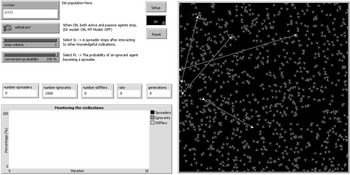
We used Netlogo 6.1.1 which is a multi-agent programmable modelling environment developed at Northwestern's Center for Connected Learning and Computer-Based Modeling (CCL) and authored by Uri Wilensky. ABM is accessible, editable and usable online at ModelingCommons.orgFootnote 1, a web-based application developed for sharing and collaborating Netlogo models by the CCL (Lerner et al., Reference Lerner, Levy and Wilensky2012). Any visitor can use the ABM and work it with different parameters by using the user-friendly interface, thanks to Netlogo Web (Fig. 1).
ABM interface with visual representation.

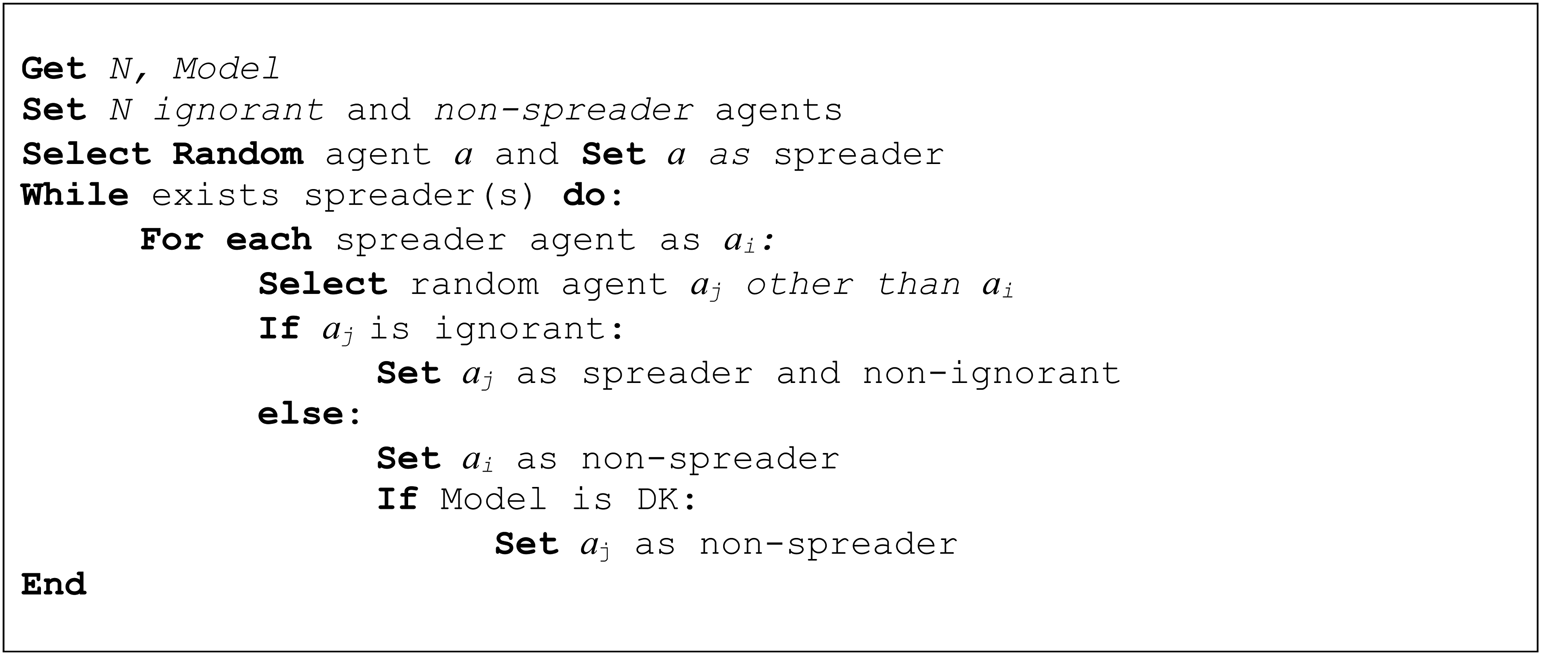
Figure 2 shows the algorithmic structure of basic DK and MT models. The model starts with N agents and all agents A = {a 1, a 2, …, aN} are initially ignorant and non-spreaders. A random agent gains spreading capability and simulation initiates. In every loop, each spreader agent (ai) reaches to another random agent (aj). If aj is ignorant, then it becomes a spreader and non-ignorant. If aj is non-ignorant, then ai converts to a stiffler. aj remains as a spreader in the MT model, but it converts to a stiffler too in the DK model.
Pseudocode of basic ABM.

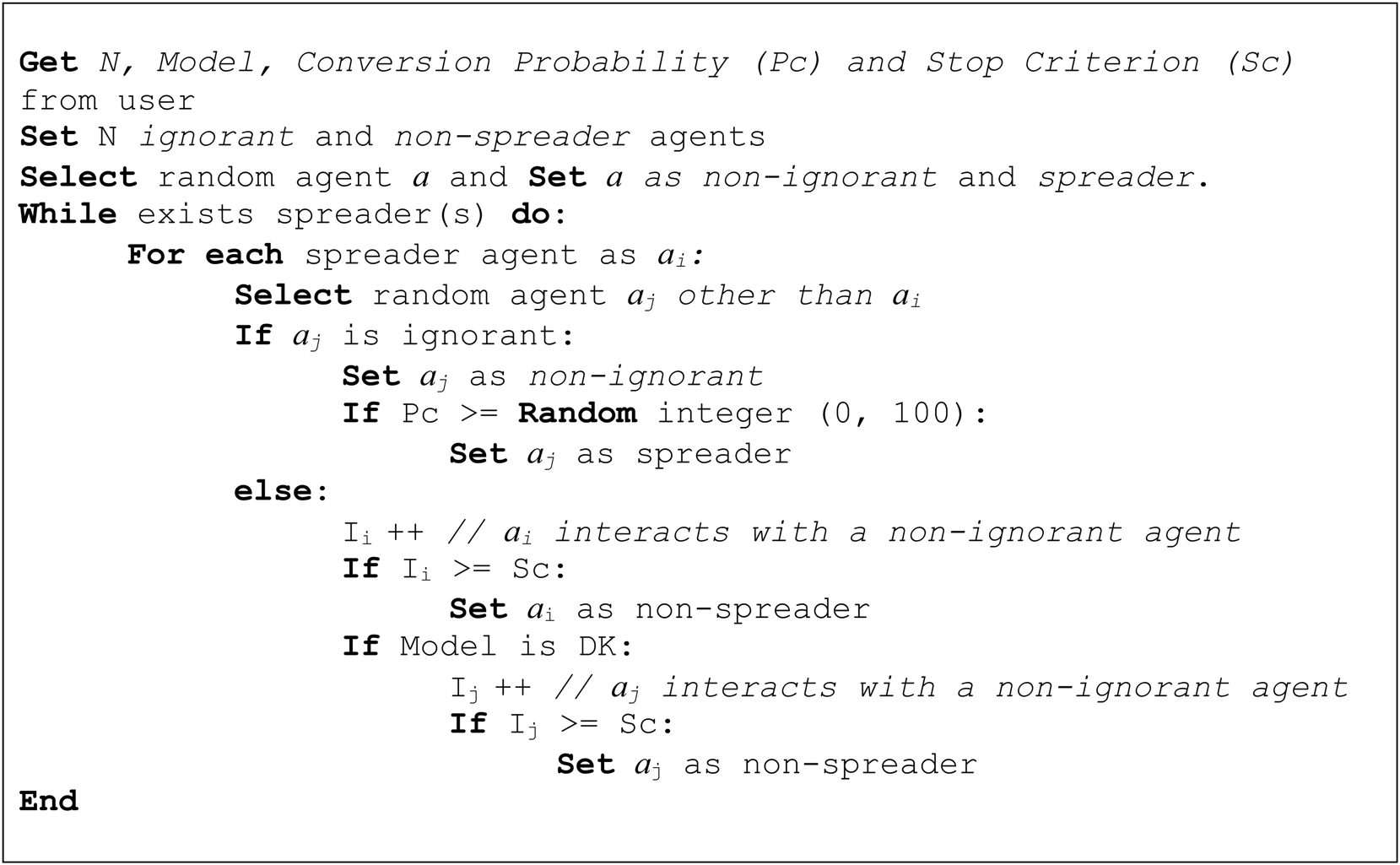
Basic models assume that all agents are eager to call new agents but they will give up calling after contacting with a knowledgeful agent (in other words, converts to a stiffler in the first interaction with a non-ignorant). We added two new features to make the models more complicated, such as (i) the conversion probability (the probability of being a spreader after communicating with another spreader), and (ii) the stop criterion (how many interactions Spreaders need for converting to a Stiffler).
The Conversion Probability (Pc) refers to the probability of being eager for searching more after informed but also it means ‘the rate of eager civilizations in the Galaxy’ at the same time. Some civilizations may have not passed an evolution path that leads them being curious and eager to communicate with others, or at least, we cannot be sure how much will they be eager to spend or capable on more resources on SETI. Making a new contact may be expensive because of the fact that it requires extensive time and resource usage, thus repeating this behaviour several times may not be preferable. They may avoid further contact because of a rationale which Kuiper and Morris (Reference Kuiper and Morris1977, p. 620) stated as ‘complete contact with a superior civilization (in which their store of knowledge is made available to us) would abort further development through ‘a culture shock’ effect’.
On the other hand, a civilization may continue to search for other civilizations, even so it communicated with one. Repeating SETI projects continuously may not be preferable due to limited resources. Hence, the ability to adjust the Stop Criterion (Sc) provides us with testing the different persistency levels of civilizations.
Figure 3 shows the enhanced model's pseudocode. Conversion Probability (Pc) and Stop Criterion (Sc) are requested from the user (default settings are the same as the basic model: Pc = 100% and Sc = 1). Interactions of agents with a non-ignorant, I = {I 1, I 2, …, IN} are also monitored and incremented with every spreader interaction of any agent.
Pseudocode of enhanced ABM.

Results
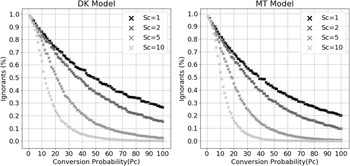
First, we ran ABM with 10000 agents under DK and MT settings, for each integer conversion probability from 1 to 100, Pc = {1, 2 … 100} and four stop criteria, Sc = {1, 2, 5, 10}.
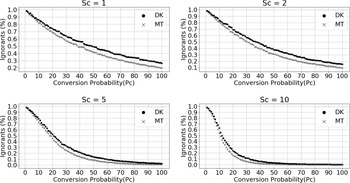
Figure 4 shows conversion probability against final ignorance rate for each stop criterion setting. As expected, ignorance rate converges to 0 with higher stop criterion and conversion probability.
Comparison between stop-criteria for each model.

Figure 5 shows the comparison of MT and DK models under the same stop-criterion conditions. Expectedly, the MT model always results in higher ignorance rates because not only the active agent but also the passive agent converts to a stiffler when stop-criterion is met. On the other hand, as seen at the lower right plot, under higher stop-criterion setting (Sc = 10), two models converge to each other, because the relative importance of the passive agent's converting to a stiffler decreases.
Comparison between models for each stop-criteria.

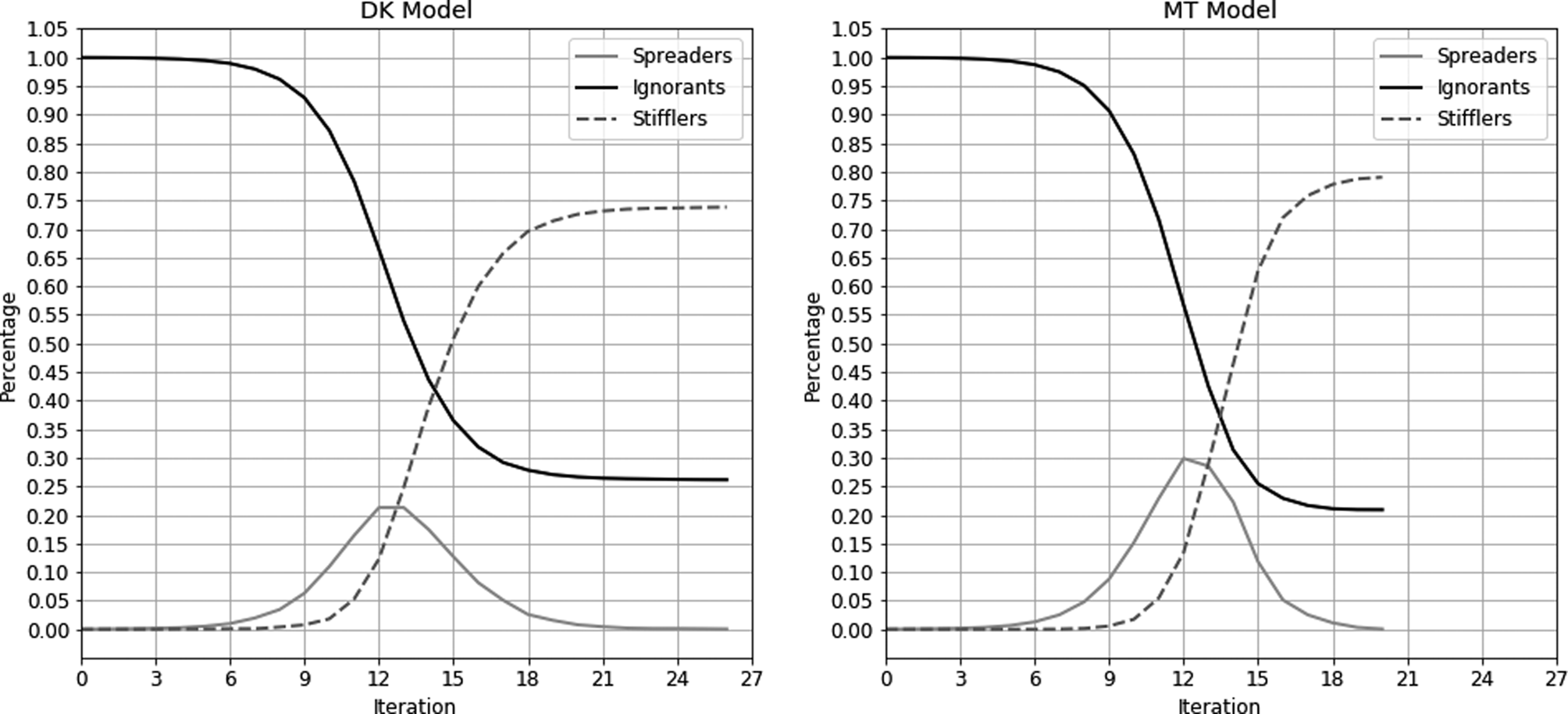
Then, we ran the ABM 40 times for 2000 agents with each binary combination of Sc = {1, 2, 5, 10} and Pc = {25, 50, 75, 100}. Figure 6 shows the population charts of basic models (with default settings). All agents are Ig initially, and simulation initiates when random one agent converts to an Sp. After a while, stifflers begin to emerge and the rate of stifflers increases until the end of the simulation, while spreaders reach the maximum and decrease again. At the end of the simulation, no spreader remains, and a part of the civilizations remains ignorant.
Change in rates of spreaders, ignorants and stifflers (Sc = 1, Pc = 100%).

Figure 6 shows the rate of all types of agents during the simulation with Sc = 1 and Pc = 100% settings. Due to the fact that the MT model's transition rate of spreaders to stifflers is lower than DK, the process ends fewer iterations and the maximum number of spreaders is greater than the DK model.
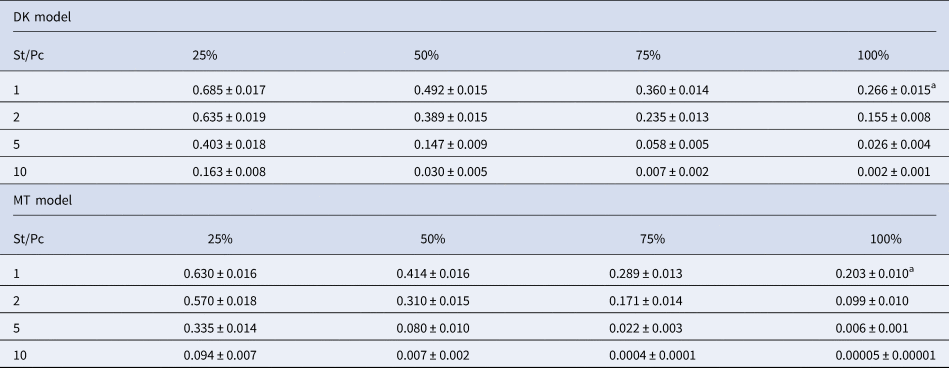
Table 1 summarizes mean and standard deviation values of final ignorance rates in both DK and MT models' settings. Horizontal percentages refer to the conversion probability of an Ig to an Sp upon receiving a call, while each row shows the stop criteria values.
Statistics for DK and MT model

a Original settings.
There is a confusion in the literature about the solution of DK and MT stochastic models. The final ignorance rate of the DK model was reported to be 0.203 by Daley and Kendall (Reference Daley and Kendall1965) and subsequent papers in the literature (Pearce, Reference Pearce2000; Belen and Pearce, Reference Belen and Pearce2004). Maki and Thompson (Reference Maki and Thompson1973) reported an ignorance rate of 0.238 in their original paper and this result was repeatedly cited by subsequent papers. Watson (Reference Watson1987) reported that both settings have the same final ignorance rate ( = 0.203) with having different variances due to the number of agents. Belen and Pearce (Reference Belen and Pearce2004) also claimed that the resultant ignorant ratio of the MT model must be same as the DK model ( = 0.203) and previously reported value of 0.238 might be a product of typographic error.
However, we found 0.203 with original MT settings and 0.266 with original DK settings. It seems that Watson (Reference Watson1987) and Belen and Pearce (Reference Belen and Pearce2004) are right with saying that ignorance rate under the original MT model conditions must be same as DK, but our finding for the DK model is quite higher than the MT model. The development of processes given in Figs. 4 and 5 also supports this, at all phases of the processes.
In fact, it is expected that the maximum rate of spreaders in the DK model must be lower than the MT model, because the amount of ‘converting to stiffler’ is higher than the MT model due to the fact that both active and passive agents convert to stiffler when interacted. As obviously indicated in Fig. 6, the rate of ignorants keeps decreasing quite steeply, while the rate of stifflers is increasing in the same fashion in the MT model, against the increasing rate of spreaders relatively higher than the DK model.
Conclusion
Rumour spread models have some limitations such as ignoring the travel-time of news and so not taking the distances into account, but it can provide us with a basic insight. In this study, we adapted two rumour spread models to interstellar contacts by developing an ABM and enhanced the ABM by adding two additional parameters called conversion probability and stop-criterion. We can find parallels with the assumptions in the workings of the theoretical and simulation results of the spread of stochastic rumours and contacting interstellar civilizations (if any) in the Galaxy. Hence our findings suggest that, if civilizations limit their SETI searches after joining ‘the Galactic Club’, some civilizations in the Galaxy may still remain uncontacted.
Today, we sometimes learn from the news that thousands of people still live in uncontacted tribes, completely ‘away’ from our modern civilization even in our hyper-connected world. We humans do not spend any special effort to search new uncontacted tribes and we simply assume that all (required) communication lines were already established. By adapting rumour models, we speculate that the civilizations will cease or limit their SETI research because they are already included in an advanced communication network, just like the spreaders' behaviour in rumour models. Therefore, if rumour spread models are assumed as well-representing models of the galaxy-wide communication, it is clear that the advancement of the communication network throughout the Galaxy is still not guaranteeing everyone to be found by others.
This case can also be in line with the Fermi-wise consensus that life is teeming in the Milky Way and Universe, and we may be quite unlucky to be not contacted until now. It is possible that we may still be waiting to be discovered (finally) as a conclusive answer to FP. One obvious solution to FP is ‘They do not communicate’, which speculates that most of the civilizations are choosing to be a listener rather than being a transmitter (Forgan, Reference Forgan2019). It is possible to add an additional solution to the master list, by modifying ‘They do not communicate’ as ‘They do not establish new contacts anymore’, bringing the simultaneity problem for contacts among civilizations at different phases of their ‘developments’.