Introduction
One consequence of the globalisation of the modern world in recent years has been to focus historical interest on human migration and movement. Sociologists and historians have argued that mobility is much more characteristic of past historical eras than we might expect given our modern nationalistic perspectives. Their works claim, perhaps with a touch of overstatement, that mobility rather than fixity was the norm in most pre-industrial societies. For example, in a fascinating ‘manifesto’ on the subject Greenblatt has argued that cultural mobility is characteristic of most pre-modern societies.Footnote 1 Such studies draw our attention to the artificiality and modernity of modern national boundaries, and the need to imagine a world without the bureaucratic accoutrements of the modern nation-state. Various studies have applied these ideas to antiquity; Horden’s and Purcell’s Corrupting Sea has been particularly influentual.Footnote 2
This article aims to contribute to this subject by surveying some of the evidence for mobility in central Italy and by examining its implications for early Rome. I will focus primarily on the plebeian movement, which is normally seen in terms of an internal political dispute. Our understanding of the ‘Struggle of the Orders’ is conditioned by the idealising view of our literary sources, which look back on the early Republic from a period when the plebeians provided many of the key members of the nobility. They generally emphasise the validity of plebeian demands, their peaceful means in securing these demands, and the measured compromises which were reached as a result. The ‘Struggle of the Orders’ is thus seen as a stage in the maturation of the full classical Republic, eventually reached with the admission of the plebeians to the magistracies and priesthoods, and the recognition of the decrees of the plebeian assembly.
However, if we see the plebeian movement in its contemporary central Italian context, it emerges as much more threatening and potentially subversive. The key plebeian tactic – secession from the state – is often regarded as little more than a military strike. Instead, I argue that it was a genuine threat to abandon the community, and secessions can be seen as ‘paused migrations’. Other episodes in early Roman history reflect this possibility and support this picture. I am going to look at two in particular, the migration to Rome of Attus Clausus and the Claudian gens, and the proposed move to Veii by the plebs.
Mobility as a Pervasive Feature of Early Rome and Central Italy
The term ‘mobility’ is used in scholarship on central Italy in a variety of ways. There are two main types of mobility that are relevant. The first is physical migration, between states or ethnic groups (the latter tend to be easier to spot in the evidence). This is sometimes called horizontal mobility. We also encounter social mobility, which is sometimes called vertical mobility. These movements involve a change in domicile or a change in status. But sometimes we are talking about both and often the two go together. Frequently migrants changed their name on moving, especially when they moved from one language group to another.
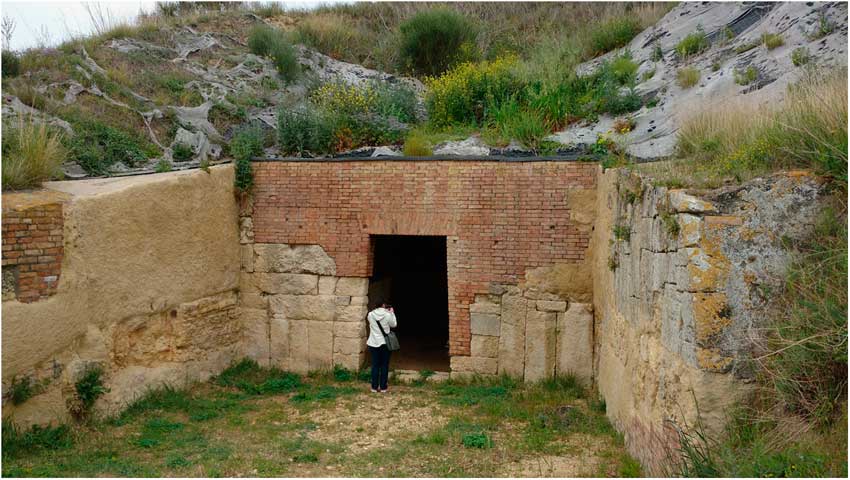
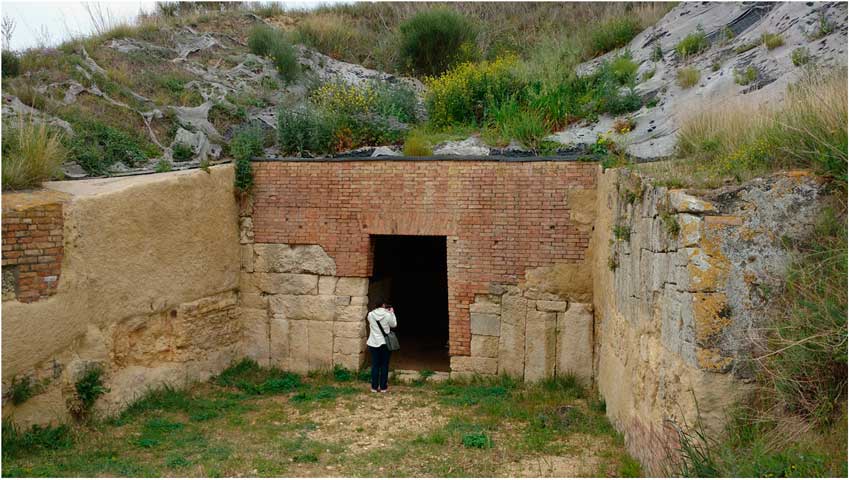
The idea of mobility as a pervasive feature of early Rome and central Italy has been well established since the pioneering studies of the 1970s by Carmine Ampolo.Footnote 3 These showed that there were many examples in the epigraphy from central Italy of members of the elite present in communities who originated from elsewhere. One famous example comes from the spectacular Tumulo del Re in Tarquinia (fig. 1). The probable occupant of the tomb, Rutilus Hippokrates, had a mixed Latin and Greek name, despite belonging to the Etruscan elite.Footnote 4 Ampolo drew attention to the parallel stories in the literary sources of migrant figures, such as Tarquinius Priscus, the fifth king of Rome. He is said to have been of Greek parentage and to have moved to Rome from Tarquinia, changing his name from the Etruscan Lucumo to the Latin Lucius Tarquinius. His family thus passed through Greek, Etruscan, and Latin cultural worlds, the mirror image of Hippokrates. Ampolo hypothesised that the elite in this period were easily able to move from place to place, aided by networks of guest friendship akin to those we find in Homer’s Odyssey, and seemed to be able to retain their social status in their new abode, a type of ‘horizontal social mobility’. Ampolo regarded this as characteristic of the Orientalising and Archaic periods, when state structures and senses of ethnicity were only weakly developed.
Monumental dromos of the Tumulo del Re, Tarquinia
This mobility is widely attested in Etruscan epigraphy. Some interesting attestions of mobile Etruscans come from Latium, for example.Footnote 5 There are a range of Etruscan inscriptions which show Etruscans dedicating items or owning items buried in tombs in Latium. For example, in the Bernardini tomb in Latin Praeneste a silver cup, on which is inscribed Vetusia (probably in Etruscan) under the rim, may document the Etruscan owner of this high status tomb. A dedication from Satricum on a bucchero cup, which reads [Laris] Velchaina, exactly matches the name on an identical bucchero cup from Etruscan Caere. And a bucchero amphora from a chamber tomb in Lavinium carries the inscription mini m[ulu]vanice mamar.ce a.puniie (‘Mamarce Apunie gave me’),Footnote 6 which is almost identical to a dedication on a bucchero olpe found at the Portonaccio sanctuary of Veii, c. 570 BC.Footnote 7
There are also many contemporary examples found in Etruscan epigraphy of individuals with newly constituted gentilicial names, sometimes drawn from place-names to indicate origin. The Etruscan city of Volsinii offers many cases from the epigraphy of the main city cemetery, the Crocefisso del Tufo.Footnote 8 Around 60% of the burials belong to individuals with names of Etruscan origin, and around 40% have names of apparent Italic origin (either Umbro-Sabine or Falisco-Latin). There are also a couple of isolated examples of names with Greek origins (e.g. Achilena, from Achilleus), and Celtic origins (e.g. Katicina, an Etruscanised version of Catacus).
Etruscan tesserae hospitales, tokens of hospitality relationships, are also revealing in this light. There is now a small corpus of seven Etruscan examples from Rome, Carthage, and Murlo. The examples from Rome and Carthage show Etruscans in relationships of hospitality with Sulcis in Sardinia and with a native of Carthage.Footnote 9 From Murlo we have a cache of five examples from a late Orientalising building that probably show the contacts of the leading figure with members of the elite in other Etruscan cities.
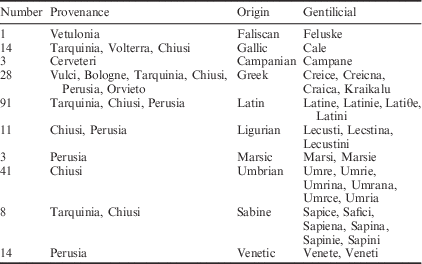
Recent reappraisals of this topic have demonstrated just how comprehensive the evidence is in the first millennium BC, and that this high level of mobility extended from the Orientalising period through the republican period.Footnote 10 For example, a large number of immigrants (or the descendants of them) are visible in Etruscan cities due to gentilicial names that derive from their place of origin (either other cities, both inside and outside Etruria), or from their ethnic group.Footnote 11 The latter are particularly interesting, revealing Latins, Umbrians, Greeks, and various other Italics incorporated as immigrants (see table 1). The high proportion of Latins who adopted Etruscan names is striking. They must have found homes in Etruscan cities and were probably bilingual.Footnote 12 High levels of private mobility thus seem to continue well beyond the Orientalising and Archaic periods.
Etruscan gentilicials derived from ethnic names (Bourdin [Reference Bourdin2012] 1055-6)
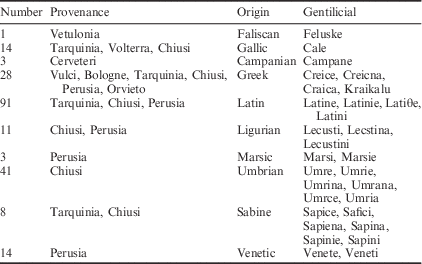
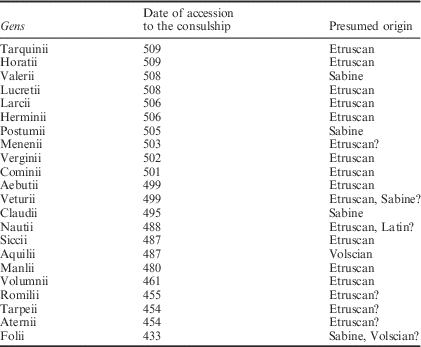
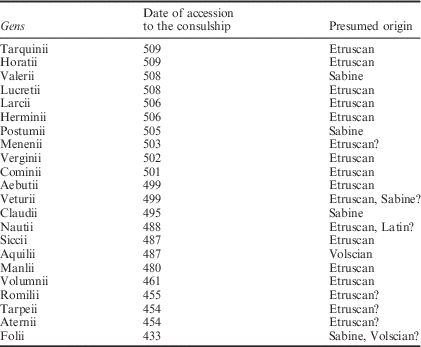
Unfortunately this mobility is less visible elsewhere in central Italy, as other regions lack the epigraphic corpus that exists for Etruria, and Latins moving to Rome would not need to change their names in this way. Nevertheless, a good case can be made that this is also a relevant model for Rome. It is well known, for instance, that there are many names in the consular fasti with foreign origins: Ranouil thought he could identify 22 families among the patricians that were of non-Latin origin (see table 2 below). Although this is optimistic, and some of his identifications seem mistaken (for example the Aquilii are Etruscan, not Volscian), it nevertheless suggests a substantial external element in the Roman elite.Footnote 13 Some individuals had cognomina formed from place names, such as Auruncus (cos. 501, 493 BC) and Sabinus Inregillensis (cos. 495 BC). Other cognomina suggest external origins of an earlier date, from areas associated with regal military activity, such as Amintinus, Camerinus, Medullinus, and Mugillanus. Although we do not know the date of their movement to Rome, and there is debate about the historicity of cognomina in this period, this evidence seems to show the full integration of these foreign gentes into the Roman elite, to the extent that they even held magistracies.Footnote 14 Torelli has characterised Rome as the mirror image of Volsinii.Footnote 15 Both can be seen as frontier cities, with a high proportion of incomers. Whereas Volsinii was a predominantly Etruscan city with many Italic immigrants, Rome was a Latin city with many Etruscan immigrants.
Patricians of presumed foreign origin (Table 28, Bourdin [Reference Bourdin2012] 543-4, from Ranouil [Reference Ranouil1975])
As is clear from these examples, in tracking such movements scholars have tended methodologically to rely on the evidence of onomastics, the study of names, generally preserved in epigraphic form. Onomastics remains a controversial source of evidence, and names are often ambiguous to interpret. The great study of early Italian names was Schultze’s Zur Geschichte lateinischer Eigennamen, published in 1904. This confidently assigned origins to a whole series of ancient names. But its conclusions have been severely criticised and it is evident, for instance, that Schultze overestimated names of Etruscan provenance. Recent studies have been more scientific, given the great accumulation of new epigraphic data, and more cautious in their conclusions. They have demonstrated that the adoption of names of apparent external origin is not necessarily a clear sign of recent immigration: some apparently Italic forms of gentilicial names in Etruscan, such as Peticina, may have had a long history and may have been married up to an Italic-derived Etruscan forename to emphasise links with ancestors rather than making a direct statement about one’s own origins.Footnote 16 Nevertheless, even this more cautious approach has reinforced the idea of widespread mobility.Footnote 17
Our picture, then, is of inter-community movement being a fundamental feature of central Italy from the Orientalising period into at least the fifth and fourth centuries BC, the time of the early Roman Republic. Although our evidence for Rome is less good than for some of its neighbours, the presence of Latins in neighbouring societies makes reciprocal movement into Rome highly likely. Of course we should not overstate the idea of mobility. It was a phenomenon in the context of permanently settled communities, sedentary on the same sites from the early Iron Age, if not earlier (from the middle Bronze Age in the case of Rome, as we now know). There was a pastoral element to the economy of central Italian communities, but they were not nomadic. Archaic Rome in fact had a mixed economy and, on the whole, the evidence suggests the prevalence of agriculture over pastoralism.Footnote 18 Crops such as olives, fruit trees, and vines (attested from at least the seventh century BC in Rome and Latium) require long-term investment and cultivation before harvesting. So these are organised societies with a high level of permeability to outsiders, unlike modern states with frontiers that control movement.Footnote 19
The Plebeian Movement
I argue that we should understand the plebeian movement in the context of this mobile environment. In part this is already established for the origins of the plebs. The emergence of the plebs must be linked to the increasing size of the population in the sixth century BC.Footnote 20 The plebs never seems to have been a closed group, in contrast with the restrictions on the patriciate or with citizens in Greek states such as Sparta or Athens. This is a characteristic feature of the central Italian environment, and one which led to the long-term increase in Rome’s population. Furthermore, links with Greek cities must have lain behind the political aspirations of the movement and seem reasonably securely attested.Footnote 21 I also think that the plebeian tactic of secession, withdrawal from the city, is connected to mobility. Whilst the possibility of the plebs migrating is sometimes alluded to, modern scholars seem more concerned with the historicity of the secessions and often seem to take the action itself for granted. Admittedly, there are serious issues with the literary tradition. We will turn to the attestations of the secessions now.
Three secessions are attested in the canonical version of early Roman history, as presented in Livy and Dionysius of Halicarnassus. They led to the patricians conceding a range of measures in favour of the plebeian organisation. The First Secession is said to have taken place in 494 BC to the Sacred Mount, a hill north of the Tiber and approximately 5 kms from the city. The story of the First Secession in Livy and Dionysius begins with a debt crisis in the community, as a large portion of the plebs had become indebted and subject to creditors’ abuses. An army was enlisted to fight against the Volsci, Aequi, and Sabines, but then refused to go to war, diverting to the Sacred Mount north of the city. There the plebeians under military oath were joined by the mass of the plebeian city-dwellers. Various discussions took place and eventually peace was restored between the Senate and the plebeians, with the latter being allowed to elect plebeian tribunes for the first time.Footnote 22 The Second Secession is dated to 449 BC and was associated with the ending of the Decemvirate. This was a board of 10 men appointed to replace the existing magistrates and draw up a law code for Rome. When the Decemvirs started to behave in a tyrannical fashion, the plebs sought to overturn the regime. Those serving in the army at first assembled on the Aventine hill in the south of the city, and then ultimately withdrew to the Sacred Mount again. The story of the Second Secession in particular comes down to us in a highly complex and somewhat dubious narrative tradition. It is a story woven around exemplary figures such as the tyrannical Decemvir Appius Claudius and the maiden Verginia.Footnote 23 Finally, in 287 BC, in the most poorly attested of the several episodes, the Third Secession of the plebs took place when the plebeians withdrew to the Janiculum hill. They only returned when they had secured a final concession, the right of the plebeian assembly to pass laws fully binding on all the population of Rome. The sources for the Third Secession suffer less from obvious problems, in part because there is so little information on it and because we have lost Livy’s narrative for this period.Footnote 24
The sources provide a range of variant traditions on the destination, date, and number of the secessions. The main tradition identifies the destination of the First Secession as the Sacred Mount, in the district of Crustumerium, between the Anio and the Tiber.Footnote 25 A variant version, less common according to Livy, identified the Aventine as the destination.Footnote 26 The Livian tradition indicates that there were two further secessions, one in 449 BC to the Aventine and Sacred Mount and a further one in 287 BC to the Janiculum. Other sources give different numbers, but it is not clear that they represent more authoritative traditions.Footnote 27 Some authors have argued that a notice in Diodorus (11.68.8) indicates that the First Secession really took place in 471 BC; but Diodorus merely reports that this was the first time four, rather than two, tribunes were elected. Our sources also differ on the names of the first elected tribunes and Livy notes that some versions have only two tribunes elected in the first instance.Footnote 28
Some of the details of the account may also be problematic because of later distortions. The parallels between the secessions and the withdrawal of C. Gracchus to the Aventine raise questions about whether the latter provided the model for the former.Footnote 29 The parable of the parts of the body told by Menenius Agrippa to convince the plebs to return to Rome and resolve the crisis drew on early Greek fables, as Dionysius recognised (Ant. Rom. 6.83.2); the severe role of the Claudii as archetypal villains in both the First and Second Secessions, in contrast with the very positive role attributed to the Valerii, has generated suspicions that Valerius Antias has had a distorting effect on the history of his ancestors.Footnote 30 In contrast, details such as the role of debt in the ‘Struggle of the Orders’ seem more plausible.Footnote 31 The lex sacrata passed by the plebeians, a sacred law (of protection for the tribunes) that probably originated as an oath, also seems plausible. This is a typically Italic phenomenon and it has military overtones; it was said to have been used by other Italic peoples such as the Samnites to levy troops, and in the context of the Sacred Spring rite.Footnote 32 According to Dionysius (Ant. Rom. 6.89.3), the oath sworn by the plebeians included the dedication to Ceres of the goods of anyone who violated tribunician sacrosanctity. The cult of Ceres was one with Campanian links and, soon afterwards, in 493 BC, the goddess was honoured with a temple on the Aventine to Ceres, Liber, and Libera, an innovative Roman mix of Italic deities. The oath to Ceres thus fits well in an early republican context, rather than being a later invention.Footnote 33 The plebs could possibly be understood as a group akin to the mobile armed bands of the Archaic period, devoted to a particular tutulary deity and potential founders of a new community on land that they conquered.
The historical issues with the secessions have been discussed at some length in modern scholarship. There is a wide spectrum of views. Most authors accept the historicity of the last secession in 287 BC and take a range of positions on the earlier secessions, from complete scepticism to cautious acceptance. Modern authors have particularly questioned the authenticity of the early secessions. Some have regarded the repetition of secessions as suspicious and doubt that the social struggle would have been ongoing for over two centuries, with the plebeians seemingly taking an extraordinarily long time to achieve their ends. On this interpretation, the earlier secessions were modelled on the secession of 287 BC, which has much more chance of being historical, given that it was within a few generations of the first Roman historian, Fabius Pictor, who was writing in the late third century.Footnote 34 Others have argued that the narrative is unbelievable and modelled on Greek stories. Forsythe claims that the First Secession was likely to have been modelled on the Herodotean story of Telines, ancestor of Gelon (Hdt. 7.153).Footnote 35 In this story, Telines brought back a group banished from Gela due to civil strife, using the sacred power of ritual objects; Telines’ descendents, as a result, became priests for life. However, this story is very sketchily outlined in Herodotus and provides only a weak parallel with the Roman story. In fact, the unique aspects of the secessions are much more striking. I would instead argue that the first two secessions are historical, even if their details are problematic, and that they should be understood in the context of widespread inter-community mobility. The Third Secession occurs considerably later, and involves a different venue much closer to Rome and an apparent military threat to the city. It therefore seems to have been a different type of event from the first two, or at least not an appropriate model for them.
Overall, the unprecedented nature of the story, and the general unanimity of the traditions on the broad lines of events, support the historical nature of the First and Second Secessions.Footnote 36 As Lintott has noted, the pecularity and distinctiveness of the events of the plebeian secessions, which saw intense political strife but did not lead to violence, make it unlikely that they were modelled on stories of stasis in Greek states. The uniqueness of the events is in fact a powerful argument in favour of their authenticity and not, as Forysthe takes it, a sign of invention.Footnote 37
Modern views of what a secession signified vary widely.Footnote 38 For Mommsen, the First Secession ‘threatened to establish in this most fertile part of the Roman territory a new plebeian city’.Footnote 39 For others, this was potentially a rival state that might join Rome’s enemies, given that many of the plebeians originated elsewhere.Footnote 40 The secession is defined in standard reference works as ‘technically a withdrawal from the state’ (Oxford Encyclopedia of the Ancient World) and an ‘extreme form of civil disobedience’ which ‘implies detachment from public life as well as emigration from Rome’ (Oxford Classical Dictionary). Other authors have been more cautious, arguing that it was clearly distinct from a defection, and the plebeians were keen to ensure that they remained part of the Roman state.Footnote 41
The contrary nature of these views is in part determined by disagreements over who the plebeians were at this point in time, which in turn reflects the complexity of the sources’ picture. Ogilvie argues that the plebeians were, for the most part, craftsmen and businessmen, recent emigrés, lacking a patron’s protection (which somewhat contradicts the image in the sources of impoverished farmers).Footnote 42 For Momigliano, the plebs largely belonged to the infra classem, the group lacking the property qualification for service in the army. This explains why plebeian demands were not immediately met and why Appius Claudius disparaged the commitment of the plebs to war.Footnote 43 But this interpretation also meets the difficulty that the sources unanimously link secession with military strike, which was provoked by the debt crisis. Richard argued that the secession must have been primarily the work of citizen soldiers, who allied with the infra classem and nexi. He argued that the adsidui were the key group affected by the agrarian crisis and the issues of the proletarii were secondary.Footnote 44 Along similar lines, Raaflaub argued that the secession must have been mainly made up of hoplites, heavily armed infantry. He thought that the power of the Roman elite, visible through the central Italian tombs of their peers and manifested in their rigid sacred control, explains the slowness of the reform process that resulted. He also asserted that the institution of the tribunate was a very dramatic concession, which implies that the plebeian power of extortion was considerable. In fact, the secession is best explained if the plebeians are seen as a mixed group, with a substantial military element, reflecting a complex economy in Rome.Footnote 45
If we therefore accept the secessions as authentically remembered events of early Roman history, how do they fit in an environment of mobility? The secessions are often seen in terms of a military strike, but a more substantial threat of leaving the community completely is implicit.Footnote 46 In the context of regular and easy migration, the act of secession implies the potential of a group to ‘up sticks’ and move to another place en masse. Secession was therefore not just a military strike, but also a kind of ‘paused migration’. In fact, the sources clearly refer to it in these terms on several occasions. In his account of the First Secession, Dionysius (Ant. Rom. 6.47.1) describes the patricians as worried that the plebs will defect to the enemy. Once the secession had been established on the Sacred Mount, the plebs remaining in the city began individually to slip away, openly and secretly, to join the movement (Dion. Hal. Ant. Rom. 6.48). Most strikingly, Dionysius has the plebeian leader Junius Brutus (not the consul of the same name) suggest in a speech that they should leave Rome and found a colony elsewhere.Footnote 47 On another occasion, when further civil strife had broken out (471 BC), Livy describes the Volsci as aiming to encourage a secession of the plebs to their side.Footnote 48
How far these annalistic views reflect fifth century conditions is uncertain.Footnote 49 Given that these are speeches or attributed feelings, it would be unwise to take them as firm evidence of historical reality. Nevertheless, they show that both Livy and Dionysius, and probably their sources, thought that secessions could lead to permanent migration to an enemy of Rome, which is an idea in striking opposition to their general construct of Roman history in the fifth century BC. This period is portrayed as one of continual battle between Rome and enemies such as the Volsci and Aequi, as a veritable struggle for survival, and whatever the realities of that historical vision (it is notable that the size of Rome implies that it had far superior demographic resources), the potential defection of the plebeians would nonetheless be a strange spectre to raise in this context.
Other evidence suggests that the idea of withdrawing from one community and transferring to another is a credible one for the Archaic period. The idea that secession can shade into migration or colonisation is preserved in later sources. Servius distinguishes colonies founded by public agreement from those founded through secession.Footnote 50 An example of the latter is the plan by a Roman garrison to seize control of Capua in 342 BC, a curious episode that almost develops into a secession. Although Livy (7.38-42) does not present it as a formalised secession like the others, the plebs still won various concessions from the Senate. In an article on early colonisation, Bayet called these movements ‘armed secessions’.Footnote 51 Some were successful in establishing what we could term a ‘colony’, such as the Mamertines at Messana in the 280s BC. In one version of the Mamertines’ story, they left their homeland and came to Messana in a Sacred Spring, echoing the sacred oath of the plebeians.Footnote 52 Secession as an option or tactic was thus linked to the broader context of general mobility and could amount to a real threat to withdraw from the community on a permanent basis and take up residence elsewhere.
Our understanding of these movements is hampered by the anachronistic approach of our much later sources. As many commentators have shown, they tend to reinterpret the early Republic in terms of their own day. Episodes of mobility are classified by them in the terminology of the late Republic, using concepts such as colonia and secessio. But we should be alert to the idea that such classifications are misleading and that types of mobility, unofficial and official, merge into one another. This is particularly evident in the sphere of colonisation, where the term ‘colonia’ is applied to a wide variety of different communities that came under Roman control in the early Republic and received varying numbers of settlers or garrisoning soldiers.Footnote 53
Ultimately then, even if we consider it impossible to recover plebeian intentions in the secessions, the act of moving out of Rome within the highly mobile environment of fifth century BC Italy has dramatic implications. Although our understanding of the nature of the threat is hindered by the successful resolution of the disputes and by the extreme hindsight of the sources, one implication must have been that the plebs could move off and found a ‘colony’, which might be in ‘enemy’ territory.
The Migration of the Claudii: a Secession in Reverse?
Important support for this picture comes from other evidence. In 504 BC the founder of the Claudian gens, Attus Clausus (who is variously named in the sources) was said to have migrated from Regillum in Sabinum to Rome, accompanied by a large number of his followers. He supposedly left Sabinum due to pressure from his political opponents over his (peaceable) stance on war with Rome. Attus was adopted into the Roman patriciate and his followers were allotted land between Fidenae and Picetia. This district became the Claudian (voting) tribe and Attus, changing his name to Appius Claudius, became a leading member of the senatorial elite and held the consulship in 495 BC. This story is thus not only an archetypal example of the mobility of elite figures and their entourages, but also a ‘reverse secession’, a movement by seceders to Rome as a result of a political dispute, even if the sources do not use the term secessio to describe it.
This much of the story is supported by a whole range of sources, including Livy, Dionysius, Plutarch, and Appian, although there are a number of issues with particular aspects of it.Footnote 54 Concerning the date of the migration, Suetonius records a variant that Clausus migrated at the time of Titus Tatius, although he states that this is less commonly held than the version recorded by Livy and others in which he migrated in the early republican period. This variant version is also referred to in Virgil (Aen. 7.706-709) and may be an Augustan invention.Footnote 55 Servius, in his commentary on Virgil, relates Clausus’ migration to the more common date of 504 BC and thinks only that the last part of this section of Virgil’s Aeneid relates to the earlier Romulean period. Ogilvie argues that the tradition that the Claudii came to Rome in the republican period must be wrong, as they were patrician and so must have been created under the monarchy.Footnote 56
The name of the original Claudius is variously reported in the sources as Titus Claudius (Dionysius), Attius Clausus (Livy), Attus Clausus (Tac. Ann. 4.9), Appius Clausus (Plutarch), and Atta Claudius (Suetonius – the most authentic version according to Bourdin). Livy states that he changed his name from Attius Clausus to Appius Claudius when in Rome, and this is the designation by which we know him as the consul of 495 BC. Name changing is something of a topos, echoing the story of the Greco-Etruscan Lucumo who, as noted above, adopted the name Lucius Tarquinius on migrating to Rome around a century earlier. But this motif is also potentially authentic, given that we come across a wide range of invented names in Etruscan epigraphy, as we have seen. Some authors have questioned the authenticity of the name, pointing out that it is odd that Attius is a distinct Italic name from Appius and claiming that it might in fact be Etruscan.Footnote 57
Epigraphic evidence shows other figures with the name Claudius in different ethnic contexts. The name Klavtie, probably an Etruscan version of Clausus/Claudius, is recorded in an Etruscan inscription on a red figure kylix discovered in the cemetery of Aleria (Sardinia), dating to c. 425 BC. Another inscription records the name Clavtie in a tomb at Caere from the late fourth century BC. These inscriptions have inspired some scholars to hypothesise that these Etruscans belonged to the same Roman gens and moved via Caere to Etruscan dominated Aleria. Others point out that the Etruscan figures may have shared nothing with their Sabine and Roman counterparts beyond their name.Footnote 58 This is possible, but the similarity of some names (some of which are, in fact, identical) found in different ethnic contexts suggests they are linked. The presence of Claudii elsewhere is paralleled by the presence of Fabii, Aquilii, Plautii, and many others in Etruscan and other central Italian contexts. These apparently ‘Roman’ elite families were linked to, or part of, broader clan groups that might have moved from city to city, and left dedications in diversely located sanctuaries (e.g. the Aquilii/Acvilnas present in Rome, Vulci, and Veii in the early fifth century).Footnote 59 An in-depth study of the name by Keaney has recently argued that Clausus was an authentic Sabine name. Whilst the name is present in Caere and elsewhere in central Italy, this does not discount the Roman story of Attus’ Sabine origins.Footnote 60
Our sources emphasise the numbers of followers that Attus bought with him, and generally agree on a figure but not on what it represents. Livy and Suetonius both talk of a large number of clients. The other sources are more specific, specifying 5,000 relatives, friends, and clients in total (Appian, Servius) or 5,000 adult males and their households (Dionysius and Plutarch). The sources thus differ on the precise details, although they are in agreement that Attus’ entourage included not just military-aged males, which strengthened Rome at an opportune time given the forthcoming hostilities with the Sabines, but also other followers (particularly clients), and perhaps whole families. Some modern scholars have been sceptical of this aspect: the round nature of the figure raises suspicions, and it is implausible that such figures were recorded at the time. Raaflaub in particular argues that it ‘clearly represents a retrojection’ on the basis of the large numbers of followers of nobles of the late Republic, and is incompatible with the low modern estimates of the total population.Footnote 61
However, these are unreliable grounds on which to question the idea of a substantial entourage per se,Footnote 62 and other scholars have been more willing to accept this aspect of the story. A large number of followers is presupposed by the creation of the new Claudian voting tribe and there are many contemporary parallels for military leaders accompanied by bands of clients, such as Publius Valerius on the Lapis Satricanus, and the Fabii with their clients at the Cremera in 479 BC.Footnote 63 This also includes the famous example of Coriolanus, who defected from Rome to the Volsci.Footnote 64 Although a heavily romanticised saga, the story of Coriolanus probably reflects the archaic reality of widespread horizontal mobility between communities.Footnote 65 It also accords with the presence of Volscians in early Roman colonies. Other stories show that this type of transfer for military purposes occurred elsewhere, with generals such as Aristodemus of Cumae leading foreign forces.Footnote 66 The most striking parallel is with the failed attempt to take Rome by the Sabine leader Appius Herdonius, who is said to have attacked with a force of 4,000 or 4,500 clients in 460 BC.Footnote 67
The sources have Clausus leave Sabinum due to political problems. According to Livy this was the result of a schism (seditio) between a war party and a peace party. Clausus was accused of favouring Rome and, in a (late republican?) detail added by Dionysius, under threat of prosecution. This led to his flight to Rome, where he was well received. In Plutarch this is due to the manoeuvrings of Valerius Publicola, which Wiseman has suspected of being a distorted, Valerian perspective introduced by Valerius Antias.Footnote 68 Clausus was made a patrician and given a large plot of land (25 iugera according to Plutarch), and his followers settled on smaller plots (distributed by Publicola in Plutarch’s account, but by Clausus in Dionysius’) in the area north of Rome between Fidenae and Picetia. Claudius, as he now was, became consul in 495 BC and ‘the chief man among the leaders of the aristocracy’ (Dion. Hal. Ant. Rom. 6.24). In this way Appius founded the Claudian gens at Rome.
The original story presumably emanates from the collective memory of this gens and their family records. We know that this genealogical legend of the Claudii’s Sabine ancestors was replayed at the funerals of Julio-Claudian emperors and its dramatisation in the republican funerals of the Claudii will have fixed it in Roman consciousness.Footnote 69 But it is notable that the story has a distinctly different feel from the much more elaborate and dramatised nature of the saga of Coriolanus, which seems much more likely to have stemmed from an oral tradition of the kind celebrated in banquet songs.Footnote 70 The Claudian migration is likely to have been anchored in Roman history by various facts recorded in official records. The creation of the Claudian tribe will have been recorded in pontifical records and Appius Claudius was recorded in the consular fasti for 495 BC.Footnote 71 Furthermore, Appius plays a major role in the plebeian disputes of the next few decades, which it is interesting to note is not linked in the sources to his migration or foreignness. His political role implies bilingualism, which accords with other attestations of linguistic ‘code-switching’ in the archaic context such as the archaic Etruscan inscriptions found in Latin-speaking Rome. As Bourdin observes, ‘l’integration de ce “prince” sabin est immédiate et totale’.Footnote 72
Therefore there are good reasons to accept as authentic the story of the migration of Attus Clausus, accompanied by a group of followers.Footnote 73 Some details are likely to be elaborated and debatable, such as the precise number of his followers. The confusion amongst the sources over aspects, such as the precise name of Attus Clausus, may suggest elaboration in oral source material. But migration across ethnic borders with a large group of followers is attested by all the sources, and fits the late sixth century context. It is also plausible, given the later name of the tribe in this area and the later power of the gens. The invention of an early republican migration later on in the Republic would not only require an implausible level of knowledge of the specific social conditions of the Archaic period on the part of later historians, but would also surely have been challenged by the family itself. Although the stated reasons for the migration are unverifiable, the general circumstances show striking parallels with the way that political disputes a decade later at Rome led to the withdrawal of the worse-off party, in this case the plebeians.Footnote 74
The Thwarted Migration to Veii
Another parallel with secession is found in the tradition about the proposed migration to Veii.Footnote 75 This is referred to on two occasions by Livy, both occurring in connection with the tradition of Camillus and the controversy ignited by the suggested distribution of the praeda Veientana (the spoils of the sack of Veii). Livy reports that the idea was first raised in 395 BC, the year after the sack, when the plebeians are said to have rejected the proposal of moving to a colony on the borders of Volscian territory, and instead favoured the distribution of land captured from Veii (Livy 5.24.5-11). The tribune Titus Sicinius proposed that half of the plebs and half of the Senate move to Veii, with the Romans holding both cities together.Footnote 76 This proposal was vehemently opposed by Camillus and the Senate, and led to the consultation of the pontiffs, who advised the dedication of a golden crown at Delphi. The proposal was then raised again after the destruction of Rome by the Gauls (390 BC), only to be thwarted by Camillus a second time, following a set-piece speech that Livy uses as the culmination of his first pentad (5.49-55).
Scholars have generally highlighted the contemporary rhetorical themes in Livy’s version of the story, which may be based on an earlier source, given the parallels with Plutarch, Camillus 31-2.Footnote 77 The idea of the proposed migration has typically been regarded as a late invention along the lines of the Gracchan proposal of a colony at Carthage or the attempt by the allies to shift the capital to Corfinium during the Social War.Footnote 78 It is also of great relevance to the period of the Civil Wars, when Julius Caesar and then Anthony were rumoured to be planning to move the capital elsewhere. This prompted Augustus to link his dynasty firmly to Rome through the building of a dynastic tomb in the city. But whilst the version found in Livy has clearly been influenced by these repeated concerns with the primacy of the Urbs, it is worth exploring the possibility that the essence of the story is authentic. The resemblance with Gracchan and Social War events is rather stretched and by no means undermines its historicity: Gracchus’ proposal was for the movement of a group of colonists from the city, a traditional idea, albeit employed in the innovative context of a colony overseas, rather than the whole population of Rome; in the Social War the allies established Corfinium as an anti-Rome rather than a refuge or alternative for the population of the Urbs. Both are of too different a character from the story about Veii to offer templates. The rumours of the Civil Wars are rather closer, but the sources common to the different versions of the story we have in Livy and others suggest that it was not invented at such a late date.Footnote 79 It is an odd story to invent and it is not at all implausible in the context of central Italy in the early fourth century BC. Rome and Veii were in fact closely linked by migration, and we know of Latins present in Veii as early as the seventh century BC.Footnote 80 Ironically, massive state-sanctioned Roman migration to Veii followed shortly afterwards, as the land was divided up and allocated to individual settlers, who were enrolled in four new tribes in 387 BC.
This proposal is therefore much more plausible than scholars have allowed. It was made repeatedly and was only resisted with difficulty. Again the narrative fits into a pattern of potential plebeian mobility which shows a distinct willingness to abandon the city for better options.
Conclusion
Mobility is a well established feature of the elite of central Italy in the Orientalising and Archaic periods. In addition, it is becoming increasingly evident that this mobility affected a wide range of social levels and continued well into the republican period. In terms of Roman history, most studies have examined this phenomenon in the context of the Roman monarchy and the first decade of the Republic, but with less emphasis on the fifth century BC. This may be due to the way the literary sources begin to categorise migration movements using anachronistic terms such as colonia. Thus obvious movements in and out of Rome like those of Tarquinius Priscus, Attus Clausus, and Coriolanus no longer crop up after the first few decades of the early Republic, as they are probably subsumed by the sources into more ‘official’ types of movement. It is thus difficult to determine whether private movement came to an end or simply that the terminology of our sources has changed.Footnote 81
Episodes like the secessions and the proposed move to Veii are manifestations of this mobility, without its full realisation. The threat of migrating away from Rome, even to an ‘enemy’ community, must have been real. It was the result of very severe grievances on the part of the plebeians, who had little to lose – or who, at least, thought that the benefits of such a move would outweigh the costs. A memory of this potential is retained in our sources, even if we are unable to identify the precise means of its preservation. The threat of secession was only averted by the patrician element of the Senate making very substantial concessions on each occasion, showing how central Italian elites were forced to compromise politically in the face of these movements to maintain the integrity of the state. It thus helps us to understand how the elites of these states, themselves a product of mobility, might attempt to control or curtail mobility to prevent the potential fission of the community and a subsequent catastrophic loss of manpower. Ampolo has talked of the tension between the rationalisation of the state that was characteristic of the later monarchy and the centrifugal forces of mobile warrior bands, and a similar tension also seems characteristic of the plebeian struggle.Footnote 82 Restraining these movements requires innovative political solutions that create unique institutions, such as the plebeian tribunate with its broad powers and freedom of action.Footnote 83 Following Woolf, we can see the formation of states as a history of ‘enclosure’, although this does not come about without cost to the hegemonic elite.Footnote 84
This scenario also raises some fascinating questions about the nature of Rome’s central Italian milieu, inter-state relations, and ethnicity. It prompts us to ask how strong these early Italian states really were, and how well defined their ‘enemies’ were. For example, Gaius Claudius, the uncle of the Decemvir Appius Claudius, is said to have returned to his ancestral city of Regillum in 450 BC despite the intervening Sabine Wars (Livy 3.58.1): rather than a situation of generalised ethnic conflict, it seems more likely that there was war between Rome and certain Sabine towns and frequent shifts of alliances. It also raises the issue of how applicable concepts like ‘migrant’ and ‘foreign’ are in a central Italian environment where movement was so easy. These terms presuppose modern-style borders and boundaries, but this has been questioned in both historical and archaeological studies. Medieval historians have shown how the idea of linear frontiers only gradually emerged in medieval Europe.Footnote 85 Archaeologists such as Lightfoot and Martinez have critiqued the idealising ‘concept of frontier borders in which relatively homogenous groups are divided by sharp boundaries as depicted in ethnographic maps of tribal areas and colonial territories’. They go on to ‘question the assumption that discrete social units, tightly bounded in space and time, should be visible in most frontier contexts’.Footnote 86 Thus we need a new terminological vocabulary and new set of models to understand the situation in archaic Rome.Footnote 87 We should also situate Roman history more profoundly in its wider central Italian context, which has long been obscured by the Romanocentricity of the literary tradition.