

Why do criminal groups sometimes use public communication to overtly transmit information to their rivals, the government, or even the general public? This kind of behavior is puzzling because criminal groups are often said to avoid the limelight, shunning publicity to avoid government attention. One key distinction the literature makes between criminal groups and more “political” groups, such as rebels or terrorists, is their level and type of public communication, particularly with the government and the public.Footnote 1 Perhaps because of the intriguing nature of criminal group public communication, a growing body of research seeks to understand it (Atuesta Reference Atuesta2017; Campbell Reference Campbell2014; Décary-Hétu and Morselli Reference Décary-Hétu and Morselli2011; Durín-Martínez 2015a; Ríos and Rivera Reference Rios and Rivera2019; Ríos and Ferguson Reference Rios and Ferguson2019).Footnote 2 However, questions remain as to why it occurs at all.
This article builds an argument for why we sometimes see criminal groups publicly communicating but more often do not. It draws on the literature on organized crime and on research about other types of violent groups, such as insurgents and terrorists. Important distinctions exist between these groups and criminal organizations (e.g., Phillips Reference Phillips2015; Campbell and Hansen Reference Campbell and Hansen2013), but work on the value of information in insurgency and the signaling nature of terrorism helps explain criminal communication. We argue that in competitive conditions, the value of public communication is especially high, and therefore criminal groups should be likely to share such information. Public criminal communication should be likely when there is antagonism among criminal groups, government crackdowns, what we call information competition with the news media, local drug consumption, and local drug production. Furthermore, we argue that some of these factors should be especially associated with communication toward particular audiences: other criminals, the state, or the public.
Empirically, this study analyzes a prominent recent type of criminal communication, the deployment of “narco-messages” during the early years of the militarized drug-related conflict in Mexico.Footnote 3 The violence led to more than one hundred thousand deaths, and tens of thousands of citizens went missing. Researchers seek to understand the levels of violence in Mexico (Osorio Reference Osorio2015; Calderón et al. Reference Calderón, Robles, Díaz-Cayeros and Magaloni2015; Ríos Reference Rios2013, Reference Rios2014, Reference Rios2015; Trejo and Ley Reference Trejo and Ley2018), but far less work analyzes dynamics within the conflict, such as communication strategies. Criminal messages in Mexico are fascinating in their own right and are an example of a phenomenon that has occurred around the world, in places such as Colombia, Southern Italy, and U.S. cities (Coleman Reference Coleman1990; Carbray Reference Carbray2002; Ortiz Reference Ortiz2013). Research on such communication is important for understanding criminal violence and its consequences.
To create the dependent variable of this study, we generated a dataset of about 1,800 narco-messages found in Mexico during the period 2007-2010.Footnote 4 These publicly deployed banners allow criminal groups to take credit for their criminal actions, intimidate other potential victims, communicate with the public, or threaten police or journalists. This dataset of narco-messages is likely to be useful to scholars of criminal violence, as well as those seeking to understand differences and overlaps between criminal and more political violence. We also introduce new data on drug consumption in Mexican municipalities, based on drug-related medical emergencies.
The article proceeds to discuss research on information and public communication by violent groups. It then presents the argument, with relevant hypotheses, followed by the original data and the empirical tests and results.
In general, we find that competitive environments are far more likely to produce public criminal communication. Examining the intended audiences of narco-messages provides additional nuanced evidence. Messages targeting authorities were more likely after government attacks on criminal groups, for example, and messages targeting the public were more likely after criminal attacks on journalists. The article concludes by discussing how it contributes to the literature, and considers possible steps for future research.
Information, Public Communication, and Organized Crime Messages
Information plays an important role in the study of subnational violence, such as civil conflict. Kalyvas’s Reference Kalyvas2006 explanation of civil war hinges on actors’ seeking information and argues that selective violence in particular depends on private information. It is also crucial for participants in violent situations to share information. For insurgents, communication can be crucial to get the public on their side, threaten the government, share information with other insurgents, and lobby foreign capitals (Coggins 2015; Huang Reference Huang2016). Information provision is also a major part of terrorism, which has been described as violent propaganda or violent communication (Schmid and de Graaf Reference Schmid and de Graaf1982). Terrorist groups sometimes claim their attacks, for reasons including intergroup competition (Hoffman Reference Hoffman2010) and intragroup communication (Brown Reference Brown2017). There are also reasons militant groups do not claim attacks; for example, to avoid a bad reputation (Kearns et al. 2014; Abrahms and Conrad Reference Abrahms and Conrad2017).
As with insurgent or terrorist violence, in organized crime, information provision is also critical. All sides of the “conflict” have information they want to share. Governments threaten groups, try to entice group members to collaborate, and try to encourage witnesses to testify. Civilians caught in the middle sometimes try to relay information publicly as well; for example, holding protests against organized crime (Cowell Reference Cowell1992; Ferrarin Reference Ferrarin2011). Beyond governments and the public transmitting messages about organized crime, criminals, of course, are often purveyors of information as well.
Criminal Groups and Public Communication
We use the term criminal group for any collective of people dedicated to illicit activity. This is a broad understanding (Varese Reference Varese2010), but consistent with other authors and institutions (e.g., Finckenauer Reference Finckenauer2005; United Nations 2004). This term includes groups from street gangs (which tend to be geographically limited) to mafias (which provide protection) to large trafficking organizations, frequently called cartels. In Mexico, much of the discussion of violence focuses on the cartels, since they tend to be the most visible (Rios and Rivera Reference Rios and Rivera2019; Ríos and Ferguson Reference Rios and Ferguson2019). However, smaller groups are increasingly common, as the government breaks up the largest cartels (Atuesta and Pérez-Dávila Reference Atuesta and Pérez-Dávila2018). All three types of criminal groups have used narco-messages.Footnote 5
Criminal groups communicate with three primary audiences: the government, other criminal groups, and the public. A great deal of criminal group communication is private, as criminals seek to share information while avoiding scrutiny from authorities (Gambetta 2009). However, our focus here is on public communication. This includes billboards, graffiti, banners, speeches to nonprivate audiences, statements to the news media, tweets, and videos on Youtube (Atuesta Reference Atuesta2017; Campbell Reference Campbell2014; Guevara Reference Guevara2013; Décary-Hétu and Morselli Reference Décary-Hétu and Morselli2011; Martin Reference Martin2012; Womer and Bunker 2010).
Public communication presents a key challenge for criminal groups. Given their clandestine nature and the illegal nature of their work, by definition, the distributors of the information need some degree of anonymity. Even if they use the group’s name in the message, they want a way to distribute it without it being traced back to specific individuals who could be targeted by authorities. For this reason, public communication by criminal groups is quite different from public communication by licit groups, such as political parties or firms.
To publicly communicate while maintaining a degree of secrecy, criminal groups have several options. One is graffiti, which can be created relatively quickly, reducing the chance of detection by authorities, and it is visible to the local community. Criminal groups also use more traditional communication methods. Colombia’s Medellín Cartel issued press releases, such as the one in 1990 pledging not to kill U.S. President George H. W. Bush when he visited (Coleman Reference Coleman1990). More recently, groups have used social media (Womer and Bunker 2010; Décary-Hétu and Morselli Reference Décary-Hétu and Morselli2011).
Criminals have also used banners or signs to communicate publicly. In 2002, a banner at a football game in Sicily sent a warning to the national government regarding a new law to impose stronger punishments against Mafia members (Carbray 2002). In 2013 in McAllen, Texas, a cardboard sign warned the residents to pay their debt to the Zetas (Ortiz Reference Ortiz2013). The most infamous case of banner use, of course, has been Mexico since the 2006 militarized crackdown on drug-trafficking organizations (e.g., Maihold Reference Maihold2012; Durín-Martínez 2017).
Banners had already been widely used in Mexico by licit actors, such as local governments and shops. Given their widespread use—probably because of relatively low cost and convenience—it makes sense that criminal groups would use them as well. When left next to dismembered bodies hung from overpasses, or when posted in areas where the public gathers, banners create a general feeling of fear among society or the criminal groups’ enemies. Atuesta (Reference Atuesta2017) offers a descriptive account of this type of messaging by criminal groups and argues that the form provides an important way to understand the development and evolution of the violence in Mexico. Mendoza Rockwell (Reference Rockwell2016) suggests that banners blur the line between the criminal and the political. Martin (Reference Martin2012) identifies types of banners, from threats to public outreach. However, it is still unclear why these banners have appeared in some parts of Mexico but not others.
The Role of Competition in Explaining Public Communication by Organized Crime
Competition is crucial for explaining public communication by criminal groups. Criminal groups compete with other criminal groups and with the state; they also contend with the public. More specifically, they engage in “information competition” with the news media, as well as messaging related to local drug consumption and local drug production. The underlying logic of competition applies to any type of public criminal communication. However, these factors should be associated with messages to specific audiences. We focus on three audiences: other criminals, authorities, and the general public.
Criminal groups engage in direct interorganizational competition to vie for market space, and might use public messages to identify their territory and to warn other criminal competitors about their power (Martin Reference Martin2012). The presence of multiple criminal groups in an area has been shown to be important for explaining violence (Durín-Martínez 2015a; Osorio Reference Osorio2015; Ríos Reference Rios2013); as these groups attack each other, the conflict is likely to affect other outcomes, such as public communication. Indeed, Durín-Martínez (2015a) finds that intergroup competition is associated with more visible types of criminal violence. Research on terrorism is also suggestive of this notion: it shows that groups are more likely to claim their attacks when multiple terrorist groups are present in the same area (Hoffman Reference Hoffman2010; Abrahms and Conrad Reference Abrahms and Conrad2017).
In the context of intergroup competition, criminal organizations face incentives to get the public and authorities on their side. The public can provide valuable information to a criminal organization, and messages directed to the police could attribute guilt for certain criminal actions to other criminal organizations. Information collected from the public can help law enforcement (e.g., Waldoff and Weiss 2010), and enforcement operations conducted against certain criminal groups could weaken them with respect to their enemies (Carpenter Reference Carpenter2010; Trejo and Ley Reference Trejo and Ley2018). As criminal organizations compete for public loyalty, it makes sense that they would threaten the public or the police (Atuesta Reference Atuesta2017) or try to convince them that other groups or the state are the enemy (Castillo and Martínez Cruz 2014; Martin Reference Martin2012). Intergroup competition should lead to public messaging, whether the messages are targeted at rival groups, authorities, or the public. Therefore, we propose the following hypothesis:
H1. Interorganizational competition leads to a higher likelihood of criminal group public communication.
Competition with the government is also likely to lead to public communication. Criminal groups are engaged in long-term contestation with the state as each side tries to outsmart the other (Kenney Reference Kenney2006). State enforcement can upset preexisting equilibria and often leads to more criminal violence (Dell Reference Dell2015; Lessing Reference Lessing2017; Osorio Reference Osorio2015; Ríos Reference Rios2013, Reference Rios2015). It is likely that enforcement operations affect public communication as well.Footnote 6 Emerging criminal organizations can use public communication to change the size, nature, or objective of enforcement operations (Durín-Martínez 2015a; Atuesta Reference Atuesta2017). Narco-messages are used to intimidate authorities, to report that another organization is doing something they consider immoral or illegal (Barboza Reference Barboza2008), to accuse them of receiving bribes and not delivering protection (Roque Madriz Reference Roque Madriz2010), or to complain about the effects of enforcement operations on the stability of the region (Belmonte Torres 2009).
The relationship between authorities and organized crime in Mexico differs depending on the level of government. Enforcement activities against organized crime are often conducted by the military or federal authorities, which are not only more professional but more prone to be influenced by national-level political considerations (Sabet Reference Sabet2012). State and local polices might take a more lax approach toward enforcement. Clientelism, personalistic leadership, and appointments of local police chiefs based on camarilla loyalties, instead of technical expertise and professional experience, are common practice (Sabet Reference Sabet2012). Municipal police forces have long been an obstacle in fighting organized crime because of their relationships with criminal groups (Sabet Reference Sabet2010; Solar Reference Solar2015). Sometimes when local police arrest members of an organized crime group, it is at the behest of the group’s rivals.
Still, substantial enforcement operations have been aimed at criminal organizations. In the presence of such crackdowns, public communication by criminal groups seems like a likely response. This suggests the following hypothesis:
H2. Government enforcement leads to a higher likelihood of criminal group public communication.
In addition to trying to communicate with other criminal groups and the state, criminal organizations also try to address the public more broadly. One relevant aspect of public communication involves efforts to control information from the mass media (Rios and Ferguson Reference Rios and Ferguson2019; Ríos and Rivera Reference Rios and Rivera2019). In certain locations, fierce competition rages over the control of information (Holland and Ríos Reference Holland and Rios2017). The role of information is instrumental to the reputation building of criminal organizations; media coverage helps them achieve massive dissemination of their message (Durín-Martínez 2015a). When information is especially salient, criminal organizations want their side to be represented.
How do we recognize information competition? Attacks on the media are an indicator of such competition, since both media and criminal organizations seek the public’s attention. Throughout the world, the assassination of journalists is unfortunately common (Gohdes and Carey 2017; Holland and Ríos Reference Holland and Rios2017), and perpetrators include states, insurgents, and criminal groups. In these situations, information provision to the public is disputed. When this happens, it is likely also that violent actors, such as criminal groups, will be engaging in their own communication with the public. This is not necessarily to suggest that one phenomenon causes the other, but that both stem from competition over information.
In the context of the Mexican drug war, information competition has manifested itself in a number of ways. Criminal groups have attacked journalists to get them to reduce their coverage of crime and strategically to get the journalists to publish more favorable coverage.Footnote 7 Some narco-messages contain direct threats to journalists, alluding to their formal or informal allegiances to rival criminal groups (Siglo de Durango 2010).Footnote 8 Even when messages are not directed at journalists, the notion of information competition suggests that criminal groups are trying to shape public discussions about them; for instance, trying to convince the public that other groups or the state are the enemy (Castillo and Martínez Cruz 2014; Martin Reference Martin2012).
It is important to mention that self-censorship, political intimidation, attacks by local private powers, and other practices created an environment of media restrictions in Mexico before contemporary criminal elements emerged. Journalists have been assassinated, almost always without sanction, since at least the late nineteenth century, with both public and private interests behind these crimes (Moncada Reference Moncada2012). Nonviolent forms of coercion and co-optation have also long played a role in limiting a free press and the democratic spread of information (Lawson Reference Lawson2002). Poor salaries and contracts, for example, hamper efficient reporting and proper research journalism (Rodriguez Luna Reference Luna, Wil, Benjamin and Watt2017). Given this history, it seems that criminal groups might be adapting to it in their own way, sometimes choosing to produce their own publicity in a crowded and especially dangerous information environment. In other words, when information is more salient, criminal groups should use do-it-yourself publishing.
H3. Information competition leads to a higher likelihood of criminal group public communication.
We also consider two ways local markets might be valuable and, as a result, might encourage criminal groups to publicly communicate: local consumption and local drug production. While criminal organizations do not always deal exclusively in drugs—they can engage in any illegal product or service provision—the drug market is the most profitable, and probably the most commonly discussed, lucrative activity for criminal organizations (UNODC 2011). Regarding the local market, when a local community includes a substantial number of illegal drug consumers, this suggests a particular kind of relationship between organized crime and the public.
In Mexico, since the early 2000s, instead of simply transporting products through an area, criminal organizations seem to have increasingly depended on the locals as customers—and as a result, are especially likely to share information with them. Communications could include threats to authorities or other criminal groups and warnings about law enforcement (Martin Reference Martin2012). Given the valuable local market, groups also face heightened incentives to threaten competing organizations and the government.Footnote 9 However, the relationship between traffickers and the general public is likely to result in greater public communication independently of interorganizational competition. Groups might want to advertise to potential consumers, warn potential customers not to buy from the competition, and recruit lower-level dealers. Overall, this suggests the following hypothesis:
H4. Local market competition leads to a higher likelihood of criminal group public communication.
Beyond a local market for consumption, certain areas are better than others for production. A territory with homegrown drugs, such as marijuana and opium poppies, is of special value to criminal organizations (Dube et al. Reference Dube, García-Ponce and Thom2016). Mexico has always been a leading supplier of marijuana, but its supply of heroin has also started to gain importance in recent decades (U.S. State Department 2011). This has changed the dynamics of criminal group operations. Criminals are interested in controlling not only drug-trafficking routes but also rural areas engaged in drug crop cultivation (Escalante Reference Escalante2009). Given the value of these territories, groups face heightened incentives to threaten competing organizations through public communication. They are also likely to threaten authorities who might interfere with production. Perhaps more important, the criminal organizations communicate with landowners and farm workers. Regardless of the specific audience, local drug production represents an area of great interest to criminal organizations, and one that should inspire public communication by these groups.
H5. Local drug production leads to a higher likelihood of criminal group public communication.
Aiming at Specific Audiences: Other Criminals, the State, and the Public
While the foregoing hypotheses address the likelihood of public communication in general, certain types of behavior should also be associated with communication aimed at particular audiences, especially the three possible audiences—other criminals, the state, and the public. Explaining this behavior should help to clarify causal mechanisms and potentially add some validity to the primary results.
First, while there are reasons to expect that intergroup competition should lead to communication with all three audiences, it seems likely that groups confronting each other should also publicly communicate with each other. Thus,
H6. Criminal group competition leads to a higher likelihood of criminal group public communication, especially when the intended audience is other criminal groups, as opposed to other audiences.
Second, state enforcement might spur criminals to communicate with other audiences, but it seems especially likely to encourage criminals to send messages to the state. Criminal groups demand that the state back off; they blame their peers; and they threaten politicians. This type of response seems realistic.
H7. Government enforcement leads to a higher likelihood of criminal group public communication where the intended audience is the state, as opposed to other audiences.
Third, attacks on the media, a local drug market, and local drug production should all be associated with communication aimed at the public. Attacks on the media indicate an interest in controlling information distributed to the public. In these situations, criminal groups are trying to reach out to the public, so it would make sense that they would also directly address the public in their own communications. Local drug consumption suggests that many members of the public are potential consumers. And with local production, many farmers are suppliers in the production chain, and their neighbors are probably aware of this. In this context, criminal groups might be especially likely to reach out to the public directly as issues arise, such as maintaining the loyalty of local farmers or community more broadly.
H8. Attacks on the media, local drug consumption, and local drug production lead to a higher likelihood of criminal group public communication for which the intended audience is the general public, as opposed to other audiences.
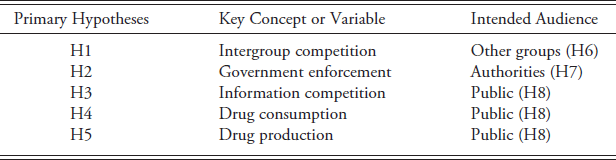
Table 1 summarizes the argument, indicating the important concepts behind the primary hypotheses (H1–5) and the actors who are the intended audiences of narco-messages (H6–8).
Narco-messages, Related Factors, and Intended Audiences

The Case of Chilpancingo
The hypotheses are primarily evaluated using the quantitative tests in the next section. First, however, we briefly discuss an illustrative case that demonstrates the plausibility of the theorized explanation. We discuss examples from the municipality of Chilpancingo, Guerrero, which is located between Mexico City and Acapulco.
Multiple criminal groups have battled for control over Chilpancingo, and this has manifested itself in narco-messages, consistent with H1. In 2009, body parts of five men appeared in the city center, with a poster purportedly from Arturo Beltrán Leyva, a powerful criminal leader. The sign mockingly called on rival groups to send “more qualified people,” implying that the victims had tried to attack his group but failed (Ramos Reference Ramos2009). The Beltrán Leyva group had been fighting the Sinaloa Cartel and La Familia Michoacana in the area. The communication to rival groups suggests support for H6.
When Mexican marines killed Beltrán Leyva several months later in a neighboring state, a narco-message at a nearby kindergarten warned authorities of a counterattack (El Universal 2009b). This response to enforcement is consistent with H2, and the government audience is consistent with H7. Criminal groups also deployed narco-messages in Chilpancingo to respond to authorities. For example, as security forces swept the area, banners addressed President Felipe Calderón, asking him to “respect families” and not to involve innocent relatives of criminal group members (La Reforma 2009).
Competition over information is apparently an issue in Chilpancingo. In 2010, a local crime reporter was found dead in a ditch with five bullet wounds in his body (El Universal 2010).Footnote 10 As noted previously, criminal groups often attack journalists for reporting news in a way that diverges from what the criminals want. A desire to shape public perceptions is also likely to help explain the regular occurrence of narco-messages, as H3 suggests. Related to this, criminal organizations have close relationships with a substantial number of inhabitants of Chilpancingo, due to local drug consumption and production (e.g., Pérez Salazar 2013; Galarce Sosa 2012). Ties to the public contribute to the idea of information competition, as groups in Chilpancingo seem to use narco-messages to convince the community that they are on the locals’ side. This would be consistent with H4, H5, and H8.
For example, in 2009 a sign—purportedly signed by Beltrán Leyva—accompanying bags of human body parts, criticized the dead as kidnappers and informed the public not to be alarmed by the deaths (El Universal 2009a). In 2016, a similar message told the public that it was not a target, informing people not to be worried by violence (El Sur 2016). In 2018, a narco-message from Cartel del Sur announced, “Citizens of Chilpancingo know that we don’t kidnap or extort” (Uno Más Uno 2018). Appealing to the public seems more likely when criminal groups depend on the local population and therefore feel a need to keep it on their side. The coexistence of journalist targeting, drug consumption, drug production, and narco-messages to the general public in Chilpancingo suggests the logic outlined for H8.
This brief snapshot provides some evidence supporting the theorized relationships, at least in this municipality. We have found similar patterns in other municipalities, such as Ecatepec, Estado de México; Zitácuaro, Michoacán; and Tecate, Baja California. This study seeks to understand whether there are relationships between hypothesized factors and narco-messages throughout the country.
Data and Analysis
Our quantitative analyses use an original database of about 1,800 narco-messages found in Mexico during the period 2007–2010. In general, narco-messages are texts left by criminal organizations in a public place to communicate with other criminal groups, the public, or authorities. Some reasons why these signs appear include to clarify why a group assassinated someone, to intimidate other potential victims, or to identify themselves or their victims. The text can be professionally printed on vinyl banners, handwritten on cardboard signs, or scrawled on bedsheets. Narco-messages are a disturbing innovation that stretches the boundaries of traditional graffiti and that, mimicking the campaign language of Mexican political parties with a tone that can be oddly formal (Salopek Reference Salopek2011), functions to communicate with citizens around the area or give instructions to the police, journalists, or local public officials. The most common topics of narco-messages are displays of territorial control, encouragement to cooperate with the sender, corruption accusations, and attempts to enforce internal drug codes or to explain a group’s activities (Martin Reference Martin2012).Footnote 11
Our dataset is unique because it not only contains information on the municipality and date of each of the 1,800 narco-messages but also records the complete message and the intended recipient of the message when available. To gather this information, we performed massive amounts of queries at online search engines using Spanish translations of narco-message(s) as our keywords. In the same way that Coscia and Ríos (Reference Coscia and Rios2012) searched for criminal activity, we relied on Google as our main search engine, but we also gathered a team of researchers to read, filter, and classify all the results. We used information from local newspapers, amateur blogs, and forums (e.g., El Blog del Narco).
One complication we faced was to make sure that each narco-banner was independent and not just a replica covered by different media sources. When a message contained the same text and was displayed in the same municipality around the same date, we assumed that it could be duplicated coverage.
To test hypotheses 6–8, we disaggregate the dependent variable depending on whether the banners targeted other criminal groups, the government, or the public. Unfortunately, for many banners, it was unclear who the intended audience was. The rest were coded as directed to one of the three. A single message can be classified in more than one category. The most common category was criminal group, with 983 cases. The same number of messages were coded for public or government audiences, 258 each.
The unit of analysis of the study is municipality-year, and models examine the nearly 2,500 Mexican municipalities in four years: 2007–2010. These have been some of the most violent years of the so-called drug war. Additionally, and important from a research design perspective, many media outlets stopped reporting about narco-messages in 2011 at the government’s urging (Martínez Reference Martinez2011). As a result, counts of narco-messages starting in 2011 could undercount the number of messages, and a time-series study with data before and after 2011 is potentially problematic.
The dependent variable is Narco-message, a dichotomous variable coded 1 if a narco-message was reported in the municipality that year. We use a dichotomous variable instead of a count because we are interested in the presence or absence of narco-messages more than in a change in their number. Additionally, the vast majority of observations never have a narco-message. The important variation seems to be between 0 and 1. (Results are similar if a count model is used.) Map 1 shows where narco-messages appeared throughout Mexico.
To measure interorganizational competition for the first hypothesis, we use Criminal organizations, a count of the number of criminal groups reported to be operating in the municipality in the year. For this variable, we use the Coscia and Ríos Reference Coscia and Rios2012 data, which employ a text analysis algorithm to extract web content about recorded criminal activities. This dataset has been widely used (Osorio Reference Osorio2015; Dube et al. Reference Dube, García-Ponce and Thom2016). For the hypotheses about government enforcement, we use data from Osorio (Reference Osorio2015) on violent confrontations by authorities to create the variable Government enforcement. The municipality-year is coded 1 if authorities attacked, killed, or wounded presumed members of organized crime.
Map 1. Geographic Distribution of Narco-Messages in Mexico, 2007–2010

For the third hypothesis, about information competition and attacks on the media, we include Journalist killed, a variable coded 1 if a journalist was killed in the municipality that year. For this variable, we use data collected by the Committee to Protect Journalists (CPJ). There are alternative sources, but we worked with CPJ data because they use a strict coding mechanism.Footnote 12 Moreover, it is the largest available time series. The data include 27 cases of journalists assassinated in 13 states. We identified the exact municipality by examining the details of the cases covered by the media.
Drug consumption, to test the fourth hypothesis, is a dichotomous measure coded 1 for municipality-years in which at least one person was hospitalized for a reason related to illegal drugs. The Secretaría Reference de Saludde Salud (2008–11) did a similar exercise using data on mortality certificates and hospitalization records. Our new data are innovative because they are not limited to patients who occupied a bed in the hospitalization area but include all cases of medical emergencies; that is, all those cases in which an individual entered an emergency room. We collected and systematized data from medical emergencies datasets to identify the extent to which drugs were commonly consumed by counting cases of urgent medical attention caused by the consumption of illegal drugs.Footnote 13 This required us to perform the substantial task of reviewing millions of medical and legal records for every case of drug consumption—related medical urgency recorded from 2007 to 2010.
The sources contain the registry of the codes of medical issues presented by the individuals according to the international classification of diseases. The location
associated with the hospitalization is the municipality where the medical event happened, not where it was registered. This location is reported by the patient individually or, in case of death, it is the victim’s place of residence. Drug consumption rates in Mexico are quite low. Consistent with this, very few municipalities have medical emergencies for drug-related reasons. For the fifth hypothesis, we use Drug production, a 0–3 ordinal variable from Osorio (Reference Osorio2015) that is used as a proxy for the degree of presence of local drug cultivation.
The models include a number of control variables to take into consideration alternative explanations for the appearance of narco-messages. The models include the three categories of “drug-related homicides,” according to the Mexican government: confrontations, executions, and aggressions (SNSP 2007–2011). Among drug-related homicides, confrontations are homicides caused by face-offs between two rival criminal organizations. Aggressions are criminal group attacks against authorities. Executions are those in which the victim was visibly targeted, rather than killed as part of a shootout. Variables use rates per one hundred thousand inhabitants. These measures are not highly correlated. In general, the models do not seem to have multicollinearity issues as indicated by pairwise correlation tests and variance inflation factors.
Regarding political dynamics, we include a dummy variable called PAN municipal government, coded 1 for municipalities ruled by the National Action Party. These municipalities saw more violence than others (Dell Reference Dell2015). Federal coordination is a dichotomous variable coded 1 if the municipality and state were ruled by the same political party. We expect this to be negatively related to narco-messages because previous work shows that coordination across levels of government can be crucial to maintaining the status quo regarding organized crime (Snyder and Durín-Martínez Reference Snyder and Durín-Martínez2009; Trejo and Ley Reference Trejo and Ley2018). We also include a dummy called Government turnover, coded 1 in the first year that a new municipal government took office. Some studies have shown that government alternation breaks relationships between the state and organized crime, leading to strife (Trejo and Ley Reference Trejo and Ley2018).
During the years of this study, the Mexican government launched major military operations to battle organized crime—but only in certain parts of the country. To take this into consideration, we include Military presence, which counts army deaths in each state-year. This is an imperfect measure, but we do not have precise data on armed forces deployments over time. Military presence is not highly correlated (<.20) with Government enforcement, perhaps because multiple government actors confront organized crime. Data come from the Drug Policy Program (PPD) at the Center for Research and Teaching in Economics (CIDE).
Regarding geographic and demographic factors, we include U.S. border, coded 1 for municipalities in states that border the United States. Economic inequality is the standard Gini coefficient measure of income inequality in each municipality (CONEVAL 2010). Some studies find inequality related to crime (Enamorado et al. Reference Enamorado, Luis, Rodríguez-Castellán and Winkler2016; Phillips Reference Phillips2017), so it could also help explain messaging. Economic development is an index of economic vulnerability that measures basic development indicators (CONAPO 2011). Population is a natural logarithm of the municipality population (CONAPO 2014). The models include year dummy variables because narco-messages might be more common in some years than in others, but these variables are not shown for space reasons.
The model is a rare events logistic regression (King and Zeng Reference King and Zeng2001) because about 95 percent of the observations are zeros. However, results are robust if a regular logit is used. Standard errors are clustered by municipality. Results are robust to other approaches, some of which are discussed below.
Results
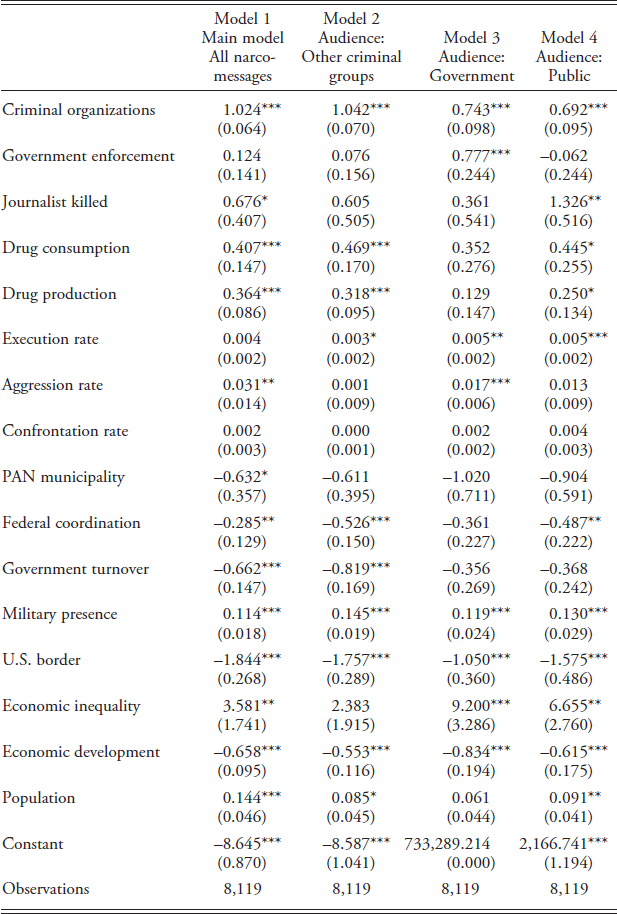
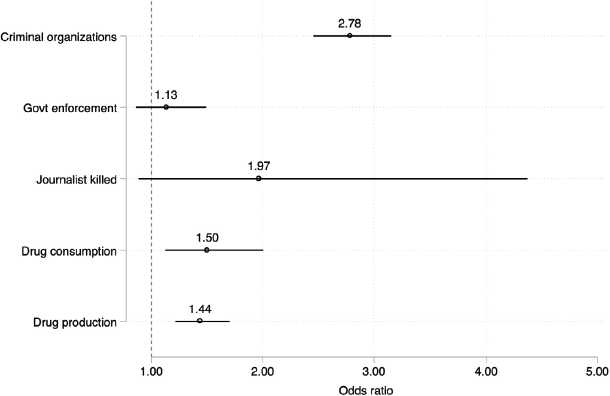
In table 2, model 1 is the primary model, with the dependent variable Narco-message regardless of intended audience. Criminal organizations is statistically significant and positively signed. This suggests support for the first hypothesis. Regarding substantive significance (see figure 1), odds ratios suggest that for each additional criminal group in a municipality, the municipality is almost three times as likely to receive a narco-message. Government enforcement is statistically insignificant. This is unexpected and suggests that government violence against criminal groups is not related to public communication by these groups. However, additional results suggest that it depends on the audience of the communication.
Rare Events Logistic Regressions of Narco-messages in Mexican Municipalities

*p < .10, **p < .05, ***p < .01
Standard errors clustered by municipality shown in parentheses.
Substantive Effects from Model 1: How Factors Relate to Narco-messages

Journalist killed is statistically significant and positively signed. This suggests support for the third hypothesis, although the statistical significance is not as strong as it is for some other variables. A municipality with a journalist killing is about twice as likely as one without one to have a narco-message. Both Drug consumption and Drug production are statistically significant and positively signed, as expected. Local drug business is related to public communication by criminal groups, suggesting support for hypotheses 4 and 5. The presence of drug consumption or drug production indicates that a municipality is about 1.5 times as likely as another municipality to have a narco-message.
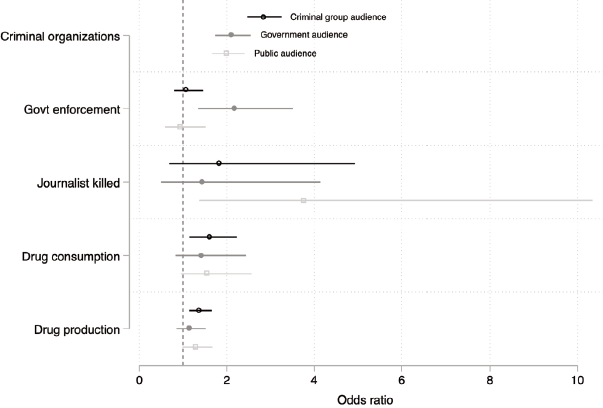
Models 2 to 4 use the disaggregated versions of the dependent variable, depending on the intended audience of the banners. Substantive effects are shown in figure 2. In model 2, the dependent variable is narco-messages aimed at criminal organizations. In this model, Criminal organizations has a larger coefficient than it did in model 1, or indeed any of the models, lending some support to the idea that interorganizational violence is especially associated with communication with other groups, hypothesis 6.
Substantive Effects from Models 2–4: With Different Narco-message Audiences

Model 3 uses the dependent variable of banners targeted at authorities. Only in this model is Government enforcement statistically significant and associated with the dependent variable. This supports hypothesis 7. Model 4’s dependent variable is narco-messages intended for the public. As expected, the coefficient for Journalist killed is highly statistically significant and much larger in this model, consistent with hypothesis 7. Figure 2 demonstrates that a municipality where a journalist was killed is almost four times more likely to have a narco-message aimed at the public. However, the results for Drug consumption and Drug production are similar to or weaker than their results in model 1, suggesting that local drug business dynamics are not especially associated with communication targeting the general public, as expected. There is mixed support for hypothesis 7, but the difference in results regarding Journalist killed is remarkable.
Many of the control variables return expected results. Regarding violence measures, none of the homicide measures are consistently associated with narco-messages. One homicide measure, Aggression rate, is statistically significant in two models, correlated with narco-messages in general and those targeting authorities. This makes sense because the “aggressions” category is for those involving attacks against authorities.
Regarding political variables, PAN municipality is statistically significant only in the first model, and negatively signed. This is surprising because other work finds that areas ruled by the PAN were especially violent (Dell Reference Dell2015). This finding suggests that violence and narco-messages are two distinct phenomena. Contrasting with this, most models show a statistically significant and negative sign on the coefficients for Federal coordination, as expected. However, Government turnover is also statistically significant and negatively signed in two models, while alternation is usually associated with increased violence. Military presence is statistically significant and positively signed in all models, suggesting that areas with military deployments and fatalities are more likely to see narco-messages. Together, these results suggest that some of the determinants of violence are also associated with narco-messages while others are not.
The coefficient for U.S. border is statistically significant but negatively signed in all models. This suggests that municipalities in states near the U.S. border are less likely than other municipalities to see a narco-message. This is surprising, but it could be because many areas bordering the United States are not official ports of entry, and therefore are less disputed by criminal groups. Although narco-messages appeared throughout the country, for various reasons they might have been more heavily concentrated far from the U.S. border, in the southern part of the country. Alternately, perhaps the stakes at the border are so high that groups simply engage directly in violence instead of communicating threats or other messages.
Economic inequality is statistically significant and positively signed in most models, as expected. Economic development is always negatively signed and statistically significant, as expected. The coefficient for Population is statistically significant and positively signed in most models, suggesting that more populous municipalities are more likely to have public criminal communications.
These results, particularly those for model 1, are robust to many changes not shown here for space reasons.Footnote 14 Most results are consistent with the following changes: no control variables, only violent municipalities, municipality random effects instead of clustered standard errors, or a traditional logit instead of rare events logit. If count models (e.g., zero-inflated negative binomials) are used with a count of narco-messages, results are robust. In other words, the factors associated with an increased likelihood of narco-messages are also associated with additional narco-messages in the same area.
Conclusions
Why do criminal organizations sometimes publicly communicate with the government, their rivals, and the public? Criminal groups around the world exhibit this behavior, which in some ways is like the tactics of insurgent or terrorist organizations (Phillips Reference Phillips2018). However, the precise motivations behind public criminal communication have been unclear. This article has outlined a theory of competition and has tested it on an important case, Mexico in the early years of its “drug war.” Consistent with the theory, the results suggest that narco-messages are especially likely to appear in municipalities with multiple criminal groups, where the state has violently confronted groups, where competition over information has led to the murder of journalists, and where local drug consumption or production is taking place. Other factors robustly associated with narco-messages are military deployments, economic inequality, and poverty. Interestingly, some variables often related to violence, such as PAN municipal governance, show no consistent relationship with narco-messages. We found government turnover, associated with criminal violence in other studies, negatively related to the messages.
These findings are important for several reasons. First, they shed light on the public and informational aspects of organized crime. While criminal groups’ motives are ultimately financial, they behave nonetheless in some ways like political actors, reaching out to governments and regular citizens (Campbell and Hansen Reference Campbell and Hansen2013), and the violence has many political implications (e.g., Ley Reference Ley2017). The relationship between the killing of journalists and the appearance of narco-messages suggests that public information provision can be a crucial element of organized crime.
Second, some findings suggest that explanations of organized crime violence are distinct from explanations of organized crime public communication. Additionally, only certain violence measures are related to narco-messages. Criminal communication appears not only where criminal violence occurs, but in a broad range of places and for different reasons.
The findings suggest additional steps for future research. Are the determinants of public communication by criminal organizations similar in other cases, such as graffiti or social media? Regarding more fine-grained analysis of the narco-messages, what does their content tell us about the nature of violence in Mexico? Some descriptive analysis of the texts of narco-messages reports interesting findings (Martin Reference Martin2012; Atuesta Reference Atuesta2017), but more work remains to be done. What can we learn from patterns in the contents of narco-messages? And are the patterns we find in this study consistent in more recent years? Finally, some work could be done to try to understand the downstream effects after criminal public communication appears. Does criminal communication affect subsequent crime or in other ways warn us about likely future behavior?