Introduction
Anorexia nervosa (AN) is a serious disorder with substantial morbidity and a lifetime mortality as high as that associated with any psychiatric illness (Sullivan, Reference Sullivan1995; Papadopoulos et al. Reference Papadopoulos, Ekbom, Brandt and Ekselius2009). No therapeutic approach for adult patients with AN has been demonstrated by more than a single controlled trial, and none of these has been replicated.
Symptoms of anxiety, obsessionality and near-delusional ideation regarding body weight and shape have led some to hypothesize that antipsychotic medications might be helpful in AN.
Olanzapine, with effects on the dopamine, serotonin and histamine receptor systems, has been described as helpful for AN in several case reports and open trials, and is frequently recommended to patients who are struggling to improve. Recently, a few small controlled trials have been reported (McKnight & Park, Reference McKnight and Park2010).
In the first published double-blind placebo-controlled trial, Brambilla et al. (Reference Brambilla, Garcia, Fassino, Daga, Favaro, Santonastaso, Ramaciotti, Bondi, Mellado, Borriello and Monteteone2007) randomly assigned 30 out-patients with AN to receive olanzapine or placebo in addition to cognitive behavioral therapy (CBT) for 3 months. Measures of compulsivity, aggressiveness and persistence improved in the group receiving olanzapine while weight and other psychological measures improved without significant group difference.
More persuasive data were published by Bissada et al. (Reference Bissada, Tasca, Barber and Bradwejn2008) who compared 10 weeks of olanzapine with placebo in 34 patients with AN who also received treatment in a 4 day-per-week day hospital program. Bissada et al. (Reference Bissada, Tasca, Barber and Bradwejn2008) found that, on average, patients in the group assigned to olanzapine had a significantly shorter time to reach target body mass index (BMI) than did the group receiving placebo. In addition, the group receiving olanzapine demonstrated significantly more improvement in obsessionality as measured by the Yale–Brown Obsessive Compulsive Scale.
This study's strengths include its larger sample size and its randomized double-blind, placebo-controlled design; however, the study does not provide information about whether olanzapine treatment is of benefit to individuals receiving out-patient treatment in the absence of the considerable benefit of an intensive weight-restoration program.
The current study was conducted to obtain preliminary information regarding the utility of olanzapine for out-patients with AN.
Method
This study was conducted at two sites: New York State Psychiatric Institute/Columbia University Medical Center and Toronto General Hospital/University of Toronto. Ethics review committees at each site approved the recruitment of human subjects for this study. Written informed consent from each participant was obtained prior to randomization.
Participants
Eligible participants were recruited between February 2006 and December 2007. Eligible participants were individuals ⩾16 years of age who met criteria for AN (excluding amenorrhea) by the Structured Clinical Interview for DSM-IV (SCID-I), and had a BMI ⩾14 kg/m2 and ⩽19 kg/m2. Exclusion criteria included having a medical or psychiatric problem requiring urgent care, or having a clinical symptom or condition inconsistent with the risk profile of olanzapine, such as diabetes, hyperglycemia, hyperlipidaemia or orthostatic hypotension. Additionally, individuals were excluded from the study with co-morbid schizophrenia, schizophreniform, or bipolar disorder.
Participants were free of other psychiatric medication for at least 4 weeks prior to study enrollment, with the exception of selective serotonin reuptake inhibitors or serotonin–norepinephrine reuptake inhibitors which were permitted if doses had not changed for 4 weeks prior to study enrollment. Participants did not receive individual psychotherapy during the conduct of this trial.
Treatment
A total of 23 subjects were randomly assigned to receive either olanzapine or matched placebo for 8 weeks in order to collect preliminary experiences regarding risks, benefits and effect size. This small pilot study was not intended to establish efficacy. Randomization lists, stratified by site and with a block size of four, were generated by a computer program. Identical, sequentially numbered bottles containing medication or placebo were prepared by pharmacy staff who did not interact with the patients. Randomization assignments were kept in sealed envelopes and all clinical staff involved in the care of patients, as well as study coordinators, remained blind to medication assignment during the study. Medication dose was initiated at one pill (2.5 mg) per day, and was increased every 2 weeks, first to two pills (5 mg), and then four pills (10 mg) if the patient was tolerating medication. Subjects remained on four pills daily of study medication for the final 4 weeks of the trial unless lower doses were necessary secondary to side effects.
Subjects were evaluated weekly for change in weight and eating disorder symptoms, medication side effects, medication compliance and general medical status. Additionally, physicians used several compliance-enhancement strategies, including weekly reminder phone calls. Serum medication levels were obtained at the end of the trial in order to confirm compliance.
Participants were withdrawn from the study if they lost weight at four consecutive sessions, reached a BMI <14 kg/m2, if their clinical status required a different treatment, or if they wished to terminate participation.
Assessments
At the baseline visit, height and weight were measured and diagnostic status was assessed via SCID-I (First et al. Reference First, Spitzer, Gibbon and Janet1996) and the Eating Disorders Examination (Fairburn & Cooper, Reference Fairburn, Cooper, Fairburn and Wilson1993). Patients were weighed at every study visit. Psychological assessments included the Beck Anxiety Inventory (BAI; Beck et al. Reference Beck, Epstein, Brown and Steer1988), Beck Depression Inventory (BDI; Beck et al. Reference Beck, Epstein, Brown and Steer1961), Body Shape Questionnaire (BSQ; Cooper et al. Reference Cooper, Taylor, Cooper and Fairburn1987), Eating Disorders Inventory (EDI; Garner & Olmsted, Reference Garner and Olmsted1984), Yale–Brown–Cornell Eating Disorders Scale (YBC-EDS; Mazure et al. Reference Mazure, Halmi, Sunday, Romano and Einhorn1994) and the Positive and Negative Syndrome Scale (PANSS; Kay et al. Reference Kay, Fiszbein and Opler1987).
Statistical analysis
Groups were compared on continuous measures using Student's t tests or analysis of covariance (ANCOVA) using data from all subjects randomized (i.e. intent to treat); the effect size of olanzapine versus placebo was assessed using η2 (full, not partial). To assess the effect of medication versus placebo on BMI using all available weights, an analysis using multi-level modeling was also conducted (Singer & Willett, Reference Singer and Willett2003). Stata (version 10.1; StataCorp LP, USA) was used to perform statistical analysis.
Results
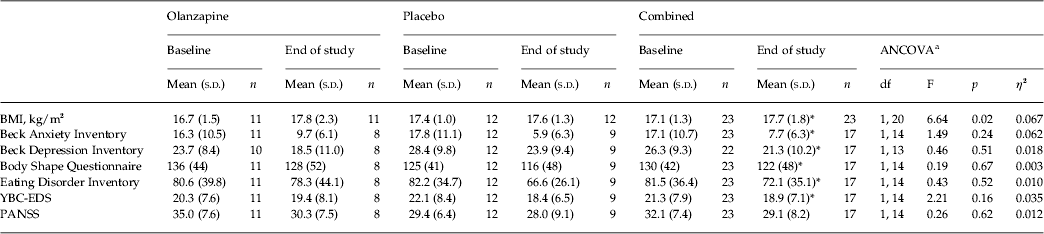
Fig. 1 presents the CONSORT (Consolidated Standards of Reporting Trials) diagram describing how patients were recruited to participate. Included in the study were 23 participants (22 females, one male; 16 in New York and seven in Toronto), with a mean age of 27.7 (s.d.=9.1) years. They were randomly assigned to olanzapine (n=11) or placebo (n=12). Of the participants, nine were taking antidepressant medication upon study enrollment. Of the 17 (74%) patients who completed the full 8-week trial, eight (73%) were assigned to olanzapine and nine (75%) to placebo. During the course of the study, there were statistically significant improvements in the average BMI, and in the average scores on the BAI, BDI, EDI and YBC-EDS (see Table 1).
CONSORT (Consolidated Standards of Reporting Trials) diagram showing patient recruitment into the study of olanzapine versus placebo.

Characteristics of patients assigned to olanzapine and placebo at baseline and at the end of the study

ANCOVA, Analysis of covariance; s.d., standard deviation; df, degrees of freedom; BMI, body mass index; YBC-EDS, Yale–Brown–Cornell Eating Disorders Scale; PANSS, Positive and Negative Syndrome Scale.
Values are given as mean (s.d.) and the number of patients for whom data were available.
* Statistically significant change from baseline in the combined group (paired t test, p<0.05).
a ANCOVA statistics assess differences between olanzapine and placebo groups at end of the study with the baseline measure as a covariate.
There were no statistically significant differences between olanzapine and placebo groups at baseline in mean BMI or in the mean scores on any of the measures of psychopathology (see Table 1). ANCOVA, with baseline BMI as a covariate, found that the end-of-treatment BMI differed significantly between the olanzapine and placebo groups. Assessment of the change in BMI over time, using all available weight data in a multi-level linear growth model, also found that the difference between olanzapine and placebo groups was statistically significant [0.105 (s.e.=0.05) kg/m2 per week, p=0.04]. There were no statistically significant effects by ANCOVA of olanzapine versus placebo on any of the measures of psychopathology (see Table 1).
Because a substantial minority of patients was taking concomitant antidepressant medication, we examined whether this might have affected response during the study. Very similar fractions of patients assigned to olanzapine and to placebo were on antidepressants (olanzapine: 5/12=42%; placebo: 4/11=36%), and their average BMIs at baseline were similar [on antidepressants: 16.9 (s.d.=1.2) kg/m2; not on antidepressants: 17.2 (s.d.=1.4) kg/m2; t=0.51, p=0.6]. Finally, by ANCOVA, being on an antidepressant had no effect on BMI at termination [F(1, 20)=0.09, p=0.77].
The characteristics of the participants at the New York and Toronto sites did not differ significantly except for the mean score on the PANSS [34.6 (s.d.=1.6) v. 26.3 (s.d.=2.3), respectively, t=2.9, p=0.009]. As analysed by ANCOVA with the baseline assessment as the covariate, there were no statistically significant differences between the sites in the average BMI at the end of treatment or in the average score on any measure of psychopathology except the BSQ. On that measure, mean baseline and end-of-treatment scores of patients in New York were 143 (s.d.=44) and 128 (s.d.=47), respectively, and, for the Toronto group, they were 97.5 (s.d.=34) and 109 (s.d.=53) [F(1, 14)=5.28, p=0.04]. The response of the single male patient, who was assigned to receive olanzapine, did not appear to differ from those of the female patients.
The average medication dose during the final week of study treatment was 7.95 (s.d.=2.70) mg (olanzapine) and 8.75 (s.d.=2.50) mg equivalent (placebo). Of the eight participants receiving olanzapine who completed the trial, one had an undetectable medication level upon study termination and the remaining seven had a mean level of 22 (s.d.=12.7) ng/ml. Medication side effects were uncommon except for sedation. The average subjective ratings of sedation during the trial on a four-point scale (where 0=not at all, 1=slight, 2=moderate and 3=severe) were significantly greater for patients receiving olanzapine compared with placebo [1.39 (s.d.=0.76) v. 0.67 (s.d.=0.62), t=2.41, p=0.03]. All patients receiving olanzapine rated sedation as moderate or severe during at least 1 week, compared with seven patients receiving placebo. However, there was no clear relationship between the level of sedation and dropping out of the trial. No participant developed hyperglycemia, or laboratory changes suggestive of liver function or lipid profile abnormalities.
Discussion
AN is a serious mental illness without clear empirical support for any specific treatments, especially for adult patients. Symptoms typical of AN, including persistent, intrusive thoughts about body shape and weight, provide a theoretical basis for considering antipsychotic medication. These observations, together with a small amount of anecdotal clinical data, suggest that olanzapine may be helpful in AN.
This 8-week study demonstrated that, in a small group of out-patients with AN, olanzapine was associated with a greater increase in BMI than was placebo. Our finding is consistent with that of Bissada et al. (Reference Bissada, Tasca, Barber and Bradwejn2008). However, unlike Bissada et al. (Reference Bissada, Tasca, Barber and Bradwejn2008) and Brambilla et al. (Reference Brambilla, Garcia, Fassino, Daga, Favaro, Santonastaso, Ramaciotti, Bondi, Mellado, Borriello and Monteteone2007), we were unable to detect psychological improvement associated with olanzapine compared with placebo. Consistent with other reports, including that of Bissada et al. (Reference Bissada, Tasca, Barber and Bradwejn2008) we did not note any adverse metabolic effects among participants receiving olanzapine. This may have resulted from the fact that our sample was small. It is also possible that the metabolic risks of olanzapine well documented in other clinical populations may not be as severe in AN. Before this can be concluded, however, a substantial number of additional patients with AN receiving olanzapine must be examined.
This study, while small in size, adds to the placebo-controlled data of Brambilla et al. (Reference Brambilla, Garcia, Fassino, Daga, Favaro, Santonastaso, Ramaciotti, Bondi, Mellado, Borriello and Monteteone2007) and Bissada et al. (Reference Bissada, Tasca, Barber and Bradwejn2008) in suggesting a possible role for olanzapine in the treatment of AN. Unlike these studies, in which olanzapine was added to CBT or to an intensive day program, patients in the current study gained weight while receiving no additional specific treatment for their eating disorder or participating in a structured program. Thus, our data suggest that olanzapine may be of help even in the context of a very limited treatment program. These findings, while encouraging, must be viewed as preliminary until larger trials of longer duration are conducted.
Even if additional studies of a greater number of patients lend support to the use of olanzapine in AN, there will challenges in implementing this treatment. Individuals with AN are typically reluctant to take medication (Halmi et al. Reference Halmi, Agras, Crow, Mitchell, Wilson, Bryson and Kraemer2005), and the metabolic side effects of olanzapine described in other populations will probably increase patients' reluctance, even if the side effect profile in AN is found to be more benign.
This study had a number of significant limitations. Primary among them is the very small sample size. This reduced our ability to detect both potentially beneficial effects of olanzapine, such as on psychological symptoms, and adverse effects, such as impaired glucose control. Another limitation is the absence of a manipulation check to determine the frequency with which clinicians were able to detect whether a patient was taking placebo or olanzapine. However, the assessment of the primary outcome measure, weight, was not dependent on clinician judgment.
Despite these limitations, the data from the current study add to existing literature indicating that olanzapine may be helpful in AN and suggest that larger, more definitive trials are warranted.
Acknowledgements
This study was supported by the National Institute for Mental Health (R21 MH069898). Eli Lilly & Co. supplied the medication as part of an investigator-initiated grant. The authors wish to thank Anne Haynos, Laurel Mayer and Christina Roberto for their help with this project. The trial is registered at clinicaltrials.gov as ‘Registration: Effectiveness of Olanzapine Versus Placebo in Treating Outpatients With Anorexia Nervosa’, clinicaltrials.gov identifier no. NCT00692185.
Declaration of Interest
This study received support from The National Institute for Mental Health (R21 MH069868) and from an investigator-initiated grant from Eli Lilly & Co. who supplied the study medication. Aside from receiving this research support from Eli Lilly & Co., the authors have no financial involvement or affiliation with any organization whose financial interests may be affected by material in the manuscript, or which might potentially bias it. B.T.W. receives research support from AstraZeneca.