





Introduction
Given its productive and commercial capacity, Latin American agriculture is destined to play a fundamental role in supplying the world with food and raw materials, while at the same time improving the situation of its farmers is an unavoidable requirement. The region needs responsive and efficient policies and programmes that increase productivity in a sustainable – both economically and environmentally – and inclusive – both socially and institutionally – way. To achieve this goal, Latin American countries have sought to advance not only in the formulation of sectoral policies but also in the coordination of efforts among the various organizations that make up the institutional architecture aimed at improving the sector’s performance. Supporting these expectations for the 21st century requires an appropriate review and interpretation of the arguments, experiences, and lessons derived from the agricultural history and the comprehension of its development, limitations, and advantages in a long-run perspective.
Latin American agriculture is heterogeneous, reflecting the wide diversity of landscapes, climates, soils, and local conditions. Its lands offer a multiplicity and diversity of products that make the region one of the world’s leading suppliers of cereals, oilseeds, horticulture, fruits, flowers, and meats. However, some common features provide a clear conceptual unity to the region (Solbrig, Reference Solbrig, Bulmer-Thomas, Coatsworth and Cortés Conde2006).
The first and most notable characteristic is the importance of agriculture in Latin American economies. Since colonial times, the region has depended on crops and livestock as its main sources of production, employment, exports, and foreign exchange. Second, the unequal distribution of land – known under the latifundio-minifundio dichotomy – constitutes a structural feature that has shaped agricultural development throughout the region. The third characteristic is the persistence of a large sector of small farmers, weakly integrated into the economy and producing mainly staple foods for local markets. Finally, in the agro-export sector, very few products (or, at times, only one) have prevailed in each country. This dependence on a small number of export commodities has exposed countries to the contingencies of external markets, price fluctuations, and marked boom-and-bust cycles.
Despite the importance of agricultural activity in most of Latin America, the sector has not been able to stimulate the rest of the economy and create sustained forward and backward linkages,Footnote 1 a particularly notable aspect during the 20th century. Similarly, the influence of other sectors and broader processes – such as demand dynamics, technological change, structural transformation, and urbanization – on agricultural activity has also been limited. This contrasts with what happened in many parts of the world, where this century was a period of enormous change in the rural sector that distinguishes it from any other time in history (Federico, Reference Federico2005). Indeed, from very traditional and conservative production methods, agriculture has been transformed into a knowledge- and science-based enterprise, especially since the second half of the 20th century. This process has increased productivity and supported the expansion of production to keep up with the greater demand brought about by a growing population. It has also altered people’s relationship with the land, as the industrialization of agriculture has increased the linkages and dependence on manufacturing, making agricultural activities more vulnerable to markets and exacerbating the environmental consequences of agriculture (Solbrig, Reference Solbrig, Bulmer-Thomas, Coatsworth and Cortés Conde2006). However, Latin America has not been able to benefit significantly from these changes in supply and demand, nor from the new institutional arrangements or the renewed technological conditions that dominated the 20th century – at least until the end of the century.
Several recent studies have addressed this topic in the last decade (Martín-Retortillo et al., Reference Martín-Retortillo, Pinilla, Velazco and Willebald2019, Reference Martín-Retortillo, Pinilla, Velazco and Willebald2022; Salazar et al., Reference Salazar, Tadeo and Alvarez2024) considering the performance of Latin American agriculture since the 1950s or 1960s until the present. Latin American agriculture possesses a set of characteristics that, from a long-term perspective, make it quite peculiar. It exhibits conditions that place it in a typical peripheral economy situation – such as the pace of production expansion – yet with labour productivity growth driven by both increases in land productivity and improvements in the land-to-labour ratio (similar to developed economies). The enormous variety of climates, endowments, types of production, and political–institutional developments prevents the identification of a single ‘Latin American agricultural pattern’, revealing a regional reality that hides significant disparities (Martín-Retortillo et al., Reference Martín-Retortillo, Pinilla, Velazco and Willebald2022). In general, the growth of labour productivity from the second half of the 20th century to the first decade of the 21st has been driven by efficiency improvements and by increased use of productive factors (per unit of labour). In the nearly 60 years covered by these studies, agricultural output grew at a steady annual average of 3%, supported – until the 1980s – by factor accumulation, and – since the 1990s – by substantial improvements in total factor productivity (TFP).
However, for previous decades, despite abundant qualitative and quantitative research on the sector about the sector, it is not possible to make a comparative analysis of the performance of the agriculture in a ‘Latin American perspective’. In light of this limitation, this article aims to make an empirical contribution to filling this gap by offering new insights into the topic. It does so by examining the interaction between factor endowments and agricultural productivity on the eve of World War I (WWI) and by analysing a novel database.
This period is particularly significant because it represents, for much of Latin America, the peak of the primary-export model. During this stage, depending on their ‘commodity lottery’ (Díaz Alejandro, Reference Díaz-Alejandro and Thorp1984), countries specialized in mineral extraction, livestock raising, the cultivation of food crops (either temperate-climate crops such as wheat and maize, or tropical crops such as sugar and bananas), or the production of textile fibres (such as cotton and henequen).
Therefore, the focus on the pre-WWI period is motivated by two considerations: its historical significance in shaping the structure and dynamics of production, and the absence of regional-level analyses comparable to those available for the period since the 1950s.
After this introduction, the article is ordered as follows. Initially, we present a historical overview covering the period of the First Globalization to the WWI to contextualize our analysis and propose our hypothesis (Section Historical overview). Then, we present our conceptual framework and empirical strategy (Section Conceptual framework and empirical strategy ) which consist in the application of a standard model and to dealt with two activities: compilation of a database (output, land, and labour force) (Section Database compilation) and describing the main relations among variables (Section Results). We work with 10 Latin American countries (Argentina, Brazil, Colombia, Chile, Cuba, Mexico, Nicaragua, Peru, Uruguay, and Venezuela), almost 90% of total GDP and population of the region. We close the paper with some highlights (Section Final remarks).
For the region as a whole, and for an earlier period than is usually examined, our findings show that agricultural producers responded in ways comparable to those of their counterparts in subsequent decades. Differences in factor endowments shape the link between factor productivities: where land is plentiful, production choices tend to favour labour-saving technologies, since labour represents the costlier input. On the contrary, when labour is the abundant factor, technological options focus on saving land.
Historical overview
The Latin American agrarian context
In the late 19th century, particularly the final third, Latin America entered a phase of relatively strong growth, driven by its dynamic integration into the global economy. This process resulted from a combination of external and internal factors (Bértola and Ocampo, Reference Bértola and Ocampo2012). Externally, the transport revolution significantly reduced shipping costs and narrowed the economic distance to Europe (O’Rourke and Williamson, Reference O’Rourke and Williamson1999). Global demand for raw materials and food reinforced this integration. Internally, political and institutional reforms since independence – notably the liberal economic reforms of the mid-19th centuryFootnote 2 – strengthened institutional stability and supported export growth.
Exports became the main driver of growth, creating backward linkages of varying intensity across countries. Growth was also fuelled by foreign capital inflows and European – and to a lesser extent Asian – immigration, though unevenly distributed (Williamson, Reference Williamson2002). While free trade dominated economic policy, it was often inconsistent and focused primarily on export needs. Policymakers assumed export growth would spill over to the rest of the economy, though this was not guaranteed.
This phase saw significant territorial expansion and the settlement of new regions (Garavaglia and Gelman, Reference Garavaglia and Gelman2003; Harley, Reference Harley2007; Willebald and Juambeltz, Reference Willebald, Juambeltz, Pinilla and Willebald2018). In some areas, larger export activities spurred diversification into handicrafts, infrastructure, and finance. Exports – mainly agricultural and mining – led economic growth, while manufacturing and services played subsidiary roles. From the mid-19th century to WWI, new agricultural exports emerged in response to industrial demand (Bulmer-Thomas, Reference Bulmer-Thomas2003): rubber, wool, cereals, meat, coffee, cocoa, bananas, sugar, among others. By WWI, Latin America specialized largely in tropical crops and temperate products (Ayuda et al., Reference Ayuda, Belloc and Pinilla2024, Bértola and Williamson, Reference Bértola, Williamson, Bulmer-Thomas, Coatsworth and Cortés Conde2008).
Export diversification was limited: dominant products declined but were replaced by others, keeping concentration high. In 1870, the main export commodity averaged 50% of exports; by 1913, it had fallen to 42%, rising again to 54% by 1929 (Bértola and Ocampo, Reference Bértola and Ocampo2012). Dependence on a few products and markets made economies vulnerable to external shocks, with little intraregional trade (Carreras-Marín et al., Reference Carreras-Marín, Badia-Miró and Peres Cajías2013).
The best outcomes occurred when exports diversified across several products and markets and productivity gains extended beyond the export sector, although this was not the norm (Bulmer-Thomas, Reference Bulmer-Thomas2003). Export competitiveness hinged on natural resources – the so-called ‘commodity lottery’ (Díaz-Alejandro, Reference Díaz-Alejandro and Thorp1984) – though outcomes depended on how efficiently economies mobilized factors (Bértola and Ocampo, Reference Bértola and Ocampo2012). Resource abundance was dynamic, shaped by prices, technology, institutions, and investment (Willebald et al., Reference Willebald, Badia-Miró, Pinilla, Badia-Miró, Pinilla and Willebald2015) and had different influences on national productive specializations.
Population growth – fuelled by immigration – increased labour supply, though still insufficiently for export demands. Internal mobility remained limited, and coercive labour practices persisted. Elites often favoured European over local labour, seeing it as superior (in terms of capacities and culturally). Selective and mass immigration – notably in Argentina, Cuba, Southern Brazil, and Uruguay – partly alleviated shortages (Bulmer-Thomas, Reference Bulmer-Thomas2003). Nevertheless, the effect of demographic growth on production should not be interpreted mechanically. Expanding labour supply coincided with other transformations, including the gradual decline of coercive labour arrangements and the adoption of new technologies, some of which reduced labour requirements. As a result, the observed relationship between population growth and productive expansion reflects the interaction of several forces whose relative importance varied across sectors and countries.
Access to land was constrained by poor transport and concentrated ownership (Bértola and Ocampo, Reference Bértola and Ocampo2012; Frankema, Reference Frankema2009) and expanding into ‘new’ lands raised productivity but reinforced inequality. As elsewhere, high land-to-labour ratios encouraged labour-saving technologies (Martín-Retortillo et al., Reference Martín-Retortillo, Pinilla, Velazco and Willebald2022), including mechanization and chemical inputs, though technical change often favoured land over labour productivity. The rural elite dominated politics, shaping fiscal and factor markets to their advantage.
Capital accumulation was modest and technical progress, when present, was capital-embodied. Banking facilitated some resource mobilization but remained limited and mainly based on rent-seeking relationships (Haber, Reference Haber, Stanley and Sokoloff2012). Investment in human capital was also weak, and the creation of universities and the expansion of technical education were slow and lagged (Frankema, Reference Frankema2009; Maloney and Valencia, Reference Maloney and Valencia2014).
Governments turned to foreign investment, mostly in railways, utilities, mining, and banking (Esteves, Reference Esteves2012; Stone, Reference Stone1999). Foreign investment in agriculture was marginal except in plantation crops, which predominated in very concentrated locations (enclaves) in tropical areas.Footnote 3
Export-led growth required rising exports and productivity, but also transmission of gains to the domestic economy. However, domestic markets lagged behind the export markets (Martín-Retortillo et al., Reference Martín-Retortillo, Pinilla, Velazco, Willebald, Pinilla and Willebald2018), with exceptions: Brazil and Venezuela were average, Peru, Cuba, and Colombia relied heavily on exports, while the Southern Cone saw stronger domestic markets (Bulmer-Thomas, Reference Bulmer-Thomas2003) and structural change (Bértola and Ocampo, Reference Bértola and Ocampo2012).
Domestic-use agriculture (DUA) – covering all non-export farming – employed the majority of the rural labour force (Bulmer-Thomas, Reference Bulmer-Thomas2003). In some cases (e.g., wheat in Argentina, beef in Uruguay), export and domestic sectors overlapped, allowing some productivity gains to spill over. In Chile, mining demand spurred agricultural change, especially in the north. Similar processes also took place in urban centres and regions with substantial purchasing power, where dynamic domestic demand contributed to economic growth despite the limited size of national markets. Generally, DUA met growing demand, but productivity gains rarely spread effectively, contributing to the ‘structural heterogeneity’ and dual economies highlighted, several decades after, by the Structuralist theory (Pinto, Reference Pinto1965, Reference Pinto1970).
Before WWI, export performance closely correlated with per-capita income (Martín-Retortillo et al., Reference Martín-Retortillo, Pinilla, Velazco, Willebald, Pinilla and Willebald2018), yet disparities emerged: Argentina and Uruguay outperformed relative to exports, while Costa Rica and Cuba underperformed, reflecting differences in how effectively economies leveraged export growth (Bulmer-Thomas, Reference Bulmer-Thomas2003).
Previous literature has emphasized that one of the most characteristic patterns in Latin America is the productive diversity. The heterogeneity of Latin American agriculture mirrors the region’s diverse landscapes, climates, soils, and local realities in terms of productive factors (land, labour, physical, financial, and human capital). These different conditions would have been decisive in determining the different technological options in the region and would have led to disparate production performances. Our aim is to propose an empirical approach to quantify these conditions.
National configurations and agrarian performance
By the eve of the WWI, the agrarian economies of Latin America displayed both shared structural traits and marked national specificities within the broader primary-export model. In what follows, we present the agrarian structure and performance of the Latin American economies that we consider representative of the region, taking 1900–1913 as our reference period.
In Argentina, the agricultural sector ranked among the most dynamic and capitalized in the Atlantic periphery. The Pampas sustained a powerful agro-export model based on wheat, maize, and cattle and sheep raising, increasingly oriented towards refrigerated beef exports following the expansion of frigoríficos and the consolidation of trade links with Britain (Míguez, Reference Míguez2008; Hora, Reference Hora2012). Frontier expansion after the Conquest of the Desert and the development of a dense railway network – largely financed by British capital – enabled rapid growth in output and labour productivity. Medium and large farms predominated, combining ownership and tenancy, with strong participation of European immigrants as labourers and producers. While the Pampas represented a modern, mechanized export platform, extra-Pampas regions maintained more domestically oriented structures, including sugar, viticulture, yerba mate, among others (Martirén and Rayes, Reference Martirén, Rayes, Martín-Retortillo, Pinilla, Velazco-Portocarrero and Willebaldin press).
In Brazil, agriculture was heavily structured around the southeastern coffee complex, particularly in São Paulo and Rio de Janeiro, which accounted for the bulk of exports (Bacha and Greenhill, Reference Bacha and Greenhill1992). Produced in large fazendas using wage labour and immigrant workers after the abolition of slavery in 1888, coffee dominated external trade. Other regional export economies – Amazonian rubber and northeastern sugar – persisted but with declining relative importance. Landownership remained highly concentrated, mechanization limited, and credit scarce, while frontier expansion on virgin land played a central role in output growth (Klein and Vidal Luna, Reference Klein, Vidal Luna, Martín-Retortillo, Pinilla, Velazco-Portocarrero and Willebaldin press). Dependence on a monoculture export crop made Brazil highly vulnerable to price fluctuations, prompting valorization policies and interstate agreements to sustain coffee prices.
In Colombia, the consolidation of the coffee model shaped external integration (Colmenares and Vivas, Reference Colmenares, Vivas, Martín-Retortillo, Pinilla, Velazco-Portocarrero and Willebaldin press). Unlike more concentrated systems elsewhere, Colombian coffee expanded largely through small- and medium-sized farms in Andean regions such as Antioquia and Caldas (Palacios, Reference Palacios2009), combining internal colonization and family labour with relatively fragmented property structures (Kalmanovitz and López, Reference Kalmanovitz and López2006). Agricultural growth was predominantly extensive, based on expanding land and labour inputs, with limited productivity gains overall. However, regional differences were significant: smallholder coffee zones such as Caldas achieved productivity levels two to three times higher than hacienda-based regions like Cundinamarca (Ocampo and Colmenares, Reference Ocampo, Colmenares and Kuntz-Ficker2017). Infrastructure constraints limited deeper integration compared to the Southern Cone.
In Chile, agriculture occupied a secondary role within an economy increasingly centred on nitrate mining (Cariola and Sunkel, Reference Cariola and Sunkel1990; Robles-Ortiz, Reference Robles-Ortiz2009). The Central Valley was dominated by large haciendas operating under traditional labour arrangements (inquilinaje), supplying domestic markets and limited regional exports (wheat, wine, livestock). Nineteenth-century frontier expansion in the south had enlarged the agricultural base (Robles-Ortiz, Reference Robles-Ortiz2019), yet by the early 20th century relative dynamism had slowed (Robles Ortiz and Droller, Reference Robles-Ortiz, Droller, Martín-Retortillo, Pinilla, Velazco-Portocarrero and Willebaldin press). Low mechanization, persistent large estates, and regional heterogeneity characterized the sector (Bauer, Reference Bauer1975), which remained subordinated to the nitrate cycle and domestic demand financed by mining rents.
In Cuba, sugar overwhelmingly structured the agrarian economy. Following independence from Spain and under growing United States influence, Cuba consolidated its position as a leading global sugar exporter. Production was concentrated in large, modernized ingenios with high property concentration and increasing vertical integration between cultivation and processing, supported by foreign capital (Santamaría et al., Reference Santamaría, Botella-Rodríguez, González-Esteban, Martín-Retortillo, Pinilla, Velazco-Portocarrero and Willebaldin press). The system combined large estates with contract-bound colonos and seasonal wage labour facing recurrent shortages (Santamaría, Reference Santamaría2022). Extreme dependence on sugar rendered the economy vulnerable to international price fluctuations and preferential trade arrangements with the United States.
In Mexico, the Porfirian era produced a dual agrarian structure. Large commercial haciendas – producing henequen, cotton, sugar, and livestock – were closely integrated into export markets and foreign capital networks, incorporating technological change and institutional modernization (Tortolero, Reference Tortolero1995). Yet this modernization was exclusionary: peasant and indigenous communities, rancheros, sharecroppers, and smallholders faced land concentration and demographic pressure (Tortolero and Méndez, Reference Tortolero, Méndez, Martín-Retortillo, Pinilla, Velazco-Portocarrero and Willebaldin press). Railway expansion and macroeconomic stability fostered export growth but deepened social tensions that contributed to the Revolution of 1910.
In Nicaragua, agriculture evolved around coffee exports cultivated on medium and large estates in the Pacific and north-central regions (Gould, Reference Gould1990). Complementary activities – cattle, sugar, food crops, and, increasingly, bananas on the Caribbean coast – served domestic, regional, and enclave export markets. Land concentration predominated, alongside seasonal labour arrangements and a dual regional structure. External integration increased but remained narrow, highly dependent on coffee prices and vulnerable to international volatility (García, Reference García1998).
In Peru, a sharp regional duality prevailed. Coastal valleys hosted large, export-oriented sugar and cotton estates integrated into world markets and reliant on irrigation and wage labour, including Asian migrants (Thorp and Bertram, Reference Thorp and Bertram1978). In contrast, highland regions maintained communal and indigenous subsistence-oriented systems with low productivity and weak external articulation (Romero, Reference Romero2006). Agriculture complemented a mining-based export economy, with coastal agribusiness forming a key component of the primary-export model (Velazco-Portocarrero, Reference Velazco-Portocarrero, Martín-Retortillo, Pinilla, Velazco-Portocarrero and Willebaldin press).
In Uruguay, livestock specialization defined the agrarian structure. Cattle and sheep raising oriented towards beef and wool exports formed the backbone of the economy (Álvarez Scaniello et al., Reference Álvarez Scaniello, Castro Scavone, Rey and Bértola2024). The rise of refrigerated meat exports and strong trade ties with Britain enhanced value added (Finch, Reference Finch2005). Medium and large estancias dominated, with high land concentration and extensive production methods, though genetic improvements and selected innovations were present (Moraes, Reference Moraes2008). Compared to more diversified systems, Uruguay exhibited high labour productivity and structural homogeneity, deeply integrated into Atlantic export circuits (Álvarez Scaniello et al., Reference Álvarez Scaniello, Castro Scavone, Rey, Willebald, Martín-Retortillo, Pinilla, Velazco-Portocarrero and Willebaldin press).
Finally, in Venezuela, agriculture maintained a diversified but unstable agro-export profile. Coffee remained the principal export, cultivated in medium and large estates in Andean and central-western regions, while cacao had declined relative to the 19th century (Cartay, Reference Cartay1988). Extensive cattle raising supplied internal and regional markets. Limited infrastructure and weak territorial integration constrained growth. Before the oil boom after WWI, agriculture formed the core of Venezuela’s external insertion, albeit with lower capitalization and dynamism than Southern Cone economies (Banko, Reference Banko, Martín-Retortillo, Pinilla, Velazco-Portocarrero and Willebaldin press).
In synthesis, on the eve of the WWI, Latin American agriculture was broadly integrated into the global primary-export system, yet its internal structures varied considerably. The Southern Cone combined high export integration and rising productivity, while Brazil and Cuba exhibited strong monoculture dependence and land concentration. Colombia represented a more fragmented, smallholder-based export model, whereas Mexico and Peru displayed pronounced dualism. Smaller economies such as Nicaragua and Venezuela showed narrower and more vulnerable export bases. Across the region, frontier expansion, land concentration, low financial depth, and limited technological deepening predominated, shaping agrarian structures that would profoundly influence subsequent development trajectories.
Conceptual framework and empirical strategy
The impacts of technological change are complex. On the one hand, it can increase productivity, improve food security, and generate economic opportunities; on the other hand, it can lead to environmental challenges, such as soil degradation and biodiversity loss, as well as social challenges related to inclusion and equity (Daum, Reference Daum2023; Federico, Reference Federico2011). To maximize benefits and minimize risks, comprehensive strategies are required that combine innovations, institutional strengthening, and inclusive policies that facilitate the participation of smallholders (Daum, Reference Daum2023; Koppel, Reference Koppel1995).
In other words, agricultural technology cannot be analysed solely as a technical process. It is a complex socio-economic phenomenon reflecting the interaction between factor endowments, social structures, and institutional capacity. Understanding these dynamics allows for the design of locally adapted strategies that integrate productive, environmental, and social objectives, recognizing that technology alone does not guarantee sustainable development.
Latin American agriculture prior to WWI was characterized by significant productive and technological heterogeneity. Regions dominated by large export-oriented estates coexisted with areas dominated by small, diversified farms aimed at subsistence. This structural diversity profoundly shaped farmers’ capacity to adopt new technologies and improve productivity (Solbrig, Reference Solbrig, Bulmer-Thomas, Coatsworth and Cortés Conde2006).
The introduction of innovations did not depend solely on individual choices but on the complex interaction between factor endowments, access to capital, integration into international markets, and local institutional conditions. In regions with a relative scarcity of labour but availability of capital and machinery, farmers tended to adopt labour-saving technologies, whereas in areas with scarce land and relatively cheap labour, technologies that maximized land use (land-saving technologies) prevailed (Hayami and Ruttan, Reference Hayami and Ruttan1985; Ruttan, Reference Ruttan, Landau and Rosenberg1986).
As Solbrig (Reference Solbrig, Bulmer-Thomas, Coatsworth and Cortés Conde2006) emphasizes, empirical evidence for the first decades of the ‘long twentieth century’ is limited, meaning many assertions about productive structure and technology adoption are informed conjectures rather than generalizable facts. Nonetheless, these conjectures provide a valuable conceptual framework for understanding the determinants of technological choice and for formulating comparative hypotheses across different regions of Latin America.
In other words, studying the pre-1914 period highlights that mechanization and technology adoption were not homogeneous processes but adaptive responses to the relative availability of factors, capital, markets, and institutions. This perspective offers a foundation for analyzing the historical dynamics of labour-saving versus land-saving technologies in the region, as well as their implications for productivity and agricultural structure. Here, we propose the first steps in this direction offering a first attempt to quantify the process.Footnote 4
Our conceptual framework is very simple because, mainly, it represents a countable relation. Following Hayami and Ruttan (Reference Hayami and Ruttan1985: 119), we know that labour productivity (Y/L) can be portioned into land-to-labour ratio (A/L) and land productivity (Y/A):
 $${Y \over L} = \;{A \over L} \times {Y \over A}$$
Analytically, we mean that the labour productivity in the agriculture depends on how each economy combines endowments (land and labour) and land productivity. In other words, two economies can achieve the same output per worker in very different productive conditions depending on the abundance or scarcity of land and its productivity (which, concurrently, can respond to natural conditions of the soils and the incorporation of technical progress).
Therefore, our working hypothesis is the following. In Latin American regions (in the late 19th century and up to the WWI) where labour was relatively scarce or costly, rural wages were high, and medium- or large-scale farmers had the capacity to invest and access imported technologies and export markets, there was greater adoption of labour-saving technologies (such as harvesting, threshing, and mowing machinery). By contrast, in regions with a relative scarcity of land, cheap or plentiful labour, weak infrastructure, and limited access to capital or lucrative external markets, the dominant strategy was the expansion of agrarian area through intensive use of the agricultural frontier, tenancy, and extensive labour practices (‘land-saving’).
To test this hypothesis, our empirical strategy includes two stages.
First, we compile and construct a database containing consistent and comparable information on agricultural output, employment in agriculture, and land used for agricultural activities. Constructing long-run series is highly challenging, so our approach is to develop a cross-country database for the previous years to WWI, for two main reasons. First, around this date, most Latin American economies were undergoing a period of strong dynamism and consolidation under the export-led growth model. Second, in 1914, WWI began, marking the onset of a period of major shocks and profound transformations for Latin American agriculture. Whenever possible, we will use the average for the 1912–1914 three-year period as a reference.
Second, we mobilize this evidence in terms of our conceptual framework, in the context of the historical overview that we presented in Section 2, deriving some conclusions and remarks. We are not innovators in this respect; Bulmer-Thomas (Reference Bulmer-Thomas2003: 120) presents a table and an analysis similar to us, but with less information and other objectives.
While the preceding discussion refers to the analytical dimension and to concepts susceptible to operationalization, it does not preclude the recognition of other equally relevant factors, which will be taken into account in the interpretation of the results.
Financial capital played a dual role in the development of Latin American agriculture on the eve of WWI. At the macroeconomic level, it financed the infrastructure that underpinned export-led growth, including railways, ports, storage facilities, and commercial networks. These investments reduced transaction costs, integrated previously isolated regions into international markets, and enabled the large-scale expansion of agricultural exports (Taylor, Reference Taylor, Bulmer-Thomas, Coatsworth and Cortés-Conde2006). Financial capital acted as a key enabling factor behind the incorporation of Latin America into the first global economy.
At the microeconomic level, however, financial capital also shaped the productive choices available to individual farmers. Agricultural production required working capital to purchase inputs, acquire machinery, improve livestock, and sustain production cycles. Access to credit was therefore an important determinant of technological adoption and productivity growth. Where credit markets were imperfect – as was often the case in rural Latin America – access to finance tended to depend on wealth, landownership, and the availability of collateral. Larger producers consequently enjoyed privileged access to credit, allowing them to adopt innovations and undertake productivity-enhancing investments more rapidly than smaller farmers (Barrett et al., Reference Barrett, Carter and Timmer2010).
From this perspective, financial capital was not merely a source of funds for infrastructure and export expansion. It also influenced the distribution of productive opportunities within the agricultural sector. The literature on rural credit markets suggests that imperfect access to finance could retard technological adoption and create persistent productivity differentials across farms. Producers with access to credit were better positioned to invest in improved livestock breeds, machinery, fencing, drainage works, and other forms of capital accumulation, while credit-constrained farmers often remained locked into less productive systems.
This interpretation adds an important dimension to the conventional view of Latin American agricultural growth before 1914. The traditional narrative emphasizes frontier expansion, abundant natural resources, immigration, and integration into world markets. While these factors were undoubtedly crucial, the availability and distribution of financial capital also mattered because they conditioned the capacity of producers to transform market opportunities into productive investments. Financial capital thus functioned not only as a facilitator of export growth but also as a mechanism through which differences in wealth and asset ownership could translate into differences in productivity and long-run development outcomes.
Database compilation
We describe the compilation of a novel database that includes three variables for the agriculture of ten Latin American countries (Argentina, Brazil, Colombia, Chile, Cuba, Mexico, Nicaragua, Peru, Uruguay, and Venezuela): output, labour, and land.
As we give priority to present comparable information, we consider statistics derived from databases that have yet discussed the representativeness of the figures and present series for large country panels.
Output
For Latin American macroeconomic and long-run series, a commonly used source is MOxLAD database (n.d.), which we adopt as our main reference. For our ten countries, the database presents information on Agriculture Value Added (AVA) expressed in local currency units (UML), in constant prices of 1970. The figure corresponding to this year was transformed in dollars and moved backwards according to the real evolution of the AVA. We transform all data into dollars to facilitate the comparisons. It is true that to improve the contrast between figures, some type of PPP adjustment would be required, but considering that we are working with a sector that produces commodities and raw materials, the problem is not so relevant.Footnote 5 We use the AVA average corresponding to 1912–1914 to moderate fluctuations and reduce the risk of selecting an abnormal year. Some countries require additional comments.
-
• Brazil. AVA series is available since 1920 onwards. This series is spliced with GDP – Agriculture (1939 = 100) from Instituto de Pesquisa Econômica Aplicada Data Base (IPEAData, n.d.).
-
• Cuba. AVA series is available since 1946 onwards. This series is spliced with the volume of sugar production (tonnes) from García Molina (Reference García Molina2005), considering the absolutely determinant role of sugar industry in Cuban agriculture and the whole economy (Santamaría, Reference Santamaría2000; Reference Santamaría2002).
-
• Nicaragua. AVA series is available since 1920 onwards. We use the average corresponding to 1920–1922 as reference.
-
• Peru. AVA series is available since 1929 onwards. This series is spliced with the AVA (1979 prices) from Seminario (Reference Seminario2015).
-
• Uruguay. AVA series is available since 1935 onwards. This series is spliced with the AVA (2005 prices) from Bértola et al. (Reference Bértola, Román, Willebald and Bértola2024).
-
• Venezuela. AVA series is available since 1936 onwards. This series is spliced with the AVA (1968 prices) for 1920–1935 and AVA (1936 prices) for 1900–1919, both from Baptista (Reference Baptista2006).
Labour
As previously explained, we give priority to the information provided by MOxLAD, using the economically active agricultural population (EAAP) as our measure of reference. In contrast to agricultural output, the availability of information in this case is significantly more limited, and we faced the challenge of estimating and adjusting the available information.
The absence of precise and comparable sources led us to rely on more structural, trend-based, and relational characteristics in order to assign plausible values for labour inputs in our estimations. In this sense, our procedure seeks to reconstruct broad patterns rather than precise measurements. Again, some countries require additional comments.
-
• Brazil. The earliest available data on EAAP and economically active population (EAP) come from census records for the years 1920 and 1940, when the shares of the agricultural sector within the total labour force were, respectively, 70% and 67%. Both are figures consistent with the characteristics of a predominantly agrarian economy. Then, we retropolated the total EAP based on the overall population dynamics (MOxLAD), while the share of the EAAP was estimated according to the rate of change observed between 1920 and 1940. With both records in 1912–1914, we calculated the EAAP in our period of interest. With this procedure, we calculated a share of 71%.
-
• Colombia. The earliest available data on the EAAP and EAP correspond to 1938, when the share of agricultural sector within the total labour force was 73% (a ratio very close to the corresponding to Brazil). Previously, we take advantage of census data corresponding to 1918 (República de Colombia, 1924) and added figures for different jurisdictional government levels (departamentos, intendencias, and comisarías). We compiled information corresponding to EAP and the EAAP including labour force developing activities in crops, livestock, and other grazing animals. We obtained a ratio of 78% that we assigned to 1912–1914.
-
• Cuba. The early figures of EAAP correspond to 1943 and 1950 and then decennial data onwards. We retropolated the data corresponding to 1943 according to the evolution of rural population, which we estimated considering the complement of the urbanization rates of the period (1943, 1931, 1919, and 1907) and total population (both from MOxLAD) and linear interpolation to obtain annual data.
-
• Mexico. Data are available for 1900, 1910, and 1921. So, we obtain the average 1912–1914 by linear interpolation.
-
• Nicaragua. Data are available from 1940 onwards (decennial), and previously available information is very scarce. We took the estimation presented in Bulmer-Thomas (Reference Bulmer-Thomas2003):120, corresponding to 1920,Footnote 6 interpolate intermediate years with 1940 and use the average 1920–1922 as reference.
-
• Peru. Data are available from 1940 onwards (decennial). An alternative source is Cruz Saco et al. (Reference Cruz Saco, Gil, Leiva, Zhang and Santa Gadea2021), which provides annual estimates of the agricultural labour force for the period 1876–2017. Given the relevance of comparative levels for our analysis, we retroprojected the 1940 level (as reported in MOxLAD) using the movement observed in the alternative series.Footnote 7
-
• Uruguay. Data are available from 1950 onwards. An alternative source is Castro Scavone and Willebald (Reference Castro Scavone and Willebald2026), which provides annual estimates of agriculture labour force for 1870–2020 (for two sub-sectors: livestock and crops). Given the relevance of comparative levels for our analysis, we retroprojected the 1950 level (as reported in MOxLAD) using the movement observed in the alternative series.Footnote 8
-
• Venezuela. The earliest available data on the EAAP and EAP correspond to 1925 and 1930, when the shares of the agricultural sector within the total labour force were, respectively, 63% and 58%. These figures are lower than those corresponding to Brazil and Colombia but consistent with the increasing trajectory of other industries based on natural resources as oil. Then, we annually retroprojected the total EAP based on the overall population dynamics (MOxLAD), while the share of the EAAP was estimated according to the rate of change observed between 1925 and 1930. With both records in 1912–1914, we calculated the EAAP in our period of interest (in fact, with levels consistent with other economies of the region: 77%; remember that the commercial exploitation of oil consolidated in the beginning of the 1920s; see Rubio-Varas, Reference Rubio-Varas, Badia-Miró, Pinilla and Willebald2015).
Land
The extent of productive land in Latin American countries in the early 20th century is inferred from the historical map presented by Bauer (Reference Bauer and Bethell1986: 154), which classifies agricultural land use for the entire region during 1870–1930. This source is employed due to the absence of homogeneous, comparable data for all countries and its suitability for direct cross-country comparisons – an essential requirement for the joint analysis of relative endowments and output. Admittedly, the period proposed by the author is extensive, and changes may have occurred over time. Nonetheless, such characterizations rest on structural forces and on expert assessments that provide an adequate representation, applicable to long time spans.
Evidently, the resulting estimates should not be interpreted as precise measures of productive land availability. Rather, they are intended as historically grounded approximations derived from the best continent-wide evidence currently available. Given the absence of comprehensive and comparable information on land effectively incorporated into production, we opted for an approach that reconstructs broad patterns of resource availability on the basis of prevailing land-use structures identified in the specialized literature.
The original map distinguishes three regions – tropical, grain and livestock, and smallholder producers – and locates the main productions within the territory, including bananas, cacao, coffee, cotton, sugar, tobacco, wheat, henequen, alpacas, goats, cattle, llamas, and sheep.
The category ‘tropical produce estates’ refers to export-oriented agricultural enterprises that emerged in the lowland and mid-altitude regions of Latin America between 1870 and 1930. These estates specialized in tropical commodities – such as coffee, sugar, bananas, cacao, rubber, henequen, and cotton – whose expansion was driven by rising demand in the industrial core economies. Typically organized as large-scale plantations or centralized processing complexes, they relied heavily on wage labour or coercive labour arrangements and often operated under foreign ownership or investment. Spatially, they formed a new agrarian frontier on the periphery of traditional hacienda and communal systems, linking Latin American rural economies more tightly to the circuits of global capitalism.
On the outskirts of this older society, generally in the lower and medium elevations, very different agricultural enterprises now appeared, brought into existence by the enormous demand in the North Atlantic countries for tropical foods and fibres. Coffee plantations spread rapidly … World sugar production at the same time grew enormously … The result, in the sugar cane zones of tropical America, was huge corporate investment, often by foreigners, in more efficient, large-scale centrales that appeared in the Caribbean and Brazil, the Peruvian north coast, and in smaller pockets of production in Colombia, Salta and Tucumán, Argentina, Morelos and the Veracruz coast. […]
Added to these two basic exports were bananas on the littoral of Central America and Ecuador; rubber … and henequen produced by thousands of peons in Yucatán … cotton and wool were shipped from Peru; cacao from Venezuela and Central America… (Bauer, Reference Bauer and Bethell1986: 179).
The category ‘grain and livestock estates’ refers to the extensive agricultural and pastoral systems that developed across the temperate lowlands of the Southern Cone – particularly Argentina, Uruguay, central Chile, and the south of Brazil – between the 1870s and the early 20th century. These large-scale estates combined traditional ranching structures with increasingly commercialized and export-oriented grain production, responding to rising European demand for wool, hides, meat, and cereals. Characterized by vast landholdings, the adoption of new technologies such as railways and refrigeration, and significant inflows of foreign capital, these estates exemplified the consolidation of a modern agro-export economy based on economies of scale and integration into global markets. In contrast to the tropical plantation zones, they relied on extensive land use and seasonal labour rather than dense, permanent workforces.
In Uruguay, foreign sales of wool and other products of sheep-farming tripled between 1876–80 and 1896–1900. While the total volume of Uruguayan production was much smaller than that of Argentina, the industry figured much more prominently in the export lists down to the end of the period. Wool exports from the two countries went mostly to the continent of Europe –chiefly France, Germany, Belgium and Austria. In 1913 a little under a fifth of the wool exported from the River Plate entered the British market.
In Argentina other export industries were experiencing substantial growth as well. Hides, a traditional product, earned about two-thirds the value of wool exports over most of the period and almost doubled in aggregate value from the mid-seventies to 1910–14. It was the development of refrigerated shipping in the 1870s, however, that paved the way for the swift rise of meat shipments from Argentina, and, to a lesser extent, Uruguay. (Glade, Reference Glade and Bethell1986: 10).
It was during the late 1870s that Argentina became a net exporter of grains, a trade which began on a small scale but which quickly gained momentum. Between 1872 and 1895, the amount of pampa acreage under cultivation in all crops, especially grains, grew fifteen times, and in the next decade, the amount of acreage planted in wheat and maize alone more than doubled. Between 1880–84 and 1890–94 wheat was the major gainer, increasing twenty-three times in export value. In the next decade, however, the value of maize exports rose more rapidly, with a nearly sixfold gain. (Glade, Reference Glade and Bethell1986: 11).
Finally, the category ‘smallholder producers’ refers to family-based agricultural units that persisted or emerged in various highland and intermontane regions of Latin America between 1870 and 1930. Typically located in areas of older settlement but limited market integration, these farms were operated by small- and medium-sized proprietors who cultivated food crops and, in some cases, export commodities such as coffee. Their origins were diverse: some resulted from internal colonization and mestizo migration into frontier zones, while others arose from the fragmentation of large estates or the development of local urban markets. Although they represented a minority of the rural population, smallholders played an important economic role as independent producers who combined family and wage labour and maintained relative autonomy from both hacienda and communal systems.
We shall look at three types of rural environment in the older zones of settlement […] where an insular agrarian society was occupied with subsistence or the production of food crops for local markets. In all of these zones, large private estates (haciendas), peasant village communities, and independent family farms were interrelated in a variety of ways. […]
A fairly small but economically important number of rural people were small and medium-sized farmers […] In a land generally dominated by the large estate, the widespread existence of family farmers is important to notice. (Bauer, Reference Bauer and Bethell1986: 156–157).
The independent family farm seems to have appeared when population or overseas immigrants brought about frontier settlement into a region where there had been no sedentary native farmers […] or where the land had not been previously granted in large units and where, although a market existed, it still was not strong enough to promote economies of scale. (Bauer, Reference Bauer and Bethell1986: 157).
This characterization presented and used in the work of Bethell (Reference Bethell1986) is appropriate, and the configuration of zones and territories is convincing. However, we lack the cartographic details of the map, having access to only a single figure, which poses a significant challenge because land use needs to be quantified in hectares. Therefore, it is necessary to develop a systematic procedure to address this limitation.
The procedure was carried out in QGIS and involved, first, georeferencing the map using control points located on permanent geographic references (coastlines, river confluences, boundary intersections) and applying a polynomial transformation to minimize the root mean square error. On the georeferenced map, vector polygons corresponding to different productive categories defined in the original legend were digitized, with each assigned a classification attribute. The resulting layer was then reprojected to an equal-area coordinate system (EPSG:6933 – WGS 84/NSIDC EASE-Grid 2.0 Global) to ensure accuracy in surface measurements. Finally, the area of each polygon was calculated in square metres and converted into hectares, thus obtaining, for each country, an estimate of productive land area that serves as a direct input for the comparative analysis of productive factors (see Map 1).Footnote 9
The agrarian landscape of Latin America, 1870–1930.
Source: own elaboration base on Bauer (Reference Bauer and Bethell1986:154).

To assess the consistency of our procedure, we compared the areas derived from that map with historical agricultural statistics for a subset of countries: Argentina, Brazil, Chile, Mexico, and Uruguay. For Argentina and Uruguay, we used the Third National Census of 1914 (Comisión Nacional del Censo, 1919) and the 1916 Agricultural Statistics (MGAP, 1917), respectively; for Brazil, the 1920 Agricultural Census (Ministério da Agricultura, 1923); for Chile, the figures reconstructed by Ortiz (Reference Robles Ortiz2003); and for Mexico, the estimates reported by Tortolero (Reference Tortolero2003).
Quantitatively, the map identifies 229 million hectares with productive suitability in Argentina compared with 163 million reported by the census; 337 million versus 175 million in Brazil; 22 million versus 19 million in Chile; 123 million versus 79 million in Mexico; and 18 million versus 16 million in Uruguay. In all cases, the productive area recorded in the statistical sources (primary and secondary) is smaller than the area estimated from the map. This difference is expected: surveys capture the land actually in use in a specific year, whereas the map reflects a longer-term agrarian structure and thus approximates each territory’s agricultural potential within a broader context of open frontiers and land that was gradually incorporated into production (Willebald and Juambeltz, Reference Willebald, Juambeltz, Pinilla and Willebald2018). Brazil shows the biggest discrepancy, likely because extensive regions such as the Cerrado – where agricultural exploitation remained limited in the early 20th century – were underreported in the census but appear in the map as areas with productive suitability.Footnote 10
For the remaining countries included in the map, direct validation is more difficult due to the limited availability of comparable historical agricultural statistics. In many regions, particularly in Central America and the Andes, early 21st century censuses exhibit coverage gaps, methodological inconsistencies, or a complete absence of information on cultivated areas, in addition to heterogeneous definitions of ‘productive land’. Moreover, large agrarian sectors operated under subsistence production, communal systems, or informal land-tenure arrangements that censuses recorded only partially, thereby underestimating the land actually in use.
In this context, our map provides a clear analytical advantage: it applies homogeneous criteria across the entire region and identifies structural patterns and productive potentialities that fragmented and uneven national statistics cannot capture. Although the quantitative comparison could be carried out only for a subset of countries, the consistency observed between both sources in these cases allows this validation logic to be extended to the region as a whole and supports the use of the map as a comparative indicator of Latin American agrarian structure.
We do not claim that these figures provide an exact quantification of the land effectively available for production. Instead, they should be understood as informed historical reconstructions aimed at capturing broad differences in resource endowments across countries. In the absence of systematic and internationally comparable evidence on the extent of land actually brought into production, our estimates rely on prevailing patterns of land use documented in the historical literature, which offer the most consistent basis currently available for approximating productive land resources at the continental scale.
Results
Use of land
The spatial distribution of land use in Latin America between 1870 and 1930 reveals well-defined regional patterns that reflect the historical specialization of agricultural production. The map illustrates how grain and livestock production tended to concentrate in the temperate zones of the Southern Cone, particularly in Argentina, Uruguay, Brazil, and central Chile, where large estates supported extensive cereal and livestock production geared towards export markets. In contrast, tropical crop plantations were concentrated in coastal and lowland tropical areas, such as northeastern Brazil, the Caribbean, and parts of Central America, highlighting the importance of sugar, coffee, cacao, and other warm-climate crops in these regions. Small-scale production, although present in various areas, was more significant in specific parts of the Andes and Central America, associated with subsistence farming and local markets. This spatial configuration is consistent with the export-oriented specialization patterns of the period and provides the geographic basis for the comparative analysis of total agricultural area and its composition presented in Table 1.
Land use in Latin American agriculture. Total and composition

Table 1. Long description
A table comparing land use in Latin American agriculture by country. The table has 11 rows and 5 columns. The columns are labeled Country, Land (Mill. has.), Tropical (%), Grain and livestock (%), Smallholder producers (%), and Main products. The rows list different countries and their respective data. Row 1: Argentina, 229, 0.04, 0.88, 0.08, Wheat, cattle, sheep, sugar, cotton. Row 2: Brazil, 337, 0.21, 0.70, 0.09, Coffee, cacao, sugar, cattle, cotton, tobacco. Row 3: Colombia, 66, 0.36, 0.35, 0.29, Coffee, cattle, cotton, sugar, bananas. Row 4: Chile, 22, 0, 1, 0, Wheat, sheep, llamas. Row 5: Cuba, 11, 0.72, 0, 0.28, Sugar, tobacco. Row 6: Mexico, 123, 0.44, 0.49, 0.06, Wheat, cotton, sugar, henequen, cattle, cacao, coffee, sheep. Row 7: Nicaragua, 8, 0.46, 0, 0.54, Coffee, bananas. Row 8: Peru, 57, 0.27, 0.69, 0.04, Bananas, cotton, cacao, goats, sugar, cattle, coffee, alpacas, llamas, sheep. Row 9: Uruguay, 18, 0, 1, 0, Wheat, cattle, sheep. Row 10: Venezuela, 50, 0.35, 0.65, 0, Coffee, cacao, sugar, cotton, cattle. Row 11: LATAM 10, 921, 0.22, 0.69, 0.09.
Source: own elaboration based on Bauer (Reference Bauer and Bethell1986: 154).
Latin America exhibits a diverse pattern of agricultural specialization. Four of the largest agrarian economies – Brazil, Argentina, Mexico, and Peru – encompass the three main categories of specialization, with grain and livestock predominating and smallholders representing a minor share (below 10%). Colombia broadly aligns with this group but displays certain distinctive features: the shares of land devoted to grain and livestock and to tropical crops are relatively balanced, and the participation of smallholders is comparatively higher.
At the opposite end of the spectrum, the smallest agrarian economies exhibit more concentrated specialization. In the Southern Cone, Chile and Uruguay focus exclusively on grain and livestock production, whereas in Central America, Cuba and Nicaragua do not engage in these typical template products, instead combining tropical crops with smallholder estates. Finally, Venezuela’s agricultural land use is divided between tropical crops and grain–livestock production, with no land allocated to smallholder farming.
Factor endowments and agricultural productivities
Table 2 presents our results: agricultural output (expressed in constant 1970 prices), production inputs (land in millions of hectares and labour in thousands of persons), and the corresponding factor productivities: output per hectare (1970 dollars per hectare) and per worker (thousands of 1970 dollars per worker). Our data cover 10 countries that represented 87% of total GDP and population in 1910 (Maddison Data Project, 2020) which reports a good representation of the whole region (all the largest economies are included).
Factorial productivities and endowments in Latin American agriculture (circa 1913)
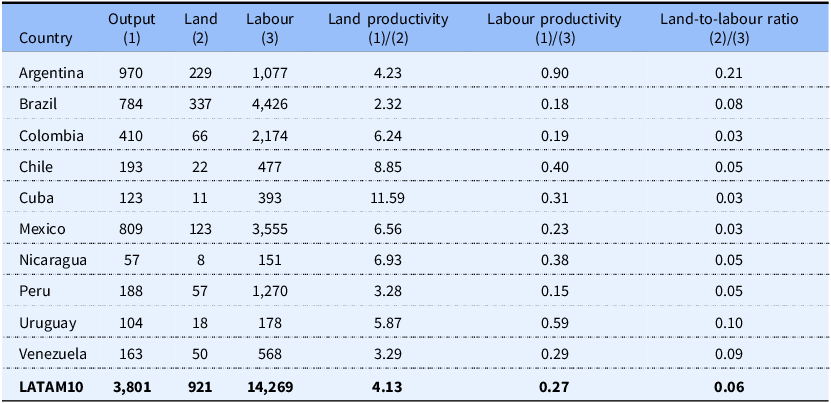
Table 2. Long description
The table presents data on agricultural output, production inputs, and factor productivities for 10 Latin American countries around 1913. It includes columns for output, land, labour, land productivity, labour productivity, and land-to-labour ratio. The countries listed are Argentina, Brazil, Colombia, Chile, Cuba, Mexico, Nicaragua, Peru, Uruguay, and Venezuela. The table also includes aggregated data for the LATAM10 region. Each row provides specific values for each country and the aggregated data. For example, Argentina has an output of 970, land of 229, labour of 1,077, land productivity of 4.23, labour productivity of 0.90, and a land-to-labour ratio of 0.21. The table aims to show the agricultural productivity and resource allocation in these countries during the specified period.
Notes: (1) Millions US$ 1970; (2) Millions of hectares; (3) Thousand workers.
Source: own elaboration. See text.
Latin America is a heterogeneous region, and our sample takes this into account this point combining large and small economies, with different modalities of agricultural activities. Figure 1 presents the main descriptive statistics.
Output, endowments and factorial productivities in Latin American agriculture. Circa 1913.
Notes: A: % on total (output (%)); B: thousands of ha per worker (A/L) (endowments); C: thousands of 1970 dollars per worker (Y/L) (labour productivity); D: 1970 dollars per hectare (Y/A) (land productivity).
Source: our elaboration. See text.

Three countries represented two-thirds of total agricultural output on the eve of WWI: Argentina, Mexico, and Brazil, followed by Colombia (11%) and six small economies with figures lower than 10% (Figure 1A).
The endowments are very varied, with a huge contrast between the extremes of the distribution (0.03 thousands of ha per worker in Cuba vs 0.21 in Argentina) which is consistent with the high geographical diversity of the region (Figure 1B).
This diversity is also expressed in terms of factorial productivity. Agricultural labour productivity positions Argentina and Uruguay as the leaders (Figure 1C) and the central economies of South America as the lagged (Peru and Brazil). In fact, agricultural land productivity is the most uniform of our indicators (Figure 1D) showing Cuba and Chile as the leaders and again Peru and Brazil as the lagged.
To advance in this analysis, we consider Equation (1) which states that both factorial productivities are not correlated one to one but mediated by the action of the relative endowments, that is, by the available quantities of inputs, which respond to natural, technological, and institutional conditions.
We represent the correlation between the land-to-labour ratios and the labour (Figure 2) and land (Figure 3) productivities to find new evidence. Our results are not surprising.
Labour productivities and land-to-labour ratios in Latin American agriculture. Circa 1913.
Source: our elaboration. See text.

Land productivities and land-to-labour ratios in Latin American agriculture. Circa 1913.
Source: our elaboration. See text.

We find a positive and strong correlation between relative endowments and labour productivityFootnote 11 which means that economies abundant in natural resources apt to agriculture (land) promote better conditions to improve the productivity of the scarce input (labour).
According to the model, this happens more evidently in the most advanced economies of Latin America in that period: the Southern Cone (Argentina, Chile, and Uruguay), and two Central American countries: Cuba and Nicaragua. In other words, those places with more intensive grains and livestock estates and plantations (see Map 1) achieved the highest levels of labour agricultural productivity. Argentina has outlier characteristics, which is not surprising, since the importance of extensive livestock farming – as one of the world leaders – and the strong expansion of wheat – to the point of becoming one of the ‘breadbaskets of the world’ – placed it in a very distinctive position.
In the cases of the agriculture of Mexico and Colombia, the results coincide with the trend and Peru, Brazil, and Venezuela show a situation of low labour productivity.
As expected, we find the contrary result when we contrast the relative endowments with the land productivity (Figure 3): the correlation between both variables is negative. However, and again, consistent with the model the economies over the trend are the same mentioned previously corresponding to the Southern Cone and Central America.
As in terms of labour productivity, the result for Argentina was notable, now the case highlighted is Cuba, with a level of land productivity that multiplies the Latin American average by 3.Footnote 12 As before, Peru, Brazil, and Venezuela constitute the cases of low (relative) endowments and land productivity.
Now we can repeat the exercise with labour and land productivities (Figure 4).
Labour and land productivities in Latin American agriculture. Circa 1913
Source: our elaboration. See text.

Labour and land productivities are not correlated which is an expression of the previous results; that is, the relation between productivities is mediated by the factor endowments, which are determined by natural resources availability together with historical, institutional, and technological conditions.
Finally, we can now integrate all the evidence and discern the main patterns that characterized Latin American agriculture on the eve of the WWI (Table 3, Figure 5).
Endowments and factorial productivities in Latin American agriculture. Deviations respect to the Latin-American average. Circa 1913

Table 3. Long description
A table comparing labour productivity, land productivity, and land-to-labour ratio across various countries. The table has 12 rows and 4 columns. The columns are labeled Country, Labour productivity, Land productivity, and Land-to-labour ratio. The row labels are Argentina, Uruguay, Chile, Nicaragua, Cuba, Venezuela, Mexico, Colombia, Brazil, Peru, and LATAM 10. Each row provides specific values for labour productivity, land productivity, and land-to-labour ratio for each country. Notable trends include Argentina having the highest labour productivity at 3.39 and the highest land-to-labour ratio at 3.30, while Cuba has the highest land productivity at 2.81. LATAM 10 serves as a baseline with values of 1.00 for all three metrics.
Endowments and factorial productivities in Latin American agriculture. Deviations respect to regional average and contributions per component. Circa 1913.
Source: our elaboration. See text.

The economies are ranked from highest to lowest labour productivity (Y/L), or more precisely, by their deviations from the Latin American average (remember Equation (1)).
Additionally, the two components contributing to this variation are shown: land endowment per worker (A/L) and land productivity (Y/A). In Figure 5, we represent the (additive) contribution of each component to the total deviation and, in Table 3, we present the original values. It is important to use the value of 1 as a reference, as it distinguishes between being above or below the regional average in Table 3 (for all figures) and in Figure 5 (for Y/L).
Economies whose labour productivity exceeds the regional average (Argentina, Uruguay, Chile, Nicaragua, Cuba, and Venezuela) combine different contributions from these two components. Argentina and Uruguay exhibit high indicators in both dimensions. Venezuela’s position is driven by relative land endowment, while Chile, Nicaragua, and Cuba rely on land productivity. Conversely, economies falling below the Latin American average display a similar diversity. Only Peru shows indicators below the continental average in both dimensions. Mexico and Colombia exhibit high land productivity, whereas Brazil’s performance is driven primarily by land endowment per worker.
Therefore, on the eve of the WWI, Latin American agriculture exhibited marked structural contrasts that allow us to distinguish several agrarian systems. These contrasts emerge from the joint observation of output per worker (Y/L), output per unit of land (Y/A), and land per worker (A/L), which together capture the degree of intensiveness in production and the sector’s potential for technological and structural change.
At one extreme stood Argentina and Uruguay, representing extensive, high-productivity systems based on large estates and export-oriented livestock and cereal production. Their combination of high output per worker (3.39 and 2.20 times the regional average, respectively) and large land-to-labour ratios (3.30 and 1.55 times the Latin American levels) reflected an abundance of land and a relatively scarce labour force. These conditions favoured mechanization, the use of capital, and integration into world markets, giving rise to agrarian systems that generated forward and backward linkages and supported broader economic modernization – at least in Latin American terms.
A second, intermediate pattern included Chile, Cuba, and Nicaragua, where agricultural structures were generally more intensive. These economies exhibited higher output per unit of land (Chile 2.14, Cuba 2.81, and Nicaragua 1.68 times the average) but smaller land-to-labour ratios (0.71, 0.42, and 0.75, respectively).
While Cuba’s sugar plantations represented a capitalized but labour-intensive form of large-scale agriculture, Nicaragua relied more on mixed farming with a significant presence of small- and medium-sized holdings. Chile, in turn, displayed a distinct configuration: the coexistence of large estates (latifundia) with a dense stratum of tenant and smallholder farms produced a dual agrarian structure that combined extensive and intensive features. The country’s high land productivity reflected both the diversification of production – grains, vineyards, and horticulture in the central valley – and the widespread use of labour within a system still marked by traditional relations of dependency. Although Chile’s agriculture was more diversified and commercially oriented than in most tropical economies, technological progress remained uneven, and the sector’s contribution to broader structural transformation was constrained by persistent social and institutional legacies from the colonial era. In this sense, Chile can be interpreted as a transitional case between the first group (the ‘Latin-American Southern Cone’) and this other group of more intensive agriculture.Footnote 13 In all three cases, production was more labour-demanding and less mechanized than in the Southern Cone. Despite maintaining active export sectors, these economies did not achieve the same capacity to generate widespread structural change as Argentina and Uruguay.
Finally, Venezuela, Mexico, Colombia, Brazil, and Peru formed a group of low-productivity, traditional agrarian systems, characterized by weak technological adoption, limited market integration, and institutional or geographic constraints. These conditions reflected the persistence of traditional structures of production and the slow diffusion of innovations, restricting agriculture’s role as a driver of overall economic development.
Naturally, our characterization is necessarily stylized and, as is often the case with highly aggregated typologies, there may be a considerable gap between the general description and the realities observed across specific territories. This is especially apparent in continental-sized countries such as Brazil, and in large and diverse economies such as Mexico and Venezuela, as well as in countries such as Colombia and Peru, where complex Andean topographies generate pronounced climatic and ecological variation across relatively short distances. Consequently, our third category encompasses a significant degree of internal heterogeneity, which calls for a cautious interpretation.
Taken together, the evidence suggests the coexistence of three broad agrarian paths in the first decade of the 20th century: (i) extensive, high-labour-productivity export systems (Argentina and Uruguay); (ii) more intensive structures with moderate productivity (Chile, Cuba, and Nicaragua); and (iii) low-productivity, traditional systems with weak structural linkages (Venezuela, Mexico, Colombia, Brazil, and Peru). These patterns capture the diversity of agrarian capitalism in Latin America and help explain the uneven capacity of national economies to initiate processes of structural change early in the century.
These differences should not be interpreted simply as the outcome of contrasting factor endowments. While the relative abundance of land and labour certainly shaped agricultural possibilities, the evidence should not obscure the importance of institutional arrangements, property-rights regimes, patterns of market integration, and the organization of production itself. Similar levels of land abundance could give rise to markedly different outcomes depending on the extent to which producers adopted new technologies, responded to international market incentives, dissimilar financial conditions or operated within institutional environments conducive to investment and commercialization. The observed variation across countries therefore reflects not only differences in resource endowments but also distinct forms of agrarian organization and rural social relations.
More broadly, these agrarian structures conditioned the capacity of agriculture to contribute to economic development beyond the rural sector. The Southern Cone economies were able to generate higher labour productivity and stronger linkages with transportation, finance, trade, and manufacturing activities, thereby reinforcing broader processes of capital accumulation and structural transformation. By contrast, where productivity remained low and market integration limited, agriculture tended to operate as a more isolated sector, generating weaker spillovers to the rest of the economy (as the case of our third category of countries). In this sense, the diversity of agrarian systems documented here helps explain why Latin American countries entered the 20th century with markedly different capacities to sustain long-run growth and economic modernization.
The patterns identified in this paper also suggest that the origins of Latin America’s developmental divergence can be traced, at least in part, to differences in agricultural performance before WWI. Rather than constituting a homogeneous peripheral region specialized in primary exports, Latin America encompassed a wide spectrum of agrarian economies, ranging from relatively dynamic export-oriented systems to more traditional and locally oriented forms of production. Recognizing this heterogeneity is essential for understanding both the opportunities and constraints that shaped subsequent development trajectories across the region.
We do not claim to be the first to make this observation, which has been noted by numerous scholars before us. Rather, our contribution consists in quantifying these differences and embedding them within a more comprehensive description and a more consistent analytical framework.
Final remarks
The main contribution of this paper lies in providing systematic, quantitative evidence that allows for a detailed comparison of agricultural performance across Latin America in the early 20th century. While some of our findings align with existing qualitative assessments, the novelty of our study is in quantifying patterns that have often been described only narratively, offering a clearer sense of relative performance and technological adoption across countries.
Our results confirm the exceptional positions of Argentina and Uruguay within the Latin American context. Previous studies, such as Martín-Retortillo et al. (Reference Martín-Retortillo, Pinilla, Velazco and Willebald2022), have highlighted these countries as outliers, noting their early demographic transitions, rapid urbanization, and favourable economic conditions. These factors supported specialization in livestock and cereal production, typical of temperate climates, and enabled both land and labour productivity to reach levels unprecedented in the region during the First Globalization era. Our data corroborate these conclusions and emphasize the enduring structural advantages that these economies exhibited in terms of utilization of factors and technological absorption.
Similarly, the experiences of Peru, Brazil, and Mexico illustrate economies that remained relatively lagged during the early 20th century, showing only gradual signs of agricultural take-off from the 1960s onwards.Footnote 14 A comparable pattern can be observed in Colombia and Venezuela, where agricultural production before the WWI remained largely organized around traditional structures, with limited technological diffusion and relatively low levels of both land and labour productivity. In Colombia, despite the expansion of coffee exports, production was frequently carried out in small- and medium-sized holdings with modest capital intensity, while in Venezuela export crops such as coffee and cacao coexisted with extensive and weakly mechanized farming systems. This pattern underscores the unevenness of agricultural modernization in the region and highlights the importance of historical context in shaping trajectories of sectoral development. In the case of Cuba, the coordination of production stages and the adoption of technical innovations – previously documented by Santamaría (Reference Santamaría2002) and Fernández Prieto (Reference Fernández Prieto2005) – explains its comparatively favourable performance. Our findings suggest that a parallel argument can be extended to Nicaragua, where the growth of coffee in the Pacific and the banana industry in the Atlantic played a similar role in fostering productivity gains within a specific commodity chain.
Across the region, our evidence indicates that agrarian producers of the early 20th century responded to factor endowments and market incentives in ways consistent with the responses observed in subsequent decades. In land-abundant regions, production decisions tended to favour labour-saving technologies, reflecting the relative scarcity and cost of labour. Conversely, in areas where labour was relatively abundant, mechanization progressed more slowly. This pattern is reflected in wages and labour costs: in 1910–1914, purchasing power-adjusted wages (UK = 100) were higher in Uruguay (85), Argentina (83), and Cuba (75) than elsewhere in the region (Bértola and Ocampo, Reference Bértola and Ocampo2012), illustrating the economic pressures that shaped technological choices.
Technological availability also played a central role. Implements such as harvesters, threshers, and seed drills, introduced in Latin America from the late 19th century, were instrumental in increasing efficiency. The introduction of tractors after WWI further accelerated mechanization, though adoption was conditioned by production-mix and commodity specialization. Cereal-dominated systems, for example, offered more opportunities for mechanization than plantation systems reliant on hand harvesting. Similarly, differences between dairy, sheep-shearing, and meat-oriented cattle production highlight how the specific nature of outputs influenced the feasibility and timing of technological adoption.
Overall, this paper provides a historical overview that establishes broad comparative patterns while pointing to the need for more nuanced analysis. Future research should complement these findings with detailed case studies and typologies that capture the diversity of agricultural organization, technological adoption, and factor allocation across the region. Such studies would not only refine our understanding of early 20th century agricultural dynamics but also offer insights into the structural foundations of long-term economic performance in Latin America.

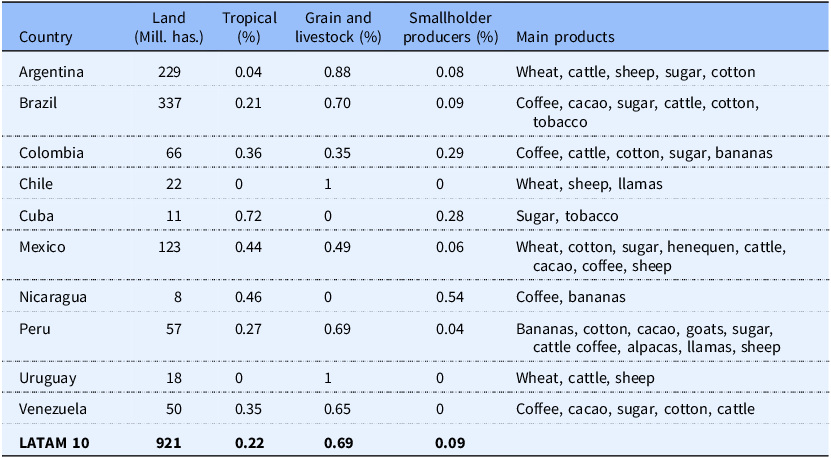
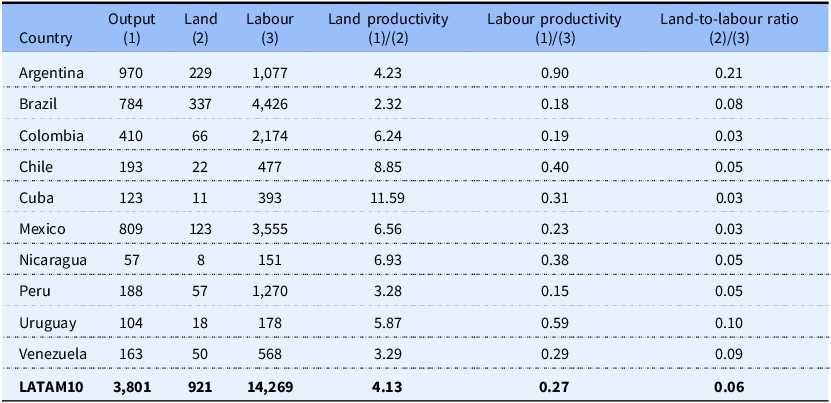
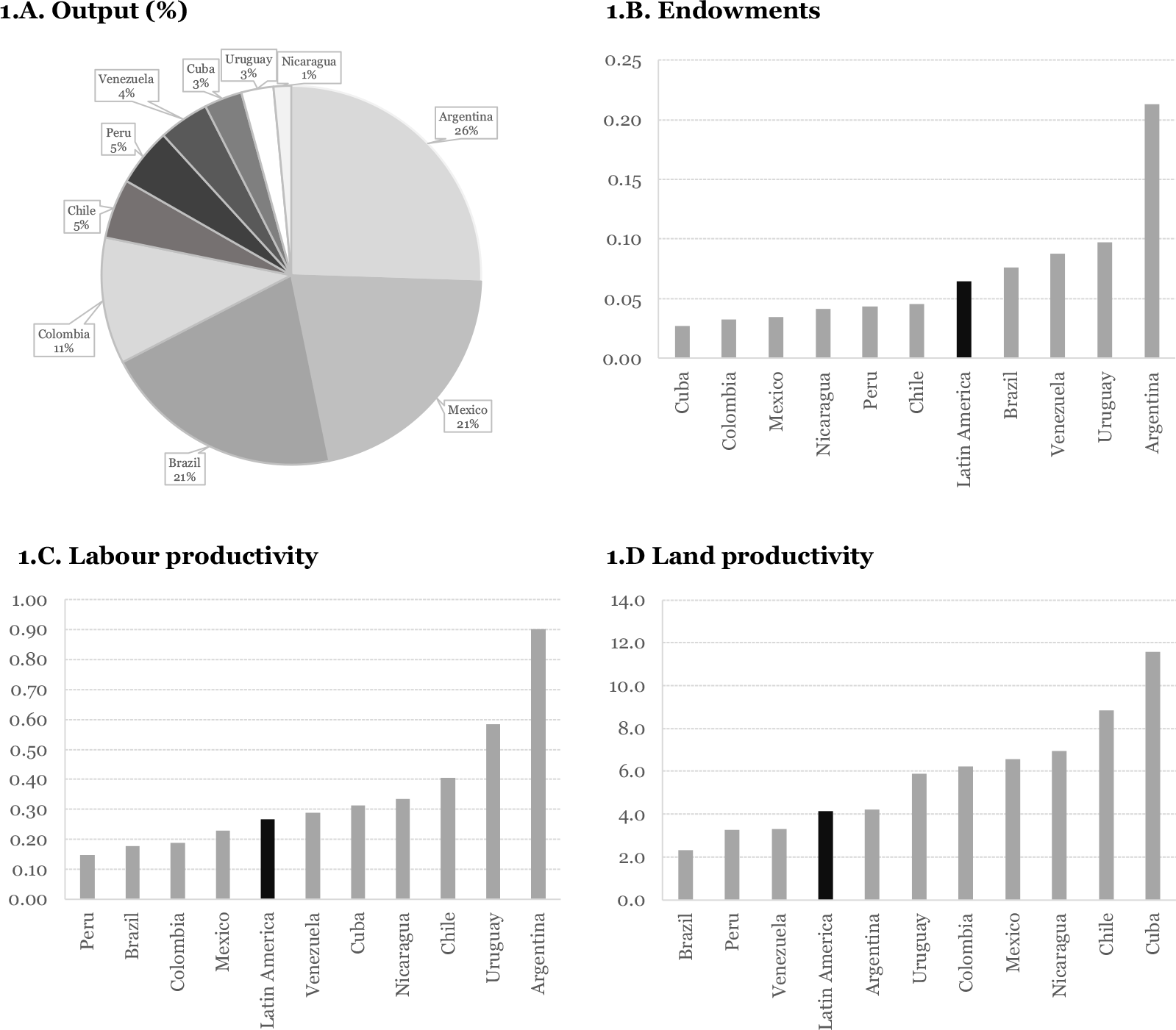
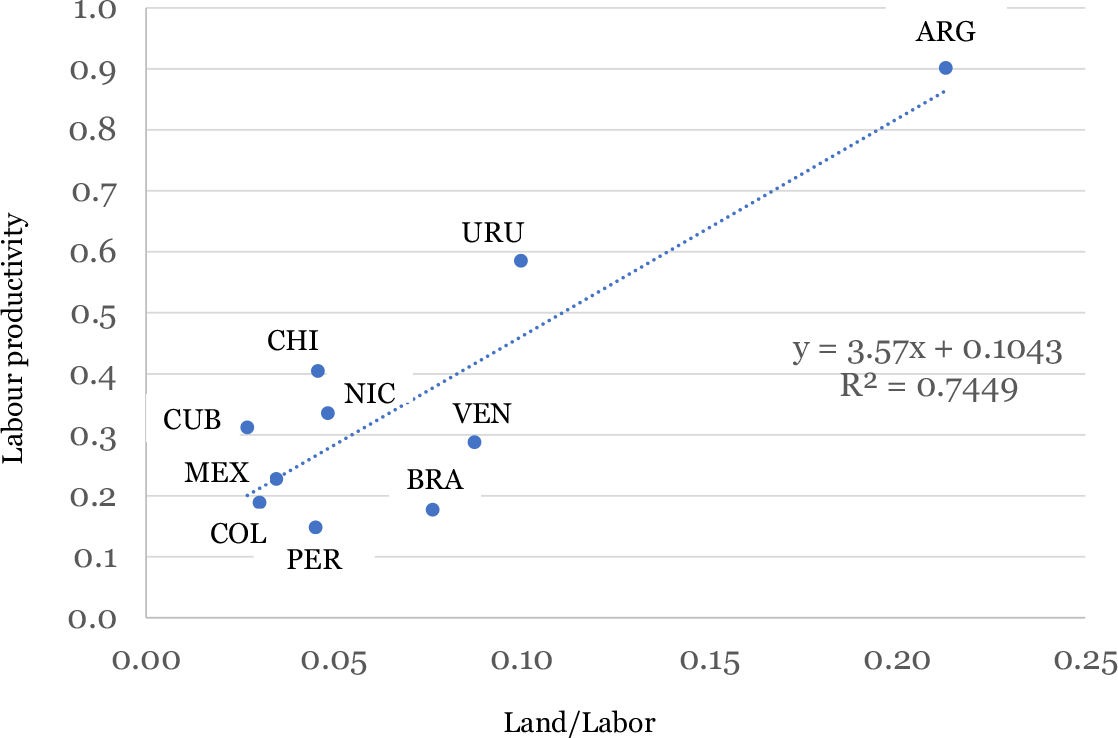
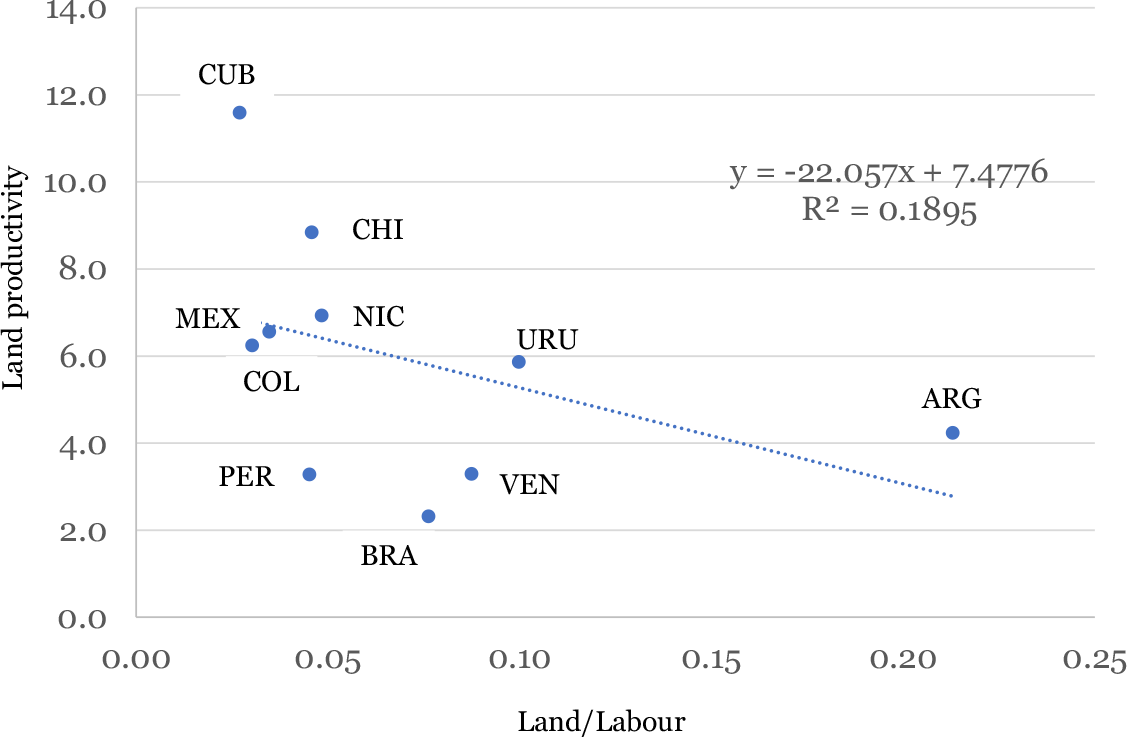
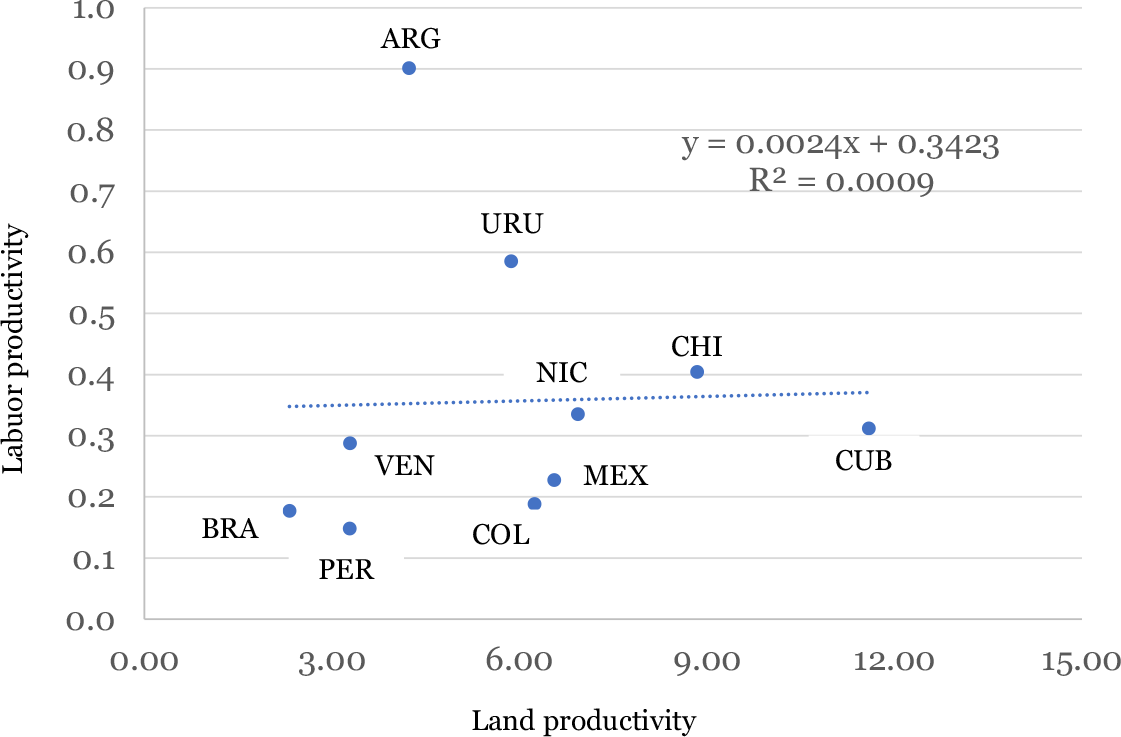
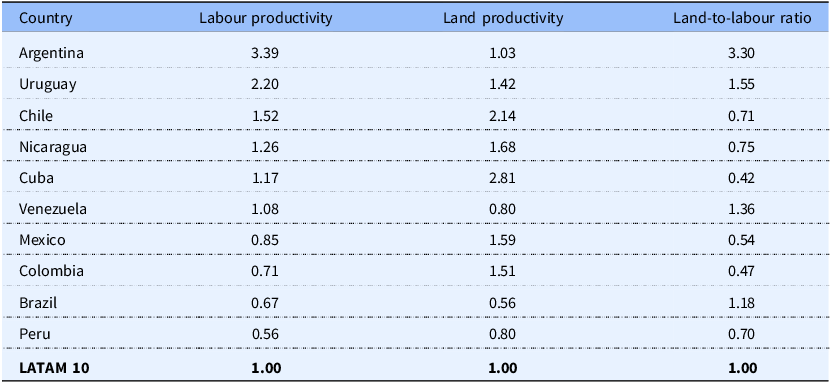
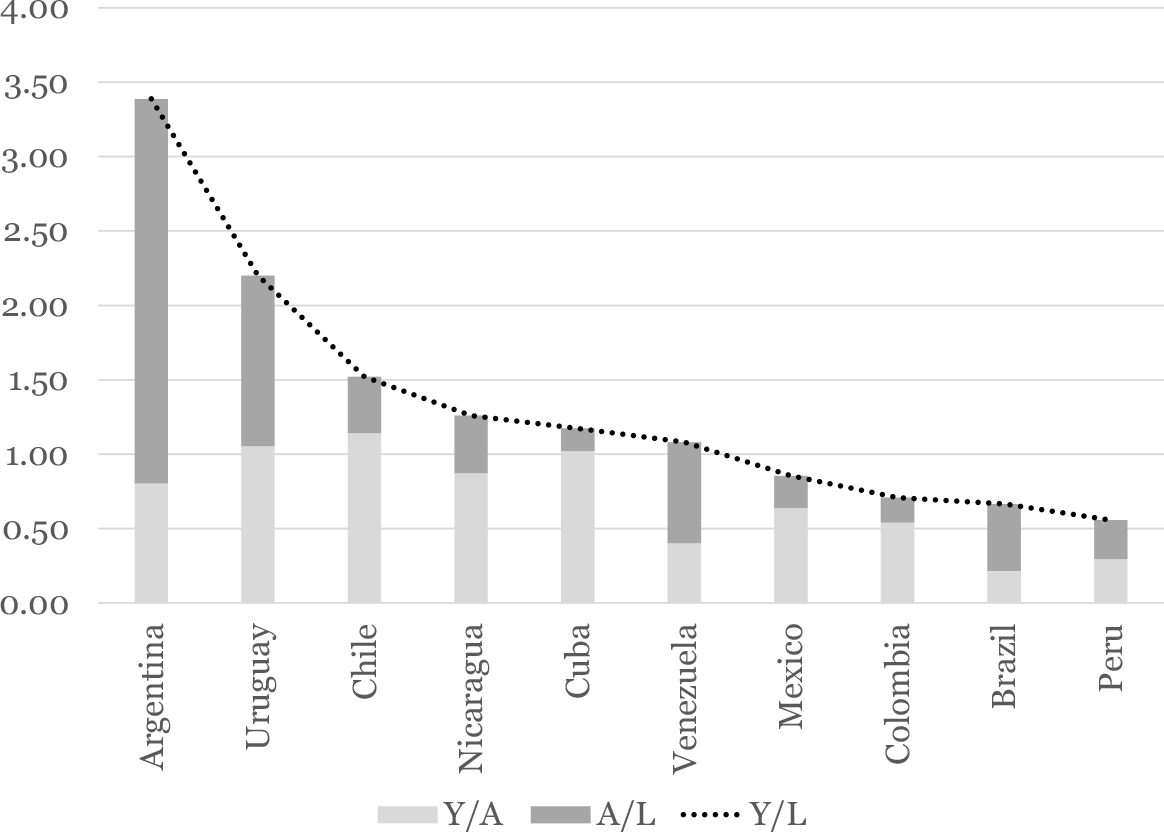

 Open access

