


Introduction
In recent years, the mental healthcare landscape in England has been transformed by the widespread dissemination of evidence-based psychological interventions delivered within a stepped care model. Stepped care is based on the premise that differing levels of intensity of treatment are required by different patients, and therefore organizing treatments according to escalating levels of intensity and cost may be an efficient way to allocate scarce resources (Haaga, Reference Haaga2000; Bower and Gilbody, Reference Bower and Gilbody2005). These assumptions are grounded in empirical evidence for the effectiveness of intensive psychotherapeutic interventions (Kendall and Chambless, Reference Kendall and Chambless1998; Chambless et al., Reference Chambless, Baker, Baucom, Beutler, Calhoun and Crits-Christoph1998; Chambless and Ollendick, Reference Chambless and Ollendick2001), and briefer low intensity guided self-help interventions (Newman, Reference Newman2000; Kaltenthaler et al., Reference Kaltenthaler, Brazier, De Nigris, Tumur, Ferriter and Beverley2006; Den Boer, Wiersma and Van Den Bosch, Reference Den Boer, Wiersma and Van Den Bosch2004; Gellatly et al., Reference Gellatly, Bower, Hennessy, Richards, Gilbody and Lovell2007). There is some experimental evidence that stepped care may be more cost-effective than intensive psychological therapy alone (Tolin, Diefenbach and Gilliam, Reference Tolin, Diefenbach and Gilliam2011), more effective than usual care in reducing the risk of onset of depression and anxiety disorders (van ‘t Veer-Tazelaar et al., Reference van‘t Veer-Tazelaar, van Marwijk, van Oppen, van Hout, van der Horst and Cuijpers2009), and more effective but marginally more costly than usual care for depression (Araya, Flynn, Rojas, Fritsch and Simon, Reference Araya, Flynn, Rojas, Fritsch and Simon2006), although there is also some evidence of non-significant differences between stepped care and usual primary care (Seekles, Van Straten, Beekman, Van Marwijk and Cuijpers, Reference Seekles, Straten, Beekman, Van Marwijk and Cuijpers2011). On balance, this developing literature leans toward stepped care as a feasible and effective model, and this view has been endorsed by national guidelines for the treatment of common mental health problems (National Institute for Health and Clinical Excellence, 2007, 2010).
Stepped care treatments are often delivered sequentially, expecting that most patients should derive some benefit from low intensity interventions, and high intensity treatments are mostly reserved for patients who have not improved in the earlier steps or those who have very severe conditions (Clark et al., Reference Clark, Layard, Smithies, Richards, Suckling and Wright2009; National Institute for Health and Clinical Excellence, 2011). The cost-effectiveness of this model is partly reliant on what Bower and Gilbody (Reference Bower and Gilbody2005) call the “self-correcting mechanism”, which requires systematic monitoring of patient outcomes and timely decisions to “step up” patients without any clear therapeutic gains to the next level of treatment. Close attention to early response and change within treatment has been proposed as a useful method to guide decision making within stepped care (Wilson, Vitousek and Loeb, Reference Wilson, Vitousek and Loeb2000) and has been shown to be a more accurate method than prognostic assessments by clinicians (Breslin, Sobell, Sobell, Buchan and Cunningham, Reference Breslin, Sobell, Sobell, Buchan and Cunningham1997). Consistent with the above, recent research has shown that patients achieving reliable symptom improvement as early as session 3 in low intensity psychological interventions are at least twice as likely to fully recover compared to those with no early improvement, and lack of clinically significant improvement is associated with treatment dropout (Delgadillo et al., in press). The fundamental role of timely decision making is clear, even though the current evidence base specific to stepped care is scarce.
A look at the wider healthcare literature confirms that decision making can be influenced by outcome measures (e.g. Dowrick et al., Reference Dowrick, Leydon, McBride, Howe, Burgess and Clarke2009) and guidelines (e.g. Rycroft-Malone, Fontenla, Seers and Bick, Reference Rycroft-Malone, Fontenla, Seers and Bick2009; Parry, Cape and Pilling, Reference Parry, Cape and Pilling2003; Woolf, Grol, Hutchinson, Eccles and Grimshaw, Reference Woolf, Grol, Hutchinson, Eccles and Grimshaw1999). Yet a variety of other factors, including patient characteristics, attitudes and preferences, are also likely to influence this process (e.g. Visintini, Ubbiali, Donati, Chiorri and Maffei, Reference Visintini, Ubbiali, Donati, Chiorri and Maffei2007; Bartak, Soeteman, Verheul and Busschbach, Reference Bartak, Soeteman, Verheul and Busschbach2007; Sandell and Fredelius, Reference Sandell and Fredelius1997). Health professional confidence, perceived abilities and relationships with patients and other professionals can also play a part in decisions about treatment (Stavrou, Cape and Barker, Reference Stavrou, Cape and Barker2009; Anthony et al., Reference Anthony, Baik, Bowers, Tidjani, Jacobson and Susman2010; Sigel and Leiper, Reference Sigel and Leiper2004; Pilgrim, Rogers, Clarke and Clark, Reference Pilgrim, Rogers, Clarke and Clark1997). Ostensibly, clinical decision making is a complex endeavour and does not rely on a single factor or process. The complexity of decision making is reflected in a number of theories such as the “health belief model” (Janz and Becker, Reference Janz and Becker1984), the “theory of reasoned action” (Ajzen and Fishbein, Reference Ajzen and Fishbein1980), “social learning theory” (Bandura, Reference Bandura1989), the “cognitive information processing model” (Joos and Hickman, Reference Joos, Hickam, Glanz, Lewis and Rimer1990), and the “theory of planned behaviour” (Ajzen, Reference Ajzen1991). The latter theory integrates many concepts from the preceding models and, indeed, a number of factors outlined above (e.g. norms, attitudes, beliefs, perceived barriers, self-efficacy). Such theories and models are yet to be applied in the specific context of stepped care psychological treatment.
In routine practice, decision making may not necessarily adhere to evidence based strategies such as those described above, and may be influenced by a range of contextual and subjective factors. In a recent qualitative study focusing specifically on how decision making is conducted within stepped care psychological services, a discrepancy between the theory and implementation of the model was revealed (Gellatly, Reference Gellatly2011). Central to the difficulties faced by health professionals when making decisions was their impetus to adopt an individualized approach, which was seen to conflict with standardized measures and guidelines. The tension between the “caring” values of health professionals and the “economic / public health” perspective underlying stepped care had an impact on professional decision making, and many clinicians seemed to err on the side of clinical judgement rather than standardization. Decision making using this clinical judgement approach was observed to be variable across clinicians and professional groups (e.g. low intensity therapists, general medical practitioners, psychologists). Congruent with this tension, some clinicians resorted to “holding” patients who were facing long waiting lists for suitable treatments, or for whom no other suitable treatment was perceived to be available. “Holding” reflects the interesting paradox that stepped care is designed to ease waiting lists, but waiting lists actually impact upon clinicians’ ability to work in line with the principles of stepped care. Furthermore, holding is likely to have important resource and cost implications for patients who are retained in a particular step of treatment without clear gains. The potential impact of delaying some patients’ access to more intensive treatments, or providing them with treatments identified as unsuitable, is still unclear, although some have suggested this may be potentially detrimental (Davidson, Reference Davidson2000; Lucock et al., Reference Lucock, Padgett, Noble, Westley, Atha and Horsefield2008). Holding is thus likely to be a drain on resources, and has significant implications for the functioning of the stepped care model in its goal of maximizing access to care.
Building upon some of the above theory and research, the present study aimed to advance our understanding of how clinicians make decisions within a stepped care system, and which factors influence their clinical judgement regarding “stepping-up” and “holding” patients in treatment. To this end, we developed a new questionnaire on factors associated with referrals and holding with reference to the theory of planned behaviour. We tested its factor structure and examined associations between this questionnaire and self-reported likelihood of holding in three groups of mental health professionals working in stepped care.
Method
Participants and study design
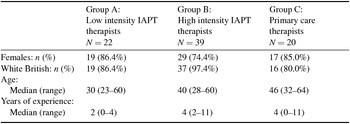
A cross-sectional sample of psychological therapists working in primary care and voluntary sector mental health teams (n = 82) completed questionnaires using an internet-based confidential survey. Participants were recruited from eight primary care and mental health teams in Leeds, England. Potential participants were informed of the study via email and informed consent was obtained using an electronic data collection system. A subsample of 43 participants responded to a second survey, which was completed within 2 to 3 weeks, using a test-retest design. The overall sample included three groups of practitioners. Group A was comprised of therapists trained to deliver brief low intensity psychosocial interventions for depression and anxiety disorders, as part of the Improving Access to Psychological Therapies (IAPT) programme in England (Clark et al., Reference Clark, Layard, Smithies, Richards, Suckling and Wright2009). These low intensity interventions included group and individual guided self-help based on cognitive behavioural therapy (CBT) principles, behavioural activation, psycho-education about common mental disorders, and assisted computerized CBT. Group B included therapists trained to deliver high intensity evidence-based psychotherapies for depression and anxiety disorders as part of the IAPT programme, including CBT, interpersonal psychotherapy (IPT) and eye-movement desensitization and reprocessing (EMDR). Group C included registered mental health nurses and counsellors working for the National Health Service (NHS) who delivered an eclectic range of brief therapeutic interventions in primary care, mostly based on person-centred counselling, guided self-help and problem-solving approaches. Table 1 provides participants’ demographic characteristics. These groups did not differ considerably in any of these characteristics apart from the difference in years of experience, which was lower in group A.
Sample characteristics

Note: Proportions are based on the total number of complete responses, excluding one case with missing demographic data
Measures
Guided by earlier qualitative research investigating factors that influence therapists’ decision making in stepped care psychological therapy services (Gellatly, Reference Gellatly2011), two measures were developed by the research team.
Likelihood of holding scale
The first measure was a single item 5-point Likert scale (ranging from 0 = never to 4 = always), which aimed to assess how frequently therapists retained patients in treatment in spite of little evidence of therapeutic improvement. This measure specifically focuses on the issue of patient “holding” described by Gellatly (Reference Gellatly2011). We endeavoured to specify this holding construct more precisely. To this end, we referred to the well established psychotherapy dose-response and early gains literature, which demonstrates that those patients who are most likely to recover usually show signs of improvement in the early stages of treatment and their symptoms generally follow a predictable trajectory (Hansen, Lambert and Forman, Reference Hansen, Lambert and Forman2002; Lueger, Lutz and Howard, Reference Lueger, Lutz and Howard2000; Lutz, Lowry, Kopta, Einstein and Howard, Reference Lutz, Lowry, Kopta, Einstein and Howard2001; Maling, Gurtman and Howard, Reference Maling, Gurtman and Howard1995; Stiles et al., Reference Stiles, Leach, Barkham, Lucock, Iveson and Iveson2003, Stulz, Lutz, Leach, Lucock and Barkham, Reference Stulz, Lutz, Leach, Lucock and Barkham2007; Tang and deRubeis, Reference Tang and DeRubeis1999). In addition, we acknowledge that IAPT and primary care interventions in England mostly follow the prescribed lengths of treatment (e.g. 1–8 sessions for low intensity, and 16–20 sessions for high intensity therapies) that are recommended by national guidelines (National Institute for Health and Clinical Excellence, 2007, 2010). Based on the above sources, we conceptualized holding as the retention of a patient in therapy who has not shown any reliable improvement halfway through the recommended number of sessions for that treatment modality. The holding measure reads: “How likely are you to continue to treat a patient who has not shown any reliable improvement halfway through the number of sessions appropriate to your role?”
Factors Associated with Referral And Holding Questionnaire (FARAH-Q)
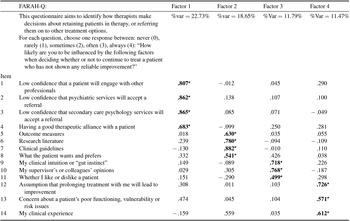
The second measure was an exploratory 14-item questionnaire aimed to investigate factors that influence therapists’ decisions to continue to treat a patient or to conclude the treatment episode and refer the patient to other support options. These items were formulated as 5-point Likert scales aiming to assess how often specific factors influence decision making (ranging from 0 = never to 4 = always). The questionnaire included factors such as reliance on clinical guidelines, the opinion of supervisors and colleagues, clinical intuition, clinical experience, perceptions about the therapeutic relationship, assumptions about likelihood of improvement, and concerns about risk or functional impairment. The full questionnaire items are presented in Table 2.
Principal components analysis after varimax rotation

* Indicates items that load highly on each of the factors; %Var = proportion of variance in the dataset explained by factor; total variance in dataset explained by underlying factors = 64.64%
Data analysis
Principal components analysis (PCA) with varimax rotation and scree tests were used to examine the underlying factor structure of the FARAH-Q. This analysis proceeds by extracting possible underlying factors and retains those that explain a large proportion of variance in the data. Following the general rule outlined by Bryant and Yarnold (Reference Bryant, Yarnold, Grimm and Yarnold1995), we estimated a minimal sample size of 70 participants for this analysis, based on a ratio of 5:1 between participants and scale items.
Assumptions of normality and homoscedasticity were assessed graphically and statistically (using Shapiro-Wilk Test) in the dataset for the FARAH-Q. This was followed by logarithmic transformation of all item scores prior to performing PCA (due to skewed distributions). Conventional statistical tests were used to empirically evaluate the adequacy of the factor solution. The Kaiser-Meyer-Olkin (KMO) statistic was calculated as a measure of sampling adequacy, where a value ≥.60 is indicative of acceptable factorability (Brace, Kemp and Snelgar, Reference Brace, Kemp and Snelgar2006). We considered retaining all items with factor loadings >0.40, and removing any items with smaller loadings in the rotated component matrix. In addition, Bartlett's test of sphericity was used, where p < .05 would be indicative of adequate factorability for the dataset as a whole. After determining the factor structure of the questionnaire and deciding if any items needed to be removed, we examined its reliability using Cronbach's alpha as a measure of internal consistency, using an alpha of .70 as a cut-off, with a higher number indicating acceptable reliability (Nunnally, Reference Nunnally1970). We also calculated the intra-class correlation coefficient (ICC) to examine test-retest reliability for each of the FARAH-Q items and the likelihood of holding scale within a period of 2 to 3 weeks, taking a conventional cut-off of .80 to indicate strong agreement between measures (Shrout, Reference Shrout1998).
Spearman's non-parametric correlations were used to investigate associations between the likelihood of holding scale, years of experience, and each of the (non log-transformed) items in the FARAH-Q. Finally, the mean likelihood of holding measures reported by the three groups of participants were compared using analysis of variance (ANOVA).
Results
Principal components analysis and reliability testing
PCA indicated that four underlying factors accounted for 64.64% of variance in the dataset after rotation (Factor 1 eigenvalue = 4.05, accounting for 22.73% of variance; Factor 2 eigenvalue = 2.51, accounting for 18.65% of variance; Factor 3 eigenvalue = 1.34, accounting for 11.79% of variance; Factor 4 eigenvalue = 1.15, accounting for 11.47% of variance). This was consistent with the scree test, which also indicated a 4-factor solution based on eigenvalues above the cut-off of 1. Table 2 presents the final rotated component matrix, displaying the correlations between all items and underlying factors. All factor loadings were above the minimal acceptable level of .40 on at least one factor, and we therefore decided to retain all 14 items in the final model. The adequacy of this set of items for factor analysis was also confirmed by Bartlett's test of sphericity, which was non-significant (approximate χ2 = 452.58, df = 91, p < .001). Consistent with these findings, the overall KMO measure of sampling adequacy was .67, indicating acceptable factorability for the set of items. Cronbach's alpha for the FARAH-Q was .75, indicative of adequate reliability and internal consistency. ICC values for the FARAH-Q items ranged between .55 and .88, denoting moderate to strong temporal stability of responses over a 3-week period. The smallest ICC estimates corresponded to the items about confidence in the acceptance of referrals to psychiatric (ICC = .55, p < .01) or secondary care psychology services (ICC = .62, p < .01), which was expected given that this is likely to vary from week to week and is influenced by many factors (e.g. whether or not the respondent had to refer patients during that week, or the nature of these referrals). The likelihood of holding scale had moderately high test-retest reliability (ICC = .70, p < .01).
Issues that influence the likelihood of holding
The likelihood of therapist-reported holding was correlated with perceptions about the therapeutic alliance (item 4, r = .50, p < .01), assumptions about the potential benefit of prolonging treatment (item 12, r = .48, p < .01), concern about poor functioning and risk issues (item 13, r = .47, p < .01), concerns that the patient may not engage with other professionals (item 1, r = .41, p < .01), low confidence that psychiatric services (item 2, r = .32, p < .01) or secondary care psychology services (item 3, r = .40, p < .01) will accept a referral, and whether the therapist likes or dislikes a patient (item 11, r = .25, p = .04). The first four of these items were moderately associated with holding; the therapeutic alliance item showed the largest correlation coefficient, and liking/disliking a patient showed the weakest correlation. Likelihood of holding was not correlated to years of experience (r = .14, p = .27). ANOVA results indicated statistically significant differences when comparing mean likelihood of holding scores between groups A (mean = 1.71, SD = .96), B (mean = 2.32, SD = .70), and C (mean = 2.33, SD = .62); F(2, 64) = 4.50, p = .02. This suggested that self-reported holding was less prominent in group A (therapists delivering low intensity interventions) compared to the other groups, which was unlikely to be explained by differences in years of experience or seniority given the preceding correlation analysis.
Discussion
Theoretical considerations
Consistent with prior insights derived from qualitative research (Gellatly, Reference Gellatly2011), this study demonstrates that a range of idiosyncratic assumptions, perceptions and attitudes are likely to influence clinicians’ decision making process. Furthermore, as suggested by the present data on self-reported holding, decision making is not necessarily congruent with standardized clinical guidelines or organizational norms. We argue that these propositions are closely attuned to key concepts in Ajzen's theory of planned behaviour (TPB). TPB asserts that deliberate and planned behaviours result from an interaction between beliefs, attitudes, subjective norms, and perceived control (Ajzen, Reference Ajzen1991). This interaction influences a subject's behavioural intentions, which are seen as immediate precursors to actual behaviours. This mechanism described by TPB counts with convincing empirical support (Sheppard, Hartwick and Warshaw, Reference Sheppard, Hartwick and Warshaw1988), and has been influential as an explanatory model and basis for applied healthcare interventions (Glanz, Rimer and Viswanath, Reference Glanz, Rimer and Viswanath2008). In what follows, we resort to this conceptual framework to examine the factors that may influence behavioural intentions to prolong treatment or “step up” within the context of stepped care psychological interventions.
Using principal components analysis, we identified four clusters (factors) of inter-correlated items that were likely to influence decision making in stepped care. The first factor included items that endorse low confidence in the possibility to engage a patient with other professionals and more intensive treatment options (at higher steps in the mental healthcare system), along with an item about the perceived quality of the therapeutic alliance. Inter-correlations between these items may reflect an interplay between perceived barriers in the stepped care system such as arbitrary inclusion criteria or onerous referral processes, or patient barriers such as concerns about psychiatric care (which would correspond to the TPB notion of perceived behavioural control / ease / difficulty), and perceptions about the quality of the therapeutic alliance (in TPB, this may be akin to attitude towards a behaviour – such as concluding treatment – that relies on the extent to which its performance would be deemed positive or negative; also normative beliefs about the importance of therapeutic alliance in psychological therapy). Based on this reasoning, we refer to this first factor as a “barriers to step up + alliance” interaction. The second factor denotes a reliance on evidence base (outcome measures, research, and clinical guidelines) and patient preferences, which we refer to as an “evidence base + patient preference” interaction. To some extent, these items are akin to the TPB concepts of normative beliefs (in this case influenced by professional / expert norms and paradigms) and subjective norms (influenced by personal assumptions / values and social pressures, in this case the patient's views and preferences). The third factor appears to be more weighted toward subjective norms (the therapist's own idiosyncratic assumptions, which may be influenced by colleagues’ opinions) and attitudes towards the patient (influenced by subjective “like” or “dislike”), and thus we refer to it as a “subjective norms + attitudes” interaction. Finally, the fourth factor appears to be weighted towards therapist perceived behavioural control (clinical experience and assumptions that prolonged treatment will succeed) in the face of risks (which denote ease and difficulty in behavioural performance according to TPB), and we refer to it as a “self-efficacy” factor. Figure 1 summarizes this theoretical integration between FARAH-Q items, factors that influence decision making and TPB concepts.
Conceptual integration of factors that influence decision making and theory of planned behaviour

We note that 4 out of 7 items that were associated with holding match up with the first factor (barriers to step up + alliance interaction). Other concepts relevant to holding included self-efficacy (perceived success of prolonging treatment in the face of risks) and attitudes towards the patient (influenced by like or dislike). In conclusion, this analysis suggests that the decision to retain a patient in treatment despite little improvement is more likely to happen if there are perceived barriers to refer the patient for further treatment, if the therapist likes the patient and has a good therapeutic alliance, and if the therapist feels confident that s/he has the ability to achieve a positive outcome by prolonging treatment.
Limitations
Although the overall sample size was sufficient for psychometric testing according to conventional guidelines (Bryant and Yarnold, Reference Bryant, Yarnold, Grimm and Yarnold1995), the relatively small number of participants from each professional group precluded separate analyses to investigate whether the factor structure may vary across groups. Perceived barriers to engage patients with psychiatric and secondary care psychology services were found to be associated with holding; however, we cautiously note that the temporal stability of these specific items was modest and the correlation coefficients were fairly weak. In addition, it is important to consider that local secondary care services / organizations are distinctly separate from the primary care teams from which our participants were recruited. This may not necessarily generalize to other localities and settings where psychiatric, psychological and psychosocial interventions are integrated within the same organization and may therefore present fewer barriers to onward referral or “stepping-up”.
An important caveat to the findings reported in this study is that they rely entirely on self-report. The study design purposely excluded triangulation of questionnaires with clinical records because we deemed it important to prioritize anonymity and confidentiality to maximize the validity of self-report, given that some of the questionnaire items are of a sensitive nature (e.g. admissions about holding, liking / disliking patients). A further consideration is that this study is limited to professionals working in the entry and middle layers of the stepped care system. Although investigating issues of holding and decision making in these strata is of crucial importance to the efficiency of the system, further research could also explore decision making in the higher tiers of specialist psychiatric and psychological care.
Considerations for clinical practice
Psychological therapists working in primary care report that some patients are likely to be retained in therapy despite little signs of therapeutic improvement, which is likely to have cost and efficiency drawbacks for stepped care systems. This holding phenomenon appears to be less prominent in the group of therapists delivering low intensity interventions, compared to nurses, counsellors and psychotherapists working in primary care. This may be because low intensity therapists in England are trained to offer very brief, structured and highly standardized interventions (IAPT, 2011) and work under considerable levels of case-management scrutiny (Turpin and Wheeler, Reference Turpin and Wheeler2011). Another plausible explanation is that therapists working at higher steps in the system have scope for more flexible and longer episodes of treatment (e.g. step 3 according to NICE guidelines, 2010, 2011), and may therefore feel less pressured to “step patients up”. It could also be argued that the stepped care model integral to the English IAPT programme has generated an “outcome focused culture”, which emphasizes attention to evidence-based practice, symptom monitoring and timely decision making at the earlier steps of treatment. This study shows that regard for the evidence base and patient preferences (factor 2) are important influences for decision making in this setting, although further research is required to replicate this observation at a larger scale and also in relation to traditional mental health and primary care settings.
Whilst clinical guidelines recommend stepping-up on the basis of routine outcome monitoring and patient preferences (NICE, 2007, 2010, 2011), it is apparent that decision making can be inconsistent. For example, the national review of the IAPT programme in England highlighted substantial variability (from 27% to 58%) in recovery rates between stepped care services, some of which was likely to be attributable to the proportions of patients who were treated with step 3 high intensity interventions (Gyani, Shafran, Layard and Clark, Reference Gyani, Shafran, Layard and Clark2011). Making decisions that improve the efficiency and effectiveness of service provision but which also support patients’ choices and preferences is a key challenge. While therapists may feel confident (self-efficacy factor described above) that they have the ability to treat patients effectively and thus hold them in therapy, clinicians should also be able to recognize when the decision to hold may be inappropriate. Evidence indicates that stepping-up at the appropriate time can improve compliance, clinical outcomes and reduce unemployment rates (Gyani et al., Reference Gyani, Shafran, Layard and Clark2011). Holding may therefore have a significant impact upon these outcomes. Raising awareness of such factors in the context of clinical supervision and case management discussions may helpfully draw attention to clinicians’ own subjective norms, attitudes and beliefs which may, in some cases, be at odds with best evidence, efficiency and effective care. For example, cases that have not shown early symptom improvements by session 4 in low intensity interventions (Delgadillo et al., in press) or by session 10 in more intensive psychotherapies (e.g. see Schindler, Hiller and Witthöft, Reference Schindler, Hiller and Witthöft2013) may be at risk of poor outcomes. Such observations at these key stages of treatment may prompt discussion and reflection in clinical supervision, considering questions such as: How do you feel about the possibility of referring this patient for another treatment option at this stage? Can you think of any barriers for onward referral? How do you think the patient would react to this suggestion? Can you think of any advantages to prolonging therapy? How do you think things may progress with extended therapy? How do you feel about the patient and your relationship?
Congruent with other authors’ reflections on the complex business of making decisions about patients’ care (Cocksedge, Reference Cocksedge2005; Davidson, Reference Davidson2000; Power, Reference Power2009; Wailoo, Roberts, Brazier and McCabe, Reference Wailoo, Roberts, Brazier and McCabe2004), this study highlights the challenge faced by health professionals trying to improve efficiency in addition to meeting their own personal and professional values and the demands of patients. The holding phenomenon emphasizes the wavering between health professional values, attitudes and norms that influence decisions that are sometimes made in accordance with or in spite of evidence-based guidelines.




Comments
No Comments have been published for this article.