INTRODUCTION
It has long been recognized that learning the grammar of a new language is a tall order for many people. Grammar, which “governs even kings and with high hands makes them obey its laws” (Molière, 2013: act 2, sc. 6), does not have complete power over second language (L2) learners, especially those who began to learn their L2 after the critical period (DeKeyser, Reference DeKeyser2000; DeKeyser, Reference DeKeyser2013; DeKeyser & Larsen-Hall, Reference DeKeyser, Larson-Hall, Kroll and de Groot2005). These learners tend to experience difficulties with such aspects of a L2 as inflectional morphology in both production and comprehension, even at advanced levels of proficiency (e.g., Ayoun, Reference Ayoun and Ayoun2007; Clahsen & Felser, Reference Clahsen and Felser2006a, Reference Clahsen and Felser2006b; Clahsen, Felser, Neubauer, Sato, & Silva, Reference Clahsen, Felser, Neubauer, Sato and Silva2010; DeKeyser, Reference DeKeyser2013; DeKeyser & Prieto Botana, Reference DeKeyser, Prieto Botana and Geeslin2014; Gor & Cook, Reference Gor and Cook2010; Gor & Jackson, Reference Gor and Jackson2013; Grüter, Lew-Williams, & Fernald, Reference Grüter, Lew-Williams and Fernald2012; Jiang, Reference Jiang2004, Reference Jiang2007; Jiang, Novokshanova, Masuda, & Wang, Reference Jiang, Novokshanova, Masuda and Wang2011; White, Valenzuela, Kozlowska-Macgregor, & Leung Reference White, Valenzuela, Kozlowska-Macgregor and Leung2004), and appear to have particular difficulties with grammatical agreement.
The computation of agreement rules plays a central role in language comprehension, especially in richly inflected languages. When processing agreement, native speakers demonstrate congruency effects evidenced in shorter reaction latencies when syntactic items agree in gender or number and incongruency effects when items have incorrect agreement (Gunter, Friederici, & Schriefers, Reference Gunter, Friederici and Schriefers2000; Gurjanov, Lukatela, Lukatela, Savic, & Turvey, Reference Gurjanov, Lukatela, Lukatela, Savic and Turvey1985; Gurjanov, Lukatela, Moskovljevic, Savic, & Turvey, Reference Gurjanov, Lukatela, Lukatela, Savic and Turvey1985; Lukatela, Kostic, Feldman, & Turvey, Reference Lukatela, Kostic, Feldman and Turvey1983; Lukatela, Kostic, Todorovic, Carello, & Turvey Reference Lukatela, Kostic, Todorovic, Carello and Turvey1987; Vainio, Hyönä, & Pajunen, Reference Vainio, Hyönä and Pajunen2003). L2 learners, in contrast, have demonstrated reduced or no sensitivity to agreement markers and difficulties in establishing agreement dependencies in processing (Blom, Polišenská, & Weerman, Reference Blom, Polišenská and Weerman2008; Chen, Shu, Liu, Zhao, & Li, Reference Chen, Shu, Liu, Zhao and Li2007; Clahsen & Felser, Reference Clahsen and Felser2006b; Franceschina, Reference Franceschina2005; Guillelmon & Grosjean, Reference Guillelmon and Grosjean2001; Jiang et al., Reference Jiang, Novokshanova, Masuda and Wang2011; Keating, Reference Keating2009; McCarthy, Reference McCarthy2008; Montrul, Foote, & Perpiñán, Reference Montrul, Foote and Perpiñán2008; Montrul, de la Fuente, Davidson, & Foote, Reference Montrul, de la Fuente, Davidson and Foote2013; Morgan-Short, Sanz, Steinhauer, & Ullman, Reference Morgan-Short, Sanz, Steinhauer and Ullman2010; Unsworth, Reference Unsworth2008).
L2 learners’ lack of sensitivity to agreement violations has been attributed to their age of acquisition and inability to activate a syntactic mechanism that checks gender agreement (Guillelmon & Grosjean, Reference Guillelmon and Grosjean2001), the engagement of different cognitive mechanisms (Clahsen & Felser, Reference Clahsen and Felser2006a; DeKeyser, Reference DeKeyser, Long and Doughty2009, Reference DeKeyser2013), and the selective integration of linguistic knowledge in late L2 acquisition (Jiang, Reference Jiang2007). Other factors include language proficiency and working memory (Sagarra & Herschensohn, Reference Sagarra and Herschensohn2010), the similarity of linguistic structures in the L1 and L2 (Chen et al., Reference Chen, Shu, Liu, Zhao and Li2007; Hawkins & Casillas, Reference Hawkins and Casillas2008; Jiang et al., Reference Jiang, Novokshanova, Masuda and Wang2011; Sabourin, Reference Sabourin2003; Tokowicz & MacWhinney, Reference Tokowicz and MacWhinney2005), and the transparency of morphophonological cues (Foote, Reference Foote2014, Reference Foote2015). The role of domain-general factors—such as low L2 working memory capacity, poor decoding, and/or slower L2 processing speed (McDonald, Reference McDonald2000, Reference McDonald2006; McDonald & Roussel, Reference McDonald and Roussel2010)—has also been pointed out. However, despite a plethora of studies demonstrating L1-L2 processing differences, the nature of L2 difficulties and the relative importance and interaction of factors modulating native and nonnative sensitivity to morphosyntactic information in online processing remain unclear.
Different views also exist regarding whether gender and number are represented and processed similarly or differently. Some researchers propose that gender, similar to number, projects its own syntactic phrase and that, accordingly, gender and number processing should not be different (Picallo, Reference Picallo1991). This view is supported by findings of similar processing for gender and number violations in monolingual (Lukatela et al., Reference Lukatela, Kostic, Feldman and Turvey1983; Lukatela et al., Reference Lukatela, Kostic, Todorovic, Carello and Turvey1987) and bilingual (Alemán Bañón, Reference Alemán Bañón2012; Dowens, Guoc, Guoc, Barber, & Carreiras, Reference Dowens, Guoc, Guoc, Barber and Carreiras2011; Sagarra & Herschensohn, Reference Sagarra and Herschensohn2010, Reference Sagarra, Herschensohn and Ortiz-López2011) speakers. Others claim that grammatical gender is a stem-inherent feature of a noun’s lexical representation that is stored as part of each noun’s grammatical description in the mental lexicon, in contrast to number, which is a morphosyntactic feature that combines with the stem of the word and needs to be computed (Barber & Carreiras, Reference Barber and Carreiras2005; Franceschina, Reference Franceschina2001). Whereas a violation of number agreement requires the processor to check the final evaluation stage of syntactic processing, a gender agreement violation forces the processor to return to the initial stage of lexical access to check if the right word has been selected. Therefore, repair after gender agreement violation may be cognitively more demanding than repair after number agreement violation (Domínguez, Cuetos, & Ségui, Reference Domínguez, Cuetos and Ségui1999; Sicuro Correa, Almeida, & Sobrino Porto, Reference Sicuro Correa, Almeida and Sobrino Porto2004). This view is supported by findings regarding delayed latencies for gender disagreement as compared to number disagreement (Barber & Carreiras, Reference Barber and Carreiras2003), greater event-related potential (ERP) effects in gender disagreement in comparison with number disagreement (e.g., the last segment of the P600 effect was greater for gender than for number violations in Barber & Carreiras, Reference Barber and Carreiras2005), and stronger brain responses to gender disagreement than to number disagreement, as is evident in the increase of P600 amplitude in violations realized at a greater distance between agreeing elements (O’Rourke & Van Petten, Reference O’Rourke and Van Petten2011) in native speakers. Nonnative speakers have also demonstrated greater accuracy on number agreement than gender agreement and faster computation of number agreement violations than gender agreement violations (Dowens et al., Reference Dowens, Guoc, Guoc, Barber and Carreiras2011; Franceschina, Reference Franceschina2001; Sagarra & Herschensohn, Reference Sagarra and Herschensohn2013; White et al., Reference White, Valenzuela, Kozlowska-Macgregor and Leung2004). However, evidence in support of differences between gender and number agreement processing in the L1 and L2 remains inconclusive. The picture becomes more intricate when models of gender versus number processing are extended to morphologically complex languages, such as Russian, in which other factors may impact morphological processing in the L2 differently than in the L1.
One such factor examined in this article is the default status of masculine gender and singular number in Russian. The default/nondefault distinction parallels the unmarked/marked relations established in research on markedness. The notion of markedness was first proposed by Nikolai Trubetzkoy and Roman Jakobson in the 1930s as a means of characterizing binary oppositions in phonology; was extended to other areas, such as morphology, syntax, and semantics; and was later adopted in L2 research to predict areas of L2 difficulty (Eckman, Reference Eckman1977; Eckman, Moravcsik, & Wirth, Reference Eckman, Moravcsik and Wirth1986). Since then, research has shown that markedness plays a role in both L1 and L2 acquisition and processing of morphology. Because unmarked classes are more frequent and less morphologically marked, they tend to be acquired earlier and produced more accurately (Eckman et al., Reference Eckman, Moravcsik and Wirth1986; Gordishevsky & Schaeffer, Reference Gordishevsky, Schaeffer, Guijarro-Fuentes, Clibbens and Larrañaga2008; Gvozdev, Reference Gvozdev1961; Kempe, Brooks, Mironova, & Fedorova, Reference Kempe, Brooks, Mironova and Fedorova2003; Popova, Reference Popova, Ferguson and Slobin1973), to be more stable than marked classes (Greenberg, Reference Greenberg1966; Gürel, Reference Gürel2004), and to require less processing effort (Deutsch & Bentin, Reference Deutsch and Bentin2001). Additionally, unmarked forms are used as the default when a grammatical category is unknown or ambiguous (Bonvillain, Reference Bonvillain2003). In most languages, including Russian, the default gender is masculine and the default number is singular (Corbett, Reference Corbett1991). Accordingly, in this article the terms default and unmarked are used interchangeably to refer to masculine and singular nouns, and the terms nondefault and marked are used to refer to feminine and plural nouns.
Akhutina and colleagues (2001) conducted a morphological priming study targeting gender agreement in two-word phrases in congruent, incongruent, and baseline (neutral) contexts. They posited that (a) because nouns in default classes are more likely to occur, their nonoccurrence leads to inhibition, whereas their occurrence does not facilitate them beyond the baseline expectation and (b) because nouns in nondefault classes are less likely to occur, their occurrence leads to facilitation, whereas their nonoccurrence does not inhibit them beyond the baseline. In their study examining the differences in performance between healthy and aphasic Russian listeners, the markedness effect found in healthy listeners included (a) inhibition (longer reaction times to violations in comparison to neutral primes) exhibited only for masculine singular nouns (based on the listener’s default form bias), (b) facilitation (shorter reaction times to correct agreement in comparison to the baseline) exhibited only for neuter nouns (based on the low probability of these nouns), and (c) both facilitation and inhibition for feminine nouns (reflecting their nondefault status and the fact that feminine nouns are a very large class, even though they are less frequently used than the masculine nouns). Footnote 1
Remarkably, the markedness effect (or the role of the default) described previously was not found in aphasic patients (Akhutina et al., Reference Akhutina, Kurgansky, Kurganskaya, Polinsky, Polonskaya, Larina, Bates and Appelbaum2001), suggesting that its absence may be a general symptom in Russian users with suboptimal language abilities. Extending this hypothesis to L2 learners of Russian in order to examine L1-L2 differences in the processing of grammatical agreement from the point of view of the presence/absence of the markedness effect in a language with a complex inflectional morphology, such as Russian, is a promising new avenue for research.
In view of the literature discussed previously, the main purpose of the study was to examine L2 processing of morphosyntactic information in agreement dependencies. The study aimed to determine whether gender and number are processed similarly in L1 and L2 Russian and whether highly proficient L2 speakers can gain nativelike strategies for processing both gender (not instantiated in their L1) and number (instantiated in their L1). The third aim was to investigate whether agreement processing is modulated by the default/nondefault status of masculine/feminine and singular/plural noun classes.
The choice of the method was guided by research methods used in cognitive psychology and was motivated by the following findings: (a) the presence of a predictive modifier speeds processing for gender/number agreement relative to an unpredictive modifier, (b) congruency in agreement speeds up processing, and (c) incongruency slows it down (Gunter et al., Reference Gunter, Friederici and Schriefers2000; Gurjanov, Lukatela, Lukatela, et al., Reference Gurjanov, Lukatela, Lukatela, Savic and Turvey1985; Gurjanov, Lukatela, Moskovljevic, Reference Gurjanov, Lukatela, Lukatela, Savic and Turvey1985; Lukatela et al., Reference Lukatela, Kostic, Feldman and Turvey1983; Lukatela et al., Reference Lukatela, Kostic, Todorovic, Carello and Turvey1987; Vainio et al., Reference Vainio, Hyönä and Pajunen2003). This “priming effect,” widely demonstrated in semantic and grammatical contexts (see Neely, Reference Neely, Besner and Humphreys1991, and Nicol, Reference Nicol1996, for reviews of semantic and syntactic priming, respectively), is quantified by subtracting reaction times (RTs) for targets in congruent/grammatical contexts from RTs for targets in incongruent/ungrammatical contexts. A methodological problem with this comparison is that one cannot determine whether congruent/grammatical primes facilitate performance, whether incongruent/ungrammatical primes inhibit performance, or whether both effects are present (see Posner & Snyder, Reference Posner, Snyder and Solso1975). To determine the relative contributions of such facilitatory and inhibitory effects to priming, a baseline condition is needed, with neutral primes that are neither semantically nor grammatically related, and that are unrelated to the target (such as the letter string xxxx) (Neely, Reference Neely, Besner and Humphreys1991). Facilitation is then quantified as the difference between the neutral condition and the congruent/grammatical condition, and inhibition is quantified as the difference between the neutral prime condition and the unrelated/ungrammatical prime condition (Posner & Snyder, Reference Posner, Snyder and Solso1975). Furthermore, an examination of priming effects can help determine the extent to which a particular underlying processing mechanism contributes to the observed priming effects. For example, whereas the presence of facilitatory effects without inhibition in congruent contexts and at short stimulus-onset asynchronies (SOAs) characterizes automatic processing, the presence of both facilitation and inhibition at longer SOAs characterizes controlled processes of expectation and rechecking in congruent and incongruent contexts, respectively (Neely, Reference Neely, Besner and Humphreys1991; Neely & Keefy, Reference Neely, Keefy and Bower1989; Posner & Snyder, Reference Posner, Snyder and Solso1975).
Few studies so far have used a neutral prime condition in L2 research. Two studies investigated whether early and late L2 learners can make use of gender cues in spoken-word recognition tasks; they have obtained conflicting results. Guillelmon and Grosjean (Reference Guillelmon and Grosjean2001) found that English-French late bilinguals did not show any sensitivity to gender marking either in grammatical or in ungrammatical contexts, and Foote (Reference Foote2014) demonstrated that whereas English-Spanish late bilinguals showed no facilitatory effects in the congruent condition, they were able to make use of incongruent gender cues in a nativelike manner. Another study by Hu and Jiang (Reference Hu, Jiang, Trofimovich and McDonough2011) used a crossmodal priming task to examine semantic integration of words at the sentence level in listening comprehension. The findings for L1 participants were consistent with previous research using the neutral baseline and showed facilitatory effects in the congruent condition and inhibitory effects in the incongruent condition. However, the L2 participants in the study showed only facilitation in the absence of inhibition, thus demonstrating their inability to integrate semantic information effectively and efficiently in listening comprehension.
In order to compare native and nonnative processing of morphosyntactic information, the present study employed a lexical decision task (LDT) within a priming paradigm and examined L1 and L2 priming patterns in noun-adjective (NA) agreement that involves establishing a link between the gender and number of the noun head and the adjective (e.g., prostoj, kozjol “simple-MASC-SG, goat-MASC-SG” → [NP prostoj kozjol]; see the Appendix for an overview of the Russian gender and number system). By using a neutral prime, we were able to measure the costs (inhibition) and benefits (facilitation) of priming and to isolate the contribution of underlying strategic mechanisms of prediction and rechecking. Together with an examination of the role of markedness (default/nondefault status), our analysis of mechanisms underlying written-word processing constitutes a novel approach rarely used in second language acquisition research that allows a nuanced comparison of L1-L2 priming patterns and can lead to a better understanding of the nature of L2 processing difficulties.
RESEARCH QUESTIONS AND HYPOTHESES
The study sought to answer the following questions:
-
1. Is gender agreement processed differently from number agreement in the L1 and in the L2?
-
2. Are L1 and L2 speakers similarly sensitive to agreement violations? Are there any L1-L2 differences in priming components?
-
3. Are both native and nonnative participants sensitive to the markedness effect (Akhutina et al., Reference Akhutina, Kurgansky, Kurganskaya, Polinsky, Polonskaya, Larina, Bates and Appelbaum2001) in processing gender and number agreement?
-
a. Is there an asymmetry between masculine and feminine noun targets in L1 and L2 agreement processing?
-
b. Is there an asymmetry between singular and plural noun targets in L1 and L2 agreement processing?
-
In line with the literature discussed previously, the study made the following predictions:
-
1. For both L1 and L2 participants, gender agreement violations will be more cognitively disruptive than number agreement violations. This will be evidenced in greater “repair costs” for gender disagreement than for number disagreement, leading to greater inhibition effects for gender than for number.
-
2. Both L1 and L2 participants will exhibit sensitivity to gender and number agreement and agreement violations. Both L1 and L2 speakers will show faster facilitation by processing targets in the grammatical (G) condition than by targets in the neutral (N) condition, and they will exhibit slower inhibition by processing targets in the ungrammatical (U) condition than by targets in the neutral condition: G < N < U. These effects will reflect an engagement of strategic expectations about the upcoming word based on morphosyntactic information on the prime and/or the costs of repair at the later rechecking stage after the target becomes available.
-
3. Only native participants will exhibit the markedness effect (Akhutina et al., Reference Akhutina, Kurgansky, Kurganskaya, Polinsky, Polonskaya, Larina, Bates and Appelbaum2001), or processing asymmetries between unmarked and marked noun targets:
-
a. Unmarked masculine and singular nouns, due to their default status, will show robust inhibition in the U condition but no facilitation in the G condition.
-
b. Marked feminine and plural nouns, due to their nondefault status, will show robust facilitation in the G condition, with or without robust inhibition in the U condition.
-
The markedness effect will not appear in L2 participants.
METHOD
Participants
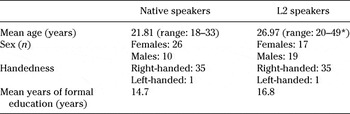
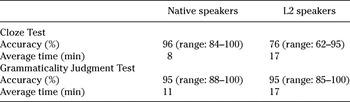
Anglophone participants residing in the United States who responded to the study announcement were first prescreened using a Web-based survey that covered, besides general information, their experience with Russian. Those participants who had had extensive practice with Russian either through study abroad, living and/or working in Russia, or attending intensive summer programs in the United States continued with two online proficiency tests, including a cloze test Footnote 2 and a grammaticality judgment task (GJT). Footnote 3 Thirty-six participants whose scores on the tests were above the previously determined cutoff points—60% on the cloze test and more than 85% on the GJT (Romanova, Reference Romanova2013)—were invited to take part in the experiment, along with 36 Russian-speaking participants residing in Russia. Table 1 provides information on the participants’ demographics. The difference in age between the native speakers and the L2 groups was not significant: t(35) = 3.57, p = .001. Results of both groups’ performance on the tests are presented in Table 2.
Participants’ demographics

* Two participants in the L2 group were more than 40 years of age (to be specific, one was 42 and the other was 49). Although there was no significant difference in the processing speed on the screening tests between these and younger participants, the two older participants were assigned to different testing groups.
Participants’ performance on the screening tests

Materials and Design
The study employed a visual LDT with priming. Experimental stimuli consisted of prime/target word pairs representing NA dependencies within syntactic phrase boundaries featuring gender and number agreement. Targets included real words (n = 288) with a frequency range between 10 and 320 occurrences per million words (72.31, SD = 59.10, for feminine nouns; 76.87, SD = 58.52, for masculine/singular nouns; and 75.45, SD = 61.90, for plural nouns). All the targets were in transparent disyllabic citation forms (the nominative case). A one-way ANOVA conducted on raw frequencies, with word category (feminine, masculine/singular, and plural) as a factor, did not find significant differences (p = .524) among the categories. The difference in word length among real feminine, masculine/singular, and plural nouns, however, was shown to be significant: F(2, 514) = 59.89, p < .001, ηρ2 = .189 (the mean length was 4.79, SD = 0.73, for feminine nouns; 5.55, SD = 0.86, for masculine nouns; and 4.80, SD = 0.65, for plural nouns). Footnote 4 A complete balance for the length in letters could not be achieved because, in order to match disyllabic feminine and plural nouns used in the study (due to feminine and plural markers), masculine nouns that have a zero ending and typically end in a consonant also had to be disyllabic, and disyllabic masculine nouns, on average, tend to be longer than feminine and plural nouns. Crucially, this unavoidable slight imbalance may potentially create a bias (with longer words taking longer to process) that goes in the opposite direction of the expected effect—namely, that masculine nouns will be processed faster than feminine nouns. Therefore, it does not pose a problem for the interpretation of the findings. Thus great care was taken to maintain the same average word length for each block of nouns in each priming condition and across lists (5.1, SD = .9). A later analysis of mean RTs as a function of word length showed that word length did not modulate RTs in either group of participants. Word frequencies (including surface frequency for plural nouns) were also carefully balanced across blocks of feminine, masculine, and plural targets used in each prime condition. A one-way ANOVA did not find significant differences in either word length or lemma frequencies among the stimuli lists (p = .617).
As is common in LDTs reported in the literature (Neely, Reference Neely, Besner and Humphreys1991), 50% of the items employed in the study were nonwords (n = 298) based on real nouns, drawn from other frequency ranges. Footnote 5 To discourage participants from responding before reading the entire nonword letter string, half of the nonwords were derived from real word stems by adding inappropriate endings (Blumstein, Milberg, Dworetzky, Rosen, & Gershberg, Reference Blumstein, Milberg, Dworetzky, Rosen and Gershberg1991). The remaining nonwords were created by randomly changing one or two letters in real word stems that were not used in the experiments. Care was taken to ensure that that the newly constructed nonwords did not use low-frequency bigrams and orthographic or phonological sequences that are illegal in Russian. No significant differences were found between the length of the real and nonce words (p = .48). The list of nonwords was checked by 10 native speakers of Russian who did not participate in the study, with the aim of identifying any low-frequency real words that could have inadvertently been created by manipulating real words. As a result, 5.18% of the nonce words were replaced or reconstructed.
In order to avoid any effects of the property of the prime, such as lexical frequency and semantic congruence with the target, on response latencies, different forms of the same prime adjective and an adverb with the same stem were used instead of a variable set of primes in all trials (Akhutina, Kurgansky, Polinsky, & Bates, Reference Akhutina, Kurgansky, Polinsky and Bates1999). This innovative approach was first introduced in a study by Akhutina and colleagues, and in order to produce comparable findings and capitalize on their design, we followed it closely. Thus the primes included (a) the masculine singular adjective prostoj (simple); (b) the feminine singular adjective prostaja; (c) the plural adjective prostyje; and (d) the adverb prosto, which was identified as semantically and syntactically neutral (Akhutina et al., Reference Akhutina, Kurgansky, Polinsky and Bates1999; Romanova, Reference Romanova2013). These primes were combined with targets to form three experimental conditions: G, U, and N.
In order to establish priming environments that would encourage both automatic and strategic processing mechanisms, the study manipulated two different time intervals between the prime and the target (i.e., the SOA)—250 and 1,000 ms—and two levels of grammaticality proportion (GP), or a different number of prime-target pairs in the G and U conditions: one with a high GP of .7 (i.e., 70% of all the words formed grammatical prime-target pairs, and 30% formed ungrammatical pairs) and one with a low GP of .3 (i.e., 30% of all the words formed grammatical prime-target pairs, and 70% formed ungrammatical pairs) (Goodman, McClelland, & Gibbs, Reference Goodman, McClelland and Gibbs1981). Thus the complete priming battery for each participant included four tests in the following experimental conditions: low GP-SOA250, low GP-SOA1000, high GP-SOA250, and high GP-SOA1000 (for a full description of the experimental design, see Romanova, Reference Romanova2013). The study also included 438 fillers appearing in noun-verb dependencies (with 228 real words and 196 nonwords).
Because each participant had to encounter all the conditions without seeing the same word/nonword twice, four master stimuli lists consisting of target real words, nonwords, and fillers were created and were matched for the number of word categories used, for word frequency, and for word length. As mentioned previously, no significant differences among the stimuli lists were found in either word length or lemma frequencies. These lists were crossed with two GPs and two SOAs, yielding 16 tests that were counterbalanced across participants. Note that because the grammaticality proportion and the SOA manipulations had a separate goal that is beyond the scope of the present study, and, crucially, because each participant was exposed to both GPs and SOAs, the two GPs and SOAs were collapsed together after checking that, statistically, there were no interactions of these variables with the priming condition (see the Data Analysis section). The total number of stimuli was 1,024 and included 516 different real words and 494 different nonwords.
Procedure
The investigations were carried out using a Web-deliverable version of the DMDX software—developed by K. I. Forster and J. C. Forster (Reference Forster and Forster2003) at the University of Arizona—that makes it possible to conduct experiments over the Internet (webDMDX). Footnote 6 Each participant completed four tests (two tests per day over a period of two days) in four experimental conditions: low GP-SOA250, low GP-SOA1000, high GP-SOA250, and high GP-SOA1000. Experimental stimuli in each test were presented via 12 blocks of 20–22 trials, depending on the list. After each block, participants were given an opportunity to take a break to avoid fatigue. A set of 14 practice pairs preceded each experiment. The practice primes included 14 prime-target pairs. The participants were instructed to take a longer break between the two tests that were completed on the same day. Each test took about 30 min to complete.
Each trial began with a preparatory cue (“+”) in the center of the computer screen, visible for 500 ms. After a blank screen interval of 1,000 ms, the first word—the prime—was displayed and remained visible for the entire duration of the SOA (which, depending on the test, was either 250 or 1,000 ms). This continuous display of the prime was meant to encourage participants to create expectancies (Balota, Black, & Cheney, Reference Balota, Black and Cheney1992). The second word—the target—was then displayed and remained on the screen for 4,000 ms or until the participant pressed the response button. The next trial was activated 1,500 ms after the previous target disappeared from the screen.
Participant reaction times, or the time from the presentation of the target to pressing the response button, were recorded to the nearest millisecond for correct responses to word and nonword targets. Errors were also recorded for both yes responses to nonword targets and the failure to recognize the word targets. The proportion of yes/no responses was 50/50. Participants received direct feedback in the form of RTs in milliseconds after each correct response. If their response was incorrect, they received negative feedback (Wrong) without RT information. On completion of each test, an e-mail with the participant’s data was sent to the experimenter automatically.
After completing the main experiment, the L2 participants and a randomly selected subgroup of native participants (n = 10) also completed a gender-monitoring task (GMT) and a number-monitoring task (NMT) to assess the probability that the observed priming effects in L2 speakers were influenced by incorrect gender or number assignment and to determine the ratio of errors made due to motor effects. The stimuli incorporated all the 516 real nouns used in the LDT experiment, with half of the masculine singular nouns used in the NMT and the other half in the GMT. Thus the GMT included 152 feminine nouns and 106 masculine singular nouns, and the NMT included 152 plural nouns and 106 masculine singular nouns.
The two tasks were completed after the main experiment and involved a dual-choice response mode. Stimuli were presented visually using webDMDX. Participants were asked to decide as quickly as possible whether the word they saw belonged to the feminine or masculine gender (in the GMT) or was singular or plural in number (in the NMT). They pressed the right control button for masculine and singular nouns and the left control button for feminine and plural nouns. They had 4 s to respond. Six practice trials were presented before each task, and the order of the stimuli was randomized for each participant. The presentation of the tasks was counterbalanced across participants.
Data Analysis
Mean RTs for each prime condition were calculated for each participant for gender and number agreement. All the RTs more and less than two standard deviations from the mean were removed from the data, as is common in the literature. The data removed constituted .86% of all responses for native participants and .99% for L2 participants. The internal consistency of the tests was assessed by computing the split-half reliability for the RT data using the Spearman-Brown formula. Reliability coefficients were very high overall, with r = 1.00 for native participants and r = .99 for L2 speakers.
Accuracy of responses on gender/number assignment on the GMT and NMT was also analyzed. The analysis revealed that L2 participants’ mean accuracy in both gender and number assignment was high: it was 97.3% (range: 90.1%–100%) on the GMT and 96.7% (range: 90.4%–100%) on the NMT. The mean accuracy scores of the subgroup of Russian participants (n = 10), who also performed the tests, were 96.9% (range: 90.2%–100%) on the GMT and 95.8% (range: 90.1%–100%) on the NMT. Errors among native participants on the gender- and number-monitoring tasks were obviously due to errors in motor responses and constituted 3.6% of all responses. Errors among L2 participants constituted 3%. For reasons of consistency in data cleaning between the native speaker and L2 groups and because of L2 participants’ nativelike error rate on the monitoring tasks, these words were not removed from the RT data.
To provide the measures of priming, mean RTs in the G condition were compared with mean RTs in the U condition. Morphosyntactic priming effects were defined as the RT difference between the U and G conditions:
 $$Priming\,effect\, = \,RTs{\,_{ungrammatical}}\, - \,RTs{\,_{grammatical}}$$
RTs for the G and U conditions were also compared with the N condition to determine the facilitatory and inhibitory components of the observed priming. Facilitation was defined as significantly shorter reaction times in the G condition than in the N condition, and, conversely, significantly longer reaction times in the U condition than in the neutral condition represented inhibition:
 $$Facilitation\, = \,RTs\,N\, &gt; \,RTs\,G$$
 $$Inhibition\, = \,RTs\,U\, &gt; \,RTs\,N$$
The average response latencies and accuracy rates for the L1 and L2 participant groups were submitted to a one-way ANOVA. Significant differences between the two groups were found in RTs—F(1, 71) = 66.04, p < .001, ηρ2 = .482—and in accuracy rates—F(1, 71) = 33.56, p < .001, ηρ2 = .321. Levene’s Test of Homogeneity of Variances indicated that group comparisons failed to meet the assumption of homogeneity of variance: F(1, 71) = 3.11, p < .05, ηρ2 = . 042, and F(1, 71) = 3.83, p < .05, ηρ2 = .051. Accordingly, the L2 and L1 groups’ data were not compared directly, and their data for both mean RTs for correct responses and priming effects were analyzed separately (Milberg, Blumstein, Katz, Gershberg, & Brown, Reference Milberg, Blumstein, Katz, Gershberg and Brown1995). For both groups, repeated-measures ANOVAs were used.
Because the purpose of the study was to examine the patterns of priming for each grammatical category and the treatment of the default (markedness relations) in native and nonnative participants, the data were collapsed over the GP and SOA conditions to isolate and quantify the variables of interest. This was done based on the absence of significant GP × SOA × priming condition interaction for either participant group, as shown in a three-way ANOVA with three within-subjects factors—namely, SOA (250, 1000), grammaticality proportion (low GP, high GP), and prime condition (G, N, or U) run on the RT data collapsed over the grammatical categories (L1: F[2, 70] = .55, p > .1, and L2: F[2, 70] = 1.69, p > .1).
RESULTS
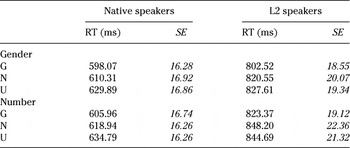
Table 3 shows mean RTs for both groups of participants for gender and number agreement across the three priming conditions. To answer the first two research questions, a two-way ANOVA with two within-subjects factors—namely, grammatical category (Gender or Number) and prime condition (G, N, or U)—was performed on the RT data separately for each group of participants.
RTs for gender and number agreement across priming conditions

Note. G = grammatical, N = neutral, and U = ungrammatical condition.
The results revealed a significant main effect of the grammatical category in both L1 (F 1[1, 35] = 9.63, p < .001, ηρ2 = .22; F 2[1, 143] = 10.5, p = .001, ηρ2 = .1) and L2 (F 1[1, 35] = 29.33, p < . 001, ηρ2 = .46; F 2[1, 143] = 8.21, p = .005, ηρ2 = .06) groups, a significant main effect of the prime condition in both L1 (F 1[2, 70] = 26.31, p < .001, ηρ2 = .43; F 2[2, 286] = 21.55, p < .001, ηρ2 = .14) and L2 (F 1[2, 70] = 8.31, p < .001, ηρ2 = .201; F 2[2, 286] = 2.3, p = .05, ηρ2 = .02) groups, and no significant grammatical category × priming condition interaction.
Processing of Gender and Number Agreement Dependencies
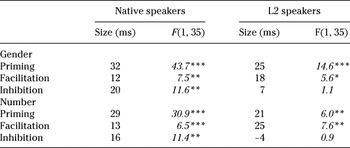
The main effect obtained for grammatical category suggests that, overall, gender agreement dependencies were processed significantly faster than number agreement dependencies by both native (8 ms, p = .009) and L2 participants (25 ms, p < .001) (Table 3). However, the lack of interaction between grammatical category and priming condition—evident in similarly robust priming effects, including facilitation and inhibition, in both gender and number agreement in both groups of participants (Table 4)—suggests no differences between the two categories in either L1 or L2 processing.
Priming effects for gender and number for native and L2 participants

* p < .05.
** p < .01.
*** p < .001.
Sensitivity to Morphosyntactic Information
The main effect of the priming condition for each group of participants found by the two-way ANOVA described previously reflects similar processing patterns of targets in the G, U, and N conditions. Although L2 participants responded to the targets more slowly than L1 participants did (Table 3), their sensitivity to morphosyntactic information was nativelike: they responded to the nouns in the ungrammatical condition significantly more slowly than they responded to the nouns in the grammatical condition, demonstrating robust priming effects (Table 4).
However, further examination of priming components using planned within-subjects contrasts revealed L1-L2 differences for both types of agreement. In contrast to priming in the L1, characterized by similarly robust facilitation and inhibition, L2 priming consisted mostly of facilitation in the absence of inhibition. The observed differences, therefore, point to different underlying mechanisms in L1 and L2 processing. Whereas native participants relied on both strategic expectations and rechecking mechanisms, L2 participants seemed to rely more on expectancy, which helped them process targets in the grammatical condition faster than targets in the neutral condition and did not demonstrate the use of rechecking after both words were accessed.
Priming Patterns and the Role of Markedness
In order to further compare L1 and L2 priming patterns, we examined the processing of each grammatical category from the perspective of markedness. A series of 2 × 3 within-subjects ANOVAs, with gender (Masculine or Feminine) and priming condition (G, U, or N) and number (Singular or Plural) and priming condition (G, U, or N) as factors, were conducted on the RT data for each grammatical category and each group of participants. The results are discussed first for gender and then for number.
Processing of Masculine and Feminine Nouns.
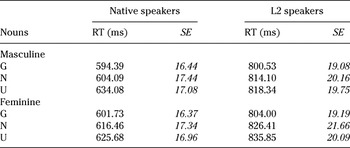
In native participants, the average 4-ms difference between the overall RTs for masculine and feminine nouns was not significant: no main effect of noun gender was found (F 1[1, 35] = 1.7, p > .1; F 2[1, 85] = 1.4, p > .1), suggesting that native speakers did not display a general advantage (independent of context) for unmarked masculine nouns (Table 5). The main effect of the priming condition, on the other hand, was found to be significant (F 1[2, 70] = 20.24, p < .001; F 2[2, 170] = 11.2, p < .001). It reflected large differences among the RTs in the G, U, and N conditions. The gender × priming condition interaction was found to be significant by subjects (F 1[2, 70] = 4.03, p = .028) but not by items (F 2[2, 170] = 1.1, p = .3), suggesting the existence of differences in the native priming patterns between unmarked masculine nouns and marked feminine nouns.
Native and L2 speakers’ RTs for marked and unmarked gender

Note. G = grammatical, N = neutral, and U = ungrammatical condition.
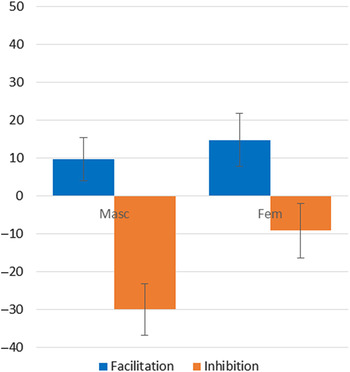
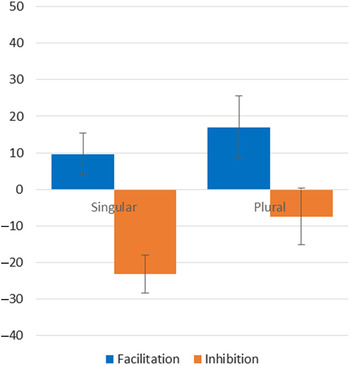
Planned within-subject contrasts for each gender showed significant “cumulative” priming effects for both masculine (40 ms, F[1, 35] = 39.02, p < .001) and feminine (24 ms, F[1, 35] = 27.58, p < .001) nouns. However, the priming in unmarked masculine nouns came entirely from significant inhibition (30 ms, F[1, 35] = 19.37, p < .001; facilitation of 10 ms was not significant), whereas priming in marked feminine nouns was dominated by significant facilitation (15 ms, F[1, 35] = 4.4, p = .04; inhibition of 9 ms did not reach significance).
Figure 1 illustrates this interaction by using facilitation and inhibition scores for each gender. As seen in the figure, native processing of masculine nouns in the grammatical condition did not rely on facilitation indicative of the strategic mechanism of prediction (due to their default status). At the same time, their inhibition in the ungrammatical condition reflected the mechanism of rechecking after both the prime and the target became available. In contrast, marked feminine nouns, due to their nondefault status, showed robust facilitation in the G condition and insignificant inhibition in the U condition.
Components of priming in the L1 (ms) for masculine (masc) and feminine (fem) nouns.

The RT means for the L2 group are reported in Table 5. Similar to the native participants, the L2 participants displayed the main effect of the priming condition (F 1[2, 70] = 6.69, p = .002; F 2[2, 170] = 4.05, p = .048) and no main effect of gender (F 1[1, 35] = 2.6, p > .1; F 2[1, 85] = 1.9, p > .1). In contrast to the results for native speakers, the interaction between priming condition and gender in the L2 group was not significant both by subjects and by items (F 1[2, 70] = .568, p > .1; F 2[2, 170] = .31, p > .5), suggesting no differences between unmarked masculine nouns and marked feminine nouns in L2 processing.
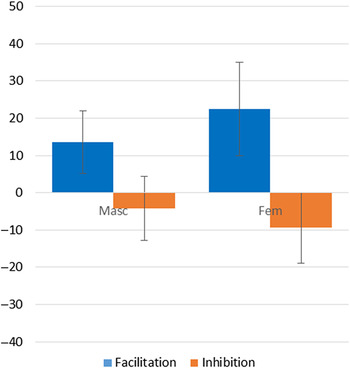
Planned within-subject contrasts conducted for the masculine and feminine nouns in the L2 group showed that significant priming effects (18 ms for the masculine nouns, F[1, 35] = 4.1, p = .05, and 31 ms for the feminine nouns, F[1, 35] = 10.81, p = .002) consisted of insignificant facilitation for unmarked masculine nouns (14 ms, n.s.) in the absence of inhibition and (barely) significant facilitation of marked feminine nouns (22 ms, F[1, 35] = 3.21, p = .052) in the presence of insignificant inhibition (9 ms) (Figure 2). When processing agreement dependencies, the L2 participants seemed to rely on the mechanism of prediction rather than on rechecking. For masculine nouns, the facilitatory effect—although insignificant, possibly due to the lack of power—was still observed; for feminine nouns, it was significant.
Components of priming in the L2 (ms) for masculine (masc) and feminine (fem) nouns.
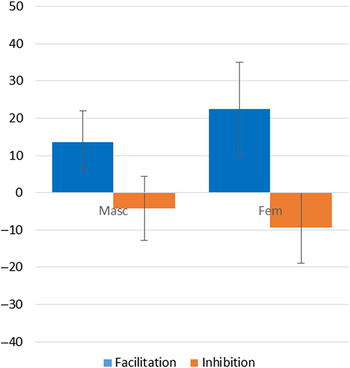
In summary, our in-depth analysis of priming patterns in L1 and L2 processing of marked versus unmarked gender classes revealed subtle differences between L1-L2 processing that were not obvious when the analysis focused only on the priming effect (the difference between the RTs in the grammatical and ungrammatical conditions) and not on its components. In concert with the predictions of the markedness effect hypothesis, the study found an asymmetry between genders in L1 agreement processing. This asymmetry was reflected in finding robust inhibition for unmarked masculine noun targets in the ungrammatical condition and no facilitation in the grammatical condition, and in finding robust facilitation of marked feminine nouns in the grammatical condition along with insignificant inhibition in the ungrammatical condition. In contrast, the L2 participants did not show evidence of gender asymmetry, as reflected in their nonrecognition of the default status of masculine nouns. This happened despite their nativelike ability to use morphosyntactic information in the prime for predicting the form of the target, which facilitated access of these targets in the grammatical condition.
Processing of Singular and Plural Nouns.
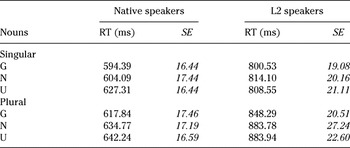
Table 6 shows native and L2 participants’ mean RTs for number agreement. Native speakers responded faster to singular than to plural nouns, and the difference was significant, as revealed by the main effect of number (23 ms; F 1[1, 35] = 28.31, p < .001; F 2[1, 85] = 29.55, p < .001). Within-subjects tests also yielded a significant main effect of the priming condition (overall average size of priming: 29 ms; F 1[2, 70] = 16.55, p < .001; F 2[2, 170] = 8.08, p < .01), but the number × priming condition interaction did not reach significance either by subjects or by items (p > .1).
Native and L2 speakers’ RTs for marked and unmarked number

Note. G = grammatical, N = neutral, and U = ungrammatical condition.
Planned within-subject contrasts conducted separately for the marked plural and unmarked singular number classes indicated that although the priming was significant for both singular (40 ms, F[1, 35] = 27.32, p < .001) and plural (24 ms, F[1, 35] = 11.7, p = .002) nouns, in unmarked singular nouns the priming was characterized, as expected, almost entirely by significant inhibition (23 ms, F[1, 35] = 19.85, p < .001), and the facilitatory effect of 10 ms was not significant. In contrast, the priming in marked plural nouns consisted of significant facilitation (17 ms, F[1, 35] = 3.9, p = .05), with almost no inhibition (7 ms, p > .1) (see Figure 3). Therefore, even though the interaction effect was not found to be significant for overall priming, a detailed analysis of the components of priming revealed significant differences between marked and unmarked numbers in L1 processing.
Components of priming in the L1 (ms) for singular and plural nouns.

A within-subjects ANOVA performed on L2 data also yielded a large, significant main effect of number (F 1[1, 35] = 80.4, p < .001; F 2[1, 35] = 22.4, p < .001), a smaller but significant main effect of the priming condition (F 1[2, 70] = 4.48, p = .015; F 2[2, 170] = 5.8, p = .019), but no significant interaction between the priming condition and number (F 1[2, 70] = 1.59, p > .1; F 2[2, 170] = 1.9, p > .1). The significant main effect of number is reflected in overall longer (64 ms) RTs to marked plural nouns than to unmarked singular nouns (Table 6).
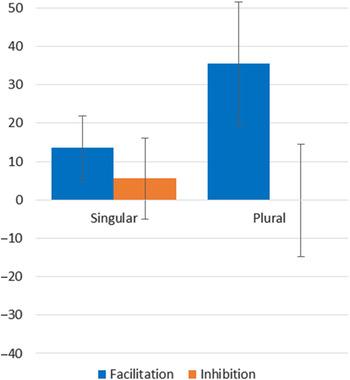
As shown in Figure 4, priming in singular nouns was small in magnitude (8 ms) and, as revealed by planned within-subjects contrasts, insignificant, and so were the components of priming, facilitation (14 ms), and reverse inhibition (i.e., facilitation in which inhibition was expected) (−5 ms). Plural nouns, on the other hand, showed significant priming (36 ms, F[1, 35] = 8.9, p = .005), which was represented by significant facilitation (36 ms, F[1, 35] = 4.86, p = .034) in the absence of inhibition.
Components of priming in the L2 (ms) for singular and plural nouns.

In summary, a detailed analysis of L1-L2 priming patterns in number agreement from the perspective of markedness found an asymmetry between numbers in L1, but not in L2, processing. As expected, priming in unmarked singular targets in the L1 group consisted of inhibition (in the absence of facilitation), whereas priming in marked plural targets consisted of facilitation (in the absence of inhibition). Conversely, L2 participants did not record inhibition of unmarked singulars but showed facilitation for both marked plural and unmarked singular nouns in the grammatical condition, thereby demonstrating their nativelike ability to predict the form of the target based on the morphosyntactic information encoded in the prime.
Thus the findings of the study show that the markedness effect was not fully realized in L2 processing. Furthermore, they indicate that whereas L1 participants employed both strategic prediction and rechecking depending on the default/nondefault status of gender or number, L2 speakers, even at advanced levels of proficiency, mostly relied on prediction and did not invoke rechecking mechanisms at later stages of lexical access.
DISCUSSION
The present study investigated the processing of gender and number agreement in L1 and highly proficient L2 participants and, using a baseline condition, dissociated the contribution of the underlying mechanisms of priming (facilitation and inhibition) that are typically confounded in the traditional analysis. We claim that to see the “devil,” or L1 and L2 processing differences, researchers need to examine the “details,” or the priming components. The results are discussed in the order of the hypotheses presented earlier.
Gender and Number Processing
The first hypothesis predicted that gender agreement violations would be more disruptive than number agreement violations for both native and L2 participants. The main effect obtained for grammatical category reflected faster overall RTs for gender agreement than for number agreement, which can be attributed to the morphological decomposition effect observed in plural nouns, that is, early obligatory activation of the segmentation of morphologically complex plural nouns into morpheme-sized units during online processing (Kazanina, Dukova-Zheleva, Geber, Kharlamov, & Tonciulescu, Reference Kazanina, Dukova-Zheleva, Geber, Kharlamov and Tonciulescu2008). However, the examination of priming and priming components for each grammatical category did not reveal differences in the priming patterns for gender and number agreement. The finding of equally robust facilitation and inhibition for both gender and number in the L1 does not support the view that repair after gender agreement violation is cognitively more complex than repair after number agreement violation (Domínguez et al., Reference Domínguez, Cuetos and Ségui1999; Sicuro Correa et al., Reference Sicuro Correa, Almeida and Sobrino Porto2004).
Furthermore, the finding of robust facilitation without inhibition in L2 priming for both gender and number agreement contrasts with the view that L2 gender agreement is more difficult to acquire and process than number agreement, due to L1 transfer (Hawkins & Casillas, Reference Hawkins and Casillas2008; Hopp, Reference Hopp2010; Sabourin, Reference Sabourin2003) or L1-L2 morphological incongruency (Jiang et al., Reference Jiang, Novokshanova, Masuda and Wang2011) in cases in which participants’ L1 does not instantiate gender but instantiates number. This finding is in line with previous monolingual (Lukatela et al., Reference Lukatela, Kostic, Todorovic, Carello and Turvey1987) and bilingual (Alemán Bañón, Reference Alemán Bañón2012; Dowens et al., Reference Dowens, Guoc, Guoc, Barber and Carreiras2011; Sagarra & Herschensohn, Reference Sagarra, Herschensohn and Ortiz-López2011) studies and is consistent with Picallo’s view (Reference Picallo1991) that number and gender may be represented and processed similarly.
Native versus L2 Processing
It was hypothesized that L1 and highly proficient L2 participants would exhibit similar sensitivity to agreement violations. The findings, again, are not straightforward. Whereas the L2 participants showed nativelike performance, evident in robust priming for both gender and number agreement, an analysis of the priming components revealed L1-L2 processing differences. In contrast to the native participants’ priming patterns for gender and number that consisted of both facilitation and inhibition, the L2 priming for both gender and number was characterized by facilitation in the absence of inhibition. In particular, both the L1 and L2 participants showed facilitation of lexical access in grammatical conditions. At the same time, the L1 participants showed inhibition in ungrammatical conditions with agreement violations, whereas the L2 participants processed the noun targets in the ungrammatical condition similarly to the baseline.
Although the design of the experiment—namely, the use of the same stem with different inflections as the prime—encouraged the engagement of both strategic processing mechanisms of building expectancies and reevaluation of the input, L2 participants in our study favored prediction over rechecking. The finding of L2 facilitation of lexical access in grammatical contexts indicates that L2 users, similarly to native speakers, deploy the mechanism of creating expectancies as they rely on morphosyntactic cues on the prime to predict the gender/number of the target. However, the lack of inhibition in ungrammatical contexts suggests that, in contrast to native speakers, they do not deploy the mechanism of rechecking for coherence after lexical access (Neely, Reference Neely, Besner and Humphreys1991).
The findings are in contrast to previous studies that either did not observe the use of predictive strategies in the L2 or observed the opposite pattern, that is, inhibition (e.g., Foote, Reference Foote2014; Grüter et al., Reference Grüter, Lew-Williams and Fernald2012; Guillelmon & Grosjean, Reference Guillelmon and Grosjean2001; Montrul, Davidson, de la Fuente, & Foote, Reference Montrul, Davidson, de la Fuente and Foote2014). A possible explanation for these contrasting results may be the use of different methods: whereas a visual LDT, as used in the current study, reflects the operation of predictive strategies, the spoken-word recognition tasks used in previous research reflect postlexical rechecking (Foote, Reference Foote2014; Montrul et al., Reference Montrul, Davidson, de la Fuente and Foote2014). Besides, one robust finding documented in these studies is that gender assignment remains a problem even for advanced L2 speakers (e.g., Grüter et al., Reference Grüter, Lew-Williams and Fernald2012), and, therefore, L2 familiarity with the items may drive the strength of predictive strategies. Crucially, none of the previous studies have considered the asymmetry in the processing of the unmarked versus marked gender and number, and it may be that the lack of a default bias in L2 Russian, in combination with context effects, affected the overreliance on predictive strategies in the L2 observed in the current study.
Similar to our findings, in previous studies high levels of facilitation with reduced or no inhibition were reported for language users affected by Parkinson’s disease (PD); these participants benefited from semantic cues (such as the primes) more than controls, possibly due to their difficulties retrieving information from semantic memory (Spicer, Brown, & Gorell, Reference Spicer, Brown and Gorell1994). Footnote 7 An alternative view attributes large facilitation in the absence of inhibition to difficulties in suppressing irrelevant information or in counteracting strong initial facilitation, as is found in PD patients (Marí-Beffa, Hayes, Machado, & Hindle, 2005) or in less skilled L1 readers and older adults (Gernsbacher & Faust, Reference Gernsbacher and Faust1991). According to Marí-Beffa et al. (Reference Marí-Beffa, Hayes, Machado and Hindle2005), the prime word does not need to be attended to in order for the target to show hyperpriming, and any displayed word would be automatically processed without being affected by an inhibitory control mechanism. As a result of enhanced or prolonged uninhibited activation of previously presented information, PD patients responded faster than controls to targets in related trials. Gernsbacher (Reference Gernsbacher1997), on the other hand, distinguished between suppression—that is, the attenuation or reduction of unwanted activation—and inhibition—that is, the blocking of unwanted activation. Whereas suppression can only occur once the information has been activated, inhibition prevents activation in the first place. As shown in Gernsbacher and Faust (Reference Gernsbacher and Faust1991), less skilled adult L1 comprehenders were less able to suppress or to decrease the activation of the contextually inappropriate meanings and incorrect forms of homophones, and they were less able to suppress words while viewing pictures or to suppress pictures while reading words.
To the best of our knowledge, the only study that reported a similar pattern of facilitation in the absence of inhibition in the SLA literature was a crossmodal priming study by Hu and Jiang (Reference Hu, Jiang, Trofimovich and McDonough2011) that examined how L2 comprehenders achieve semantic integration at the sentence level. They, too, attributed the lack of an inhibition effect in the L2 either to nonnative speakers’ inability to preactivate a cohort of possible sentence endings quickly enough to access meaning or to their inability “to suppress the (unwanted) most predictable ending of a sentence, which blocks the neutral ending from being considered a coherent part of a sentence” (p. 213), as is typical for less skilled comprehenders (Gernsbacher, Reference Gernsbacher1997; Gernsbacher & Faust, Reference Gernsbacher and Faust1991).
It remains an open question whether the large facilitatory effects for gender and number (especially for the unmarked categories) in the absence of inhibition in the nonnative participants in our study could be explained by their reliance on the prediction mechanism at the expense of postlexical rechecking, by their morphosyntactic information retrieval difficulties, or by their difficulties with suppressing or inhibiting inappropriate morphosyntactic information. It also remains unclear whether this priming pattern characterizes other types of representations in L2 and what factors (e.g., working memory capacity and language proficiency) can modulate this phenomenon.
The Markedness Effect: The Role of the Default Category
According to the third hypothesis, only native participants would exhibit the markedness effect (Akhutina et al., Reference Akhutina, Kurgansky, Kurganskaya, Polinsky, Polonskaya, Larina, Bates and Appelbaum2001), displaying asymmetries between marked feminine and unmarked masculine nouns and between marked plural and unmarked singular nouns. The hypothesis was confirmed. The native participants recorded predicted processing asymmetries between the two genders and numbers, with unmarked targets showing stronger inhibition in the ungrammatical contexts and marked targets showing stronger facilitation in the grammatical contexts. In contrast, the nonnative participants did not record inhibition of unmarked targets in the ungrammatical condition, but they did show facilitation of both marked and unmarked targets in the grammatical condition.
The findings suggest that highly proficient L2 participants, despite showing nativelike sensitivity to grammatical contexts, failed to demonstrate the markedness effect, which was robust in native processing. This result parallels the findings for gender priming in Akhutina and colleagues’ study (2001), which showed differences in the priming patterns between healthy and aphasic patients.
Akhutina and colleagues explained the markedness effect by evoking Elman’s (Reference Elman1990) account of a recurrent network model of grammatical processing. According to Elman, lexical items are defined by their positions within a high-dimensional lexical space, and their similarity is defined by the relative distance among them. Lexical access involves movement into the correct position within this space. An unmarked region (including the unmarked gender and number) would be relatively central along one or more dimensions from which the largest number of moves could be made in the shortest time. Using a tennis court metaphor, Akhutina and colleagues argued that, similar to a good tennis player who “moves back to center court as quickly as possible after each move” (2001; p. 311), a competent language user—in our case, a native speaker—processes targets from this unmarked, default position. Footnote 8 When the grammatical form of the upcoming target can be predicted from the morphosyntactic cues on the prime, the processor can move closer to or further away from the region where the target will occur. In the absence of this information (e.g., at the beginning of a new trial), the processor moves back into a more central position to maximize processing efficiency. In our study, congruent contexts (masculine/singular adjective primes) did not facilitate the upcoming unmarked targets in the L1 more than the baseline (prosto condition), as they provided no gender- or number-relevant information beyond what was expected based on the default status of the prime. By contrast, incongruent contexts (feminine/plural adjective primes) produced larger inhibition for masculine/singular targets (unmarked, default forms) than for feminine/plural targets (marked, nondefault forms). As for the marked feminine/plural targets, the markedness effect was demonstrated in the form of facilitation, because the time required for recognizing a feminine or a plural noun was reduced by gender- or number-congruent information. Because Russian speakers expect the default/unmarked gender or number when processing language, the inhibitory effects on the marked targets in incongruent conditions were smaller.
Akhutina and colleagues further argued that less competent language users—in our case, L2 participants—can use the grammatical context to assist them in lexical identification (i.e., they can show priming and facilitation) but “fail to move back toward a maximally efficient central position” (Akhutina et al., Reference Akhutina, Kurgansky, Kurganskaya, Polinsky, Polonskaya, Larina, Bates and Appelbaum2001, p. 320). This lack of default form bias, which optimizes the efficiency of native language processing, may be concealed in highly proficient L2 users by their seemingly nativelike sensitivity to context—the ability to use morphosyntactic cues to predict the form of the upcoming word, evidenced in strong facilitation of both marked and unmarked targets. Yet, as discussed previously, this finding may also reflect their processing weakness—either an inability to preactivate and retrieve morphosyntactic information from memory (Spicer et al., Reference Spicer, Brown and Gorell1994) or an inability to inhibit or suppress previously activated information (Gernsbacher, Reference Gernsbacher1997; Gernsbacher & Faust, Reference Gernsbacher and Faust1991; Marí-Beffa et al., Reference Marí-Beffa, Hayes, Machado and Hindle2005).
The role of morphological markedness has been demonstrated in both native and L2 processing before. For example, native speakers of Hebrew showed greater sensitivity (reflected by a larger P600) to subject-verb agreement violations for marked plural verbs compared to unmarked singulars (Deutsch & Bentin, Reference Deutsch and Bentin2001), and adult English-speaking learners of Spanish showed a representational asymmetry between marked and unmarked forms in both comprehension and production (McCarthy, Reference McCarthy2008). The unique contribution of the present study lies in showing how markedness, or defaultness, interacts with underlying processing mechanisms in the L2 (prediction, in particular); whereas, in agreement with previous research findings, L2 learners tend to be generally sensitive to the default gender and number, they appear to make little or no use of the default when predicting the gender or number of the upcoming noun in number-adjective agreement.
CONCLUSION
The study found no evidence for a differential treatment of number and gender in the L1 and L2 at the level of processing costs but found subtle differences in the priming profiles between L1 and L2 groups. The results suggest that although nativelike sensitivity to morphosyntactic information in grammatical agreement can be developed in late L2 learners, they seem to rely on different processing mechanisms even at the advanced levels of proficiency.
The study contributes to the current debates about the nature of L1-L2 processing differences and provides a new insight into the cognitive bases of L2 performance. The findings highlight the importance of employing a neutral baseline to dissociate facilitatory and inhibitory priming components for reaching valid conclusions about L2 morphosyntactic processing. Together with an examination of the markedness effect, the method has advantages over a traditional priming paradigm, providing a more nuanced analysis and allowing researchers to better understand the intricacies of L2 morphosyntactic processing and to identify the processes by which grammatical knowledge in a L2 is accessed and deployed.
APPENDIX
OVERVIEW OF THE RUSSIAN GENDER AND NUMBER SYSTEM
Russian has three genders: masculine, feminine, and neuter. Masculine nouns constitute about 46% of the nominal lexicon, feminine nouns are at 41%, and neuter nouns are at 13% (statistics based on the 34,000-word count; Akhutina et al., Reference Akhutina, Kurgansky, Polinsky and Bates1999). According to a more recent count, masculine nouns constitute 47.5%, feminine nouns are at 34.1%, and neuter nouns are at 18.4% (statistics based on the 6,000,000-word count; Samojlova & Slioussar, Reference Samojlova and Slioussar2014). For most (but not all) nouns, their ending in the nominative singular acts as an indicator of their gender.
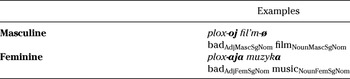
This article focuses only on masculine and feminine genders, and, because the nouns used in the study were restricted entirely to nouns with transparent morphological marking, the most important correlations for our purposes are the following: (a) nouns ending in a hard, nonpalatalized consonant (with zero ending) are masculine, and (b) nouns ending in -a are feminine if inanimate (Table A1).
Noun-adjective gender agreement in Russian (for masculine and feminine nouns)

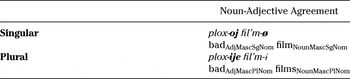
Russian has two numbers: singular and plural. The citation form of all nouns is singular. A plural is formed by the attachment of the plural morpheme -ɨ/-i (or -a for a small group of masculine nouns) to the stem (the process involves the truncation of the -a vowel in feminine nouns). To eliminate the need to consider additional process of vowel truncation during processing, this study focuses only on the plural form of masculine nouns (Table A2).
Noun-adjective number agreement in Russian (for masculine nouns)