




No CrossRef data available.
Article contents
Cell differentiation and infectivity of Leishmania mexicana are inhibited in a strain resistant to an ABC-transporter blocker
Published online by Cambridge University Press: 13 May 2004
Abstract
We analysed whether markers of cell differentiation and infectivity differed when compared to the parental sensitive strain [NR(Gs)] in an in vitro selected Leishmania strain [NR(Gr)] resistant to Glibenclamide®, an ATP-binding-cassette (ABC)-transporter blocker. The data show that the cell body area was larger in NR(Gr) compared to NR(Gs) and that functional characters associated with an infective metacyclic phenotype, such as resistance to the lytic effect of the alternative complement pathway and expression of the Meta-1 protein, were reduced. The infectivity of NR(Gr) to J774.1 macrophages was also significantly reduced. These results suggest that resistance in Leishmania against Glibenclamide®, a general blocker of P-glycoproteins, could produce functional modifications that may be relevant for Leishmania differentiation, infectivity and survival.
Information
- Type
- Research Article
- Information
- Copyright
- 2004 Cambridge University Press
INTRODUCTION
In Leishmania, in vitro drug resistance is often correlated with the increased expression of a P-glycoprotein (P-gp) that belongs to the ATP-binding-cassette (ABC) transporter family (Légaré, Hettema & Ouellette, 1994). Besides the specific membrane permeability changes, chemoresistance in Leishmania can involve functional modifications which are relevant for the parasite–host cell interaction; for example, alterations in membrane fluidity and in saturated fatty acid levels (Mbongo et al. 1998), or in mitochondrial enzyme activities and in lipophosphoglycan (LPG) expression (Basselin & Robert-Gero, 1998). There is a widely held belief that understanding such functional changes involved in drug resistance will eventually improve treatment outcome.
While in the sandfly, Leishmania parasites go through sequential differential stages from actively dividing non-infective parasites to non-dividing infective metacyclic forms (Sacks & Perkins, 1984) and morphological distinctions between non-infective and infective parasites are now clear (Rogers, Chance & Bates, 2002). Studies in Leishmania (L.) major show that (a) promastigotes obtained in vivo from infected sandflies shortly after parasite ingestion from mammals are, like their in vitro logarithmic phase counterparts, essentially avirulent and (b) in stationary-phase cultures, infective L. major promastigotes are routinely separated from non-infective parasites by taking advantage of their failure to be agglutinated by the Arachis hypogaea lectin peanut agglutinin (PNA). This change in lectin binding accurately reflects the development of metacyclic (infective) promastigotes (Sacks & da Silva, 1987). Differential PNA binding has not proved to be applicable to L. mexicana, and the definition and purification of metacyclic (infective) parasites have required the use of alternative methods (Bates & Tetley, 1993; Zakai, Chance & Bates, 1997), including the expression of the product of the meta-1 gene, originally described in L. major (Nourbakhsh, Uliana & Smith, 1996), highly conserved in Old and New World parasites and predominantly expressed in metacyclic promastigotes of Leishmania (Berberich et al. 1998; Uliana et al. 1999).
The sulfonylurea (Glibenclamide® (GLIB))-sensitive receptor is a member of the ABC transporter family (Inagaki et al. 1995), to which the Leishmania P-gpA belongs; of note, Leishmania shows a moderate sensitivity to this inhibitor (Ponte-Sucre et al. 1997, 1998). In cancer cells with an increased expression of P-gp GLIB and two GLIB derivatives which are substrates for P-gp, can acutely increase [3H]-colchicine accumulation and invert the multidrug resistance phenotype in a similar way to verapamil (Golstein et al. 1999). These data suggest that GLIB could be considered a general ABC transporter blocker that binds to a conserved motif. Leishmania parasites are extremely flexible and easily develop resistance against a great variety of compounds. To further our insight into the physiological basis of Leishmania drug resistance, we have selected in vitro a L. mexicana strain (NR(Gr)) resistant to GLIB, by continuous drug pressure. Herein we have analysed whether metacyclogenesis and infectivity differed between NR(Gr) and their parental L. mexicana (NR(Gs)) strain which are sensitive to GLIB (Ponte-Sucre et al. 1997; García et al. 2000). Our results show that resistance could influence important biological functions involved in the regulation of Leishmania differentiation and survival that may decrease the occurrence of putative metacyclics and parasite infectivity.
MATERIALS AND METHODS
Chemicals
Glibenclamide® (GLIB) was purchased from Aldrich International Co., Milwaukee, USA and prepared as previously described (Ponte-Sucre et al. 1997). The other biochemicals were purchased from Sigma Chemical Co. (St Louis, MO, USA) and Gibco Life Technologies, (Gaithersburg, MD, USA).
Cell lines and cultures
Leishmania NR(Gs), MHOM/VE/80/NR, was kindly provided by Dr Angel Hernández, Universidad Central de Venezuela. It was originally isolated in 1980 from a Venezuelan patient with tegumentary diffuse leishmaniasis and identified as a member of Leishmania mexicana (Luis et al. 1998). Promastigotes of Leishmania NR(Gs) were grown as described (Eresh et al. 1993). The resistant strain NR(Gr) was selected in vitro by successive passages of the parental sensitive strain grown in the presence of 16×10−6M GLIB as previously described (Ponte-Sucre et al. 1997) and maintained under the pressure of the drug. The macrophage cell line J774.1 was grown as previously described (Ponte-Sucre et al. 1998).
Parasite morphology
The morphology of Leishmania promastigotes was determined by previously described methods (Penin et al. 1992; Bates & Tetley, 1993). Parasite aliquots of 0·5 ml were removed and concentrated by centrifugation, 10 μl aliquots were air-dried, fixed in methanol and stained with Giemsa stain diluted in phosphate-buffered saline (PBS), pH 7·2. Afterwards the slides were observed through a calibrated microscope at 400× total magnification. The body length (L), the width (W) and the flagellum length (fL) were determined for 100 parasites analysed for each experimental condition.
Lysis of parasites by human serum
The lytic assay was carried out as described elsewhere (Louaissini et al. 1994) at 37 °C. Fresh human blood from healthy volunteers was allowed to clot at room temperature for 2 h and overnight at 4 °C. Aliquots of the resulting serum were stored at −70 °C until needed. Promastigotes at different growth phases were washed and resuspended to a density of 1×10⁷/ml in PBS. They were exposed for 1 h to several dilutions of serum and the lytic reaction was stopped by the addition of 20 μl of 5×10⁻²M EDTA. A control vial was exposed to 100% heat-inactivated human serum. The parasite viability was estimated in each experiment by checking the motility of the flagellum in 100 promastigotes for each experimental condition.
Electrophoresis and Western blotting
Crude cell homogenates were separated by polyacrylamide gel electrophoresis (PAGE) and transferred onto nitrocellulose membranes by standard procedures. The membranes were assayed with a polyclonal antibody prepared against the Leishmania Meta-1 protein (Meta-1) (1[ratio ]1000) (Berberich et al. 1998) and a monoclonal antibody against L. mexicana flagellar proteins (B7) (1[ratio ]10000) (Ismach et al. 1989). Diluted peroxidase-coupled goat anti-rabbit (1[ratio ]5000) or anti-mouse (1[ratio ]2500) were used as secondary antibodies.
Infectivity
J774.1 macrophages (2·5×105 cells/ml) were resuspended and incubated at 37 °C under 5% CO2 in air, for 2 h in 0·5 ml of Click-RPMI 1640 culture medium supplemented with 2×10⁻³ML-glutamine, 20 μg/ml gentamicin, 2×10⁻⁵M 2-mercaptoethanol and 10% fetal bovine serum, pH 7·2. Immediately thereafter, the non-adherent macrophages were removed by thorough washing with fresh Click-RPMI, and the adherent macrophages were infected with stationary-phase promastigotes of NR(Gs) or NR(Gr) for 4 h at a parasite to macrophage ratio of 5 to 1. After removal of extracellular parasites by thorough rinsing with fresh Click-RPMI, the wells were incubated further for 24 h either in the absence of drugs or in the presence of 3×10⁻⁶M GLIB. Intracellular parasites were quantified at the end of either the 4 h infection or 24 h incubation by staining with acridine orange and ethidium bromide and were analysed by fluorescence microscopy at 495 nm (Ponte-Sucre et al. 1997).
Statistical analysis
Resistance to complement lysis is expressed as the mean±S.E.M. of the dilution of serum capable of immobilizing 50% of a population of 100 parasites in 3 independent experiments, for each experimental condition carried out in duplicate. Statistical significance was evaluated by the Student's t-test (Schefler, 1981). The size of the promastigotes is expressed as the mean±S.E.M. of a population of 100 parasites for 2 independent experiments for each experimental condition carried out in duplicate. Statistical significance was evaluated by the Student's t-test (Schefler, 1981). An infection index was calculated as {[(number of parasites/100 infected cells)24 h/(number of parasites/100 infected cells)4 h]×100} of 3 experiments done in duplicate. Statistical significance was evaluated by the Student's t-test (Schefler, 1981).
RESULTS
Parasite morphology
Intact promastigotes showed their usual appearance under light microscopy; they did not have membrane damage and possessed flagellum motility. To determine if some morphological properties of L. mexicana are changed in NR(Gr), we evaluated the parasite body length (L) and width (W), as well as the flagellum length (fL) (Table 1). The flagellum length (a) was always greater for NR(Gr) than for NR(Gs), (b) increased significantly between log phase and stationary phase in NR(Gs) (P<0·0001), and (c) did not change significantly between log phase and stationary phase in NR(Gr). Exponentially growing NR(Gs) cells were significantly narrower (P<0·05) than NR(Gr) cells but had a similar body length; by contrast, parasites from both strains had a similar width at their stationary phase. Of note, NR(Gr) cells became significantly longer at stationary phase (P<0·001) than NR(Gs) cells. A frequency distribution of cell body area for parasites at their exponential and stationary phase of growth was calculated with these data (Fig. 1A,B). The frequency distribution measured in exponentially growing parasites (Fig. 1A) showed statistically significant differences; the mean body cell areas were 22·6±0·9 μm2 and 27·2±1·27 μm2 for NR(Gs) and NR(Gr) respectively (P<0·001). This difference was maintained in stationary phase parasites (Fig. 1B) and the cell body areas were 24·40±0·86 μm2 in NR(Gs) and 29·40±1·18 μm2 in NR(Gr) (P<0·001). Also, the shape of the frequency distributions differed in that the NR(Gs) cell body area had a narrower range than the cell body area of NR(Gr). These results suggest that in stationary phase cultures of NR(Gs) there is a higher proportion of cells with a morphology suggestive of metacyclic forms than in NR(Gr) cultures.

Fig. 1. (A) Frequency distribution of cell body area in exponential-phase wild-type [NR(Gs)] and GLIB-resistant [NR(Gr)] cultures. (B) Frequency distribution of cell body area in stationary-phase [NR(Gs)] and [NR(Gr)] cultures.

Functional signs of metacyclogenesis
To test if this difference in cell body area reflects changes in the proportion of differentiated cells in NR(Gr) compared to NR(Gs), functional signs of metacyclogenesis were quantified in Leishmania by the use of two techniques i.e. lysis by human serum (Table 1) and expression of the Meta-1 protein (Fig. 2). Resistance to the lytic effect of human serum was calculated by reference to a control experiment where the parasites were exposed to 100% heat-inactivated serum. Resistance to complement lysis was always greater in NR(Gs) than in NR(Gr) and increased significantly in the stationary phase of NR(Gs) promastigotes. In contrast, exponentially growing cells of NR(Gr) showed a resistance to the lytic effect of human serum that did not increase significantly in stationary phase. Regarding the expression of Meta-1, a protein band of a relative molecular mass of 12 kDa, similar to the subunit previously described for various Leishmania, was recognized exclusively in stationary phase parasites (Fig. 2). The amount of protein loaded for each sample was similar, as demonstrated by the intensity of the signal recognized by the B7 antibody against flagellar pocket proteins; nevertheless, in NR(Gs) the band recognized by the Meta-1 antibody was stronger than in NR(Gr). Altogether these results indicate again that a greater proportion of promastigotes expressing metacyclic properties were present in stationary phase cultures of NR(Gs) compared with NR(Gr).

Fig. 2. Western blot analysis of exponential-phase (Exp) and stationary-phase (Stat) wild-type [NR(Gs)] and GLIB-resistant [NR(Gr)] strains. Homogenates were separated by PAGE, transferred into nitrocellulose membranes and exposed to B7 or Meta-1 antibodies.
Infectivity
Finally, as metacyclogenesis is associated with increased infectivity and in order to further validate the results described above, we compared the infectivity to J774.1 macrophages and sensitivity to GLIB of both NR(Gs) and NR(Gr). Previously (García et al. 2000) we had determined that at 4 h and in the absence of drugs, J774.1 macrophages are infected by NR(Gs) and L. major to a similar percentage (17%) and that this rate of infection is 30% smaller in J774.1 macrophages infected with NR(Gr). It should be noted that NR(Gs) and NR(Gr) had the same passage number. Herein we have measured the proliferation of parasites 24 h after a 4 h infection (Fig. 3). The degree of infection determined at the end of the 4 h is here referred to as 100%. In macrophage/parasite cultures incubated without GLIB for 24 h the infection index increased to 200% if infected with NR(Gs), but did not change for macrophages infected with NR(Gr) (P<0·0001) (Fig. 3). The increase in the degree of infection observed in non-treated macrophages infected with NR(Gs) was impaired by treatment with GLIB for 24 h (P<0·001). On the contrary, no further changes in the infection index were observed in macrophages infected with NR(Gr) and treated with GLIB. These results suggest that the proportion of parasites able to proliferate inside the macrophages was greater in NR(Gs) than in NR(Gr), that intracellular NR(Gs) parasites were sensitive to GLIB and that intracellular NR(Gr) parasites remained insensitive to GLIB.

Fig. 3. Infection index of stationary-phase wild-type [NR(Gs)] and GLIB-resistant [NR(Gr)] within J774.1 macrophages either untreated or treated for 24 h with 3×10⁻⁶M GLIB. Dashed line at 100 indicates infection index at 4 h. Compared means are identified by the same letter: aP<0·001, bP<0·001, cP<0·05.
DISCUSSION
We have investigated whether chemoresistance of Leishmania to GLIB, an ABC transporter blocker, was accompanied by changes in parasite markers of metacyclogenesis and infectivity, and found that, compared to NR(Gs), NR(Gr) parasites (a) have a longer cell body and a greater cell body area, (b) are more sensitive to the lytic effect of the activated human complement system, (c) show a decreased expression of the Meta-1 protein, and (d) show a decreased infectivity towards J774.1 macrophages.
Metacyclic parasites should possess short, narrow cell bodies (Bates & Tetley, 1993; Zakai et al. 1997). The present results indicate that stationary-phase NR(Gr) have greater length and area than NR(Gs), suggesting a reduction in metacyclogenesis. In stationary-phase NR(Gr), sensitivity to human serum was greater than in NR(Gs) suggesting that a modified expression of surface membrane carbohydrates, related to drug resistance, could also affect other important signals and functions, including the parasite resistance to human serum complement. The specific expression of Meta-1 protein in stationary-phase parasites has been associated with their development into metacyclic promastigotes (Nourbakhsh et al. 1996; Berberich et al. 1998). In NR(Gr) stationary-phase cultures, the level of expression of this protein was significantly lower than in NR(Gs), suggesting again that metacyclogenesis was reduced in NR(Gr) compared to NR(Gs).
Finally, metacyclogenesis has been associated with increase in infectivity. We previously showed (García et al. 2000) that infectivity, like metacyclogenesis shown in the present results was reduced in NR(Gr). It could be possible that the drug carried by the NR(Gr) on their way into the host cell during the initial 4 h infection may inhibit the activity of the macrophages to incorporate them. This possibility is ruled out, firstly since pre-treatment of macrophages with GLIB does not alter the J774.1 macrophage infection for L. major or NR(Gs) at 4 h (Silva & Ponte-Sucre, 2001) or the expression of surface markers such as the major histocompatibility complex II (MHC-II) and the co-stimulatory molecules CD80 (B7.1) and CD86 (B7.2) (data not shown). Secondly, intracellular parasites hosted by naïve J774.1 macrophages were sensitive to GLIB even if the drug was added to the culture medium after an initial 18 h infection (Ponte-Sucre et al. 1998).
Alternatively, the mechanisms involved in the maintenance of resistance could interact per se with the parasite differentiation, survival and intra-macrophage sensitivity, as has been also suggested for antimony-resistant parasites (Sereno et al. 2001). Bates & Tetley (1993) have demonstrated that among the determinant factors for metacyclogenesis, the pH of the environment that surrounds the parasite is crucial; a change in the pH could induce physiological signals that may increase the probability of individual promastigotes differentiating into metacyclic forms (Bates & Tetley, 1993). We do not have direct evidence on how and when the decision to become a metacyclic form is made through the cell cycle, but the results presented herein are suggestive of differences between NR(Gs) and NR(Gr) and indicate that resistance to general blockers of P-gp such as GLIB is accompanied by a decreased ability to differentiate into metacyclic forms and indicate that important biological properties involved in the regulation of parasite proliferation and differentiation could be affected.
Antibodies Meta-1 and B7 were kindly donated by Dr Christof Berberich and Dr Diane McMahon Pratt respectively. We thank Dr Paul A. Bates for critical reading of the manuscript and helpful suggestions. We thank Carla D'Amario and Gabriela Pérez Pereda for technical help. Financial support: Venezuelan Fac. Med. and CDCH-UCV Grants 00054/2000, 09.33.4581.2001 and 09.33.4882.2001, FONACIT S1-2002000532.
References
REFERENCES
BASSELIN, M. &
ROBERT-GERO, M.
(
1998).
Alterations in membrane fluidity, lipid metabolism, mitochondrial activity and lipophosphoglycan expression in pentamidine-resistant Leishmania.
Parasitology Research 60, 78–83.Google Scholar
BATES, P. A. &
TETLEY, L.
(
1993).
Leishmania mexicana: induction of metacyclogenesis by cultivation of promastigotes at acidic pH.
Experimental Parasitology 76, 412–423.CrossRefGoogle Scholar
BERBERICH, C.,
MARÍN, M.,
RAMÍREZ, J. R.,
MUSKUS, C. &
VÉLEZ, I. D.
(
1998).
The metacyclic stage-expressed Meta-1 gene is conserved between Old and New World Leishmania species.
Memórias Instituto Oswaldo Cruz 93, 819–821.CrossRefGoogle Scholar
ERESH, S.,
MENDOZA-LEÓN, A. &
BARKER, D. C.
(
1993).
A small chromosome of Leishmania (Viannia) lainsoni occupies a unique niche within the subgenus Viannia.
Transactions of the Royal Society of Tropical Medicine and Hygiene 89, 231–236.Google Scholar
GARCÍA, N.,
FIGARELLA, K.,
MENDOZA-LEÓN, A. &
PONTE-SUCRE, A.
(
2000).
Changes in the infectivity, pyruvate kinase and acid phosphatase activity and P-glycoprotein expression in glibenclamide resistant Leishmania mexicana.
Parasitology Research 86, 899–904.CrossRefGoogle Scholar
GOLSTEIN, P. E.,
BOOM, A.,
VAN GEFFEL, J.,
JACOBS, P.,
MASERET, B. &
BEAUWENS, R.
(
1999).
P-glycoprotein inhibition by glibenclamide and related compounds.
Pflüger's Archiv 437, 652–660.CrossRefGoogle Scholar
INAGAKI, N.,
GONOI, T.,
CLEMENT IV, J. P.,
NAMBA, N., INAZAWA, J.,
GONZALEZ, G.,
AGUILAR-BRYAN, L.,
SEINO, S. &
BRYAN, J.
(
1995).
Reconstitution of IKATP: an inward rectifier sub-unit plus the sulfonylurea receptor.
Science 270, 1166–1169.CrossRefGoogle Scholar
ISMACH, R.,
CIANCI, C. M. L.,
CAULFIELD, J. P.,
LANGER, P. J.,
HEIN, A. &
McMAHON-PRATT, D.
(
1989).
Flagellar membrane and paraxial rod proteins of Leishmania: characterization employing monoclonal antibodies.
Journal of Protozoology 36, 617–624.CrossRefGoogle Scholar
LÉGARÉ, D.,
HETTEMA, E. &
OUELLETTE, M.
(
1994).
The P-glycoprotein-related gene family in Leishmania.
Molecular and Biochemical Parasitology 68, 81–91.CrossRefGoogle Scholar
LOUAISSINI, M.,
ADROHER, F. J.,
FOULQIUIE, M. R. &
BENITEZ, R.
(
1994).
Investigations on the in vitro metacyclogenesis of a visceral and a cutaneous human strain of Leishmania infantum.
Acta Tropica 70, 355–368.Google Scholar
LUIS, L.,
RAMÍREZ, A.,
AGUILAR, C. M.,
ERESH, S.,
BARKER, D. C. &
MENDOZA-LEÓN, A.
(
1998).
The genomic fingerprinting of the coding region of the beta-tubulin gene in Leishmania identification.
Acta Tropica 69, 193–204.CrossRefGoogle Scholar
MBONGO, N.,
LOISEAU, P. M.,
BILLION, M. A. &
ROBERT-GERO, M.
(
1998).
Mechanism of amphotericin B resistance in Leishmania donovani promastigotes.
Antimicrobial Agents and Chemotherapy 42, 352–357.Google Scholar
NOURBAKHSH, F.,
ULIANA, S. R. &
SMITH, D. F.
(
1996).
Characterisation and expression of a stage-regulated gene of Leishmania major.
Molecular and Biochemical Parasitology 76, 201–213.CrossRefGoogle Scholar
PENIN, P.,
GAMALLO, C.,
PENIN, M. L.,
MAYER, F.,
DEL REY, J. &
DE DIEGO, J. A.
(
1992).
Analytic morphometry of the Trypanosoma cruzi (Bolivia strain) forms found in the intestine of Rhodnius prolixus.
Memórias Instituto Oswaldo Cruz 63, 159–161.CrossRefGoogle Scholar
PONTE-SUCRE, A.,
CAMPOS, Y.,
VÁSQUEZ, J.,
MOLL, H. &
MENDOZA-LEÓN, A.
(
1997).
Sensitivity of Leishmania spp. to glibenclamide and 4-aminopiridine: a tool for the study of drug resistance development.
Memórias Instituto Oswaldo Cruz 92, 601–606.Google Scholar
PONTE-SUCRE, A.,
CAMPOS, Y.,
FERNÁNDEZ, M.,
MOLL, H. &
MENDOZA-LEÓN, A.
(
1998).
Leishmania sp.: Growth and survival are impaired by ion channel blockers.
Experimental Parasitology 88, 11–19.Google Scholar
ROGERS, M. E.,
CHANCE, M. L. &
BATES, P. A.
(
2002).
The role of promastigote secretory gel in the origin and transmission of the infective stage of Leishmania mexicana by the sandfly Lutzomyia longipalpis.
Parasitology 124, 495–507.CrossRefGoogle Scholar
SACKS, D. L. &
PERKINS, P. V.
(
1984).
Development of infective stage Leishmania promastigotes within phlebotomine sand flies.
American Journal of Tropical Medicine and Hygiene 34, 456–459.Google Scholar
SACKS, D. L. &
DA SILVA, P.
(
1987).
The generation of the infective stage Leishmania major promastigotes is associated with the cell surface expression and release of a developmentally regulated glycolipid.
Immunology 139, 3099–3106.Google Scholar
SCHEFLER, W.
(
1981).
Análisis de varianza. In
Bioestadística
(
ed. Schefler, W.), pp. 122–157.
Fondo Educativo Interamericano,
México.
SERENO, D.,
GUILVARD, E.,
MAQUAIRE, S.,
CAVALEYRA, M.,
HOLZMULLER, P.,
OUAISSI, A. & LEMESRE, J. L.
(
2001).
Experimental studies on the evolution of antimony-resistant phenotype during the in vitro life cycle of Leishmania infantum: implications for the spread of chemoresistance in endemic areas.
Acta Tropica 80, 195–205.CrossRefGoogle Scholar
SILVA, N. &
PONTE-SUCRE, A.
(
2001).
ABC proteins in Leishmania mexicana: Modulation of parasite host cell interaction.
Archivos Venezolanos de Farmacología y Terapéutica 20, 134–138.Google Scholar
ULIANA, S. R. B.,
GOYAL, N.,
FREYMULLER, E. &
SMITH, D. E.
(
1999).
Overexpression and comparative structural analysis of the satage-regulated meta-1 gene.
Experimental Parasitology 92, 183–191.CrossRefGoogle Scholar
ZAKAI, H. A.,
CHANCE, M. L. &
BATES, P. A.
(
1997).
In vitro stimulation of metacyclogenesis in Leishmania braziliensis, L. donovani, L. major and L. mexicana.
Parasitology 116,
305–309.Google Scholar
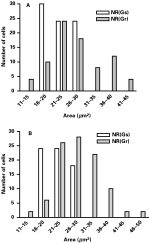
Fig. 1. (A) Frequency distribution of cell body area in exponential-phase wild-type [NR(Gs)] and GLIB-resistant [NR(Gr)] cultures. (B) Frequency distribution of cell body area in stationary-phase [NR(Gs)] and [NR(Gr)] cultures.
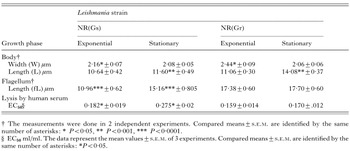
Table 1. Body and flagellum size and resistance to the lytic effect of human serum in exponential and stationary phase NR(Gs) and NR(Gr)
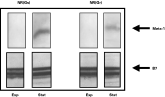
Fig. 2. Western blot analysis of exponential-phase (Exp) and stationary-phase (Stat) wild-type [NR(Gs)] and GLIB-resistant [NR(Gr)] strains. Homogenates were separated by PAGE, transferred into nitrocellulose membranes and exposed to B7 or Meta-1 antibodies.
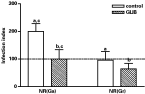
Fig. 3. Infection index of stationary-phase wild-type [NR(Gs)] and GLIB-resistant [NR(Gr)] within J774.1 macrophages either untreated or treated for 24 h with 3×10⁻⁶M GLIB. Dashed line at 100 indicates infection index at 4 h. Compared means are identified by the same letter: aP<0·001, bP<0·001, cP<0·05.
 You have
Access
- 14
- Cited by