Among the changes reshaping postindustrial economic opportunity, two of the most disruptive are digitization and urbanization. Predicted to alter the very nature of work and the entire structure of the economy, much economic growth now depends on the knowledge, skills, and infrastructure required to develop and apply digital technologies (Kenney and Zysman Reference Kenney and Zysman2016). Rapid technological change places cities “at the very pivot” of this transformation (Savitch and Kantor Reference Savitch and Kantor2002). Digital innovation privileges people and places with the “right mix” of skills and technologies and disadvantages those without, making uneven regional development one of the most pressing policy challenges facing twenty-first-century industrialized economies (Sunley, Martin, and Tyler Reference Sunley, Martin and Tyler2017). A vocal and growing “geography of discontent” raises important political questions about urban economic resilience and the policy interventions and institutional capacity required for reinvention (Rodriguez-Pose Reference Rodriguez-Pose2018).
The degree of freedom for local policy action remains an enduring question in comparative urban research. We know much about large, economically secure urban regions and deeply distressed deindustrialized ones but much less about the development prospects for other city types (Wolfe and Bramwell Reference Wolfe and Bramwell2008; Reference Wolfe and Bramwell2016). To address this gap, this study compares urban policy making in three midsized or “ordinary” cities operating in three different multilevel policy contexts. All caught in the crosshairs of economic change, each of the three cities—Greensboro, North Carolina; London, Ontario; and Saint Etienne, France—face the challenge of adapting their local economies to rapidly changing digital-economy demands without exacerbating socioeconomic inequality. Policy innovation is evident in all three cities but tradeoffs compromise local institutional capacity in each case. These findings indicate that local context matters a great deal. Urban policy making is powerfully mediated through national policies but also shaped in important ways by local institutions. The dynamics of economic transformation cannot be simply deduced from those of larger places. City size and economic specialization shape urban policy making as much as the multilevel context in which it operates.
POLICY INNOVATION AND THE “ORDINARY” CITY
Widely seen to be beyond the capacity of governments alone, urban policy making in the twenty-first century often is characterized as a complex problem-solving process that crosses conventional policy silos, levels of government, and public and private divides. Inherently tied to geographical scale, a definitional aspect is the participation of societal- or community-based actors alongside governmental ones, and the uneven power relations that ensue. The rapidly accelerating pace of the digital economy, with its ambiguous sociospatial, socioeconomic, and sociotechnical implications, is one such complex challenge that unfolds most evidently at the urban scale. Not conforming neatly to conventional economic development activities (e.g., firm attraction, downtown revitalization, and land-use development) nor to the administrative responsibilities of any single organization, the process of adapting local economies to technological change is more complex and demanding, and the outcomes are even less certain. Although there is “no one best way,” it is widely argued that the distinction between more and less successful places lies in the collective capacity required for such strategic policy innovation (Cowell Reference Cowell2013; Storper et al. Reference Storper, Kemeny, Makarem and Osman2015). This draws important analytical attention to the institutional dimension of local and regional economic development.
Yet, an important empirical gap remains in comparative urban research that tends to focus on large economically vibrant and knowledge-intensive “strong-market” urban regions or on “weak-market” places that are deindustrializing and deeply distressed. As Amin and Graham (Reference Amin and Graham1997) observed, generalizations based on a few “paradigmatic” cases ignores the more “multiplex,” relational, and often idiosyncratic nature of the “urban” scale of activity. Missing from much of this work is reference to different city types and how variation in size, location, and economic specialization shape institutional capacity (Bradford and Bramwell Reference Bradford and Bramwell2014; Kaufmann Reference Kaufmann2018). We still know little about what accounts for differences in urban policy making between “national-champion” cities that appear to have more autonomy to “design their own institutional environments and attract more resources” and “second-tier cities from the same national polity” (da Cruz, Rode, and McQuarrie Reference da Cruz, Rode and McQuarrie2019, 13).
Although much of the world lives in them, these second-tier cities remain understudied, making them a distinct category worthy of empirical exploration (cf. Clarke and Gaile Reference Clarke and Gaile1998). Despite definitional debates, the terms “secondary,” “second-tier,” “midsized,” and “ordinary” retain substantial heuristic appeal. With populations of roughly between 250,000 and 500,000, these types of cities are neither small towns nor global, national, or even regional economic hubs. Neither appreciably growing nor deeply distressed, they lack the concentration of knowledge-intensive activity required to compete globally but do not suffer the same profound hollowing out as their larger deindustrialized counterparts. Although their economic futures are uncertain, opportunities for reinvention remain. However, changing course is difficult. The question of whether these midsized places have the policy autonomy to forge new development pathways has important implications for uneven regional development (Tödtling and Trippl Reference Tödtling and Trippl2005).
The question of whether these midsized places have the policy autonomy to forge new development pathways has important implications for uneven regional development.
In keeping with this symposium’s exploration of the distinctiveness of the urban as a site for policy making, this research examines how context shapes institutional capacity for urban policy innovation. It compares strategic economic policy making in three ordinary cities operating in three different macro-institutional policy contexts: Greensboro, North Carolina, in the United States; London, Ontario, in Canada; and Saint-Etienne in the Rhone-Alpes region of France. All three are of similar size and economic specialization in mature manufacturing, are overshadowed by contiguous larger and more economically secure urban regions, and face the challenge of restructuring their economies without exacerbating socioeconomic inequality. This research asks whether similar policy innovations are emerging or if macro-institutional differences definitively shape strategic diversity. It also is interested in the question of institutional capacity and whether policy innovations are durable or if political tradeoffs compromise implementation. Given the ambiguous nature of this policy area, policy innovation refers to the ideas underlying local economic policy making and the identifiable programs that result. Institutional capacity is characterized according to (1) the macro-institutional context in which urban policy making operates; (2) the primary “enabler” and funder of the innovation; (3) the local intermediaries and networks that leverage these resources and develop the policy innovation; and (4) the patterns of participant engagement that shape local governance in each case.
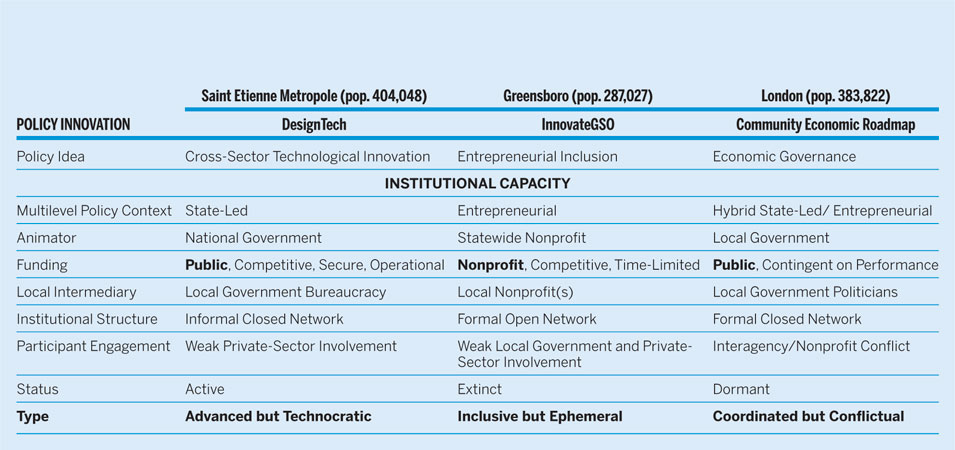
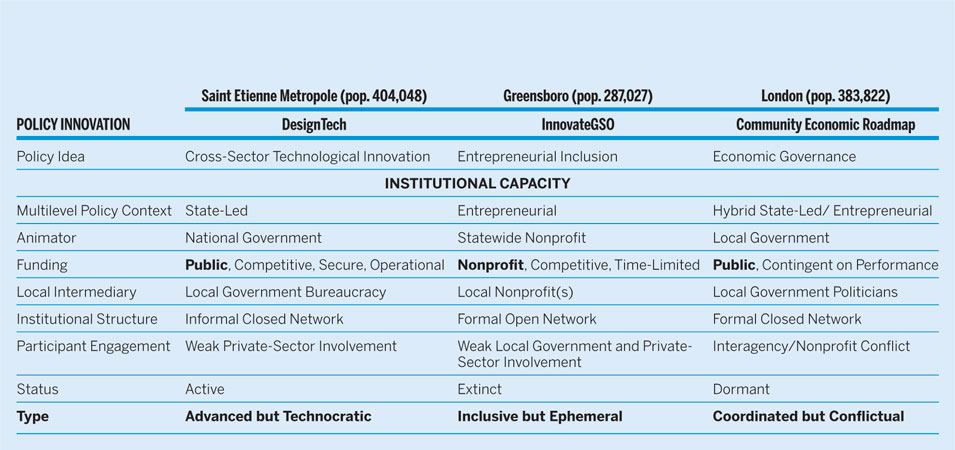
The findings of this research are decidedly mixed, demonstrating evidence of both coordination and fragmentation and both convergence and divergence. Highly variable but not entirely idiosyncratic dynamics emerge as local coalitions design and implement policy innovations distinctive to local priorities and conditions. Yet, subject to important tradeoffs, structural limitations, and political conflicts, durable multi-stakeholder coalitions are difficult to build and even more difficult to sustain. The following typology captures this complex mix of institutional capacities and limitations in each case. In Saint Etienne, a bureaucratic network with multilevel policy support but insufficient program take-up is “advanced but technocratic.” In Greensboro, a diverse multi-stakeholder network of nonprofits and anchor institutions unable to sustain program momentum after funding expired is “inclusive but ephemeral.” In London, where local politicians funded unsuccessful efforts to encourage collaboration among competitive economic development organizations, institutional capacity is “coordinated but conflictual.” Following are brief “vignettes” of each case study and the results are summarized in table 1.
Comparing Institutional Capacity for Urban-Policy Innovation
Saint Etienne, Rhone-Alpes, France: “Advanced but Technocratic”
Located in the shadow of Lyon, the second largest city in France, Saint Etienne continues to struggle with restructuring a local economy reliant for several centuries on specialized steel manufacturing for firearms production for the French military. Securely funded through multilevel sources and integrated into the objectives of local public organizations, Saint Etienne’s efforts are comparatively durable, which largely accounts for why it represents the most “advanced” policy innovation of the three. Operating in a state-led macro-institutional context that provides broad policy direction and funds a wide range of programs to support local and regional development, the Saint Etienne Metropole is one of only nine city-regions to have successfully leveraged the national La FrenchTech program.
Under this program, local actors coordinate resources to support the DesignTech initiative, a strategic urban policy that supports the shift to new specializations for firms to apply digital technologies to existing economic activities as well as to entrepreneurial startups. Multiple public investments and programs are aligned around the core vision of integrating industrial design, manufacturing, and digital technologies. However, its small, informal network of metropolitan government officials, anchor institutions, and publicly funded nonprofits is narrow, closed, and loosely institutionalized, making the DesignTech initiative highly “technocratic” and largely clientelistic. Not atypical in France, state actors unilaterally set policy direction and the participation of the local business community is conspicuously absent. Despite numerous organizations dedicated to digital innovation, there is insufficient program take-up.
Greensboro, North Carolina: “Inclusive but Ephemeral”
Located midway between North Carolina’s Research Triangle and the national financial-services hub in Charlotte, Greensboro is vulnerable to deindustrialization due to an historical reliance on mature manufacturing. Operating in an “entrepreneurial” macro-institutional context, the paucity of funding from federal and state governments means that self-financing and competitive municipalities are preoccupied with economic-development imperatives; fragmentation typically prevails. Greensboro experienced substantial job loss in the early 2000s as textile manufacturing moved to low-cost production sites overseas and the tobacco industry declined. Urban policy makers in this ordinary American city have not yet found a common agenda for how to respond strategically.
Against this backdrop, Greensboro’s InnovateGSO demonstrates counterintuitive urban policy innovation. The most “inclusive” of the three, this collaborative multi-stakeholder initiative was intended to “connect the under-connected” to knowledge-based economic opportunity. Funded through a competitive statewide nonprofit grant, participants were invited from local government; universities; foundations; social, cultural, and economic-development nonprofits; and large local firms. In a formalized but open structure that welcomed new participants, the group met regularly to develop a collective vision that ultimately focused on expanding access to support services for minority and women entrepreneurs. However, with funding limited to two years, the project-based network proved to be “ephemeral,” meeting for a time after funding ended but eventually dissolving. Sufficiently influential civic leadership was difficult to retain in this case. Neither the mayor nor business leaders attended after the first few meetings, leaving nonprofits and anchor institutions that lacked resources to sustain the program’s momentum.
London, Ontario: “Coordinated but Conflictual”
Cities struggling for reinvention are numerous in the province of Ontario, Canada’s industrial heartland. Geographically isolated from the Toronto–Waterloo “digital corridor” and struggling with the loss of multiple industries from food production to insurance, London is one such ordinary city (Bradford Reference Bradford, Bradford and Bramwell2014). Often left out of comparative studies, the macro-institutional context of Canadian federalism is characterized here as a “hybrid” form in which multilevel interactions occur in some policy areas but in which provincial authority over local governments renders the scope for urban policy autonomy ambiguous. Although the pressures of restructuring were felt in the region as early as the mid-1980s, neither provincial nor local policy makers devoted concerted attention to economic transformation, leaving the city with little strategic policy direction.
London’s municipally driven economic governance efforts are comparatively rare in Canada. In the most “coordinated” policy innovation of the three cities, London’s Community and Economic Roadmap was launched in 2014 by the mayor and city council as part of a larger agenda to improve interagency coordination for strategic decision making. It is a formally institutionalized multi-stakeholder network with working groups dedicated to collectively determined economic development priorities. Participants represent all organizations related to economic and workforce development in the city—some are funded by local government, others are nonprofits or funded provincially—as well as the business community, the local university, and the community college. However, the most coordinated urban policy innovation of the three cities is also the most “conflictual.” Although the Community and Economic Roadmap was launched with high aplomb and higher expectations, a politically compromised mayor, interagency conflict, and political impatience with weak performance made its contingent funding precarious. The network is currently dormant and exists largely in name only.
In summary, the findings of this project suggest that urban policy making is mediated through distinctive multilevel arrangements but also represents independent political choice. Despite important differences in macro-institutional context, urban-policy innovation is evident in all three cases, ostensibly suggesting substantial local agency for policy making in ordinary cities. However, it is one thing for local governance institutions to form and entirely another for them to perform (Bramwell and Pierre Reference Bramwell and Pierre2017). Durable and inclusive governance coalitions are difficult to build and even more difficult to sustain. Consistent with earlier studies of economic policy making in midsized cities, none are “success stories” (Clarke and Gaile Reference Clarke and Gaile1998). Given the ordinary or midsized city empirical gap identified herein, the challenge remains of how to account theoretically for these findings. A brief overview of prevailing theoretical approaches is presented followed by a discussion of how the findings of this research advance our understanding of how context influences urban policy making.
Durable and inclusive governance coalitions are difficult to build and even more difficult to sustain.
URBAN POLICY MAKING IN A DIGITAL AGE: WHY CONTEXT MATTERS
Theoretical ambiguity has prompted speculation about whether constructs drawn from other fields might make the study of urban policy making more analytically robust (Sapotichne, Jones, and Wolfe Reference Sapotichne, Jones and Wolfe2007). Among the prevailing theoretical approaches most often applied to state–societal decision-making processes, theories of the policy process explain how institutional arrangements that bridge formal and informal processes for complex public problem-solving are negotiated, structured, and function in practice. However, these theories tend to privilege state power and ignore the multiple levels at which policy making occurs (Sabatier Reference Sabatier1993). Whereas theories of collaborative governance in public administration better account for the resourceful participation of non-state actors in multi-stakeholder structures and deliberative processes, generic frameworks remain agnostic to scale; accounting for power imbalances remains a thorny issue (Ansell and Gash Reference Ansell and Gash2008). In other words, neither approach adequately accounts for context.
As demonstrated in this article, urban policy making is neither uniform nor static. Urban regions operate within and between shifting scales of activity, from the global to the neighborhood, each of which implies distinct policy challenges, political responses, and power relations. Substantial differences in regional outcomes result from different policy objectives as well as context-specific structural conditions and institutional configurations, which suggests the need for analytical models that can better account for variation. Focusing on the extent to which urban policy objectives are simultaneously shaped by those at “higher institutional levels” and by “local political, social, and economic interests,” theories of comparative urban governance in multilevel context offer a way forward (Pierre Reference Pierre2005, 450).
Capturing variation in urban policy agency requires attention to how “top-down” public policies and “bottom-up” local institutions interact to shape decision-making processes among local state and societal actors with “shared purposes but no shared authority” (Clarke Reference Clarke and Giloth2004, 30–31). Explaining how cities go about solving this “empowerment puzzle” in complex twenty-first-century urban policy environments is a central preoccupation of comparative urban governance studies (Stone Reference Stone2015). Research finds that macro-institutional context has significant importance but is not entirely deterministic; cities can and do make distinctive policy choices about how social and economic dynamics unfold (Savitch and Kantor Reference Savitch and Kantor2002; Sellers Reference Sellers2002).
The determining factor is local institutional capacity. This refers not only to the structure and process of negotiated governing arrangements but also to the heterogeneity of actors involved and the patterns of politics among them (Rich and Stoker Reference Rich and Stoker2014). Some scholars find that stable governing arrangements are possible but rare and highly context-specific, whereas others emphasize that emerging new “modalities” of governance operate alongside endemic tradeoffs and political conflicts (Benner and Pastor Reference Benner and Pastor2016; Gross Reference Gross2017). Policy ideas do matter (Bradford Reference Bradford2016) but the attenuation of private-sector participation (Hanson et al. Reference Hanson, Wolman, Connolly, Pearson and McManmon2010), power and resource asymmetries among community-based actors (Clarke Reference Clarke2017), and conflicts between elected and unelected civic leaders over local policy agendas (Bramwell and Pierre Reference Bramwell and Pierre2017) call into question the prospects for durable strategic governance at citywide and regional scales (Stone and Stoker Reference Stone and Stoker2015). These studies provide important insight into the vertical and horizontal networks and political tradeoffs that shape urban policy making in different macro-institutional settings, yet—somewhat counterintuitively—give almost no analytical attention to variation in local conditions.
This research on ordinary cities makes several contributions that further our understanding of urban policy making. First, institutional capacity clearly matters. Although problem solving involving multiple actors, interests, and ideas occurred in all three cases, these dynamics were not sufficiently durable to have measurable impact, except in the French case. Second, this suggests that multilevel policy context also matters. The digital-innovation agenda was the most “advanced” in Saint Etienne, where supportive intergovernmental relations are the most secure; the most “ephemeral” in Greensboro, where under-resourced nonprofits and universities were most directly involved; and the most “conflictual” in London, where local actors compete for policy resources.
Most important, however, these findings also indicate that local context matters—a great deal. Comparative research tends to focus on large cities, but the dynamics of economic transformation cannot simply be deduced from these places (Kodrzycki and Muñoz Reference Kodrzycki and Muñoz2015). “Big-city” problems and solutions apply less well to “ordinary” cities. Although novel ideas drive policy innovation in each case, weak local government or private-sector engagement, interagency conflict, resource insufficiency, and power ambiguity underscore the fragmentation that emerges in these places. The finding that city size and economic specialization shape urban policy making at least as much as the multilevel context in which it operates provides several insights into the question of what accounts for differences between “national-champion” and “second-tier” cities (da Cruz, Rode, and McQuarrie Reference da Cruz, Rode and McQuarrie2019). It explains why cities in different macro-institutional settings ultimately pursue similar policy strategies. It also suggests that policy innovation is more difficult in ordinary cities. The implication that strong-market cities have greater institutional capacity for this type of innovation may explain why their policy choices dominate theoretical assumptions about urban policy making.
“Big-city” problems and solutions apply less well to “ordinary” cities... city size and economic specialization shape urban policy making at least as much as the multilevel context in which it operates.
From a theoretical perspective, these findings emphasize the value of more nuanced models that consider not only the multilevel interplay of public policies and local capacities but also variation in city types (Bradford and Bramwell Reference Bradford and Bramwell2014; Kaufmann Reference Kaufmann2018). They also have important implications for public policy. Ordinary cities are at an important crossroads, necessitating strategic intervention to alter their development trajectories. Due partly to structural forces beyond their control and partly to local actor configurations and political choices, policy innovation is particularly problematic in these places. This suggests that regional development policies will fail without careful attention to local context.