Introduction
Word generation or verbal fluency (VF) tasks are simple and efficient clinical tools to detect language impairment and, in a broader sense, cognitive decline. Participants are encouraged to say as many words as possible from a category in a given time (usually 60 seconds). The ability to measure lexico-semantic impairment, semantic memory, working memory deficits and executive dysfunction renders these tasks very suitable as a measure of cognitive impairment of various etiologies, such as Parkinson's disease (Henry and Crawford, Reference Henry and Crawford2004), schizophrenia (Bowie et al., Reference Bowie, Harvey, Moriarty, Parrella, White and Davis2004), bipolar disorder (Robinson et al., Reference Robinson2006) and dementia of various etiologies (Henry et al., Reference Henry, Crawford and Phillips2005; Jones et al., Reference Jones, Laukka and Bäckman2006).
VF tasks are widely used as screening measures of cognitive decline, being accurate, swift and straightforward to administer, as well as adequate as follow-up measures of cognitive performance (Henry et al., Reference Henry, Crawford and Phillips2004).
VF tasks may be employed according to semantic categories, initial letters (e.g. FAS-COWA) and verbs (action). The most frequently used semantic categories are animals and fruits, although there are alternative categories that can be used as well, such as vegetables, tools, supermarket items, and first names (Acevedo et al., Reference Acevedo2000; March and Pattison, Reference March and Pattison2006; Sáez-Zea et al., Reference Sáez-Zea, Carnero-Pardo and Gurpegui2008). Different categories recruit distinct brain regions and exert different demands on cognitive resources (Baldo et al., Reference Baldo, Schwartz, Wilkins and Dronkers2006).
It is well known that multiple variables such as age, gender and schooling of subjects, as well as category size, and age of acquisition of the word, may influence the performance in VF tasks (Mathuranath et al., Reference Mathuranath, George, Cherian, Alexander, Sarma and Sarma2003; Diaz et al., Reference Diaz, Sailor, Cheung and Kuslansky2004; Forbes-McKay et al., Reference Forbes-McKay, Ellis, Shanks and Venneri2005). Moreover, cross-cultural differences in this task are important, and VF tests have been validated in many different languages (Acevedo et al., Reference Acevedo2000; Mok et al., Reference Mok, Lam and Chiu2004)
VF tasks are commonly used in cognitive and mental examinations in patients with suspected dementia, but their accuracy in the detection of mild cognitive impairment (MCI) is still under investigation. Amnestic MCI patients were found to produce fewer names than healthy controls, although within the normal score. It has also been hypothesized that the combination of multiple categories (both semantic and formal) may be useful to increase the sensitivity and specificity of this screening task (Murphy et al., Reference Murphy, Rich and Troyer2006; Nutter-Upham et al., Reference Nutter-Upham2008).
The objective of the present study was to evaluate and compare the accuracy of two semantic categories (animals and fruits) in discriminating cognitively unimpaired subjects from patients with MCI and Alzheimer's disease (AD) in a sample of Portuguese speaking older Brazilian adults.
Methods
We studied 178 subjects, all Brazilian Portuguese native speakers, recruited from our Psychogeriatric Clinic. The study comprised 70 controls (CG), 70 MCI subjects and 38 patients with mild AD. The control group was defined as subjects who achieved normal scores in the neuropsychological evaluation (corrected for age and schooling). The diagnosis of MCI was based on Petersen's criteria (Petersen et al., Reference Petersen, Smith, Waring, Ivnik, Tangalos and Kokmen1999) while the diagnosis of “probable AD” was based on the NINCDS-ADRA (McKhann et al., Reference McKhann, Drachman, Folstein, Katzman, Price and Stadlam1984) criteria. Multiple-domain MCI was the most common MCI subtype, accounting for 57.1% of the cases (n = 40), followed by amnestic, single-domain MCI (31.4%, n = 22), and non-amnestic, single-domain MCI (11.4%, n = 8).
All subjects were initially assessed for cognitive impairment using the Brazilian version of the MMSE (Folstein et al., Reference Folstein, Folstein and McHugh1975; Brucki et al., Reference Brucki, Nitrini, Caramelli, Bertolucci and Okamoto2003) and the Informant Questionnaire of Cognitive Disorders of the Elderly (IQ-CODE) (Jorm and Jacomb, Reference Jorm and Jacomb1989). Subsequently, all subjects were evaluated using the Brazilian version of the CAMDEX semi-structured interview (including the CAMCOG) (Roth et al., Reference Roth1986; Bottino et al., Reference Bottino, Almeida, Tamai, Forlenza, Scalco and Carvalho1999), and a neuropsychological protocol fully described in previous studies (Diniz et al., Reference Diniz, Yassuda, Nunes, Radanovic and Forlenza2007; Nunes et al., Reference Nunes2008). Evidence of functional decline was based on reports by close relatives or caregivers, or on the patient's self-reports of difficulties in performing basic and instrumental activities of daily living. Concurrent depression (defined as a score of 8 or more in the 21-item Hamilton Rating Scale for Depression; Hamilton, Reference Hamilton1960) was excluded. All participants underwent a laboratory diagnostic workup that included the following examinations: routine blood tests, standard chemistry screen, serology for syphilis, thyroid function, and serum B12 levels. A CT or MRI brain scan was also performed. Consensus diagnosis was reached by a multidisciplinary team, based on clinical, neuropsychological, laboratory and neuroimaging data. The existence of chronic medical illness (e.g. diabetes, hypertension) was not an exclusion criteria provided that the condition was under proper treatment, that subjects were clinically stable, and that there were no signs of complications that could affect cognition (e.g. concurrent cerebrovascular disease). Subjects with a history of alcohol or drug abuse, or using psychotropic medications in doses that could impair cognition, were excluded.
All participants were tested on two semantic VF tasks (animals and fruits). They were asked to name as many items they could remember in each category in one minute. The total sample was divided in two subgroups, according to their educational level: the first was composed of participants with four to eight years of formal education and the second of participants with nine or more years of formal education. The first subgroup comprised 74 subjects: 25 controls, 33 MCI and 16 AD; the second subgroup comprised 104 subjects: 45 controls, 37 MCI and 22 AD. The performance of the three groups (CG, MCI and AD) was compared in each category task by one-way ANOVA with Tukey's post test. The cut-off scores that best discriminated CG from MCI, CG from AD and MCI from AD were then determined by means of receiver operator characteristics (ROC) curve analysis in both fluency tasks, with the respective sensitivities and specificities. Logistic regression (forward LR method) was employed to verify which task, or combination of tasks, was the best predictor for each diagnosis.
All statistical analyses were performed using the SPSS for Windows® 10.0.1 software, and a significance level of 0.05 was adopted.
The study was approved by the Ethics Committee of the Hospital das Clinicas, Faculty of Medicine, University of São Paulo. All subjects (or their legal representatives) gave their informed consent before enrollment in the study. The study was part of a larger multidisciplinary research program on aging and cognition, which included volunteer participation, anonymous handling of data, safety guidelines and the accomplishment of good clinical practice at the local institution, and was performed in accordance with the Helsinki Declaration.
Results
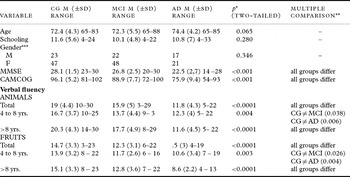
The demographic variables of the sample and the results in the MMSE and the CAMCOG are displayed in Table 1. There were no differences between the three groups regarding age, schooling and gender for the total sample. As expected, all groups differed in the MMSE and CAMCOG scores. The comparison between the three groups in the semantic VF tasks (animals and fruits) according to educational level is displayed in Table 1. All groups differed in both semantic categories VF scores. Less educated subjects obtained lower scores than higher educated ones in both semantic categories in the CG and MCI groups; the opposite occurred in the AD group, where higher educated subjects performed poorer than lower educated ones.
Demographic characteristics of the sample and intergroup comparison in the VF tasks according to educational level

*ANOVA **Tukey's post hoc test ***χ2 test.
ROC curve analysis
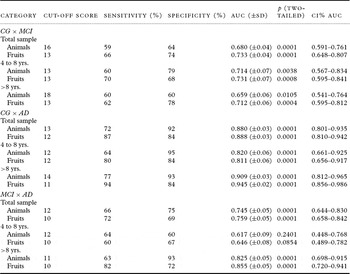
Animals and fruits fluency adequately discriminated CG from AD in the total sample and in both education groups, and MCI from AD in the higher educated group. The accuracy of both tasks was moderate in discriminating CG from MCI in the total sample and in both education groups, and MCI from AD in the total sample; fruits fluency was generally more accurate in all these conditions. In the less educated group, neither of the two tasks was powerful enough to differentiate MCI from AD patients (Table 2).
Cut-off scores, sensitivity and specificity for each semantic category in the discrimination between CG, MCI and AD according to educational level

SD = Standard Deviation; AUC = area under the curve; CI = confidence interval.
Logistic regression analysis
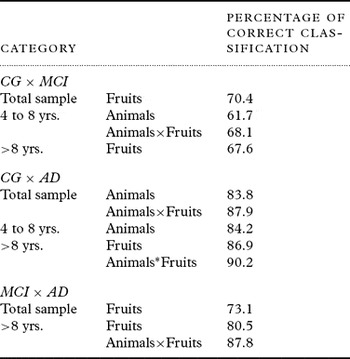
In the total sample, fruits fluency alone was the best task to discriminate CG from MCI and MCI from AD; animals and fruits fluency used in combination improved the discrimination between CG and AD when compared to animals fluency alone. In the less educated group, the combination of animals and fruits fluency improved the low accuracy of the task for the discrimination of CG and MCI when compared to animals fluency alone; animals fluency alone was the best task to differentiate CG and AD; and neither was powerful enough to differentiate MCI from AD. In the higher educated group, fruits fluency alone was the best task in discriminating CG from MCI, but showed low accuracy; the combination of the two semantic tasks improved the accuracy of diagnosis between CG and AD when compared to fruits fluency alone, and also between MCI and AD when compared to fruits fluency alone (Table 3).
Logistic regression analysis results

Discussion
Semantic VF tasks are reliable measures of executive function and semantic memory integrity. They depend on the preserved fronto-temporal circuitry, and are thus altered in a variety of conditions affecting this regions (Baldo et al., Reference Baldo, Schwartz, Wilkins and Dronkers2006), hence their widespread use as a tool in the diagnosis of AD (Henry et al., Reference Henry, Crawford and Phillips2004). Word fluency tasks are a suitable means to assess whether and how effectively subjects organize their thinking. In a semantic fluency task, even though the initial structure for searching is provided (e.g. animals), the subject will have to develop strategies for organizing the recall (subcategories, such as domestic animals, sea animals, birds, mammals, and so on), thus requiring an intact executive system, preserved attention, and short-term memory (to keep track of what words have already been produced). From a linguistic perspective, VF tasks are dependent on semantic knowledge (conceptualizing), lexical retrieval, phonological encoding, and articulation. Functional neuroimaging studies have shown that both the left posterior and anterior temporal regions to be as active during word generation tasks (Ostberg et al., Reference Ostberg, Crinelli, Danielsson, Wahlund, Bogdanovic and Fernaeus2007; Patterson et al., Reference Patterson, Nestor and Rogers2007) as the frontal lobe (Baldo et al., Reference Baldo, Schwartz, Wilkins and Dronkers2006; Hirshorn and Thompson-Schill, Reference Hirshorn and Thompson-Schill2006). In the latter, BA 44 is probably more related to high-level aspects of programming speech production, while BA 45 is more related to semantic processing (Amunts and Zilles, Reference Amunts, Zilles, Grodzinsky and Amunts2006).
There are still few studies on VF tasks in the preclinical stages of dementia. This study was conducted in order to verify the performance of MCI subjects in VF tasks, and to evaluate the accuracy of these tasks in the discrimination of MCI subjects either from controls or from mild AD patients, taking into account the need for education-adjusted scores in our population.
Our results are consistent with those found in previous studies developed in Brazil with respect to the mean scores of controls, MCI and AD patients in the animals and fruits categories (Brucki and Rocha, Reference Brucki and Rocha2004; Caramelli et al., Reference Caramelli, Carthery-Goulart, Porto, Charchat-Fichman and Nitrini2007; Radanovic et al., Reference Radanovic2007; Balthazar et al., Reference Balthazar, Cendes and Damasceno2007), and the ability of these tasks to differentiate the three diagnostic groups.
Both tasks were less accurate in discriminating controls from MCI, regardless of the higher cut-off scores encountered for animals fluency in the more educated group. The discrimination between MCI from AD patients, although adequate in the higher educated group, was not as precise in the total sample and in the less educated group. The diagnosis of MCI or, in other words, the establishment of the boundaries between unequivocal normal performance and unequivocal dementia poses a critical clinical challenge, whatever cognitive tests are used. Educational level is a major confounding factor on this matter. The difficulty in determining whether a subject's poor performance in cognitive tasks reflects real cognitive impairment or only low education is a recurrent issue in neuropsychological studies, as well as attempts to find new strategies in order to minimize the impact of formal education when evaluating subjects with cognitive complaints.
An intriguing finding was that AD patients with high educational level performed more poorly than AD patients with low educational level, in both semantic categories. A possible explanation for this finding might be that with the advance of AD neuropathology, differences in cognitive performance associated with educational level tend to be attenuated, due to a failure in the compensatory mechanisms responsible for cognitive reserve (Koepsell et al., Reference Koepsell, Kurland, Harel, Johnson, Zhou and Kukull2008). Since all the subjects enrolled in this study are still in follow-up, we are not able to provide any data on neuropathology to confirm this hypothesis.
Logistic regression generated a model in which fruits fluency surpassed animals fluency in discrimination power, in the total sample (for CG and MCI, MCI and AD) and in the higher educated group (for CG and MCI, CG and AD, MCI and AD). Animals fluency was superior to fruits fluency in differentiating correctly CG from MCI as well as CG from AD in the less educated group. However, these differences are not to be overestimated, taking into account that the sensitivity and specificity values obtained for each category are quite similar in most cases, as can be seen in Table 2. These results suggest that, in clinical practice, animals and fruits categories can be used interchangeably, as they show comparable accuracy in discriminating the three diagnostic groups (although with different cut-off scores). The cut-off scores for fruits fluency were relatively constant for the total sample, and for each level of schooling analyzed, when compared to the animals fluency cut-off scores, which showed greater variation according to the educational level in the less compromised subjects (CG and MCI). Such peculiarities may reflect the differences in semantic representations, where a more relevant category (food) is less influenced by literacy, while animals fluency (and especially the ability to store and organize the information of diverse subcategories of animals in the semantic memory, as well as to retrieve it) is more dependent on exposure to formal education (da Silva et al., Reference da Silva, Petersson, Faisca, Ingvar and Reis2004). Other semantic categories which have been proposed as less dependent on schooling are people's names (Sáez-Zea et al., Reference Sáez-Zea, Carnero-Pardo and Gurpegui2008), supermarket items (da Silva et al., Reference da Silva, Petersson, Faisca, Ingvar and Reis2004) and household items (Fernandez et al., Reference Fernandez2002).
An advantage of determining the cut-off scores for various categories is the possibility of alternating the tasks in follow up retest situations, thus avoiding the learning effect (Cunje et al., Reference Cunje, Molloy, Standish and Lewis2007). This can be particularly useful when evaluating less impaired subjects, although it has been proposed that the practice effect may already be compromised in MCI (Cooper et al., Reference Cooper, Lacritz, Weiner, Rosenberg and Cullum2004).
We were also interested in determining if the addition of a second semantic category might increase the power of the task. The use of both categories combined improved the accuracy of the test in discriminating controls from MCI in the less educated group, controls from AD patients in the total sample and in the higher educated group, and MCI from AD in the higher educated group. These results suggest that the combination of two semantic categories may be useful in some clinical situations. However, it must be noted that VF was not suitable to differentiate MCI from AD in the less educated group, even when both semantic categories were combined.
As pointed out earlier, our results show that VF tasks are not as accurate in discriminating controls from MCI. In this respect, alternative methods of scoring VF tasks have been proposed. Analyses of clustering (the ability to generate semantically related items) and switching (the ability to change to a different cluster) have been proposed as means of increasing the sensitivity of the task as well as the analysis of the performance of subjects in the second half of the task, where there are fewer items available for retrieval. These analyses provide evidence of the greater demand on the executive and working memory components of the task (Troyer et al., Reference Troyer, Moscovitch, Winocur, Leach and Freedman1998; Gomez and White, Reference Gomez and White2006; Fernández-Turrado et al., Reference Fernández-Turrado, Pascual-Millán, Fernández-Arín, Larrodé-Pellicer, Santos-Lasaosa and Mostacero-Miguel2007).
Recent studies have reported that the performance of MCI subjects resembles that of normal subjects rather than that of AD patients, also emphasizing the importance of using multiple semantic categories to increase the accuracy of the task in the assessment of preclinical dementia (Brandt and Manning, Reference Brandt and Manning2009; Nutter-Upham, Reference Nutter-Upham2008).
A limitation of this study is the wide range of schooling in our sample, with a large proportion of subjects having a very low level of education (less than 8 years of formal education). Nevertheless, this reflects the usual pattern observed in developing countries, especially among the elderly. Further longitudinal studies are now necessary to increase our understanding on the usefulness of varied VF tasks as early markers of cognitive decline, and to determine which semantic category (or combination of semantic categories) is more appropriate for the distinction between MCI and controls, particularly in subjects with lower education.
Conflict of interest
None.
Description of authors’ roles
Marcia Radanovic was responsible for study design, acquisition and interpretation of data, statistical analysis, and manuscript preparation. Breno Satler Diniz was responsible for acquisition and interpretation of data, study design, and manuscript revision. Roberta M Mirandez was responsible for acquisition and interpretation of data. Tânia Maria da Silva Novaretti was responsible for acquisition and interpretation of data. Mariana Kneese Flacks was responsible for acquisition and interpretation of data, and final manuscript revision. Mônica S Yassuda was responsible for acquisition and interpretation of data, supervision of data collection, and final manuscript revision. Orestes Vicente Forlenza was responsible for intellectual contributions to the study, supervision of data collection, and final manuscript revision.