Introduction
In Sir 15:11–20, Ben Sira has a brief discussion of the free will problem, the tension between free will and determinism. While modern scholars have noticed certain similarities between his discussion and that of the Stoics, they miss some nuances of such similarities. For instance, Martin Hengel claims that Ben Sira had difficulties with the free will problem as did the Stoics but ignores how Ben Sira might be influenced by them. Ursel Wicke-Reuter points out that Chrysippus’s discussion of the free will problem resembles the modern theory of compatibilism and is comparable to that of Ben Sira; however, she does not discuss whether Ben Sira and Chrysippus developed the same kind of compatibilism.Footnote 1
In this article, I argue that both Ben Sira and Chrysippus base their solutions to the free will problem on compatibilism. Ben Sira is probably influenced by Chrysippus in this regard, but they understand free will differently. In the terms of modern understanding, free will is people’s capacity to control their own actions, and this capacity does not make the question of freedom to perform such control meaningless.Footnote 2 Therefore, there remains a “free will problem” to solve. Because the element conflicting with free will is determinism, the idea that “the facts of the past … entail every truth about the future,”Footnote 3 the free will problem involves a tension between free will and determinism. Moreover, since free will is required for moral responsibility, free will is as much a problem in moral philosophy as in metaphysics.Footnote 4 As Table 1 below shows, there are four solutions to the free will problem.
Positions on the Free Will Problem

Like Chrysippus, Ben Sira argues against hard determinism: the view that since determinism is true, the existence of free will required by moral responsibility is false. Ben Sira argues, as does Chrysippus, for compatibilism: the theory that both free will and determinism are true. Yet, Chrysippus believes that people have free will in that they are the cause of their actions, whereas Ben Sira claims that a person’s free will lies in the fact that they could have done otherwise. While I am using modern terminology relating to the free will problem throughout this article, I am not arguing, anachronistically, that either Ben Sira or Chrysippus holds any modern theory. Rather, this terminology will help us to specify the theories of Ben Sira and Chrysippus, just as contemporary philosophical concepts have shed important light on our understanding of ancient Jewish texts.Footnote 5 First, I discuss the relevant texts of Ben Sira and Chrysippus. Next, I analyze the arguments of Ben Sira and Chrysippus for compatibilism. Last, I demonstrate that although Ben Sira’s idea of compatibilism resembles that of Chrysippus, their versions of compatibilism differ because of their different conceptions of free will.
Texts of Ben Sira and Chrysippus on the Free Will Problem
A. Sir 15:11–20
Sirach 15:11–20 records Ben Sira’s response to the challenge of his imagined opponents that God should be responsible for a person’s sins. Two issues here deserve our consideration: the structure of this passage and the meaning of רצי in verse 14. Regarding the issue of structure, Ben Sira’s argument changes its focus from God to humanity as the passage continues, so that Sir 15:11–20 can be divided into three stanzas: 11–13, 14–17, and 18–20.
11 Do not say, “My transgression is from God,” for he does not do what he hates.
12 Do not say, “It is he who leads me astray,” for he has no need of wicked men.
13 He hates abomination and he does not make fall the one who fears him.
14 At the beginning, God created man, and gave him into the hand of his free will.Footnote 6
15 If you want, you can keep the commandment, and fidelity is to do his favor; if you believe in him, you can also live.
16 There are poured out before you fire and water; stretch out your hand for whichever you want.
17 Before each man is death and life; whichever he wants will be given to him.
18 The wisdom of the Lord is abundant, his might is strong, and he sees all of them.
19 The eyes of God will watch his work, and he will observe every deed of a person.
20 He does not command persons to sin, and persons who lie are not healthy; he has no compassion for one who does vanity, and he makes exiled one who departs.Footnote 7
In verses 11–13, Ben Sira concentrates on the nature of God. In verses 14–17, Ben Sira turns to the nature of humanity, specifically their capacity to choose between two alternatives. Verses 18–20 returns to the nature of God. In this passage, Ben Sira offers two arguments against his opponents, and the poem employs a chiastic structure of A(God)-B(human)-A’(God). Given these two arguments, the details of which I will discuss in Section II, it is incorrect to claim that Ben Sira makes no systematic attempt to reconcile human moral responsibility with “a strongly deterministic notion of divine control over human destiny.”Footnote 8 It is also misleading to state that “difficult questions such as those concerning determinism and freedom of will Ben Sira never completely thought out,”Footnote 9 because Ben Sira does offer solutions to the difficult question of the free will problem.
The meaning of רצי in verse 14, which is “almost equivalent to free-will,”Footnote 10 is central to our understanding of Sir 15:11–20. In his widely cited discussion of Ben Sira’s use of רצי, Jean Hadot explains that this term should have a neutral rather than negative meaning here.Footnote 11 Hadot’s argument is convincing because, as he points out, the following three verses (vv. 15–17) clearly indicate Ben Sira’s belief that a person has the capacity to choose between two options. It is thus appropriate to conclude, in the words of Hadot, that “the stress here is clearly on the ‘voluntary’ aspect of רצי with the free choice between good or bad, that is the ‘neutrality.’ ”Footnote 12
This study offers further evidence for reading רצי in a neutral way.Footnote 13 If we render this term as bad desire or evil impulse,Footnote 14 then verse 14 conveys the idea that God created human beings and gave them into the hands of evil. This rendering may lead to a conclusion that God causes human beings to sin, which is the position of Ben Sira’s opponents. Ben Sira surely realizes the strong connection between the negative meaning of רצי and his opponents’ position. Also note that, in Ben Sira, רצי does not mean unrestricted freedom to do whatever people want. Rather, it refers to people’s capacity to choose between opposites, “the freedom or power to deliberate and choose between the good and the bad.”Footnote 15 This qualification of רצי makes it possible to compare Ben Sira with the Stoic philosopher Chrysippus, as Stoics do not believe in an unrestricted freedom either, despite their belief in people’s responsibility for their actions.Footnote 16
B. Chrysippus
Three sources are pertinent to my comparison of Ben Sira with Chrysippus. The first is from Plutarch, who records a challenge to Chrysippus and his response to it: “Indeed, the same [Chrysippus] says in On Judgement and again [in] On the Second Book on Gods, ‘It is not reasonable for gods to be a cause of shameful deeds. For just as a law could never be a cause of illegal deeds, gods could never be a cause of shameful deeds; thus, it is reasonable to say that they are not causes of shameful deeds.’ ”Footnote 17 It is evident that the opponents of Chrysippus reach a generalized conclusion that gods are the causes of human transgressions (shameful deeds) and that Chrysippus appeals to the righteousness of the gods, which is compared to law, to respond to this challenge. In other words, Chrysippus opposes the generalized statement that gods should be responsible for human transgressions and denies that the character of gods supports such a statement.
The second source comes from Aulus Gellius, who reports another challenge from Chrysippus’s opponents, as follows:
But the authors of other views and philosophical schools protest against this definition <i.e. Chrysippus’ definition of fate> in the following ways … (Gell. NA 7.2.4)
They say: (1a) If Chrysippus believes that all things are set in motion and ruled by fate and that it is not possible for the paths and coils of fate to be bent or transcended, (b) then the sins and misdeeds of human beings, too, should not cause anger or be attributed to themselves and their wills, (c) but to a certain necessity and importunity which arises from fate, which is the mistress and arbiter of all things, <and> through which it is necessary that whatever is going to happen, happens; (2a) and because of this the establishing of penalties for criminals by laws is unfair, (b) if human beings do not do evils voluntarily, (c) but dragged by fate. (NA 7.2.5)Footnote 18
In Gellius’s report, the opponents of Chrysippus do not argue that the gods should be responsible for a person’s own transgressions, as the opponents in the report of Plutarch do, but rather that Chrysippus’s definition of fate is false. This poses a new challenge to Chrysippus, the argument of which is summarized in the reconstruction of Susanne Bobzien as follows:
Argument I of the Second Challenge to Chrysippus

Note that the first challenge to Chrysippus recorded in Plutarch omits the assumption that God is in control of the world, including human destiny. By addition of this assumption, the argument of the first challenge becomes clear:
The Argument of the First Challenge to Chrysippus

As we can see, P1 in the argument of the first challenge is like P1 in the argument I of the second challenge, both indicating hard determinism: the view that if determinism is true then the existence of free will is false (see Table 1).
Bobzien claims that her addition of P4 and C in Argument I above is further supported by the parallel argument in Cicero (Fat. 40).Footnote 20 While Bobzien’s reconstruction makes sense, we do not know whether Cicero’s parallel argument comes from his reading of Chrysippus or his own reconstruction. From a logical point of view, we can transform the argument reconstructed by Bobzien into the argument below (Argument II). Reading these two arguments together, we will see a more complicated connection between the two challenges posed by the opponents of Chrysippus.
Argument II of the Second Challenge to Chrysippus

The conclusion of this second argument is like the conclusion of the first challenge, both emphasizing that people are not responsible for their own transgressions. It is thus possible that the opponents of Chrysippus in Plutarch developed their argument to refute Chrysippus’s original response to them. This new challenge impales Chrysippus on the horns of a dilemma. One horn, Argument II, forces us to accept fate and conclude that people are not responsible for their own transgressions. Another horn, Argument I, compels us to accept that people are responsible for their own transgressions and to abandon fatalism.
Chrysippus’s response to this second challenge is recorded by Cicero as follows:
But Chrysippus … distinguished kinds of causes, in order that he should both escape necessity and retain fate. For, he says, some causes are perfect and principal, others auxiliary and proximate. Because of this, when we say that everything happens by fate by way of antecedent causes we do not want this understood as by perfect and principal causes, but by auxiliary and proximate causes. Thus he retorts in the following way to the argument which I presented a little while ago: if everything happens by fate, it follows indeed that everything happens by way of preceding causes, but not by perfect and principal causes, but by auxiliary and proximate causes. If these are not in our power, it does not follow that impulse is not in our power either. (Cic. Fat. 41)Footnote 21
As we can see, Chrysippus distinguishes two types of causes: perfect and principal cause, and auxiliary and proximate cause. The former type of cause is external and beyond our power, while the latter is internal and within our control.Footnote 22 For Chrysippus, fate, the external cause, does not necessitate our actions, as our actions are also triggered by the internal cause of our assent. As I will show below, this response of Chrysippus is a form of compatibilism.
Ben Sira and Chrysippus on Compatibilism
A. Ben Sira
My discussion of the meaning of רצי (I.A) demonstrates that Sir 15:14–17 supports the existence of free will. Therefore, as Table 1 shows, Ben Sira could be either a libertarian or compatibilist, depending on whether or not he accepts determinism. There are two ways to argue that Ben Sira denies the truth of determinism and is therefore a libertarian, but, as I argue below, both are problematic.
According to Otto Kaiser, Ben Sira adapted the Stoic concept of providence and rejected its deterministic connotation.Footnote 23 Kaiser grounds his argument on Sir 15:11–20, which indicates that human beings have the power to do good or evil. Given this power, Kaiser concludes that Ben Sira avoided the tension between free will and determinism with which the Stoics had struggled.Footnote 24 Kaiser’s conclusion is based on Ben Sira’s evident belief in the existence of free will, but this does not exclude the possibility of a determinist element in Ben Sira. To show that Ben Sira is a libertarian, we need to prove that, although believing in the existence of free will, Ben Sira did not believe in the truth of determinism.
In a comprehensive discussion of the different types of Jewish compatibilism, Jonathan Klawans takes a different approach to demonstrate Ben Sira’s libertarianism.Footnote 25 He distinguishes predestination, which has the connotation of determinism, from divine election and argues that Sir 33 is evidence of divine election rather than predestination. Thus, he concludes that “nothing we find in Sirach 33 prevents reaching the conclusion that the sage was a firm believer in free will, just as Sirach 15 tells us.”Footnote 26
Klawans presumes that divine election excludes predestination, but his definitions of these two concepts indicate the reverse. According to Klawans, predestination is “the belief that all has been determined ahead of time, including especially who will be sinful and who will be righteous,” while divine election “refers to the idea that a certain group or nation has been singled out from among others for both revelation and responsibility.”Footnote 27 His definitions imply that divine election could be a function of predestination and, in this sense, these two concepts could be compatible with each other.Footnote 28 Dewey D. Wallace also points out that predestination actually refers to God’s choice of certain groups or individuals for salvation.Footnote 29 Hence, as some scholars argue, nothing obstructs the conclusion that Sir 33 is evidence of both predestination and divine election.Footnote 30 In fact, Klawans concedes that “there is of course a deterministic element to the idea of divine election,”Footnote 31 but he denies that Sir 33 has any element of predestination because “if Sirach 33 is predeterministic, then all ancient Jews become predeterminists.”Footnote 32 However, this argument of Klawans is invalid unless he proves the falsity of the statement that “all ancient Jews become predeterminists.”
In addition to Sir 33, there are other passages which support Ben Sira’s acceptance of determinism and, therefore, indicate his compatibilism. For instance, Sir 39:25 presents the idea that the good was created for good people but the bad for sinners. In the words of Wicke-Reuter, this idea indicates that “the world as a whole is determined to the least extent by God’s care, so that nothing is out of his plan and attention.”Footnote 33 Jan Liesen claims that Sir 39:25 implies “an inescapability about God’s work which is linked to the moral quality of the work of human beings,” and that “this intrinsic necessity is anchored in God’s omnipotence and omniscience.”Footnote 34 Because theological determinism is usually understood as God’s omnipotence and omniscience,Footnote 35 Liesen’s view also supports an element of determinism in Sir 39:25.
Sirach 10:4 states that the governance of the earth is in the hands of the Lord. Regarding this statement, Benjamin G. Wright comments that “here Ben Sira asserts God’s ultimate control over all the earth.”Footnote 36 The control emphasized by Wright is a sign of determinism because, as George Foot Moore points out, in Jewish determinism the decision of God is “embodied in a decree (הרזג) of the sovereign ruler of the world.”Footnote 37 Sir 15:11–20 also contains a sense of theological determinism, for verse 18b shows “God’s omnipotence and omniscience,” which “are included in his wisdom.”Footnote 38
All in all, because Ben Sira believes in the truth of both free will and determinism, we draw the conclusion that he is a compatibilist rather than a libertarian. The statement that God created humans and placed them “into the hands of free will” (15:14) clearly shows Ben Sira’s position of compatibilism: although God is in control of humans through his omnipotence, they have free will.
B. Chrysippus
As already mentioned in section I.B, Chrysippus puts forward a form of compatibilism in response to the challenge reported by Gellius that either fatalism is wrong, or persons are not responsible for their sins. His response is based on a distinction between two types of causes of our actions: the internal and the external. This response indicates his compatibilism because, while the existence of the external cause is evidence for determinism, the internal cause comes from our free will. Chrysippus’s theory of compatibilism is further illustrated in the following analogy of the cylinder:
Thus, he [Chrysippus] says, just as the person who shoved the cylinder gave it the beginning of its motion, but did not give it its roll-ability, so likewise, an impression, when encountered, will imprint and so to speak stamp its form on the mind, but assent will be in our power; and, just as was said in the case of the cylinder, being pushed from outside, for the rest it will move by its own power and nature. (Cic. Fat. 43.1)Footnote 39
A consideration of Miryam T. Brand’s ambiguous discussion of the difference between Ben Sira and Chrysippus helps us to make clear the latter’s theory of compatibilism. Brand states:
As opposed to the deterministic stance of some of the Jewish prayers examined above, the focus in Hellenistic determinism was not the determinism of human sinfulness but the determination of human actions. For instance, Chrysippus’ famous cylinder analogy, meant to clarify Stoic determinism, expresses the idea that actions, like the rolling of the cylinder, are determined both by antecedent causes (the cylinder being pushed) and by the human’s nature (the cylinder’s roundness).Footnote 40
Brand’s comment that the rolling of the cylinder is determined both by external and internal causes sounds like hard determinism. She proceeds to state that this idea “may have been transposed to Jewish thought to include the act of sin itself. It is the idea that actual sins are determined by God that Ben Sira finds objectionable.”Footnote 41 Brand puts Chrysippus in the camp of Ben Sira’s opponents, who hold the view of hard determinism. In other words, she takes the determinism of Chrysippus as hard determinism.
However, Chrysippus does not use the analogy of the cylinder to explain that our actions are determined by both internal and external powers. Rather, he uses this analogy to clarify that, in a world where our actions are determined by some external causes, such as laws of physics or biological necessities, we nevertheless have the freedom to respond because our actions are also in our own control.Footnote 42 Put another way, this analogy indicates that “all events are causally connected and assent connects an external cause with an internal effect.”Footnote 43 If we take assent as the product of reason, then it is appropriate to state that, “According to Chrysippus, the reason is entirely coextensive with hégémonikon,” and that this reason “is completely the master of soul which is voluntary.”Footnote 44 Therefore, reason’s dominance over human actions in a determined world demonstrates Chrysippus’s version of compatibilism.Footnote 45
A Comparison of Ben Sira with Chrysippus
A. The Question of the Influence of Chrysippus on Ben Sira
I have argued that both Ben Sira and Chrysippus developed forms of compatibilism as a solution to the free will problem. A question is naturally raised: is it a coincidence that both writers supported compatibilism or did one writer have an influence on the other? In what follows, I demonstrate the potential influence of Chrysippus on Ben Sira.
It is worth considering the Jewish background of Ben Sira before we turn to Chrysippus, because this consideration will help us to discern that Ben Sira was probably influenced by Chrysippus. According to the comment of Patrick W. Skehan and Alexander A. Di Lella on Sir 15:11–20, “the doctrine of free will is nothing new; Ben Sira found the elements of it in Deut 11:26–28 and 30:15–20.”Footnote 46 However, the term “doctrine of free will” is ambiguous because it may refer to either the concept of free will or the solution to the free will problem.Footnote 47 In Deut 11:26–28 and 30:15–20, Moses claims that if the Israelites choose to obey the commandments of the Lord they will be blessed, but if they choose to disobey they will be cursed. In fact, the context does not indicate that free will is a problem for Moses: Moses has assumed the Israelites’ freedom to choose between two options. Thus, in Deut 11:26–28 and 30:15–20, Moses does not deal with the free will problem but rather takes free will for granted. By contrast, Ben Sira is treating the free will problem because his opponents clearly challenge the compatibility of free will and determinism (Sir 15:11–13). Although the claim in Sir 15:11–20 that persons have free control of their actions has Jewish precedents, the passage is nevertheless the first-known Jewish treatment of the free will problem as such.
Skehan and Di Lella also believe that the opposing views that Ben Sira presents, “My transgression is from God” (15:11) and “It is he who leads me astray” (15:12), are from the Hebrew Bible. They state: “in some of the earlier books of the OT there are statements that seem to imply that God was the cause of sins; cf., for example, Exod 11:10; 2 Sam 24:1; Jer 6:21; Ezek 3:20.”Footnote 48 However, the connection between these biblical texts and the position of the opponents of Ben Sira is unclear. The statement in Exod 11:10 that the Lord hardened the heart of Pharaoh does not seem to imply the Lord’s responsibility for Pharaoh’s rejection of Moses and Aaron’s request; nor does the context of 2 Sam 24:1 seem to indicate that the Lord should be responsible for the census conducted by David. As for Jer 6:21 and Ezek 3:20, which mention the Lord’s placing of a stumbling block (לושכמ) before the people, most scholars argue that these two passages involve the Lord’s “punishment, judgment, or threatening” of his people.Footnote 49 According to this reading, Jer 6:21 and Ezek 3:20 do not indicate the Lord’s responsibility for human sins.
Even if we agree that certain passages like Exod 11:10 and 2 Sam 24:1 imply that God is the cause of sin, there is a crucial distinction to make between the biblical statements and those counter positions presented by Ben Sira. These biblical passages are singular instances that suggest God is the cause of a person’s transgressions; it never infers through these instances a generalized conclusion that God is the cause of human transgressions. The Hebrew Bible has no concern with the philosophical deduction concerning the human responsibility for sins. By contrast, such a concern is implied in the hypothetical opponents of Ben Sira who draw a generalized conclusion that God is the cause of human sins (Sir 15:11–12). It is thus justified to accept the view of Wicke-Reuter regarding the current issue: “The challenge of people’s responsibility for their sins is therefore not a real Jewish theme. At this point, Ben Sira encountered a new problem.”Footnote 50 This “new problem,” a philosophical issue, appears in the writings of Chrysippus; his statement that “it is not reasonable for the gods to be a cause of shameful deeds” (I.B) is a generalized judgement on the gods’ responsibility for human sins.
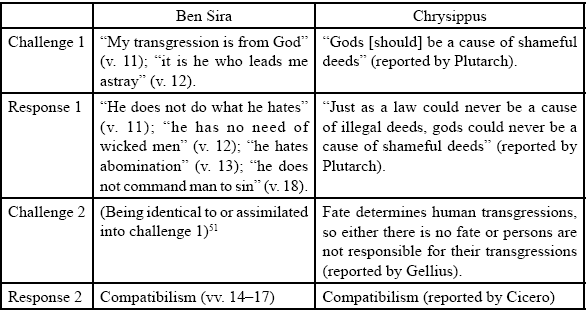
Now we turn to the question of Chrysippus’ potential influence on Ben Sira, by showing two similarities between Ben Sira and Chrysippus. First, Ben Sira’s argument against his opponents in Sir 15:11–13 and 18–20 resembles Chrysippus’ response to the first challenge from his own opponents. In this argument, Ben Sira emphasizes the benevolent nature of God in his response to the challenge of his opponents. According to the report of Plutarch, Chrysippus argues that the righteous gods cannot be the cause of unrighteous deeds. Therefore, both Ben Sira and Chrysippus oppose the view that God (gods) must be accountable for human sins, and both deny that the character of God (gods) supports such a view. Second, as I have also demonstrated (II.A, B), Ben Sira’s argument against his opponents in Sir 15:14–17 is a form of compatibilism, and Chrysippus’ response to the second challenge to him is also based on compatibilism. Thus, we get a picture of the two similarities between Ben Sira and Chrysippus on the free will problem, as Table 2 below shows.
Two Similarities between Ben Sira and Chrysippus

Simply put, both Ben Sira and Chrysippus respond to the view that persons are not responsible for their own transgressions because these evils are caused by external powers. Both Ben Sira and Chrysippus offer two responses to the problem of sin, one involving God’s nature and the other involving a form of compatibilism. As mentioned earlier, there was no Jewish discussion of the free will problem before Ben Sira. By contrast, the discussion of the free will problem had been popular in the Hellenistic world at the time of Ben Sira.Footnote 52 Thus, these two similarities suggest Chrysippus’s influence on Ben Sira.
B. Ben Sira’s Main Difference from Chrysippus
Ben Sira and Chrysippus base their versions of compatibilism on two different capacities in a person: to give assent or to freely choose. While Chrysippus emphasizes the role of a person’s assent in carrying out an action, Ben Sira concentrates on a person’s choice between alternatives. At first glance, assent resembles choice. However, a closer look will demonstrate that these two capacities can be distinguished from each other based on a crucial difference between two conceptions of free will. Since such a difference is clearly shown in the modern discussion of incompatibilism and compatibilism, I would like to sketch out this discussion before turning to Ben Sira and Chrysippus.
According to McKenna and Coates’s review of the modern theories of compatibilism, a convenient way to classify these theories is to identify the different arguments for incompatibilism. They note that two different understandings of free will have led to two classes of arguments for incompatibilism: the Classical Incompatibilist Argument and the Source Incompatibilist Argument. The Classical Incompatibilist Argument defines free will as freedom to choose between alternatives and is simplified in the following syllogism:Footnote 53
P1 If a person acts of her own free will, then she could have done otherwise.
P2 If determinism is true, no one can do otherwise than one actually does.
C Therefore, if determinism is true, no one acts of her own free will.
By contrast, the Source Incompatibilist Argument defines free will as involving the human source of an action and is simplified as follows:Footnote 54
P1 A person acts of her own free will only if she is its ultimate source.
P2 If determinism is true, no one is the ultimate source of her actions.
C Therefore, if determinism is true, no one acts of her own free will.
These two arguments result in two sets of compatibilism. First, one may agree that free will is the capacity to do otherwise but disagree that determinism threatens that capacity.Footnote 55 Second, one may assert that free will concerns the source of a person’s actions but deny that determinism makes a person impossible to be the source as such.Footnote 56
With these two conceptions of free will in mind, we can now turn to Chrysippus. His understanding of free will can be shown through a survey of the Stoic theories of causation and morality. The Stoic theory of causation denies that someone can do otherwise, and this idea is clearly described by Alexander of Aphrodisias: “they are relying on the argument that ‘if in the same circumstances someone will act sometimes in this way and sometimes in another, motion without a cause is introduced,’ and because of this they say that it is not possible for someone to do what is opposite to what he will do” (Alex. Fat. 185.7–11).Footnote 57 A similar denial of our capacity to do otherwise is seen in Stoic moral philosophy, as reported by Alexander:
If, they say, those things, of which we are also capable of the opposite, are in our power, and [if] it is to such cases that praise and blame, encouragements and discouragements, and punishments and rewards [apply], then to be prudent and to be virtuous are not in the power of those who have them, for they are no longer receiving the vices which are opposite to the virtues; and, similarly, vices are not in the power of those who are vicious. (Alex. Fat. 196.24–29)
According to A. A. Long and D. N. Sedley’s recapitulation of Stoic moral philosophy, “it would be absurd to suggest that what makes a bad man responsible for his misdeed is that he was at that moment capable of performing a good deed.”Footnote 58
The Stoic theory on causation can be traced back to Chrysippus.Footnote 59 He states, according to the report of Plutarch, that “no individual … can come to be otherwise (ἄλλως) than in accordance with common nature and in accordance with the reason (λόγον) of common nature” (Plut. Mor. 1050A).Footnote 60 As J. M. Rist points out, Chrysippus held that “it is no longer possible for what has become the case to cease to be so.”Footnote 61 The analogy of the cylinder clearly illustrates this idea of Chrysippus. The possibility that the cylinder could have not rolled down when being pushed is absent in Chrysippus’s analogy. As our common sense indicates, the cylinder could not have done otherwise than rolled down if it were pushed by a person. Chrysippus’s point is that, even if the cylinder must roll down, it is responsible for rolling because its round shape causes the movement. It might be argued that the cylinder could have not rolled down if it had another shape. Nevertheless, in that hypothetical case, the object that was pushed would no longer have been a cylinder. Therefore, it is reasonable to accept Wicke-Reuter’s following comment on this analogy: “however, it is hardly conceivable whether he really has freedom of action so that he could act differently than he actually does, if the external course of events is determined.”Footnote 62
We can approach Chrysippus’s understanding of free will and his version of compatibilism from the perspective of moral philosophy as well. According to Bobzien, there are two basic conceptions of moral responsibility. For the first one (MR1), the necessary condition for praising or blaming an agent of an action is that this agent should “be causally responsible for whether the action occurred.”Footnote 63 For the second (MR2), the necessary condition for moral praise or blame is that “the agent could have done otherwise.”Footnote 64 Bobzien’s distinction, which resembles that of McKenna and Coates, leads to the conclusion that “we have no reason to assume that Chrysippus, or his opponents, were involved in a debate about the compatibility of freedom to do otherwise and causal determinism.”Footnote 65
Thus, both Chrysippus’s theory of causation and his moral philosophy indicate that he understands free will not as a person’s capacity to do otherwise but rather as the source of a person’s action. Accordingly, his version of compatibilism looks like a response to an argument which resembles the Source Incompatibilist Argument.
Turning to Ben Sira, we discern a different conception of free will. Sir 15:14–17 states that a person can choose to obey the commandments and choose between life and death, or between fire and water. This statement suggests that Ben Sira understands free will as a person’s capacity to do otherwise rather than as the source of a person’s action. Accordingly, his version of compatibilism looks like a response to an argument which resembles the Classical Incompatibilist Argument.
All in all, the difference between Ben Sira and Chrysippus lies in their different understandings of free will. Such a difference is clearly shown in two types of incompatibilist arguments put forward by modern philosophers, and it distinguishes Ben Sira’s version of compatibilism from that of Chrysippus. Therefore, the main similarity and difference between Ben Sira and Chrysippus concerning the free will problem can be summarized in the chart below.
The Main Similarity and Difference between Ben Sira and Chrysippus

To put it simply, both Ben Sira and Chrysippus argue for compatibilism as a response to hard determinism. The position of compatibilism distinguishes Ben Sira and Chrysippus from other schools of their time, such as Skepticism and Epicureanism.Footnote 66 However, Ben Sira and Chrysippus diverge in their different understandings of free will required by moral responsibility, leading to two distinct versions of compatibilism.
Conclusion
As I have shown, regarding the free will problem Ben Sira and Chrysippus argue for two different versions of the same general theory of compatibilism. The similarities between these two writers indicate that Ben Sira’s discussion of the free will problem is possibly influenced by that of Chrysippus, and he may have accepted the latter’s position of compatibilism. At the same time, the difference between them demonstrates that Ben Sira puts forward a new form of compatibilism based on his distinct conception of free will which is found in the Hebrew Bible (Deut 11:26; 30:15). Ben Sira creatively applies his own tradition to the free will problem popularly discussed in the Hellenistic world and provides a new solution to it.