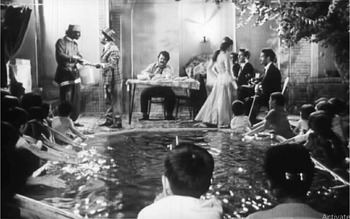
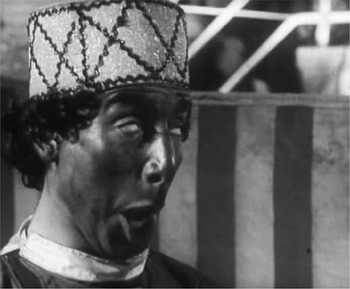
On its own, Iranian theatre actress and filmmaker Maryam Khakipour’s 2004 Sīyāh Bāzī: The Joymakers is a pathos‐saturated chronicle of the death of traditional Iranian theatre, a post‐revolutionary allegory of decline. The film opens with a scene from Parviz Osanlu’s 1972 Hasan Sīyāh (Hasan the Black) that exemplifies the specific kind of theatre the film will mourn: sīyāh bāzī (“black play”), the tradition of what will troublingly if inevitably translate into Persian “blackface.” In the Osanlu clip that initiates Khakipour’s documentary, young children gathered around a backyard pool (hawz) laugh heartily at the incoherent spectacle of a man in black makeup who contorts his face, lolls his eyes, and wags his tongue wildly. The metaphor coalesces swiftly and proudly: like a prosthetic, the sīyāh, or black, embodied by one of the tradition’s most famous actors, Saadi Afshar, exteriorizes the stolen joy of the Iranian people in The Joymakers. Though not plot‐based in the traditional sense, Khakipour’s documentary follows the troupe that performs in the Nasr, one of Tehran’s last remaining theatres in the once‐bustling but now defunct Lalehzar district, where news of the theatre’s impending demolition sounds sīyāh bāzī’s death knell.
Neither the style of its directing, nor its narrative, nor its cinematography distinguish The Joymakers from similar independent documentaries. But, when placed together with its 2008 sequel, Shadi (Joy; also the name of a female protagonist), the films provoke reflection on how various media translate and transfigure the enigmatically widespread tradition of blackface comedy, connecting it to the apparition of a global public and destabilizing the defensive fictions atomizing its origins. Shadi chronicles the same troupe’s travel from Tehran to Paris to perform sīyāh bāzī in 2006 for a French audience under the auspices of Ariane Mnouchkine, the prestigious stage director and founder of Théâtre du Soleil. As a series, The Joymakers and Shadi form an exemplary site for exploring the structure of a supposed distinction between racial and nonracial blackface that is also the epiphylogenetic translation of sīyāh bāzī into a global idiom and context — that is, a translation facilitated by technological means (Stiegler Reference Stiegler, Beardsworth and Collins1998).Footnote 1 The space between The Joymakers and Shadi marks the challenge of a resistant and demonic historicity that situates blackness both within and beyond time and space (McKittrick Reference McKittrick2006): “the life‐force of the world” through which human culture territorializes its own phantasmic boundaries (Brady Reference Brady2013).
Part I: The Joymakers
The Joymakers narrates the erosion of opportunity for a once‐thriving acting community through devolutions in Tehran’s Lalehzar theatre district. Once there were “four theatres, three cabarets, six cinemas, three bars,” a man explains to the camera, while an assenting anonymous group clusters around him on a street corner.Footnote 2 In the 1960s, cultural critics like Karim Emami lamented Lalehzar’s class degeneration. Originally a venue for “serious drama” under Nasir al‐Din Shah Qajar, the Nasr Theatre had devolved, as a result of Tehran’s expansion in the 20th century, into another “bawdy music hall” catering to the vulgar tastes of Lalehzar’s changed working‐class clientele (Emami Reference Emami and H˘ūrā2014). Today, complains the documentary informant, the theatres have yielded to shopping arcades and wholesale electric suppliers. Mutations in Tehran’s urban landscape, set afoot by the never mentioned Islamic Republic, drain the joy from the city and vaporize the affective forces binding Iranian civil society to public space. Like the traditional coffeehouses (qahvahkhānah), public baths (hammām), squares (maydān), and sports clubs (zūrkhānah), the Pahlavi‐era theatres and cabarets (kābarah) provided sites of homosocial bonding and informal or clandestine political discourse in the mid‐20th century; they also doubled, in the popular imagination, as diabolical spaces of corporeal transgression and sexual depravity, so powerfully portrayed in the commercial mode of prerevolutionary cinema, often disparagingly known as fīlmfārsī (Meftahi Reference Meftahi2016). In Khakipour’s documentary, anonymous street witnesses addressing an unspecified “you” mourn this corrosion of communal space, as images of morally loaded architectural decay affirm their apostrophic losses.Footnote 3 Shots of city dwellers assembled together voicing amorphous complaints synchronize with sīyāh bāzī skits inside the dilapidated Nasr and the troupe of actors gathered in dressing rooms addressing uncertain futures. In moments of reminiscence and contemplation, the gendered focus of the film sharpens, competing with the primary theme and object of The Joymakers: sīyāh bāzī.
As its name suggests, sīyāh bāzī focalizes a male character who has blackened his face with soot or vegetable fat and who improvises scenarios through saccadic self‐deprecation, vulgarity, and insolence toward his arbāb (master), hājī (representing the merchant class), or another figure of social rank, such as a sultan or court official, or even a grocer. Pidrām L’al Bakhsh calls this elemental dynamic a “slave relation” (ravābit‐i ghulāmī; 2016:49). Like Hājī Fīrūz, the ubiquitous blackfaced icon who appears during the Persian New Year, the sīyāh of sīyāh bāzī often wears red trousers, a red blouse, boots, and a red‐jeweled crown. “The red color of clothing might be due to the fact that African slaves are attracted to brighter colors,” Ardashīr Sālih’pūr writes (Reference Sālih’pūr2011:107), taking his cue from the writings of Jakob Polak, Nasir al‐Din Shah’s physician from 1855 to 1860; an equally specious explanation attributes the red to sun symbolism (Fāzāilī Reference Fāzāilī2009). Uncritical explanations for details like the sīyāh’s attire symptomize greater lacunae in the scholarship surrounding this theatre tradition. The lack of archival material documenting sīyāh bāzī’s history compounds the fact that, by definition, traditional improvisatory theatre is unscripted, transmitted orally — literally sīnah bi sīnah (chest‐to‐chest), allowing for myriad apocryphal conclusions, conjectures, and myths of origin (Azīzī Reference Azīzī2008:190–91). Moreover, even where such scripts or story synopses exist, peculiarly, they often exclude the sīyāh figure,Footnote 4 despite his intra‐ and extra‐diegetic centrality. Theatre troupes of the 20th century derived their prestige from their sīyāh pūsh — “the true [star]” (Breyley and Fatemi Reference Breyley and Fatemi2016:11) and rivalry over which troupe retains him fuels the plot for the fīlmfārsī from which Khakipour repurposes epigraphic footage for both of her films.
Mired in the absurdity of context, pestering ( pakarī), sweet‐talking (shīrīn sukhanī), sight gags (shākhah bi shākhah parīdan), repetition, and distorted Persian speech (Fathalī Baygī Reference Fathalī Baygī and Taqiyān1995, Reference Fathalī Baygī1999; Āzhand Reference Āzhand1993), commentators overwhelmingly argue that the sīyāh’s rebellious prowess overshadows his subservience, thus disavowing the deprecatory image of Black people — and inevitably, Black IraniansFootnote 5 — that sīyāh bāzī produces, while enshrining the sīyāh as a primordial, vernacular figure of the political. Khakipour’s explicit pronouncements about sīyāh bāzī in an interview recirculate mainstream warnings about a misunderstanding that would arise through a contamination of perspective: “it’s very difficult to explain for the American society,” she tells an interlocutor, who worries about a Western audience’s reception of sīyāh bāzī. “[…T]here is no relationship between this theatre and the racial prejudice we know in the West” (Reference Khakipour2010). Thus, Khakipour’s recurring and typical analogy between sīyāh bāzī and commedia dell’arte defends against what she and many others identify and understand, albeit simplistically, as the unambiguously racist North American version of blackface. Above all, sīyāh bāzī is not to be misread as the kind of racialized blackface minstrelsy one might observe in the 19th‐century US, for the “sīyāh is the most lovable character in the group […,] a delegate of truth,” giving voice to the deepest political unconscious of the Iranian populace: “He is the voice of the oppressed and expresses their deepest emotion, their discontent with life, and their fear and hopes for the future” (Haery Reference Haery1982:72). Two underlying intentions animate sīyāh bāzī: to create joy and reflect civil society’s discontents (Anṣārī Reference Anṣārī2008:45); theatre is “bite and protest [namāyish nīsh va intiqād ast]” (Nasīrīyān Reference Nasīrīyān1978:24). It is clear from the ubiquity of the comparative logic that those who disavow sīyāh bāzī’s relation to US American blackface know very little about the latter. For example, the recurring emphasis on the sīyāh’s lovability and his political dimension betrays an ignorance of the complexity of US American blackface minstrelsy history. For, like the sīyāh, blackface minstrels, too, were “beloved” by North American audiences.
More positively, comparisons between the sīyāh of sīyāh bāzī and the black‐masked Harlequin of commedia dell’arte recur in Persian discourse on sīyāh bāzī. The masked Harlequin may himself originate in or converge with the image of a Black slave (Vaughan Reference Vaughan2005); commedia dell’arte’s origins are as equally opaque as sīyāh bāzī’s, perhaps even borrowing from the Persian tradition. These are possibilities that recourse to an Italian — European, thus, “civilized,” but also non–North American — culture and tradition appear to abort. In a recent volume, Erith Jaffe‐Berg situates commedia dell’arte within its larger Mediterranean context and “challenges the tendency to see [it] as a distinctive Italian art form rather than considering the ways in which commedia was itself possibly influenced by performance traditions coming from Asia and the Middle East” (Reference Jaffe-Berg2015:14). Speculating on Persian influences on ancient Greek theatre, Aleksander Chodz´ko wondered about the etymological connection between farce and Fars (in Sattārī Reference Sattārī2000:141), deepening the breadth of Persian influence on Western theatre. Italian scholarship on commedia dell’arte’s “labyrinthine” origins, in classical studies by Vito Pandolfi (Reference Pandolfi1957) and Roberto Tessari (Reference Tessari1981) shares sīyāh bāzī’s insecure, or “antiofficial” historicization (Green and Swan Reference Green and Swan1993:1), and reflects the difficulty of cleanly linearizing the development of improvisatory theatre: “The pedigree of the Harlequin resembles an ancient tree with long, straggling roots and many branches intertwined” (Beaumont Reference Beaumont1967:25). With some recent exceptions, most of the scholarship on commedia dell’arte has not been translated from Italian into English. Yet where it has, the genre’s debt to deep, “irretrievable” mythology precludes pretension to positivist historical light (Vianello Reference Vianello, Balme, Vescovo and Vianello2018).
While no commentator claims to know sīyāh bāzī’s origin with absolute certainty, the tension created by a radical divergence of opinions reflects the desire for and significance of such origin. Commentators oscillate between dating sīyāh bāzī’s emergence back to the Sumerian (4500–1900 BCE) (Bahār Reference Bahār and Mazdāpūr1996); Achaemenid (550–330 BCE) (Fāzāilī Reference Fāzāilī2009); Sassanian (224–651 CE) (Razī Reference Razī1979); Safavid (1502–1736 CE); and even Qajar (1789–1925 CE) periods; or building fragmented hypotheses that purl through predocumentary history and culminate during the Safavid era, when the art achieves its most “complete shape” (Anṣārī Reference Anṣārī2008). Improvisatory theatre originated prior to Islam, writes Mahmoud Haery, and “after the Arab invasion, [was] abandoned for many centuries until reanimation in the Safavid period” (1982:20). Farrokh Ghaffary generalizes that sīyāh bāzī’s roots were in the courtly performances of jesters in pre‐Islamic times, but admits to sharing the same kind of doubt about the truth of its origins that was characteristic of most descriptions: the sīyāh’s “date of appearance is unknown” (Ghaffary Reference Gaffary1984:372). Commentators on the practice of sīyāh bāzī can only agree upon the unlikelihood of delineating its precise origins, yet clashing more or less consistently, and often contradictorily, on the question of sīyāh bāzī’s relationship to slavery, despite the obvious and consistent intradiegetic references to the sīyāh’s slave position, most clearly conveyed through dialogue and his distorted Persian speech, but also indicated by his various names: “Mubarak,” “Almas,” “Yaqut,” “Qanbar” — as L’al Bakhsh suggests, all traditionally slave names (2016). (In some versions, the sīyāh appears as the slave of an Egyptian or Arab merchant, and instead of a crown wears a fez.) In a study of improvisatory Persian theatre, Muhammad Bāqir Anṣārī gives equal weight to completely disparate myths of origin: Bahrām Bāyzāī’s hypothesis about a South Asian origin (discussed below), and Ali Nasīrīyān’s suggestion that sīyāh bāzī approximates a kind of ethnography of Black slaves owned by sultans and stationed at the courtFootnote 6 .
Iranian nationalists favor a popular, even hegemonic, if warped explanation for the practice that palliates sīyāh bāzī’s relation to slavery and connects it to the ancient Mesopotamian ritual of Tammuz, or Dumuzi — from the myth of a shepherd who becomes king through marriage with the goddess Inanna. The linguist Mihrdād Bahār (Reference Bahār1995, Reference Bahār and Mazdāpūr1996) drew a correlation between the popular blackface icon Hājī Fīrūz and the Sumerian practice of women blackening their faces in mourning for Dumuzi at an annual festival. Bahār articulated this connection through an intermediate speculation about the Iranian ritual of Sīyāvashūn, which he suggested also shared roots in this Sumerian ritual. But, as the literature on commedia dell’arte and blackface minstrelsy both show, other correlations to mythological and divine figures can easily be forged and mooted. The blackened face or mask, often associated with the devil or fool in early modern European theatres, absorbs a divine and spiritual signification in many South Asian blackface practices, like the Saivan cults of Lakulīs´a and the figure of Semar in Javanese shadow play.Footnote 7
Because of sīyāh’s popularity as a folk practice, contemporary Iranians share stakes in its lineage. Avowing any antiblackness inherent in sīyāh bāzī not only despoils a beloved tradition; it simultaneously fathoms a version of Iranian culture that many Iranians, understandably, wish neither to endorse nor recognize.Footnote 8 Avowing any antiblackness inherent in sīyāh bāzī also allows for Euro‐American intrusions: the very concept of race and the phenomenon of antiblack racism. This anxious formulation so deeply permeates Iranian popular discourse on sīyāh bāzī, spreading across the range of social media from YouTube comments to attacks on scholars in online platforms, that it is not surprising to see the same framework mirrored in academic discourse. Just as the concept of race did not develop or unfold in Iranian history but rather in 18th‐century Germany, and just as the form of African slavery in Iran differed from African slavery in the New World, the concept of racial blackness does not exist in Iranian culture. Thus runs a simplistic and positivist logic about the history of race and slavery that overwhelmingly dictates the historicist frame of its study. Only a “contaminated” perspective could perceive things otherwise, as Khakipour’s comments suggest.
Film still from Shadi (2008). The troupe performs at the Théâtre du Soleil to warm audience reception. (Screenshot courtesy of Parisa Vaziri)

This is also the logic that seals off the world of The Joymakers, a world in which the death of sīyāh bāzī is univocally and irrefutably tragic and colored by a communal sense of nostalgia for prerevolutionary Iran. Afshar’s sympathetic portrait crystallizes this sentiment. Opportune shots picture him seated cross‐legged with a bowl of watermelon in his living room; he recites aphoristic Sufi poetry, or banters with his defiant, camera‐shy wife, who refuses him tea. Such sequences interpose more emotional scenes in the Nasr Theatre back rooms, such as one featuring Leila who fears that at 55 she has nowhere to go and will not be able to find a job once the Nasr Theatre closes down, as the government has warned. No longer able to act, Leila works as a tea server at the theatre. “We love this ruin [kharābih]. Don’t let them take this ruin away from us.” Another actress intervenes: “We don’t have any more Saadi Afshars. There’s just this one. We don’t have any black players who are Saadi Afshar. This is a reality!” Afshar responds. “I’m a man in my 70s. Say I want to train a sīyāh. I see it’s not in his blood!” He draws out the end of the sentence and leans forward for emphasis, while a few others offer vocal affirmations. The sīyāh has to be “an iventor.” The scene evokes an almost parodic example of this same nostalgia from a film made nearly 40 years earlier. In Reza Safāī’s fīlmfārsī Rāmishgar (Minstrel, 1976), a dastah, or troupe, invites a new sīyāh performer into their group. During the scene of his initiation, the sīyāh’s trainer begins to tear up as another troupe member toasts the trainer’s achievement — his “chivalry [lūtīgarī ] and humanity [insānīyat]” (MrMahdihadi [1976] 2013). The cloying extradiegetic music crescendos over the speech, as a slow shot/reverse shot sequence frames close‐ups of the trainer and the sīyāh’s hyperbolic tears of mutual affection.
As in Rāmishgar, Afshar’s troupe members show him exaggerated esteem, reminding each other, and the documentary’s audience, that Peter Brook once kissed Afshar’s hand after watching him perform, and questioning their fellow countrymen who would demean the troupe as mere mutrib. The derogatory “mutrib” label alludes to the theatre actors’ humble class position, a frictive theme that thickens the pathos surrounding sīyāh bāzī.Footnote 9 As Ida Meftahi has shown, Marxian‐inspired discourse in the 1930s exacerbated a class antagonism ensconced in the early Pahlavi‐era modernist arts scene, which denigrated improvisatory theatre associated with popular culture (2016). Street performance like taghlīd (a generalized term for improvisatory theatre) eventually was to the more serious, politically committed theatre scene what vulgar (mubtazal) fīlmfārsī would later become to the elite world of Iranian New Wave cinema. The distinction between high and low art is reflected in the localization of sīyāh bāzī in lower‐class cafés, and The Joymakers reflects the legacy of this distinction. Working‐class men amble through the Nasr lobby, as a promoter offers two‐for‐one showings. “With all its filth, I prefer this to the city theatre,” Shadi confesses to the camera. “I feel more comfortable both with the actors and with the audience here. They show themselves just as they are.” Empathic affection for the working‐class performers and audiences, who are spurned by their elite theatre counterparts, seems to cancel out any doubt about the value and meaning of what it is precisely that their survival preserves.
This private and secure microcosm of nostalgia expires unceremoniously in The Joymakers, only to reemerge and implode in the film’s sequel, Shadi. Inspired after seeing Khakipour’s original documentary, Mnouchkine invited the troupe to Paris to perform at her theatre, providing Khakipour with new narrative material for a second film. But sīyāh bāzī, Shadi reveals, does not translate easily into a French idiom. In the tense and paranoiac exchanges that ensue between the French theatre director and the Iranian troupe in Khakipour’s sequel, sīyāh bāzī’s quaint wit seems to devolve into insipid gaucherie. Both sīyāh bāzī’s transmedial shift into film and the Nasr Theatre troupe’s physical move to the French metropole illuminate the challenge of “context” in relation to sīyāh bāzī. The movement across geographical borders and the translation across media appear to dissolve sīyāh bāzī’s historical contexts in unique but parallel ways, while at the same time exposing the very impossibility of context as univocal, fully knowable, and secure.
Impending discord manifests in the first scenes of Shadi through the troupe’s anxiety about the trip. As they gather in a teahouse someone worries about news of Parisian riots, while another actor wants to ask Khakipour if they are allowed to bring nuts with them on the trip. Shadi has to convince her reluctant husband, Abbas, to grant her official permission to leave the country as she navigates congested one‐way streets; the interaction is recorded, Kiarostami‐style, from the back seat of their car. Abbas finally consents, on one condition: that Shadi “remain the same” in Paris, and that she “remain an Iranian,” a statement that agitates Shadi. “You are going there as a symbol, a role model, do you understand what I’m saying?” Abbas continues, alluding to the French ban on the veil, and insinuating that when he says “remain an Iranian” and “going there as a symbol,” he means retaining hejab.
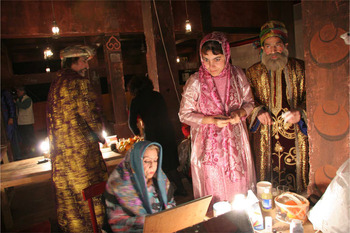
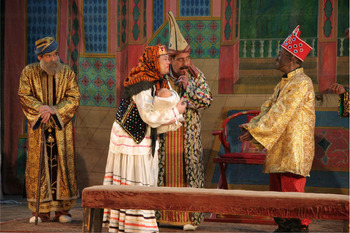
The sīyāh bāzī troupe from Tehran in 2006, backstage at Théâtre du Soleil. (Photo by Behnam Monadizadeh)

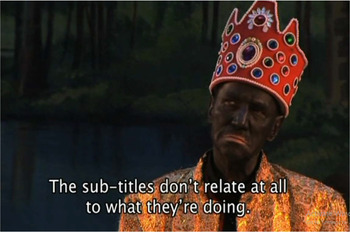
Khakipour’s focus on Shadi through the remainder of the film suggests how difficult it is to “remain the same” in Paris. (To the consternation of her fellow troupers, Shadi will in fact remove her veil, exchanging it for colorful berets, winter hats, and large hoop earrings.) But, despite the filmmaker’s obvious focus — the title of her sequel could not spell it out more clearly — and despite the specificity of his conditions, the true difficulty of Abbas’s request concerns the entire troupe, rather than Shadi individually. More importantly, his directives have less to do with the familiar trope of the female body as national symbol, than with the complicated blackness of the sīyāh. That is, the problem of “remain[ing] the same” in Paris as in Tehran concerns the inevitable translation of racially uninflected sīyāh bāzī into the execration of blackface. During an initial rehearsal, Mnouchkine dramatically interrupts the group. “Je ne comprends rien,” she announces, lowering weight on “rien”: I understand nothing. It’s worth taking a few moments, she announces with her measured, articulate French — allowing Khakipour time to translate her words for the troupe — how are we going to make the French audience understand: “comment va‐faire que le publique Francais comprenne.” The subjunctive syncs with a medium shot of Afshar on the stage. He wears a bright gold embroidered coat and red crown studded with round, multicolored jewels. His mouth forms a distinct frown that is emphasized because his pale lips, uncolored, contrast so starkly with his darkly blackened face (fig. 3).
Mnouchkine repeats her concern and approaches the stage, as the troupe watches her in confusion. “There are two dangers here,” she gravely informs them. “The first is that the French audience understands nothing. This would be a catastrophe.” The director chosen to lead the troupe does not understand Mnouchkine’s concern, informing her that when the troupe performed at Peter Brook’s Paris theatre (Bouffes du Nord) it was without subtitles. Khakipour translates his response. “C’est leur spectacle” (It’s their show). Mnouchkine concedes in frustration, releasing her own responsibility for bringing this spectacle to Paris. “C’est leur risque” (It’s their risk). As the troupe members’ despondent confusion suggests, Mnouchkine’s sudden aggravation at this rehearsal has no clear prompt. Rather, it seems to reveal an affective recognition of a danger she never directly states, perhaps aware of the impossibility of its communication: for how could a French audience fail to see in sīyāh bāzī anything but blackface? The real, unspeakable danger is thus not that the French audience will understand nothing, but that they will understand much better than the joymakers themselves the ugly essence of sīyāh bāzī.
Film still from Maryam Khakipour’s Shadi (2008). Saadi Afshar listens to Ariane Mnouchkine, who recommends subtitles to the troupe. (Screenshot courtesy of Parisa Vaziri)

Mnouchkine’s outburst communicates the global, universal familiarity of blackface, even if her recognition misses the political undertones, or overtones, that are so significant for Persian commentators and audiences, and what, according to their sensibilities — if myopically — makes sīyāh bāzī the exception to analogous, and potentially related, genres of racial caricature. When Mnouchkine confronts the Nasr group a second time in the Théâtre du Soleil communal kitchen, it is for a different reason. She has been accused of sabotage, she announces in agitation, which has made her “très en colère” (very angry). Mnouchkine has heard rumors that the sīyāh bāzī director, Saleh Panahi, suspects her of intentionally mistranslating the play’s subtitles, ensuring the failure of their performance; Mnouchkine feels “dishonored” by the accusations. One of many tense interactions between the French theatre director and the Nasr acting troupe, this scene, like Mnouchkine’s outburst at the troupe’s first rehearsal, makes a parody out of her liberal sensibilities: French Islamophilia or Persophilia not only fails as an antidote to Islamophobia, but invigorates unforeseen tensions. Having invited a Persian acting troupe to her world‐renowned theatre, no doubt as a gesture of philanthropic, cosmopolitan embrace, Mnouchkine is humiliated by sīyāh bāzī’s cultural untranslatability and irrepressible racial evocations.
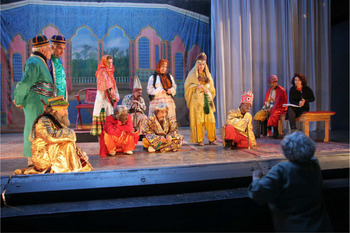
The sīyāh bāzī troupe from Tehran onstage at Théâtre du Soleil in 2006, listening to Ariane Mnouchkine during rehearsal. (Photo by Behnam Monadizadeh)

Mnouchkine’s paranoia expresses anxiety over the foreignness and dissonance of sīyāh bāzī once it is removed from its original context and simulated by the Nasr Theatre troupe’s performance when transposed from Tehran to Paris. This incongruity, in a different way, is expressed in the transition of sīyāh bāzī from a theatre practice into a cinematic trope, as thematized by Khakipour’s twin epigraphic citations of the form in both her films. Sīyāh bāzī’s new circulation in Iran after the invention of cinema did not contradict but rather extended its history of mobility. As Bahrām Bāyzāī suggested in a foundational and frequently cited text on the history of Iranian theatre, sīyāh bāzī’s origins lie in the scattering of indigenous peoples in the Indian subcontinent (kowlī) throughout the Iranian plateau before and after Islam (Reference Bāyzāī2000:184). In the Shahnameh, the poet Firdawsī (940–1019/1025 CE) describes a related anecdote: the Sasanian king Bahram Gur asked the Indian King for singers and dancers, and “received 4,000 gypsies in response” (in Mathee and Baron Reference Mathee and Baron2000). As Rudi Mathee and Beth Baron (Reference Mathee and Baron2000) point out, in Persian literature Indian kowlī men are commonly presented as professional musicians and kowlī women as entertainers. Despite his insistence on the correlation, Bāyzāī does not explain why the South Asian kowlī, to whom the author traces the figure of the sīyāh, needed to exaggerate his already dark skin with black smoke or ash to create comedic effect, or why the inherent comedy of blackness should appear self‐evident.
Part II: Filmic Sīyāh Bāzī
Cinema extends a history of making images portable. From site‐specific frescoes to book illuminations and Renaissance oil paintings, this history is also one of shifting scale and perspective (Elsaesser Reference Elsaesser2016). At first glance, the transubstantiation of sīyāh bāzī appears to articulate a teleology of ever‐increasing mobility: from vagrant but stationary theatre performed on portable wooden stages (rūhawzī, or takht‐i hawzī; on the plank)Footnote 10 during the Safavid era, to its entry into theatre halls (tamāshawkhānah) as entr’acts ( pīsh pardah) during the Qajar period (Nasīrīyān Reference Nasīrīyān1978), to its induction into local kafah (café) culture under the Pahlavi regime in the 1930s, to its inscription onto celluloid in 1950s fīlmfārsī, to stylized television programming in the 1970s and ’80s, and then to the digital images of the 21st century. Black‐and‐white footage of Hasan Sīyāh opens both The Joymakers and Shadi. The rūhawzī scene in which Ardavan Mofid entertains a group of children syncs to the sound of film coiling through projector reels, as if to indicate a temporal shift in the documentary — digital back to analog. Vertical scratches slightly disfigure the preserved film stock, further eliciting a temporal density in Hasan Sīyāh that is conveyed through poor resolution and opaque images. Like the digital glitch effect, damaged celluloid draws attention to its obsolescent materiality and mirrors the precarious, unscripted, and undocumented artifactuality of sīyāh bāzī — a sense of “agedness” that exceeds historicization or historical specificity and reflects its myriad spurious origin stories. Degraded stock also allegorizes the dense impurity at the heart of visuality. Crisp images cannot guarantee the object’s integrity; neither can one count on a logical hierarchy to characterize scales of resolution.
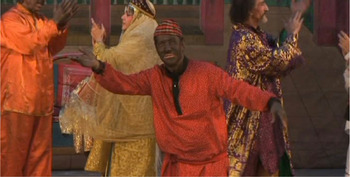
Film still from a clip of the prerevolutionary film Hasan Sīyāh (1972), which opens Maryam Khakipour’s The Joymakers (2004). (Screenshot courtesy of Parisa Vaziri)

The embedded footage alludes specifically to two earlier moments in sīyāh bāzī’s transmedial genealogy: its performances on backyard wooden stages and in the Iranian commercial cinema known as fīlmfārsī. These two moments’ truths become mutually entangled through the synchronized reel track. Even while noting this potent transmission from rūhawzī to film, commentators rarely draw out any theoretical implications, treating the movement from context‐specific sīyāh bāzī to film as a mere chronological event — ignoring how the shift recursively affects the meaning of the practice and creates epistemological tension.Footnote 11 This neglect can only partly be explained by the derogatory view of fīlmfārsī, which has resulted in its being erased from Anglophone Iranian film scholarship, despite fīlmfārsī’s significance in Iran’s 20th‐century domestic film industry in relation to the nation’s statistically marginal but internationally championed art cinema.Footnote 12 Rather, the unthought transmediality of sīyāh bāzī seems to do with the inheritance of a literary approach to studying media that privileges narrative and content over cinema’s formal capacities. By transforming the borders and conditions of its reception, the movement of sīyāh bāzī onto cinema and later television screens demands a rethinking of the critical role played by the interaction between performers and changing audiences for the production of its meaning, as well as sīyāh bāzī’s relationship to American blackface minstrelsy, whose medium and structures of circulation it now shares.
Close up of Ardavan Mofid acting as the sıyāh in Hasan Sıyāh. (Screenshot courtesy of Parisa Vaziri)

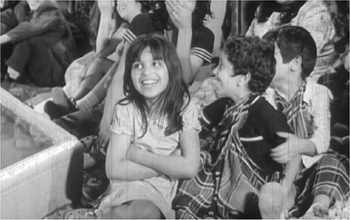
Sīyāh bāzī’s humor exhumes a peculiar intimacy and power dissymmetry between the blackface figure and the audience. “All the audience members see themselves in the sīyāh,” one actor reports to the viewers of The Joymakers, after an onstage scene in which he, playing the sīyāh, climbs onto a throne with his back to the audience, shakes his hips, sits, and makes arbitrary commands. “No wonder whoever comes up here never wants to come back down,” he announces in creaking Persian. It is only because the sīyāh represents the lowest possible stratum of society that his pleonastic and outrageous insolence (bī‐hayāyī), often centering around sexual taboos, elicits humor. When asked to address Gulsāna (a woman, played by Shadi), the sīyāh loudly calls her khul nana (idiot mama). Glottal scrapes contribute to the absurdity produced by confused consonants. Low social rank and improper Persian, suggests anthropologist William O. Beeman, explain why children, “the most restricted members of society” (Beeman Reference Beeman, Bonine and Keddie1981a:524) particularly relish sīyāh bāzī performance. Beatific young faces temper the violence of sīyāh bāzī’s laughter in the Osanlu clip. In the rural celebrations Beeman attended during the 1970s, two or three men worked full‐time to keep the children who were in the first rows of spectators from inching too close to the performers (Reference Beeman1981b:375).
As a stock character foil to the penurious, dyspeptic, and falsely pious haji — who stuffs a pillow under his shirt to symbolize greed (Gharībpūr Reference Gharībpūr2005), the sīyāh is not only affable, but adorable: “Contrasting with his dark and sombre face is a luminous heart” (Haery Reference Haery1982:72). And yet to celebrate his charm without examining its source is to do so in bad faith. His actions lack consequences because the sīyāh is, like a lovable pet, beyond social rank and therefore innocent of the anathematizing judgments of the social world for which his presence offers respite. The “immersion into blackness,” writes Lewis Gordon, is “the desire to be protected from human beings” (Reference Gordon1995:118). The disavowed source of the sīyāh’s wretched station is conveyed through his blackness, but his blackness is dynamic and multisensory — not only epidermal, but visceral, verbal, aural, gestural, affective. Indeed, his cosmetic and cosmic blackness does not belong to, on, or in the body, but draws the body toward its outermost limits, to a space that is both beyond the body and beyond the world. Broken black speech, a pervasive feature of racial caricatures, renders black as unassimilable. Aphetic language, nonsequiturs, solecisms, and malapropisms ensure the “joke” of black communicative rationality (Warren Reference Warren2018).Footnote 13 Unable to pronounce Persian syllables properly, the sīyāh missounds “s” for the letter shīn (sh), and the sound “l” for re (r) (Gharībpūr Reference Gharībpūr2005); “[he] breaches all of the rules and principles of words, grammar and pronunciation in the Farsi [sic] language,” transforming innocent phrases into ribald commentary, and metamorphosing the audience’s “smiles into loud laughter” (Isaloo Reference Isaloo2017:74). Black subversion of communication is thus the condition of ludic pleasure in sīyāh bāzī, but also requires intimate knowledge of the Persian language and its idiomatic structures as inherent to its success. (In the absence of access to this basic element of sīyāh bāzī’s comedy, Mnouchkine encounters profound discomfort.)
If language is the basis upon which reality materializes as meaningful and organized for its speakers, mutilated grammar lampoons the security of propriety and proper delivery. No wonder that theorists of laughter, in the absence of any physiological justification, see it as the exhalation of accumulated tension and an index of the fundamentally schismatic nature of humanness (Baudelaire [1868] Reference Baudelaire2015). Anthropologists understand the prevalence of sīyāh bāzī at occasions of high tension, such as weddings, as a necessary relief from pressured social performances predicated on codified and internalized hierarchies (Beeman Reference Beeman1981b). But because sensual registers converge in cinema, this ruined speech and general vehicle of comedy is layered by other mechanisms — frame movement, angle, depth of field. More specifically, perspective and point‐of‐view shots highlight and further disfigure meaning even as the source of perspective effaces its own constitution. In both televised broadcasting of sīyāh bāzī in the 1970s and the cinematic forms that appeared earlier in fīlmfārsī, point‐of‐view shots shuttle back and forth between a perspective from which the sīyāh is seen, and one from which the audience can be seen looking and enjoying his performance, suggesting a dislocation and revitalization of the comedic object that renews emphasis on projection — the audience’s implication in the production of humor.
Children laughing at the sīyāh bāzī spectacle in Hasan sīyāh. (Screenshot courtesy of Parisa Vaziri)

As if replicating its epigraphic citation — Hasan Sīyāh’s sīyāh bāzī — The Joymakers adapts this stratagem of pairing and proliferating viewpoints. In the clip of Hasan Sīyāh, shots alternate between the spectacle of Ardavan Mofid’s havoc and children who watch and laugh along the sides of the pool. In the spectacle, Mofid, the sīyāh, refuses through gesture and circumvention to comply with a café owner’s orders to leave his makeshift restaurant. In defiance, the sīyāh pours and rubs a bowl of white milky fluid on a café customer’s head. A medium close‐up of a group of giggling children who mime his actions then substitutes and supplements the spectacle. The camera’s shifting points of view “complete” the sense of sīyāh bāzī — whose most important dimension lies less in the intradiegetic plane of events between actors than in the relation of desire actualized through the audience‐sīyāh dynamic. The Hasan Sīyāh clip is “embedded” in The Joymakers. Later in the film, candid interview sequences intercut overhead shots of sīyāh bāzī in action on the Nasr Theatre stage and shots of individual audience members — this time, adults — roaring with laughter.
By virtue of its formal possibilities, filmic sīyāh bāzī describes a shift in the ontology of sīyāh bāzī. In the rehearsal at the Théâtre du Soleil, a seemingly untranslatable moment unleashes a semiotic antiblackness that surfaces as tension, confused but explosive affect, rather than as lucid meaning. Mnouchkine never once explicitly suggests a problem with the very essence of sīyāh bāzī. Perhaps, from her position, she cannot suggest, or even truly see the source of what moves her to frustration. Like the theatre rehearsal in Paris, filmic sīyāh bāzī exposes an inner dimension of sīyāh bāzī that is revealed, on the one hand, by the very mobility of the medium of film and the possibilities of dissemination it enables. On the other hand, the inclusion of the spectacle within the film suggests that the sīyāh now performs for two connected audiences — two viewers: the diegetic spectator and the extradiegetic spectator who watches the spectators watching. In the theatre rehearsal, cultural friction sparks an untapped insight into an internal “offness.” In film, doubled spectatorship embeds reflexivity within a new medium. But just as Mnouchkine’s inarticulable malaise goes nowhere and changes nothing, film’s embedded reflexivity does not necessarily lead to new realizations.
Film also returns sīyāh bāzī to the original essence that commentators so boldly insist makes sīyāh bāzī unlike other forms of blackface minstrelsy: the paramount audience‐performer dynamic is a modular, political relation. Hence, the prevalence of the aside in sīyāh bāzī, in which characters momentarily but frequently step outside of their roles (Nasīrīyān Reference Nasīrīyān1978:24). This articulation heightens the exceptionalism that commentators of sīyāh bāzī consistently prize at the expense of attempts to understand the centrality of blackness to sīyāh bāzī’s valued politicism. Exceptionalism disregards the universally political function of blackface minstrelsy in the emergence of global public spheres. In bringing together multiple, discordant frames of reference through mangled speech, sīyāh bāzī activates schismogenesis, laughter; and by revealing the human to be fundamentally nonidentical to itself, blackface breaks with the illusion of one real world. By virtue of form, filmic sīyāh bāzī centralizes and thematizes this previously latent discordance of the frame.
Scholarship on blackface minstrelsy has long noted the political character of this tradition and connected it to the growth of American democratic culture, a vernacular form of producing national identity that “[slashes] back at the pretensions and politesse of authority” (Lhamon Reference Lhamon1998:44). W.T. Lhamon describes the “moiling” proletarian attraction to blackface as a method of defiance and alchemical community‐building — “Abstracting themselves as blacks,” immigrant groups came together under the semaphore of blackness in 19th‐century North America (44). Eventual entrepreneurial control over youth‐driven grassroots minstrelsy evaporated its inherent political critique of the merchant class in the US just as Pahlavi‐era censorship muted the politicism of sīyāh bāzī as it moved from itinerant improvisation to the screen. Unlike the Safavid and Qajar kings who patronized minstrelsy, understanding clowning (dalghak) as a source, if not the only source, of communication between the populace and the royal court (Anṣārī Reference Anṣārī2008; Nūrbakhsh Reference Nūrbakhsh1976; Martin Reference Martin2007), Reza Shah’s authoritarian censorship dissolved the critiques embedded in sīyāh bāzī. Identification and dissociation can coexist (Lhamon Reference Lhamon1998; Jones Reference Jones2014), and a vehicle of liberation can function simultaneously as a tool of racial subjection (Hartman Reference Hartman1997), just as marginalized groups’ participation in blackface does not prove its innocuousness (Valle Reference Valle2019). The resonances between regional traditions exceeds analogy. The more diachronically and comparatively oriented iterations of scholarship situates blackface minstrelsy within a historical tradition that includes Elizabethan theatre, English folk festivals, Dutch farce, and the ubiquitously influential commedia dell’arte (Rehin Reference Rehin1975). The reemergent Mediterranean common ground of sīyāh bāzī and the more familiar North American blackface minstrelsy is thus worth closer consideration and attests to the cross‐civilizational exchanges of the 1500s (Subrahmanyam Reference Subrahmanyam1997). Robert Hornback suggests Old World theatrical mockery of black dialect “emerged first on the Iberian Peninsula before extending to England by the end of the sixteenth century” (Reference Hornback2018:143), echoing scholarship that suggests that the tradition of blackface comedy moved East to West, and not the other way around. It is not inconceivable to imagine Persian sīyāh bāzī as the source of Western forms of blackface minstrelsy, including its maligned American version that Persian commentators hold at a far distance.Footnote 14
So long as one does not take seriously the political exceptionalism that Iranian commentators emphasize, the antique and medieval contacts between sīyāh bāzī, commedia dell’arte, and European and North American minstrelsy may seem like a pile of merely amusing, unverifiable historical details. And yet, the apocryphal historical origins and chronological narratives presented by Iranian commentators all share a common morphology that it is worth attending to: the culmination of sīyāh bāzī during the Safavid period. This ubiquitous observation suggests a synchronic development, a common force propelling sīyāh bāzī into its most “complete” (kāmil) shape (Anṣārī Reference Anṣārī2008:44), and the simultaneous eruption of the performative tradition known as Muharram (including ta’ziyeh theatre) into an officiated public ritual. In a work that chronicles dramatic shifts in state‐society relations under Shah Abbas I (1571–1629 CE), Babak Rahimi identifies the inception of an early modern public sphere and the “crystallization of distinct social spaces” in 17th‐century Safavid Iran (Reference Rahimi2012:13). For Rahimi, increasing Safavid sponsorship of Shi’a mourning rituals like Muharram and the proliferation of ceremonial sites created a distinctly Persian “theatre state,” which both affirmed a permanent religio‐national identity and authority transcending individual life as it produced possibilities for carnivalization and misrule. The growth of festive additions to the Muharram mourning rituals (fireworks, spectacularized and orchestrated self‐flagellation — not featured in documentations of earlier iterations) corresponded to Safavid economic growth, symbolically enshrined by Isfahan’s 1598 designation as the new capital of Iran, Isfahan nisf‐i jahān (Isfahan, Half of the World).
In commentary, sīyāh bāzī is often taken to be synonymous with performative traditions that are also thought to have developed alongside rawzah khānī (garden recitations), which are narrations of the life, deeds, and suffering of Shi’ite martyrs (Nīkfām Reference Nīkfām2005; Isaloo Reference Isaloo2017). In his work on the Muharram rituals, Peter Chelkowski saw ta’ziyeh as an outgrowth of more stationary garden traditions of religious recitation and the mobile commemorations reliving the events of Karbala on wheeled platforms, horses, and camels and through living tableaux of martyrs — a sort of “compromise between the moving procession and the stationary recitation […] staged at street intersections and squares” (Reference Chelkowski1979:4). Indeed, nonreligious and religious theatre developed simultaneously in Safavid Iran (Haery Reference Haery1982:17). If the Safavid project entailed nothing less than the spiritual consolidation of Persian national identity, as classical scholarship devoted to the period suggests (Arjomand Reference Arjomand1984; Savory Reference Savory1980) and as more recent scholarship on its construction of political theatricality affirms (Rahimi Reference Rahimi2012), then sīyāh bāzī, like the Muharram rituals, evolved in the crucible of Persianization. There is then, a deeply sedimented intimacy between the sīyāh figure — “the spokesman of the people” — and Persianness itself. If comedy “helps us test or figure out what it means to say ‘us,’” then its foundational status in the development of civil society is unsurprising (Berlant and Ngai Reference Berlant and Ngai2017:235). Sīyāh bāzī yields a collective pronoun and gestures toward forms of intersubjectivity whose genesis depends on a prosthetic and excluded blackness that bears the terror of the “we” and manifests as its condition of possibility and expression. A robust and contemporary version of this intimacy seeps through the coercive pathos of The Joymakers, and is finally affirmed by Shadi.
The emotive text affects Mnouchkine, who confesses to being “moved” by the joymakers’ losses: “I asked myself,” (after seeing Khakipour’s film), “what would I want a friend to do for me?” Yet, her recriminatory reaction to the Nasr troupe’s dress rehearsal in Paris shows that translation erodes the object’s integrity; she recommends better subtitles. But language cannot reconcile nonlinguistic loss. Her visceral response (“Je ne comprends rien!”) releases an intuition of violence; this interruption is also allegorical. Violence materializes wherever sīyāh bāzī has traveled. Hamid Naficy writes of the “dissonance” produced when in the 1980s Southern California Iranians in exile began producing television programs and commercials featuring the sīyāh as Hājī Fīrūz in the month before the Persian New Year (Reference Naficy1993:183). Such dissonance shows that this intimacy between blackness and the political produces pleasure in proportion to displeasure, anxiety, or rage. In blackface, the conflation of terror and enjoyment is never absolute, predictable, or fully legible. The black mask generates a void that stands in for the death of the singular, and births or ventriloquizes a collective existence.
The sīyāh (right) rehearsing at Théâtre du Soleil, 2006. (Photo by Behnam Monadizadeh)

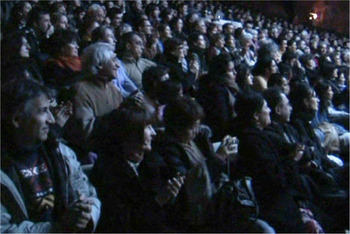
Miraculously, despite the preperformance drama, the Nasr troupe eventually performs their sīyāh bāzī sketches to warm audience reception at the Théâtre du Soleil. In the final scenes of Shadi, Mnouchkine’s anxiety about the troupe’s performance is assuaged by this success. Brief sequences of the troupe performing onstage alternate with shots of a packed French audience who aggressively applaud. (The sequence frames individual actors sulking offstage between acts: Shadi has learned about Abbas’s multiple sexual affairs back in Tehran; as if in revenge of her departure, he has taken their son away from Shadi’s mother and to his own mother’s house.)
The performance culminates in a standing ovation and a beaming Mnouchkine. Blackface comedy — but especially, or perhaps only, somebody else’s — shatters the fear attached to modern remonstrations of political correctness and liberates the French audience’s raucous laughter. Resurfaced decades‐old photographs of politicians guised in blackface in the US and elsewhere elicit contemporary scandal, and however mildly and transiently, affirm the profanity of blackface in postwar Western liberal democracies. “Polite, politically correct society” disclaims, but also privatizes blackface, transposing it from the proscenium to the exclusionary and orgiastic spaces of secret societies and fraternity parties (Cole Reference Cole and Johnson2012:225). Its deceptive disappearance from public space is continuously interrupted and invaded by the archaic in the form of infinitely reproducible still and moving, material and psychic, cultural, theological, and mythological imagery. Frantz Fanon, drawing on psychoanalytic language, aptly called this the imago of the “nègre” — untimely, anoriginary; historicism fails its truth (Fanon [1952] Reference Fanon2008; Marriott Reference Marriott2013).
In his comparative study of sīyāh bāzī, L’al Bakhsh (2016) suggests that the variety of hat shapes (crown [tāj], cone [kulā būqī ], skullcap [ fīnah], and fez) exemplify the sīyāh’s malleability and his evolution throughout Iranian history, a figure unfolding from a mythical symbol. Writing on blackface minstrelsy as the inspiration for Walt Disney’s Mickey Mouse and of minstrelsy for the animation industry more generally, Nicholas Sammond argues against the “originary fantasy” that positions one temporal iteration of blackface as more “genuine” than another; its cultural durability is demonstrated by adaptability, the “fantastic nature of imagined blackness” (Reference Sammond2015:23). One might add to this a caution about the kind of “disciplinary decadence” (Gordon Reference Gordon2014) that falls into the fantasy or escapism of historicism — more colloquially, that misses the forest for the trees. For as I have suggested, the very feature Iranian scholars assume makes sīyāh bāzī exceptional — its politicism — is shared ubiquitously by other, more legibly virulent iterations. “By definition,” writes George Rehin against the insularity of scholarship on blackface, “there is nothing to compare to a unique phenomenon” (Reference Rehin1975:685). Where scholarship on blackface has moved toward the transnational, assumptions about a Euro‐American origin take the 19th century as a starting point and follow the signs of a dispersal premised a priori on colonialism and globalization. By contrast, the obscure longevity of sīyāh bāzī undermines the commonplace West‐East, North‐South, and even South‐South itinerary of racial tropes, evoking a far more tortuous, arcane lineage. “Each of [the sīyāh’s] movements is occult (nahuftah)” (Nasīrīyān Reference Nasīrīyān1978:23). The ontic political senses of sīyāh bāzī dissolve in translation or by the whims of regime, but the more general politicism of blackface connects to the very structure of its comedic form. The humor released in colliding registers of meaning have implications for forms of being (you, us, them, world): “We wish that the jokes would be such that we could all laugh together,” Saeid Shanbehzadeh, a musician from Būshihr, says in an interview on Black Iranians’ reactions to and experience of sīyāh bāzī (Iran International 2019). In producing and fracturing univocity, blackface comedy ciphers an intransigent world order whose anatomy shifts shape, appears and disappears according to how one looks, where one stands, and what makes one laugh.
Film still from Maryam Khakipour’s Shadi (2008). The audience at the Théâtre du Soleil watches the sīyāh bāzā performance intently. (Screenshot courtesy of Parisa Vaziri)