Introduction
The global expansion of migration and the complex, sometimes paradoxical associations between immigration status and mental health have fostered research on the relationship between acculturation and risk of psychiatric disorders. Acculturation is the multidimensional process by which immigrants and their descendants adapt to the norms, values, and lifestyles of the new cultural setting while retaining, revising, or learning their culture of origin (Alegría et al. Reference Alegría, Sribney, Woo, Torres and Guarnaccia2007c ; Guarnaccia et al. Reference Guarnaccia, Martínez Pincay, Alegría, Shrout, Lewis-Fernández and Canino2007). Most epidemiological research assesses the construct of acculturation via very few measures (e.g. nativity) under the implicit assumption that a single process explains how acculturation is associated with mental health across various populations; this assumption is rarely tested (Abraido-Lanza et al. Reference Abraido-Lanza, Armbrister, Florez and Aguirre2006; Alegría, Reference Alegría2009). A corollary of this limitation is that the relationship between acculturation and mental health is seldom examined in detail across population subgroups with ethnic similarities, potentially omitting important cultural and historical/contextual differences that would affect the acculturation process and its relationship with health outcomes (Alegría, Reference Alegría2009). For example, among US Latinos, Mexicans face substantial immigration barriers, Puerto Ricans are US citizens, and Cuban immigration is federally facilitated (Massey & Sana, Reference Massey and Sana2003). More fine-grained studies are needed that assess diverse acculturation dimensions (e.g. language orientation, social network ethnic preference) simultaneously across subethnic groups (Zane & Mak, Reference Zane, Mak, Chun, Organista and Marín2003). Without these analyses, it is difficult to generate hypotheses regarding the mechanisms of action for the association between acculturation dimensions and psychiatric disorders, including the role of subgroup-specific cultural-historical factors affecting acculturation processes.
The complex relationships between acculturation and mental health across Latino subgroups make this an excellent test population (Alegría et al. Reference Alegría, Canino, Stinson and Grant2006, Reference Alegría, Shrout, Woo, Guarnaccia, Sribney, Vila, Polo, Cao, Mulvaney-Day, Torres and Canino2007b ; Guarnaccia et al. Reference Guarnaccia, Martínez Pincay, Alegría, Shrout, Lewis-Fernández and Canino2007). Early studies found a general association between higher acculturation and increased prevalence of psychiatric disorders. This was labeled the ‘Hispanic/immigrant paradox’ because it contradicts the expected association between poorer health outcomes and the lower socioeconomic status and greater utilization barriers typical of recent immigrants (Burnam et al. Reference Burnam, Hough, Karno, Escobar and Telles1987; Scribner, Reference Scribner1996). Recent research, however, reveals that the ‘paradox’ applies only to certain disorders and Latino subgroups. This suggests that different mechanisms of acculturation linked to particular disorders may have been masked in early studies by an overarching category for Latino ethnicity and by limited acculturation measures. For substance use disorders, the association of greater acculturation with higher prevalence of disorder is consistent across Latino subgroups, types of substance, and diverse acculturation measures (Ortega et al. Reference Ortega, Rosenheck, Alegría and Desai2000; Grant et al. Reference Grant, Stinson, Hasin, Dawson, Chou and Anderson2004b ; Alegría et al. Reference Alegría, Canino, Stinson and Grant2006, Reference Alegría, Shrout, Woo, Guarnaccia, Sribney, Vila, Polo, Cao, Mulvaney-Day, Torres and Canino2007b ; Blanco et al. Reference Blanco, Morcillo, Alegría, Dedios, Fernández-Navarro, Regíncos and Wang2013). For mood and anxiety disorders, however, the Hispanic/immigrant paradox is largely found among Mexican-origin Latinos and often examined only for nativity and age of immigration (Vega et al. Reference Vega, Kolody, Aguilar-Gaxiola, Alderete, Catalano and Caraveo-Anduaga1998; Ortega et al. Reference Ortega, Rosenheck, Alegría and Desai2000; Grant et al. Reference Grant, Stinson, Hasin, Dawson, Chou and Anderson2004b ; Alegría et al. Reference Alegría, Canino, Stinson and Grant2006, Reference Alegría, Shrout, Woo, Guarnaccia, Sribney, Vila, Polo, Cao, Mulvaney-Day, Torres and Canino2007b , Reference Alegría, Canino, Shrout, Woo, Duan, Vila, Torres, Chen and Meng2008).
One reason epidemiological studies rarely disaggregate ethnic groups for analysis is because of sample size limitations involving subgroups. Disaggregation is especially difficult for 12-month data, with its lower disorder prevalence compared to lifetime rates. However, a 12-month time-frame is preferable to lifetime data for acculturation analyses because it reveals the contemporary association between acculturation and mental health, which varies as the individual's level of acculturation changes, and is less prone to recall bias (Vega et al. Reference Vega, Sribney, Aguilar-Gaxiola and Kolody2004).
The National Epidemiologic Survey on Alcohol and Related Conditions (NESARC) is a representative survey of the US population with a large sample size of US Latinos (N = 6359), allowing for ethnic subgroup analysis. To our knowledge, we are the first to test a range of acculturation measures across subethnic groups by examining the linear association between five individual-level measures of acculturation and the 12-month presence of mood and anxiety disorders across four US Latino subgroups: Mexicans, Puerto Ricans, Cubans, and Other Latinos. Specifically we sought to investigate, for each Latino subgroup: (1) the sociodemographic characteristics associated with mood/anxiety disorders; (2) the relationship between presence of mood/anxiety disorders and degree of acculturation (across multiple dimensions); and (3) whether there is a linear association between acculturation levels and presence of mood/anxiety disorders.
Method
Sample
The 2004–2005 Wave 2 NESARC (Grant et al. Reference Grant, Kaplan and Stinson2007) is the second wave of the National Epidemiologic Survey on Alcohol and Related Conditions (Hasin & Grant, Reference Hasin and Grant2004). The target population was the civilian non-institutionalized population aged ⩾18 years residing in households and group quarters (e.g. college dormitories). Non-Latino Blacks, Latinos, and adults aged 18–24 were oversampled, with data adjusted for oversampling and household- and person-level non-response. Interviews were conducted by experienced lay interviewers. All procedures, including informed consent, received human subjects review and approval from the U.S. Census Bureau and the Office of Management and Budget. Wave 1 surveyed 43 093 individuals; the response rate was 81%. Excluding ineligible respondents (e.g. deceased), the Wave 2 response rate was 86.7%, resulting in a cumulative response rate of 70.2% (n = 34 653) (Grant et al. Reference Grant, Goldstein, Chou, Huang, Stinson, Dawson, Saha, Smith, Pulay, Pickering, Ruan and Compton2008). The present analyses are based on Wave 2 NESARC respondents who self-identified as Hispanic/Latino (n = 6359). We divided this sample into four subgroups according to self-reported ethnicity: Mexicans (n = 3472), Puerto Ricans (n = 755), Cubans (n = 335), and ‘Other Latinos’ (all others who self-identified as Hispanic/Latino) (n = 1797).
DSM-IV psychiatric disorders
All psychiatric diagnoses followed DSM-IV criteria (APA, 1994) using the Alcohol Use Disorder and Associated Disabilities Interview Schedule-DSM-IV (AUDADIS-IV) Wave 2 version (Grant et al. Reference Grant, Dawson and Hasin2004a ). DSM-IV Axis I mood disorders assessed by the AUDADIS-IV were: major depressive, dysthymic, and bipolar disorder. Anxiety disorders included specific phobia and panic, social anxiety, generalized anxiety, and post-traumatic stress disorder. Test–retest reliabilities of AUDADIS-IV measures of DSM-IV mood and anxiety disorders were fair to good, including in a Latino population (Canino et al. Reference Canino, Bravo, Ramírez, Febo, Lewis-Fernández and Hasin1999; Grant et al. Reference Grant, Stinson, Hasin, Dawson, Chou and Anderson2004b , Reference Grant, Hasin, Stinson, Dawson, Ruan, Goldstein, Smith, Saha and Huang2005).
Sociodemographic characteristics
Sociodemographic measures included sex, age, education level, individual income, employment status, and marital status.
Acculturation measures
Five complementary self-reported dimensions of acculturation were collected in the Wave 2 interview: (1) Age of immigration to the United States (categorized as migration at age ⩾25 years, migration between ages 18–24, migration before age 17, and US-born). (2) Time spent in the United States (⩽13 years, 14–24 years, >24 years, and US-born). (3) Language orientation was assessed with seven items from the Language Orientation subscale of the Short Acculturation Scale (SAS; Marín, Reference Marín, Sabogal, Marín, Otero-Sabogal and Pérez-Stable1987) (α = 0.93 in this sample). Language orientation was categorized as: mostly or completely Spanish; both, but more Spanish; both, but more English; and mostly or completely English. (4) Social network ethnic preference was measured with the 4-item Ethnic Social Relations subscale of the SAS (α = 0.78). Those items queried about the ethnicity of the respondent's close friends, persons respondents visited or socialized with, and preferences for the ethnicity of the friends of the respondent's children (mostly or all Latino; both, but more Latino; both, but less Latino; mostly or all other ethnic groups). (5) Ethnic identification was measured with eight items (α = 0.90) using an expansion of the 3-item Ethnic Identity Scale from the National Comorbidity Survey – Replication and the National Latino and Asian American Study (Guarnaccia et al. Reference Guarnaccia, Martínez Pincay, Alegría, Shrout, Lewis-Fernández and Canino2007). Items queried about Latino identification, Latino pride, importance of Latino heritage, role of Latino background in respondents’ interactions with others, and whether ‘your values, attitudes, and behaviors are shared by people of Hispanic or Latino origin’ (strong Latino identification; middle-high Latino identification; middle-low Latino identification; and low Latino identification). For scales 3–5, higher scores indicated greater Latino identification. Due to the non-normal distribution of these three measures, the total scores were categorized by quartiles (Blanco et al. Reference Blanco, Morcillo, Alegría, Dedios, Fernández-Navarro, Regíncos and Wang2013).
Analytic strategy
Odds ratios (ORs) were calculated for the association between each sociodemographic correlate with presence of 12-month DSM-IV mood/anxiety disorders, stratified by Latino subgroup (Mexican, Puerto Rican, Cuban, Other Latino). We examined whether the relationship between sociodemographic characteristics and disorder presence differed across Latino subgroups by identifying significant subgroup ×characteristic interaction terms in each logistic regression.
We then assessed whether each acculturation measure should be analyzed separately (Zane & Mak, Reference Zane, Mak, Chun, Organista and Marín2003). Specifically, we examined: (1) the correlation between acculturation measures in the full sample and (2) whether the relationship with disorder presence differed by acculturation measure across Latino subgroups. To conduct the second analysis, we examined the relationship of the five acculturation measures and disorder in the same regression, separately by Latino subgroup. Then, for each measure, another set of regressions was conducted with presence of disorder as the outcome and the interaction of Latino subgroup and level of acculturation as the predictor. In both analyses, acculturation measures were dichotomized at the median to maximize statistical power (Alegría et al. Reference Alegría, Shrout, Woo, Guarnaccia, Sribney, Vila, Polo, Cao, Mulvaney-Day, Torres and Canino2007b ).
The association between each acculturation dimension and presence of mood/anxiety disorders was estimated separately by Latino subgroup by deriving adjusted odds ratios from logistic regressions that used level of acculturation as the predictor variable and presence of mood/anxiety disorder as the outcome, and adjusted for sociodemographic characteristics of the sample. Linear χ2 trend tests were used to examine potential linear associations between level of acculturation and presence of mood/anxiety disorders within Latino subgroups. Because the smaller Cuban cohort resulted in cells of <10 participants and unstable estimates, for this subgroup only we collapsed the top two quartiles into a high-acculturation group and the bottom two quartiles into a low-acculturation group. All analyses considered the category with the highest acculturation (e.g. US-born Latinos, low Latino ethnic identification) as the reference group (Agresti & Min, Reference Agresti and Min2002). We considered an OR to be significant if its 95% CI did not include 1. All standard errors and 95% CIs were estimated using SUDAAN (Research Triangle Institute, 2004) to adjust for the NESARC's complex design.
Results
Sociodemographic characteristics of Latino subgroups with past-year mood/anxiety disorders
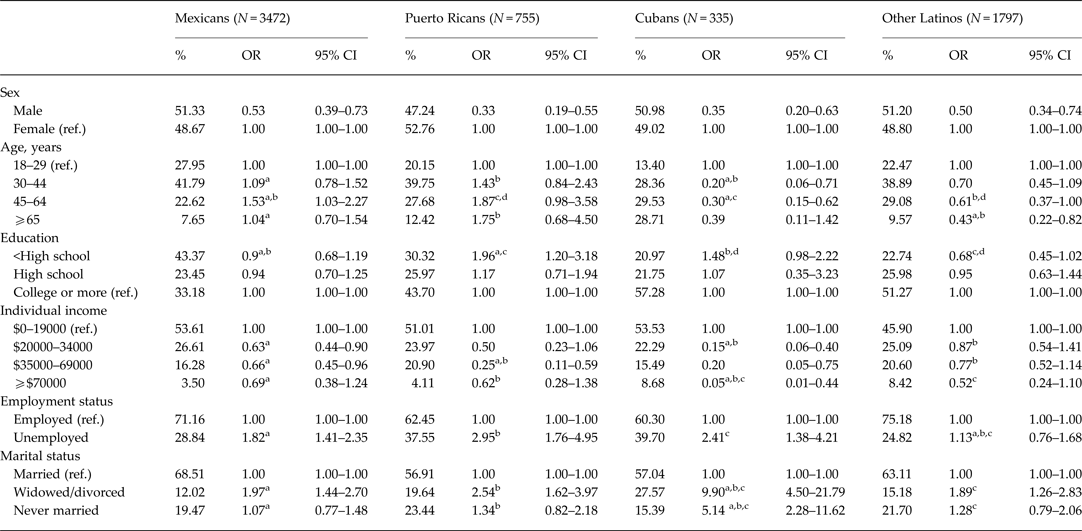
The sociodemographic characteristics associated with past-year mood/anxiety disorders showed similarities and differences across Latino subgroups (Table 1). Female sex and unemployment status were associated with higher odds of past-year mood/anxiety disorders in all subgroups except unemployment among Other Latinos (this latter relationship differed significantly from all other subgroups).
Sociodemographic characteristics related to past-year mood and/or anxiety disorder among US Latinos, by Latino subgroup (N = 6359) in Wave 2 of the National Epidemiologic Survey on Alcohol and Related Conditions

OR, Odds ratio; CI, confidence interval; ref., reference category.
In each row, values with paired superscripts differ significantly (p < 0.05–p < 0.001).
Marital status and income showed both similarities and differences across subgroups. Widowed/separated/divorced individuals had higher odds of disorder in all subgroups, but the adverse effect of disrupted marital status was significantly greater among Cubans. Never-married individuals were also at higher risk only among Cubans, who differed significantly from other subgroups in this respect. For income, the high-middle range ($35 000–69 000) was associated with lower odds of mood/anxiety disorders in all subgroups except Other Latinos; this association was strongest for Puerto Ricans, who had significantly lower odds of disorder than Mexicans and Other Latinos. Lower odds of disorder were also observed for Mexican and Cuban participants in the $20 000–34 000 bracket relative to lower-income respondents; this association was strongest for Cubans compared to Mexicans and Other Latinos. Moreover, only among Cubans, this protective association extended to the highest income bracket; their odds were significantly lower than other subgroups.
In terms of differences, Mexicans had higher odds of disorder at ages 45–64 years – significantly higher than Cubans and Other Latinos – while for Cubans age 30–64 years was the period of lowest risk; Other Latinos had lower risk at age ⩾65 years. Puerto Ricans differed significantly from Cubans and Other Latinos in odds of disorder across several age groups, but disorder presence was evenly distributed by age among Puerto Ricans. Education was associated with disorder presence only among Puerto Ricans, for whom less than a high school education was associated with higher risk. The odds of disorder differed significantly across several Latino subgroups with less than a high school education.
Correlation between acculturation measures and relationship with disorder
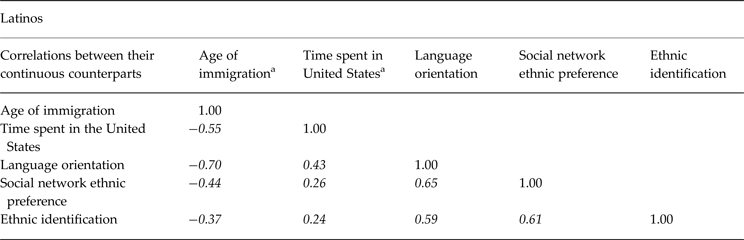
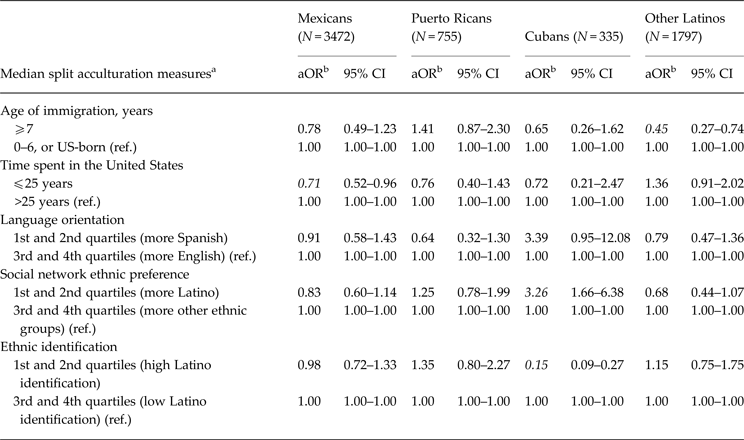
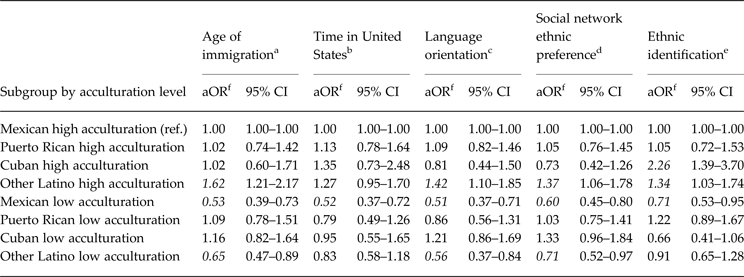
Correlations between acculturation measures ranged from 0.24 to 0.70 (Table 2), indicating that, although the measures likely address the same construct, they may capture different aspects of it. In the first set of regressions, the acculturation dimension(s) that remained significant varied by Latino subgroup (Table 3), suggesting that the measures function differently for each subgroup. The second set of regressions found at least one significant subgroup × acculturation-level interaction for each regression (Table 4), indicating that the strength of the association of each acculturation measure with mood/anxiety disorders varies by Latino subgroup. Based on these results, we examined each acculturation dimension separately across Latino subgroups.
Correlation matrix of the five acculturation measures among Latinos (N = 6359) in Wave 2 of the National Epidemiologic Survey on Alcohol and Related Conditions

Significant correlations (p < 0.05) are in italics.
a For US-born Latinos, age of immigration is defined as zero, and time spent in the United States is defined as their age.
Multivariate logistical regression of acculturation dimensions among Latinos with past-year mood and/or anxiety disorder, by Latino subgroup

aOR, Adjusted odds ratio; CI, confidence interval; ref., reference category.
Significant odds ratios are in italics.
a For US-born Latinos, age of immigration is defined as zero, and time spent in the United States is defined as their age.
b Mutually adjusted odds ratio among the five acculturation measures stratified by Latino subgroup.
Multivariate logistic regression of Latino subgroup × level-of-acculturation interaction among Latinos with past-year mood and/or anxiety disorder, by acculturation measure

aOR, Adjusted odds ratio; CI, confidence interval; ref., reference category.
Significant odds ratios are in italics.
a Immigration 0–6 years or US-born (high acculturation) v. immigration age ⩾7 years (low acculturation).
b In United States >25 years (high acculturation) v. in United States ⩽25 years (low acculturation).
c Median split of greater English orientation (high acculturation) v. greater Spanish orientation (low acculturation).
d Median split of lower Latino social network preference (high acculturation) v. greater Latino social network preference (low acculturation).
e Median split of lower Latino ethnic identification (high acculturation) v. greater Latino ethnic identification (low acculturation).
f Mutually adjusted odds ratio among the subgroup × acculturation-level interactions stratified by acculturation measure.
Acculturation and past-year mood/anxiety disorders, by Latino subgroup
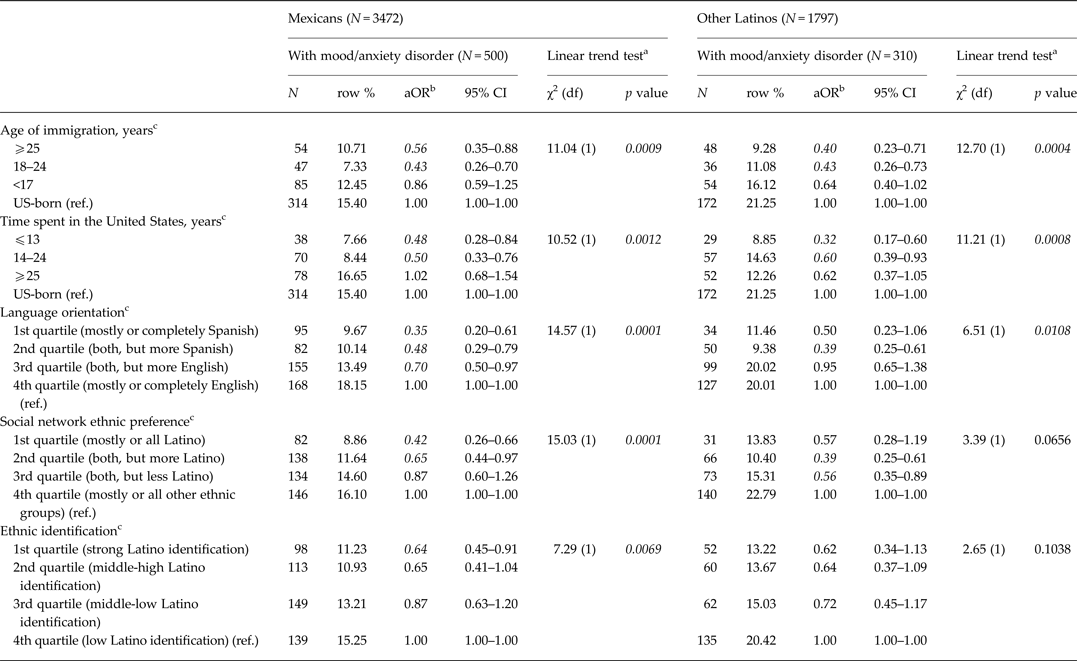
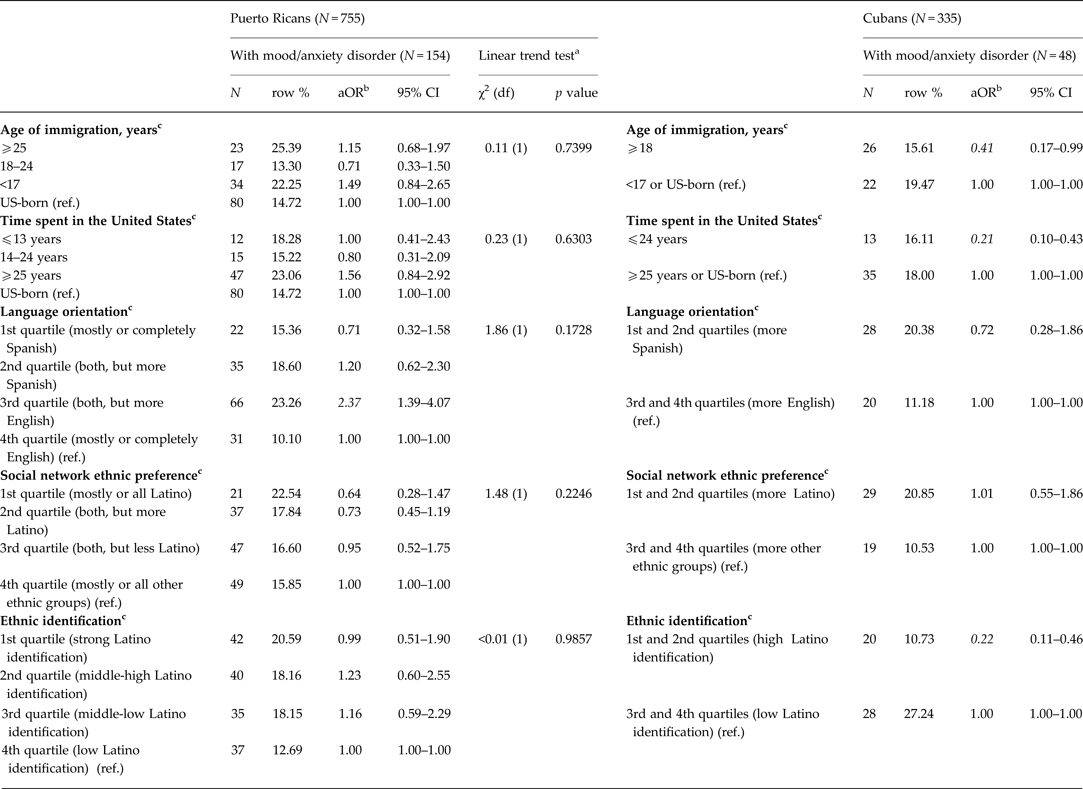
In all Latino subgroups except Puerto Ricans, multiple measures of higher acculturation were associated with past-year mood/anxiety disorders. After adjusting for sociodemographic characteristics, a linear association was observed among Mexicans for all five acculturation dimensions, as reflected by the significant linear-trend tests (Table 5). Among Other Latinos, four dimensions were associated with higher disorder risk (all except ethnic identification), but only three showed a linear trend (Table 5). Linear-trend tests were not conducted in the Cuban subgroup due to sample size limitations, but a protective relationship between lower acculturation and disorder was observed for three of five acculturation measures (Table 6).
Acculturation dimensions among Mexicans and other Latinos with past-year mood and/or anxiety disorder (except specific phobia)

aOR, Adjusted odds ratio; CI, confidence interval; ref., reference category.
a Significant odds ratios and p values are in italics.
b Adjusted odds ratio controlled for sociodemographic characteristics (sex, age, education, individual income, employment status, and marital status).
c Each acculturation measure is included in a separate logistic regression model for each Latino subgroup.
Acculturation dimensions among Puerto Ricans and Cubans with past-year mood and/or anxiety disorder (except specific phobia)

aOR, Adjusted odds ratio, CI, confidence interval, ref., reference category.
a Significant odds ratios and p values are in italics.
b Adjusted odds ratio controlled for sociodemographic characteristics (sex, age, education, individual income, employment status, and marital status).
c Each acculturation measure is included in a separate logistic regression model for each Latino subgroup.
By contrast, the pattern of associations between level of acculturation and past-year mood/anxiety disorders was not found among Puerto Ricans (Table 6). Only one acculturation variable, bilingual language orientation with greater preference for English (but not exclusively English-language orientation), was significantly associated with higher odds of mood/anxiety disorders. In this subgroup, no linear association was observed for any acculturation measure.
Discussion
In the NESARC, diverse acculturation measures were associated differentially with 12-month presence of mood/anxiety disorders across US Latino subgroups. Among Mexicans, the five dimensions of acculturation showed a clear linear association with past-year mood/anxiety disorders, after adjusting for sociodemographic characteristics. In Other Latinos, only age of immigration, time in the United States, and language orientation showed this linear association. Age of immigration, time in the United States, and ethnic identification were associated with disorder among Cubans, but a linear relationship was not assessed due to sample size limitations. By contrast, we found no relationship between acculturation and mood/anxiety disorders, and no linear association, among Puerto Ricans. Latino subgroup also significantly patterned the relationship between sociodemographic characteristics and presence of disorder. While some demographic characteristics were uniformly associated with disorder (being female), other associations were specific to certain subgroups (low formal education in Puerto Ricans) or differed across groups (the relationship of disrupted marital status and disorder was significantly higher in Cubans). Further, the strength of the association of each acculturation dimension, and the dimension that had an independent relationship with disorder presence, also varied by Latino subgroup. These findings suggest that, in diverse Latino subgroups, the acculturation measures may index distinct processes all linked to acculturation but associated differently with past-year mood/anxiety disorder risk.
Acculturation and past-year mood/anxiety disorders among Mexicans, Cubans, and Other Latinos
A linear association across multiple acculturation measures among Mexican-origin Latinos has not been reported before and confirms previous research in this group on mood/anxiety disorder prevalence and the Hispanic/immigrant paradox (Ortega et al. Reference Ortega, Rosenheck, Alegría and Desai2000; Grant et al. Reference Grant, Stinson, Hasin, Dawson, Chou and Anderson2004b ; Vega et al. Reference Vega, Sribney, Aguilar-Gaxiola and Kolody2004; Alegría et al. Reference Alegría, Canino, Stinson and Grant2006, Reference Alegría, Shrout, Woo, Guarnaccia, Sribney, Vila, Polo, Cao, Mulvaney-Day, Torres and Canino2007b , Reference Alegría, Canino, Shrout, Woo, Duan, Vila, Torres, Chen and Meng2008; Breslau et al. Reference Breslau, Borges, Hagar, Tancredi and Gilman2009). By contrast, the relationship between higher acculturation and odds of disorder among Cubans and Other Latinos contradicts most previous community-based national findings showing no or very limited association between nativity or early immigration and lifetime and 12-month prevalence (Turner & Gil, Reference Turner and Gil2002; Alegría et al. Reference Alegría, Canino, Stinson and Grant2006, Reference Alegría, Shrout, Woo, Guarnaccia, Sribney, Vila, Polo, Cao, Mulvaney-Day, Torres and Canino2007b , Reference Alegría, Canino, Shrout, Woo, Duan, Vila, Torres, Chen and Meng2008; Breslau et al. Reference Breslau, Borges, Hagar, Tancredi and Gilman2009). Exceptions are two previous studies that found an association between higher acculturation and lifetime anxiety disorders among Other Latinos (Turner & Gil, Reference Turner and Gil2002; Breslau et al. Reference Breslau, Borges, Hagar, Tancredi and Gilman2009). These discrepancies across datasets may be due to different acculturation measures and sample sizes, the limitations of lifetime data in evaluating a time-dependent process like acculturation, or diverse compositions of the Other Latino groups across studies. For example, the Wave 2 NESARC, compared to the National Latino and Asian American Survey (Alegría et al. Reference Alegría, Shrout, Woo, Guarnaccia, Sribney, Vila, Polo, Cao, Mulvaney-Day, Torres and Canino2007b ), enrolled fewer Cubans (355 v. 576, respectively) but more Other Latinos (1797 v. 613).
The finding of a linear association with acculturation in Mexicans and Other Latinos suggests that mood/anxiety disorder presence among many Latino immigrants is associated with hardships related to socio-cultural adaptation that grow steadily over time. Within the Mexican and Other Latino cohorts in this nationally representative sample, progressively greater acculturation is associated with increasing prevalence of disorder. Prior critical thresholds for disorder – such as specific ages of immigration (Alegría et al. Reference Alegría, Shrout, Woo, Guarnaccia, Sribney, Vila, Polo, Cao, Mulvaney-Day, Torres and Canino2007b ) or cut-offs regarding time in the United States (Vega et al. Reference Vega, Kolody, Aguilar-Gaxiola, Alderete, Catalano and Caraveo-Anduaga1998) – could be due to sample size limitations for detecting subgroup-level effects or to the local particularities of regional samples.
Four main processes may be involved in this linear association: (1) Progressive loss of protective cultural factors, including gradual reductions in: family cohesion and support among extended relatives, ethnic pride, reliance on spiritual practices to cope with adversity, and use of strategies such as resignación (acceptance/resignation) to adapt to hardship (Escobar, Reference Escobar1998; Hovey & Magaña, Reference Hovey and Magaña2002; Alegría et al. Reference Alegría, Shrout, Woo, Guarnaccia, Sribney, Vila, Polo, Cao, Mulvaney-Day, Torres and Canino2007b ); (2) Cumulative adverse experiences related to immigration, acculturation, and exposure to US society in the context of low socio-economic status (SES), such as: racial/ethnic discrimination, acculturative stress, substance abuse, and marital disruption (Finch et al. Reference Finch, Kolody and Vega2000; Blanco et al. Reference Blanco, Morcillo, Alegría, Dedios, Fernández-Navarro, Regíncos and Wang2013; Pérez-Rodríguez et al. Reference Pérez-Rodríguez, Baca-García, Oquendo, Wang, Wall, Liu and Blanco2014); (3) Gradual loss of the ability to compare adverse post-migration circumstances with even worse pre-migration circumstances (‘relative deprivation’) (Burnam et al. Reference Burnam, Hough, Karno, Escobar and Telles1987; Alegría et al. Reference Alegría, Canino, Shrout, Woo, Duan, Vila, Torres, Chen and Meng2008); and (4) Rising demoralization due to inability to achieve expected socio-economic goals (‘frustrated status hypothesis’) (Burnam et al. Reference Burnam, Hough, Karno, Escobar and Telles1987; Hovey, Reference Hovey2000).
Our cross-sectional data do not allow us to examine these potential mechanisms of action. To guide future research, we suggest specific mechanisms by which adverse acculturation processes may raise the odds of mood/anxiety disorders in the context of the low-SES stressors affecting most Latino immigrants. First, developmental vulnerability due to younger age of arrival may increase disorder risk in association with early exposure to racial/ethnic discrimination and internalization of a negative self-identity as a low-status immigrant (Vega et al. Reference Vega, Sribney, Aguilar-Gaxiola and Kolody2004; Alegría et al. Reference Alegría, Sribney, Woo, Torres and Guarnaccia2007c ). Second, growing discrepancy over time between traditional Latino values of strong family orientation (‘familism’, Sabogal et al. Reference Sabogal, Marín and Otero-Sabogal1987) and ‘modern’ views of individualism and lower familial interdependence more common in the United States than Latin America (Falicov, Reference Falicov2001; Spector et al. Reference Spector, Cooper, Poelmans, Allen, O'Driscoll, Sánchez, Siu, Dewe, Hart and Lu2004) could lessen the individual's commitment to marital stability and family cohesion and support, augmenting acculturative stress and intergenerational family conflicts (Zhou, Reference Zhou1997; Morcillo et al. Reference Morcillo, Duarte, Shen, Blanco, Canino and Bird2011). Third, loss of familism may reduce the buffering effect that living in extended families has on the pathogenic impact of stressful events related to low SES (Hovey, Reference Hovey2000; Hovey & Magaña, Reference Hovey and Magaña2002; Alegría et al. Reference Alegría, Shrout, Woo, Guarnaccia, Sribney, Vila, Polo, Cao, Mulvaney-Day, Torres and Canino2007b ). In fact, after adjusting for family burden and family cultural conflict, low-acculturation and high-acculturation Mexican Americans have similar odds of past-year depressive disorder (Alegría et al. Reference Alegría, Shrout, Woo, Guarnaccia, Sribney, Vila, Polo, Cao, Mulvaney-Day, Torres and Canino2007b ), highlighting the importance of family-related factors. These hypotheses should be examined in future studies.
Acculturation and past-year mood/anxiety disorders among Puerto Ricans
In line with previous research (Ortega et al. Reference Ortega, Rosenheck, Alegría and Desai2000; Alegría et al. Reference Alegría, Canino, Stinson and Grant2006, Reference Alegría, Shrout, Woo, Guarnaccia, Sribney, Vila, Polo, Cao, Mulvaney-Day, Torres and Canino2007b , Reference Alegría, Canino, Shrout, Woo, Duan, Vila, Torres, Chen and Meng2008), acculturation is unrelated to the presence of mood/anxiety disorders among Puerto Ricans. Several potential reasons for this difference from other Latino subgroups could be tested in future studies. First, Puerto Rico's dependent political and economic relationship with the United States since 1898 has resulted in marked conflict on the Island over the role of acculturation to US society v. affirmation of a separate cultural identity (Bird, Reference Bird1982; Duany, Reference Duany2002). This process may precipitate acculturative stress in some Island residents even before they migrate (Bird, Reference Bird1982; Duarte et al. Reference Duarte, Bird, Shrout, Wu, Lewis-Fernández, Shen and Canino2008; Alegría et al. Reference Alegría, Canino, Shrout, Woo, Duan, Vila, Torres, Chen and Meng2008), helping to explain why Puerto Ricans with ⩽13 years in the United States and US-born Puerto Ricans have similar risk of disorder (Table 6). Partly supporting this hypothesis, youth internalizing disorders are associated with youth and parents’ acculturative stress about US culture among Puerto Ricans on both the Island and the Mainland (Duarte et al. Reference Duarte, Bird, Shrout, Wu, Lewis-Fernández, Shen and Canino2008). By contrast, among other Latin American immigrants, the deleterious effects of acculturative stress may develop gradually only after their arrival in the United States, leading to an increase over time of mood/anxiety disorders. Second, US citizenship may facilitate the immigration of Puerto Ricans with mood/anxiety disorders, relative to other Latino immigrants. This would also help account for the finding that recent immigrants share similar risk to longstanding mainland residents. Third, US citizenship, English-language exposure in Puerto Rico, and higher proportion of skilled laborers may accelerate the effect of the ‘frustrated status hypothesis’, since Puerto Rican immigrants may thereby expect easier socio-economic success in the United States than foreign-born Latinos (Massey & Sana, Reference Massey and Sana2003; Alegría et al. Reference Alegría, Shrout, Woo, Guarnaccia, Sribney, Vila, Polo, Cao, Mulvaney-Day, Torres and Canino2007a , Reference Alegría, Mulvaney-Day, Torres, Polo, Cao and Canino b ).
Relationship of self-reported acculturation measures and Latino subgroup-level adaptation pathways
Historical and contextual factors may help explain why the self-report acculturation measures are inconsistently associated with disorder across Latino subgroups. Although the acculturation measures were intended to capture similar pathways of socio-cultural adaptation across populations, these measures may instead tap subgroup-specific processes affecting disorder risk.
One possible explanation for our findings is that, within each Latino subgroup, the acculturation measures may index the relationship of acculturation and disorder to the extent that the measures are associated differentially in each subgroup with protective or pathogenic pathways that unfold over time (Cook et al. Reference Cook, Alegría, Lin and Guo2009). Among Puerto Ricans living in the United States, for example, protective cultural behaviors, e.g. family cohesion or spiritually oriented coping, may not be associated preferentially with Spanish-language orientation, given the complex relationship between language and cultural identity in the context of prolonged economic dependency and pervasive ‘circular migration’ between Puerto Rico and the United States (Zentella, Reference Zentella1997; Duany, Reference Duany2002). Likewise, an ethnically mixed social network may index more positive adaptation possibilities for Cubans than Mexicans, explaining why this acculturation measure is a more consistent marker of the presence of disorder for the latter than the former. Given their federally facilitated immigration context, initial arrival into encapsulated Cuban neighborhoods, and higher SES (Massey & Sana, Reference Massey and Sana2003; Laria & Lewis-Fernández, Reference Laria, Lewis-Fernández and Lim2015), among Cubans this measure might indicate growing social mobility, while among Mexicans it might signal a different factor, such as loss of family support. Even the simpler acculturation measures, such as time in the United States or age of immigration, may not index identical coping processes across Latino subgroups. Given the prevalence of acculturative stress on the Island regarding US culture (Duarte et al. Reference Duarte, Bird, Shrout, Wu, Lewis-Fernández, Shen and Canino2008), for example, recent immigrants from Puerto Rico may have experienced the deleterious effects of acculturative stress on mood/anxiety disorders earlier in the process of adaptation, compared to recent immigrants from other Latin American countries. Among Puerto Ricans, it appears none of the acculturation measures studied taps adaptive coping mechanisms; new measures may be required to tap this process in this ethnic subgroup.
An alternative explanation is that the relationship between acculturation and disorder is determined largely by the prevalence of mood/anxiety disorders in each Latin American sending country (Breslau et al. Reference Breslau, Borges, Hagar, Tancredi and Gilman2009). Since prevalence in Puerto Rico is like that of the US (Canino et al. Reference Canino, Bird, Shrout, Rubio-Stipec, Bravo, Martínez, Sesman and Guevara1987) and higher than in Mexico (Medina-Mora et al. Reference Medina-Mora, Borges, Lara, Benjet, Blanco, Fleiz, Villatoro, Rojas and Zambrano2005), the Latino subgroups may be following a uniform acculturation process once the role of the sending country is considered. Although compelling for the Puerto Rican subgroup, this explanation does not clarify the reasons for the differences across the other subgroups in terms of the acculturation dimension that was independently associated with disorder presence (Table 3), the magnitude of the association of each dimension (Table 4), and the associations of specific dimensions and disorder (Tables 5, 6).
Clinical implications
Our findings suggest that it is clinically valuable to obtain information directly from patients about how their individual adaptation pathways relate to their acculturation process. A simple reliance on acculturation measures may be misleading, as their ability to index the risk for mood/anxiety disorders may vary across ethnic subgroups, partly due to historical and contextual aspects of different Latino subgroups’ pre-migration, entry, and adaptation processes.
Past research suggests a list of candidate factors that complicate the adaptation of racial/ethnic minority immigrants and their US-born offspring, potentially elevating the risk for mood/anxiety disorders. These factors should be assessed during a mental health evaluation, and include: acculturative stress, intergenerational conflict, demoralization, marital disruption, racial/ethnic discrimination, and loss of family cohesion, family support, ethnic pride, adaptive resignation, and spiritually-oriented coping (Escobar, Reference Escobar1998; Finch et al. Reference Finch, Kolody and Vega2000; Hovey & Magaña, Reference Hovey and Magaña2002; Vega et al. Reference Vega, Sribney, Aguilar-Gaxiola and Kolody2004; Alegría et al. Reference Alegría, Shrout, Woo, Guarnaccia, Sribney, Vila, Polo, Cao, Mulvaney-Day, Torres and Canino2007b ; Morcillo et al. Reference Morcillo, Duarte, Shen, Blanco, Canino and Bird2011). Cultural tailoring of treatment approaches might concentrate on clarifying which acculturation experiences are connected to beneficial adaptation pathways for the individual patient and his/her social network so that they can be reinforced. For instance, some therapeutic strategies, such as encouraging engagement with Latino social networks to reduce deleterious effects of culture change, may be more successful among some Latino groups (e.g. Mexicans) than others (e.g. Cubans). Cultural assessments, such as the DSM-5 Cultural Formulation Interview, provide a systematic evaluation approach that can help guide this cultural tailoring (Lewis-Fernández et al. Reference Lewis-Fernández, Aggarwal, Hinton, Hinton and Kirmayer2016).
Psychotherapy approaches focused on reframing or resolving acculturation-related interpersonal disputes over gender roles (Markowitz et al. Reference Markowitz, Patel, Balan, McNamara, Blanco, Brave Heart, Sosa and Lewis-Fernández2009); maladaptive cognitions and behaviors related to acculturative stress and other culture change-related stressors (Comas-Díaz, Reference Comas-Díaz1981, Reference Comas-Díaz1985); problem-solving limitations in confronting novel predicaments (Ell, Reference Ell, Katon, Xie, Lee, Kapetanovic, Guterman and Chou2010) (common upon migration); and family conflicts worsened by differential intergenerational acculturation (Szapocznik & Kurtines, Reference Szapocznik and Kurtines1993) have all been found efficacious among US Latinos, suggesting the value of focusing on adaptation pathways as potential mechanisms of action for the association of acculturation and psychopathology. Emphasizing prevention and early intervention efforts with Latino youth and recent immigrants of all ages targeting the emergence of both the maladaptive pathways and the mood/anxiety disorders – e.g. via peer-to-peer programs, community media, school-based activities, and community organizations (Aguilar-Gaxiola et al. Reference Aguilar-Gaxiola, Loera, Méndez, Sala and Nakamoto2012) – may help reduce the morbidity of maladaptive social processes that increase gradually upon exposure to US society.
Limitations
Our study has several limitations. First, the NESARC did not directly assess historical factors (e.g. cohort effects of immigration barriers) or certain individual-level data (e.g. family support) to clarify the relationship between acculturation measures and adaptation pathways associated with mood/anxiety disorders. Use of these variables in large-scale epidemiological studies could help determine whether Latino subgroup remains independently associated with odds of disorder. Second, the cross-sectional design prevents attributions of causality between mood/anxiety disorders and acculturation; it is also precludes testing for time-lagged effects of acculturation milestones and their trajectories on mental health status (Brown et al. Reference Brown, Baysu, Cameron, Nigbur, Rutland, Watters, Hossain, LeTouze and Landau2013). Third, because the NESARC sample only included populations 18 years and older, information was unavailable on youth. The challenges and effect of acculturation among young immigrants and its relation with mood/anxiety disorders may differ from those faced by adults.
Conclusion
The relationship between acculturation and presence of mood/anxiety disorder varies by Latino subgroup and acculturation measure. Among US Mexicans, Cubans, and Other Latinos, different dimensions of acculturation have a direct relationship with presence of disorder, frequently in a linear association, while among Puerto Ricans no such relationship was observed. The association between acculturation and disorder may be related to a common set of maladaptive behavioral pathways which are differentially associated with Latino subgroup origin as a result of historically-driven group processes. These processes may be active during the immigration process (e.g. discrimination) or precede it (e.g. sending-country disorder prevalence). Clinicians should consider focusing treatment on these common pathways, while culturally tailoring their approach to the particular associations between acculturation dimensions and maladaptive behaviors that characterize the person. Future research should examine multiple acculturation dimensions across population subgroups (including non-immigrants) and incorporate direct measures of maladaptive behavioral pathways and their relationship to acculturation.
Acknowledgements
The authors appreciate the assistance with manuscript preparation of Samantha Díaz, MA, Research Assistant at the New York State Psychiatric Institute.
This work was supported by NIDA (CSD, grant no. DA033172); NIMH (RLF, grant no. MH 077226), (C.B., grant no. MH076051), (C.S.D., grant no. MH9416301), (NKA, grant number MH102334); NICHD (C.S.D., grant no. HD060072); and institutional funds from the New York State Psychiatric Institute (R.L.F., A.S.L., C.B., C.S.D.).
The views and opinions expressed in this report are those of the authors and should not be construed to represent the views of any of the sponsoring organizations, agencies, or the U.S. government.
The funders did not have any input into the design and conduct of the study; collection, management, analysis, and interpretation of the data; and preparation, review, or approval of the manuscript.
Declaration of Interest
R.L.F. receives salary support through an investigator-initiated study funded by Eli Lilly & Co. The other authors report no financial or other relationship relevant to the subject of this article.