The focal article (Reynolds, McCauley, Tsacoumis, & the Jeanneret Symposium Participants, Reference Reynolds, McCauley and Tsacoumis2018) discusses the accepted wisdom and challenges surrounding the assessment and development of senior leaders. Specific to our response, the authors highlight the importance of rigorous assessment and the relevance of accounting for contextual factors. The present response integrates both of these topics by advocating the use of parallel leader and organizational culture assessments to guide continued leader development. By explicitly measuring leadership and contextual factors, we expand on the contextual focus brought up in the focal article while providing guidance to practitioners on how to utilize the framework presented.
Context, Broadly Defined
The authors begin the article by advocating the use of validated tools to inform ongoing leader development, much as we, as a field, advocate the use of validated tools in other domains, such as selection or performance appraisal (Reynolds et al., Reference Reynolds, McCauley and Tsacoumis2018). In discussing assessment, the authors note that its successful implementation is contingent on the broader context in which the leader's development is taking place. In other parts of the article, this idea of context is discussed in a variety of ways. The broader business landscape, organizational conditions (i.e., volatility, uncertainty, complexity, and ambiguity), and the “real job context” are all examples of how context is both directly addressed and also interwoven into the complexities addressed in the focal article. With this evident complexity, the authors highlight the need to improve the “consistency and precision with which we describe and use contextual variables” (Reynolds et al., Reference Reynolds, McCauley and Tsacoumis2018, p. 638), suggesting taxonomic structures that include both context and leader behaviors. We agree wholeheartedly and (re)introduce a broadly applicable model of culture and leadership assessment that provides a framework which extends this discussion.
Leader–Culture Fit
The focal article very briefly mentions that culture fit is one way in which individual effectiveness is operationalized. We argue that organizational culture is a critical contextual factor and should not only be explicitly acknowledged, but should also be formally assessed alongside the leader to aid in developmental initiatives. Organizational culture is not relevant in this discussion solely for a culture's ability to foster development via feedback and accountability, as directly noted in the focal article. It has long been linked to senior leadership (e.g., Schein, Reference Schein2010), change management, and organizational performance (e.g., Boyce, Nieminen, Gillespie, Ryan, & Denison, Reference Boyce, Nieminen, Gillespie, Ryan and Denison2015).
We have previously introduced the leader–culture fit framework (LCFF) as a coaching tool rooted in the person–environment fit literature (Nieminen, Biermeier-Hanson, & Denison, Reference Nieminen, Biermeier-Hanson and Denison2013). Its applicability, however, dovetails perfectly with the assessment and development of leaders outside of a coaching environment and follows preexisting calls to attend to leader-context dynamics (Day, Reference Day2001). The LCFF posits the importance of the reliable and valid measurement of both the leader and the organizational culture using commensurate and parallel, or mirrored, measures. It allows for targeted, individual-level description and development while accounting for organizational-level factors.
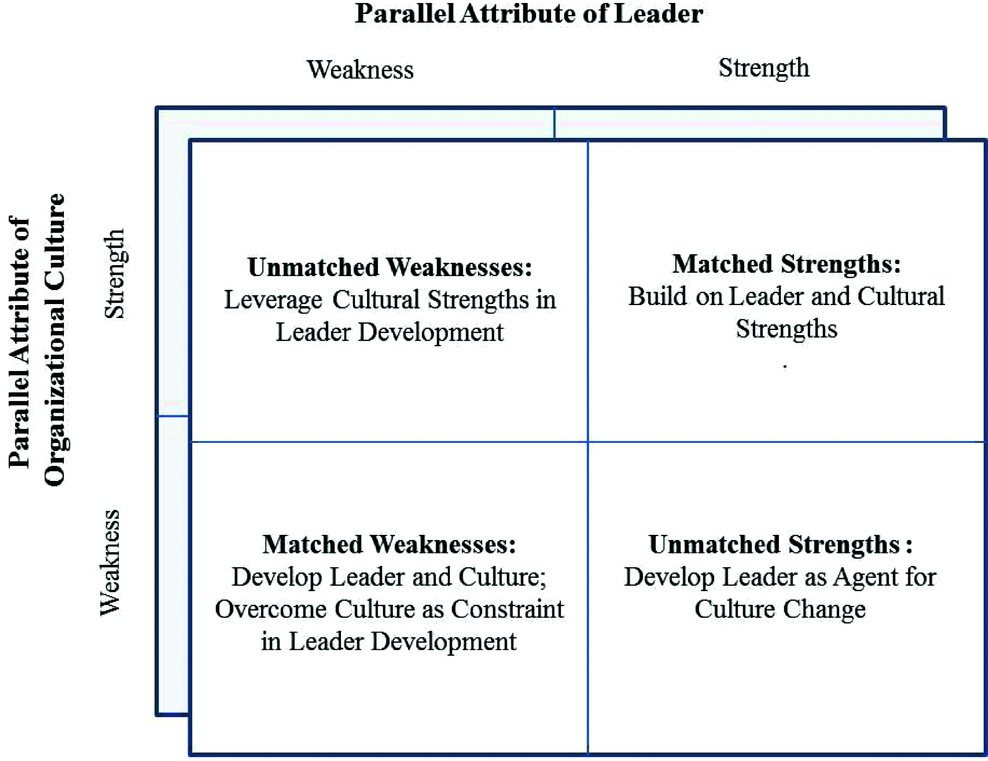
In practice, implementation of the LCFF requires measurement along commensurate and parallel constructs to first establish evaluative scores for both the leader and culture. Leader ratings can be collected via traditional 360-degree feedback, whereas culture ratings can be collected at the group (for lower level leaders) or organizational (for more senior leaders) levels. These ratings are then used to identify cultural dimensions of fit or misfit, as well as areas where the leader and culture are aligned or misaligned (see Figure 1).
Figure 1.Leader culture fit framework.
The areas of fit and misfit in this model lead to differing developmental strategies. In areas of “unmatched lows,” where the culture has strength where the leader does not, a leader has an opportunity to develop in an area where there is already preexisting support. This may let the leader gain momentum by achieving early success in a developmental plan due to the preexisting cultural support. In areas of “matched highs,” leaders may be able to capitalize on existing cultural support to develop their abilities further.
The areas of “unmatched highs” and “matched lows” present more challenges. In areas of “unmatched highs,” the leader is strong in an area where the culture is comparatively weak. This provides both a challenge and an opportunity for the leader: On one hand, the leader has the ability to positively affect the broader organizational culture. On the other hand, culture change is also both extremely time consuming and difficult. It may also be out of the scope of individual development plans. Individual developmental progress in this area may also stall out due to the unsupportive nature of the culture. Finally, areas of “unmatched lows” represent areas where both the culture and leader are relatively weak. The identification of “unmatched lows” calls for caution when planning leaders’ development, signals a warning sign for potential stagnation in this area, and highlights the potential need for outside experiences to continue to develop.
By identifying these matches and mismatches leadership developmental plans can (a) identify dimensions where the leader or the culture have relative strengths and weaknesses, (b) explicitly account for contextual factors, and (c) take into account how difficult development may be along a given dimension when planning out long-term development. We would like to note that this can be done with either prescriptive or descriptive measurements and is not limited to any set of proprietary tools, so long as there are commensurate and parallel measurements for both the leader and culture.
Conclusions
The authors of the focal article are consistent in bringing up the importance of context in the assessment and development of senior leaders. We hone in on this in greater detail, introducing the leader–culture fit framework as a way to explicitly assess cultural context alongside the leaders themselves to further promote development. The LCFF takes a systems view approach of leadership development by explicitly measuring and accounting for the cultural context in which a leader operates. In doing so, it addresses several of the inherent calls within the focal article for greater contextual attention by utilizing a contextual construct that is inextricably linked to senior leadership and broader environmental factors. The LCFF also has potential to address other topics, such as succession planning (by identifying lower level leaders who fit the culture), within the broader leadership development domain. Although we believe this framework has considerable potential, we encourage both practitioners and researchers to empirically examine outcomes of LCFF-driven leadership development initiatives.




 You have
Access
The focal article (Reynolds, McCauley, Tsacoumis, & the Jeanneret Symposium Participants, Reference Reynolds, McCauley and Tsacoumis2018) discusses the accepted wisdom and challenges surrounding the assessment and development of senior leaders. Specific to our response, the authors highlight the importance of rigorous assessment and the relevance of accounting for contextual factors. The present response integrates both of these topics by advocating the use of parallel leader and organizational culture assessments to guide continued leader development. By explicitly measuring leadership and contextual factors, we expand on the contextual focus brought up in the focal article while providing guidance to practitioners on how to utilize the framework presented.
Context, Broadly Defined
The authors begin the article by advocating the use of validated tools to inform ongoing leader development, much as we, as a field, advocate the use of validated tools in other domains, such as selection or performance appraisal (Reynolds et al., Reference Reynolds, McCauley and Tsacoumis2018). In discussing assessment, the authors note that its successful implementation is contingent on the broader context in which the leader's development is taking place. In other parts of the article, this idea of context is discussed in a variety of ways. The broader business landscape, organizational conditions (i.e., volatility, uncertainty, complexity, and ambiguity), and the “real job context” are all examples of how context is both directly addressed and also interwoven into the complexities addressed in the focal article. With this evident complexity, the authors highlight the need to improve the “consistency and precision with which we describe and use contextual variables” (Reynolds et al., Reference Reynolds, McCauley and Tsacoumis2018, p. 638), suggesting taxonomic structures that include both context and leader behaviors. We agree wholeheartedly and (re)introduce a broadly applicable model of culture and leadership assessment that provides a framework which extends this discussion.
Leader–Culture Fit
The focal article very briefly mentions that culture fit is one way in which individual effectiveness is operationalized. We argue that organizational culture is a critical contextual factor and should not only be explicitly acknowledged, but should also be formally assessed alongside the leader to aid in developmental initiatives. Organizational culture is not relevant in this discussion solely for a culture's ability to foster development via feedback and accountability, as directly noted in the focal article. It has long been linked to senior leadership (e.g., Schein, Reference Schein2010), change management, and organizational performance (e.g., Boyce, Nieminen, Gillespie, Ryan, & Denison, Reference Boyce, Nieminen, Gillespie, Ryan and Denison2015).
We have previously introduced the leader–culture fit framework (LCFF) as a coaching tool rooted in the person–environment fit literature (Nieminen, Biermeier-Hanson, & Denison, Reference Nieminen, Biermeier-Hanson and Denison2013). Its applicability, however, dovetails perfectly with the assessment and development of leaders outside of a coaching environment and follows preexisting calls to attend to leader-context dynamics (Day, Reference Day2001). The LCFF posits the importance of the reliable and valid measurement of both the leader and the organizational culture using commensurate and parallel, or mirrored, measures. It allows for targeted, individual-level description and development while accounting for organizational-level factors.
In practice, implementation of the LCFF requires measurement along commensurate and parallel constructs to first establish evaluative scores for both the leader and culture. Leader ratings can be collected via traditional 360-degree feedback, whereas culture ratings can be collected at the group (for lower level leaders) or organizational (for more senior leaders) levels. These ratings are then used to identify cultural dimensions of fit or misfit, as well as areas where the leader and culture are aligned or misaligned (see Figure 1).
Leader culture fit framework.
The areas of fit and misfit in this model lead to differing developmental strategies. In areas of “unmatched lows,” where the culture has strength where the leader does not, a leader has an opportunity to develop in an area where there is already preexisting support. This may let the leader gain momentum by achieving early success in a developmental plan due to the preexisting cultural support. In areas of “matched highs,” leaders may be able to capitalize on existing cultural support to develop their abilities further.
The areas of “unmatched highs” and “matched lows” present more challenges. In areas of “unmatched highs,” the leader is strong in an area where the culture is comparatively weak. This provides both a challenge and an opportunity for the leader: On one hand, the leader has the ability to positively affect the broader organizational culture. On the other hand, culture change is also both extremely time consuming and difficult. It may also be out of the scope of individual development plans. Individual developmental progress in this area may also stall out due to the unsupportive nature of the culture. Finally, areas of “unmatched lows” represent areas where both the culture and leader are relatively weak. The identification of “unmatched lows” calls for caution when planning leaders’ development, signals a warning sign for potential stagnation in this area, and highlights the potential need for outside experiences to continue to develop.
By identifying these matches and mismatches leadership developmental plans can (a) identify dimensions where the leader or the culture have relative strengths and weaknesses, (b) explicitly account for contextual factors, and (c) take into account how difficult development may be along a given dimension when planning out long-term development. We would like to note that this can be done with either prescriptive or descriptive measurements and is not limited to any set of proprietary tools, so long as there are commensurate and parallel measurements for both the leader and culture.
Conclusions
The authors of the focal article are consistent in bringing up the importance of context in the assessment and development of senior leaders. We hone in on this in greater detail, introducing the leader–culture fit framework as a way to explicitly assess cultural context alongside the leaders themselves to further promote development. The LCFF takes a systems view approach of leadership development by explicitly measuring and accounting for the cultural context in which a leader operates. In doing so, it addresses several of the inherent calls within the focal article for greater contextual attention by utilizing a contextual construct that is inextricably linked to senior leadership and broader environmental factors. The LCFF also has potential to address other topics, such as succession planning (by identifying lower level leaders who fit the culture), within the broader leadership development domain. Although we believe this framework has considerable potential, we encourage both practitioners and researchers to empirically examine outcomes of LCFF-driven leadership development initiatives.