

Introduction
What does social protection expenditure tell us about the Western Balkans? In this paper, we address this question by analysing how much do the nations of the region spend, the functional structure of that expenditure, the ways it is financed, the variables that may impact the structure of the expenditure, and how expenditure relates to redistribution. We also make comparisons with developments in the European Union (EU).
The region has gone through two decades of relative stability following the troubled 1990s and all of its nations have entered contractual relationships with the EU towards potential accession. The EU’s accession leverage – promising integration and improved material, security and normative standards – has made it a powerful influence in the post-communist trajectories of the Southeastern Europe (Vachudova, Reference Wilensky2008). However, the EU has not maintained a unified approach or had much influence on social policy pathways compared to other policy sectors during pre-accession (Deacon & Hulse, Reference Deacon and Hulse1997; Lendvai, Reference Lendvai, Deacon and Stubbs2007). In spite of that, most social policies in the Western Balkans, except for Kosovo, resemble the fundamental welfare state principles of continental Europe since they are organised mainly around social insurance institutions. Social expenditure and the size of its redistribution effects have increased over time due to an expansion in poverty protection and other minimum income rights, as well as tax structure reforms. Yet, the overall size of the region’s expenditure remains much smaller, and the functions of social protection expenditure substantially different than in the EU, with a less balanced expenditure pattern and a smaller and less balanced redistribution impact.
Seen from this perspective, one can observe strong legacies especially among the former republics of Yugoslavia. The Yugoslav variant of “self-management” socialism (1952–1989) combined Bismarckian institutions with other typical socialist institutions, such as universal free education. Many of these institutions were maintained after the fall of communism and the transition to a mixed economy. Despite the size, most cash social transfers in Yugoslav socialism (as in other communist countries of Eastern Europe) were non-redistributive, because incomes were more evenly distributed than in the capitalist countries but within the working population, and protection against poverty was marginal (Milanovic, Reference Milanovic1993).Footnote 1 While compared to socialism, poverty protection has, nowadays, improved (because it was more needed) along with the introduction of minimum wages, it is remarkable that rather than converging with the EU social protection policies, Western Balkans countries still differ substantially in their policy mix and balance. However, within these general trends, there are substantial variations between countries of the region in terms of the design of welfare regimes and their outcomes.
Literature review
Comparative research on social protection expenditure has experienced almost a “U” shape trajectory during the past decades – from being taken as the equivalent of the welfare state dependent variable to plain dismissal and then relevant return. In his pioneering work, Wilensky (1975, pp. 47–49) explained the social protection expenditure (welfare effort) variance by the level of economic affluence as well as by the age of the social protection programmes and population demography, whereas he found variables, such as the political system and ideology to be irrelevant. This approach was later powerfully criticised from the influential “politics matters” school of comparative research which, arguing that expenditure per se does not help much in understanding welfare states, emphasised the importance of the qualitative dimensions of social rights, such as the variations in eligibility and entitlement, generosity (or decommodification), coverage and financing. Drawing on the conceptual work of Titmuss (1974) and Marshall (Reference Marshall1950), this school argued that once social rights are understood as rights of citizenship, political coalitions and historical legacy become central in explaining the institutional and redistributive variations among liberal, Bismarckian and social-democratic capitalist welfare states (Esping-Andersen, Reference Esping-Andersen1990; Korpi, Reference Korpi1983; Korpi & Palme, Reference Korpi and Palme1998).
Later, improved data were published by the Organisation for Economic Co-operation and Development (OECD) and by the European System of Integrated Social Protection Statistics (ESSPROS, 2016). Such data allowed researchers (see Castles, Reference Castles2009; Castles & Obinger, Reference Castles and Obinger2007; Morel & Palme, Reference Morel, Palme and Greve2019; Obinger & Wagschal, Reference Obinger, Petersen and Starke2010) to break down social protection into several categories (such as expenditure on old age, working age, health and other expenditure), as well as its financing sources (such as social insurance contributions, general taxation, mandatory savings and private voluntary insurance). These more detailed data “provide important indicators of both the logic and pattern of welfare state” (Obinger & Wagschal, Reference Obinger, Petersen and Starke2010, p. 334). For example, research drawing on expenditure and its financing has helped to further and better comprehend the welfare regime categorisations and their underpinning social contract differences. Comparisons over time have demonstrated that countries usually included in the social democratic and the Bismarckian welfare regime families demonstrate the highest levels of total expenditure, yet with considerable differences between them. The social-democratic welfare states are more generous with family and similar benefits provided during the working age in addition to universal services and they use income taxation as major source of financing expenditure (Castles, Reference Castles2009; Obinger & Wagschal, Reference Obinger, Petersen and Starke2010), while the continental welfare states tend to concentrate benefits towards the old age citizens through cash transfers and to finance them through social insurance contributions (Castles, Reference Castles2009; Obinger & Wagschal, Reference Obinger, Petersen and Starke2010). Similar to the social democratic model, nations falling in the liberal regime family demonstrate an extensive level of service expenditure, but in contrast with other regimes they have a much higher degree of cash expenditure financed through private sources and high levels of net “hidden welfare” expenditure (Adema & Ladaique, Reference Adema, Fron and Ladaique2009; Obinger & Wagschal, Reference Obinger, Petersen and Starke2010). Despite these regime variations in terms of concentration of expenditure, the literature also points to a growing expenditure convergence among nations due to translation of policies and good practices (Morel & Palme, Reference Morel, Palme and Greve2019).
The disaggregated expenditure has helped to understand redistribution as well. Overall, transfers are generally considered more redistributive than taxes, gross expenditure similarly more redistributive than net expenditure, and public expenditure more than private expenditure (Adema, Fron, & Ladaique, Reference Adema and Ladaique2014; Morel & Palme, Reference Morel, Palme and Greve2019; Obinger & Wagschal, Reference Obinger, Petersen and Starke2010). While high expenditure correlates with lower inequality and poverty as a rule, working age benefits and other expenditure correlate with higher vertical redistribution while expenditure on old age and healthcare may not do so (Castles, Reference Castles2009; Obinger & Wagschal, Reference Obinger, Petersen and Starke2010). Expenditure on the working age population has been found to be an even better predictor of redistribution than decommodification (Obinger & Wagschal, Reference Obinger, Petersen and Starke2010, p. 343). On the financing sources side, while income and other direct taxation are generally more redistributive, shifting of costs to the private sector, social insurance contributions and (uniform) consumption taxation can prove regressive (Morel & Palme, Reference Morel, Palme and Greve2019). The literature has emphasised the “combined effect” of both expenditure and its financing in redistribution (Korpi & Palme, Reference Korpi and Palme1998; Morel & Palme, Reference Morel, Palme and Greve2019). Adema, Fron, and Ladaique (Reference Adema and Ladaique2014) add to the “combined effect” – in addition to the size of expenditure and its financing – also the degree of targeting of expenditure and of tax burdens.
When it comes to the impact of structural and political variables on expenditure, recent literature has pointed to the difference between gross and net expenditure and difference between various expenditure categories: socio-economic determinants have been found to be much more relevant than political ones in the net expenditure and old-age related transfers (see Obinger & Wagschal, Reference Obinger, Petersen and Starke2010) while politics (the left) more relevant for working age benefits and other services (Castles, Reference Castles2009). Other important determinants are considered to be new social needs and unemployment (Obinger & Wagschal, Reference Obinger, Petersen and Starke2010).
Data and methods
The paper first analyses social protection expenditure and its financing in the Western Balkans from 2005 to 2016. It draws on the ESSPROS’s data for Serbia and North Macedonia and national administrative data for Albania, Bosnia and Herzegovina, Montenegro, North Macedonia (earlier data) and Kosovo.Footnote 2 It follows the ESSPROS’s (2016) methodology, which defines social protection expenditure as expenditure on social benefits, administration costs, transfers redirected to other schemes, and other expenditure such as interest and taxes. We break down expenditure by function into expenditure on (1) old age, (2) healthcare, (3), unemployment, (4) means-tested programmes and (5) other expenditure. The procedure of breaking down the expenditure was limited by the inability to disaggregate some expenditure lines of non-ESSPROS data, which made it impossible to combine unemployment expenditure with other working-age expenditure (eg. parental leave and related benefits) and thus to provide a unified picture of the welfare effort on the working-age population.
On the financing side of expenditure, we break down receipts into (1) social insurance contributions of employers and employees, (2) government financing (general revenue) and (3) private financing such as through mandatory individual pension savings, personal pension schemes in the market and private health insurance. The Western Balkan region is characterised by large private expenditures on social protection that are not included in these financing sources and this creates a second limitation, which we address by referring to relevant literature and documentation.
In order to explain the overall trends in the Western Balkans and the important variations between countries, we follow the approach of Esping-Andersen (Reference Esping-Andersen1990) and Korpi and Palme (Reference Korpi and Palme1998) and analyse the impacts of policy design and the qualitative dimensions of social rights on the size and functions of social protection expenditure using available public data and qualitative evidence. Through similar evidence, we further analyse how other relevant variables, such as legacy of socialism and war, party politics, international organisations, economic resources and aging impact the design (and change) of rights and social protection expenditure. Here, future quantitative studies, made possible by improving data availability, can overcome the paper’s limitations through providing more explicit indices on the impact of these variables.
The paper finally analyses the connection between disaggregated social expenditure on the one hand, and inequality and poverty on the other. Using data from Eurostat, we then observe levels of inequality and poverty before social transfers, after pensions and after all transfers to understand the relationship between social protection expenditure and redistribution. We also look at the size of consumption taxation (Value Added Tax, excise and international trade) and developments in other forms of taxation for discussing the wider structure and progressivity of taxes.
Patterns of social protection expenditure and its financing
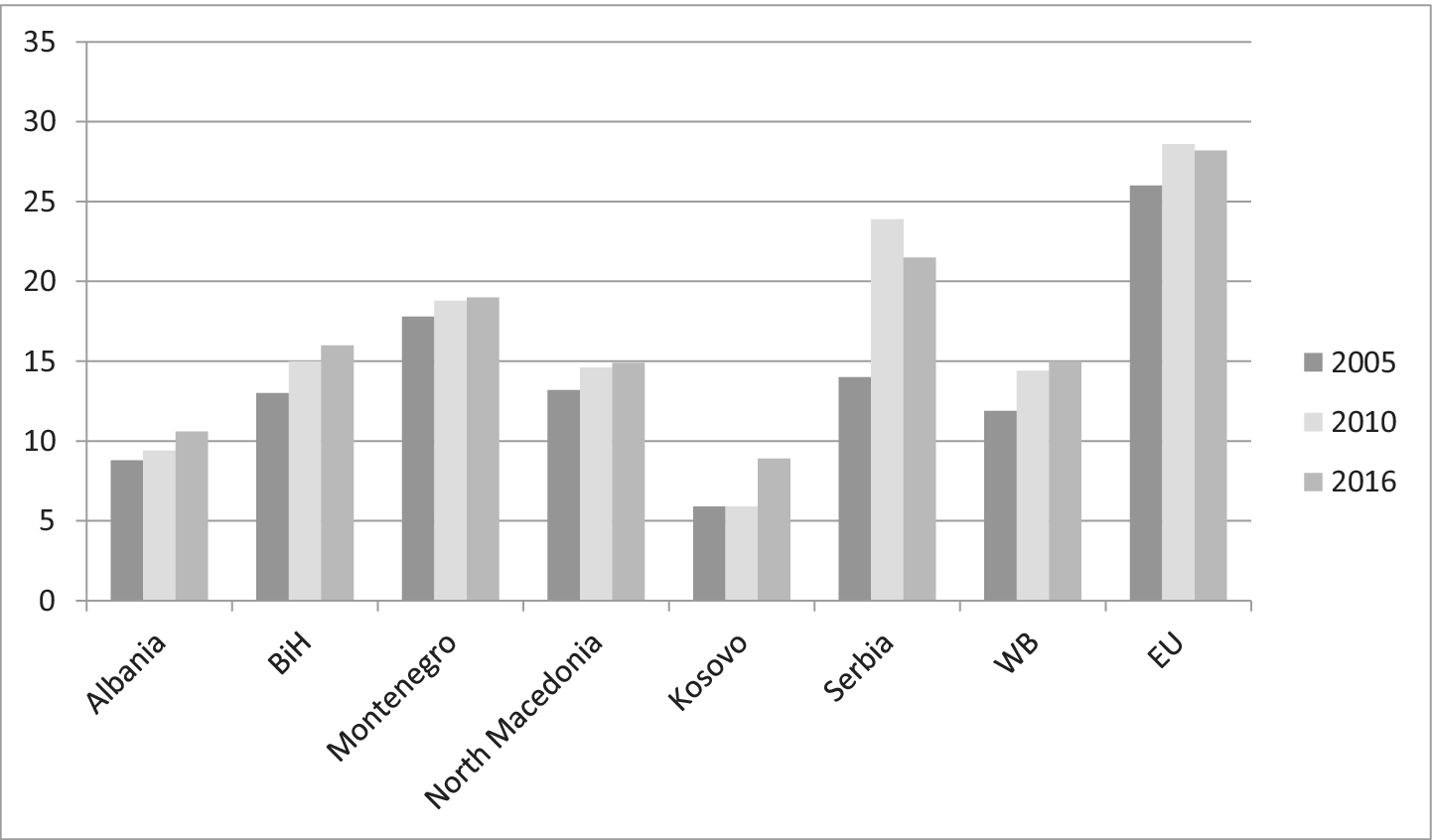
The average social protection expenditure of the Western Balkans increased during the observed period (2005–2016) as a share of GDP although at an ever-slower rate. The average regional expenditure increased despite some short-term decline (eg. in Bosnia and Herzegovina) or longer-term indirect negative impacts of the 2008 financial crisis most notably in Serbia (see Obradović & Jusić, Reference Obradović and Jusić2019; Pejin Stokić & Bajec, Reference Pejin Stokić2019). As Figure 1 shows, the expenditure growth in the Western Balkans has been larger than in the EU during the time period covered, although the average social protection expenditure in the EU countries as a percentage of GDP was about 13 percentage points (p.p.) greater.

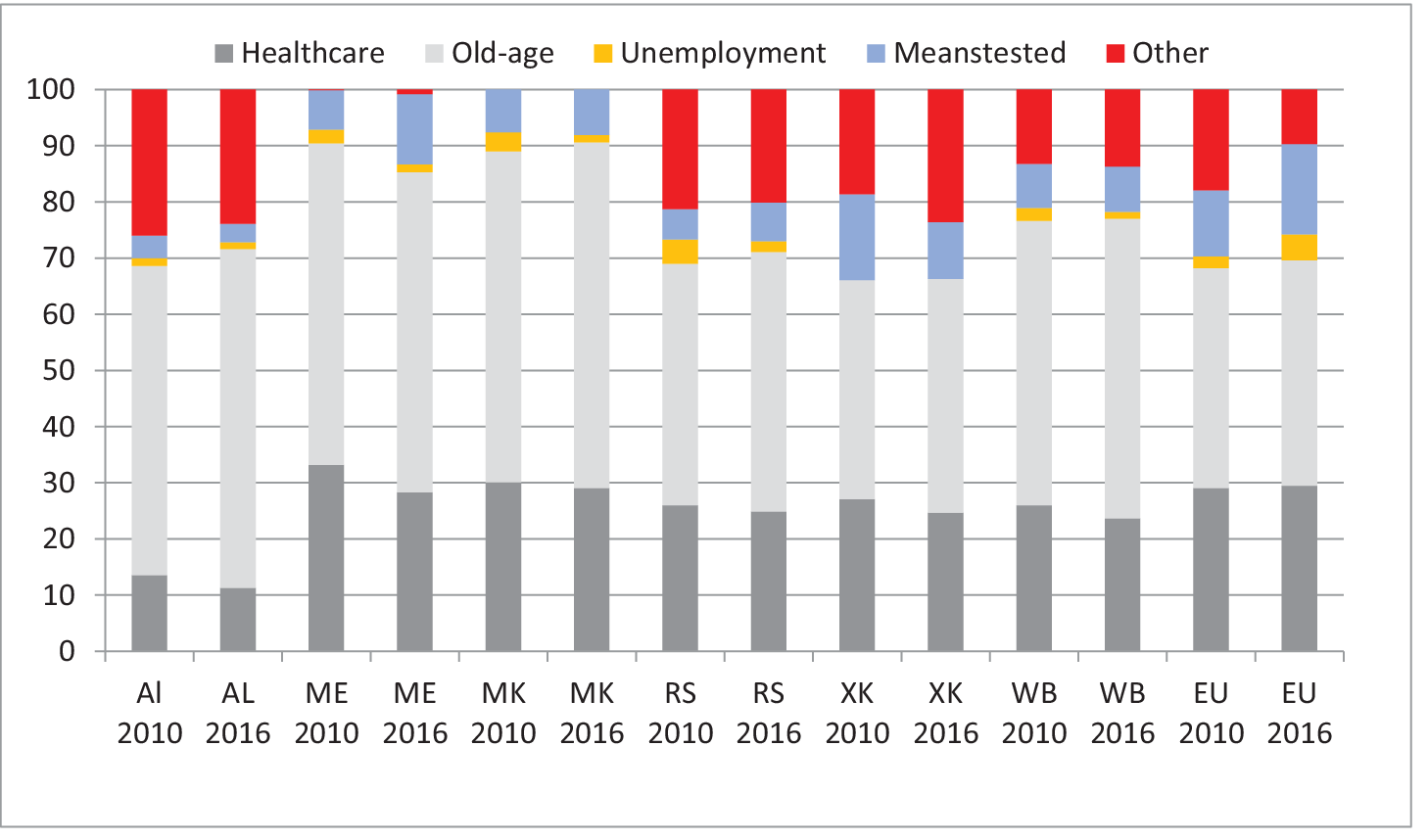
The disaggregated expenditure by function shows a strong concentration on the elderly population, which was larger and growing faster in the Western Balkans than in the EU (Figure 2). The Western Balkan countries spent less on means-tested social protection programmes, and this type of expenditure was growing more slowly. They were also increasing their spending on the “Other” category, in contrast with the EU. While here the EU spent on programmes such as housing, family and social inclusion, in the Western Balkan countries, especially in Bosnia and Herzegovina and in Kosovo, the “other” line of expenditure involved particularistic social programmes, such as those for veterans and the casualties of war and former political prisoners (Mustafa & Haxhikadrija, Reference Mustafa and Haxhikadrija2019; Obradović & Filic, Reference Obradović and Filic2019; Obradović & Jusić, Reference Obradović and Jusić2019). At the same time, the Western Balkans’ healthcare and unemployment protection expenditure was declining, in contrast to the trend in the EU. There are, however, strong variations within the region. For example, Serbia is the largest welfare spender of the group, and is much closer to the mean EU’s average welfare effort (21.5 per cent of GDP in 2016), while Kosovo is the lowest spender with only 8.9 per cent of GDP.
Social protection expenditure by function (%).
Source: ESPN (2019). Note: Data for Bosnia and Herzegovina are missing. Albanian expenditure on health is approximate. “Other” function includes expenditure on maternity leave, survivor and disability at work related expenditure, housing, social exclusion, veterans of war and related expenditure and administration costs. Abbreviations: AL, Albania; ME, Montenegro; MK, North Macedonia; RS, Serbia; XK, Kosovo.

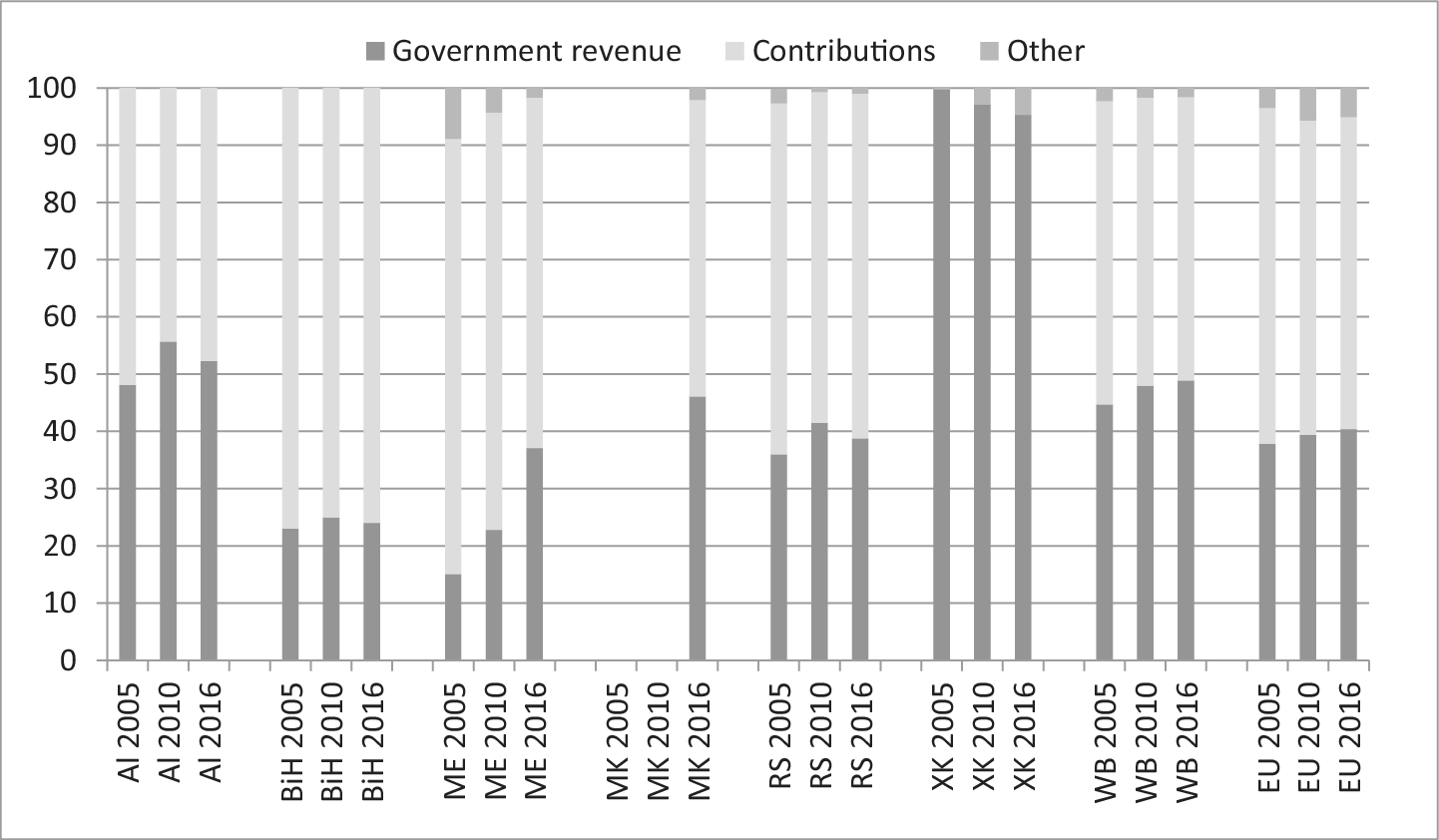
As Figure 3 shows, most social expenditure in the Western Balkans and EU is financed through contributions of employers and employees via social insurance institutions. Contribution rates were highest in Bosnia and Herzegovina (around 41.5 per cent on the Federation level), followed by Serbia (37.8 per cent), Montenegro (34.3 per cent), North Macedonia (27.5 per cent) and Albania (24.5 per cent) (ESPN, 2019). Kosovo imposes the smallest contributions directed towards mandatory pension savings (10 per cent). However, the share of financing through government revenues was rising in the entire region. The growth of government financing is due to the expansion of various tax-paid social rights, such as, eg., the establishment of minimal social pensions for the elderly with no work history in Albania, the rise in family-related expenditure in Montenegro and North Macedonia, “other” expenditure in Kosovo and Bosnia and Herzegovina, and the financing of the deficit of social insurance funds by governments. In recent years, revenues of the social insurance funds have been falling due to a general reduction of contribution rates (in North Macedonia), and reductions of specific contribution rates (such as the health insurance in Serbia and Montenegro); in the case of Serbia, lower revenues were also caused indirectly by cuts to public sector wages and the unpaid contributions of many workers in public enterprises (Kaluđerović & Golubović, Reference Kaluđerović and Golubović2019; Pejin Stokić & Bajec, Reference Pejin Stokić2019). In Albania, social insurance finances the disability and parental leave programmes in addition to contributory pensions, healthcare and unemployment protection. This increases the need for the state to finance the deficits. In addition, all countries have major issues with informality; the smaller the social protection expenditure, the larger informality seems to be. Kosovo is the exception as it finances almost all social transfers, public healthcare services and the pensions of former pay-as-you-go (PAYG) contributors through general taxation. Over time, however, the share of private financing (eg. deriving from pension savings) in Kosovo is expected to grow.
Structure of financing of expenditure (%).
Source: ESPN (2019). Abbreviations: Al, Albania; BiH, Bosnia and Herzegovina; EU, European Union; MK = North Macedonia (data for 2005 & 2010 missing); RS, Serbia; XK=Kosovo.

Explaining expenditure patterns: design of social rights and determinants of their change
The increase of economic resources – as reflected by growth of GDP, social contributions and tax revenues – may contribute to social protection expenditure and its expansion (Wilensky, 1975), but as Kenworthy (Reference Kenworthy2010) argues, GDP growth, eg., does not necessarily translate in improved social welfare for the more disadvantaged parts of society if social rights are not tied to growth. In the Western Balkans, as an illustration, the most intensive growth during the observed time-period was seen in Kosovo, yet this was not directly translated in a similar intensive growth of social protection expenditure since the benefits of its broadest social programmes are tied to the minimum food poverty threshold rather than to economic growth. Thus, in our analyses, we embark from the literature (eg. Castles & Obinger, Reference Castles and Obinger2007; Esping-Andersen, Reference Esping-Andersen1990; Kenworthy, Reference Kenworthy2010; Korpi & Palme, Reference Korpi and Palme1998) that considers the underlying welfare regime principles, the design of social rights, and their changes over time as the crucial explanators of the size and patterns of social expenditure.
In the Western Balkans, while overall expenditure varies between Serbia, Montenegro, Bosnia and Herzegovina, North Macedonia and Albania (Figure 1), these variations are due more to the extent of social rights and their generosity than to variations in welfare regime principles, since all these countries generally follow the principles of the Bismarckian social insurance model and resemble in these principles continental European welfare states (see eg. Obinger & Wagschal, Reference Obinger, Petersen and Starke2010). On the other hand, Kosovo, the smallest spender, has a substantially different welfare state logic. Cocozzelli (Reference Cocozzelli, Deacon and Stubbs2007) has called it “a caricature” of the liberal welfare regime because it underwent much stronger marketisation due to the unprecedented influence of international organisations such as the World Bank during the United Nations Mission in Kosovo (June 1999 to February 2008). Its policy (especially in the long term) commits as it stands lower social protection expenditure due to high targeting, narrow public services and generally flat-rate other benefits.
Pensions
The intensive concentration of social protection expenditure on the elderly population confirms Wilensky’s (1975) expectation that the longevity of programmes, among other factors, might explain their higher contribution to the overall welfare effort. Pension programmes were one of the major institutions of the Western Balkan welfare states, in the post-socialist period (Bartlett & Xhumari, Reference Bartlett and Xhumari2007). But, as shown by the disaggregated expenditure data, there are important variations. Four countries, Albania, Bosnia and Herzegovina, Montenegro and North Macedonia, have very high focus of their total expenditure on pensions (Figure 2). Their pension expenditure share, as a percentage of GDP, in the total expenditure is about 20 percentage points higher compared to that of EU. While all these countries inherited big pension programmes, there have been further recent expansive developments in Albania and North Macedonia. In 2014, Albania launched a tax-financed minimum basic pension for people over 70 with no work history, or with income below the minimum contributory pension. This took place 1 year after the return in power of the Socialist Party following 8 years spent in opposition. In addition, Albania’s pension arrangements differ to other PAYG systems in the region in that it maintains a relatively generous approach towards farmers and rural contributors; it provides easier eligibility criteria and higher income replacement in relation to their contribution history (Ymeri, Reference Titmuss2019, p. 6). In North Macedonia, changes in the PAYG pension indexations have allowed fixed increases in the pension amounts received rather than reflecting contributions made (Gerovska-Mitev, Reference Gerovska-Mitev2019, p. 7).
On the other hand, Serbia has a more balanced total expenditure. This is primarily due to its larger welfare state with more extensive social rights, but it is also a result of the various parametric reforms on its PAYG pension system (see Matković & Stanić, Reference Matković and Stanić2020). The Serbian Government, opting for continuity, had avoided paradigmatic pension changes towards privatisation and individualisation as advised by the international organisations in early 2000s (Arandarenko & Uvalic, Reference Arandarenko and Uvalic2014). However, following 2008 financial crisis, Serbia increased the pension age for women to 60 in 2011 and then to 65 in 2014, and it changed pension indexation and reduced pension income by up to 25 per cent between 2014 and 2018. As a result, although there were almost a quarter (23 per cent) more pensioners in 2018 than in 2008, total pension expenditure increased only marginally; in 2014, 61 per cent of elderly people received a pension income below the at-risk-of-poverty (AROP) threshold (Pejin Stokić & Bajec, Reference Pejin Stokić2019, pp. 8–10). It is noteworthy however that these parametric pension reforms in Serbia were resisted and impacted, particularly in the form of postponing them, by the Party of United Pensioners of Serbia, which was part of the governing coalitions since 2008 (Žarković-Rakić et al. Reference Ymeri2017, p. 2430).
Kosovo’s smaller share of pension expenditure in total expenditure is largely caused by its pension system design that leads to small, generally flat-rate benefits. The World Bank designed three-pillar system, launched in 2001 via UNMIK, consists first (Pillar I) of a tax-financed universal basic pension which issues flat-rate benefits to elderly persons above 65 based on residence by tying benefits to the value of the national extreme (food) poverty threshold – the cost of 2,100 calories intake per day. This programme has ensured full coverage of women and rural population among whom employment has been historically weaker. The rest of pension income was expected to be ensured through mandatory individual savings (Pillar II) at Kosovo Pensions Savings Trust (KPST). Savings are managed through investments in the international financial markets and through the purchase of government bonds. The system is backed up by private, voluntary pension schemes (Pillar III). Following Kosovo’s declaration of independence, however, the tax-financed pension pillar has begun issuing top-up payments to people who worked in the pre-privatisation “self-managed” companies who can prove at least 15 years of contribution (pre-1999) in the former socialist PAYG system. Through these top-ups, maximum pension income (for the pensioners with higher education that worked in the Kosovan Albanian educational “parallel system” during 1990s) can reach 75 per cent of average wages in the market. However, ultimately, most pension income is flat-rate, quite small and not designed to reflect former income or contributions. In the long-term, when the tax-financed top-up scheme for former PAYG contributors is exhausted, pension expenditure should be dominated by mandatory savings.
North Macedonia is the only other country of the region to have moved towards some pension privatisation in the form of mandatory individual savings (in 2006), but the PAYG scheme remains its largest institution (Gerovska-Mitev, Reference Gerovska-Mitev2019, p. 9). Private, voluntary pension schemes remain small sized throughout the region; the largest of them, in Serbia, covers only 2.7 per cent of the population (Pejin Stokić & Bajec, Reference Pejin Stokić2019, p. 8).
Despite all these differences in pension arrangements, coverage of the elderly population with pension income is quite broad. This coverage makes aging a relevant variable in social protection expenditure in the Western Balkans since the region’s population above 65 years old grew from 12.1 per cent in 2005 to 14.5 per cent in 2016 (World Bank, Reference Žarković-Rakić, Aleksić-Mirić, Lebedinski and Vladisavljević2021). Aging furthermore occurs in a context of extensive outmigration of the working-age population in search of jobs in Central Europe and elsewhere, what means the region may face worsening pensioner–contributor dependency ratio also due to outmigration for work. Where aging and dependency ratio became more salient in public policy considerations, such as in Serbia and Montenegro, it was addressed, as in the EU (Manow, Reference Manow and Palier2010), through piecemeal parametric reforms mentioned above. Yet, such reduced pension benefits have not caused a shift to private pension schemes. To the contrary, even in Kosovo, aging has been a less relevant consideration (compared, eg., to ideological motivations) behind the radical pension privatisation.
Healthcare
The public healthcare systems throughout the region (except for Kosovo) are financed through health insurance and government revenues. Overall decline in public heath expenditure (Figure 2) in the Balkans could be related to the fact that these benefits are less salient (compared to cash monthly social transfers) and therefore cuts are less resisted by the public, and perhaps to extensive private expenditure in some of the countries. In Serbia, which provides very good access to quality healthcare, public health insurance covers 97.5 per cent of the population (Pejin Stokić & Bajec, Reference Pejin Stokić2019). But, other countries within the health insurance model, as, eg., Albania, despite having a public health insurance in place, still have high levels of private health expenditure (see eg. Kaminska et al., Reference Kaminska, Druga, Stupele and Malinar2021). The private expenditure indicates both lower coverage rates through public insurance and lower quality of rights (especially in terms of access to insurance compensated medicine). In Bosnia and Herzegovina, private health expenditure ranges between 2 per cent and 3 per cent of GDP (Obradović & Jusić, Reference Obradović and Jusić2019). In Kosovo, public healthcare services are financed by the state and by co-payments at the point of service. A modicum of medicines is also provided by the state even though in practice these medicines are harder to access. Patients must finance themselves most medicines and services that are not provided by public hospitals, with up to 40 per cent of all expenditure financed through private health expenditure (World Bank, 2014, p. 70). Private health insurance in Kosovo covers only around 10 per cent of the population, so most citizens are practically uninsured.
Former Yugoslav republics generally inherited the health insurance model in post-socialism, while Albania embraced it having rejected other proposals from the international organisations (Kaminska et al., Reference Kaminska, Druga, Stupele and Malinar2021). But, in line with Kaminska’s (Reference Kaminska2013) socialism’s legacy argument, the Western Balkan countries that finance public healthcare through social health insurance model, in contrast with the practice of Bismarckian regimes in Western Europe, are state-dominated since they do not involve corporate partners in management and (with the exception of North Macedonia) usually do not cover expenditure in private practices. In the case of Kosovo, public health services do not come through an explicit commitment to a National Health Service model, but rather through a policy ambiguity that results from non-decisions in terms of long-term commitments towards statutory health financing models.
Unemployment
As shown so far, Western Balkans resemble the “pro-old” social contracts of the continental European welfare states (Birnbaum et al., Reference Birnbaum, Ferrarini, Nelson and Plame2017) in that they focus expenditure on old-age compared to models that better balance expenditure intergenerationally – among the elderly, working-age people and children. The declining expenditure on unemployment in the region further supports this argument. The decline was generally due to inertia in the unemployment protection rights, which have stringent eligibility criteria and offer low payments despite still substantially high levels of unemployment – although in some of the countries the unemployment rates have fallen as well compared to 2000s. Kosovo applies this approach in an extreme form: it has no unemployment protection insurance at all despite having the highest unemployment rate.
Unemployment insurance schemes in the Western Balkans might again offer some backing for Wilensky’s (1975) age of the programme argument. Contrary to pension and health insurance institutions – the countries that emerged from former Yugoslavia had only a small unemployment protection programme during self-management socialism, while Albania had none in place. So, the programmes are newer and the countries are perhaps less used to and less skilled in dealing with unemployment. By contrast, we do not find backing from the region’s past two decades for Castles and Obinger’s (Reference Castles and Obinger2007) argument that the working-age expenditure correlates with the strength of the left. In several countries – such as in Montenegro, Albania, Serbia, Bosnia and Herzegovina (especially in the Republica Srpska) and Macedonia – left-wing parties have been in power at times or for more substantial periods of time without translating this power in increased unemployment benefits. However, recent interaction with the EU and gender-equalisation pressures have led to movements and discussions such as towards installing parental leave (eg. in Albania and Kosovo) and towards extending benefits towards the unemployed (Kosovo), what may make left-wing parties begin display a more obvious impact towards the working age.
Means-tested expenditure
During 1990s and 2000s, the Balkan countries all expanded their direct poverty protection through social assistance (SA) programmes compared to socialism. The schemes came as a result of loss of employment and influence of international organisations such as in particular the World Bank. These programmes are targeted on the poor, have often low level of generosity and reach only a small proportion of poor people (Gotcheva & Sundaram, Reference Gotcheva, Sundaram, Laderchi and Savastano2013). However, most of these programmes have more recently undergone what Hacker, Pierson, and Thelen (Reference Hacker, Pierson, Thelen, Mahoney and Thelen2015) describe as change through “drift” by not adjusting to a changing environment. For example, the SA expenditure declined radically in Kosovo since the programme, tied to extreme food poverty, failed to update its eligibility criteria set in a post-war context as the economy improved. This non-adjustment led to extensive exclusion of beneficiaries over years. Similar drift took place in North Macedonia, where despite a comprehensive revision of Social Assistance in 2019, expenditure remained still smaller than the average Western Balkan one. The most extreme erosion happened in Albania where the SA expenditure was only 0.025 per cent of GDP (2018), issued to a falling number of beneficiaries (Ymeri, Reference Titmuss2019, p. 9).
Child allowances in the region were similarly small and organised on means-testing principles during the covered time period. Kosovo applied the most rigorous targeting as it issued benefits only to the permanently disabled children and children in community. Albania does still not provide child cash benefits at all except for a one-off payment upon birth (Ymeri, Reference Titmuss2019). However, child benefit rights were improving lately in most of the countries. In September 2021, Kosovo launched universal child benefits that by 2023 should gradually cover all children aged between 0 and 16 years old, Montenegro introduced universal child benefits for children aged between 0 and 6 years old in 2021, North Macedonia relaxed the eligibility criteria to child benefits resulting in increased coverage, while Serbia’s relaxed means-tested benefits ensure a very broad coverage as well (Mustafa, Reference Mustafa2021; Pejin Stokić, Reference Pejin Stokić and Bajec2021; UNICEF, Reference Vachudova, Orenstein, Bloom and Lindstrom2021).
“Other” expenditure
On the other hand, the significant expenditure expansion in the “Other” category, especially in Bosnia and Herzegovina and Kosovo, is mainly a reflection of social rights targeting the next kin of the dead in war, military veterans and invalids as well as civilian victims of war. As such, these rights do not necessarily target poverty, are categorical and in the case of the benefits of veterans of war discourage able people from work. While wars have usually had expenditures legacies for welfare states (Obinger, Petersen, & Starke, Reference Obinger, Wagschal, Castles, Leibfried, Lewis, Obinger and Pierson2018), in Kosovo and Bosnia and Herzegovina the clientelist relationship of veteran groups with certain political parties has resulted in an extensive share of permanent cash benefits for these groups which are also tied to other tax and service rights (see eg. Mustafa & Haxhikadrija, Reference Mustafa and Haxhikadrija2019; Obradović & Filic, Reference Obradović and Filic2019). In Albania, particularistic rights have been connected more with what Esping-Andersen (Reference Esping-Andersen1990) calls “etatist” institutions, such as special pensions for high political and state officials and, as in Kosovo, it has a scheme to protect former political prisoners of socialism. Serbia has a generally more balanced “other” category in that reflects expenditure on housing, survivors and social exclusion.
Social protection and redistribution
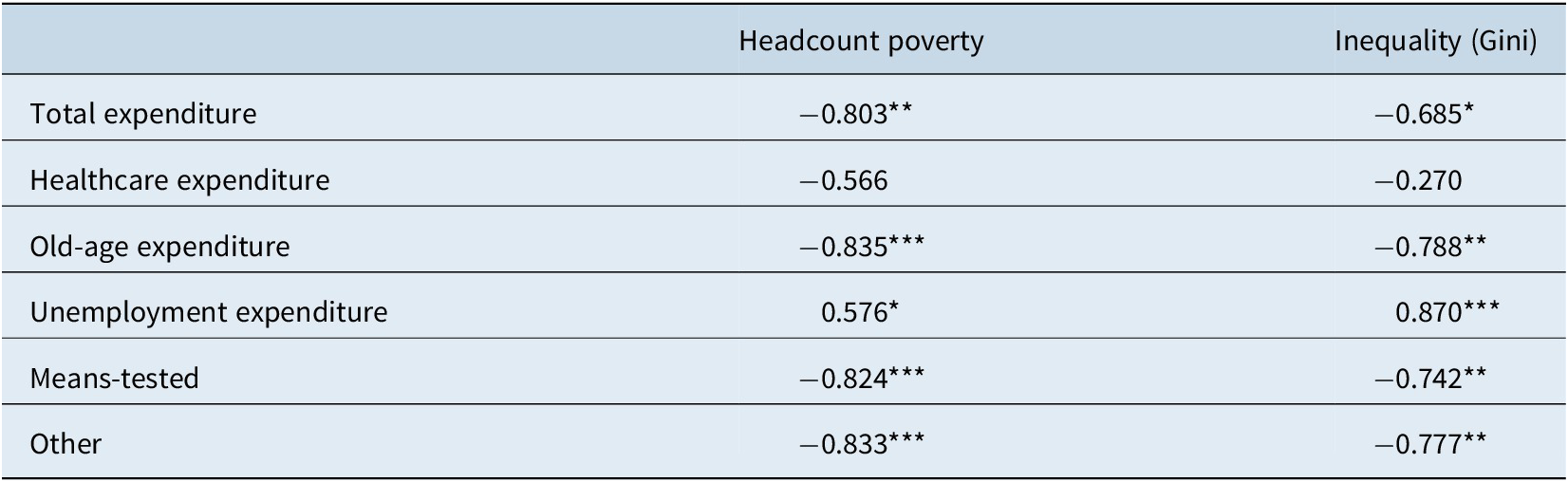
Social protection expenditure in the Western Balkans correlates significantly negatively with headcount poverty and inequality (Table 1). A negative correlation here implies that the expenditure is poverty or inequality reducing. Impact on poverty is higher than on inequality. This impact of total expenditure is consistent with Castles’ (Reference Castles2009) findings for advanced economies – in that the higher the expenditure, the lower seems to be the poverty and inequality. The same occurs with the Western Balkan’s health expenditure which did not seem to contribute relevantly in vertical redistribution in the western, advanced economies as well (Castles, Reference Castles2009; Obinger & Wagschal, Reference Obinger, Petersen and Starke2010). But in contrast with the literature on advanced economies – where expenditure on the working age was found the most relevant in redistribution (Castles, Reference Castles2009; Obinger & Wagschal, Reference Obinger, Petersen and Starke2010), old-age expenditure, means-tested and other expenditure do reduce poverty and inequality significantly in the Western Balkans while unemployment expenditure is significantly positively related. This very likely is explained by the pre-transfer context, with the Western Balkans having a considerably smaller employment rate and a higher co-habitation incidence of old people with other family members. In such a context, any family income through social protection is likely to improve their relative income position. At the same time, unemployment expenditure may correlate positively because most unemployment benefits in the Western Balkans are very short, small and means-tested what signifies high decline in family income after loss of employment. These findings however require cautious reading, in particular due to a very small number of observations – what has been a known problem for comparative studies of advanced welfare states in the near past as well (see Castles, Reference Castles2009; Obinger & Wagschal, Reference Obinger, Petersen and Starke2010).
Strength of correlations of social protection expenditure with poverty and inequality.

N(12); observations are time series of the Balkan mean figures for the period 2005–2016. Data for Bosnia and Herzegovina are missing. *p < 0.05, **p < 0.01, ***p < 0.001; own calculations. Data for national inequality and poverty from the World Bank (Reference Žarković-Rakić, Aleksić-Mirić, Lebedinski and Vladisavljević2021); data for Kosovo based on HBS surveys.
Social transfers and redistribution
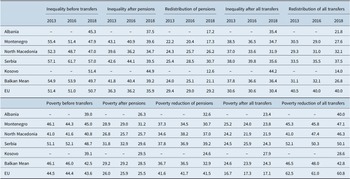
The correlation findings are backed by more straightforward indices produced by Eurostat based on EU-SILC surveys. Table 2 provides evidence on the redistributive impact of the expenditure in the Western Balkans although this is limited to the impact of expenditure as social transfers alone since from Eurostat’s publicly available data, it is impossible to compute the impact of taxes and health expenditure. Table 2 shows that the Western Balkan countries had somewhat higher overall inequality and poverty (eg., 2013 and 2016) compared to EU before transfers, which later (2018) improved. The Western Balkan’s redistribution by pensions is worsened by the addition of Kosovo and Albania, but it is quite substantial. The Balkans though reduce considerably less poverty and inequality by other non-pension transfers compared to the EU. While the means-tested and similar transfers should improve the poverty protection and low-income floors, the EU’s higher redistributive effects should come from higher transfers for the working age, more generous transfers and perhaps higher accuracy. As mentioned before, in some of the Western Balkan countries many transfers are tied to the food poverty line and have eroded over time.
Inequality, poverty (%) and redistributive effects (%).

Variable codes: Inequality before transfers (ilc_di12b), inequality after pensions (ilc_di12c), inequality after transfers (ilc_di12), poverty before transfers (ilc_li09), poverty after pensions (ilc_li10), poverty after transfers (ilc_li02). Inequality = Gini index of inequality. Poverty = At-risk-of-poverty rate (AROP), 60% of median income. Data on Bosnia and Herzegovina are missing. Last update used: 14 September 2021.
Source: Eurostat ( 2021 ).
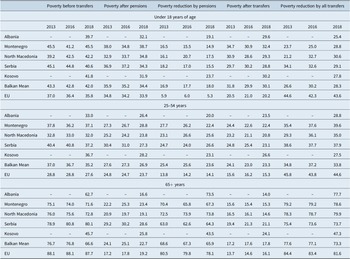
An even more informative picture, backing these arguments, emerges when poverty and the effects of social transfers in reducing it are considered from a cohort perspective (Table 3). While the Western Balkans and the EU have more similar levels of old-age population at risk of poverty (based on disposable income), the Western Balkan poverty rate is higher for the working age population (25–55) and for children (0–18). The Western Balkans have a lower pre-transfer poverty rate among the elderly than does the EU, but the redistributive effect is higher in the EU implying a greater proportionate size of pension payments. Kosovo’s poverty reduction efficiency for the elderly population is considerably below the Balkan mean. The most crucial factor, however, behind the overall smaller poverty and inequality reduction effects of the Western Balkans comes from the fact that poverty before transfers for the working age (25–54 years old) population in the Western Balkans is much higher than in the EU: again more directly indicating that the smaller poverty and inequality reduction effect is related to the tax structure, higher unemployment and a more unequal structure of earnings. This is reflected in higher pre-transfer and overall poverty among children as well, since most parents with young children are normally found in this cohort (25–54).

As has been observed elsewhere (Braithwaite, Grootaert, & Milanovic, Reference Braithwaite, Grootaert and Milanovic1999), the rights to a minimum income are much weaker in post-communist countries than in more advanced welfare states. In addition, the unbalanced expenditure in Western Balkan welfare states, which have much smaller size of working-age and child transfers compared to old-age transfers, is a strong reason behind the different generational outcomes as well, in line with the expectation of Birnbaum et al. (Reference Birnbaum, Ferrarini, Nelson and Plame2017), pp. 67–69) that pro-old social contracts are associated with greater poverty among younger cohorts. But, perhaps a more adequate, fuller explanation relates to the “combined effect” thesis (Adema, Fron, & Ladaique, Reference Adema and Ladaique2014; Morel & Palme, Reference Morel, Palme and Greve2019). We find support for the thesis in that the combined effect of a concentration of transfers to the elderly population, the poor targeting of means-tested transfers, the addition of particularistic (categorical) rights, the smaller overall and working-age size of social protection expenditure compared to the EU, and a regressive tax structure all combine to produce a much less balanced redistributive effect between cohorts. The difference between working-age poverty and old-age poverty is by contrast very small in the EU.
Regressive taxation
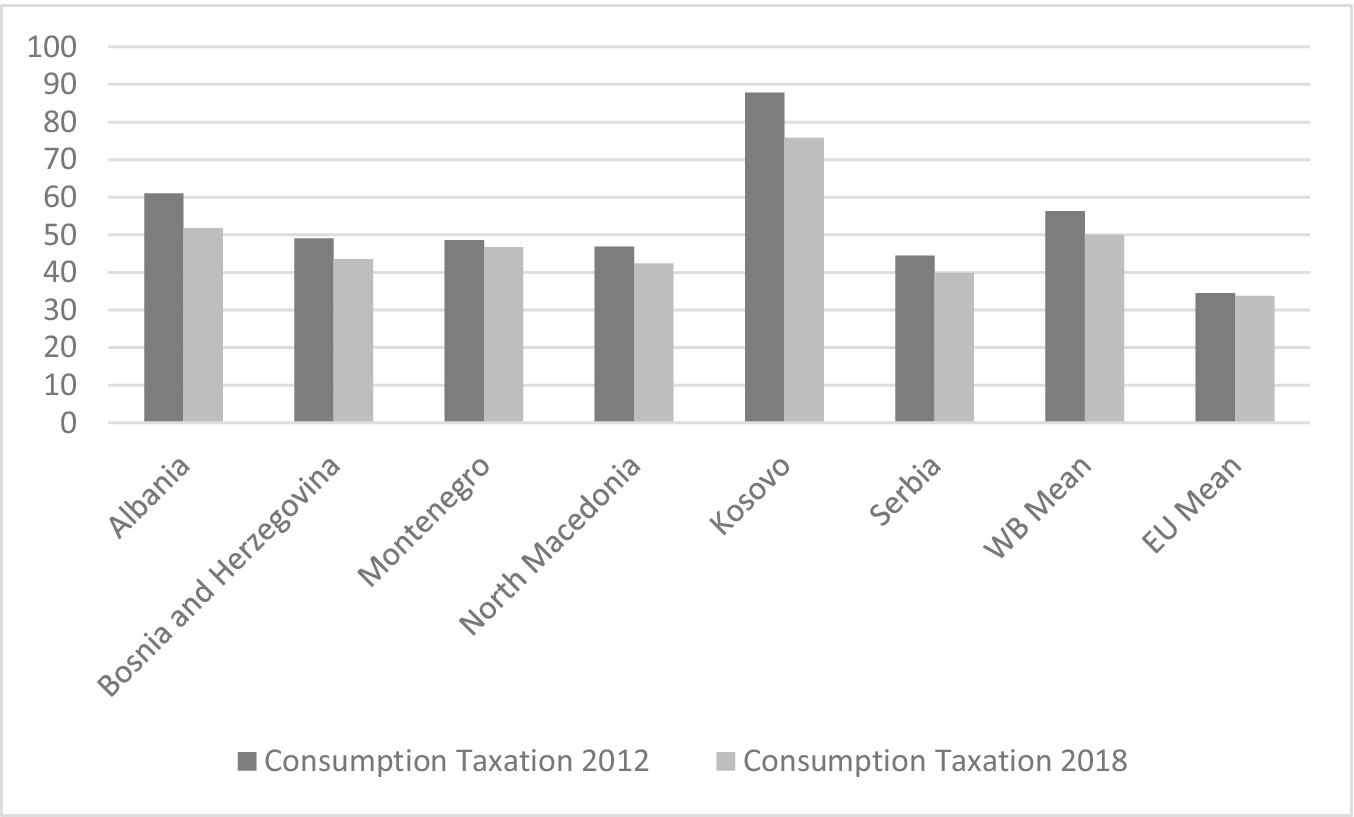
The structure of taxes in the Western Balkans is significantly regressive because the region relies heavily on social contributions, which tend to be regressive everywhere since they generally do not include a zero-contribution bracket. But, since the states’ share in financing social protection expenditure is growing, tax sources of government revenues are relevant to consider as well and may be regressive depending on their structure. Thus, (uniform) consumption taxation tends to be generally more regressive than income taxation, since poorer people spend more of their budget on consumption to cope with living expenses compared to the better-off who may also be able to invest and save (Morel & Palme, Reference Morel, Palme and Greve2019). This is especially relevant for Kosovo, which finances about 75 per cent of its national revenues from consumption taxation and relies heavily on tax revenue for financing its social protection expenditure. In recent years, with an increase of employment, most governments have expanded their revenue through income taxation and the share of consumption taxes has fallen (see Figure 4). Although West Balkan countries apply less progressive income taxation than the EU, Albania improved the tax progressivity of its income tax structure in 2014. In contrast to the EU, reliance on consumption taxation has declined in the recent past. There are some progressive aspects of wealth taxation in the region regarding property taxes as well. Overall, however, the tax structure in the Western Balkans remains quite regressive due to strong reliance on social insurance contributions and consumption taxation.
The share of consumption taxation in total government revenue.
Consumption taxes include VAT, excise duties and customs duties. Sources: IMF 2012a,b, 2018, 2019, 2020a,b; Eurostat, 2014, 2019; Centre of Official Publications (Albania), 2020; Official Gazette of the Republic of Kosovo (2019).

Conclusion
In this paper, we have shown that social protection expenditure relative to GDP is growing in the Western Balkans, although it is smaller than in the EU. However, expenditure is concentrated on the elderly population and is generally financed from a regressive tax structure (made up of social contributions and consumption taxation). This concentration and tax structure, increasing particularism, plus poor means-tested and working-age rights, in addition to the overall smaller size of expenditure, create a smaller redistribution effect – especially towards the working-age and child cohorts – compared to the EU. These outcomes are primarily a result of the design of social rights – determined arguably more by the legacy of socialism and war, decisions and non-decisions of politics, and ideas of international organisations rather than aging and economic resources however relevant these may be.
Hence, the region needs a more balanced generational contract to enhance social justice and the sustainability of the welfare states. The existing contracts have already been tested by the Covid-19 pandemic since March 2020 and new policies tried and utilised in response to the pandemic (see Gerovska-Mitev, Reference Gerovska-Mitev2021; Matković & Stubbs, Reference Matković and Stubbs2020) may lead to long-term modifications of social protection systems. In addition, the recent impact and articulations of the left in countries such as Albania, North Macedonia and Kosovo suggest that the Balkan left’s power may translate in more social rights for the working-age contrary to the experience of the past two decades where politics may have had a bigger role on rejecting neoliberal ideas in key social protection programmes in most countries rather than in expansion of social rights.
Disclosures
Disclosure statement. No potential conflict of interest was reported by the authors.
Notes on Contributors
Artan Mustafa is a senior lecturer of Comparative Politics of Welfare State and Social Policy Analysis at the University for Business and Technology (UBT) in Kosovo. He serves as a national expert on pensions and social inclusion at the European Social Policy Network (ESPN). His research interests and publications include politics of welfare state, social policy design, change and outcomes, social foundations of political parties, Southeastern Europe, etc.
Maja Gerovska-Mitev is a Profess or of Social Policy at the Faculty of Philosophy, Ss. Cyril and Methodius University in Skopje. She is Vice President of the Scientific Advisory Committee of the UNESCO Program “Management of Social Transformations” (2020-2023). She is National Coordinator for North Macedonia at the European Social Policy Network (ESPN). Dr. Gerovska-Mitev’s research examines the changing nature of the welfare systems and its impact on poverty and social exclusion; explores inequalities in access to social protection as well as essential services for low-income people.
Acknowledgment
We are very thankful to Will Bartlett, Milica Uvalić, and anonymous peer reviewers of the journal for their contributing comments and to our European Social Policy Network (ESPN) colleagues Jurij Bajec, Vojin Golubović, Amir Haxhikadrija, Mirna Jusić, Jadranka Kaluđerović, Nikolina Obradović, Ljiljana Pejin Stokić, and Sabina Ymeri - we have relied on and referenced extensively their ESPNpublished national reports on financing social protection.