


1 Introduction
This paper is concerned with local properties of solutions of linear kinetic equations of Fokker–Planck type in some cylindrical domain
 $Q^{0}$
 $$ \begin{align} (\partial_{t} + v \cdot \nabla_{x}) f = \nabla_{v} \cdot ( A \nabla_{v} f) + B \cdot \nabla_{v} f + S \end{align} $$
assuming that the diffusion matrix A is uniformly elliptic and B and S are essentially bounded: There exist
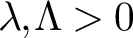 $\lambda ,\Lambda>0$
such that, for almost every
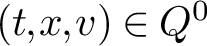 $(t,x,v) \in Q^{0}$
,
 $$ \begin{align} \begin{cases} \text{eigenvalues of } A(t,x,v) = A^{T}(t,x,v) \text{ lie in } [\lambda,\Lambda], \\ \text{the vector field }B\text{ satisfies: } |B(t,x,v)| \le \Lambda. \end{cases} \end{align} $$
In particular, coefficients do not enjoy further regularity such as continuity, vanishing mean oscillation etc. For this reason, coefficients are said to be rough.
1.1 Main result
We classically reduce the local study to the case where
 $Q^{0}$
is at unit scale. For some reasons we expose below,
 $Q^{0}$
takes the form
 $(-1,0]\times B_{R_{0}} \times B_{R_{0}}$
for some large constant
 $R_{0}$
only depending on dimension and the ellipticity constants
 $\lambda ,\Lambda $
in (2).
Before stating our main result, we give the definition of (weak) super-solutions in a cylindrical open set
 $\Omega $
, that is to say an open set of the form
 $I \times B^{x} \times B^{v}$
. A function
 $f \colon \Omega \to \mathbb {R}$
is a weak super-solution of (1) in
 $\Omega $
if
 $f \in L^{\infty } (I, L^{2} (B^{x} \times B^{v})) \cap L^{2} (I \times B^{x}, H^{1}(B^{v}))$
and
 $(\partial _{t} + v \cdot \nabla _{x}) f \in L^{2}(I \times B^{x}, H^{-1}(B^{v}))$
and for all nonnegative
 $\varphi \in \mathcal {D} (\Omega )$
,
 $$ \begin{align*} - \int_{Q^{0}} f (\partial_{t} + v \cdot \nabla_{x}) \varphi \, \mathrm{d}z \ge - \int_{Q^{0}} A \nabla_{v} f \cdot \nabla_{v} \varphi \, \mathrm{d}z + \int_{Q^{0}} (B \cdot \nabla_{v} f+S) \varphi \, \mathrm{d}z. \end{align*} $$
Theorem 1.1 weak Harnack inequality
Let
 $Q^{0} = (-1,0] \times B_{R_{0}} \times B_{R_{0}}$
and
 $A,B$
satisfy (2) and S be essentially bounded in
 $Q^{0}$
. Let f be a nonnegative super-solution of (1) in some cylindrical open set
 $\Omega \supset Q^{0}$
. Then
 $$ \begin{align*} \left( \int_{Q_{-}} f^{p} (z) \, \mathrm{d}z\right)^{\frac1p} \le C \left( \inf_{Q_{+}}f + \|S\|_{L^{\infty} (Q_{+})} \right)\end{align*} $$
where
 $Q_{+} = (-\omega ^{2},0] \times B_{\omega ^{3}} \times B_{\omega }$
and
 $Q_{-} = (-1, -1+\omega ^{2}] \times B_{\omega ^{3}} \times B_{\omega }$
; the positive constants C, p,
 $\omega $
and
 $R_{0}$
only depend on the dimension and the ellipticity constants
 $\lambda , \Lambda $
.
Remark 1. Combined with the fact that nonnegative subsolutions are locally bounded [Reference Pascucci and Polidoro33], the weak Harnack inequality implies the Harnack inequality proved in [Reference Golse, Imbert, Mouhot and Vasseur13]; see Theorem 1.3
Remark 2. The proof of Theorem 1.1 is constructive. As a consequence, it provides a constructive proof of the Harnack inequality from [Reference Golse, Imbert, Mouhot and Vasseur13].
Remark 3. The (weak) Harnack inequality implies Hölder regularity of weak solutions.
Remark 4. Such a weak Harnack inequality can be generalized to the ultraparabolic equations with rough coefficients considered for instance in [Reference Pascucci and Polidoro33, Reference Wang and Zhang40, Reference Wang and Zhang41, Reference Wang and Zhang42].
Remark 5. This estimate can be scaled and stated in arbitrary cylinders thanks to Galilean and scaling invariances of the class of equations of the form (1). These invariances are recalled at the end of the introduction.
Remark 6. As in [Reference Golse, Imbert, Mouhot and Vasseur13, Reference Imbert and Silvestre18], the radius
 $\omega $
is small enough so that when ‘stacking cylinders’ over a small initial one contained in
 $Q_{-}$
, the cylinder
 $Q_{+}$
is captured; see Lemma 4.3. As far as
 $R_{0}$
is concerned, it is large enough so that it is possible to apply the expansion of positivity lemma (see Lemma 4.1) to every stacked cylinder.
Soon after this work was completed, another constructive proof of the Harnack inequality was proposed by the second author and C. Mouhot in [Reference Guerand and Mouhot14]. While in the present article, we start from ideas developed by W. Wang and L. Zhang (see below for further details) and go further than their Hölder bound by deriving a weak Harnack inequality for super-solutions, the first author and C. Mouhot show that De Giorgi’s arguments implemented in [Reference Golse, Imbert, Mouhot and Vasseur13] can be made constructive. It is worth mentioning that they also derive the weak Harnack inequality.
1.2 Historical background and motivations
The weak Harnack inequality from our main theorem and the techniques we develop to establish it are deeply rooted in the large literature about elliptic and parabolic regularity, both in divergence and nondivergence form.
De Giorgi’s theorem and Harnack inequality
E. De Giorgi proved that solutions of elliptic equations in divergence form with rough coefficients are locally Hölder continuous [Reference De Giorgi7, Reference De Giorgi8]. This regularity result for linear equations allowed him to solve Hilbert’s 19th problem by proving the regularity of weak solutions of a nonlinear elliptic equation. The case of parabolic equations was addressed by J. Nash in [Reference Nash32]. Then J. Moser [Reference Moser30, Reference Moser31] showed that a Harnack inequality can be derived for nonnegative solutions of elliptic and parabolic equations with rough coefficients by considering the logarithm of positive solutions. The proof of E. De Giorgi applies not only to solutions of elliptic equations but also to functions in what is now known as the elliptic De Giorgi class. Parabolic De Giorgi classes were then introduced in particular in [Reference Ladyzhenskaya, Solonnikov, Ural’tseva and Smith24].
The log-transform
While the proof of the continuity of solutions for parabolic equations by J. Nash [Reference Nash32] includes the study of the ‘entropy’ of the solution, related to its logarithm, the proof of the Harnack inequality for parabolic equations by Moser [Reference Moser31] relies in an essential way on the observation that the logarithm of the solution of a parabolic equation in divergence form satisfies an equation with a dominating quadratic term in the left-hand side. This observation is then combined with a lemma that is the parabolic counterpart of a result by F. John and L. Nirenberg about functions with bounded mean oscillation. Independently, S. N. Kružkov reached Hölder continuity thanks to a Poincaré inequality due to Sobolev; see [Reference Kružkov21, Reference Kružkov22, Eq. (1.18)]. But his method is not adapted to prove the Harnack inequality. This point will be further discussed in Subsection 1.4 below.
Weak Harnack inequality
Moser [Reference Moser31] and then Trudinger [Reference Trudinger37, Theorem 1.2] proved a weak Harnack inequality for parabolic equations. Lieberman [Reference Lieberman27] made the following comment: ‘It should be noted […] that Trudinger was the first to recognize the significance of the weak Harnack inequality even though it was an easy consequence of previously known results. […]’ He also mentioned that DiBenedetto and Trudinger [Reference DiBenedetto and Trudinger9] showed that nonnegative functions in the elliptic De Giorgi class corresponding to super-solutions of elliptic equations satisfy a weak Harnack inequality and G. L. Wang [Reference Wang38, Reference Wang and Sun39] proved a weak Harnack inequality for functions in the corresponding parabolic De Giorgi class.
Parabolic equations in nondivergence form
N. V. Krylov and M. V. Safonov [Reference Krylov and Safonov23] derived a Harnack inequality for equations in nondivergence form. In order to do so, they introduced a covering argument now known as the ink-spots theorem; see for instance [Reference Imbert and Silvestre17]. Such a covering argument will be later used in the various studies of elliptic equations in divergence form; see e.g., [Reference Wang38, Reference Wang and Sun39] or [Reference DiBenedetto and Trudinger9].
Expansion of positivity
Ferretti and Safonov [Reference Ferretti and Safonov11] established the interior Harnack inequality for both elliptic equations in divergence and nondivergence form by establishing what they called growth lemmas, allowing to control the behavior of solutions in terms of the measure of their super-level sets.
Gianazza and Vespri introduced in [Reference Gianazza and Vespri12] suitable homogeneous parabolic De Giorgi classes of order p and proved a Harnack inequality. They shed light on the fact that their main technical point is an expansion of positivity in the following sense: If a solution lies above
 $\ell $
in a ball
 $B_{\rho }(x)$
at time t, then it lies above
 $\mu \ell $
in a ball
 $B_{2\rho } (x)$
at time
 $t+C \rho ^{p}$
for some universal constants
 $\mu $
and C, that is to say constants only depending on dimension and ellipticity constants. They mentioned that G. L. Wang also used some expansion of positivity in [Reference Wang38].
More recently, R. Schwab and L. Silvestre [Reference Schwab and Silvestre36] used such ideas in order to derive a weak Harnack inequality for parabolic integro-differential equations with very irregular kernels.
Hypoellipticity
In the case where A is the identity matrix, equation (1) was first studied by Kolmogorov [Reference Kolmogoroff19]. He exhibited a regularizing effect, despite the fact that diffusion only occurs in the velocity variable. This was the starting point of the hypoellipticity theory developed by Hörmander [Reference Hörmander15] for equations with smooth variable coefficients (unlike A and B in (1)).
Regularity theory for ultraparabolic equations
The elliptic regularity for degenerate Kolmogorov equations in divergence form with discontinuous coefficients, including (1) with
 $B=0$
, started at the end of the 1990s with contributions including [Reference Bramanti, Cerutti and Manfredini5, Reference Manfredini and Polidoro29, Reference Polidoro and Ragusa34, Reference Polidoro and Ragusa35]. As far as the rough coefficients case is concerned, A. Pascucci and S. Polidoro [Reference Pascucci and Polidoro33] proved that weak (sub)solutions of (1) are locally bounded (from above). This result was later extended in [Reference Cinti, Pascucci and Polidoro6, Reference Anceschi, Polidoro and Ragusa2]. Then W. Wang and L. Zhang [Reference Wang and Zhang40, Reference Wang and Zhang41, Reference Wang and Zhang42] proved that solutions of (1) are Hölder continuous. Even if the authors do not state their result as an a priori estimate, it is possible to derive from their proof the following result for a class of ultraparabolic equations that contains equations of the form (1).
Theorem 1.2 Hölder regularity – [Reference Wang and Zhang40, Reference Wang and Zhang41, Reference Wang and Zhang42]
There exist
 $\alpha \in (0,1)$
only depending on dimension,
 $\lambda $
and
 $\Lambda $
such that all weak solution f of (1) in some cylindrical open set
 $\Omega \supset Q_{1}=(-1,0] \times B_{1} \times B_{1}$
satisfies
 $$ \begin{align*} [f]_{C^{\alpha} (Q_{1/2})} \le C (\|f\|_{L^{2} (Q_{1})} + \|S\|_{L^{\infty}(Q_{1})}) \end{align*} $$
with
 $Q_{1/2} = (-1/4,0] \times B_{1/8} \times B_{1/2}$
; the constant C only depends on the dimension and the ellipticity constants
 $\lambda , \Lambda $
.
More recently, M. Litsgård and K. Nyström [Reference Litsgård and Nyström28] established existence and uniqueness results for the Cauchy Dirichlet problem for Kolmogorov–Fokker–Planck type equations with rough coefficients.
Linear kinetic equations with rough coefficients
Since the resolution of the 19th Hilbert problem by E. de Giorgi [Reference De Giorgi8], it is known that being able to deal with coefficients that are merely bounded is of interest for studying nonlinear problems. There are several models from the kinetic theory of gases related to equations of the form (1) with A, B and S depending on the solution itself. The most famous and important example is probably the Landau equation [Reference Landau, Lifshitz, Peierls and Peierls25].
An alternative proof of the Hölder continuity Theorem 1.2 was proposed by F. Golse, C. Mouhot, A. F. Vasseur and the second author [Reference Golse, Imbert, Mouhot and Vasseur13] and a Harnack inequality was obtained.
Theorem 1.3 Harnack inequality – [Reference Golse, Imbert, Mouhot and Vasseur13]
Let f be a nonnegative weak solution of (1) in some cylindrical open set
 $\Omega $
containing
 $Q^{0} := (-1,0] \times B_{R_{0}} \times B_{R_{0}}$
. Then
 $$ \begin{align*} \sup_{Q_{-}} f \le C \left( \inf_{Q_{+}} f + \| S \|_{L^{\infty}(Q^{0})} \right), \end{align*} $$
where
 $Q_{+} = (-\omega ^{2},0] \times B_{\omega ^{3}} \times B_{\omega }$
and
 $Q_{-} = (-1,-1+\omega ^{2}] \times B_{\omega ^{3}} \times B_{\omega }$
; the positive constants C,
 $R_{0}$
and
 $\omega $
only depend on the dimension and the ellipticity constants
 $\lambda , \Lambda $
.
On the one hand, this new proof is closer to the original argument used by De Giorgi. On the other hand, the second step of the proof from [Reference Golse, Imbert, Mouhot and Vasseur13] relies on a compactness argument while the proof by W. Wang and L. Zhang is constructive. It is worth mentioning that the second author and C. Mouhot [Reference Guerand and Mouhot14] managed to make constructive the De Giorgi argument. We will give further details below.
Such a Harnack inequality implies in particular the strong maximum principle [Reference Anceschi, Eleuteri and Polidoro1] relying on a geometric construction known as Harnack chains. The Hölder regularity result of [Reference Wang and Zhang40] was extended by Y. Zhu [Reference Zhu43] to general transport operators
 $\partial _{t} + b(v)\cdot \nabla _{v}$
for some nonlinear function b.
To finish, we mention that C. Mouhot and the second author [Reference Imbert and Mouhot16] initiated the study of a toy nonlinear model, and F. Anceschi and Y. Zhu continued it in [Reference Anceschi and Zhu3]. Both studies rely in an essential way on Hölder continuity of weak solutions to the linear equation (1).
Hypoelliptic estimates
We previously mentioned that in the case where A and B are
 $C^{\infty }$
, the study of (1) falls into the realm of the hypoellipticity theory developed by Hörmander in [Reference Hörmander15]. Such a point of view over (1) is adopted in [Reference Armstrong and Mourrat4]. Let A be the identity matrix for simplicity. We can write (1) by writing
 $X_{1}^{2}f + X_{0} f + c=0$
, where
 $X_{1}$
and
 $X_{0}$
are the following vector fields:
 $X_{1} = \nabla _{v}$
,
 $X_{0} = (\partial _{t} + v \cdot \nabla _{x})$
and
 $c = B \cdot \nabla _{v} f + S$
. Hörmander mentions that ‘the main point of [his] paper is the proof’ of [Reference Hörmander15, Estimate (3.4)]. In our setting, it reads
 $$ \begin{align*} \| f \|_{H^{\epsilon}_{t,x,v}} \le C (\|f\|_{L^{2}_{t,x}H^{1}_{v}} + \|(\partial_{t} + v \cdot \nabla_{x}) f\|_{L^{2}_{t,x} H^{-1}_{v}})\end{align*} $$
for some
 $\epsilon>0$
.
In order to derive local properties of solutions such as their Hölder continuity by elliptic regularity methods, it is necessary to be able to work with subsolutions of (1). In this case, the source term S is supplemented with
 $- \mu $
, where
 $\mu $
is an arbitrary Radon measure. Such a source term cannot be treated directly by the previous estimate. Comparison principles are used in [Reference Golse, Imbert, Mouhot and Vasseur13] to gain locally some integrability for nonnegative subsolutions.
Kinetic equations with integral diffusions
We would like to conclude this review of literature by mentioning the weak Harnack inequality derived in [Reference Imbert and Silvestre18] for kinetic equations. The proof also relies on De Giorgi type arguments that are combined with a covering argument, referred to as an ink-spots theorem and inspired by the elliptic regularity for equations in nondivergence form (see above). The interested reader is referred to the introduction of [Reference Imbert and Silvestre18] for further details.
1.3 Weak expansion of positivity
The proof of the main result of this article relies on proving that super-solutions of (1) expand positivity along times (Lemma 4.1) and to combine it with the covering argument from [Reference Imbert and Silvestre18] mentioned in the previous paragraph. The derivation of the weak Harnack inequality in the present article from the expansion of positivity follows very closely the reasoning in [Reference Imbert and Silvestre18].
In contrast with parabolic equations, it is not possible to apply the Poincaré inequality in v for
 $(t,x)$
fixed when studying solutions of linear Fokker–Planck equations such as (1). Instead, if a subsolution vanishes enough, then a quantity replacing the average in the usual Poincaré inequality is decreased in the future. See
 $\theta _{0} M$
in the weak Poincaré inequality in the next paragraph (Theorem 1.4).
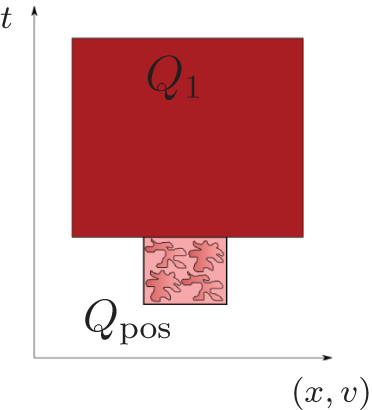
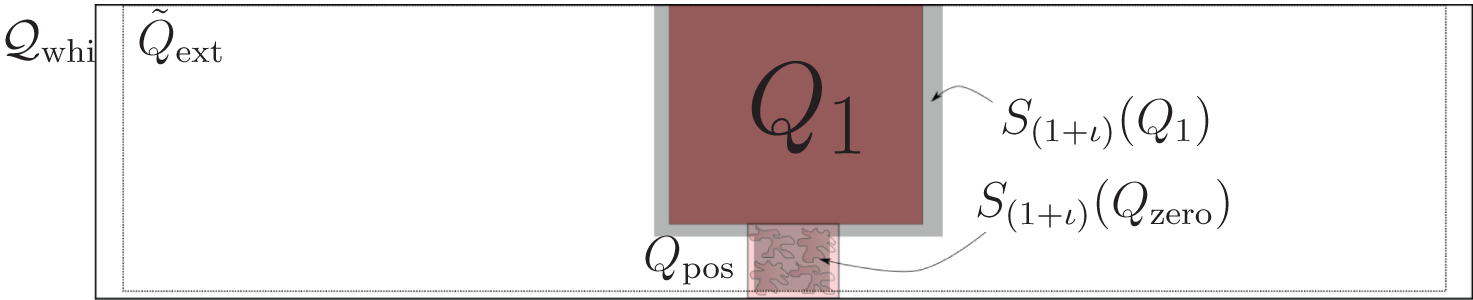
We establish the expansion of positivity of super-solutions in the spirit of [Reference Ferretti and Safonov11]. Given a small cylinder
 $Q_{\mathrm {pos}}$
lying in the past of
 $Q_{1}$
(see Figure 1), Lemma 4.1 states that, if a super-solution f lies above
 $1$
in ‘a good proportion’ of
 $Q_{\mathrm {pos}}$
, then it lies above a constant
 $\ell _{0}>0$
in the whole cylinder
 $Q_{1}$
. Roughly speaking, such a lemma transforms an information in measure about positivity in the past into a pointwise positivity in the future in a (much) larger cylinder.
Expansion of positivity.

We emphasize the fact that in the classical parabolic case, S. N. Kružkov does not need to prove such an expansion of positivity to get Hölder continuity of solutions. But he cannot reach the weak Harnack inequality. To get an Hölder estimate, he uses an appropriate Poincaré inequality that can be applied at any time
 $t>0$
. Such an approach is not applicable in the x-dependent case.
Such a weak propagation of positivity was already proved in [Reference Golse, Imbert, Mouhot and Vasseur13] thanks to a lemma of intermediate values in the spirit of De Giorgi’s original proof. While the proof of this key lemma uses a compactness argument in [Reference Golse, Imbert, Mouhot and Vasseur13], C. Mouhot and the first author [Reference Guerand and Mouhot14] found a constructive proof of it.
1.4 A weak Poincaré inequality
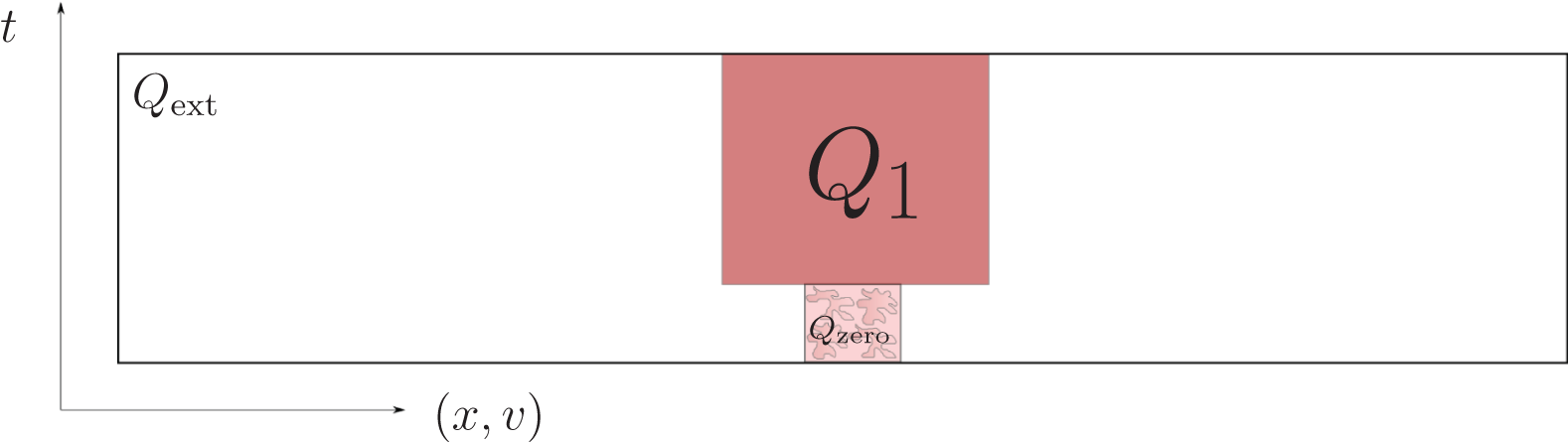
The proof of the expansion of positivity relies on a weak Poincaré inequality. It is worth mentioning that Armstrong and Mourrat proved in [Reference Armstrong and Mourrat4] a Poincaré inequality. Unfortunately, such a Poincaré inequality cannot be applied to subsolutions (see the discussion on page 5). The geometric setting of the next theorem is shown in Figure 2
Theorem 1.4 Weak Poincaré inequality
Let
 $\eta \in (0,1)$
. There exist
 $R> 1$
and
 $\theta _{0} \in (0,1)$
depending on dimension and
 $\eta $
such that, if
 $Q_{\mathrm {ext}} = (-1-\eta ^{2},0] \times B_{8R} \times B_{2R}$
and
 $Q_{\mathrm {zero}} = (-1-\eta ^{2},-1] \times B_{\eta ^{3}} \times B_{\eta } $
(see Figure 2), then for any nonnegative function
 $f \in L^{2} (Q_{\mathrm {ext}})$
such that
 $\nabla _{v} f \in L^{2} (Q_{\mathrm {ext}})$
,
 $(\partial _{t} +v\cdot \nabla _{x}) f \in L^{2}((-1-\eta ^{2},0] \times B_{8R},H^{-1}(B_{2R}))$
,
 $f \le M $
in
 $Q_{\mathrm {ext}}$
and
 $|\{ f = 0 \} \cap Q_{\mathrm {zero}}| \ge \frac 14 |Q_{\mathrm {zero}}|, $
satisfying
 $$ \begin{align*} (\partial_{t} + v \cdot \nabla_{x}) f \le H &\quad \mbox{ in } \mathcal{D}^{\prime} (Q_{\mathrm{ext}}) \quad \mbox{ with } H \in L^{2}_{t,x} H^{-1}_{v}(Q_{\mathrm{ext}}), \end{align*} $$
we have
 $$ \begin{align*} \| (f -\theta_{0} M)_{+} \|_{L^{2} (Q_{1})} \le C (\|\nabla_{v} f \|_{L^{2} (Q_{\mathrm{ext}})} + \|H\|_{L^{2}_{t,x} H^{-1}_{v}(Q_{\mathrm{ext}})}) \end{align*} $$
for some constant
 $C>0$
only depending on dimension.
Remark 7. In the previous statement,
 $L^{2}_{t,x} H^{-1}_{v}(Q_{\mathrm {ext}})$
is a shorthand notation for
 $L^{2}((-1-\eta ^{2},0] \times B_{8R}, H^{-1}(B_{2R}))$
.
Geometric setting of the weak Poincaré inequality.

A somewhat similar inequality was introduced by W. Wang and L. Zhang for subsolutions of ultraparabolic equations; see for instance [Reference Wang and Zhang40, Lemmas 3.3 & 3.4] and the corresponding lemmas in [Reference Wang and Zhang41, Reference Wang and Zhang42]. The statements and proofs share similarities, and we explain next in what they differ. The main difference between statements comes from the fact that the information in measure in Theorem 1.4, the information in measure
 $|\{f=0\} \cap Q_{\mathrm {zero}}| \ge \frac 14 |Q_{\mathrm {zero}}|$
comes ‘from the past’ since
 $Q_{\mathrm {zero}}$
is contained in
 $\{t \le -1\}$
while the functional inequality is stated in
 $Q_{1} \subset \{t>-1\}$
. This is in contrast with [Reference Wang and Zhang40, Reference Wang and Zhang41, Reference Wang and Zhang42] and [Reference Kružkov21, Reference Kružkov22]; indeed, in these works the information in measure is contained in
 $\{ -1 < t \le 0\}$
and the pointwise bound is derived in the same time interval. For this reason, it is not possible to derive a (weak) Harnack inequality directly from these proofs because no time lap is considered or no positivity is propagated in time. Moreover, we adopt the functional framework from [Reference Armstrong and Mourrat4] and forget about the equation under study. The main difference in proofs lies on the fact that we avoid using repeatedly the exact form of the fundamental solution of the Kolmogorov equation, and we seek for arguments closer to the classical theory of parabolic equations presented, for instance, in [Reference Ladyzhenskaya, Solonnikov, Ural’tseva and Smith24] or [Reference Lieberman27]. In contrast with [Reference Wang and Zhang40, Reference Wang and Zhang41, Reference Wang and Zhang42], the information obtained through the log-transform is summarized in only one weak Poincaré inequality (while it is split it several lemmas in [Reference Wang and Zhang40, Reference Wang and Zhang41, Reference Wang and Zhang42]) and the geometric settings of the main lemmas are as simple as possible. For instance, it is the same for the weak Harnack inequality and for the lemma of expansion of positivity (Lemma 4.1). We also mostly use cylinders respecting the invariances of the equation (see the defintion of
 $Q_{r}(z)$
in the paragraph devoted to notation), except the ‘large’ cylinders where the equation is satisfied such as
 $Q_{\mathrm {ext}}$
in Theorem 1.4.
The Lie group structure
Equation (1) is not translation invariant in the velocity variable because of the free transport term. But this (class of) equation(s) comes from mathematical physics, and it enjoys the Galilean invariance: In a frame moving with constant speed
 $v_{0}$
, the equation is the same. For
 $z_{1} =(t_{1},x_{1},v_{1})$
and
 $z_{2} = (t_{2},x_{2},v_{2})$
, we define the following noncommutative group product
 $$ \begin{align*} z_{1} \circ z_{2} = (t_{1}+t_{2},x_{1}+x_{2} + t_{2} v_{1}, v_{1} + v_{2}). \end{align*} $$
In particular, for
 $z = (t,x,v)$
, the inverse element is
 $z^{-1} = (-t,-x+tv,-v)$
.
Scaling and cylinders
Given a parameter
 $r>0$
, the class of equations (1) is invariant under the scaling
 $$ \begin{align*} f_{r} (t,x,v) = f(r^{2} t, r^{3}x, r v ). \end{align*} $$
It is convenient to write
 $S_{r}(z) = (r^{2}t,r^{3}x,rv)$
if
 $z = (t,x,v)$
. It is thus natural to consider the following cylinders ‘centered’ at
 $(0,0,0)$
of radius
 $r>0$
:
 $Q_{r} = (-r^{2},0] \times B_{r^{3}} \times B_{r} = S_{r} (Q_{1})$
. Moreover, in view of the Galilean invariance, it is then natural to consider cylinders centered at
 $z_{0} \in \mathbb {R}^{1+2d}$
of radius
 $r>0$
of the form:
 $Q_{r} (z_{0}) := z_{0} \circ Q_{r} $
which is
 $$ \begin{align*} Q_{r}(z_{0}) &:= \left\{ z \in \mathbb{R}^{1+2d} \ : \ z_{0}^{-1} \circ z \in Q_{r}(0) \right\} \\ &:= \left\{ -r^{2} <t-t_{0} \le 0, \ |x - x_{0}- (t-t_{0})v_{0}| < r^{3}, \ |v-v_{0}| < r \right\}. \end{align*} $$
Organization of the article
In Section 2, the definition of weak subsolutions, super-solutions and solutions for (1) is recalled and two properties of the log-transform are given. Section 3 is devoted to the proof of the weak Poincaré inequality. In Section 4, we explain how to derive the lemma of expansion of positivity from the weak Poincaré inequality and how to prove the weak Harnack inequality from expansion of positivity by using a covering lemma called the ink-spots theorem. This last result is recalled in Appendix A. In another appendix, see B, we recall how Hölder regularity can be derived directly from the expansion of positivity of super-solutions. The proof of a technical lemma about stacked cylinders is given in Appendix C.
Notation
The open ball of the Euclidian space centered at c of radius R is denoted by
 $B_{R} (c)$
. The measure of a Lebesgue set A of the Euclidian space is denoted by
 $|A|$
. The z variable refers to
 $(t,x,v) \in \mathbb {R} \times \mathbb {R}^{d} \times \mathbb {R}^{d} =\mathbb {R}^{1+2d}$
. For
 $z_{1},z_{2} \in \mathbb {R}^{1+2d}$
,
 $z_{1} \circ z_{2}$
denotes their Lie group product and
 $z_{1}^{-1}$
denotes the inverse of
 $z_{1}$
with respect to
 $\circ $
. For
 $r>0$
,
 $S_{r}$
denotes the scaling operator. A constant is said to be universal if it only depends on dimension and the ellipticity constants
 $\lambda ,\Lambda $
appearing in (2). The notation
 $a \lesssim b$
means that
 $a \le Cb$
for some universal constant
 $C>0$
.
For an open set
 $\Omega $
,
 $\mathcal {D} (\Omega )$
denotes the set of
 $C^{\infty }$
functions compactly supported in
 $\Omega $
while
 $\mathcal {D}^{\prime } (\Omega )$
denotes the set of distributions in
 $\Omega $
.
2 Weak solutions and log-transform
2.1 Weak solutions
We start with the definition of weak (super- and sub-) solutions of (1).
Definition 2.1 Weak solutions
Let
 $\Omega = I \times B^{x} \times B^{v}$
be open. A function
 $f\colon \Omega \to \mathbb {R}$
is a weak super-solution (resp. weak subsolution) of (1) in
 $\Omega $
if
 $f \in L^{\infty } (I, L^{2} (B^{x} \times B^{v})) \cap L^{2} (I \times B^{x}, H^{1}(B^{v}))$
and
 $(\partial _{t} + v \cdot \nabla _{x}) f \in L^{2}(I \times B^{x}, H^{-1}(B^{v}))$
and
 $$ \begin{align*} - \int f (\partial_{t} + v \cdot \nabla_{x}) \varphi \, \mathrm{d}z + \int A \nabla_{v} f \cdot \nabla_{v} \varphi \, \mathrm{d}z - \int (B \cdot \nabla_{v} f+S) \varphi \, \mathrm{d}z \ge 0 \quad \text{(resp. }\le 0\text{)} \end{align*} $$
for all nonnegative
 $\varphi \in \mathcal {D}(\Omega )$
. It is a weak solution of (1) in Q if it is both a weak super-solution and a weak subsolution.
As explained in the introduction, the local boundedness of subsolutions has been known since [Reference Pascucci and Polidoro33]. We give below the version contained in [Reference Golse, Imbert, Mouhot and Vasseur13].
Proposition 2.1 Local upper bound for subsolutions – [Reference Golse, Imbert, Mouhot and Vasseur13]
Consider two cylinders
 $Q_{\mathrm {int}} = (t_{1},T] \times B_{r_{x}} \times B_{r_{v}}$
and
 $Q_{\mathrm {ext}} = (t_{0},T] \times B_{R_{x}} \times B_{R_{v}}$
with
 $t_{1}> t_{0}$
,
 $r_{x} <R_{x}$
and
 $r_{v} < R_{v}$
. Assume that f is a subsolution of (1) in some cylindrical open set
 $\Omega \supset Q_{\mathrm {ext}}$
. Then
 $$ \begin{align*} \sup_{Q_{\mathrm{int}}} f \le C ( \| f_{+} \|_{L^{2}(Q_{\mathrm{ext}})} + \|S\|_{L^{\infty} (Q_{\mathrm{ext}})}), \end{align*} $$
where C only depends on
 $d,\lambda ,\Lambda $
and
 $(t_{1} -t_{0},R_{x}-r_{x},R_{v}-r_{v})$
.
2.2 Log-transform of subsolutions
For technicals reasons, the positive part of the opposite of the logarithm is replaced with a more regular function G that keeps the important features of
 $\max (0, {-}\ln )$
. The function
 $\max (0, {-}\ln )$
was first considered in [Reference Kružkov21, Reference Kružkov22].
Lemma 2.1 A convex function
There exists
 $G: (0, {+}\infty ) \to [0, {+}\infty )$
nonincreasing and
 $C^{2}$
such that
-
•
 $G^{\prime \prime } \ge (G^{\prime })^{2} \text { and } G^{\prime } \le 0 \text { in } (0,+\infty )$
,
-
• G is supported in
$(0,1]$
, -
•
$G (t) \sim - \ln t$
as
$t \to 0^{+}$
, -
•
$-G^{\prime }(t) \le \frac 1t$
for
$t \in (0,\frac 14]$
.


Lemma 2.2 Log-transform of solutions
Let
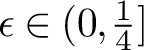 $\epsilon \in (0,\frac 14]$
and f be a nonnegative weak super-solution of (1) in a cylinder
 $Q_{\mathrm {ext}} = (t_{0},T] \times B_{R_{x}} \times B_{R_{v}}$
. Then
 $g = G(\epsilon +f)$
satisfies
 $$ \begin{align*} (\partial_{t} + v \cdot \nabla_{x} ) g + \lambda |\nabla_{v} g|^{2} \le \nabla_{v} \cdot (A \nabla_{v} g) + B \cdot \nabla_{v} g + \epsilon^{-1} |S| \quad \text{ in } Q_{\mathrm{ext}}, \end{align*} $$
i.e., it is a subsolution of the corresponding equation in
 $Q_{\mathrm {ext}}$
.
Proof. We first note that
 $g \in L^{\infty } (Q_{\mathrm {ext}})$
since
 $0 \le g \le G(\epsilon )$
. Moreover,
 $\nabla _{v} g = G^{\prime }(\epsilon + f) \nabla _{v} f$
with
 $|G^{\prime }(\epsilon +f)| \le |G^{\prime }(\epsilon )|$
. In particular,
 $g \in L^{2} ((t_{0},T] \times B_{R_{x}}, H^{1} (B_{R_{v}}))$
. In order to obtain the subequation, it is sufficient to consider the test-function
 $G^{\prime }(\epsilon +f) \Psi $
in the definition of super-solution for f.
The following observation is key in Moser’s reasoning since the square of the
 $L^{2}$
-norm of
 $\nabla _{v} g$
is controlled by the mass of g.
Lemma 2.3 The mass of g
Let f be a nonnegative weak subsolution of (1) in a cylinder
 $Q_{\mathrm {ext}} = (t_{0},T] \times B_{r_{x}} \times B_{r_{v}}$
and
 $Q_{\mathrm {int}} = (t_{1},T] \times B_{R_{x}} \times B_{R_{v}}$
with
 $t_{1}> t_{0}$
,
 $r_{x} < R_{x}$
and
 $r_{v} < R_{v}$
. Then
 $$ \begin{align*} \frac{\lambda}2 \int_{Q_{\mathrm{int}}} |\nabla_{v} g |^{2} \le C \left( \int_{Q_{\mathrm{ext}}} g(\tau) + 1 + \epsilon^{-1} \|S\|_{L^{\infty}(Q_{\mathrm{ext}})} \right), \end{align*} $$
where C depends on dimension,
 $\lambda $
,
 $\Lambda $
,
 $Q_{\mathrm {int}}$
and
 $Q_{\mathrm {ext}}$
.
Proof. Consider a smooth cut-off function
 $\Psi $
valued in
 $[0,1]$
, supported in
 $Q_{\mathrm {ext}}$
and equal to
 $1$
in
 $Q_{\mathrm {int}}$
, and use
 $\Psi ^{2}$
as a test-function for the subequation satisfied by g, and get
 $$ \begin{align*} \lambda \int |\nabla_{v} g|^{2} \Psi^{2} \le &- 2 \int A \nabla_{v} g \cdot \Psi \nabla_{v} \Psi + \int g (\partial_{t} + v \cdot \nabla_{x}) \Psi^{2} + \int (B \cdot \nabla_{v} g + \epsilon^{-1} |S| ) \Psi^{2} \\ \le & \frac\lambda4 \int |\nabla_{v} g |^{2} \Psi^{2} + C (1+\int_{Q_{\mathrm{ext}}} g) + \frac\lambda4 \int |\nabla_{v} g |^{2} \Psi^{2} + C \epsilon^{-1} \|S\|_{L^{\infty}(Q_{\mathrm{ext}})}. \end{align*} $$
This yields the desired estimate.
2.3 Kružkov’s proof in the parabolic case
In this subsection, we discuss how Kružkov proved in [Reference Kružkov21, Reference Kružkov22] (see also [Reference Kružkov20]) Hölder continuity of solutions of parabolic equations corresponding to solutions u of (1) such that the solution and the coefficients
 $A,B$
and S are independent of the x variable. It relies on the local boundedness of nonnegative subsolutions [Reference Kružkov20, Theorem 2.1] and a Poincaré inequality due to Sobolev and Ilin.
A Poincaré inequality
We start with presenting the functional inequality [Reference Kružkov22, (1.8)]: for any
 $u \in H^{1}(B_{r})$
and
 $N \subset B_{r}$
such that
 $|N| \ge c_{0} r^{d}$
,
 $$ \begin{align*} r^{-2d/p} \|u\|^{2}_{L^{p}(B_{r})} \le c \left[ r^{-d+2} \| \nabla u\|_{L^{2}(B_{r})}^{2} + r^{-d} \|u\|^{2}_{L^{2}(N)} \right] \end{align*} $$
for
 $p \in [2, 2d/(d-2)]$
for
 $d \ge 3$
and
 $p>0$
arbitrary for
 $d=2$
and
 $c=c(d,p)$
. In particular, if
 $N = \{ u =0\}$
and
 $p=2$
, this implies
 $$ \begin{align} \|u\|_{L^{2}(B_{r})} \le C \| \nabla u \|_{L^{2} (B_{r})} \end{align} $$
for some
 $C = C(d,r)$
.
Decrease of the oscillation
Kružkov proves a local Hölder estimate [Reference Kružkov20, Theorem 3.1] by proving that the oscillation of a bounded solution decreases by a universal factor strictly smaller than
 $1$
. We change here some constants in his proof, but we follow exactly the same reasoning. See [Reference Kružkov20, p. 187--190].
Consider a nonnegative super-solution
 $u=u(t,v)$
of (1), and assume that
 $$ \begin{align} |\{ u \ge 1\} \cap (-1,0]\times B_{1} | \ge \frac12 |B_{1}|. \end{align} $$
WeFootnote
1
then prove that
 $u \ge \ell _{0}$
in
 $(-\theta ^{2},0] \times B_{\theta }$
. Such a result implies the decrease of oscillation and in turn yields the Hölder estimate.
A pointwise in time estimate
In order to get a lower bound on u in
 $(-\theta ^{2},0] \times B_{\theta }$
, Kružkov first proves that there exist
 $\omega , \beta , h>0$
such that, for a.e.
 $t \in (-\omega ,0]$
, we have
 $$ \begin{align} |\{ x \in B_{\beta} : u \ge h \}| \ge (1/4)|B_{\beta}|. \end{align} $$
In words, the lower bound on the volume of
 $\{ u \ge 1\}$
is made pointwise in time. It is necessary to apply the Poincaré inequality (3) after freezing the time variable.
To get such a result, Kružkov first considers
 $\mu (t) = |\{ u(t) \ge 1 \} \cap B_{1}|$
and remarks that (4) implies that there exists
 $\omega $
small and
 $\tau \in (-1,-\omega ]$
so that u is defined a.e. in
 $B_{1}$
and
 $\mu (\tau ) \ge \frac {1/2-\omega }{1-\omega } |B_{1}|$
. In particular, considering
 $w = G(u+h)$
 $$ \begin{align*} \int_{B_{\beta}} w(\tau,v) \, \mathrm{d}v & \le G(h) |\{ u(\tau) \le 1 \} \cap B_{1}| \\ & \le G(h) \left( 1 - \frac{1/2-\omega}{1-\omega} \right) |B_{1}| \\ & \le \frac23 G(h) |B_{\beta}| \end{align*} $$
the last inequality holding true if
 $\beta $
is chosen so that
 $2(1-\omega ) \beta ^{d} = 3/2$
.
He then uses the evolution of the mass of w with time. Let us assume
 $B=0$
and
 $S=0$
for simplicity. Using Lemma 2.2, we can get that, for a.e.
 $t \in (\tau , 0]$
,
 $$ \begin{align*} \int_{B_{\beta}} w(t,v) \, \mathrm{d}v \le \int_{B_{\beta}} w(\tau,v) \, \mathrm{d}v + C .\end{align*} $$
Since for
 $u(t,v) \le h$
, we also have
 $w(t,v) \ge G(2h)$
, we can write, for a.e.
 $t \in (-\omega ,0]$
,
 $$ \begin{align*} G(2h) |\{ u( t) \le h \} \cap B_{\beta} | & \le \int_{B_{\beta}} w(t,v) \, \mathrm{d}v \\ & \le \int_{B_{\beta}} w(\tau,v) \, \mathrm{d}v + C \\ & \le \frac23 G(h) |B_{\beta}| +C. \end{align*} $$
This implies (5) by choosing h small enough.
The decrease of oscillation
With (5) at hand, Kružkov then considers
 $g = G((u+\epsilon )/h)$
and combines i) local boundedness of nonnegative subsolutions with ii) the Poincaré inequality (3) and iii) the rough estimate of the mass of g given by Lemma 2.3 to get for
 $\theta $
small enough,
 $$ \begin{align*} \sup_{(-\theta^{2},0]\times B_{\theta}} g^{2} & \le C \int_{(-\omega,0] \times B_{\beta}} g^{2}\, \mathrm{d}t \, \mathrm{d}v \quad \text{(local boundedness of subsolutions)} \\ & \le C \int_{(-\omega,0] \times B_{\beta}} |\nabla_{v} g|^{2} \, \mathrm{d}t \, \mathrm{d}v \quad \text{(Poincar}\acute{\rm e}\ \text{inequality)} \\ & \le C \left(\int_{(-\omega,0] \times B_{\beta}} g \, \mathrm{d}t \, \mathrm{d}v +1 \right) \quad \text{(Lemma 2.3)} \\ & \le C G(\epsilon/h). \end{align*} $$
This implies that
 $G((u+\epsilon )/h) \le C \sqrt {G(\epsilon /h)}$
in
 $Q_{\theta }$
, and since
 $G(t) \sim -\ln t$
as
 $t \to 0^{+}$
, we get the desired lower bound on u in
 $Q_{\theta }$
by choosing
 $\epsilon $
small enough.
3 A weak Poincaré inequality
In order to prove Theorem 1.4, we first derive a local Poincaré inequality (Lemma 3.1) with an error function h due to the localization. This function h satisfies
 $$ \begin{align} \begin{cases} \mathcal{L}_{K} h = f \mathcal{L}_{K} \Psi, & \text{ in } (a,b) \times \mathbb{R}^{2d},\\ h = 0, & \text{ in } \{a \} \times \mathbb{R}^{2d}, \end{cases} \end{align} $$
where
 $\mathcal {L}_{K} = (\partial _{t} + v\cdot \nabla _{x}) - \Delta _{v}$
is the Kolmogorov operator and
 $\Psi $
is a cut-off function equal to
 $1$
in
 $Q_{1}$
. We will estimate h in Lemma 3.2 below.
Lemma 3.1 A local estimate
Let
 $Q_{\mathrm {ext}} = (a,0] \times B_{R_{x}} \times B_{R_{v}}$
be a cylinder such that
 $\overline {Q_{1}} \subset Q_{\mathrm {ext}}$
, and let
 $\Psi \colon \mathbb {R}^{2d+1} \to [0,1]$
be
 $C^{\infty }$
, supported in
 $Q_{\mathrm {ext}}$
and
 $\Psi =1$
in
 $Q_{1}$
. Then for any function
 $f \in L^{2} (Q_{\mathrm {ext}})$
such that
 $\nabla _{v} f \in L^{2} (Q_{\mathrm {ext}})$
and
 $(\partial _{t} + v \cdot \nabla _{x}) f \le H$
in
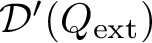 $\mathcal {D}^{\prime } (Q_{\mathrm {ext}})$
with
 $H \in L^{2} ((a,0] \times B_{R_{x}} ,H^{-1}(B_{R_{v}}))$
, we have
 $$ \begin{align*} \| (f -h)_{+} \|_{L^{2} (Q_{1})} \le C (\|\nabla_{v} f \|_{L^{2} (Q_{\mathrm{ext}})} + \|H \|_{L^{2} ((a,0] \times B_{R_{x}} ,H^{-1} (B_{R_{v}}))}), \end{align*} $$
where h satisfies the Cauchy problem (6) and
 $C = c(a) (1+\|\nabla _{v} \Psi \|_{\infty })$
for some constant
 $c(a)$
only depending on
 $|a|$
.
Proof. Since
 $H \in L^{2}((a, 0]\times B_{R_{x}},H^{-1} (B_{R_{v}}))$
, there exists
 $H_{0},H_{1} \in L^{2} (Q_{\mathrm {ext}})$
such that
 $H = \nabla _{v} \cdot H_{1} + H_{0}$
and such that
 $ \|H_{0} \|_{L^{2}(Q_{\mathrm {ext}})}+\|H_{1} \|_{L^{2}(Q_{\mathrm {ext}})}\leq 2\|H \|_{L^{2} ((a,0] \times B_{R_{x}} ,H^{-1} (B_{R_{v}}))}$
(see for instance [Reference Evans10]). The function
 $g = f \Psi $
satisfies
 $$ \begin{align*} \mathcal{L}_{K} g \le \nabla_{v} \cdot \tilde H_{1} + \tilde H_{0} + f [(\partial_{t} + v \cdot \nabla_{x}) \Psi - \Delta_{v} \Psi] \text{ in } \mathcal{D}^{\prime}((a,0) \times \mathbb{R}^{2d}) \end{align*} $$
with
 $\tilde H_{1} = (H_{1}- \nabla _{v} f) \Psi $
and
 $\tilde H_{0} = H_{0} \Psi - H_{1} \nabla _{v} \Psi - \nabla _{v} \Psi \cdot \nabla _{v} f$
. We thus get
 $$ \begin{align*} \mathcal{L}_{K} (g-h) \le \tilde H \text{ in } \mathcal{D}^{\prime}((a,0) \times \mathbb{R}^{2d}) \end{align*} $$
with
 $\tilde H = \nabla _{v} \cdot \tilde H_{1} + \tilde H_{0}$
. We then multiply by
 $(g-h)_{+}$
to get the natural energy estimate for all
 $T, T^{\prime }\in (a,0)$
and
 $\epsilon>0$
,
 $$ \begin{align*} \int (g-h)_{+}^{2} (T,x,v) \, \mathrm{d}x \, \mathrm{d}v & + \int_{a}^{T^{\prime}} \int |\nabla_{v} (g-h)_{+} |^{2} \, \mathrm{d}t \, \mathrm{d}x \, \mathrm{d}v \\ \le & 2 \int_{a}^{0} \int |-\tilde H_{1} \cdot \nabla_{v} (g-h)_{+} + \tilde H_{0} (g-h)_{+}| \, \mathrm{d}t \, \mathrm{d}x \, \mathrm{d}v \\ \le & \frac12 \| \nabla_{v} (g-h)_{+}\|^{2}_{L^{2} ((a,0] \times \mathbb{R}^{2d})}+ 2\|\tilde H_{1}\|^{2}_{L^{2} ((a,0] \times \mathbb{R}^{2d})}\\ &+ 2\epsilon \| (g-h)_{+} \|^{2}_{L^{2} ((a,0] \times \mathbb{R}^{2d})} + \frac1{2\epsilon} \| \tilde H_{0} \|^{2}_{L^{2} ((a,0] \times \mathbb{R}^{2d})}. \end{align*} $$
Remark that we can deal with the two terms of the left-hand side separately so that we can consider the two parameters T and
 $T^{\prime }$
. Writing
 $\|\cdot \|_{L^{2}}$
for
 $\|\cdot \|_{L^{2} ((a,0] \times \mathbb {R}^{2d})}$
, we get after integrating in T from a to
 $0$
, and choosing
 $T^{\prime }=0$
 $$ \begin{align*} \| (g-h)_{+}\|_{L^{2}}^{2} \le -2\epsilon a \| (g-h)_{+}\|^{2}_{L^{2} } - a \|\tilde H_{1}\|^{2}_{L^{2}} - \frac{a}{2\epsilon} \|\tilde H_{0}\|^{2}_{L^{2} } .\end{align*} $$
Then remark that the function
 $(g-h)_{+}$
equals
 $(f -h)_{+}$
in
 $Q_{1}$
and that
 $$ \begin{align*} \| \tilde H_{1} \|_{L^{2}((a,0] \times \mathbb{R}^{2d})} & \le \|H_{1}\|_{L^{2}(Q_{\mathrm{ext}})} + \|\nabla_{v} f \|_{L^{2}(Q_{\mathrm{ext}})}, \\ \| \tilde H_{0} \|_{L^{2}((a,0] \times \mathbb{R}^{2d})} & \le \|H_{0}\|_{L^{2}(Q_{\mathrm{ext}})} + \|\nabla_{v} \Psi\|_{\infty} ( \|H_{1}\|_{L^{2}(Q_{\mathrm{ext}})} + \|\nabla_{v} f \|_{L^{2}(Q_{\mathrm{ext}})} ). \end{align*} $$
We get the desired inequality by combining the three previous inequalities and choosing
 $\epsilon = -(4a)^{-1}$
.
In view of Lemma 3.1, in order to prove Theorem 1.4, it is sufficient to prove that, if the function f satisfies
 $$ \begin{align*}|\{ f = 0 \} \cap Q_{\mathrm{zero}}| \ge \frac14 |Q_{\mathrm{zero}}|, \end{align*} $$
then the function h given by the Cauchy problem (6) is bounded from above by
 $\theta _{0} M$
for some universal parameter
 $\theta _{0} \in (0,1)$
.
Lemma 3.2 Control of the localization term
Let
 $\eta \in (0,1]$
. There exist a (large) constant
 $R>1$
and a (small) constant
 $\theta _{0} \in (0,1)$
both depending on the dimension and
 $\eta $
, and a
 $C^{\infty }$
cut-off function
 $\Psi \colon \mathbb {R}^{2d+1} \to [0,1]$
, supported in
 $Q_{\mathrm {ext}} = (-1-\eta ^{2},0] \times B_{8R} \times B_{2R}$
and equal to
 $1$
in
 $Q_{1}$
, such that, for all nonnegative bounded function
 $f: Q_{\mathrm {ext}} \to \mathbb {R}$
satisfying
 $$ \begin{align} |\{ f = 0 \} \cap Q_{\mathrm{zero}}| \ge \frac14 |Q_{\mathrm{zero}}|, \end{align} $$
the solution h of the following initial value problem
 $$ \begin{align*} \begin{cases} \mathcal{L}_{K} h = f \mathcal{L}_{K} \Psi & \text{ in } (-1-\eta^{2},0) \times \mathbb{R}^{2d} \\ h = 0 & \text{ in } \{ -1-\eta^{2} \} \times \mathbb{R}^{2d} \end{cases} \end{align*} $$
satisfies
 $h \le \theta _{0} \|f\|_{L^{\infty }(Q_{\mathrm {ext}})}$
in
 $Q_{1}$
.
Remark 8. This lemma is related to [Reference Wang and Zhang40, Lemma 3.4] and [Reference Wang and Zhang41, Lemma 3.3].
Remark 9. The conclusion of the lemma and its proof are essentially unchanged under the weaker assumption
 $ |\{ f = 0 \} \cap Q_{\mathrm {zero}}| \ge \alpha _0 |Q_{\mathrm {zero}}| $
for some
 $\alpha _{0} \in (0,1)$
.
Remark 10. Theorem 1.4 will be used in the proof of Lemma 4.1 about the expansion of positivity of super-solutions. The parameter
 $\eta $
will be then chosen after choosing
 $\theta $
.
The proof of Lemma 3.2 requires the following test-function whose construction is elementary.
Lemma 3.3 Cut-off function
Given
 $\eta \in (0,1]$
and
 $T \in (0,\eta ^{2})$
, there exists a smooth function
 $\Psi _{1} : [-1-\eta ^{2},0] \times \mathbb {R}^{d}\times \mathbb {R}^{d} \to [0,1]$
, supported in
 $[-1-\eta ^{2},0] \times B_{8} \times B_{2}$
, equal to
 $1$
in
 $(-1,0] \times B_{1} \times B_{1}$
, such that
 $(\partial _{t} + v \cdot \nabla _{x}) \Psi _{1} \ge 0$
everywhere and
 $(\partial _{t} + v \cdot \nabla _{x}) \Psi _{1} \ge 1$
in
 $(-1-\eta ^{2},-1-T] \times B_{1} \times B_{1}$
.
Proof. Consider
 $\Psi _{1} (t,x,v) = \varphi _{1} (t) \varphi _{2} (x-tv) \varphi _{3} (v)$
with
-
• a smooth function
$\varphi _{1}: [-1-\eta ^{2},0] \to [0,1]$
equal to
$1$
in
$[-1,0]$
with
$\varphi _{1} (-1-\eta ^{2}) = 0$
,
$\varphi _{1}^{\prime } \ge 0$
in
$[-1-\eta ^{2},0]$
and
$\varphi _{1}^{\prime }=1$
in
$[-1-\eta ^{2},-1-T]$
; -
• a smooth function
$\varphi _{2} : \mathbb {R}^{d} \to [0,1]$
supported in
$B_{4}$
and equal to
$1$
in
$B_{3}$
; -
• a smooth function
$\varphi _{3} : \mathbb {R}^{d} \to [0,1]$
supported in
$B_{2}$
and equal to
$1$
in
$B_{1}$
.


It is then easy to check that the conclusion of the lemma holds true.
We can now turn to the proof of Lemma 3.2.
Proof of Lemma 3.2
If
 $f=0$
in
 $Q_{\mathrm {ext}}$
, then
 $h=0$
. We thus can assume from now on that f is not identically
 $0$
. We next reduce to the case
 $\|f\|_{L^{\infty }(Q_{\mathrm {ext}})}=1$
by considering
 $f/\|f\|_{L^{\infty }(Q_{\mathrm {ext}})}$
.
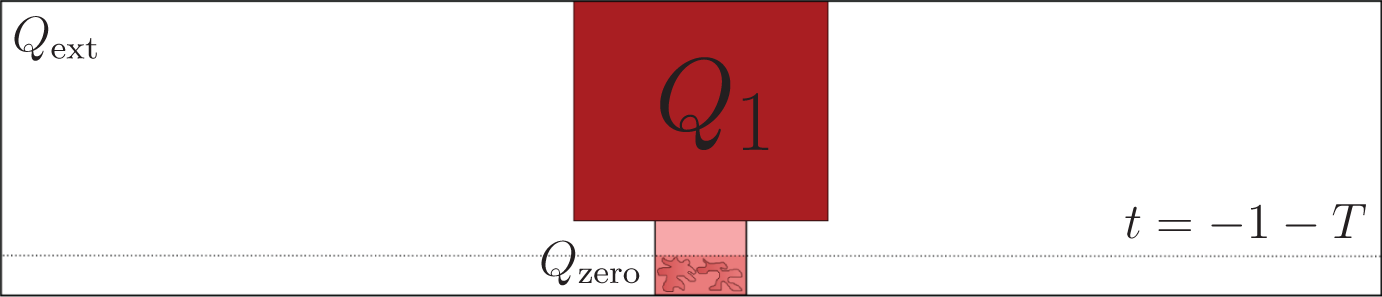
We introduce a time lap T between the top of the cylinder
 $Q_{\mathrm {zero}}$
and the bottom of the cylinder
 $Q_{1}$
; see Figure 3.
Reducing to the case with a time lap.

Fix
 $T=\eta ^{2}/8$
. Since
 $|Q_{\mathrm {zero}} \cap \{ t \ge -1-T\}| = \frac 18|Q_{\mathrm {zero}}|$
, then
 $$ \begin{align} |\{ f = 0 \} \cap Q_{\mathrm{zero}} \cap \{t \le -1-T\}| \ge \frac18 |Q_{\mathrm{zero}}|. \end{align} $$
Let
 $R>1$
to be chosen later. We consider the cut-off function
 $$ \begin{align*} \Psi (t,x,v) = \Psi_{1} (t,x/R,v/R). \end{align*} $$
Remark that
 $\Psi $
is supported in
 $Q_{\mathrm {ext}}$
and equal to
 $1$
in
 $(-1,0] \times B_{R} \times B_{R}$
. Moreover,
 $$ \begin{align*} \mathcal{L}_{K} \Psi (t,x,v) = (\partial_{t} + v \cdot \nabla_{x}) \Psi_{1} (t,x/R,v/R) - R^{-2} \Delta_{v} \Psi_{1} (t,x/R,v/R), \end{align*} $$
where in the last equation
 $v \cdot \nabla _{x}$
means the scalar product of the value of third variable in
 $\Psi $
(here it is
 $\frac {v}{R}$
) with the gradient in the second variable. We then have
 $$ \begin{align*} \mathcal{L}_{K} (h- \Psi) = -(1-f) (\partial_{t} + v \cdot \nabla_{x}) \Psi_{1} (t,x/R,v/R) + \frac{1-f}{R^{2}} \Delta_{v} \Psi_{1} (t,x/R,v/R), \end{align*} $$
and we can write
 $$ \begin{align*}h - \Psi = -P_{R} + E_{R} \end{align*} $$
(
 $P_{R}$
for positive and
 $E_{R}$
for error) with
 $P_{R}$
and
 $E_{R}$
solutions of the following Cauchy problems in
 $(-1-\eta ^{2},0) \times \mathbb {R}^{2d}$
:
 $$ \begin{align*} \mathcal{L}_{K} P_{R} &= (1-f) (\partial_{t} + v \cdot \nabla_{x}) \Psi_{1}(t,x/R,v/R), \\ \mathcal{L}_{K} E_{R} &= \frac{1-f}{R^{2}} \Delta_{v} \Psi_{1} (t,x/R,v/R), \end{align*} $$
and
 $P_{R} = E_{R} =0$
at time
 $t=-1-\eta ^{2}$
.
We claim that there exist constants
 $C>0$
and
 $\delta _{0}>0$
depending on the dimension and
 $\eta $
(in particular independent of R) such that
 $$ \begin{align} E_{R} \le C R^{-2} \quad \text{ and } \quad P_{R} \ge \delta_{0} \quad \text{ in } Q_{1}. \end{align} $$
As far as the estimate of
 $E_{R}$
is concerned, it is enough to remark that
 $\mathcal {L}_{K} E_{R} \le C_{0} R^{-2}$
for some constant
 $C_{0}= \| \Delta _{v} \Psi _{1} \|_{L^{\infty }}$
only depending on
 $d,\lambda ,\Lambda , \eta $
(in particular not depending on R). The maximum principle then yields the result for some universal constant C. As far as
 $P_{R}$
is concerned, we remark that
 $$ \begin{align*} \mathcal{L}_{K} P_{R} \ge \mathbb{I}_{\mathcal{Z}} \quad \text{ in } (-1-\eta^{2},0] \times \mathbb{R}^{2d}, \end{align*} $$
where
 $\mathcal {Z} = \{f = 0\} \cap Q_{\mathrm {zero}} \cap \{ t \le -1-T\}$
. We use here the fact that
 $(\partial _{t} + v \cdot \nabla _{x}) \Psi _{1} \ge 1$
in
 $(-1-\eta ^{2},-1-T) \times \mathbb {R}^{2d}$
. Let P be such that
 $\mathcal {L}_{K} P = \mathbb {I}_{\mathcal {Z}}$
in
 $(-1-\eta ^{2},0] \times \mathbb {R}^{2d}$
and
 $P=0$
at the initial time
 $-1-\eta ^{2}$
. The maximum principle implies that
 $P_{R} \ge P$
in the time interval
 $(-1-\eta ^{2},0]$
and in particular in
 $Q_{1}$
.
We now claim that
 $P \ge \delta _{0}$
in
 $Q_{1}$
for some constant
 $\delta _{0}>0$
depending on the dimension and
 $\eta $
. Indeed, one can use the fundamental solution
 $\Gamma $
of the Kolmogorov equation and write
 $$ \begin{align*} P (t,x,v) = \int \Gamma (z,\zeta) \mathbb{I}_{\mathcal{Z}} (\zeta) \, \mathrm{d} \zeta \ge \frac18 \mathsf{m} |Q_{\mathrm{zero}}| = \delta_{0},\end{align*} $$
with
 $\mathsf {m}= \min \limits _{Q_{1} \times Q_{\mathrm {zero}}\cap \{ t \le -1-T\}} \Gamma .$
The claim (9) is now proved.
Inequalities from (9) imply that
 $$ \begin{align*} h \le 1 - \delta_{0} + C R^{-2} \text{ in } Q_{1}.\end{align*} $$
This yields the desired result with
 $\theta _{0} = 1-\delta _{0}/2$
for R large enough. Note in particular that R only depends on C and
 $\delta _{0}$
and consequently depends on the dimension and
 $\eta $
.
4 The weak Harnack inequality
Before proving the weak Harnack inequality stated in Theorem 1.1, we investigate how equation (1) expands positivity of super-solutions.
Lemma 4.1 Expansion of positivity
Let
 $\theta \in (0,1]$
and
 $Q_{\mathrm {pos}} = (-1-\theta ^{2},-1] \times B_{\theta ^{3}} \times B_{\theta }$
, and let R be the constant given by Lemma 3.2 which depends on
 $\theta $
, d,
 $\lambda $
,
 $\Lambda $
. There exist
 $\eta _{0},\ell _{0} \in (0,1)$
, only depending on
 $\theta $
, d,
 $\lambda $
,
 $\Lambda $
, such that for
 $\mathcal {Q}_{\mathrm {whi}} := (-1-\theta ^{2},0] \times B_{9 R} \times B_{3 R}$
and any nonnegative super-solution f of (1) in some cylindrical open set
 $\Omega \supset \mathcal {Q}_{\mathrm {whi}}$
and
 $\|S\|_{L^{\infty } (\mathcal {Q}_{\mathrm {whi}})} \le \eta _{0}$
and such that
 $ |\{ f \ge 1 \} \cap Q_{\mathrm {pos}} | \ge \frac 12 |Q_{\mathrm {pos}}|$
we have
 $f \ge \ell _{0}$
in
 $Q_{1}$
.
Remark 11. The parameter
 $\theta $
will be chosen in such a way that the stacked cylinder
 $\overline {Q_{\mathrm {pos}}}^{m}$
is contained in
 $Q_{1}$
(see the definition of stacked cylinders in Appendix A). The cylinder
 ${\overline {Q_{\mathrm {pos}}}}^{m}$
can be thought of as the union of m copies of
 $Q_{\mathrm {pos}}$
stacked above (in time) of
 $Q_{\mathrm {pos}}$
. Such cylinders are used in the covering argument used in the proof of the weak Harnack inequality, and the parameter
 $m \in \mathbb {N}$
only depends on dimension.
Proof of Lemma 4.1
We consider
 $g = G(f+\epsilon )$
. We remark that
 $g \le G(\epsilon )$
since f is nonnegative and G is nonincreasing. We also remark that
 $|G^{\prime }(f+\epsilon )|\le |G^{\prime }(\epsilon )| \le \epsilon ^{-1}$
since
 $f \ge 0$
; see Lemma 2.1.
We know from Lemma 2.2 that g is a nonnegative subsolution of (1) with S replaced with
 $S G^{\prime }(f+\epsilon )$
. In particular,
 $(\partial _{t} + v \cdot \nabla _{x} )g \le H$
with
 $H = \nabla _{v} \cdot (A \nabla _{v}g) + B\cdot \nabla _{v} g+ \epsilon ^{-1}|S|$
. Recall that, for a set
 $Q \subset \mathbb {R}^{2d+1}$
,
 $S_{(r)}(Q)=\{(r^{2}t,r^{3}x,rv) \quad \mbox {for } z=(t,x,v)\in Q \}. $
We introduce
 $\eta \in (0,\left (\frac {4}{5}\right )^{\frac {1}{4d+2}}\theta )$
and
 $\iota>0$
two parameters depending on
 $\theta $
to be chosen later in the proof.
We are going to apply successively: the
 $L^{2}-L^{\infty }$
estimate from
 $Q_{1}$
to a slightly larger cylinder
 $Q_{1+\iota }$
for an accurate choice of
 $\iota $
; the (scaled) weak Poincaré inequality in the big cylinder
 $\tilde {Q}_{\mathrm {ext}} = S_{(1+\iota )}(Q_{\mathrm {ext}})$
with
 $Q_{\mathrm {ext}} = (-1-\eta ^{2}, 0] \times B_{8R} \times B_{2R}$
. Then we estimate the
 $L^{2}$
-norm of
 $\nabla _{v} g$
by the square root of its mass in a cylinder larger than
 $\tilde {Q}_{\mathrm {ext}}$
, namely
 $S_{(1+\iota )^{2}}(Q_{\mathrm {ext}})\subset \mathcal {Q}_{\mathrm {whi}}$
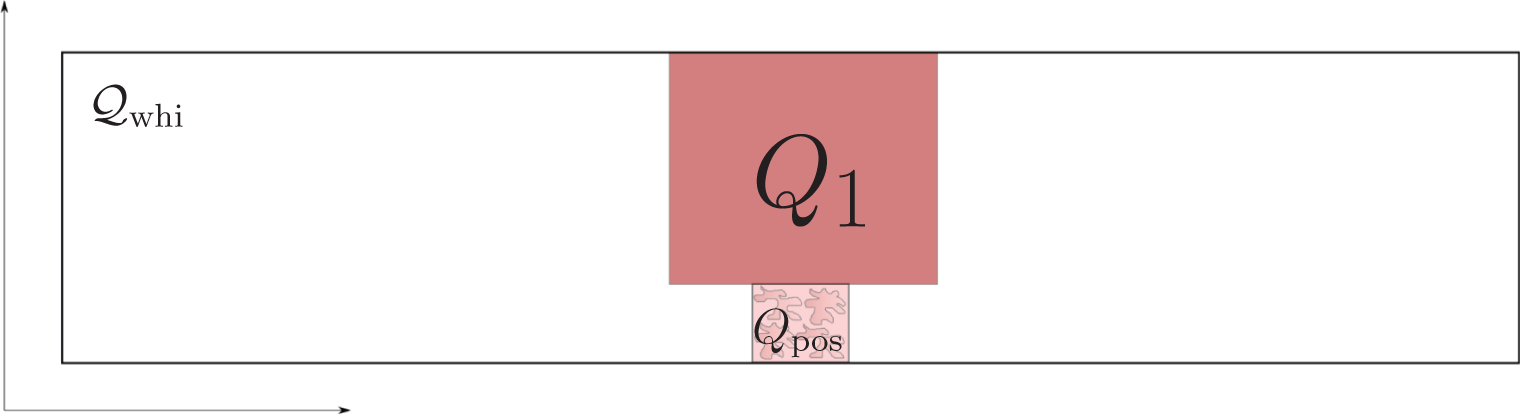
. This is illustrated in Figure 5.
Geometric setting of the expansion of positivity lemma. It is the same as the one of the weak Poincaré inequality, except that
 $Q_{\mathrm {ext}}$
and
 $Q_{\mathrm {zero}}$
are replaced with
 $\mathcal {Q}_{\mathrm {whi}}$
and
 $Q_{\mathrm {pos}}$
. Here,
 $Q_{\mathrm {pos}}$
denotes a set ‘in the past’ where
 $\{f \ge 1\}$
occupies half of it.

Intermediate cylinders in the proof of the expansion of positivity. The great parts are obtained after a scaling with a parameter
 $1+\iota $
close to
 $1$
. This is necessary in order to keep f vanishing in a ‘good ratio’ of
 $S_{(1+\iota )}(Q_{\mathrm {zero}})$
.

The remainder of the proof is split into several steps. We explain in Step 1 how to choose
 $\iota $
to ensure that cylinders are properly ordered and
 $\eta $
so that we retain enough information from the assumption
 $ |\{ f \ge 1 \} \cap Q_{\mathrm {pos}} | \ge \frac 12 |Q_{\mathrm {pos}}|$
. We then apply the aforementioned successive estimates in Step 2 before deriving the lower bound on f in Step 3.
Step 1. Choose
 $\iota $
small enough so that
 $Q_{\mathrm {ext}} \subset \tilde {Q}_{\mathrm {ext}} \subset S_{(1+\iota )^{2}}(Q_{\mathrm {ext}})\subset \mathcal {Q}_{\mathrm {whi}}$
. We only need to check the last inclusion. We choose
 $\iota>0$
small enough so that
 $(1+\iota )^{4} (1+\eta ^{2})\leq 1+\theta ^{2} $
,
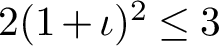 $2(1+\iota )^{2}\le 3$
and
 $8(1+\iota )^{6}\le 9$
. Since
 $\eta \in (0,\left (\frac {4}{5}\right )^{\frac {1}{4d+2}}\theta )$
, to satisfy the first inequality it is enough to satisfy
 $(1+\iota )^{4} \left (1+\left (\frac {4}{5}\right )^{\frac {1}{2d+1}}\theta ^{2}\right )\leq 1+\theta ^{2} $
. So we pick
 $\iota = \min \left (\left (\frac {5^{\frac {1}{2d+1}}(1+\theta ^{2})}{5^{\frac {1}{2d+1}}+4^{\frac {1}{2d+1}}\theta ^{2}}\right )^{1/4}-1,\left (\frac {9}{8}\right )^{1/6}-1,\left (\frac {3}{2}\right )^{1/2}-1\right ).$
Recall that
 $Q_{\mathrm {zero}} = (-1-\eta ^{2},-1] \times B_{\eta ^{3}} \times B_{\eta }$
. In particular,
 $S_{(1+\iota )}(Q_{\mathrm {zero}}) = (-(1+\iota )^{2}(1+\eta ^{2}),-(1+\iota )^{2}] \times B_{(1+\iota )^{3}\eta ^{3}} \times B_{(1+\iota ) \eta }$
. We next pick
 $\eta \in (0,\left (\frac {4}{5}\right )^{\frac {1}{4d+2}}\theta )$
big enough so that
 $$ \begin{align*} |Q_{\mathrm{pos}} \setminus S_{(1+\iota)} (Q_{\mathrm{zero}})| \le \frac14 |S_{(1+\iota)} (Q_{\mathrm{zero}})|. \end{align*} $$
It is then enough to satisfy
 $\theta \le (5/4)^{\frac {1}{4d+2}} (1+\iota ) \eta $
, so we pick
 $\eta = (4/5)^{\frac {1}{4d+2}} (1+\iota )^{-1}\theta $
. In particular, the previous volume condition implies that
 $$ \begin{align*} | \{ g =0 \} \cap S_{(1+\iota)}(Q_{\mathrm{zero}})|\ge |\{f \ge 1 \} \cap S_{(1+\iota)}(Q_{\mathrm{zero}})| \ge \frac14 |S_{(1+\iota)}(Q_{\mathrm{zero}})|. \end{align*} $$
Step 2. With such an information at hand, we know that there exists
 $\theta _{0} \in (0,1)$
, only depending on
 $\eta $
and thus only depending on
 $\theta $
, such that
 $$ \begin{align*} \sup_{Q_{1}} (g- \theta_{0} G(\epsilon))_{+} & \lesssim \|(g-\theta_{0} G(\epsilon))_{+}\|_{L^{2} (Q_{1+\iota})} +\eta_{0} & \text{from Proposition 2.1} \\ & \lesssim_{\iota} \|\nabla_{v} g \|_{L^{2}(\tilde{Q}_{\mathrm{ext}})} + (\eta_{0}/\epsilon) + \eta_{0} & \text{from Theorem 1.4} \\ & \lesssim \left( \int_{\mathcal{Q}_{\mathrm{whi}}} g + 1+ \eta_{0} / \epsilon\right)^{\frac12}+ (\eta_{0} /\epsilon ) + \eta_{0} & \text{from Lemma 2.3} \\ & \lesssim \left( G(\epsilon) + 2\right)^{\frac12}+2 & \text{for }\eta_{0} \le \epsilon \le 1 \\ & \lesssim \sqrt{G(\epsilon)} & \text{for }\epsilon\text{ such that }G(\epsilon)\geq 2. \end{align*} $$
Remark that it has been necessary to scale g before applying Theorem 1.4. This generates a constant depending on
 $\iota $
. This is emphasized by writing
 $\lesssim _{\iota }$
. But
 $\iota $
only depends on dimension,
 $\lambda $
,
 $\Lambda $
and
 $\theta $
.
Step 3. The previous computation yields
 $$ \begin{align*} g \le C \sqrt{G(\epsilon)} + \theta_{0} G (\epsilon) \quad \text{ in } Q_{1}\end{align*} $$
for some
 $\theta _{0} \in (0,1)$
depending on universal constants and
 $\theta $
. Since
 $G(\epsilon ) \to +\infty $
(we can pick
 $\epsilon $
and
 $\eta _{0}$
small enough only depending on the universal constants and
 $\theta $
), we thus have
 $$ \begin{align*}G(f+\epsilon)= g \le \frac{1+2\theta_{0}}3 G (\epsilon) \quad \text{ in } Q_{1}.\end{align*} $$
Now recall that
 $G(t) \sim - \ln t$
as
 $t \to 0+$
and
 $-G^{\prime }(t)\leq \frac {1}{t}$
for
 $t\in \left (0,\frac {1}{4}\right ]$
. The previous inequality thus implies that, as
 $\epsilon \to 0+$
,
 $$ \begin{align*} \ln (f+\epsilon) \ge \frac{2+\theta_{0}}3 \ln \epsilon .\end{align*} $$
This yields the result with
 $\ell _{0} = \epsilon ^{\frac {2+\theta _{0}}3} - \epsilon>0$
.
Before iterating the lemma of expansion of positivity, we state and prove a straightforward consequence of it that will be used when applying the ink-spots theorem.
Lemma 4.2. Let
 $m \ge 3$
be an integer and R be given by Lemma 4.1 for
 $\theta =m^{-1/2}$
. There exists a constant
 $M>1$
only depending on m, d,
 $\lambda $
,
 $\Lambda $
such that for all nonnegative super-solution f (1) with
 $S=0$
in some cylindrical open set
 $\Omega \supset (-1,m] \times B_{9Rm^{3/2}} \times B_{3Rm^{1/2}}$
, such that
 $$ \begin{align*} |\{ f \ge M \} \cap Q_{1} | \ge \frac12 |Q_{1}|, \end{align*} $$
then
 $f \ge 1$
in
 $\bar Q_{1}^{m} = (0,m] \times B_{m+2} \times B_{1}$
.
Proof. Let
 $\theta =m^{-\frac {1}{2}}$
so that
 $\bar Q_{1}^{m} \subset (0,\theta ^{-2}] \times B_{\theta ^{-3}} \times B_{\theta ^{-1}}$
. We apply Lemma 4.1 to
 $\frac {f}{M}$
with
 $Q_{1}$
and
 $\bar Q_{1}^{m}$
taking the role of
 $Q_{\mathrm {pos}}$
and
 $Q_{1}$
thanks to a rescaling argument. This yields that
 $f \ge \ell _{0}M$
in
 $(0,\theta ^{-2}] \times B_{\theta ^{-3}} \times B_{\theta ^{-1}}$
. We then pick
 $M = 1/\ell _{0}$
, and we conclude the proof.
When deriving the weak Harnack inequality, we will need to estimate how the lower bound deteriorates with time. Indeed, such information is needed in the ink-spots theorem: Since cylinders can ‘leak’ out of the set F, a corresponding error has to be estimated; see the term
 $Cm r_{0}^{2}$
in Theorem A.1. The geometric setting is the one from Theorem 1.1. In particular, recall that
 $Q_{+} = (-\omega ^{2},0] \times B_{\omega ^{3}} \times B_{\omega }$
and
 $Q_{-} = (-1,-1+\omega ^{2}] \times B_{\omega ^{3}} \times B_{\omega }$
, where
 $\omega $
is small and universal. It has to be small enough so that, when spreading positivity from a cylinder
 $Q_{r}(z_{0})$
from the past, i.e., included in
 $Q_{-}$
, the union of the stacked cylinders where positivity is expanded captures
 $Q_{+}$
. Then the radius
 $R_{0}$
in the statement of weak Harnack inequality is chosen so that the expansion of positivity lemma can be applied as long as new cylinders are stacked over previous ones. These two facts are stated precisely in the following lemma.
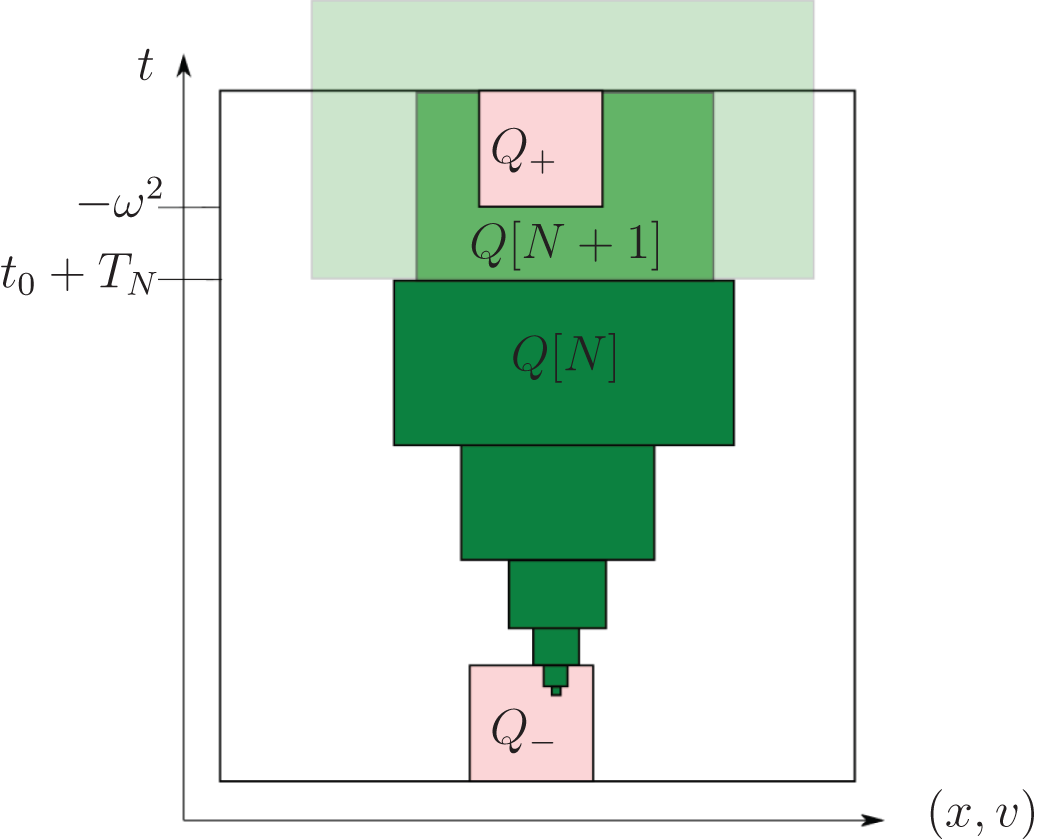
In order to avoid the situation where the last stacked cylinder (see
 $Q[N+1]$
in the next lemma) leaks out of the domain where the equation is satisfied, we choose it in a way that we can use the information obtained in the previous cylinder
 $Q[N]$
: the ‘predecessor’ of
 $Q[N+1]$
is contained in
 $Q[N]$
(see Figure 6).
Lemma 4.3 Stacking cylinders
Let
 $\omega < 10^{-2}$
. Given any nonempty cylinder
 $Q_{r} (z_{0}) \subset Q_{-}$
, let
 $T_{k} = \sum _{j=1}^{k} (2^{j}r)^{2}$
and
 $N \ge 1$
such that
 $ T_{N} \le -t_{0} < T_{N+1}$
. Let
 $$ \begin{align*} Q[k] &= Q_{2^{k}r}(z_{k}) \text{ for } k =1,\dots, N,\\ Q [N+1] &= Q_{R_{N+1}}(z_{N+1}), \end{align*} $$
where
 $z_{k} = z_{0} \circ (T_{k},0,0)$
and, letting
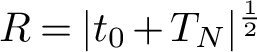 $R =|t_{0}+T_{N}|^{\frac 12}$
and
 $\rho = (4\omega )^{\frac 13}$
,
 $R_{N+1} = \max (R,\rho )$
and
 $$ \begin{align*} z_{N+1} = \begin{cases} z_{N} \circ (R^{2}, 0,0) & \text{ if } R \ge \rho, \\ (0,0,0) & \text{ if } R < \rho. \end{cases} \end{align*} $$
These cylinders satisfy
 $$ \begin{align*} Q_{+} \subset Q[N+1], \qquad \bigcup_{k=1}^{N+1} Q[k] \subset (-1,0] \times B_{2} \times B_{2}, \qquad Q[N] \supset \tilde Q[N], \end{align*} $$
where
 $\tilde Q[N]$
is the ‘predecessor’ of
 $Q[N+1]$
:
 $\tilde Q[N] = Q_{R_{N+1}/2} (z_{N+1} \circ (-R_{N+1}^2, 0,0)).$
Stacking cylinders above an initial one contained in
 $Q_{-}$
. We see that the stacked cylinder obtained after
 $N+1$
iterations by doubling the radius leaks out of the domain. This is the reason why
 $Q[N+1]$
is chosen in a way that it is contained in the domain and its ‘predecessor’ is contained in
 $Q[N]$
. Notice that the cylinders
 $Q[k]$
are in fact slanted since they are not centered at the origin. We also mention that
 $Q[N+1]$
is choosen centered if the time
 $t_{0}+T_{N}$
is too close to the final time
 $0$
.

The proof of this lemma is posponed until Appendix C.
With such a technical lemma at hand, expansion of positivity for large times follows easily.
Lemma 4.4 Expansion of positivity for large times
Let
 $R_{1/2}$
given by Lemma 4.1 with
 $\theta =1/2$
. There exist a universal constant
 $p_{0}>0$
such that, if f is a nonnegative weak super-solution of (1) with
 $S=0$
in some cylindrical open set
 $\Omega \supset Q=(-1,0] \times B_{18 R_{1/2}} \times B_{6 R_{1/2}}$
such that
 $$ \begin{align*} |\{ f \ge A \} \cap Q_{r} (z_{0})| \ge \frac12 |Q_{r}(z_{0})| \end{align*} $$
for some
 $A>0$
and for some cylinder
 $Q_{r}(z_{0}) \subset Q_{-}$
, then
 $f \ge A (r^{2}/4)^{p_{0}}$
in
 $Q_{+}$
.
Proof. We first apply Lemma 4.1 with
 $\theta =1/2$
to
 $f/A$
(after rescaling
 $Q_{r}(z_{0})$
into
 $Q_{\mathrm {pos}}$
) and get
 $f/A \ge \ell _{0}$
in
 $Q[1]$
. We then apply it to
 $f / (A \ell _{0})$
and get
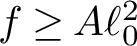 $f \ge A \ell _{0}^{2}$
in
 $Q[2]$
. By induction, we get
 $f \ge A \ell _{0}^{k}$
in
 $Q[k]$
for
 $k=1,\dots , N$
.
We then apply Lemma 4.1 one more time and get
 $f \ge A \ell _{0}^{N+1}$
in
 $Q[N+1]$
and in particular
 $f \ge A \ell _{0}^{N+1}$
in
 $Q_{+}$
. Since
 $T_{N} \le 1$
, we have
 $4^{N} r^{2} \le 1$
. Choosing
 $p_{0}>0$
such that
 $\ell _{0} = (1/4)^{p_{0}}$
, we get
 $f \ge A ((1/4)^{N+1})^{p_{0}} \ge A (r^{2}/4)^{p_{0}}$
.
We finally turn to the proof of the main result of this paper, Theorem 1.1.
Proof of Theorem 1.1
We start the proof with general comments about the geometric setting. The proof is going to use a covering argument through the application of the ink-spots theorem. To apply this result, we will consider an arbitrary cylinder Q contained in
 $Q_{-}$
. The parameter
 $\omega $
used in the definition of
 $Q_{-}$
and
 $Q_{+}$
is chosen small enough (
 $\omega \leq 10^{-2}$
) so that the cylinder
 $Q_{+}$
is ‘captured’ when stacking cylinders (Lemma 4.3) and propagating positivity (Lemma 4.4). We also pick the parameter
 $R_{0}$
in the definition of the cylinder
 $Q^{0}$
large enough so that the stacked cylinders do not leak out of
 $Q^{0}$
; we impose
 $R_{0} \ge 18 R_{1/2}$
, where
 $R_{1/2}$
is given by Lemma 4.1 for
 $\theta =1/2$
. We also impose
 $R_{0} \ge 9 R_{m^{-1/2}} m^{3/2} \omega ^{3}$
, where
 $R_{m^{-1/2}}$
is given by Lemma 4.1 with
 $\theta = m^{-1/2}$
in order to be in position to apply Lemma 4.2 to cylinders contained in
 $Q^{-}$
, hence of radius smaller than
 $\omega $
.
We first classically reduce to the case
 $$ \begin{align*} \inf_{Q_{+}} f \le 1 \quad \text{ and } \quad S=0. \end{align*} $$
Considering
 $\tilde {f}(t,x,v)=f(t,x,v)+\|S \|_{L^{\infty }} t$
,
 $\tilde {f}$
is a super-solution of the same equation with no source term (
 $S=0$
), and the weak Harnack inequality for
 $\tilde {f}$
implies the one for f. So from now we assume
 $S=0$
. Considering next
 $\tilde {f} = f / (\inf _{Q_{+}} f +1)$
reduces to the case
 $\inf _{Q_{+}} f \le 1$
.
We then aim at proving that
 $\int _{Q_{-}} f^{p} (z) \, \mathrm {d}z$
is bounded from above by a universal constant for some universal exponent p. This amounts to prove that, for all
 $k \in \mathbb {N}$
,
 $$ \begin{align*} |\{ f> M^{k}\} \cap Q_{-} | \le C_{\text{w.h.i.}} (1-\tilde{\mu})^{k} \end{align*} $$
for some universal parameters
 $\tilde {\mu } \in (0,1)$
,
 $M>1$
and
 $C_{\text {w.h.i.}}>0$
to be determined later. We can see that this property would be enough by transposing it to the continuous case (k real and above
 $1$
) and by application of the layer cake formula to
 $\int _{Q_{-}} f^{p} (z) \, \mathrm {d}z$
.
We are going to apply Theorem A.1 with
 $\mu =1/2$
. We pick
 $m \in \mathbb {N}$
such that
 $\frac {m+1}m (1-c/2) \le 1 -c/4$
. Then the constant
 $M>1$
is given by Lemma 4.2.
We prove the result by induction. For
 $k=1$
, we simply choose
 $\tilde {\mu } \le 1/2$
and
 $C_{\text {w.h.i.}}$
such that
 $|Q_{-}| \le \frac {1}{2}C_{\text {w.h.i.}}$
. Now assume that the claim holds true for
 $k \ge 1$
, and let us prove it for
 $k+1$
. We thus consider
 $$ \begin{align*} E = \{ f> M^{k+1} \} \cap Q_{-} \quad \text{ and } \quad F = \{ f > M^{k} \} \cap Q_{1}. \end{align*} $$
These two sets are bounded and measurable and such that
 $E \subset F \cap Q_{-}$
. We consider a cylinder
 $Q =Q_{r} (t,x,v) \subset Q_{-}$
such that
 $|Q \cap E |> \frac 12 |Q|$
, that is to say
 $$ \begin{align*} |\{f> M^{k+1} \} \cap Q | > \frac12 |Q|.\end{align*} $$
We first prove that r is small, i.e., we determine a universal
 $r_{0}$
which depends on k such that
 $r < r_{0}$
. Lemma 4.4 (after translation in time) implies that
 $ f \ge M^{k+1} (r^2/4)^{p_0} $
in
 $Q_{+}$
. In particular,
 $1 \ge \inf _{Q_{+}} f \ge M^{k+1} (r^{2}/4)^{p_{0}}$
, so
 $r^{2p_{0}}\leq 4^{p_{0}} M^{-(k+1)}$
. We thus choose
 $r_{0} = 2 M^{-\frac {k+1}{2p_{0}}}$
.
We next prove that
 $\bar Q^{m} \subset F$
, i.e.,
 $$ \begin{align*} \bar Q^{m} \subset \{ f> M^{k}\} .\end{align*} $$
In order to do so, we apply Lemma 4.2 to
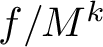 $f/M^{k}$
after rescaling Q in
 $Q_{1}$
where we assume
 $\omega \leq (2m+3)^{-1/2}$
to be able to rescale.
By Theorem A.1, we conclude thanks to the induction assumption that
 $$ \begin{align*} |\{ f> M^{k+1} \} \cap Q_-| &\le (1-c/4) \bigg(C_{\text{w.h.i.}} (1 -\mu)^k + C m r_0^2 \bigg) \\ & \le (1-c/4) \bigg(C_{\text{w.h.i.}} (1 -\mu)^k + C m M^{-\frac{k+1}{p_0}} \bigg). \end{align*} $$
Then pick
 $\tilde {\mu }$
small enough so that
 $M^{-1/p_0} \le (1- \mu )$
and
 $\tilde {\mu } \le \frac {c}{4}$
, and get
 $$ \begin{align*} & \le C_{\text{w.h.i.}} (1-c/4) \bigg(1 + C_{\text{w.h.i.}}^{-1} C m M^{-\frac{1}{p_0}} \bigg) (1 -\tilde{\mu})^k. \end{align*} $$
Now pick
 $C_{\text {w.h.i.}}$
large enough (depending on c, C, m and
 $M^{-1/p_0}$
), and get
 $$ \begin{align*} & \le C_{\text{w.h.i.}} (1 - c/4) (1 -\tilde{\mu})^k\\ & \le C_{\text{w.h.i.}} (1 -\tilde{\mu})^{k+1}. \end{align*} $$
The proof is now complete.
The full Harnack inequality is a direct consequence of the local boundedness of subsolutions and the weak Harnack inequality.
Proof of Theorem 1.3
Combine Proposition 2.1 and Theorem 1.1, and rescale to reach the result. See, for example, [Reference Li and Zhang26] for more details.
Appendix A the ink-spots theorem
In order to state the ink-spots theorem, we need to define stacked cylinders. Given
 $Q = Q_{r} (t,x,v)$
and
 $m \in \mathbb {N}$
,
 $\bar Q^{m}$
denotes the cylinder
 $\{ (t,x,v): 0<t-t_{0}\le m r^{2}, |x-x_{0} - (t-t_{0})v_{0}| < (m+2) r^{3}, |v-v_{0}| < r \}$
. We recall that
 $Q_{-} = (-1, -1+\omega ^{2}] \times B_{\omega ^{3}} \times B_{\omega }$
for some constant
 $\omega \in (0,1)$
.
Theorem A.1 Ink-spots – [Reference Imbert and Silvestre18]
Let E and F be two bounded measurable sets of
 $\mathbb {R} \times \mathbb {R}^{2d}$
with
 $E \subset F \cap Q_{-}$
. We assume that there exist two constants
 $\mu , r_{0} \in (0,1)$
and an integer
 $m \in \mathbb {N}$
such that, for any cylinder
 $Q \subset Q_{-}$
of the form
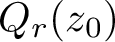 $Q_{r} (z_{0})$
such that
 $|Q \cap E | \ge (1-\mu )|Q|$
, we have
 $\bar Q^{m} \subset F$
and
 $r < r_{0}$
. Then
 $$ \begin{align*} |E| \le \frac{m+1}m (1-c\mu) \bigg( |F \cap Q_{-}| + C m r_{0}^{2} \bigg),\end{align*} $$
where
 $c \in (0,1)$
and
 $ C>0$
only depend on dimension d.
Remark 12. This corresponds to [Reference Imbert and Silvestre18, Corollary 10.1] with
 $Q_{-}$
instead of
 $Q_{1}$
, i.e., the ink-spots theorem with leakage, with
 $s=1$
. Indeed, the statement in [Reference Imbert and Silvestre18] is more general since the cylinders are of the form
 $z_{0} \circ Q_{r}$
with
 $Q_{r} = (-r^{2s},0] \times B_{r^{1+2s}} \times B_{r}$
for some
 $s \in (0,1]$
. In the statement above, we only deal with
 $s=1$
.
Appendix B local Hölder estimate
The Hölder estimate from Theorem 1.2 is classically obtained by proving that the oscillation of the solution decays by a universal factor when zooming in. Such an improvement of oscillation is obtained from Lemma 4.1 with
 $\theta =1$
.
Of course, it is not necessary to prove this lemma in order to prove the Harnack inequality since the Hölder estimate can be derived from it. Even though, we provide a proof to emphasize that it can be easily derived from Lemma 4.1.
Lemma B.1 Decrease of oscillation
Let
 $\bar R>0$
be such that
 $Q_{\bar R} \supset (-2,0] \times B_{9 R_{1}} \times B_{3R_{1}}$
with
 $R_{1}$
universal given by Lemma 4.1 with
 $\theta =1$
. There exist (small) universal constants
 $\eta _{0},\ell _{0}>0$
such that, for any solution f of (1) in some cylindrical open set
 $\Omega \supset Q_{\bar R}$
such that
 $0 \le f \le 2$
in
 $Q_{\bar R}$
and
 $\|S\|_{L^{\infty } (Q_{\bar R})} \le \eta _{0}$
,
 $\operatorname {\mathrm {osc}}_{Q_{1}} f \le 2 -\ell _{0}$
.
Proof. Remark that either
 $| \{f \le 1 \} \cap (-2,-1] \times B_{1} \times B_{1} | \le \frac 12 |(-2,-1] \times B_{1} \times B_{1} |$
or
 $| \{f \le 1 \} \cap (-2,-1] \times B_{1} \times B_{1} | \ge \frac 12 |(-2,-1] \times B_{1} \times B_{1} |$
. In the former case, Lemma 4.1 implies that
 $f \ge \ell _{0}$
in
 $Q_{1}$
while, in the latter, we simply consider
 $\tilde f = 2 -f$
, apply Lemma 4.1 to this new function and get
 $f \le 2 -\ell _{0}$
in
 $Q_{1}$
. In both cases, we get the desired reduction of oscillation:
 $\operatorname {\mathrm {osc}}_{Q_{1}} f \le 2 - \ell _{0}$
.
Deriving Theorem 1.2 from Lemma B.1 is completely standard, but we provide details for the sake of completeness and for the reader’s convenience.
Proof of Theorem 1.2
Let f be a solution of (1) in
 $Q_{1}$
. By scaling, we can reduce to the case
 $\|f\|_{L^{2}(Q_{\bar R})} \le 1$
and
 $\|S\|_{L^{\infty } (Q_{\bar R })} \le \eta _{0}$
, where
 $\eta _{0}$
is given by Lemma B.1. We deduce from Proposition 2.1 that f is bounded in
 $Q_{1}$
.
In order to prove that f is Hölder continuous in
 $Q_{1/2}$
, it is sufficient to prove that, for all
 $z_{0} \in Q_{1/2}$
and
 $r \in (0,1/(9R_{1}))$
,
 $$ \begin{align*} \operatorname{\mathrm{osc}}_{Q_{r} (z_{0})} f \le C_{\alpha} r^{\alpha} \end{align*} $$
for some universal constants
 $\alpha \in (0,1)$
and
 $C_{\alpha }$
.
We reduce to the case
 $z_{0}=0$
by using the invariance of the equation by the transformation
 $z \mapsto z_{0} \circ z$
, and we simply prove
 $$ \begin{align*} \operatorname{\mathrm{osc}}_{Q_{\bar R^{-k}}} f \le C (1-\delta_{0})^{k} \end{align*} $$
for some C and
 $\delta _{0} = \ell _{0}/2 \in (0,1)$
universal. By scaling, this amounts to prove that, if
 $\operatorname {\mathrm {osc}}_{Q_{\bar R}} f \le 2$
, then
 $\operatorname {\mathrm {osc}}_{Q_{1}} f \le 2( 1-\delta _{0})$
. By considering
 $\tilde f = 1+ \frac {f}{\|f\|_{L^{\infty }(Q_{\bar R})} + \|S\|_{L\infty (Q_{\bar R})}/\eta _{0}}$
, we can assume that
 $0 \le f \le 2$
and
 $|S| \le \eta _{0}$
in
 $Q_{\bar R}$
. Remark that the
 $L^{\infty }$
bound of S is reduced when zooming in. We now apply Lemma B.1 and conclude.
Appendix C stacking cylinders
Proof of Lemma 4.3
We first check that the sequence of cylinders is well defined for
 $\omega <1/\sqrt 5$
, say. Since
 $r \le \omega $
, we have
 $t_{0}+T_{1} \le -1 +\omega ^{2} + 4r^{2} < 0$
, and we know that there exists
 $N \ge 1$
such that
 $T_{N}< -t_{0} \le T_{N+1}$
.
We check next that
 $Q_{+} \subset Q[N+1]$
. If
 $R < \rho $
, we simply remark that
 $\omega \le \rho $
to conclude. In the other case, when
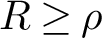 $R \ge \rho $
, we have to prove that
 $Q_{\omega } (z_{N+1}^{-1}) \subset Q_{R}$
. In this case, we have
 $z_{N+1}^{-1} = (0,x_{0} -t_{0} v_{0},v_{0})^{-1} = (0, -x_{0} + t_{0} v_{0}, -v_{0})$
and for
 $z \in Q_{\omega }$
,
 $$ \begin{align*} z_{N+1}^{-1} \circ z = (t,-x_{0}+t_{0} v_{0} + x -tv_{0}, v-v_{0}) \in Q_{R}\end{align*} $$
if
 $\omega ^{2} \le R^{2}$
and
 $\omega ^{3} + \omega + \omega ^{3} + \omega ^{3} \le R^{3}$
and
 $2 \omega \le R$
. This is true for
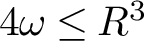 $4\omega \le R^{3}$
, that is to say
 $\rho \le R$
.
Let us now check that for all
 $k \in \{1,\dots , N+1\},$
 $Q[k] \subset (-1,0] \times B_{2} \times B_{2}$
.
As far as
 $Q[N+1]$
is concerned, we use the fact that
 $R = |t_{0}+T_{N}|^{\frac 12} \le 1$
and
 $\rho = (4\omega )^{\frac 13} \le 1$
to get
 $R_{N+1} \le 1$
. Moreover,
 $z_{N+1} \in Q_{1}$
, and thus,
 $Q[N+1] \subset (-1,0]\times B_{2} \times B_{2}$
.
We remark
 $T_{N} \le -t_{0} \le 1$
implies that
 $(2^{N}r)^{2} \le \frac 34 +r^{2} \le 1$
and in particular
 $2^{N} r \le 1$
. If
 $\bar z_{k} =(t_{k},x_{k},v_{k}) \in Q[k]$
for
 $k \le N$
, then there exists
 $(t,x,v) \in Q_{1}$
such that
 $\bar z_{k} = z_{0} \circ (T_{k},0,0) \circ ((2^{k}r)^{2}t,(2^{k} r)^{3}x,2^{k} r v)$
. This implies that
 $x_{k} = x_{0} +T_{k} v_{0}+ (2^{k}r)^{2} t v_{0} + (2^{k}r)^{3} x$
and
 $v_{k} = v_{0} + 2^{k} r v$
, and since
 $z_{0} \in Q_{-}$
,
 $$ \begin{align*} |x_{k}| \le \omega^{3} + 2\omega + 1 \le 2 \text{ and } |v_{k}| \le \omega + 1 \le 2.\end{align*} $$
In particular,
 $Q[k] \subset (-1,0] \times B_{2} \times B_{2}$
.
We are left with proving that
 $\tilde {Q}[N] \subset Q[N]$
.
If
 $R \ge \rho $
, then the conclusion follows from the fact that
 $R/2 \le 2^{N} r$
(since
 $T_{N+1}>0$
).
Let us deal with the case
 $R \le \rho $
. In view of the definitions of these cylinders, this is equivalent to
 $$ \begin{align*}Q_{\rho/2} (\bar z) \subset Q_{2^{N} r} \text{ with } \bar z = (-T_{N},0,0) \circ z_{0}^{-1} \circ (-\rho^{2},0,0).\end{align*} $$
In order to prove this inclusion, we first estimate
 $2^{N} r$
from below. Since
 $t_{0}+T_{N+1}> 0$
and
 $-t_{0} \ge 1 -\omega ^{2}$
, we have
 $(4/3)(4^{N+1}-1)r^{2} \ge 1-\omega ^{2}$
and in particular
 $4^{N} r^{2} \ge (1/4) (3/4 - 7/4 \omega ^{2}) \ge 1/8$
. We conclude that
 $$ \begin{align} 2^{N} r \ge 1/(2\sqrt2). \end{align} $$
With such a lower bound at hand, we now compute
 $\bar z = (R^{2}-\rho ^{2}, -x_{0} + (t_{0}+\rho ^{2})v_{0}, -v_{0})$
and get for
 $z \in Q_{\rho /2}$
,
 $$ \begin{align*} \bar z \circ z = (R^{2}-\rho^{2} + t, -x_{0} + (t_{0}+\rho^{2})v_{0} + x -tv_{0},v-v_{0}) \in Q_{2\rho}. \end{align*} $$
Indeed,
 $-2\rho ^{2} < R^{2} -\rho ^{2} + t \le 0$
and
 $|-x_{0} + (t_{0}+\rho ^{2})v_{0} + x -tv_{0}| \le \omega ^{3} +3 \omega + (\rho /2)^{3} \le 2 \rho ^{3}$
and
 $|v-v_{0}|\le 2 \rho $
. It is thus sufficient to pick
 $\omega $
such that
 $\rho \le 1/(2\sqrt 2)$
to get the desired inclusion. This is true for
 $\omega \le 10^{-2}$
.
Acknowledgements
The authors are indebted to C. Mouhot for the fruitful discussions they had together during the preparation of this paper. They are also greatful to the anonymous referee for his careful reading of the article. The first author acknowledges funding by the ERC grant MAFRAN 2017-2022.
Competing Interests
None.